
Impingement Syndrome Market Size and Share
Market Overview
| Study Period | 2020 - 2031 |
|---|---|
| Market Size (2026) | USD 2.48 Billion |
| Market Size (2031) | USD 3.34 Billion |
| Growth Rate (2026 - 2031) | 6.12 % |
| Fastest Growing Market | Asia-Pacific |
| Largest Market | North America |
| Market Concentration | Medium |
Major Players *Disclaimer: Major Players sorted in no particular order Image © Mordor Intelligence. Reuse requires attribution under CC BY 4.0. | |
Impingement Syndrome Market Analysis by Mordor Intelligence
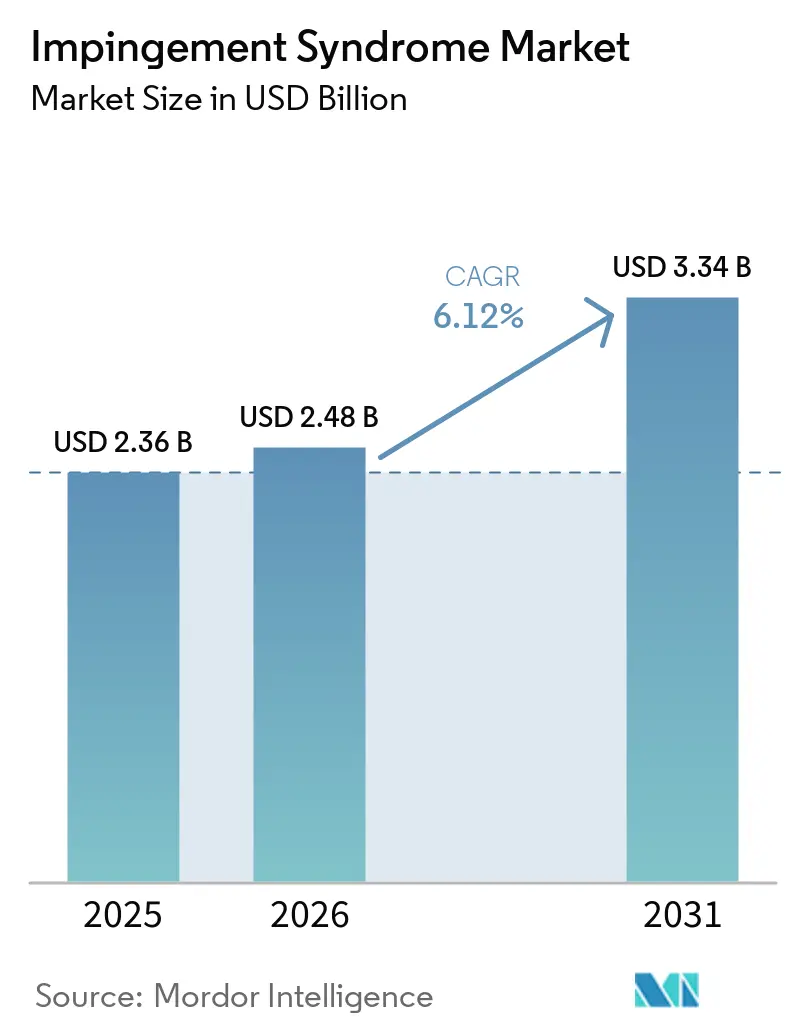
The impingement syndrome market is expected to increase from USD 2.36 billion in 2025 to USD 2.48 billion in 2026 and reach USD 3.34 billion by 2031, growing at a CAGR of 6.12% over 2026-2031. The impingement syndrome market continues to draw volume from a large clinical base because subacromial impingement represented 40% to 64% of shoulder-related complaints in clinical settings and remained a common diagnosis in primary care consultations. Revenue growth in 2026 is supported by the combined pull of sports-related shoulder stress, population aging, and a longer care pathway that often includes diagnosis, therapy, injections, and rehabilitation before surgery is authorized. The impingement syndrome market is also benefiting from wider use of imaging-guided diagnosis, minimally invasive care, biologic augmentation, and outpatient surgical workflows that increase throughput without depending on higher unit pricing. At the same time, reimbursement scrutiny and conservative-first treatment rules continue to slow immediate procedure conversion, which keeps therapy, medication, and post-procedure recovery services important across the full care cycle. Mature North American demand still anchors the impingement syndrome market, while Asia-Pacific is expanding faster as orthopedic capacity improves and aging-related shoulder disorders add a steadier stream of cases.
Key Report Takeaways
- By type, primary impingement syndrome held 39.84% share in 2025, while acute impingement syndrome is projected to grow at a 6.64% CAGR through 2031.
- By patient age group, adults held 42.63% share in 2025, while geriatric patients are projected to grow at an 8.67% CAGR through 2031.
- By component, diagnosis accounted for 51.83% share in 2025, and is projected to grow at a 7.28% CAGR through 2031.
- By end-user, orthopedic clinics accounted for 44.72% share in 2025, while rehabilitation centers are projected to grow at an 8.16% CAGR through 2031.
- By geography, North America held 45.08% share in 2025, while Asia-Pacific is projected to grow at a 9.28% CAGR through 2031.
Note: Market size and forecast figures in this report are generated using Mordor Intelligence’s proprietary estimation framework, updated with the latest available data and insights as of January 2026.
Market Trends and Insights
Drivers Impact Analysis of Impingement Syndrome Market*
| Driver | (~) % Impact on CAGR Forecast | Geographic Relevance | Impact Timeline |
|---|---|---|---|
| Rising Sports Participation and Overuse Injuries | +1.3% | Global, highest in North America, Europe, and East Asia | Medium term (2-4 years) |
| Aging Population and Degenerative Shoulder Disorders | +1.5% | Global, most acute in Japan, Germany, South Korea, and Italy | Long term (≥ 4 years) |
| Earlier MRI and Ultrasound Based Diagnosis | +0.7% | North America and Western Europe, with spillover to core Asia-Pacific markets | Short term (≤ 2 years) |
| Expansion of Outpatient Orthopedic Care | +0.5% | North America core, with early expansion in Australia and Germany | Medium term (2-4 years) |
| Rise in Arthroscopic and Minimally Invasive Shoulder Procedures | +0.9% | North America, Europe, Japan, and South Korea | Medium term (2-4 years) |
| Tele-Rehabilitation and Home-Based Recovery Pathways | +0.4% | North America and Western Europe, with early-stage adoption in urban Asia-Pacific | Short term (≤ 2 years) |
| Source: Mordor Intelligence | |||
Rising Sports Participation and Overuse Injuries
The impingement syndrome market continues to benefit from repetitive overhead motion because athletic activity creates a steady stream of shoulder complaints that move patients into diagnosis, therapy, and follow-up care. A 2025 study among university athletes confirmed a statistically significant association between overhead athletic activities and shoulder impingement syndrome across age groups, which supports stable case generation in active populations.[1] A related 2025 exercise study also showed measurable biomechanical risk in overhead athletes, which supports the demand for early rehabilitation protocols instead of waiting for more severe dysfunction to develop.[2] Sport-specific loading patterns also matter because swimming, baseball, and racket sports do not place the same mechanical demands on the shoulder, and that keeps treatment protocols from becoming standardized too quickly. The result is that the impingement syndrome market draws repeat demand from both acute sports injuries and recurring overuse patterns that require monitoring over time.
Aging Population and Degenerative Shoulder Disorders
The impingement syndrome market is becoming more dependent on older adults because degenerative shoulder dysfunction is expanding the case base beyond sports injuries alone. A 2025 analysis of Global Burden of Disease patterns showed that musculoskeletal disorder incidence in China, Japan, and South Korea is expected to remain heavy through 2036 under the combined effect of age, period, and body mass index trends.[3] European billing data published in 2024 also showed that degenerative shoulder conditions were concentrated in women and in people older than 60, with impingement-related presentations peaking in the 60 to 64 age group. Older patients also tend to move through longer conservative care pathways, which keeps imaging, medication, physiotherapy, and rehabilitation relevant even when surgery is not immediate. This leaves the impingement syndrome market with a broader and more persistent patient base, especially in countries where aging is already advanced.
Earlier MRI and Ultrasound Based Diagnosis
Earlier diagnosis is widening the addressable base for the impingement syndrome market because more patients can be staged before symptoms become prolonged or confused with other shoulder disorders. A 2025 peer-reviewed study found that dynamic ultrasound reached 100% sensitivity and 100% specificity for subacromial impingement when combined with provocative positioning, which reinforced its clinical value in real-time visualization. Once imaging confirms structural findings, clinicians can separate patients more clearly into conservative management, injection therapy, or surgical referral, which improves the efficiency of the full care pathway. Payer and utilization management rules also make documented evaluation important before procedural approval, which further increases the value of reliable imaging in practice. The impingement syndrome market, therefore, gains not only from more diagnoses but also from better sequencing of treatment across multiple revenue points.
Rise in Arthroscopic and Minimally Invasive Shoulder Procedures
The impingement syndrome market still depends heavily on arthroscopic care because minimally invasive surgery remains the preferred procedural route when conservative treatment does not deliver adequate relief. A 2025 systematic review found that arthroscopic subacromial decompression improved functional shoulder scores over 12 months and reported minimal complications, which supports continued clinical confidence in selected cases. Practice patterns in South Korea are also shifting toward arthroscopic-first management for suitable cases, showing that procedural adoption is still evolving rather than plateauing. At the same time, authorization rules still require documented non-surgical treatment in many cases, which keeps procedural growth controlled instead of unchecked. This balance allows the impingement syndrome market to keep adding procedure volume while still preserving a meaningful conservative care phase before surgery.
Restraints Impact Analysis of Impingement Syndrome Market*
| Restraint | (~) % Impact on CAGR Forecast | Geographic Relevance | Impact Timeline |
|---|---|---|---|
| Conservative Treatment Success Reduces Procedure Conversion | -0.8% | Global, strongest in markets with established physiotherapy infrastructure such as the United Kingdom, Germany, and the Netherlands | Medium term (2-4 years) |
| High Reliance on Clinical Judgment and Variable Coding | -0.4% | Global, especially in middle-income markets with limited specialist access | Long term (≥ 4 years) |
| Limited Reimbursement Clarity Across Markets | -0.7% | North America, Western Europe, and Asia-Pacific markets with mixed public and private systems | Medium term (2-4 years) |
| Underdiagnosis of Non-Traumatic Shoulder Pain | -0.5% | Asia-Pacific, the Middle East and Africa, and South America | Long term (≥ 4 years) |
| Source: Mordor Intelligence | |||
Limited Reimbursement Clarity Across Markets
Reimbursement variation remains a direct brake on the impingement syndrome market because it affects who gets surgery, where the case is scheduled, and how much administrative effort is required before payment is secured. A separate 2025 reimbursement study reported that only 26.5% of 22-modifier shoulder surgery claims were successfully reimbursed, and that commercial payer success rates lagged far behind Medicare. These conditions lower willingness to take on more complex outpatient cases, even when ambulatory settings offer lower cost and faster throughput. Policy-driven documentation rules also slow movement from diagnosis to procedure, which spreads decision-making over a longer period and reduces same-pathway conversion. As a result, the impingement syndrome market can expand in value while still facing friction in the highest-revenue treatment setting.
Underdiagnosis of Non-Traumatic Shoulder Pain
The impingement syndrome market loses potential volume when non-traumatic cases are not recognized early, because postural, degenerative, and metabolic presentations often appear less urgent than acute injury. A 2025 Mendelian randomization study also linked higher body mass index with shoulder impingement incidence, which suggests that metabolic risk remains under-screened in routine shoulder assessment. In settings where primary-care imaging access and specialist referral channels remain limited, these patients are more likely to stay outside active treatment pathways for longer periods. This leaves the impingement syndrome market with a latent pool of demand that will not fully convert until earlier recognition becomes more routine.
*Our forecasts treat driver/restraint impacts as directional, not additive. The impact forecasts reflect baseline growth, mix effects, and variable interactions.
Impingement Syndrome Market Segment Analysis
By Type:
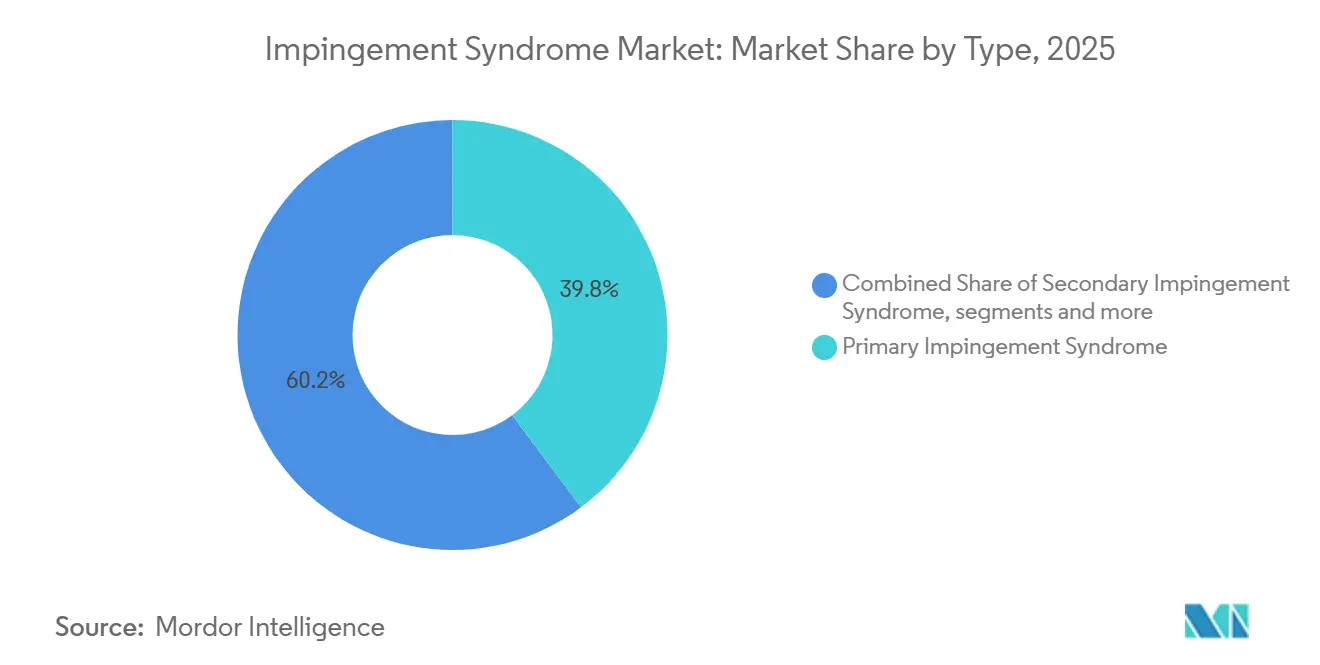
Primary Classification Anchors Volumes, Acute Cases AcceleratePrimary impingement syndrome held 39.84% of the impingement syndrome market share in 2025, which reflected its position as the most familiar clinical presentation linked to structural narrowing, bursal irritation, and rotator cuff crowding. Its broad clinical visibility supports steady demand across examination, imaging, medication, physical therapy, and surgery, rather than concentrating value in a single point of care. Secondary impingement syndrome remains clinically distinct because instability, scapular dyskinesis, and neuromuscular dysfunction often require more layered management than classic structural narrowing alone. Acute impingement syndrome is projected to grow at a 6.64% CAGR through 2031, which reflects faster movement from sports injury to diagnosis and a shorter path into structured intervention.
This faster-growing acute category favors providers and device makers that can support rapid imaging, arthroscopic treatment, and closely supervised rehabilitation in the same care episode. The impingement syndrome industry, therefore, keeps its volume base in primary presentations, while growth leans toward cases that are diagnosed and escalated more quickly.

By Patient Age Group:
Adults Drive Volume, Geriatric Patients Define the Growth FrontierAdults held 42.63% share in 2025, which made them the largest age cohort across the impingement syndrome market because sports-related and occupational shoulder loading is concentrated in active working years. Adults also remain the most procedure-ready group because they are more likely to pursue imaging, injection therapy, and surgical resolution when symptoms interfere with work or routine function. Geriatric patients are projected to grow at an 8.67% CAGR through 2031, which reflects a broader structural shift toward degenerative shoulder disease and longer-duration care needs.
The adolescent segment remains the smallest by volume, but it is drawing more clinical attention as overhead athletic activity exposes younger patients to measurable biomechanical stress earlier in life. This keeps rehabilitation and prevention protocols important even when surgery is not the likely first-line route for younger patients. The impingement syndrome industry, therefore, has a volume center in adults and a growth frontier in older patients whose care pathways are often longer and more varied.
By Component:
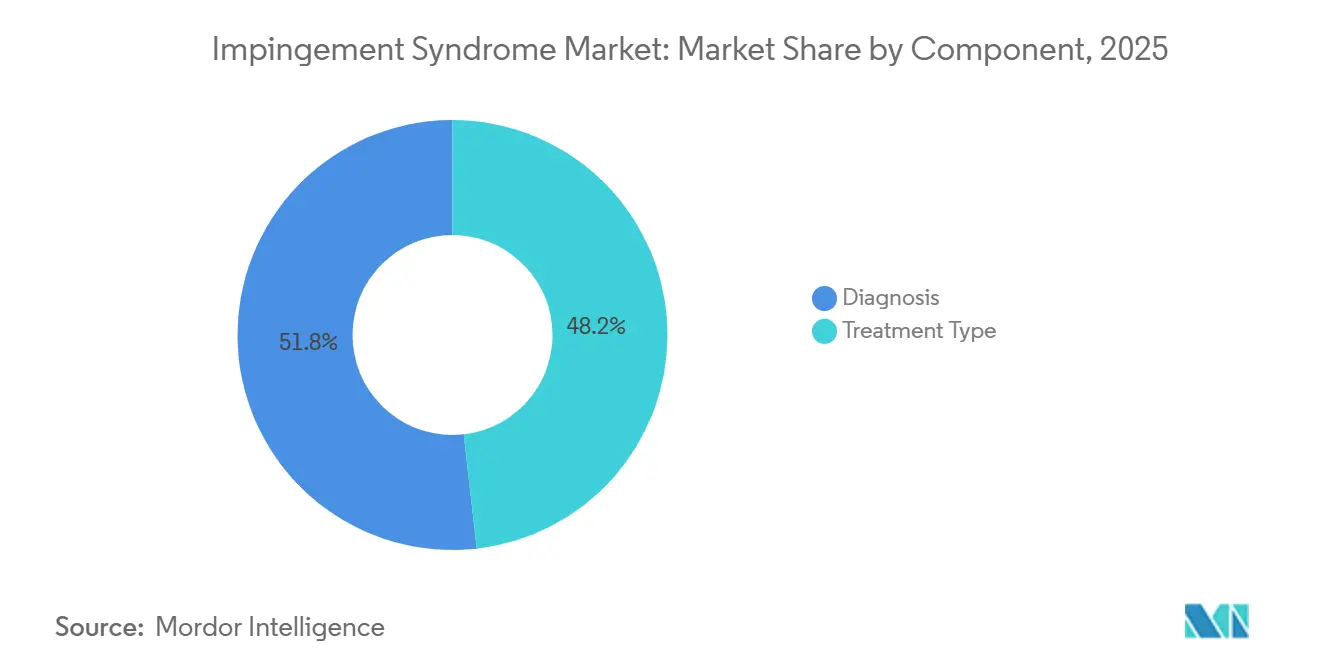
Treatment Continues to Lead Revenue, Diagnosis Drives Future GrowthThe diagnosis segment accounted for 51.83% of the impingement syndrome market in 2025 and is projected to expand at a CAGR of 7.28% through 2031, making it the fastest-growing component of the impingement syndrome market. Physical examination remains the foundation of diagnosis and serves as the first-line assessment in most suspected shoulder impingement cases. Dynamic ultrasound has emerged as a valuable tool for confirming subacromial impingement and improving treatment planning, with a 2025 study reporting exceptionally high diagnostic accuracy when used under provocative positioning protocols. As a result, market value is progressively shifting toward more precise staging, patient stratification, and treatment selection, supporting sustained growth in diagnostic services.
The treatment type segment is reflecting the substantial revenue contribution of surgical and non-surgical interventions used across the patient care pathway. Surgical treatments remained the dominant revenue generator within this segment, particularly for patients who failed to respond to conservative management. The treatment landscape is further supported by payer requirements that often mandate documented conservative care before surgical authorization, reinforcing the role of medication and rehabilitation alongside operative procedures.
By End-User:
Orthopedic Clinics Anchor Revenue, Rehabilitation Centers Gain SpeedOrthopedic clinics accounted for 44.72% of the impingement syndrome market in 2025, which reflected their role as the main point for diagnosis, imaging referral, injection therapy, and procedural decision-making. These clinics remain central because they control patient flow into both conservative and surgical pathways and often coordinate the full course of shoulder care. Rehabilitation centers are projected to grow at an 8.16% CAGR through 2031, the fastest pace among end users in the impingement syndrome market. Ambulatory infrastructure is supporting that shift, as seen in the May 2025 grounding of a USD 10 million outpatient surgery center in Wisconsin with operating rooms focused on joint replacement and sports medicine procedures.
Physiotherapy clinics keep a meaningful role because they handle high visit frequency even when revenue per visit is lower than in surgical settings. The result is that the impingement syndrome market keeps its revenue anchor in orthopedic clinics while the faster expansion is moving toward rehabilitation-centered care delivery.
Geography Analysis
North America Impingement Syndrome Market
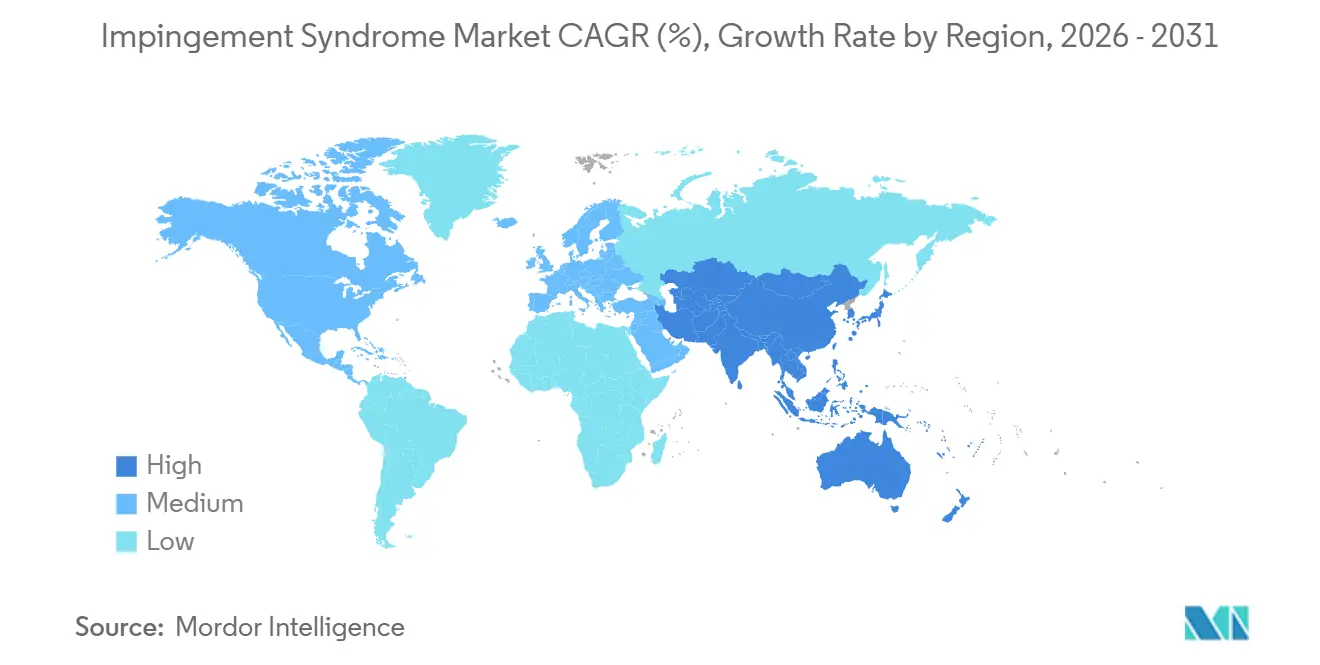
North America held 45.08% of the impingement syndrome market share in 2025, which kept it as the largest regional contributor to revenue. High procedure volumes, broad commercial coverage for arthroscopic care, and a mature ambulatory surgery center network continue to support the region’s leading position in the impingement syndrome market. In the United States, Smith & Nephew states that shoulder replacement procedures total 250,000 annually in 2025, which indicates the scale of the shoulder care base that supports adjacent impingement-related intervention. The concentration of advanced workflow launches in North America keeps the region at the center of premium competition, especially for robotics-enabled planning and shoulder surgery execution.
APAC Impingement Syndrome Market
Asia-Pacific is projected to grow at a 9.28% CAGR through 2031, which makes it the fastest-growing regional block in the impingement syndrome market. A 2025 burden analysis showed that musculoskeletal disorder incidence in China, Japan, and South Korea is expected to remain heavy through 2036, which gives the region a strong aging-related demand base. South Korea also offers a clear signal of changing practice because a 2026 survey documented movement toward arthroscopic-first management in suitable cases. This means the region combines expanding patient need with evolving procedural readiness, rather than relying on only one of those growth factors.
EMEA and South America Impingement Syndrome Market
Europe remains a meaningful revenue contributor, but growth is shaped more heavily by guideline-based conservative care and more varied reimbursement structures. Germany stands out within the region because degenerative shoulder disease remains widespread, and the shift from inpatient care toward outpatient settings is continuing. This keeps physiotherapy, rehabilitation, and imaging services important in Europe even when procedural growth is more measured than in faster-expanding regions. Middle East and Africa and South America remain smaller, but private orthopedic expansion and infrastructure investment keep long-term opportunities open for the impingement syndrome market.
Competitive Landscape
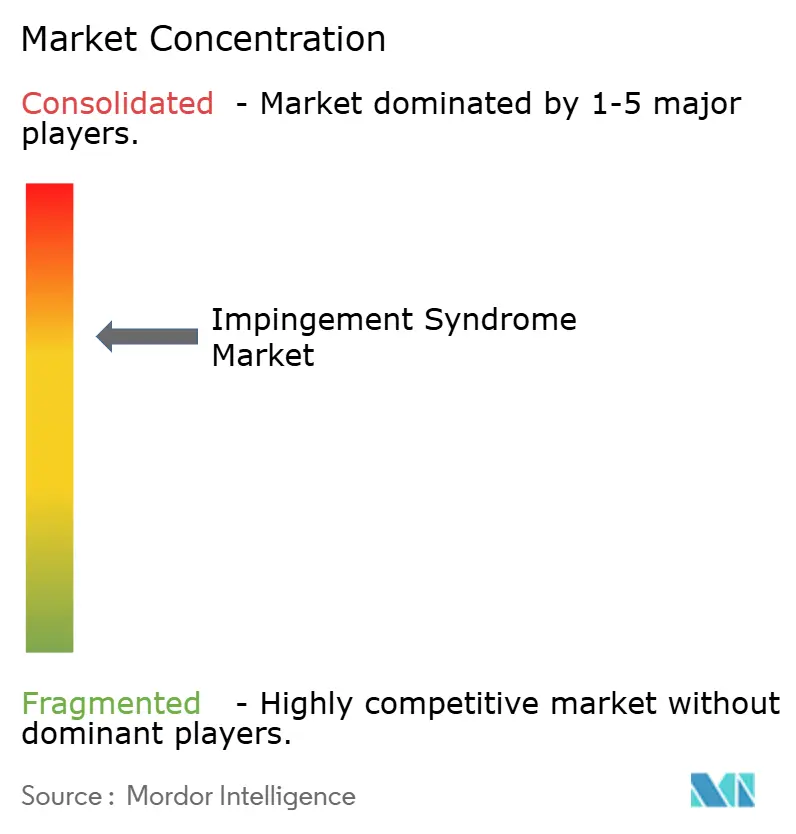
The impingement syndrome market shows a moderately concentrated structure in surgical devices, while rehabilitation and bracing remain more dispersed across a wider set of suppliers. Large medtech players compete across implants, arthroscopy, planning software, and workflow integration, which keeps competition centered on complete care pathways rather than only on single products. That structure limits easy vendor lock-in because providers can compare platforms on planning support, procedural efficiency, and post-operative alignment with outpatient recovery. The impingement syndrome market therefore rewards companies that can connect diagnosis, surgical execution, and recovery support in a more seamless offering. It also leaves smaller niches open in rehabilitation, pain management, and accessory support products where no single company appears to dominate the full pathway.
In 2026, the clearest competitive contest is in robotic shoulder workflow adoption. Smith & Nephew now announces the first clinical cases with the CORI XT handheld robotics platform in both hospital and ambulatory surgical center settings, which shows a direct push into sites that want a more flexible shoulder workflow. Zimmer Biomet also received expanded FDA 510(k) clearance for ROSA Shoulder capabilities in May 2026, which strengthens its position in robotically assisted glenoid reaming and humeral resection. That dynamic is tightening the commercialization window across the impingement syndrome market and raising the value of fast clinical adoption after approval.
Biologic augmentation is the second major strategic front in the impingement syndrome market because companies are trying to improve healing quality alongside surgical technique. Smith & Nephew strengthens its shoulder repair portfolio in January 2026 by acquiring Integrity Orthopedics for an initial USD 225 million payment and up to USD 225 million in performance-based consideration. These moves show that competitive positioning is shifting toward broader outcome support, not just toward selling hardware for the operating room.
Impingement Syndrome Industry Leaders
-
Arthrex, Inc.
-
Stryker
-
Johnson & Johnson
-
Smith & Nephew plc
-
Zimmer Biomet
- *Disclaimer: Major Players sorted in no particular order
Impingement Syndrome Market Companies Covered in this Report
- Arthrex
- B. Braun
- Bioventus Inc.
- Breg
- Conmed
- DJO Global
- Enovis Corporation
- Globus Medical
- Johnson & Johnson
- LimaCorporate S.p.A.
- Medtronic
- Orthofix
- OssDsign AB
- Ossur
- Smiths Group
- Stryker
- Wright Medical Group
- Zimmer Biomet
Recent Industry Developments in Impingement Syndrome Market
- June 2026: Smith & Nephew announced first clinical cases with its next-generation CORI XT Handheld Robotics Platform for shoulder arthroplasty, completed at Duke Health by Dr. Christopher Klifto and at North Valley Surgery Center, Scottsdale, Arizona, by Dr. Bertrand Kaper, marking the platform's debut in both hospital and ASC settings for anatomic and reverse shoulder procedures.
- May 2026: Zimmer Biomet received FDA 510(k) clearance for an advanced version of its ROSA Shoulder System featuring improved robotically assisted glenoid reaming and humeral resection for both anatomic and reverse total shoulder arthroplasty techniques.
- April 2026: Zimmer Biomet received 510(k) clearance for expanded Identity and Comprehensive Reverse Shoulder Systems with additional implant sizes, including a small-diameter tray for smaller patient anatomy, and a new Alliance humeral bearing with Vitamin E polyethylene to improve wear resistance.
Global Impingement Syndrome Market Report Scope
According to the report’s scope, the impingement syndrome market comprises products and services used for the diagnosis, treatment, and management of impingement syndrome, a musculoskeletal condition caused by the compression of tendons or bursae, most commonly in the shoulder. The market includes pharmaceuticals, physical therapy solutions, orthopedic implants, minimally invasive surgical devices, diagnostic imaging technologies, and rehabilitation services aimed at reducing pain, restoring mobility, and improving joint function.
The impingement syndrome market is segmented into type, patient age group, component, end-user, and geography. By type, the market is segmented into primary impingement syndrome, secondary impingement syndrome, and acute impingement syndrome. By patient age group, the market is segmented into adolescents, adults, and geriatrics. By component, the market is segmented into treatment type and diagnosis. The treatment type is further segmented into surgical treatment and non-surgical treatment. The non-surgical treatment is further divided into physical therapy and medication. The diagnosis is further segmented into physical examination, imaging techniques, and electromyography. By end-user, the market is segmented into orthopedic clinics, ambulatory surgical centers, rehabilitation centers, and physiotherapy clinics. By geography, the market is segmented into North America, Europe, Asia-Pacific, the Middle East and Africa, and South America. The report also covers the estimated market sizes and trends for 17 countries across major regions globally. The report offers values (USD) for all the above segments.
Segmentation Overview
| Primary Impingement Syndrome |
| Secondary Impingement Syndrome |
| Acute Impingement Syndrome |
| Adolescents |
| Adults |
| Geriatrics |
| Treatment Type | Surgical Treatment | |
| Non-Surgical Treatment | Physical Therapy | |
| Medication | ||
| Diagnosis | Physical Examination | |
| Imaging Techniques | ||
| Electromyography | ||
| Orthopedic Clinics |
| Ambulatory Surgical Centers |
| Rehabilitation Centers |
| Physiotherapy Clinics |
| North America | United States |
| Canada | |
| Mexico | |
| Europe | Germany |
| United Kingdom | |
| France | |
| Italy | |
| Spain | |
| Rest of Europe | |
| Asia-Pacific | China |
| Japan | |
| India | |
| Australia | |
| South Korea | |
| Rest of Asia-Pacific | |
| Middle East and Africa | GCC |
| South Africa | |
| Rest of Middle East and Africa | |
| South America | Brazil |
| Argentina | |
| Rest of South America |
| By Type | Primary Impingement Syndrome | ||
| Secondary Impingement Syndrome | |||
| Acute Impingement Syndrome | |||
| By Patient Age Group | Adolescents | ||
| Adults | |||
| Geriatrics | |||
| By Component | Treatment Type | Surgical Treatment | |
| Non-Surgical Treatment | Physical Therapy | ||
| Medication | |||
| Diagnosis | Physical Examination | ||
| Imaging Techniques | |||
| Electromyography | |||
| By End-User | Orthopedic Clinics | ||
| Ambulatory Surgical Centers | |||
| Rehabilitation Centers | |||
| Physiotherapy Clinics | |||
| By Geography | North America | United States | |
| Canada | |||
| Mexico | |||
| Europe | Germany | ||
| United Kingdom | |||
| France | |||
| Italy | |||
| Spain | |||
| Rest of Europe | |||
| Asia-Pacific | China | ||
| Japan | |||
| India | |||
| Australia | |||
| South Korea | |||
| Rest of Asia-Pacific | |||
| Middle East and Africa | GCC | ||
| South Africa | |||
| Rest of Middle East and Africa | |||
| South America | Brazil | ||
| Argentina | |||
| Rest of South America | |||
Key Questions Answered in the Report
What is the expected growth path for impingement syndrome market through 2031?
The impingement syndrome market is expected to rise from USD 2.36 billion in 2025 to USD 2.48 billion in 2026 to USD 3.34 billion by 2031 at a 6.12% CAGR, supported by aging, sports-related injuries, and broader outpatient care delivery.
Which component category leads current revenue?
Diagnosis led with 51.83% share in 2025.
Which patient group is expanding the fastest?
Geriatric patients are projected to grow at an 8.67% CAGR through 2031 as age-related shoulder degeneration and broader musculoskeletal burden continue to rise.
Which region offers the strongest long-term expansion opportunity?
Asia-Pacific is projected to grow at a 9.28% CAGR through 2031, making it the fastest-growing region as orthopedic capacity improves and aging-related shoulder disorders increase.