
Immersive Marketing Services Market Size and Share
Market Overview
| Study Period | 2020 - 2031 |
|---|---|
| Market Size (2026) | USD 4.62 Billion |
| Market Size (2031) | USD 11.28 Billion |
| Growth Rate (2026 - 2031) | 19.55 % |
| Fastest Growing Market | Asia-Pacific |
| Largest Market | North America |
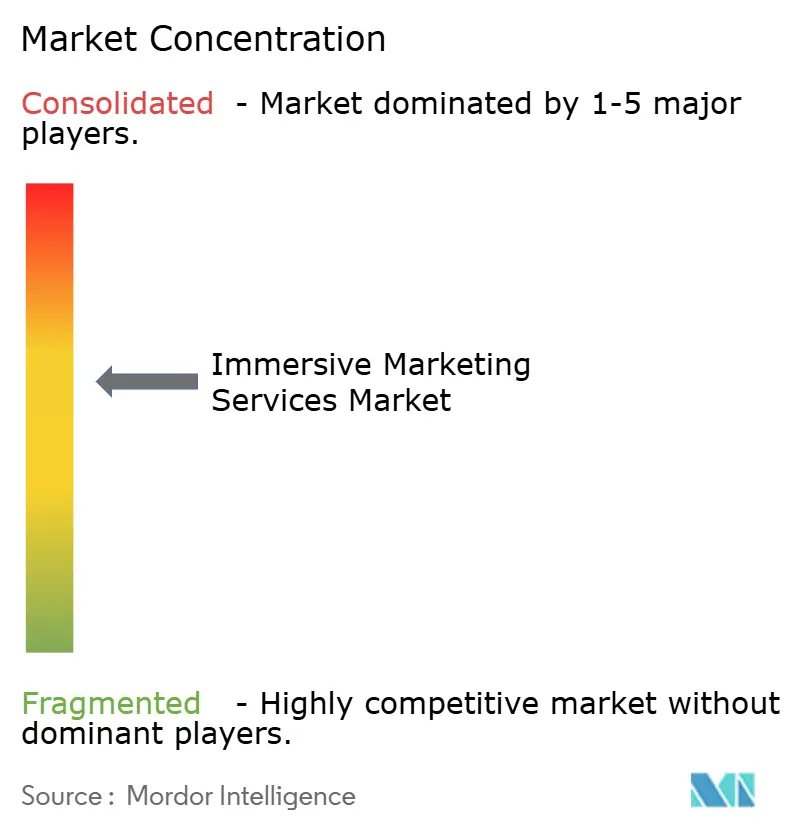
| Market Concentration | Medium |
Major Players *Disclaimer: Major Players sorted in no particular order Image © Mordor Intelligence. Reuse requires attribution under CC BY 4.0. | |
Immersive Marketing Services Market Analysis by Mordor Intelligence
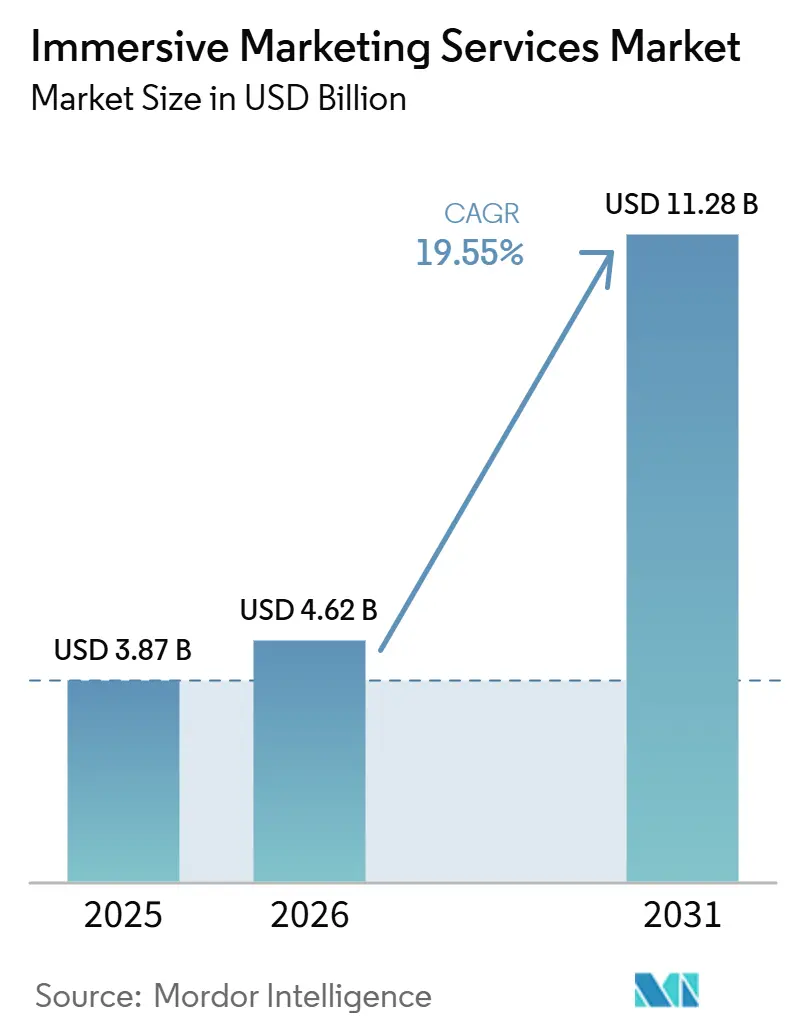
The immersive marketing services market size is projected to expand from USD 3.87 billion in 2025 and USD 4.62 billion in 2026 to USD 11.28 billion by 2031, registering a CAGR of 19.55% between 2026 to 2031. Brand budgets are moving toward formats that ask audiences to participate rather than only view a message. This shift supports demand across the immersive marketing services market for AR, VR, in-game, and live brand experiences that can link engagement to purchase activity. Retailers, consumer brands, and agencies in the immersive marketing services market are also looking for tools that reduce the cost and time required to create 3D content. Platform investments are making immersive placements easier to buy and measure across gaming, social media, and commerce environments. However, weak attribution standards, privacy obligations, and uneven device compatibility still limit broader adoption.
Key Report Takeaways
- By application, advertising and branding held 31.64% of the immersive marketing services market share in 2025, while virtual commerce and try-on experiences are projected to expand at a CAGR of 23.07% through 2031.
- By end-use industry, retail and e-commerce accounted for 21.58% of the immersive marketing services market share in 2025, while healthcare is projected to record the highest CAGR at 22.78% through 2031.
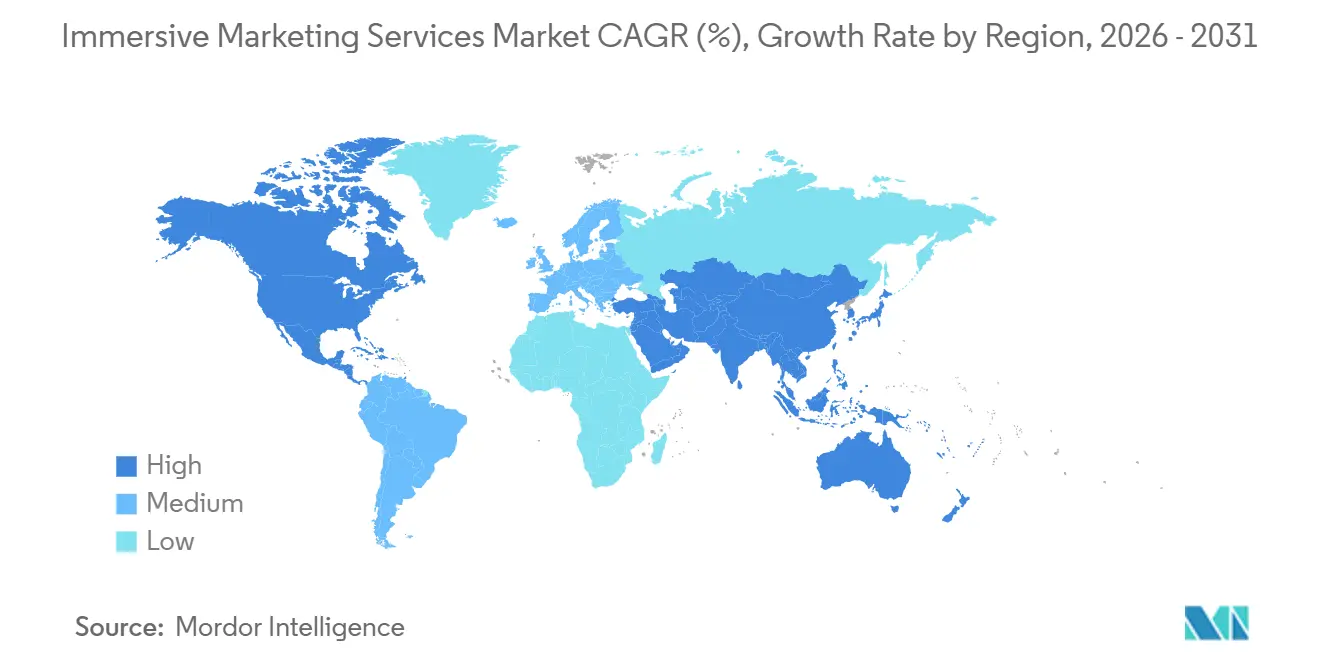
- By geography, North America held 38.42% in 2025, while the Asia-Pacific is projected to expand at a CAGR of 23.31% through 2031.
Note: Market size and forecast figures in this report are generated using Mordor Intelligence’s proprietary estimation framework, updated with the latest available data and insights as of January 2026.
Market Trends and Insights
Drivers Impact Analysis of Immersive Marketing Services Market*
| Driver | (~) % Impact on CAGR Forecast | Geographic Relevance | Impact Timeline |
|---|---|---|---|
| Rising Demand for Participatory Brand Engagement | +4.5% | Global, with concentrated gains in North America and Europe | Short term (≤ 2 years) |
| Brand Budget Shift Toward Experiential and Interactive Media | +3.8% | North America and Europe, with spillover to Asia-Pacific | Short term (≤ 2 years) |
| AR-Enabled Commerce and Virtual Try-On Adoption | +3.2% | Global, led by North America and China | Medium term (2-4 years) |
| Social Platforms and Creator Tools Normalize Immersive Campaigns | +2.6% | Global, with Asia-Pacific growth centered on India and Southeast Asia | Medium term (2-4 years) |
| Commerce Media and Gaming Platforms Open New Immersive Inventory | +2.0% | North America, Europe, and Asia-Pacific gaming markets | Medium term (2-4 years) |
| Generative AI and Digital Twins Reduce 3D Content Costs | +1.8% | Global, with faster adoption among cost-sensitive mid-market users | Long term (≥ 4 years) |
| Source: Mordor Intelligence | |||
Rising Demand for Participatory Brand Engagement
The immersive marketing services market is benefiting as advertisers seek active forms of brand engagement. SugarXR reported that products with AR or 3D content converted 94% higher than products without it, while average AR dwell time was 4x longer than video engagement. The IAB reported that 41% of U.S. advertising buyers expected to increase in-person and experiential spending in 2026.[1] Kantar identified sponsored events as the fastest-growing paid channel in 2025, with a net 22% of marketers shifting budget allocation toward them. Participation also allows brands to collect first-party behavioral signals at the moment of interaction. That capability becomes more valuable as third-party signals decline across browsers and mobile environments.
Brand Budget Shift Toward Experiential and Interactive Media
The immersive marketing services market is also supported by a more durable shift in media planning. The IAB documented continued interest in in-person and experiential formats, with 41% of U.S. buyers planning higher spending during 2026. Kantar reported that event sponsorships led paid-channel growth globally in 2025. The 2026 FIFA World Cup and Winter Olympics are supporting additional sponsorship activation across major markets. Buyers are seeking formats that combine live participation, digital content, and measurable audience response. This creates more demand in the immersive marketing services market for agencies and technology providers that can deliver connected campaigns rather than isolated events.
AR-Enabled Commerce and Virtual Try-On Adoption
AR commerce is becoming a more direct part of retail performance programs. A 2025 Snap and Publicis study of 4,028 shoppers found that 80% of people using AR product interactions reported greater purchase confidence, and 66% reported a lower likelihood of returning an item.[2] Genlook reported that sessions with a virtual try-on had a 29.2% add-to-cart rate, compared with 9.4% for sessions without one, across 577 Shopify stores in the second quarter of 2026. Snap cited a 2024 survey in which 71% of consumers said they would shop more often if AR were available. Warby Parker, Nike, and Gucci integrated AR try-on tools into primary shopping journeys during 2024 and 2025. Generative AI tools that convert 2D images into 3D assets can lower the barrier for smaller retailers.
Social Platforms and Creator Tools Normalize Immersive Campaigns
Platform tools are shortening the path from campaign brief to live immersive experience. Snap introduced Snap OS 2.0 and Snap Cloud in December 2025, including WebXR browser support and cloud tools for richer AR assets. Roblox expanded its advertising offering in January 2026 with homepage ads, programmatic partnerships, and tools that convert video creative into 3D experiences.[3] Electronic Arts launched EA Advertising in June 2026, giving brands access to in-game placements across more than 120 million monthly players. TikTok introduced Symphony Agent in June 2026 to connect performance signals, creators, and production workflows. These tools lower specialist overhead and make delivery speed a more important part of competition in the immersive marketing services market.
Restraints Impact Analysis of Immersive Marketing Services Market*
| Restraint | (~) % Impact on CAGR Forecast | Geographic Relevance | Impact Timeline |
|---|---|---|---|
| High Production Costs and Integration Complexity | -1.8% | Global, most acute in mid-market and emerging market segments | Short term (≤ 2 years) |
| ROI Measurement Standards Remain Immature | -1.4% | Global, most acute where digital-native attribution is the expected standard | Medium term (2-4 years) |
| Biometric and Gaze-Tracking Compliance Risk | -0.9% | Europe, United Kingdom, and United States with biometric privacy rules, with spillover to Asia-Pacific | Medium term (2-4 years) |
| Browser and Device Fragmentation for WebAR and WebXR Deployment | -0.7% | Global, most acute in emerging markets with heterogeneous device fleets | Long term (≥ 4 years) |
| Source: Mordor Intelligence | |||
High Production Costs and Integration Complexity
The immersive marketing services market still requires substantial upfront spending for full-scale projects. Custom WebXR environments, digital twins, and physical-digital activations need specialized production and technical resources. Mondelez invested USD 40 million in an AI marketing content platform in October 2025 and targeted advertising production cost reductions of 30-50%. AR try-on programs also need connections to commerce platforms, CRM systems, and analytics tools. Microsoft reported that Unilever used digital-twin workflows to reduce content-production timelines from months to days and costs by 50%. Many mid-market brands in the immersive marketing services market do not yet have the internal capability to deploy these workflows at scale.
ROI Measurement Standards Remain Immature
Measurement remains a barrier to larger commitments in the immersive marketing services market. Immersive activations may create earned media, creator activity, and offline behavior that conventional pixel-based attribution does not capture. Attribution windows can extend from 30 to 90 days, which makes it harder to link a campaign to downstream revenue. DE-YAN became the first organization to receive MASB certification for the ERIC experiential ROI framework in 2025. The framework gives marketing leaders a more consistent basis for discussing investment with finance teams. Broader adoption still requires shared metrics across AR, VR, gaming, and physical activations.
*Our forecasts treat driver/restraint impacts as directional, not additive. The impact forecasts reflect baseline growth, mix effects, and variable interactions.
Immersive Marketing Services Market Segment Analysis
By Application:
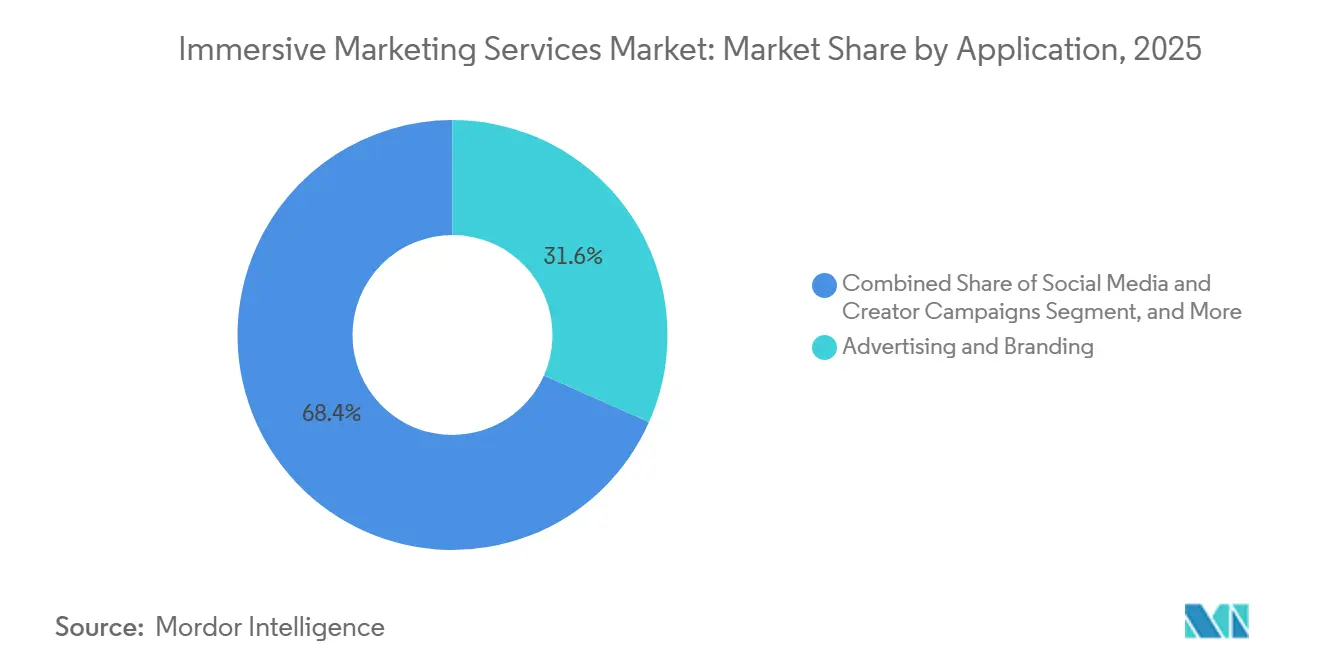
Virtual Commerce Expands Beyond Advertising-Led ProgramsAdvertising and branding held 31.64% of the immersive marketing services market size in 2025. Its position reflects an established role in campaigns that combine physical events, digital media, and in-store activity. Product launches and demonstrations remain important in automotive, consumer electronics, and luxury goods, where virtual walk-arounds can extend product reveals and related media coverage. Social media and creator campaigns have expanded with lower-cost AR tools from Snap Lens Studio and TikTok Effect House. These tools let creators and agencies design and distribute effects more quickly than earlier production models.
Virtual commerce and try-on experiences are projected to expand at a CAGR of 23.07% through 2031. Genlook recorded a 3.1x add-to-cart difference for sessions that used try-on tools in the second quarter of 2026. This has moved the format closer to a direct revenue tool for retailers. The immersive marketing services industry benefits when brands can connect campaign activity to conversion and return reduction. AI-powered 2D-to-3D conversion can create product models from standard photography, reducing an asset-production constraint that previously limited use among smaller brands.

By End-Use Industry:
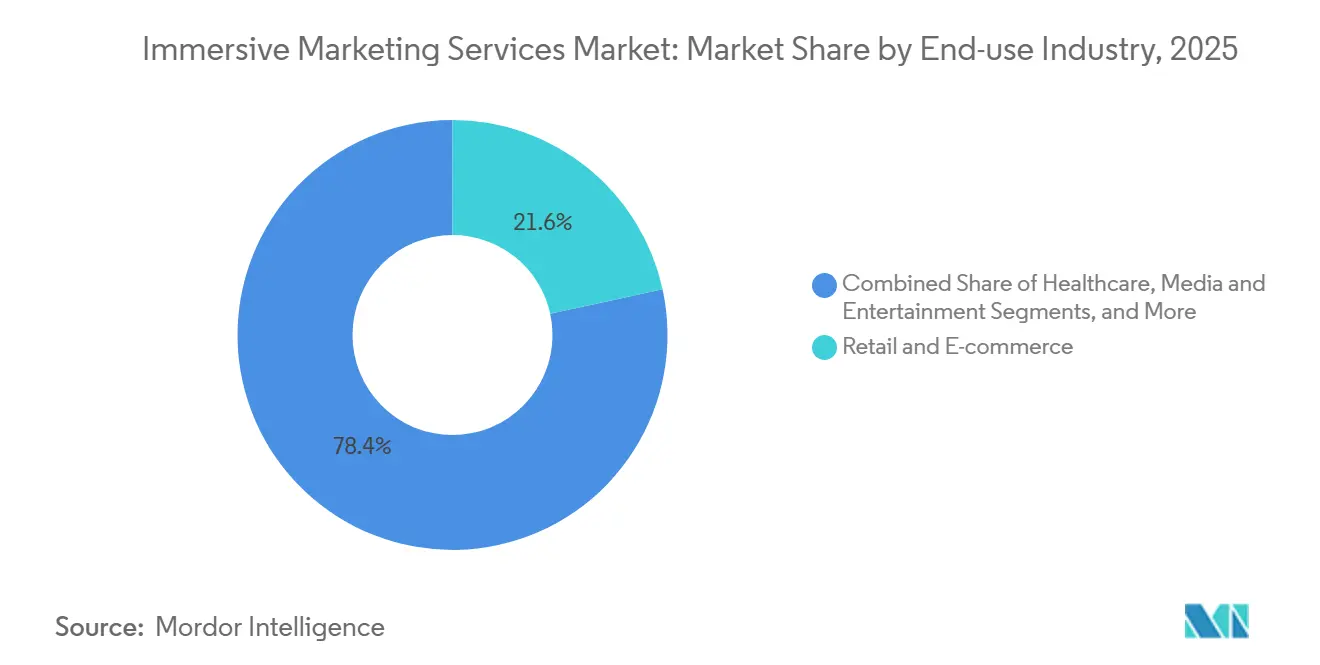
Healthcare Gains on Retail and E-CommerceRetail and e-commerce accounted for 21.58% of the immersive marketing services market size in 2025. Retailers use AR commerce tools to support purchase confidence and reduce return rates. Automotive is the second-largest end-use area, supported by 3D configurators and virtual showrooms that help buyers finalize specifications before visiting a dealership. Media and entertainment, real estate, travel and hospitality, and education use immersive formats to show places customers cannot access during early decisions. BFSI and sports and fitness remain at earlier stages of adoption, although financial services firms in Asia-Pacific are increasing AR-based advisory visualizations.
Healthcare is projected to expand at a CAGR of 22.78% from 2026 to 2031. Pharmaceutical and medical-device organizations are using VR simulations and AR-guided programs for patient engagement and clinical communication. Philips finalized an exclusive collaboration with The Walt Disney Company in May 2026 to provide immersive ambient experiences for pediatric MRI scanning in facilities across 87 countries. The University of Miami Health System deployed Avatar Medical's patient-specific 3D visualization platform for physician-patient consultations in June 2026. FDA guidance on digital health communications and institutional procurement rules make healthcare contracts more specialized than many other immersive marketing services market engagements.
Geography Analysis
North America Immersive Marketing Services Market
North America held 38.42% of the immersive marketing services market in 2025. The region combines large brand advertisers, technology-focused agencies, and consumers familiar with AR social commerce and gaming. The United States is the main national market, supported by World Cup co-hosting, Winter Olympics sponsorships, and election-related activation spending in 2026. The IAB finding that 41% of U.S. buyers expected to increase experiential spending indicates demand across consumer goods, technology, financial services, and retail. Canada contributes through gaming, entertainment, and direct-to-consumer retail, while Mexico benefits from smartphone adoption and World Cup momentum.
APAC Immersive Marketing Services Market
Asia-Pacific is projected to record the fastest regional CAGR at 23.31% from 2026 to 2031. China has a mature AR commerce base through Alibaba's Taobao and ByteDance's Douyin platforms. South Korea's broad 5G coverage supports low-latency WebXR and spatial-computing experiences. India is projected to post the highest national CAGR in Asia-Pacific, supported by a young consumer base, rising network access, and low virtual try-on penetration. India’s Digital Personal Data Protection Act is also shaping the handling of biometric and gaze data in the immersive marketing services market.
EMEA and South America Immersive Marketing Services Market
Europe accounted for 26% of broader global experiential marketing spending in 2026, led by the United Kingdom, Germany, and France. The United Kingdom’s agency base, luxury retail activity, and Germany’s trade-fair culture support high-production AR programs and digital-twin-enabled exhibits. France and Spain are gaining importance, with Jack Morton opening an Iberia office in Barcelona in March 2026. South America, the Middle East, and Africa remain smaller but offer longer-term opportunities through sports, tourism, mobile internet access, and direct-to-consumer retail development.
Competitive Landscape
The immersive marketing services market is moderately concentrated among large agencies and fragmented across specialist studios and platform vendors. Jack Morton, The Freeman Company, Momentum Worldwide, and George P. Johnson compete through integrated delivery, measurement tools, and established enterprise relationships. Groove Jones, Rock Paper Reality, NEXT/NOW, and Sector 5 Digital compete through AR and VR production capabilities. Specialists often work both directly with brands and as delivery partners for larger agencies. The boundary between agency and studio roles is becoming less distinct as agencies build technical capability and studios add planning and account management services.
Momentum Worldwide retained 100% of clients and won 70% of new-business pitches in 2025, adding GEICO, Arby's, and Hyatt to its roster. Jack Morton and Impact XM combined in February 2026 to form a broader agency network across more than 20 offices, while The Freeman Company unified 9 live-experience brands to offer integrated delivery for complex events. These moves give larger providers in the immersive marketing services market wider geographic coverage and more control over campaign execution. They also increase competitive pressure on specialist providers that do not have comparable scale.
Measurement infrastructure remains an important open area for providers in the immersive marketing services market. DE-YAN's MASB-certified ERIC framework is a step toward a more accepted approach to experiential ROI. Trivver launched its PlayCanvas SDK on Google Cloud Marketplace in June 2026, allowing developers to place measurable, interaction-based brand experiences in browser games. Freeman released its Belief Gap study in June 2026, based on research among 506 U.S. marketing professionals. Competition will depend on technical delivery and the ability to demonstrate commercial outcomes.
Immersive Marketing Services Industry Leaders
-
Jack Morton Worldwide
-
George P. Johnson (GPJ)
-
GMR Marketing
-
Freeman
-
Momentum Worldwide
- *Disclaimer: Major Players sorted in no particular order
Immersive Marketing Services Market Companies Covered in this Report
- Jack Morton Worldwide, Inc.
- GMR Marketing, LLC
- NEXT/NOW LLC
- Sector 5 Digital, LLC
- Freeman Company, LLC
- Groove Jones LLC
- Rock Paper Reality
- BRC Imagination Arts, Inc.
- Momentum Worldwide
- George P. Johnson Experience Marketing
- ASTOUND Group
- Verve The Live Agency
- Opus Agency
- DEEPlocal Inc.
- Amplify
- 2Heads
- Collaborate Global
- Spiro
- 160over90 LLC
- Auditoire
Recent Industry Developments in Immersive Marketing Services Market
- June 2026: TikTok unveiled the Symphony Agent at Cannes Lions on June 22, 2026, an agentic AI platform that reads real-time campaign performance signals, matches creators, and coordinates content creation and optimization across TikTok's product suite in a single workflow. Starbucks was named the first brand to pilot the companion Custom Creator Networks feature, built on its Green Apron employee-content program initiated in 2024. The launch directly positions TikTok to compete with agency creative production pipelines for immersive and creator-led campaign mandates.
- June 2026: Electronic Arts launched EA Advertising on June 15, 2026, a programmatic in-game marketing platform enabling brands to place real-time, dynamic creative within EA's global game portfolio, which reached more than 120 million monthly players during fiscal year 2026. Launch partners included Visa, Red Bull, Lowe's, Xfinity, and Mountain Dew. Lowe's campaigns generated more than 987,000 games played and more than 200,000 challenges completed, while Red Bull activations drove more than 128 million matches played and more than 1.2 million objectives completed. Impression measurement is aligned to IAB standards through a partnership with Integral Ad Science.
- June 2026: The Freeman Company released the Belief Gap study on June 18, 2026, independently conducted by Harris Poll across 506 U.S. marketing professionals, formally quantifying the disconnect between AI-generated brand awareness and consumer brand belief formation. The research introduces a named, operationalizable metric for a structural challenge that the immersive experience sector had previously been unable to present in CFO-grade budget conversation terms.
- March 2026: Jack Morton opened a dedicated Iberia office in Barcelona, at Mobile World Congress, as part of a broader EMEA expansion program following the completion of the Impact XM merger. The launch follows a recent Japan office opening and extends the combined agency's presence across more than 20 global locations.
Global Immersive Marketing Services Market Report Scope
The Immersive Marketing Services Market refers to the industry encompassing specialized marketing, advertising, and customer engagement services that leverage immersive technologies such as augmented reality (AR), virtual reality (VR), mixed reality (MR), extended reality (XR), 3D visualization, metaverse environments, interactive digital experiences, and spatial computing to create highly engaging and personalized brand interactions.
The Immersive Marketing Services Market Report is Segmented by Application (Advertising and Branding, Product Launches and Demonstrations, Social Media and Creator Campaigns, and Virtual Commerce and Try-On Experiences), End-use Industry (Retail and E-commerce, Automotive, Media and Entertainment, Travel and Hospitality, Real Estate, Healthcare, Education, BFSI, and Sports and Fitness), and Geography (North America, South America, Europe, Asia-Pacific, Middle East, and Africa). The Market Forecasts are Provided in Terms of Value (USD).
| Advertising and Branding |
| Product Launches and Demonstrations |
| Social Media and Creator Campaigns |
| Virtual Commerce and Try-On Experiences |
| Retail and E-commerce |
| Automotive |
| Media and Entertainment |
| Travel and Hospitality |
| Real Estate |
| Healthcare |
| Education |
| BFSI |
| Sports and Fitness |
| North America | United States |
| Canada | |
| Mexico | |
| South America | Brazil |
| Argentina | |
| Chile | |
| Rest of South America | |
| Europe | Germany |
| United Kingdom | |
| France | |
| Italy | |
| Spain | |
| Russia | |
| Rest of Europe | |
| Asia-Pacific | China |
| Japan | |
| India | |
| South Korea | |
| Australia | |
| Singapore | |
| Indonesia | |
| Rest of Asia-Pacific | |
| Middle East | United Arab Emirates |
| Saudi Arabia | |
| Turkey | |
| Qatar | |
| Rest of Middle East | |
| Africa | South Africa |
| Egypt | |
| Nigeria | |
| Kenya | |
| Rest of Africa |
| By Application | Advertising and Branding | |
| Product Launches and Demonstrations | ||
| Social Media and Creator Campaigns | ||
| Virtual Commerce and Try-On Experiences | ||
| By End-use Industry | Retail and E-commerce | |
| Automotive | ||
| Media and Entertainment | ||
| Travel and Hospitality | ||
| Real Estate | ||
| Healthcare | ||
| Education | ||
| BFSI | ||
| Sports and Fitness | ||
| By Geography | North America | United States |
| Canada | ||
| Mexico | ||
| South America | Brazil | |
| Argentina | ||
| Chile | ||
| Rest of South America | ||
| Europe | Germany | |
| United Kingdom | ||
| France | ||
| Italy | ||
| Spain | ||
| Russia | ||
| Rest of Europe | ||
| Asia-Pacific | China | |
| Japan | ||
| India | ||
| South Korea | ||
| Australia | ||
| Singapore | ||
| Indonesia | ||
| Rest of Asia-Pacific | ||
| Middle East | United Arab Emirates | |
| Saudi Arabia | ||
| Turkey | ||
| Qatar | ||
| Rest of Middle East | ||
| Africa | South Africa | |
| Egypt | ||
| Nigeria | ||
| Kenya | ||
| Rest of Africa | ||
Key Questions Answered in the Report
What is the size of the immersive marketing services market?
The immersive marketing services market was USD 4.62 billion in 2026 and is projected to reach USD 11.28 billion by 2031 at a CAGR of 19.55%.
Which application is expanding fastest?
Virtual commerce and try-on experiences are projected to record a 23.07% CAGR from 2026 to 2031.
Which end-use area leads adoption?
Retail and e-commerce held the largest end-use share at 21.58% in 2025, supported by AR commerce and return-reduction goals.
Which end-use area is expanding fastest?
Healthcare is projected to expand at a 22.78% CAGR through 2031 as providers use immersive tools for patient engagement and clinical communication.
Which region leads immersive marketing services?
North America held 38.42% in 2025, supported by brand advertisers, agency capacity, and established AR and gaming use.
Which region has the fastest outlook?
Asia-Pacific is projected to record a 23.31% CAGR from 2026 to 2031, supported by AR commerce, 5G networks, and retail digitization.