
IAM Professional Services Market Size and Share
Market Overview
| Study Period | 2021 - 2032 |
|---|---|
| Market Size (2027) | USD 16.27 Billion |
| Market Size (2032) | USD 32.11 Billion |
| Growth Rate (2027 - 2032) | 14.56 % |
| Fastest Growing Market | Asia-Pacific |
| Largest Market | North America |
| Market Concentration | Medium |
Major Players *Disclaimer: Major Players sorted in no particular order Image © Mordor Intelligence. Reuse requires attribution under CC BY 4.0. | |
IAM Professional Services Market Analysis by Mordor Intelligence
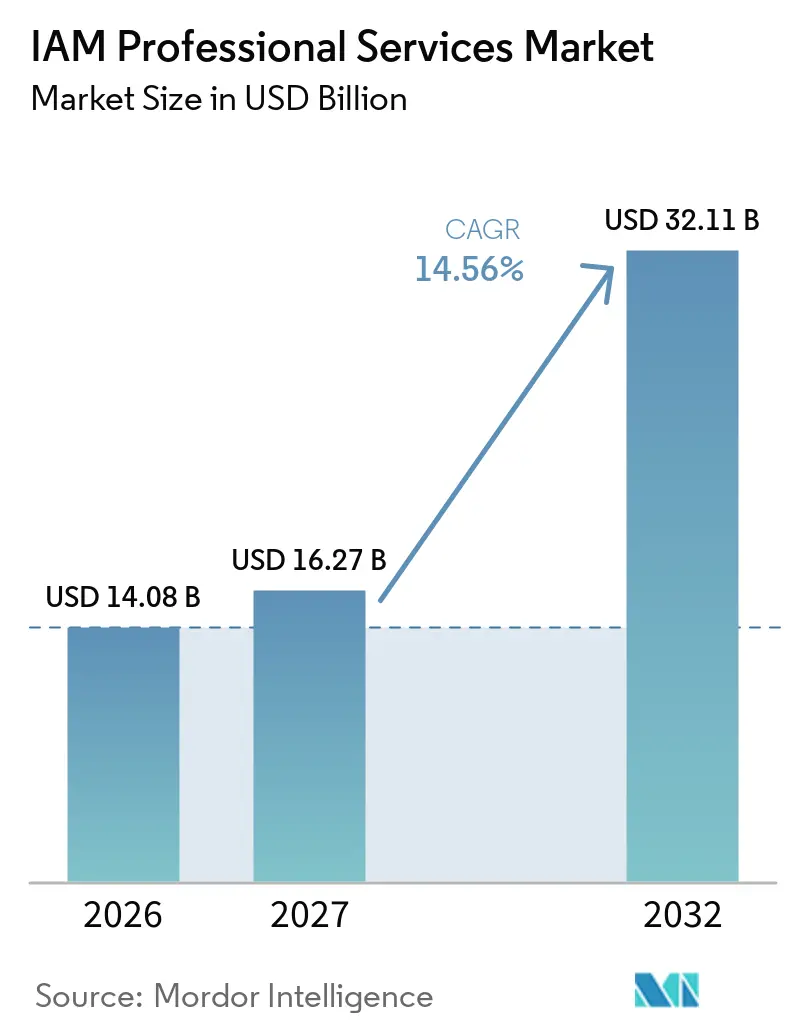
The IAM professional services market size is projected to expand from USD 14.08 billion in 2026 and USD 16.27 billion in 2027 to USD 32.11 billion by 2032, registering a CAGR of 14.56% between 2027 and 2032. Identity has become a central security control for many enterprises, which is increasing demand for advisory, implementation, integration, and support work. Organizations are moving beyond isolated access projects and are redesigning their identity operating models across applications, users, and data environments. This broad scope supports longer service engagements and creates follow-on work after an initial platform deployment. The IAM professional services market also benefits from deferred modernization programs that are now receiving committed budgets. Competition is therefore focused on delivery capacity, cloud expertise, and the ability to manage complex migrations without interrupting identity controls.
Key Report Takeaways
- By service type, Implementation and Configuration held 26.81% of revenue in the IAM professional services market in 2026, while Integration and Migration is projected to expand at a 16.76% CAGR through 2032.
- By identity type, Workforce Identity accounted for 32.96% of revenue in 2026, while AI-Agent Identity is projected to expand at a 17.32% CAGR through 2032.
- By application, Identity Governance and Administration accounted for 24.87% of revenue in 2026, while Identity Threat Detection and Response is projected to expand at a 17.43% CAGR through 2032.
- By industry vertical, Banking, Financial Services, and Insurance held 26.69% of revenue in the IAM professional services market in 2026, while Government and Public Administration is projected to expand at an 18.66% CAGR through 2032.
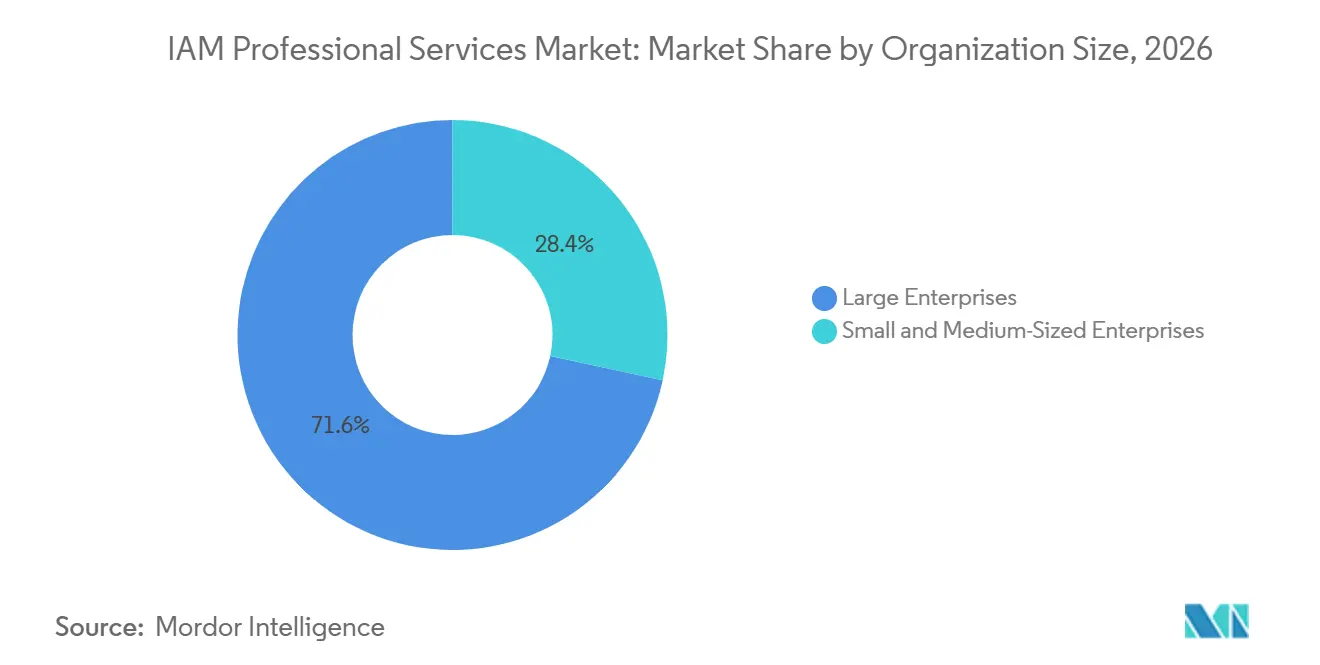
- By organization size, Large Enterprises held 71.62% of revenue in 2026, while Small and Medium-Sized Enterprises are projected to expand at a 16.86% CAGR through 2032.
- By deployment environment, Cloud accounted for 67.58% of revenue in 2026 and is projected to grow at a 17.21% CAGR through 2032.
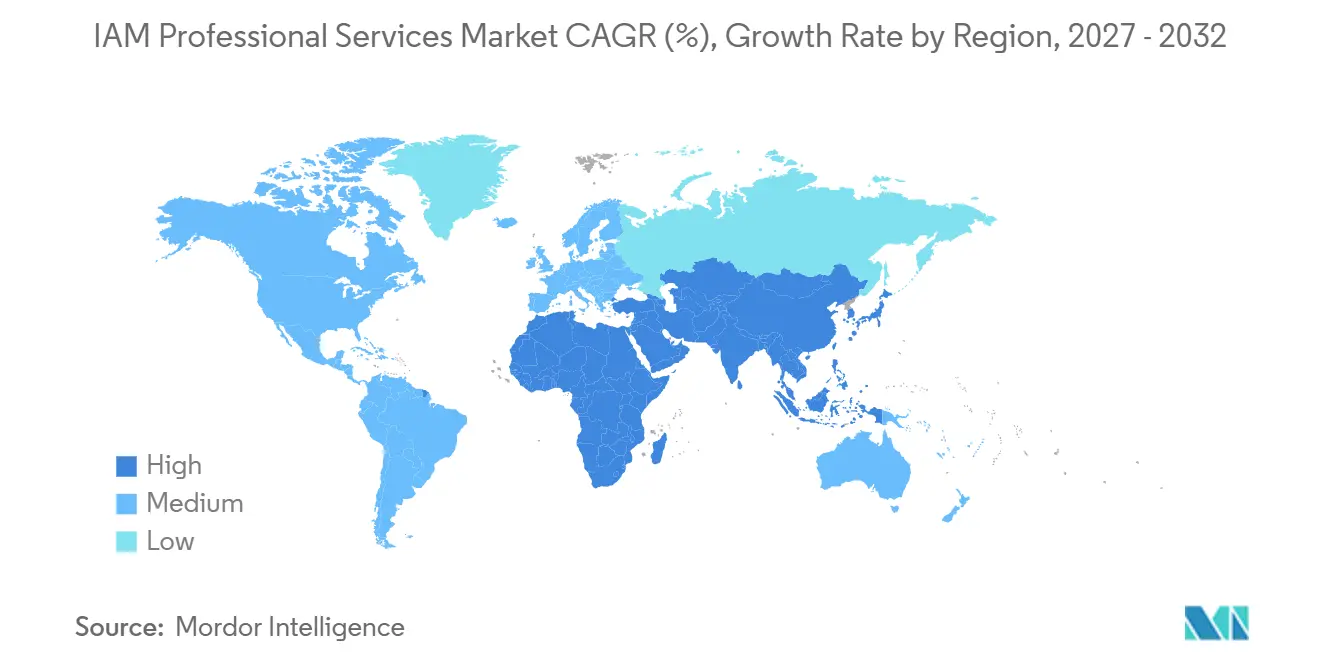
- By geography, North America held 41.64% of the IAM professional services market share in 2026, while Asia-Pacific is projected to expand at an 18.31% CAGR through 2032.
Note: Market numbers in this report are based on Mordor Intelligence's proprietary estimation framework, which combines nine months of actuals with Q4 projections for base year 2026.
Market Trends and Insights
Drivers Impact Analysis of IAM Professional Services Market*
| DRIVER | (~) % IMPACT ON CAGR FORECAST | GEOGRAPHIC RELEVANCE | IMPACT TIMELINE |
|---|---|---|---|
| Rising Identity-Centric Security Spending | +3.5% | Global | Short term (≤ 2 years) |
| AI-Agent and Machine-Identity Governance Requirements | +2.8% | Global, concentrated in North America and Asia-Pacific | Medium term (2-4 years) |
| Accelerating Cloud and Hybrid-Cloud IAM Modernization | +2.5% | Asia-Pacific core, spillover to Middle East and South America | Short term (≤ 2 years) |
| Zero Trust and Continuous Access Enforcement Programs | +2.2% | North America and Europe | Medium term (2-4 years) |
| Regulatory Demand for Auditable Identity Governance | +1.8% | Europe, with spillover to North America and Asia-Pacific | Short term (≤ 2 years) |
| IAM Operating-Model Redesign After SAP Identity Management Retirement | +1.4% | Europe and Asia-Pacific, with strong signal in Germany and Japan | Medium term (2-4 years) |
| Source: Mordor Intelligence | |||
Rising Identity-Centric Security Spending
Enterprise security budgets are placing greater weight on identity controls, which turns planned technology spending into demand for professional services. Legacy platforms remain common, and many organizations must redesign policies, directories, and operating processes before they can deploy modern capabilities. Legacy identity environments leave a large base of modernization work across enterprise accounts. Passwordless authentication and risk-based access controls also require configuration, system integration, policy redesign, and user enablement. The IAM professional services market gains from this work because enterprises are changing their operating model rather than replacing a single product. Larger accounts can sustain multi-year engagements when identity programs span applications, user groups, and regulatory requirements.
AI-Agent and Machine-Identity Governance Requirements
Autonomous software agents and non-human identities are increasing the number of identities that organizations must govern. The Cloud Security Alliance documented that non-human identities outnumber human users by an average of 45 to 1 in enterprise settings, reaching 144 to 1 in cloud-native architectures.[1] A 2025 scientific paper found that established identity frameworks lack delegation, intent-binding, and runtime control mechanisms for agents acting across enterprise applications. The OpenID Foundation states that agents should receive dedicated lifecycle management and accountability controls as first-class identities. These requirements expand the IAM professional services market because clients need architecture, governance design, and implementation support for a new class of enterprise identity. Amazon Bedrock AgentCore Identity and HashiCorp Vault Agentic IAM add platforms that require specialized deployment skills.
Accelerating Cloud and Hybrid-Cloud IAM Modernization
Cloud modernization supports continuing service demand because identity platforms release capabilities frequently and require recurring configuration work. An enterprise with workloads across several cloud environments must reconcile authorization models that do not interoperate by default. This work creates a sustained need for integration, migration, and policy alignment services. Hybrid architecture is not only a temporary stage for many organizations because on-premises directories, cloud identity providers, and SaaS application directories often remain in use at the same time. The IAM professional services market, therefore, benefits from advisory work that connects these environments under common controls. Cloud adoption also makes ongoing optimization and managed support more relevant after the original implementation is complete.
Zero Trust and Continuous Access Enforcement Programs
Zero-trust programs require organizations to design policies around their own applications, user populations, devices, and legacy directories. This makes advisory and architecture services necessary even when the underlying identity platform has already been selected. NIST published its final SP 1800-35 guidance with 19 example zero trust implementations developed with 24 commercial collaborators.[2] The guidance gives organizations a practical reference for defining program scope and implementation deliverables. The U.S. Department of Labor used Microsoft Entra ID for phishing-resistant multifactor authentication, risk-based Conditional Access, and device-level signals in its zero-trust journey. These requirements help the IAM professional services market because service teams must adapt a general security model to individual technology estates. Continuous access enforcement also leads to follow-on work as organizations refine policy coverage and operational processes.
Restraints Impact Analysis of IAM Professional Services Market*
| RESTRAINT | (~) % IMPACT ON CAGR FORECAST | GEOGRAPHIC RELEVANCE | IMPACT TIMELINE |
|---|---|---|---|
| Legacy Directory and Application Integration Complexity | -2.1% | Global | Long term (≥ 4 years) |
| High Cost and Long Payback Period of Enterprise IAM Transformation | -1.8% | Asia-Pacific, South America | Long term (≥ 4 years) |
| Identity Data Fragmentation Across Cloud Platforms | -1.3% | Global, with intensity in North America and Asia-Pacific | Medium term (2-4 years) |
| Limited Availability of Senior Identity Governance Specialists | -0.9% | Global | Medium term (2-4 years) |
| Source: Mordor Intelligence | |||
Legacy Directory and Application Integration Complexity
Modern cloud identity platforms can be difficult to connect with older directory structures and custom applications. Organizations that use SAP Identity Management must reconstruct access provisioning logic, role hierarchies, and joiner-mover-leaver workflows during a migration. SAP stated that SAP Identity Management reaches the end of mainstream maintenance in December 2027, which makes migration planning more urgent for affected customers. The process can lengthen projects because each integration must maintain reliable access and governance controls. Identity data fragmentation across cloud platforms adds another layer of reconciliation and testing. The IAM professional services market faces slower revenue recognition when large projects take longer to design and deploy. The shortage of senior specialists further constrains delivery when organizations need expertise across governance, privileged access, detection, and agent identity.
High Cost and Long Payback Period of Enterprise IAM Transformation
Enterprise identity programs can exceed their original scope because integration requirements emerge after an assessment begins. The financial return often depends on risk reduction and compliance rather than direct revenue generation, which can delay approval during periods of budget pressure. Clients in Asia-Pacific and South America can show greater price sensitivity and slower deal completion than mature enterprise markets. This can reduce initial project scale and make service margins more difficult to protect. Managed IAM services and subscription delivery models can spread the upfront cost across recurring operating payments. The IAM professional services market can benefit over time from these recurring contracts, although adoption is uneven across customer groups and geographies.
*Our forecasts treat driver/restraint impacts as directional, not additive. The impact forecasts reflect baseline growth, mix effects, and variable interactions.
IAM Professional Services Market Segment Analysis
By Service Type:
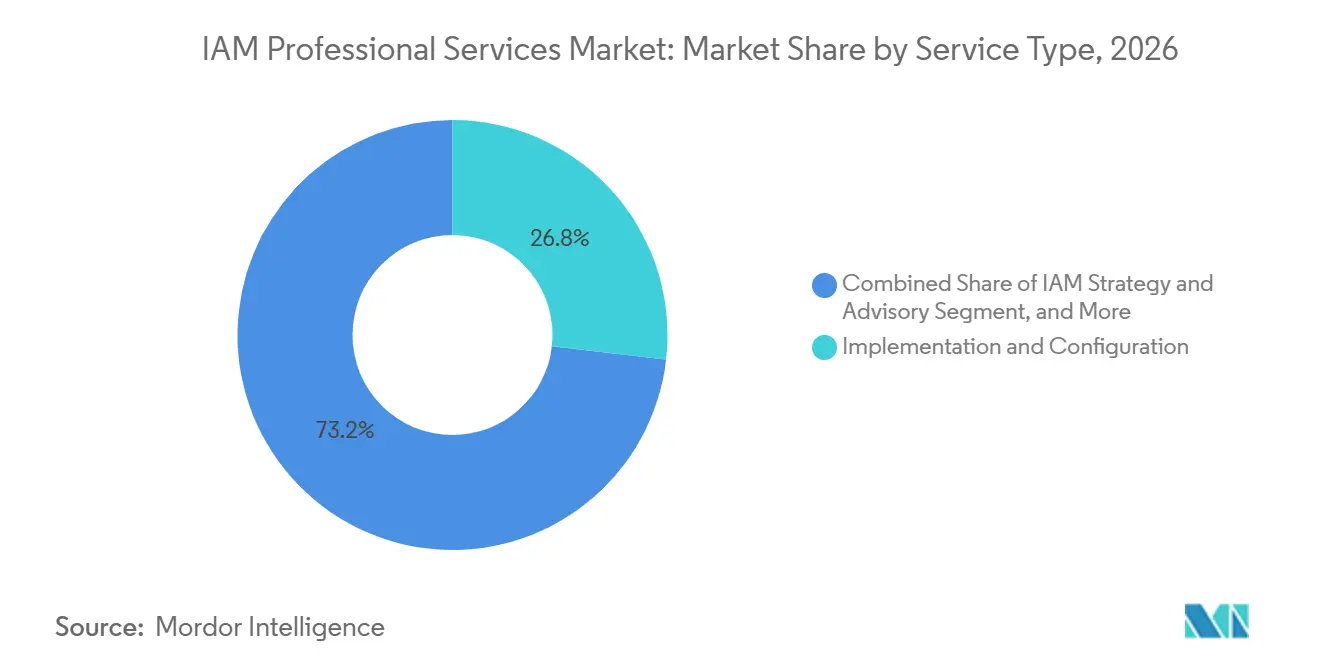
Implementation Anchors Revenue While Migration Gains PaceImplementation and Configuration held 26.81% of revenue in 2026, while Integration and Migration is projected to expand at a 16.76% CAGR through 2032. Implementation work remains labor-intensive because enterprises deploy identity platforms across multiple directories, applications, and user populations. The IAM professional services market is supported in this category by the need to configure controls for complex technology estates. SAP Identity Management is scheduled to reach the end of mainstream maintenance in December 2027, which is creating demand for assessment, architecture, and technical migration work.[3] Organizations must often rebuild provisioning logic and role structures rather than move them directly to a new platform. This requirement gives systems integrators an advantage when they combine SAP knowledge with modern cloud identity skills.
IAM Strategy and Advisory services remain important for organizations beginning first-generation identity programs. These engagements typically define maturity, governance, policy priorities, and a modernization sequence. Assessment and Maturity Diagnostics are increasingly paired with migration work to establish the starting point before implementation begins. Architecture and Design services gain relevance when clients begin zero trust programs that need tailored policy models. Support, Optimization and Training services provide a recurring revenue base because cloud releases can introduce configuration drift after deployment. The IAM professional services market benefits when this work moves from a project handoff to continuous managed support. Service providers that maintain training and operational support capabilities can retain accounts after the initial transformation phase.

By Identity Type:
Workforce Foundations Support Scale While AI-Agent Identity ExpandsWorkforce Identity held 32.96% of revenue in 2026, while AI-Agent Identity is projected to expand at a 17.32% CAGR through 2032. Workforce programs reflect long-standing enterprise investment in joiner-mover-leaver automation and single sign-on. Service firms are now updating these controls for cloud-native applications and more distributed workforces. The IAM professional services market is supported by Workforce Identity because every large identity program still requires foundational employee access controls. AI-Agent Identity adds a newer service opportunity around the governance of autonomous software systems. The OpenID Foundation calls for lifecycle management and accountability measures that treat AI agents as first-class identities. This creates demand for advisory and architecture services before organizations can operationalize agent-based workflows.
Privileged Identity and Customer Identity remain material areas for service providers. Privileged access programs are moving from reactive administration toward ongoing posture management and review. Customer identity work addresses the need for secure authentication across digital channels without adding unnecessary friction for users. Machine and Non-Human Identity engagements are also increasing because enterprises have far more non-human than human identities to oversee. The Cloud Security Alliance documented an average ratio of 45 non-human identities for every human user in enterprise settings. The IAM professional services industry needs practitioners who can link lifecycle controls, access policy, accountability, and runtime oversight across these identity classes. This capability is becoming a differentiator for firms that want to serve advanced cloud and AI deployments.
By Application:
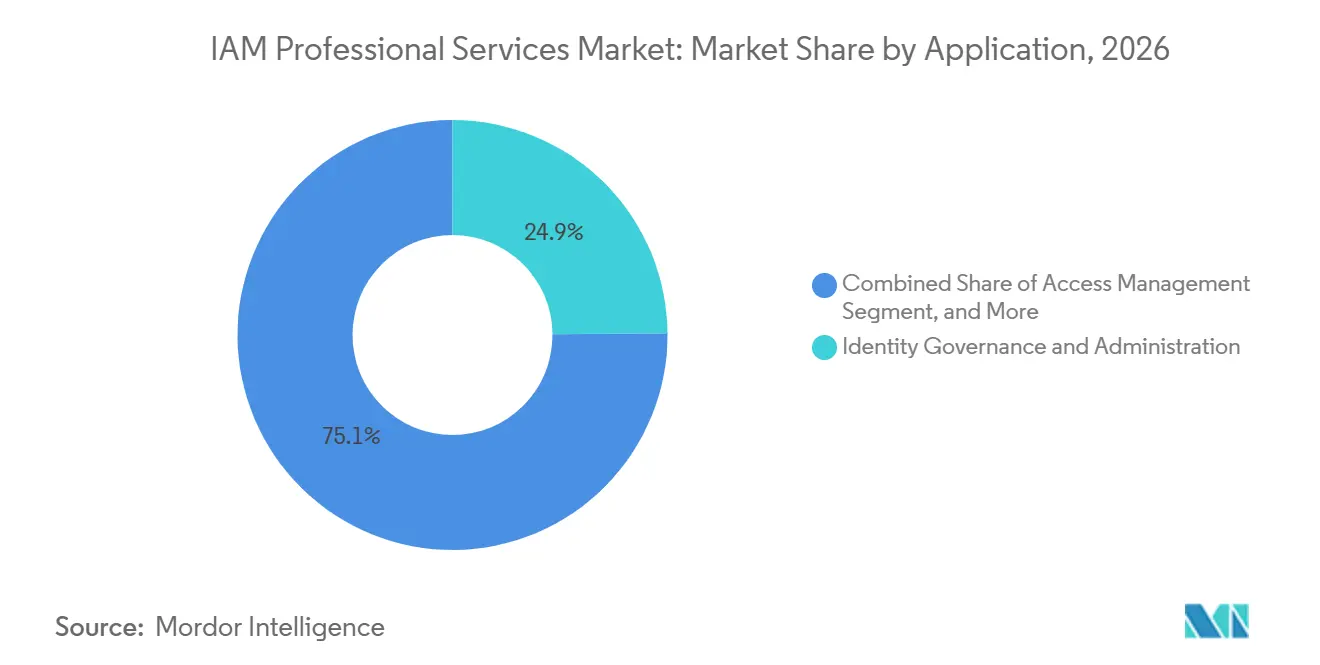
IGA Retains Scale While ITDR Changes Security Architecture EngagementsIdentity Governance and Administration held 24.87% of revenue in 2026, while Identity Threat Detection and Response is projected to expand at a 17.43% CAGR through 2032. IGA serves as an anchor application because it connects human resources systems, enterprise resource planning platforms, and cloud directories. Its wide integration surface creates continued demand for advisory and implementation support in regulated organizations. ITDR adds behavioral analytics and credential-abuse detection to the identity security architecture. This application often follows IGA and privileged access deployments, giving providers an opportunity to extend relationships with existing clients. The IAM professional services market gains from this sequence because each established account can produce a later security architecture engagement. ITDR also requires teams to align identity signals with broader detection and response practices.
Access Management and Privileged Access Management remain significant application areas. Their deployment supports zero-trust-aligned access policies and regular access certification. Customer Identity and Access Management is relevant when organizations need secure digital experiences for external users. Cloud Infrastructure Entitlement Management receives focused attention where multicloud permissions have become a governance concern. Directory and Identity Infrastructure services address Active Directory and LDAP modernization before a cloud migration begins. These preparatory assignments generate work before a platform-level transformation starts. The IAM professional services market remains active across applications because a mature identity program usually combines several of these capabilities rather than adopting a single tool.
By Industry Vertical:
BFSI Anchors Volume While Government Programs Lead GrowthBanking, Financial Services, and Insurance held 26.69% of revenue in 2026, while Government and Public Administration is projected to expand at an 18.66% CAGR through 2032. Financial institutions invest in identity governance because access controls support audit requirements and fraud prevention. These clients also require complex programs that can extend across business units, customer channels, and regulated processes. Government demand is supported by zero-trust mandates, national digital identity programs, and formal public-sector cybersecurity frameworks. NIST guidance provides a practical structure for organizations implementing a zero-trust architecture. The IAM professional services market is sustained in these verticals by projects that must align technology deployment with security and compliance obligations. Public organizations also need identity programs that can serve workforce, citizen, and partner access requirements.
The healthcare and life sciences industry requires patient identity management, clinical access governance, and compliant provisioning processes. Retail and E-Commerce spending centers on customer identity work that supports secure authentication during digital transactions. Telecommunications and Media and Travel and Hospitality are adopting identity services as they modernize customer and workforce access. Manufacturing, energy, education, and other verticals form a fragmented but expanding client base. Operational technology and connected environments are extending identity requirements beyond traditional corporate information technology. The IAM professional services industry can serve these sectors by adapting common governance practices to different operational risks. This broad base limits dependence on a single vertical even though BFSI remains the largest revenue contributor.
By Organization Size:
Large Enterprises Drive Engagement Value While SMEs Expand AccessLarge Enterprises held 71.62% of revenue in 2026, while Small and Medium-Sized Enterprises are projected to expand at a 16.86% CAGR through 2032. Large programs can span thousands of applications, large identity populations, and several regulatory jurisdictions. Such a scope requires extended advisory, implementation, and integration work. The IAM professional services market continues to rely on Large Enterprises because complex transformations create high contract values. These accounts are likely to remain important because their identity environments cannot be standardized easily. They also require specialist support for governance, privileged access, cloud permissions, and continuous access controls. Delivery firms, therefore, compete for large enterprise accounts through global capacity and deep platform knowledge.
Small and Medium-Sized Enterprises are becoming more accessible through SaaS delivery models that reduce the need for upfront infrastructure investment. Service providers are responding with fixed-scope and fixed-fee offerings that move from assessment to deployment on shorter schedules. These packages can lower the initial barrier for organizations that could not previously fund a broad transformation. Managed delivery also lets providers build recurring relationships even when the initial project is smaller. The IAM professional services market benefits from higher addressable deal volume across the mid-market. A wider SME customer base requires repeatable delivery methods and pricing that remains clear for budget-conscious buyers. Firms that balance standardized packages with sufficient integration support can address this opportunity without weakening service quality.
By Deployment Environment:
Cloud Leads While Hybrid Creates Complex EngagementsCloud held 67.58% of revenue in 2026 and is projected to expand at a 17.21% CAGR through 2032. Cloud delivery is preferred by many organizations, but it does not remove the need for continuing identity management work. Multicloud identity sprawl creates requirements for policy alignment, entitlement review, and lifecycle governance. Microsoft reported that an independent study found a 131% ROI for Microsoft Entra Suite deployments in 2025.[4] The IAM professional services market benefits from cloud deployment and the recurring optimization work needed after initial implementation. On-Premises deployment remains relevant in regulated sectors, classified government settings, and environments with data residency requirements.
Hybrid environments often create high-value service engagements because they combine on-premises directories, cloud identity providers, and SaaS application directories. Organizations need unified policy enforcement across these separate environments. This work requires architecture design, integration, testing, and continued optimization. The IAM professional services market serves hybrid customers through longer engagements because each environment has distinct authorization practices and operational teams. Hybrid deployment can therefore remain a durable source of demand instead of disappearing after cloud adoption. Service providers must integrate controls without disrupting business processes or weakening compliance. The ability to handle these mixed environments is important for firms seeking complex enterprise work.
Geography Analysis
North America IAM Professional Services Market
North America held 41.64% of revenue in 2026, representing the largest IAM professional services market share. The region has dense enterprise technology estates and a large concentration of cybersecurity mandates. U.S. federal zero-trust directives have created an ongoing procurement cycle across defense and civilian agencies, as well as critical infrastructure. NIST provides a detailed zero-trust implementation reference in SP 1800-35. Accenture acquired Canadian IAM specialist IAMConcepts in September 2025, underscoring the value placed on regulated-sector delivery capability in the region.[5] AWS also published ZTAG-I, a reference zero-trust architecture for U.S. federal agencies that includes integrations with CrowdStrike, Okta, and Zscaler.
APAC IAM Professional Services Market
Asia-Pacific is projected to expand at an 18.31% CAGR through 2032, making it the fastest-growing regional area. India’s financial technology and digital payments infrastructure, Japan’s enterprise modernization programs, and Southeast Asia’s cloud-first service models create distinct demand pools. Large Indian technology services firms bundle identity implementation into broader cloud transformation projects. This approach can reduce per-seat delivery costs while extending the scope of work. China, South Korea, and Southeast Asia add demand as organizations update workforce and customer identity systems. The IAM professional services market in Asia-Pacific is supported by government-led digital identity initiatives. These conditions favor providers that can combine regional delivery capacity with cloud, governance, and integration expertise.
EMEA and South America IAM Professional Services Market
Europe has a compliance-led demand profile and a significant migration opportunity for organizations using SAP Identity Management. SAP’s end-of-mainstream-maintenance date in December 2027 requires affected customers to assess replacement options and rebuild relevant provisioning logic. South America is led by Brazil and Argentina, where banking-sector digitalization supports new identity programs. The Middle East, particularly Saudi Arabia and the United Arab Emirates, is investing in digital government programs. Africa remains an early-stage region, with demand driven by financial services and telecommunications in South Africa and Nigeria. The IAM professional services market can develop in these regions as regulated organizations formalize identity governance and extend digital services.
Competitive Landscape
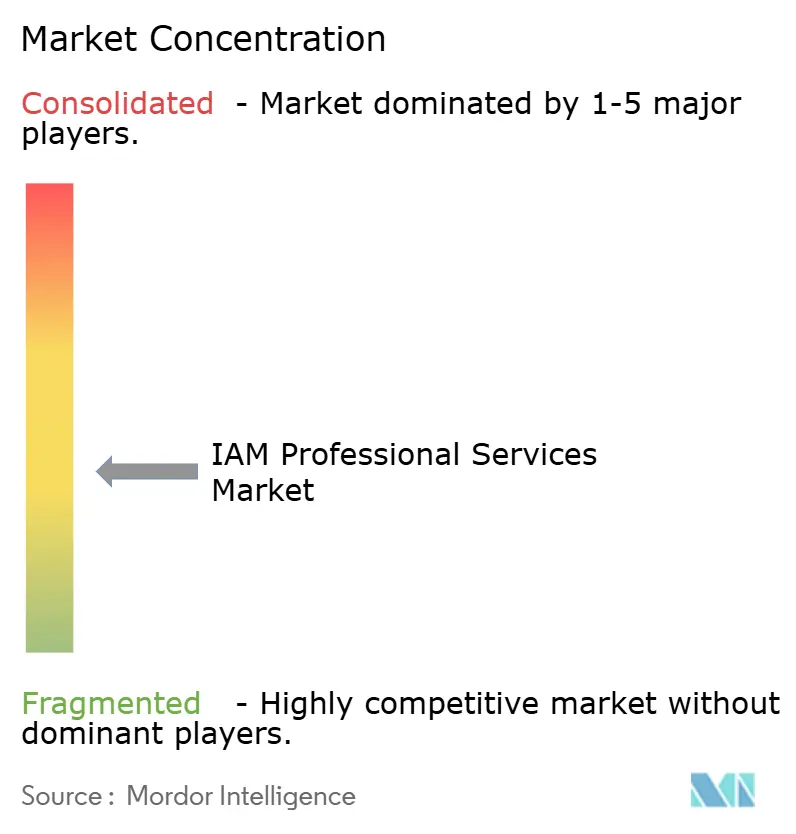
The IAM professional services market is moderately fragmented, with no single firm described as holding a market-defining share. Large systems integrators, including Accenture, IBM, Deloitte, TCS, and Capgemini, compete with specialist boutiques, managed service providers, and regional integrators. Competition increasingly depends on the ability to implement AI-agent identity governance and to shorten delivery timelines through reusable methods and connectors. Platform vendors also influence competition through their partner ecosystems and delivery certifications. SailPoint named Accenture its 2025 Global Partner of the Year and named Deloitte its Global Impact Partner of the Year. These relationships can help selected integrators gain access to platform expertise and complex client opportunities.
White space remains in AI-agent identity governance, ITDR, and the convergence of IGA with cloud entitlement management. Smaller competitors can establish positions through continuous managed identity operations rather than solely through project-based implementations. This model can generate recurring revenue and deepen client retention. IBM made HashiCorp Vault Agentic IAM generally available with per-request access evaluation and a centralized agent registry. This capability positions IBM to support machine and AI-agent identity services across product and service delivery. CyberArk’s acquisition of Zilla Security in February 2025 added IGA capabilities to its identity security platform and expanded opportunities for integrated program delivery.
Accenture strengthened its Canadian identity capability by acquiring IAMConcepts in September 2025. SailPoint and HCLTech formed a strategic partnership in September 2025, combining SailPoint Identity Security Cloud with HCLTech’s managed identity framework. SailPoint and Deloitte also expanded their collaboration in June 2025 around AI-agent identity governance. These moves show how leading firms are combining platform capabilities, managed services, and advisory work. Talent availability remains a constraint because senior identity architects must work across governance, privileged access, detection, cloud permissions, and agent identity. The IAM professional services market rewards firms that can build this specialized practitioner base while maintaining repeatable global delivery.
IAM Professional Services Industry Leaders
-
Accenture plc
-
International Business Machines Corporation
-
Deloitte Touche Tohmatsu Limited
-
Ernst & Young Global Limited
-
PricewaterhouseCoopers International Limited
- *Disclaimer: Major Players sorted in no particular order
IAM Professional Services Market Companies Covered in this Report
- Accenture plc
- International Business Machines Corporation
- Deloitte Touche Tohmatsu Limited
- Ernst & Young Global Limited
- PricewaterhouseCoopers International Limited
- KPMG International Limited
- Capgemini SE
- Tata Consultancy Services Limited
- Infosys Limited
- Wipro Limited
- Cognizant Technology Solutions Corporation
- HCL Technologies Limited
- NTT DATA Corporation
- DXC Technology Company
- Atos SE
- Fujitsu Limited
- LTIMindtree Limited
- Tech Mahindra Limited
- Okta, Inc.
- SailPoint Technologies Holdings, Inc.
- CyberArk Software Ltd.
- Microsoft Corporation
- Broadcom Inc.
- Thales Group
- Simeio Solutions, Inc.
Recent Industry Developments in IAM Professional Services Market
- September 2026: Wipro and CrowdStrike launched the CISO Command Center, a consulting-led enterprise security offering integrating IAM, endpoint security, cloud security, and AI-risk management under a unified risk-led operating model. Operationalized through CyberTransform and CyberShield solutions, the Center signals Wipro's repositioning from tool-implementation vendor to enterprise security transformation partner.
- October 2025: CyberArk expanded its machine identity security portfolio with advanced discovery and context capabilities one year after closing the Venafi acquisition. The release extended certificate lifecycle management, shrinking certificate lifes enforcement, and AI-agent identity capabilities, creating new implementation service requirements for enterprise clients.
- September 2025: Accenture acquired IAMConcepts, a Toronto-based IAM specialist with end-to-end IGA, PAM, and CIAM capabilities serving Canada's largest banks, insurance companies, and critical infrastructure operators, its 22nd cybersecurity acquisition since 2015.
- September 2025: SailPoint and HCLTech announced a strategic partnership combining SailPoint Identity Security Cloud via the AI-driven Atlas platform with HCLTech's MiDaaS managed identity framework. HCLTech received SailPoint's Global Delivery Admiral certification, the highest partner delivery status, acknowledging its deployment scale and long-term client impact.
Global IAM Professional Services Market Report Scope
The IAM professional services market encompasses advisory, assessment, architecture, implementation, integration, migration, optimization, and training services for identity and access management programs. It includes IAM strategy, solution design, product deployment, legacy migration, zero-trust transformation, and identity governance implementation.
The IAM Professional Services Market Report is Segmented by Service Type (IAM Strategy and Advisory, Assessment and Maturity Diagnostics, Architecture and Design, Implementation and Configuration, Integration and Migration, and Support, Optimization and Training), Identity Type (Workforce Identity, Customer Identity, Partner and B2B Identity, Privileged Identity, Machine and Non-Human Identity, and AI-Agent Identity), Application (Identity Governance and Administration, Access Management, Privileged Access Management, Customer Identity and Access Management, Directory and Identity Infrastructure, Identity Proofing and Verification, Identity Threat Detection and Response, and Cloud Infrastructure Entitlement Management), Industry Vertical (Banking, Financial Services, and Insurance (BFSI), Government and Public Administration, Healthcare and Life Sciences, Retail and E-Commerce, Telecommunications and Media, Travel and Hospitality, and Industry Verticals), Organization Size (Large Enterprises, and Small and Medium Enterprises), Deployment Model (Cloud-Based, On-Premises, and Hybrid), and Geography (North America, South America, Europe, Asia-Pacific, Middle East, and Africa). The Market Forecasts are Provided in Terms of Value (USD).
Segmentation Overview
| IAM Strategy and Advisory |
| Assessment and Maturity Diagnostics |
| Architecture and Design |
| Implementation and Configuration |
| Integration and Migration |
| Support, Optimization and Training |
| Workforce Identity |
| Customer Identity |
| Partner and B2B Identity |
| Privileged Identity |
| Machine and Non-Human Identity |
| AI-Agent Identity |
| Identity Governance and Administration |
| Access Management |
| Privileged Access Management |
| Customer Identity and Access Management |
| Directory and Identity Infrastructure |
| Identity Proofing and Verification |
| Identity Threat Detection and Response |
| Cloud Infrastructure Entitlement Management |
| Banking, Financial Services, and Insurance (BFSI) |
| Government and Public Administration |
| Healthcare and Life Sciences |
| Retail and E-Commerce |
| Telecommunications and Media |
| Travel and Hospitality |
| Other Industry Verticals |
| Large Enterprises |
| Small and Medium-Sized Enterprises |
| Cloud |
| On-Premises |
| Hybrid |
| North America | United States |
| Canada | |
| Mexico | |
| South America | Brazil |
| Argentina | |
| Rest of South America | |
| Europe | United Kingdom |
| Germany | |
| France | |
| Italy | |
| Rest of Europe | |
| Asia-Pacific | China |
| India | |
| Japan | |
| Rest of Asia-Pacific | |
| Middle East | Saudi Arabia |
| United Arab Emirates | |
| Rest of the Middle East | |
| Africa | South Africa |
| Nigeria | |
| Rest of Africa |
| By Service Type | IAM Strategy and Advisory | |
| Assessment and Maturity Diagnostics | ||
| Architecture and Design | ||
| Implementation and Configuration | ||
| Integration and Migration | ||
| Support, Optimization and Training | ||
| By Identity Type | Workforce Identity | |
| Customer Identity | ||
| Partner and B2B Identity | ||
| Privileged Identity | ||
| Machine and Non-Human Identity | ||
| AI-Agent Identity | ||
| By Application | Identity Governance and Administration | |
| Access Management | ||
| Privileged Access Management | ||
| Customer Identity and Access Management | ||
| Directory and Identity Infrastructure | ||
| Identity Proofing and Verification | ||
| Identity Threat Detection and Response | ||
| Cloud Infrastructure Entitlement Management | ||
| By Industry Vertical | Banking, Financial Services, and Insurance (BFSI) | |
| Government and Public Administration | ||
| Healthcare and Life Sciences | ||
| Retail and E-Commerce | ||
| Telecommunications and Media | ||
| Travel and Hospitality | ||
| Other Industry Verticals | ||
| By Organization Size | Large Enterprises | |
| Small and Medium-Sized Enterprises | ||
| By Deployment Model | Cloud | |
| On-Premises | ||
| Hybrid | ||
| By Geography | North America | United States |
| Canada | ||
| Mexico | ||
| South America | Brazil | |
| Argentina | ||
| Rest of South America | ||
| Europe | United Kingdom | |
| Germany | ||
| France | ||
| Italy | ||
| Rest of Europe | ||
| Asia-Pacific | China | |
| India | ||
| Japan | ||
| Rest of Asia-Pacific | ||
| Middle East | Saudi Arabia | |
| United Arab Emirates | ||
| Rest of the Middle East | ||
| Africa | South Africa | |
| Nigeria | ||
| Rest of Africa | ||
Key Questions Answered in the Report
What is the size of the IAM professional services sector?
The IAM professional services market size is projected to expand from USD 14.08 billion in 2026 and USD 16.27 billion in 2027 to USD 32.11 billion by 2032, registering a CAGR of 14.56% between 2027 to 2032.
Which IAM service type has the largest revenue share?
Implementation and Configuration held the largest service type share at 26.81% in 2026.
What is driving AI-agent identity services?
Enterprises need lifecycle management, accountability, delegation, and runtime control for autonomous agents, creating demand for advisory and implementation work.
Which application is expected to expand fastest?
Identity Threat Detection and Response is projected to expand at a 17.43% CAGR through 2032.
Which customer group accounts for the largest share of IAM services demand?
Large Enterprises held 71.62% of revenue in 2026 because their programs cover extensive applications, identities, and regulatory requirements.
Which region is expected to expand fastest?
Asia-Pacific is projected to expand at an 18.31% CAGR through 2032, supported by cloud modernization and digital identity programs.