
Hydrogenated Styrene Block Copolymers Market Size and Share
Market Overview
| Study Period | 2021 - 2031 |
|---|---|
| Market Size (2026) | USD 2.62 Billion |
| Market Size (2031) | USD 3.49 Billion |
| Growth Rate (2026 - 2031) | 5.91 % |
| Fastest Growing Market | Asia-Pacific |
| Largest Market | Asia-Pacific |
| Market Concentration | Medium |
Major Players *Disclaimer: Major Players sorted in no particular order Image © Mordor Intelligence. Reuse requires attribution under CC BY 4.0. | |
Hydrogenated Styrene Block Copolymers Market Analysis by Mordor Intelligence
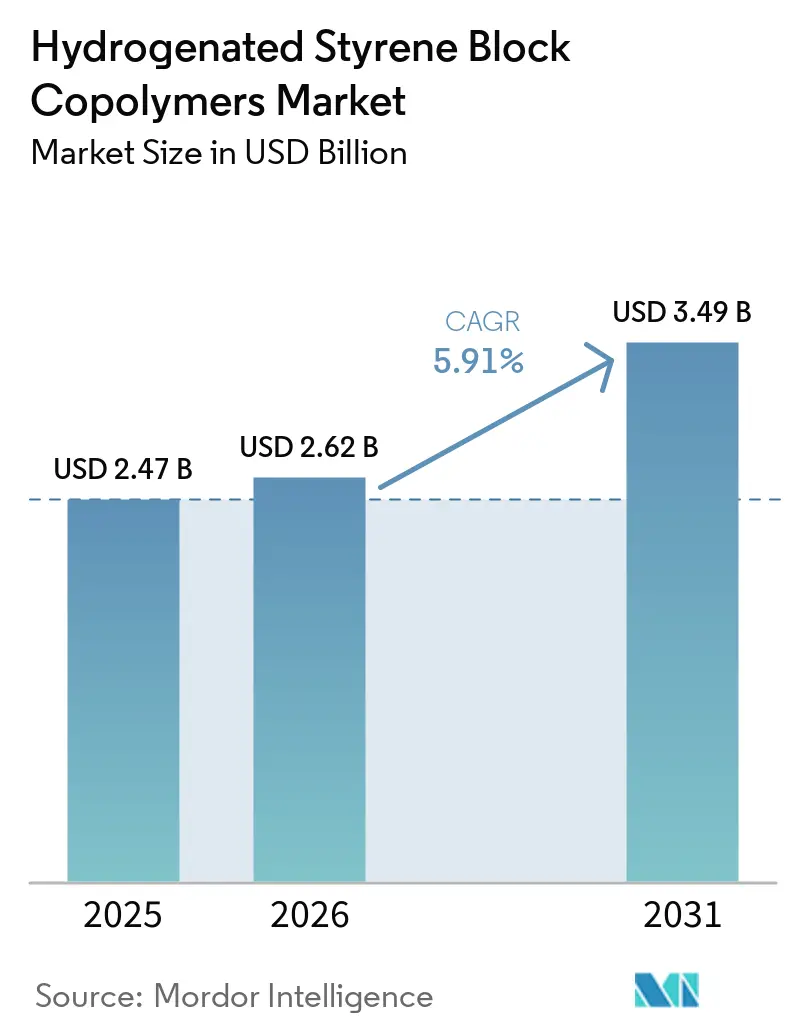
The Hydrogenated Styrene Block Copolymers Market size was valued at USD 2.47 billion in 2025 and is estimated to grow from USD 2.62 billion in 2026 to reach USD 3.49 billion by 2031, at a CAGR of 5.91% during the forecast period (2026-2031). Demand is shifting toward applications where thermal stability, chemical resistance, and lower extractables carry more weight than the initial material cost. Requirements for recyclable automotive components, polyvinyl chloride (PVC)-free medical devices, and solvent-free adhesives support this shift across several consuming industries. Producers are responding to lower-priced commodity grades by prioritizing functionalized materials, bio-attributed offerings, and grades that hold application approvals. Feedstock inflation remains a near-term concern for producers without integrated monomer supply, while medical devices and electric vehicle components provide demand that is less sensitive to price changes. The hydrogenated styrene block copolymers market, therefore, has opportunities in qualified specialty applications, even as standard grades face more direct price competition.
Key Report Takeaways
- By product type, styrene ethylene butylene styrene (SEBS) held 57.73% of the hydrogenated styrene block copolymers market share in 2025, while styrene ethylene propylene styrene (SEPS) is projected to advance at a 6.24% CAGR through 2031.
- By application, adhesives and sealants held 38.28% of the hydrogenated styrene block copolymers market share in 2025 and are projected to advance at a 6.43% CAGR through 2031.
- By end-use industry, automotive held 35.07% of the hydrogenated styrene block copolymers market share in 2025, while healthcare is projected to advance at a 6.87% CAGR through 2031.
- By geography, Asia-Pacific held 43.16% of the hydrogenated styrene block copolymers market share in 2025 and is projected to advance at a 6.51% CAGR through 2031.
Note: Market size and forecast figures in this report are generated using Mordor Intelligence’s proprietary estimation framework, updated with the latest available data and insights as of January 2026.
Global Hydrogenated Styrene Block Copolymers Market Trends and Insights
Drivers Impact Analysis*
| Driver | (~) % Impact on CAGR Forecast | Geographic Relevance | Impact Timeline |
|---|---|---|---|
| Automotive Lightweighting and Electric Vehicle Component Durability | +1.5% | Global, concentrated in APAC, EU, and North America | Medium-term (2–4 years) |
| Medical-Grade, Non-PVC Material Qualification | +1.2% | North America, Europe, and APAC | Long-term (≥ 4 years) |
| Growth of High-Performance Hot-Melt Adhesives and Sealants | +1.1% | Global, concentrated in APAC | Short-term (≤ 2 years) |
| Asia-Pacific Infrastructure and Manufacturing Expansion | +0.9% | APAC (China, India), with spillover to ASEAN | Medium-term (2–4 years) |
| Recyclable Multilayer Films and Polymer Compatibilization | +0.7% | EU and North America, early gains in select APAC markets | Long-term (≥ 4 years) |
| Source: Mordor Intelligence | |||
Automotive Lightweighting and Electric Vehicle Component Durability
Electric vehicle architectures create uses for hydrogenated styrene block copolymers in battery enclosures, high-voltage cable insulation, thermal interface layers, and halogen-free grommet systems. These parts require elastomer compounds that can operate from -40 °C to above 120 °C while maintaining compression-set performance. SEBS formulations have established qualification histories for these demanding uses. Kraton Corporation launched its MD1672 next-generation SEBS grade in August 2026 for oil-free thermoplastic elastomer compounds. The grade provides up to 30% improved room-temperature compression set, improved barrier properties, and lower volatile organic compound (VOC) and fogging emissions. The hydrogenated styrene block copolymers market can benefit as automotive manufacturers seek materials that combine durability, lower emissions, and efficient processing.
Medical-Grade, Non-PVC Material Qualification
Medical-device applications support hydrogenated styrene block copolymers where suppliers can document biocompatibility, extractables, and processing consistency. KURARAY CO., LTD.’s SEPTON medical grades include the 2000-series Styrene Ethylene Propylene Styrene materials, 4000-series Styrene Ethylene Ethylene Propylene Styrene materials, and 8000-series Styrene Ethylene Butylene Styrene materials. These grades carry ISO 10993 testing records, including blood-interaction and cytotoxicity testing, along with United States Pharmacopeia Class VI documentation. Asahi Kasei Corporation’s TUFTEC and S.O.E. grades for medical tubing are plasticizer-free and can withstand steam sterilization at 121 °C. The company states that the materials showed lower adsorption for isosorbide mononitrate and miconazole than polyvinyl chloride in its application testing. The hydrogenated styrene block copolymers market gains a longer demand runway because medical qualification work takes time and creates a high barrier for unqualified alternatives.
Growth of High-Performance Hot-Melt Adhesives and Sealants
Adhesive formulators use SEBS when bond performance under heat, low odor, and low fogging are important. The material is used in hot-melt pressure-sensitive adhesive formulations for hygiene, labels, automotive interiors, and electronics assembly. China’s GB 38507-2020 standard has volatile organic compound limits that became effective in 2024 and support the move from solvent-based systems to solvent-free hot melts[1]China Ministry of Ecology and Environment, “GB 38507-2020: Emission Standards for Volatile Organic Compounds in the Industrial Coating,” China Ministry of Ecology and Environment, mee.gov.cn . TSRC participated in a hot-melt adhesive development forum in Suzhou in March 2026 and presented TAIPOL Styrene Ethylene Butylene Styrene and VECTOR Styrene Isoprene Styrene solutions for hygiene and label applications. This transition supports the hydrogenated styrene block copolymers market because compliance needs can sustain material conversion even when wider manufacturing conditions are uneven.
Asia-Pacific Infrastructure and Manufacturing Expansion
Asia-Pacific combines a large production base with growing demand from automotive, electronics, construction, adhesives, and healthcare manufacturing. China Petrochemical Corporation commissioned a 250,000-metric-ton-per-year thermoplastic elastomers facility in November 2024, including 50,000 metric tons per year of Styrene Ethylene Butylene Styrene capacity. The facility used proprietary domestic process technology, creating a local supply base for the Chinese hydrogenated styrene block copolymers market. BASF inaugurated its Zhanjiang Verbund site in Guangdong in March 2026, with a EUR 8.7 billion investment (approximately USD 9.5 billion) that includes a 1-million-metric-ton-per-year flexible-feed ethylene steam cracker and more than 70 products in production. India’s specialty chemical and medical-device manufacturing plans, alongside adhesive and footwear clusters in Association of Southeast Asian Nations countries, broaden the region’s consumption base.
Restraints Impact Analysis*
| Restraint | (~) % Impact on CAGR Forecast | Geographic Relevance | Impact Timeline |
|---|---|---|---|
| Styrene, Butadiene, and Isoprene Feedstock Volatility | -0.8% | Global | Short-term (≤ 2 years) |
| High Hydrogenation Catalyst and Qualification Costs | -0.7% | Global | Long-term (≥ 4 years) |
| Substitution by TPU, TPO, POE, PEBA, Silicone, and Engineered Olefins | -0.5% | Footwear (APAC), Automotive (EU, North America) | Medium-term (2–4 years) |
| Source: Mordor Intelligence | |||
Styrene, Butadiene, and Isoprene Feedstock Volatility
Hydrogenated styrene block copolymer producers rely on styrene, butadiene, and isoprene from separate petrochemical supply streams. This exposure makes margin planning difficult because price movements do not necessarily occur at the same time. The styrene prices rose 35% and butadiene prices rose 28% in early 2025 after Gulf Coast cracker outages[2]U.S. Energy Information Administration, “Styrene and Butadiene Price Trends,” U.S. Energy Information Administration, eia.gov. KURARAY CO., LTD. announced global SEPTON and HYBRAR price revisions during 2026 as raw material and utility costs exceeded the company’s ability to absorb them internally. Producers with captive monomer supply can manage these cost movements more effectively than companies that depend on external purchases. This constraint can lead downstream customers to qualify competing materials when material prices rise sharply.
High Hydrogenation Catalyst and Qualification Costs
Hydrogenation gives these copolymers their heat resistance and weatherability, but it also adds catalyst and process-control costs. Producers must selectively saturate diene blocks while preserving the needed aromatic structure in the polymer. Medical materials also require testing and documentation for extractable substances from completed polymer lots. New suppliers must fund commercial hydrogenation reactors, catalyst systems, and lengthy automotive or medical qualification programs before substantial sales begin. These requirements limit supply access in regions that could otherwise adopt more polyvinyl chloride-free materials. The hydrogenated styrene block copolymers industry, therefore, retains a cost barrier that protects qualified suppliers but can slow adoption in price-sensitive uses.
*Our forecasts treat driver/restraint impacts as directional, not additive. The impact forecasts reflect baseline growth, mix effects, and variable interactions.
Segment Analysis
By Product Type: Styrene Ethylene Butylene Styrene Anchors Revenue While Styrene Ethylene Propylene Styrene Builds Specialty Demand
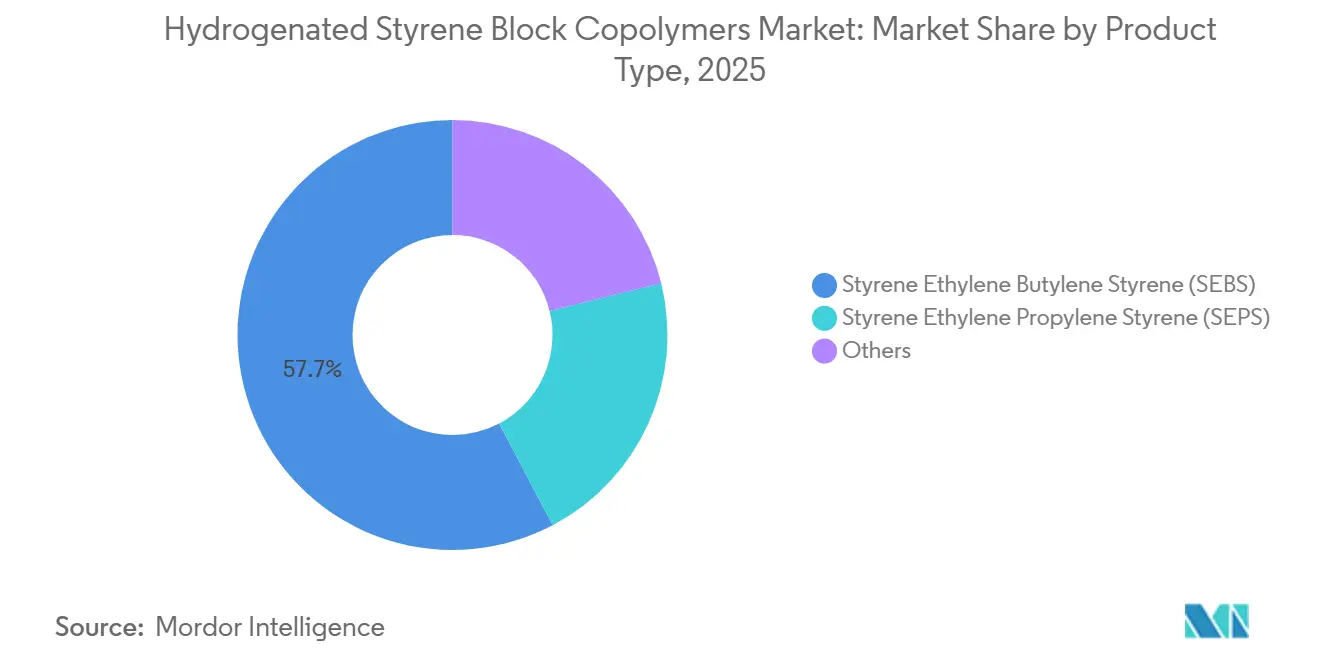
Styrene ethylene butylene styrene (SEBS) held 57.73% of the hydrogenated styrene block copolymers market share in 2025. Its large position reflects compatibility with processing oils and polypropylene, along with proven heat and chemical resistance in varied applications. Adhesive hot melts, automotive seals, and medical tubing all use the material’s flexible compounding profile. The hydrogenated styrene block copolymers market size for this product family is supported by its use across qualified applications. Commodity competition has intensified after foundational hydrogenation patents expired during 2023 and 2024. This competition has placed greater importance on formulations, supply reliability, and customer approval records than on standard tri-block polymer supply alone.
Styrene ethylene propylene styrene (SEPS) is projected to advance at a 6.24% CAGR through 2031, supported by optical clarity and low-temperature flexibility requirements. Medical plasters, drug-delivery laminates, and premium cosmetic packaging are relevant uses where these properties matter. KURARAY CO., LTD.’s 2000-series Styrene Ethylene Propylene Styrene and 4000-series Styrene Ethylene Ethylene Propylene Styrene products have ISO 10993 biocompatibility documentation. KURARAY CO., LTD.’s SEPTON BIO-series uses sugarcane-derived beta-farnesene and offers up to 80% bio-content. These product options direct supplier competition toward certified or differentiated grades rather than standard material alone.



By Application: Adhesives and Sealants Lead Demand and Growth
Adhesives and sealants held 38.28% of the hydrogenated styrene block copolymers market share in 2025 and are projected to advance at a 6.43% CAGR through 2031. This application combines demand from hygiene products, labels, construction, automotive interiors, and electronics assembly. Formulators use styrene ethylene butylene styrene hot melts for thermal durability, low odor, and low fogging properties. China’s volatile organic compound limits have accelerated conversion from solvent-based adhesive systems toward solvent-free formulations. TSRC presented TAIPOL Styrene Ethylene Butylene Styrene materials for hygiene pressure-sensitive adhesive and label uses during its March 2026 forum. The hydrogenated styrene block copolymers industry is supported when compliance standards favor adhesive systems that avoid solvents.
Paints and coatings use lower-molecular-weight styrene ethylene butylene styrene as an elasticity and texture modifier. Demand in this area remains tied to general polymer-processing activity and is more sensitive to material cost. Films are becoming relevant where functionalized styrene ethylene butylene styrene improves compatibility in recycled multilayer packaging structures. The material forms ester bonds at the polypropylene and ethylene vinyl alcohol interface, which helps preserve barrier properties after recycling. This gives the hydrogenated styrene block copolymers market a role in packaging designs responding to recyclability requirements.
By End-Use Industry: Healthcare Expands Through Qualification While Automotive Retains Its Lead
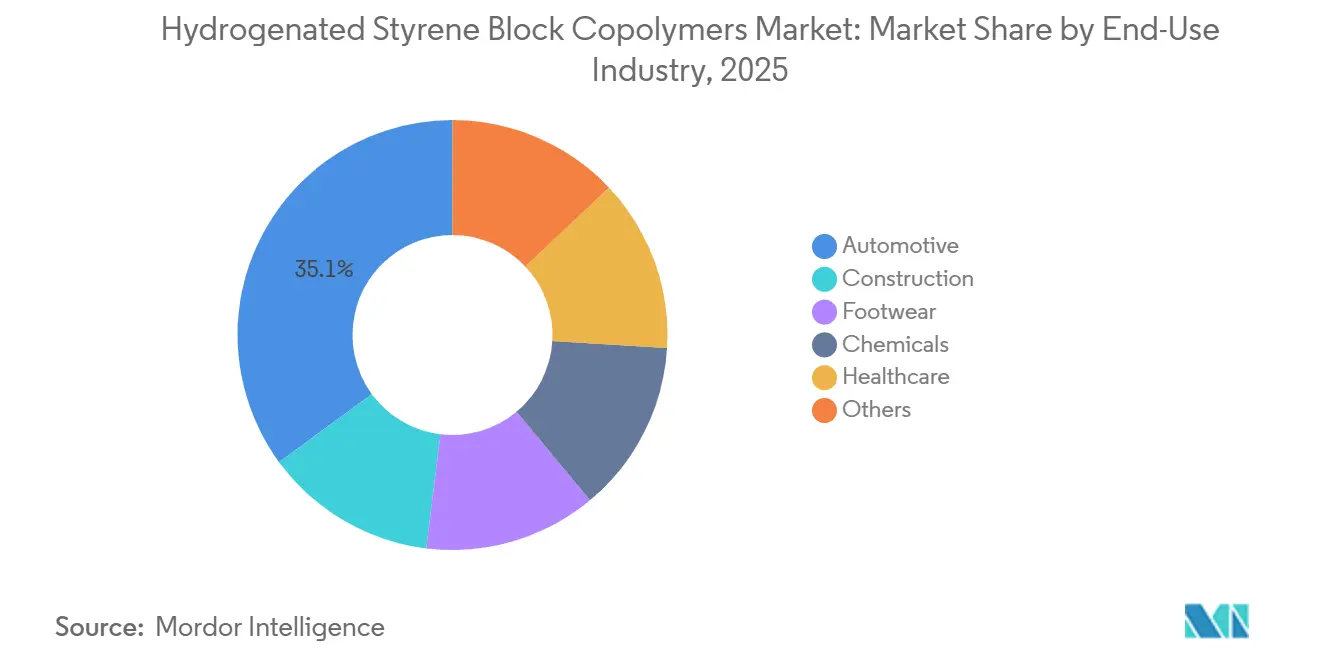
Automotive held 35.07% of the hydrogenated styrene block copolymers market share in 2025. Vehicle makers use these materials in seals, interior skins, grommets, and components around battery systems. Asahi Kasei Corporation has described a core-back injection molding process that forms automotive instrument panel skin and foam layers in one step. The process bonds the layers to polypropylene carriers without adhesive layers and supports a simpler component design. Electric vehicle programs add demand for lightweight, halogen-free materials in areas requiring long-term thermal and compression-set performance. These needs help the hydrogenated styrene block copolymers market maintain its automotive position despite the presence of competing elastomer materials.
Healthcare is projected to advance at a 6.87% CAGR through 2031. Asahi Kasei Corporation’s TUFTEC N527 is designed for medical rubber-stopper compounds that need low needle penetration resistance, resealing after needle withdrawal, and reduced coring. Construction sealants provide a steady additional source of demand where aging resistance and thermal cycling are required. Footwear faces pressure from thermoplastic polyurethane in midsole applications where cost is the main specification factor. Chemicals use styrene ethylene butylene styrene and styrene ethylene propylene styrene as viscosity index improvers in lubricants. A 2025 Italian patent from Versalis and Eni covers linear hydrogenated multiblock styrene-butadiene copolymers for improving lubricant viscosity index.
Geography Analysis
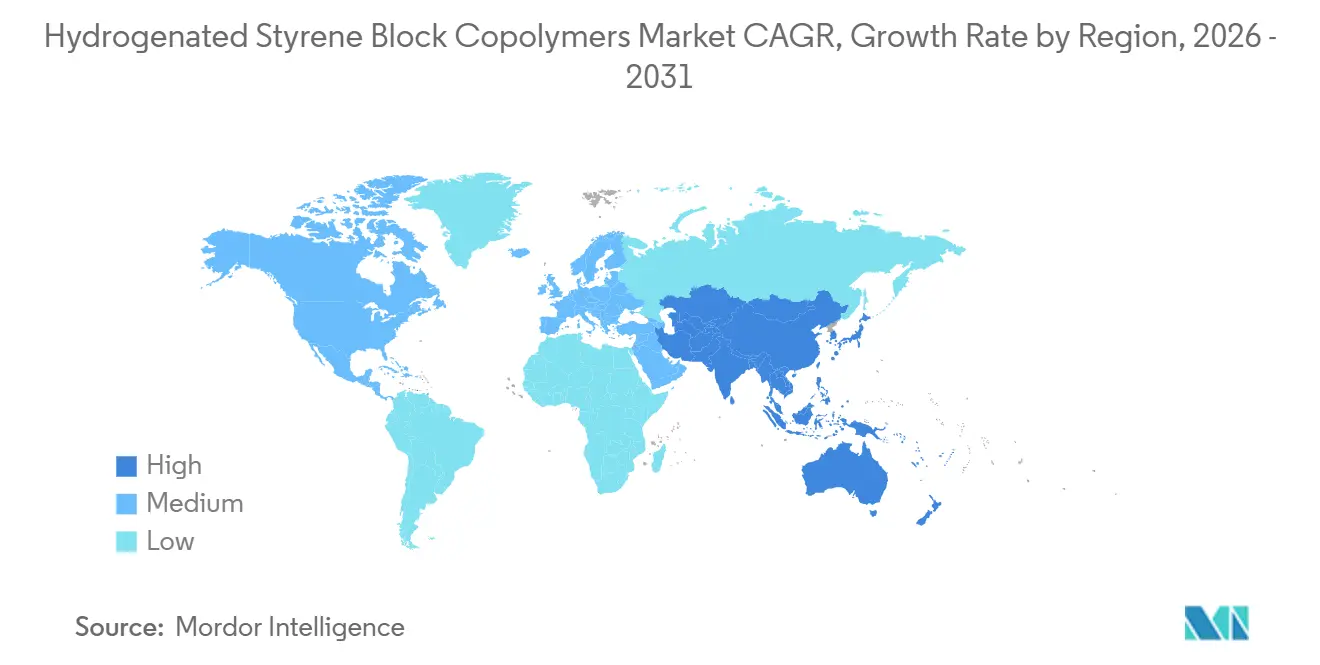
Asia-Pacific held 43.16% of the hydrogenated styrene block copolymers market share in 2025 and is projected to advance at a 6.51% CAGR through 2031. The region brings together large-scale manufacturing demand, local capacity additions, and increasingly specialized applications. China Petrochemical Corporation commissioned 50,000 metric tons per year of styrene ethylene butylene styrene capacity within its new facility in November 2024. The project established a commercial-scale domestic hydrogenated styrene block copolymer process technology in China. Japan and South Korea remain technology centers for medical-grade and high-performance automotive materials. Asahi Kasei Corporation, KURARAY CO., LTD., JSR Corporation, and ZEON CORPORATION have research and manufacturing operations that support specialty grade development in the region.
India’s medical-device and specialty chemical manufacturing development adds another source of regional demand. Adhesive and footwear clusters in Vietnam, Indonesia, and Thailand continue to rely mainly on imported supplies for hydrogenated materials. This supply structure can support regional distributors, improve customer access to qualified grades, and create an eventual case for localized production as demand rise over time across several regional customer groups and application areas globally. North America and Europe remain focused on medical-device qualification, electric vehicle sealing, and high-performance construction adhesives. The United States has demand linked to medical compliance requirements and a growing electric vehicle manufacturing footprint. Europe has demand from automotive supply chains that are seeking recyclable interior materials and lower-emission component designs.
Kraton Corporation announced in October 2025 that it would stop hydrogenated styrene block copolymer production at Berre, France, while maintaining customer supply through its global network. The decision reflects global overcapacity in commodity grades and may alter European sourcing patterns. South America and Middle East and Africa represent smaller consumption areas, with Brazil and Saudi Arabia serving as demand anchors in their subregions. Brazil’s construction adhesive activity and automotive supply chain create demand that is largely supplied by imports. South Africa’s packaging and healthcare sectors follow wider substitution interest in plasticizer-free materials.

Competitive Landscape
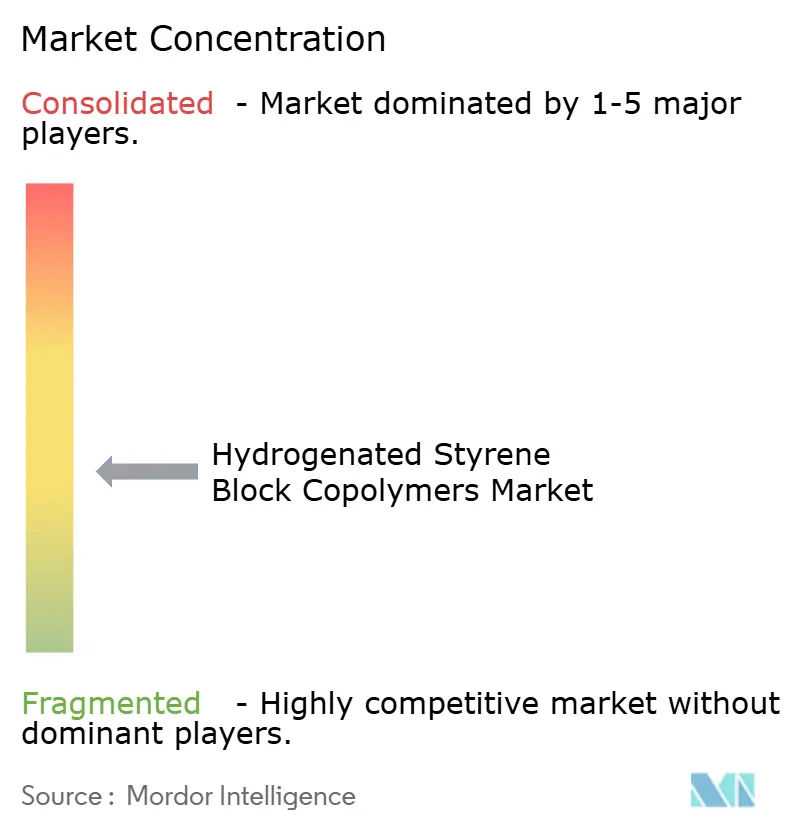
The hydrogenated styrene block copolymers market is moderately concentrated, with the top five players including Kraton Corporation, Asahi Kasei Corporation, KURARAY CO., LTD., TSRC, and China Petrochemical Corporation. Their positions are supported by production capacity, proprietary grades, and long qualification relationships with customers. The expiry of foundational hydrogenation patents in 2023 and 2024 allowed more Asian producers to commercialize commodity styrene ethylene butylene styrene. This pressure is strongest in standard adhesive and asphalt-modifier uses, where customers can qualify alternatives more readily. Medical, automotive-critical, and specialty grades continue to benefit from more demanding application approvals.
KURARAY CO., LTD. is building differentiation through its SEPTON BIO-series, which includes materials made with sugarcane-derived beta-farnesene and up to 80% bio-content. Kraton Corporation launched MD1672 in August 2026 to enable oil-free thermoplastic elastomer formulations with lower fogging, lower volatile organic compound emissions, and improved compression set. Asahi Kasei Corporation is using its core-back molding approach to produce automotive interior skin and foam layers without adhesive interlayers. These moves show how leading suppliers are directing investment toward material performance, sustainability attributes, and process advantages. The hydrogenated styrene block copolymers market is becoming more divided between price-sensitive standard grades and applications that require detailed material qualifications.
Kraton Corporation received a U.S. patent for a styrenic block copolymer architecture intended for adhesive and protective film performance. Patent activity and formal qualification records can extend the time needed for competitors to enter specialized applications. Smaller producers can compete by developing custom compounds and grades with improved processability rather than trying to match the scale of large suppliers. Potential areas for further development include bio-sourced materials for medical packaging, spunbond nonwovens for hygiene and wound care, and high-temperature halogen-free sealing compounds for electric vehicles. The hydrogenated styrene block copolymers industry has room for new suppliers in these areas, but they must establish reliable production and application approval records. The supply decisions of major producers will continue to shape availability and pricing across regional customer bases.
Hydrogenated Styrene Block Copolymers Industry Leaders
Kraton Corporation
Asahi Kasei Corporation
KURARAY CO., LTD.
TSRC
China Petrochemical Corporation
- *Disclaimer: Major Players sorted in no particular order

Recent Industry Developments
- August 2026: Kraton Corporation received a U.S. patent for a styrenic block copolymer architecture designed to improve adhesive and protective film performance. The development supports innovation in hydrogenated styrene block copolymers for high-performance adhesives and protective films requiring enhanced adhesion, durability, and flexibility.
- June 2026: KURARAY CO., LTD. presented its SEPTON hydrogenated styrene block copolymers at the Society of Tribologists and Lubrication Engineers (STLE) 2026 for lubricant and grease applications. The materials provide high thickening efficiency, low-temperature performance, and shear stability, supporting demand for HSBCs in automotive and industrial lubricants.


Global Hydrogenated Styrene Block Copolymers Market Report Scope
Hydrogenated styrene block copolymers are thermoplastic elastomers produced by hydrogenating styrenic block copolymers to improve stability and resistance to environmental conditions. They combine rubber-like elasticity with thermoplastic processability, supporting durable and flexible material formulations.
The Hydrogenated Styrene Block Copolymers Market is segmented by product type, application, end-use industry, and geography. By product type, the market is segmented into styrene ethylene butylene styrene (SEBS), styrene ethylene propylene styrene (SEPS), and others. By application, the market is segmented into adhesives and sealants, paints and coatings, films, and others. By end-use industry, the market is segmented into automotive, construction, footwear, chemicals, healthcare, and others. The report also covers the market size and forecasts for hydrogenated styrene block copolymers in 15 countries across major regions. For each segment, the market sizing and forecasts have been done on the basis of value (USD).
| Styrene Ethylene Butylene Styrene (SEBS) |
| Styrene Ethylene Propylene Styrene (SEPS) |
| Others |
| Adhesives and Sealants |
| Paints and Coatings |
| Films |
| Others |
| Automotive |
| Construction |
| Footwear |
| Chemicals |
| Healthcare |
| Others |
| Asia-Pacific | China |
| India | |
| Japan | |
| South Korea | |
| ASEAN Countries | |
| Rest of Asia-Pacific | |
| North America | United States |
| Canada | |
| Mexico | |
| Europe | Germany |
| United Kingdom | |
| France | |
| Italy | |
| NORDIC Countries | |
| Rest of Europe | |
| South America | Brazil |
| Argentina | |
| Rest of South America | |
| Middle East and Africa | Saudi Arabia |
| South Africa | |
| Rest of Middle East and Africa |
| By Product Type | Styrene Ethylene Butylene Styrene (SEBS) | |
| Styrene Ethylene Propylene Styrene (SEPS) | ||
| Others | ||
| By Application | Adhesives and Sealants | |
| Paints and Coatings | ||
| Films | ||
| Others | ||
| By End-Use Industry | Automotive | |
| Construction | ||
| Footwear | ||
| Chemicals | ||
| Healthcare | ||
| Others | ||
| By Geography | Asia-Pacific | China |
| India | ||
| Japan | ||
| South Korea | ||
| ASEAN Countries | ||
| Rest of Asia-Pacific | ||
| North America | United States | |
| Canada | ||
| Mexico | ||
| Europe | Germany | |
| United Kingdom | ||
| France | ||
| Italy | ||
| NORDIC Countries | ||
| Rest of Europe | ||
| South America | Brazil | |
| Argentina | ||
| Rest of South America | ||
| Middle East and Africa | Saudi Arabia | |
| South Africa | ||
| Rest of Middle East and Africa | ||


Key Questions Answered in the Report
What is the size of the hydrogenated styrene block copolymers market?
The hydrogenated styrene block copolymers market stands at USD 2.62 billion in 2026 and is projected to reach USD 3.49 billion by 2031.
What is driving demand for hydrogenated styrene block copolymers?
Automotive components, medical materials, high-performance adhesives, recyclable packaging applications, and regional manufacturing expansion in the Asia-Pacific support the hydrogenated styrene block copolymers demand.
Which product type held the largest share in 2025?
Styrene ethylene butylene styrene (SEBS) held 57.73% share in 2025, supported by broad use in adhesives, automotive parts, and medical tubing.
Which end-use industry is projected to grow fastest through 2031?
Healthcare is projected to advance at a 6.87% CAGR through 2031, supported by medical material qualification requirements.
Page last updated on:





