
Hydrogen Production Catalysts Market Size and Share
Market Overview
| Study Period | 2021 - 2031 |
|---|---|
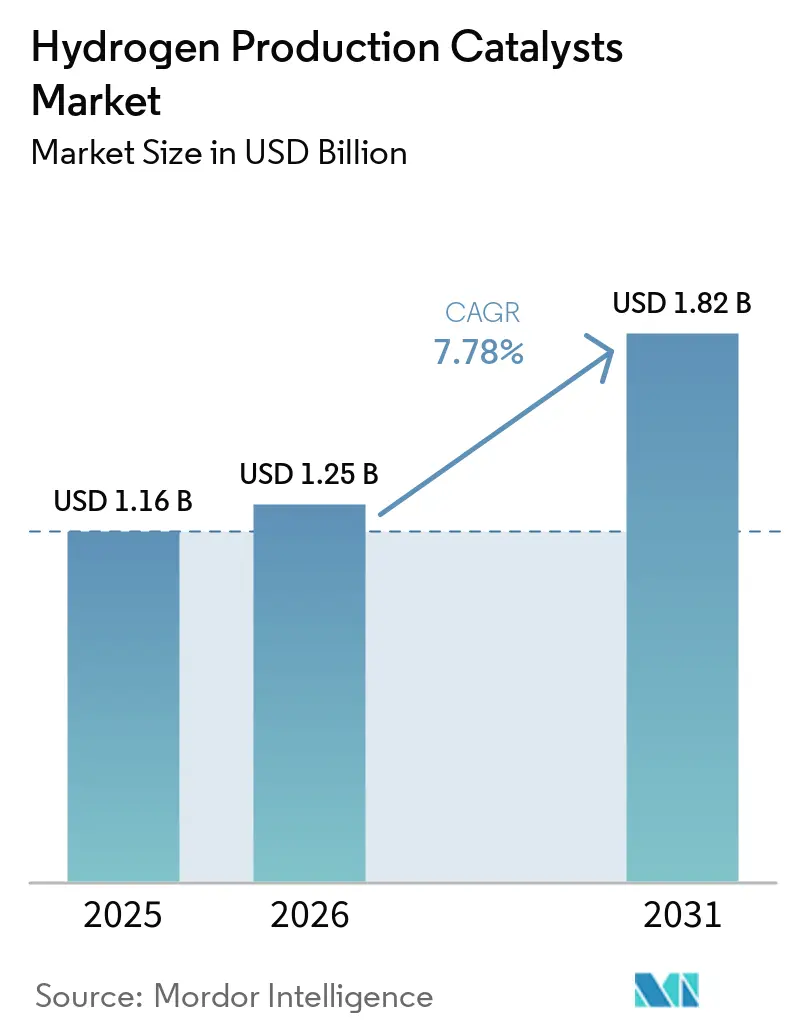
| Market Size (2026) | USD 1.25 Billion |
| Market Size (2031) | USD 1.82 Billion |
| Growth Rate (2026 - 2031) | 7.78 % |
| Fastest Growing Market | Asia-Pacific |
| Largest Market | Asia-Pacific |
| Market Concentration | Medium |
Major Players *Disclaimer: Major Players sorted in no particular order Image © Mordor Intelligence. Reuse requires attribution under CC BY 4.0. | |
Hydrogen Production Catalysts Market Analysis by Mordor Intelligence
The Hydrogen Production Catalysts market size was valued at USD 1.16 billion in 2025 and is estimated to grow from USD 1.25 billion in 2026 to reach USD 1.82 billion by 2031, at a CAGR of 7.78% during the forecast period (2026-2031). The hydrogen production catalysts market is supported by investment in electrolytic hydrogen projects and by replacement demand from steam methane reforming assets. Global capital spending on low-emissions hydrogen projects nearly doubled to almost USD 7 billion in 2025 and is set to approach USD 10 billion in 2026, with electrolysis investment overtaking investment in hydrogen using carbon capture for the first time. This allocation expands opportunities in the hydrogen production catalysts market for electrolyzer catalyst suppliers, while steam methane reforming continues to provide a stable source of demand. Suppliers in the hydrogen production catalysts market are competing through catalyst loading, service life at high current density, and proprietary formulations for next-generation electrolyzers. Precious-metal availability and price exposure remain important limits on project economics, which increases the value of recovery and lower-loading catalyst designs.
Key Report Takeaways
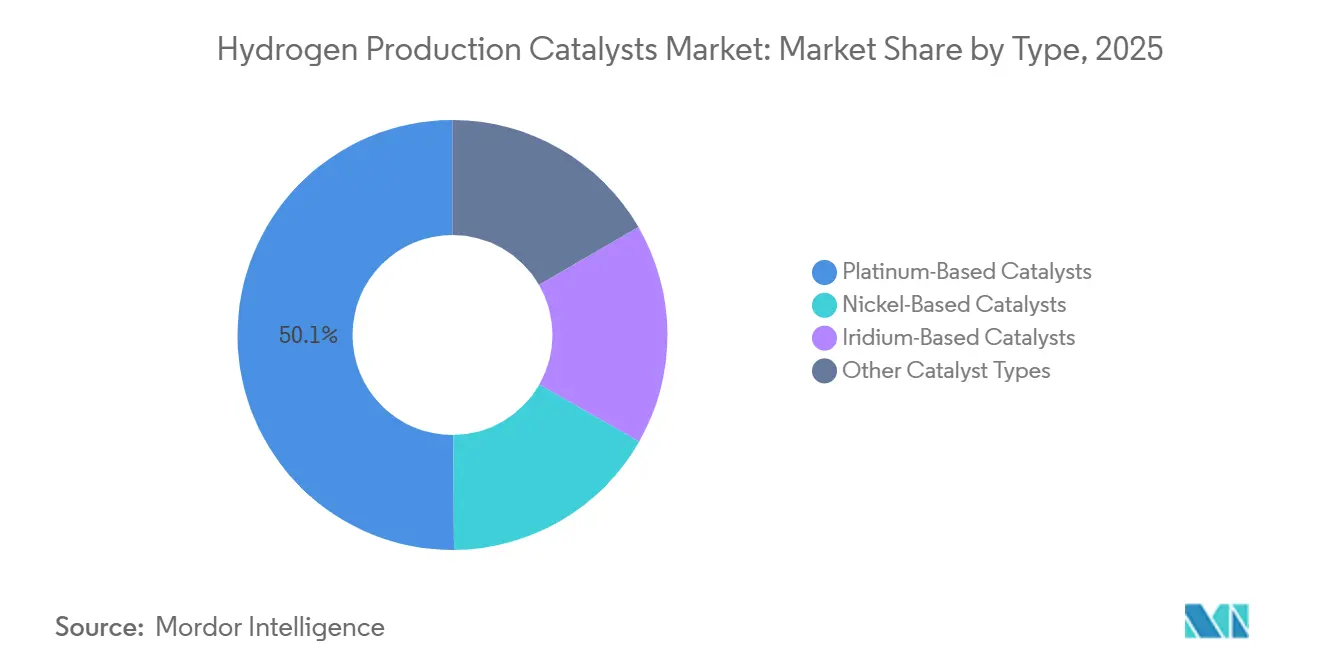
- By type, platinum-based catalysts held 50.12% of the hydrogen production catalysts market share in 2025, while iridium-based catalysts are projected to advance at an 8.23% CAGR through 2031.
- By production technology, Steam Methane Reforming (SMR) held 52.45% of the hydrogen production catalysts market share in 2025, while Proton Exchange Membrane (PEM) water electrolysis is projected to advance at an 8.78% CAGR through 2031.
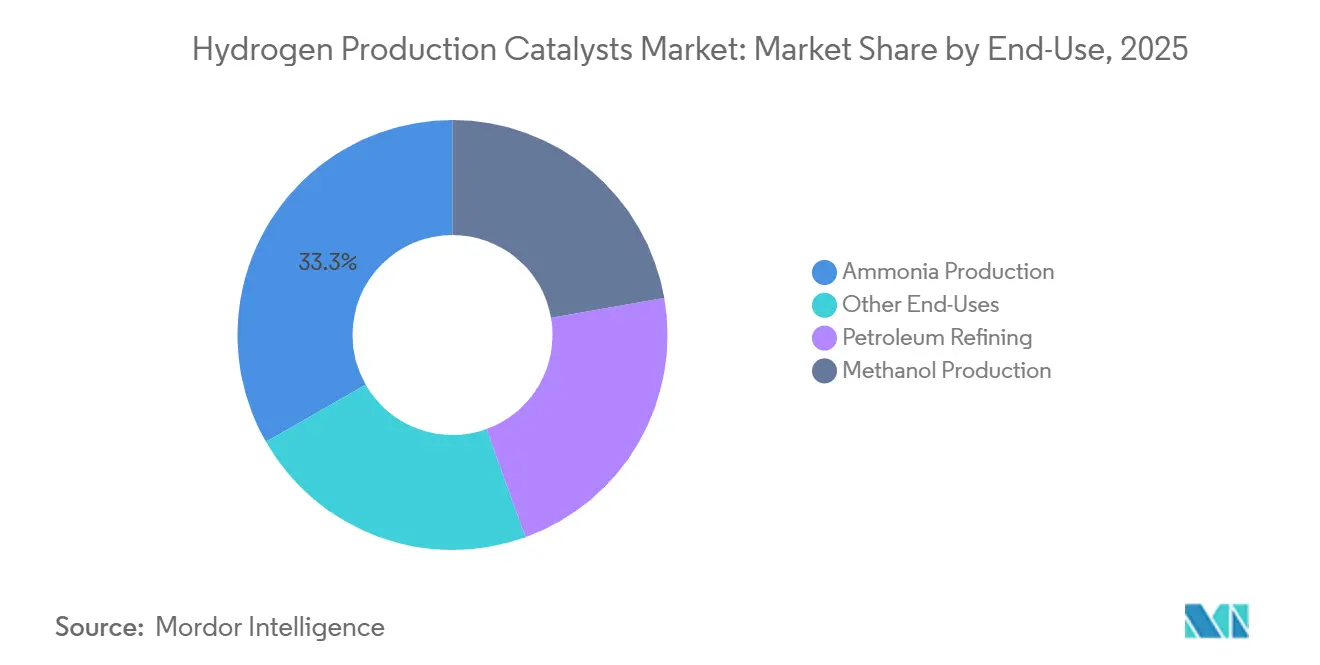
- By end-use, ammonia production held 33.27% of the hydrogen production catalysts market share in 2025, while methanol production is projected to advance at a 9.06% CAGR through 2031.
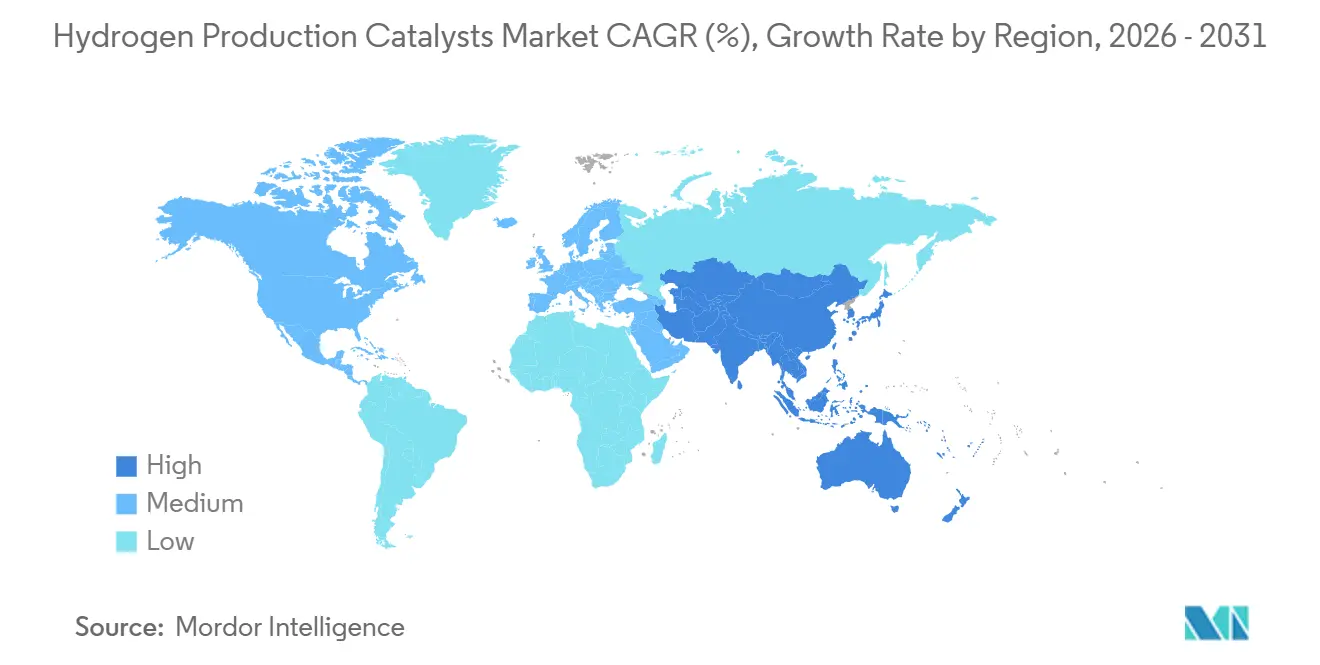
- By geography, Asia-Pacific held 37.88% of the hydrogen production catalysts market share in 2025 and is projected to advance at an 8.61% CAGR through 2031.
Note: Market size and forecast figures in this report are generated using Mordor Intelligence’s proprietary estimation framework, updated with the latest available data and insights as of January 2026.
Market Trends and Insights
Drivers Impact Analysis of Hydrogen Production Catalysts Market*
| Driver | (~) % Impact on CAGR Forecast | Geographic Relevance | Impact Timeline |
|---|---|---|---|
| Green Hydrogen and Electrolyzer Deployment | +2.8% | Global, led by China, Europe, and North America | Medium term (2–4 years) |
| Hydrogen Fuel-Cell Adoption in Mobility and Distributed Power | +1.9% | Asia-Pacific core (China, Japan, South Korea), spillover to North America and Europe | Medium term (2–4 years) |
| Catalyst Loading Reduction and Precious-Metal Utilization | +1.4% | Global, with R&D epicentres in Japan, South Korea, Germany, and the United States | Long term (≥ 4 years) |
| Advancement in Catalyst Activity, Durability, and Energy Efficiency | +0.9% | Global; early commercialization in Europe and East Asia | Long term (≥ 4 years) |
| Catalyst-Coated Membrane and Catalyst Recycling Integration | +0.7% | Europe (EU regulatory alignment), Japan | Long term (≥ 4 years) |
| Source: Mordor Intelligence | |||
Green Hydrogen and Electrolyzer Deployment
Electrolyzer deployment is a major demand driver for the hydrogen production catalysts market. Installed electrolysis capacity doubled in 2025 and surpassed 4 gigawatts globally, while more than 2.5 gigawatts were under construction for commissioning in 2026[1]. China supports demand for alkaline stacks and the nickel and iridium catalysts used within them. This scale lowers alkaline stack costs, but it also puts pressure on suppliers that sell catalyst materials without supplying the wider stack. Proton exchange membrane systems represented 66% of installed water electrolysis in Europe in 2024, concentrating regional demand on iridium-based anode catalysts. Air Liquide’s 200-megawatt ELYgator project in the Netherlands and Repsol’s 100-megawatt Cartagena project reached a final investment decision in 2025, providing visible demand anchors for European suppliers. The European Union Renewable Energy Directive III provides clearer hydrogen targets for industry and transport, which support purchasing decisions through 2030.
Hydrogen Fuel-Cell Adoption in Mobility and Distributed Power
Hydrogen fuel-cell adoption in transport and distributed power supports catalyst demand beyond hydrogen generation assets. The global fuel cell vehicle fleet approached 100,000 units by mid-2025, and more than 1,300 hydrogen refueling stations were operating. Heavy-duty truck deployments grew 72% from 2023 to 2025, increasing demand for platinum catalyst coatings. Stationary power also creates a route for catalyst recovery when fuel cells reach the end of their vehicle life. Honda began a joint demonstration with Tokuyama Corporation and Mitsubishi Corporation in August 2025 that used by-product hydrogen to power a data center through repurposed automotive fuel cells. Toyota Motor North America stated in May 2026 that it planned to deploy fuel-cell-powered Class 8 trucks in commercial logistics fleets by early 2027, and its third-generation fuel cell stacks achieved American National Standards Institute and Canadian Standards Association Fuel Cell 1 certification.
Catalyst Loading Reduction and Precious-Metal Utilization
Catalyst loading reduction is becoming a commercial requirement for the hydrogen production catalysts market. The United States Department of Energy’s 2026 target calls for total platinum-group-metal loading below 0.5 milligrams per square centimeter in proton exchange membrane devices. Commercial cathodes typically use 0.4 to 0.6 milligrams of platinum per square centimeter, leaving limited allowance for iridium at the anode. Heraeus Precious Metals reported that supported iridium catalyst systems can operate with 100 kilograms of iridium per gigawatt, compared with the historical 250-to-400-kilogram benchmark. In the hydrogen production catalysts market, carrier-structure optimization can therefore reduce material use by more than 60%. Research on ruthenium and iridium composite catalysts indicated that structural iridium substitution may be technically possible, but commercial scale-up and long-duration validation remain necessary.
Advancement in Catalyst Activity, Durability, and Energy Efficiency
Advances in catalyst formulation are improving hydrogen output and reducing energy use across established and emerging technologies. Solid oxide electrolysis can use process heat and operate near 800 °C, which reduces electrical input requirements compared with alkaline or proton exchange membrane water electrolysis. Topsoe A/S opened its solid oxide electrolyzer cell manufacturing facility in Herning, Denmark, in November 2025, with an initial capacity of 500 megawatts per year and scalability to 1.5 gigawatts. The company stated that this technology can be 20% to 30% more energy efficient than alkaline or proton exchange membrane alternatives when suitable waste heat is available. Japan Science and Technology Agency-backed research at the University of Tokyo reduced iridium use from 2 to 4 milligrams per square centimeter to 0.02 to 0.08 milligrams per square centimeter while maintaining stable operation for more than 2,500 hours. The hydrogen production catalysts market will depend on whether these results can retain performance at an industrial scale over long operating periods.
Restraints Impact Analysis of Hydrogen Production Catalysts Market*
| Restraint | (~) % Impact on CAGR Forecast | Geographic Relevance | Impact Timeline |
|---|---|---|---|
| High Cost of Platinum-Group-Metal Catalysts | -1.8% | Global, most acute in Europe and North America where PEM dominates | Short term (≤ 2 years) |
| Iridium and High-Purity Titanium Supply Constraints | -1.2% | Global; production concentrated in Southern Africa with logistics risk | Medium term (2–4 years) |
| Durability and Qualification Challenges for Non-Precious Catalysts | -0.7% | Global, with qualification timelines longest in North America and Europe | Long term (≥ 4 years) |
| Source: Mordor Intelligence | |||
High Cost of Platinum-Group-Metal Catalysts
High costs for platinum-group-metal catalysts are an immediate restraint on the hydrogen production catalysts market. Total platinum-group-metal demand in 2025 was projected at 231.9 metric tons, compared with a supply of 180.6 metric tons, creating a deficit that raised baseline catalyst costs. Platinum reached an intraday high of USD 91,176 per kilogram in January 2026, compared with an average of USD 41,000 per kilogram in 2025. This price movement increases the capital cost of proton exchange membrane electrolyzer stacks because precious-metal catalyst materials account for a meaningful share of the stack bill of materials. Cost sensitivity is particularly high where project costs are paid in US dollars, but revenue is earned in local currencies. Evonik Industries AG has stated that customers who own their precious metal do not face higher platinum-containing catalyst prices, although synthesis losses can still raise effective costs. Registration, Evaluation, Authorisation and Restriction of Chemicals (REACH) requirements in Europe add compliance costs for platinum-group-metal catalyst workflows.
Iridium and High-Purity Titanium Supply Constraints
Iridium scarcity is a binding material constraint for proton exchange membrane electrolysis growth. Mining operations produce 7 to 8 metric tons of iridium each year as a by-product of platinum mining, which limits annual proton exchange membrane electrolyzer installations to 2 gigawatts at prevailing anode loadings of 1 to 2 milligrams of iridium per square centimeter. Iridium was priced at USD 132 per gram in April 2025, making the catalyst layer a major cost driver in megawatt-scale systems. High-purity titanium faces similar sourcing constraints because it is used as the porous transport layer in contact with iridium catalyst coatings. Its required purity exceeds conventional industrial specifications, which limits the qualified supplier base. Furuya Metal paused its planned investment to expand iridium catalyst production capacity to 2 gigawatts per year in August 2025 because of changed global hydrogen conditions. For the hydrogen production catalysts market, delayed capacity investment can create supply lags when electrolyzer deployment accelerates.
*Our forecasts treat driver/restraint impacts as directional, not additive. The impact forecasts reflect baseline growth, mix effects, and variable interactions.
Hydrogen Production Catalysts Market Segment Analysis
By Type:
Platinum-Based Catalysts Lead Market, Iridium-Based Catalysts Redefining the Growth CurvePlatinum-based catalysts accounted for 50.12% of the hydrogen production catalysts market size in 2025. This position reflected long-standing use in steam methane reforming cathode applications, fuel cell membrane electrode assemblies, and hydrocarbon refining reactions. These demand pools are unlikely to contract at the same time, which supports recurring consumption through the platinum supply chain. Platinum-based catalysts, therefore, remain important to near-term revenue even as new electrolysis technologies scale. Iridium-based catalysts are projected to advance at an 8.23% CAGR through 2031. Their growth is tied to proton exchange membrane electrolysis, where iridium oxide remains the established anode catalyst under acidic and highly oxidative conditions.
TANAKA PRECIOUS METAL GROUP Co., Ltd. received Japan’s 2025 Catalyst Manufacturers Association Technology Award for developing and commercializing a dual-function electrode catalyst. The design combines oxygen evolution reaction and gas recombination functions in proton exchange membrane water electrolysis. It addresses hydrogen crossover while enabling thinner membranes. Nickel-based catalysts continue to serve alkaline electrolysis and steam methane reforming, where cost and availability often matter more than precious-metal performance per gram. Other catalyst types include ruthenium-based, cobalt-based, and emerging non-precious formulations. The European Union Critical Raw Materials Act classifies iridium as a strategic raw material, strengthening the incentive to diversify catalyst portfolios.

By Production Technology:
SMR Anchors Revenue While PEM Water Electrolysis Rewrites Long-Term EconomicsSteam Methane Reforming (SMR) accounted for 52.45% of the hydrogen production catalysts market size in 2025. More than 600 large-scale reformers worldwide provide replacement catalyst demand on 3- to 7-year cycles. This installed base supplies a relatively stable revenue source despite changes in green hydrogen policy. Electric reforming can add a further demand route that sits between conventional reforming and pure electrolysis. CLARIANT signed a supply agreement with SYPOX in September 2025 for catalysts used in a 10-megawatt electric steam methane reformer scheduled to begin operations in 2026.
Proton Exchange Membrane (PEM) water electrolysis is projected to advance at an 8.78% CAGR through 2031. Proton exchange membrane systems accounted for 66% of electrolyzer deployment in the European Union 27, the European Free Trade Association, and the United Kingdom in 2024. Alkaline water electrolysis remains cost-competitive in large-scale applications because it uses nickel-based catalysts. Solid oxide electrolysis is moving toward commercial scale through Topsoe A/S production capacity in Herning. International Electrotechnical Commission 62282 requirements and evolving European certification frameworks create qualification timelines that favor suppliers with established regulatory records.
By End-Use:
Ammonia Production Commands the Base, While Methanol Production Gains MomentumAmmonia production accounted for 33.27% of the hydrogen production catalysts market size in 2025. The Haber-Bosch process consumes 30 million metric tons of hydrogen each year, making it the largest established source of hydrogen demand. This use supports recurring demand for iron-based and nickel-based reforming catalysts. Plants in South Asia and the Middle-East operate large-scale Haber-Bosch loops and require multi-year catalyst replacement programs. Topsoe A/S and CLARIANT have syngas and shift catalyst portfolios that directly serve these applications. The hydrogen production catalysts market benefits from the predictable replacement needs of ammonia production, even when investment in new projects is uneven.
Methanol production is projected to advance at a 9.06% CAGR through 2031. Green methanol is being used as a shipping fuel and as a circular chemical feedstock. CLARIANT’s MegaMax 900 catalyst supported the April 2025 startup of European Energy’s Kasso e-methanol plant in Denmark, which can produce up to 42,000 metric tons of green methanol each year from biogenic carbon dioxide and green hydrogen. Petroleum refining also consumes hydrogen production catalysts in hydrodesulfurization and hydrocracking units. Demand in this application is linked more closely to crude throughput than to energy-transition policy. Other end-uses include Fischer-Tropsch synthesis, direct reduction of iron, and synthetic aviation fuel production.
Geography Analysis
APAC Hydrogen Production Catalysts Market
Asia-Pacific accounted for 37.88% of the hydrogen production catalysts market in 2025 and is projected to advance at an 8.61% CAGR through 2031. China supports regional catalyst demand through its ammonia and methanol base. It consumed an estimated 8,000 to 12,000 metric tons of secondary reforming catalysts annually and commissioned nearly 65% of global installed electrolysis capacity. This pattern favors nickel-based catalysts because China emphasizes alkaline electrolysis for large domestic projects. India is expanding planned ammonia capacity by 4 to 6 million metric tons per year through 2030, which will require additional catalyst supply. Japan and South Korea retain demand for high-purity platinum-group-metal formulations through fuel cell vehicle fleets and hydrogen programs.
Europe and North America Hydrogen Production Catalysts Market
South Korea held 36% of the global fuel cell vehicle fleet in 2025, supporting continued demand for platinum-based fuel cell catalysts. JERA and Denso began a solid oxide electrolysis demonstration in September 2025 at Nishi-Nagoya Power Plant. The project used vehicle-derived solid oxide electrolyzer cell technology to produce hydrogen with 10% lower electricity consumption than conventional electrolysis methods. North America and Europe represented half of the remaining global market. The United States retains refinery hydrogen demand and private investment from Hyundai, Toyota, and Cummins in fuel cell module programs. Canada’s oil sands requirements and Mexico’s refinery base provide additional demand for reforming catalysts.
EMEA and South America Hydrogen Production Catalysts Market
Europe’s policy framework is shaping the technology mix for the hydrogen production catalysts market. Renewable Energy Directive III requires 42% of industrial hydrogen to come from renewable sources by 2030, which supports proton exchange membrane electrolysis demand. The Critical Raw Materials Act’s strategic designation of iridium is influencing procurement approaches. BASF commissioned Germany’s largest 54-megawatt proton exchange membrane electrolyzer in Ludwigshafen in March 2025, with the capacity to produce up to 1 metric ton of hydrogen per hour. South America, and Middle-East and Africa remain smaller demand pools, but green hydrogen exports and refining create project pipelines. Saudi Arabia’s NEOM Green Hydrogen Project includes a 2.2-gigawatt electrolyzer, creating a concentrated future demand event for catalyst materials. Axens expanded its Axens Catalyst Arabia Limited site in Saudi Arabia in April 2025 to produce tail gas treatment catalysts locally.
Competitive Landscape
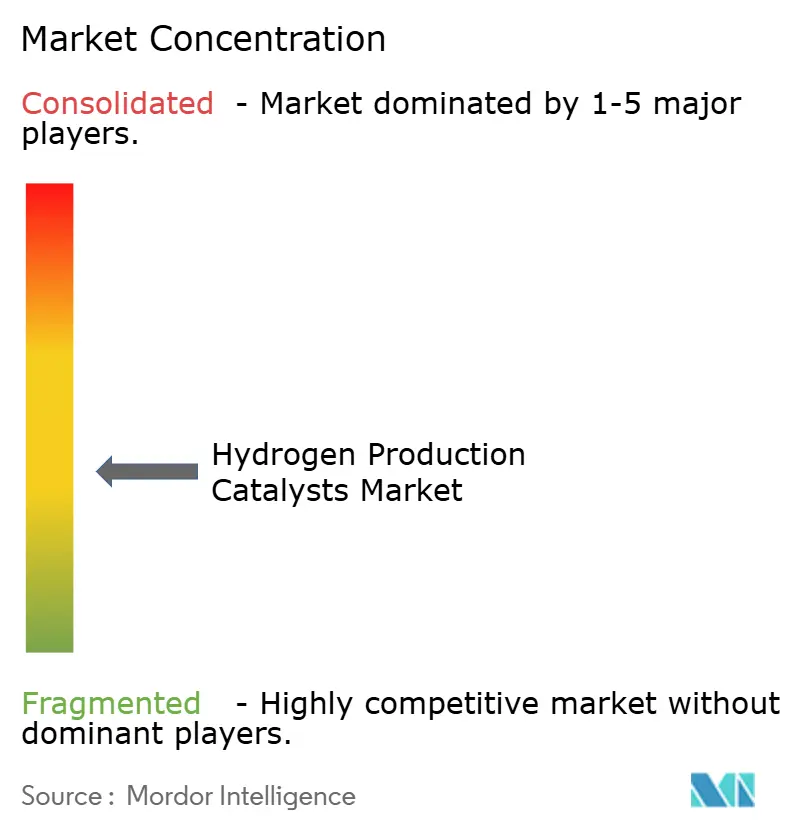
The hydrogen production catalysts market is moderately concentrated, with the top five players including Johnson Matthey, Umicore, TANAKA PRECIOUS METAL GROUP Co., Ltd., BASF, and Heraeus Precious Metals. Competition in the hydrogen production catalysts market centers on catalyst loading, durability, process integration, and the ability to qualify materials with equipment manufacturers. Honeywell International Inc. completed its acquisition of Johnson Matthey’s Catalyst Technologies business for GBP 1.325 billion (approximately USD 1.76 billion) in July 2026. The transaction combined Honeywell UOP process licensing with reforming, blue hydrogen, and ammonia catalyst portfolios.
Johnson Matthey retained its Hydrogen Technologies business, which includes catalyst-coated membranes for fuel cells and electrolyzers. This separation leaves Honeywell with a broader process catalyst platform and Johnson Matthey with an electrolytic hydrogen specialization. The hydrogen production catalysts market increasingly rewards companies that can reduce precious-metal loading without reducing operating life. Heraeus Precious Metals has demonstrated material intensity reductions through supported iridium systems. Recycling is another area of strategic importance because it can reduce exposure to iridium supply risk. The European Union-funded IRION project is developing closed-loop recovery of iridium and ionomers from end-of-life catalyst-coated membranes using green solvents and electrodeposition[2].
Smaller specialists and university spin-offs are developing single-atom and high-entropy alloy catalyst architectures. Their commercial path remains constrained by the years required for industrial electrolyzer qualification. JX Advanced Metals Corporation published research with Columbia University in June 2026 on iridium oxide supported on tantalum carbide. The work showed a route to improve iridium utilization and reduce iridium use in proton exchange membrane water electrolysis. Industrie De Nora S.p.A. received final orders for the Moeve Green Hydrogen Project in Spain in July 2026 for a 300-megawatt alkaline electrolysis system. These moves show that material development, recovery programs, and large project supply contracts are shaping competitive positions.
Hydrogen Production Catalysts Industry Leaders
-
Johnson Matthey
-
Umicore
-
TANAKA PRECIOUS METAL GROUP Co., Ltd.
-
BASF
-
Heraeus Precious Metals
- *Disclaimer: Major Players sorted in no particular order
Hydrogen Production Catalysts Market Companies Covered in this Report
- 3M
- Axens
- BASF
- CLARIANT
- De Nora S.p.A.
- Evonik Industries AG
- Heraeus Precious Metals
- Honeywell International Inc.
- Johnson Matthey
- Shell plc
- TANAKA PRECIOUS METAL GROUP Co., Ltd.
- Topsoe A/S
- Umicore
Recent Industry Developments in Hydrogen Production Catalysts Market
- August 2026: Industrie De Nora S.p.A. completed the installation, testing, and commissioning of its 1 MW Dragonfly electrolyzer at Maffei Sarda Silicati’s Florinas site in Sardinia, with the capacity to produce up to 50 metric tons of green hydrogen annually. The deployment expands real-world electrolyzer capacity and, consequently, the requirement for hydrogen production catalysts.
- July 2026: Honeywell International completed the acquisition of Johnson Matthey’s Catalyst Technologies, strengthening its portfolio of catalysts and process technologies across refining, petrochemicals, renewable fuels, and lower-carbon hydrogen. The transaction expands Honeywell International’s catalyst capabilities and installed base, supporting greater scale and integration across hydrogen and other energy-transition applications.
Global Hydrogen Production Catalysts Market Report Scope
Hydrogen production catalysts are materials that facilitate chemical reactions involved in hydrogen generation by lowering reaction energy requirements and improving reaction rates and efficiency. They are used in conventional and emerging hydrogen production systems to support reliable operation, productivity, and process performance.
The Hydrogen Production Catalysts Market is segmented by type, production technology, end-use, and geography. By type, the market is segmented into platinum-based catalysts, nickel-based catalysts, iridium-based catalysts, and other catalyst types. By production technology, the market is segmented into steam methane reforming (SMR), alkaline water electrolysis, proton exchange membrane (PEM) water electrolysis, and other production technologies. By end-use, the market is segmented into ammonia production, petroleum refining, methanol production, and other end-uses. The report also covers the market size and forecasts for hydrogen production catalysts in 15 countries across major regions. For each segment, the market sizing and forecasts have been done on the basis of value (USD).
Segmentation Overview
| Platinum-Based Catalysts |
| Nickel-Based Catalysts |
| Iridium-Based Catalysts |
| Other Catalyst Types |
| Steam Methane Reforming (SMR) |
| Alkaline Water Electrolysis |
| Proton Exchange Membrane (PEM) Water Electrolysis |
| Other Production Technologies |
| Ammonia Production |
| Petroleum Refining |
| Methanol Production |
| Other End-Uses |
| Asia-Pacific | China |
| India | |
| Japan | |
| South Korea | |
| Rest of Asia-Pacific | |
| North America | United States |
| Canada | |
| Mexico | |
| Europe | Germany |
| United Kingdom | |
| France | |
| Italy | |
| Rest of Europe | |
| South America | Brazil |
| Argentina | |
| Rest of South America | |
| Middle-East and Africa | Saudi Arabia |
| South Africa | |
| Rest of Middle-East and Africa |
| By Type | Platinum-Based Catalysts | |
| Nickel-Based Catalysts | ||
| Iridium-Based Catalysts | ||
| Other Catalyst Types | ||
| By Production Technology | Steam Methane Reforming (SMR) | |
| Alkaline Water Electrolysis | ||
| Proton Exchange Membrane (PEM) Water Electrolysis | ||
| Other Production Technologies | ||
| By End-Use | Ammonia Production | |
| Petroleum Refining | ||
| Methanol Production | ||
| Other End-Uses | ||
| By Geography | Asia-Pacific | China |
| India | ||
| Japan | ||
| South Korea | ||
| Rest of Asia-Pacific | ||
| North America | United States | |
| Canada | ||
| Mexico | ||
| Europe | Germany | |
| United Kingdom | ||
| France | ||
| Italy | ||
| Rest of Europe | ||
| South America | Brazil | |
| Argentina | ||
| Rest of South America | ||
| Middle-East and Africa | Saudi Arabia | |
| South Africa | ||
| Rest of Middle-East and Africa | ||
Key Questions Answered in the Report
What is the size of the hydrogen production catalysts market?
The hydrogen production catalysts market stands at USD 1.25 billion in 2026 and is projected to reach USD 1.82 billion by 2031.
What is driving demand for hydrogen production catalysts?
Electrolyzer deployment, fuel-cell adoption, lower precious-metal loading, and improved catalyst durability are supporting demand.
Which catalyst type held the largest share in 2025?
Platinum-based catalysts held 50.12% of the market in 2025.
Which production technology is expected to grow fastest through 2031?
Proton Exchange Membrane (PEM) water electrolysis is projected to advance at an 8.78% CAGR through 2031.