
Ammonia Cracking Catalysts Market Size and Share
Market Overview
| Study Period | 2021 - 2031 |
|---|---|
| Market Size (2026) | USD 40.62 Million |
| Market Size (2031) | USD 92.29 Million |
| Growth Rate (2026 - 2031) | 17.84 % |
| Fastest Growing Market | Asia-Pacific |
| Largest Market | Asia-Pacific |
| Market Concentration | High |
Major Players *Disclaimer: Major Players sorted in no particular order Image © Mordor Intelligence. Reuse requires attribution under CC BY 4.0. | |
Ammonia Cracking Catalysts Market Analysis by Mordor Intelligence
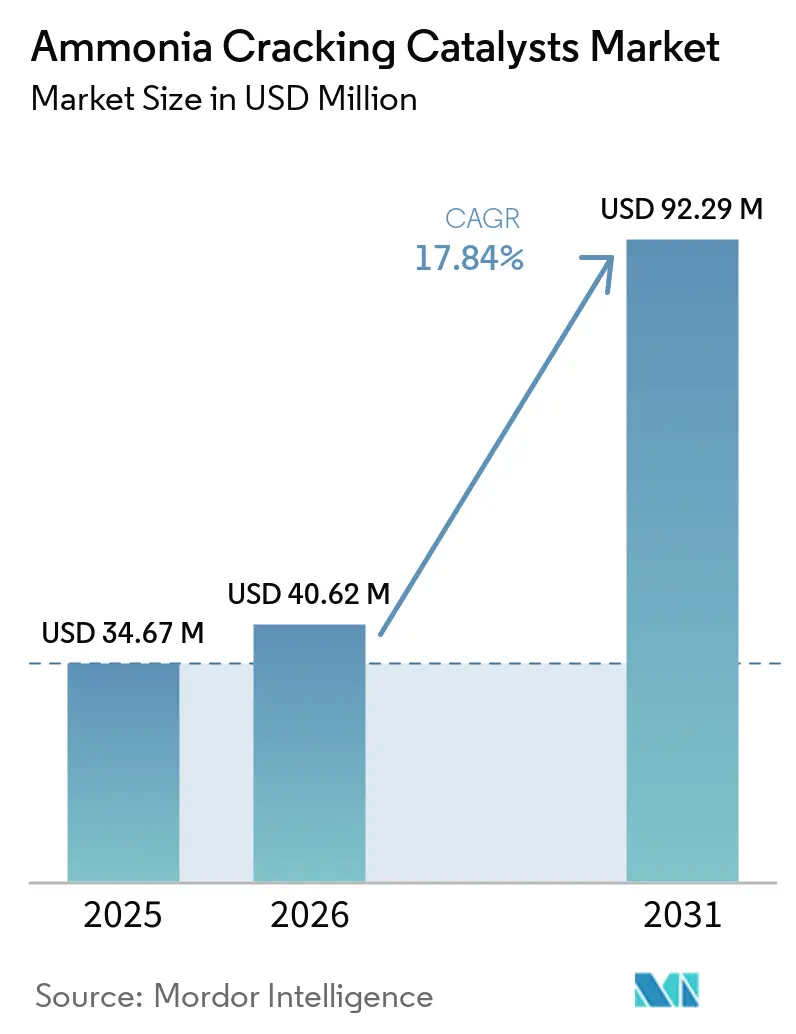
The Ammonia Cracking Catalysts Market was valued at USD 34.67 million in 2025 and is estimated to grow from USD 40.62 million in 2026 to reach USD 92.29 million by 2031, at a CAGR of 17.84% during the forecast period (2026–2031). Ammonia is moving beyond its traditional role as a fertilizer feedstock and is becoming a transport medium for hydrogen across long distances. This shift is bringing large cracking projects to import terminals in Europe and Asia, which is advancing catalyst purchasing plans. Air Liquide commissioned a 30-metric-ton-per-day industrial-scale pilot at the Port of Antwerp-Bruges in November 2025, showing that the technology can operate at plant scale. The International Energy Agency expects renewable and low-carbon ammonia production to reach 200 million metric tons per year by 2050, which provides a long-term demand base for catalyst suppliers and process licensors. The ammonia cracking catalysts market is also changing as licensors bundle catalysts with process packages and manufacturers develop lower-cost alternatives to precious-metal systems.
Key Report Takeaways
- By catalyst, nickel-based catalysts held 42.67% of the ammonia cracking catalysts market share in 2025, while ruthenium and other Platinum Group Metals (PGM) catalysts are projected to grow at a 19.55% CAGR through 2031.
- By end-use, industrial hydrogen held 44.78% of the ammonia cracking catalysts market share in 2025, while fuel cell and mobility are projected to grow at a 20.43% CAGR through 2031.
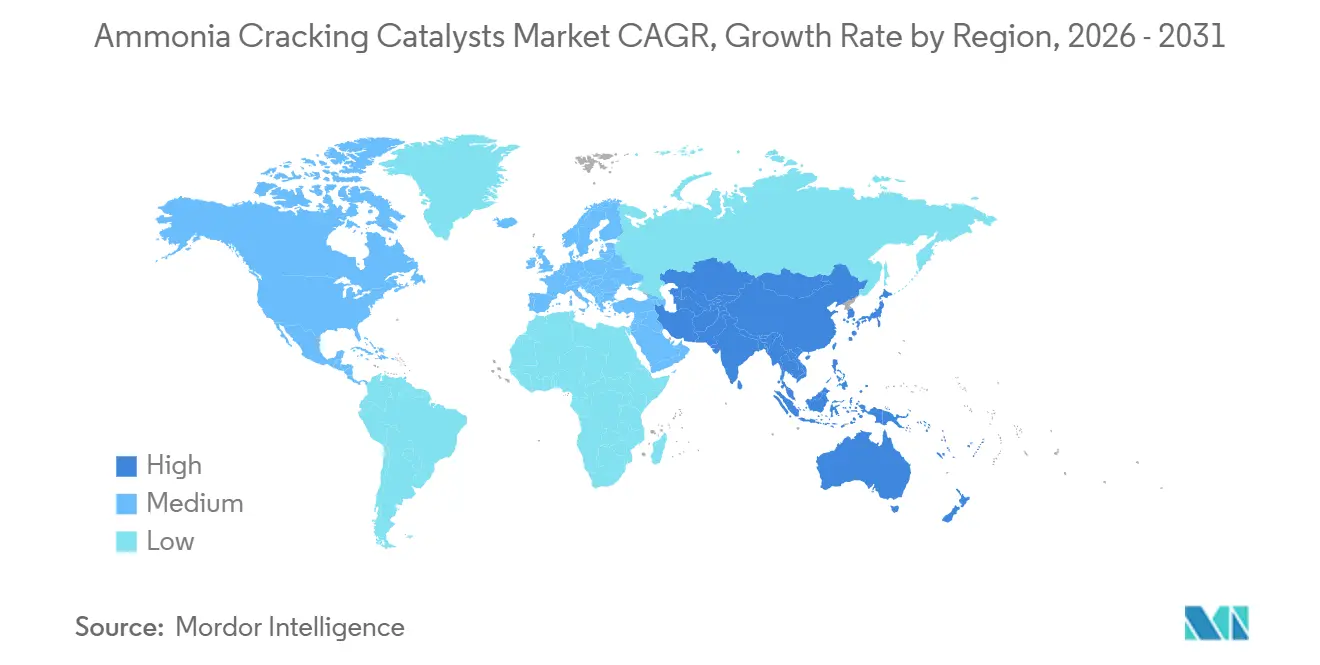
- By geography, Asia-Pacific held 36.34% of the ammonia cracking catalysts market share in 2025 and is projected to grow at a 20.80% CAGR through 2031.
Note: Market size and forecast figures in this report are generated using Mordor Intelligence’s proprietary estimation framework, updated with the latest available data and insights as of January 2026.
Market Trends and Insights
Drivers Impact Analysis of Ammonia Cracking Catalysts Market*
| Driver | (~) % Impact on CAGR Forecast | Geographic Relevance | Impact Timeline |
|---|---|---|---|
| Hydrogen Import Hubs Requiring Ammonia-to-Hydrogen Conversion | +4.2% | Global, with concentrated early gains in Western Europe (Germany, Belgium, Netherlands) and Northeast Asia | Short term (≤ 2 years) |
| Industrial Decarbonization and High-Purity Hydrogen Demand | +3.5% | Global, led by EU carbon-price exposure and East Asia's heavy industrial base | Medium term (2-4 years) |
| Existing Ammonia Storage, Shipping and Handling Infrastructure | +1.9% | Global, strategic advantage in South Korea, Japan, Germany, Saudi Arabia | Short term (≤ 2 years) |
| Growth of Distributed Power and Fuel-Cell Applications | +2.7% | APAC core (Japan, South Korea, China); spill-over to North America | Medium term (2-4 years) |
| Low-Temperature Catalyst and Heat-Integration Innovation | +2.2% | Global R&D-led; early commercial deployments in Japan and South Korea | Medium term (2-4 years) |
| Port-Based Hydrogen Demand Creating Cracker Anchor Loads | +1.6% | Europe (Rotterdam, Antwerp, Hamburg, Wilhelmshaven); major APAC ports | Short term (≤ 2 years) |
| Source: Mordor Intelligence | |||
Hydrogen Import Hubs Requiring Ammonia-to-Hydrogen Conversion
Europe and Northeast Asia are building facilities that can move ammonia cracking from a specialized process to larger commercial operations. Each terminal can support a long-term catalyst supply relationship. Air Liquide commissioned its 30-metric ton-per-day cracking pilot at Antwerp-Bruges in November 2025. The project gives operators a plant-scale reference point while they plan future import facilities. Centralized projects in Japan and South Korea are designed to send hydrogen into industrial pipelines serving several customers. The ammonia cracking catalysts market benefits because catalyst fills need replacement every 3 to 7 years, creating recurring demand after a terminal enters service.
Industrial Decarbonization and High-Purity Hydrogen Demand
Global hydrogen demand reached nearly 100 million metric tons in 2024, while low-emissions hydrogen represented less than 1% of total use[1]. Steel, glass, chemicals, and refining users increasingly require hydrogen purity above 99.9% for compatible operations. Catalytic cracking paired with pressure swing adsorption can meet this need at industrial facilities. Topsoe states that its H2Retake process can deliver hydrogen purity of up to 99.999% at 30 bar gauge. Port-based users can switch from natural-gas-reforming hydrogen to imported cracked-ammonia hydrogen without changing their core process equipment as carbon costs rise. A 2026 scientific study found that integrated ammonia cracking, autothermal reforming, and solid oxide electrolysis can reduce hydrogen costs in petrochemical clusters.
Existing Ammonia Storage, Shipping and Handling Infrastructure
Global trade moves 25 million metric tons of liquid ammonia each year through specialized tankers, refrigerated terminals, and marine infrastructure. This established network avoids the simultaneous buildout of liquefaction, cryogenic shipping, and receiving assets required by direct liquid hydrogen imports. South Korea imported 1.35 million metric tons of ammonia in 2021 for fertilizer applications, and existing facilities can be adapted for energy imports. This infrastructure base allows the ammonia cracking catalysts market to develop before every part of a new hydrogen import chain is built. It also shortens the path from terminal planning to catalyst orders. The advantage is strongest where ammonia logistics already connect ports with industrial customers.
Growth of Distributed Power and Fuel-Cell Applications
Fuel cell heavy trucks were the only rapidly growing vehicle category for hydrogen demand worldwide in 2024. China held nearly 95% of the global fuel cell commercial vehicle stock, linking its transport buildout to demand for distributed cracking systems. On-site cracking at refueling stations and logistics hubs can reduce the need to transport and store hydrogen outside pipeline networks. Compact systems favor ruthenium formulations because they can achieve strong conversion at 400-500 °C. A 2025 study reported 99.99% ammonia conversion in a hollow-fiber palladium membrane reactor sized for a 100 kW automotive fuel cell system. Japan and South Korea are also pursuing stationary fuel cell and cogeneration applications, which create demand less dependent on transport policy cycles.
Restraints Impact Analysis of Ammonia Cracking Catalysts Market*
| Restraint | (~) % Impact on CAGR Forecast | Geographic Relevance | Impact Timeline |
|---|---|---|---|
| Ruthenium and Precious-Metal Cost Exposure | -2.3% | Global; most acute for European and Japanese buyers outside PGM supply chains | Short term (≤ 2 years) |
| High Endothermic Heat Duty and Energy-Integration Complexity | -1.5% | Global; magnified in regions with high energy costs such as Europe and Japan | Medium term (2-4 years) |
| Ammonia Toxicity, Slip Control and Permitting Requirements | -0.9% | National; complex in EU member states, South Korea, and US coastal industrial zones | Short term (≤ 2 years) |
| Catalyst Deactivation Under Water, Hydrogen and Impurity Exposure | -0.7% | Global; particularly acute for ammonia feed streams with variable quality | Long term (≥ 4 years) |
| Source: Mordor Intelligence | |||
Ruthenium and Precious-Metal Cost Exposure
Ruthenium costs are a material constraint for catalysts using conventional metal loading levels. Global primary ruthenium production was 31 metric tons in 2025, with more than 90% of output coming from South Africa's Bushveld Igneous Complex[2]. This supply concentration gives mines a limited ability to respond quickly to a demand increase. Amogy's low-ruthenium catalyst and Mitsubishi Heavy Industries' non-precious-metal HyMACS catalyst show how suppliers are reducing this exposure. The ammonia cracking catalysts market is therefore likely to support both premium low-temperature formulations and lower-metal alternatives.
High Endothermic Heat Duty and Energy-Integration Complexity
Ammonia decomposition absorbs 46 kJ/mol, so every system needs an external heat source regardless of catalyst choice. Nickel catalysts commonly operate at 700-950 °C and may require combustion-based heat unless renewable electricity or waste heat is available. Ruthenium systems can operate at 450-500 °C, but their catalyst cost is higher. The German Aerospace Center (DLR) NEILOS project is developing a liquid-salt-heated plate reactor that targets more than 90% hydrogen yield at a 5 kg/h scale. The Deutsche Wissenschaftliche Gesellschaft für Erdöl, Erdgas und Kohle (DGMK) consortium is also developing precious-metal-free systems for energy-efficient hydrogen recovery from ammonia. These design choices can delay catalyst decisions because reactor configuration and catalyst selection must be assessed together.
*Our forecasts treat driver/restraint impacts as directional, not additive. The impact forecasts reflect baseline growth, mix effects, and variable interactions.
Ammonia Cracking Catalysts Market Segment Analysis
By Catalyst:
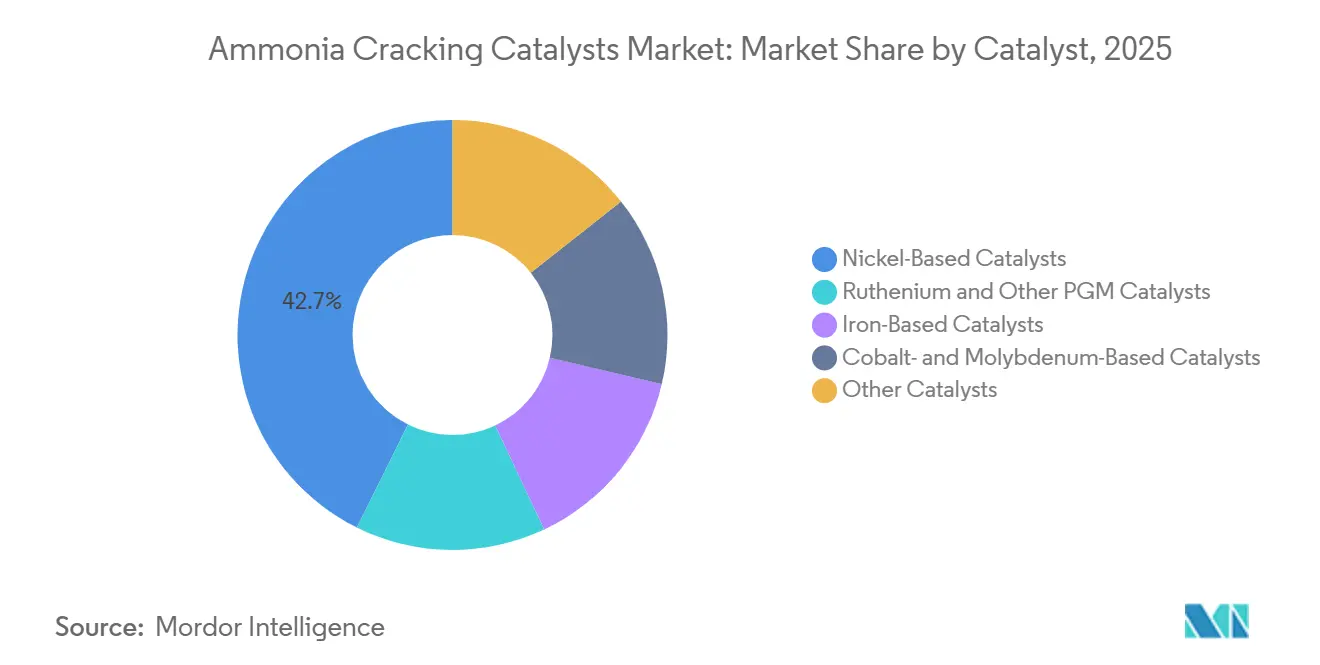
Nickel-Based Catalysts Lead the Ammonia Cracking Catalysts Market While Ruthenium and Other PGM Catalysts Grow FasterNickel-based catalysts held 42.67% of the ammonia cracking catalysts market share in 2025. Their position reflects long operating experience in large industrial crackers and their resilience at the temperatures used in tubular-fired equipment. Topsoe's DNK-30 Retake and DNK-40 Retake catalysts have accumulated more than 300,000 operating hours in industrial reference plants. The two products are designed for different sections of a tubular-fired cracker. Iron-based materials retain a niche in heavy-water plants where cobalt-iron chemistry suits operating conditions. Cobalt- and molybdenum-based systems are also receiving attention as lower-cost bimetallic alternatives.
Ruthenium and other PGM catalysts are forecast to grow at a 19.55% CAGR from 2026 to 2031. Their lower-temperature performance supports compact crackers for fuel cell and mobility uses where high-temperature nickel reactors are less practical. Heraeus Precious Metals completed an R&D program in May 2025 that produced a stable ruthenium catalyst for ammonia cracking under industrially relevant conditions. A 2025 study found that CoNi catalysts on alumina achieved 95% ammonia decomposition at 500 °C in conditions relevant to decentralized systems. The Korea Chemical Research Institute reported 81.9% ammonia-to-hydrogen conversion at 450 °C for a cobalt-iron layered double oxide catalyst in February 2025. The Korea Institute of Energy Research also reported 1.7 times higher hydrogen yield and 20% lower activation energy from a ruthenium synthesis method in July 2025.

By End-Use:
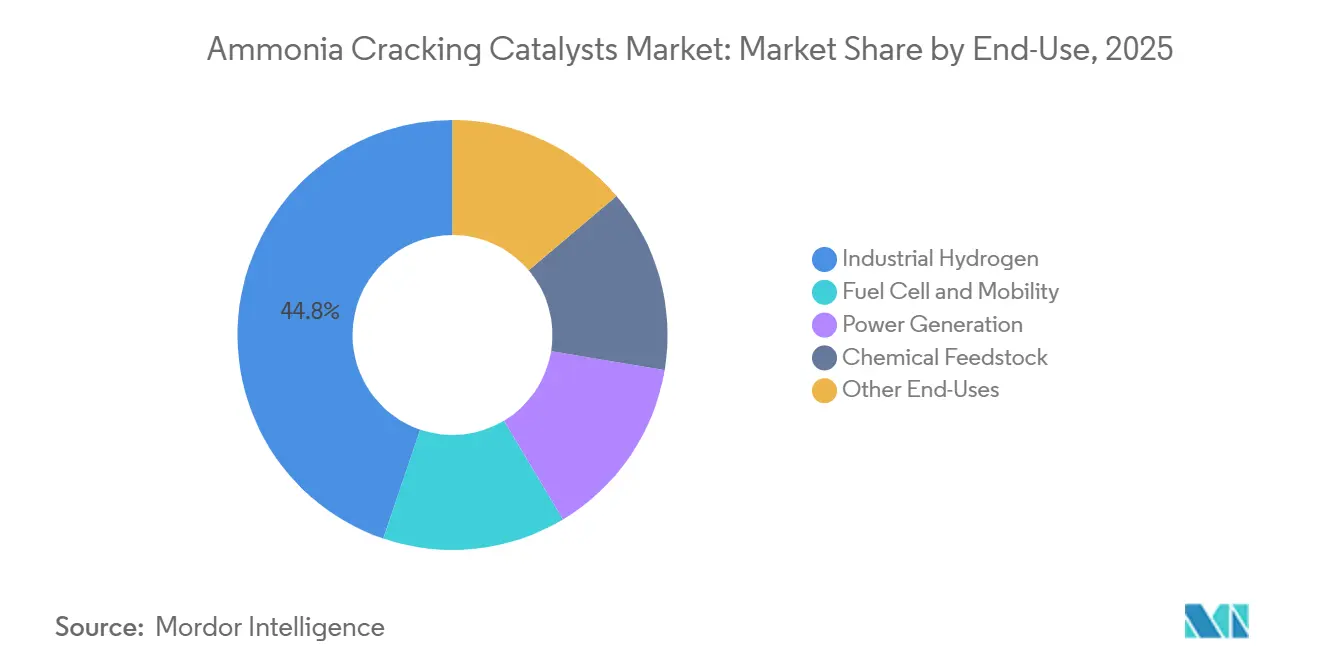
Industrial Hydrogen Supports the Ammonia Cracking Catalysts Market While Fuel Cell and Mobility Drives GrowthIndustrial hydrogen accounted for 44.78% of the ammonia cracking catalysts market share in 2025. Refining, steel, chemical, and gas-network customers need high throughput and consistent hydrogen purity. It helps justify large cracking facilities at European and Asian import ports. Established nickel-based catalysts suit the continuous operating requirements of these sites. Japan and South Korea also use hydrogen from cracked ammonia in co-firing programs for power generation. A 2026 study supported the role of cracking within integrated petrochemical hydrogen supply systems.
Fuel cell and mobility is projected to expand at a 20.43% CAGR from 2026 to 2031. The ammonia cracking catalysts market size for this use is supported by hydrogen heavy-truck deployment and emerging ammonia-based refueling infrastructure. A 2025 study described a 100 kW automotive system that used a hollow-fiber palladium membrane reactor and achieved 99.99% ammonia conversion with effluent purity above 99.5%. Chemical feedstock uses remain a stable application for methanol synthesis, hydrotreating, and specialty chemical production. They benefit from being close to import terminals but use smaller individual catalyst fills. Large terminals support nickel demand, while mobility and fuel cell installations support faster PGM growth.
Geography Analysis
APAC Ammonia Cracking Catalysts Market
Asia-Pacific held 36.34% of global revenue in 2025 and is expected to grow at a 20.80% CAGR through 2031. The region is the central demand area in 2026 because it combines hydrogen-import planning with catalyst development. South Korea targets ammonia imports of 4 million metric tons per year by 2030. Its ammonia infrastructure offers a practical basis for hydrogen imports. Japan is supporting domestic technology development through New Energy and Industrial Technology Development Organization (NEDO)-backed programs. Amogy and JGC Holdings deployed a low-ruthenium catalyst pilot in April 2025. Mitsubishi Heavy Industries and Nippon Shokubai were selected for a NEDO supply-chain development project in October 2025.
Europe Ammonia Cracking Catalysts Market
In Europe, Germany is advancing multiple import-terminal plans, while Belgium and the Netherlands benefit from the Rhine-Scheldt port cluster. Air Liquide's November 2025 Antwerp-Bruges pilot processed 30 metric tons of ammonia per day. Germany also has publicly supported research activity in reactor heat management and precious-metal-free catalysts. These efforts strengthen Europe’s capability in the catalyst technology tier.
The Americas and MEA Ammonia Cracking Catalysts Market
North America has a more gradual demand profile centered on industrial hydrogen and early ammonia co-firing activity. The U.S. Gulf Coast is developing blue-ammonia export supply chains that can create return-flow cracking demand in importing regions. South America remains a prospective ammonia production area, particularly in Brazil and Argentina. The Middle-East and Africa are also more important as production and supply regions than as major cracking markets. Saudi Arabia is developing ammonia production capacity for export. South Africa's majority share of primary ruthenium output gives the region an upstream role in catalyst supply.
Competitive Landscape
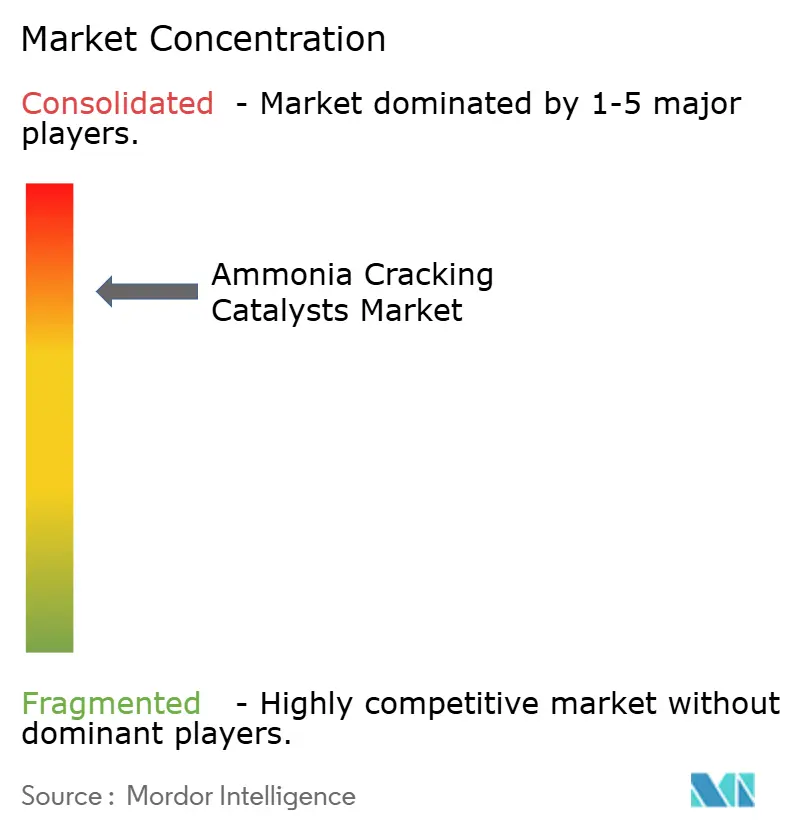
The ammonia cracking catalysts market is consolidated, with the top five players including Johnson Matthey, CLARIANT, Topsoe, Heraeus Precious Metals, and Dorf Ketal. The competitive split is between dedicated catalyst makers and licensors that include proprietary catalysts in their process packages. This model can secure catalyst supply for the operating life of a plant. Topsoe's H2Retake platform has 4 operational reference plants, more than 300,000 combined service hours, and feed capacities from 100 to 3,100 metric tons per day. These references create an advantage in qualification processes that require long-duration operating evidence.
Johnson Matthey worked with Air Products in early 2025 to supply catalysts for planned ammonia-to-hydrogen plants. This type of partnership helps established suppliers secure positions in large infrastructure projects. AMOGY and JGC Holdings deployed a low-ruthenium catalyst pilot in Japan in April 2025. These moves show that suppliers are competing on process integration, operating evidence, and lower precious-metal use.
Open opportunities include low-ruthenium and non-precious-metal catalysts for distributed and mobility systems. Suppliers can also address ammonia feeds with variable quality from blue ammonia production. Floating terminals need catalysts that can operate under changing loads and vibration. Mitsubishi Heavy Industries demonstrated its HyMACS system in December 2025 and produced 99% purity hydrogen at 450-500 °C using a non-precious-metal catalyst and steam heating. The company is targeting commercialization by 2030 after further work with Hokkaido Electric Power. A 2026 study reported 99.3% ammonia conversion at 450 °C with negligible degradation over 300 hours for a strain-engineered ruthenium catalyst.
Ammonia Cracking Catalysts Industry Leaders
-
Johnson Matthey
-
CLARIANT
-
Topsoe
-
Heraeus Precious Metals
-
Dorf Ketal
- *Disclaimer: Major Players sorted in no particular order
Ammonia Cracking Catalysts Market Companies Covered in this Report
- AMOGY Inc.
- Casale SA
- Catator AB
- CLARIANT
- Dorf Ketal
- Evonik Industrues AG
- HEESUNG CATALYSTS CORP
- Heraeus Precious Metals
- Honeywell International Inc.
- Johnson Matthey
- Nikki-Universal Co., Ltd.
- TANAKA PRECIOUS METAL GROUP Co., Ltd.
- thyssenkrupp Uhde GmbH
- Topsoe
- UNICAT Catalyst Technologies, LLC
Recent Industry Developments in Ammonia Cracking Catalysts Market
- November 2025: Air Liquide commissioned the world's first industrial-scale ammonia cracking pilot at the Port of Antwerp-Bruges in Belgium, with a daily capacity of 30 metric tons. The facility converts ammonia into hydrogen to support clean-energy transport and is backed by the European Union to scale up regional low-carbon supply chains.
- April 2025: AMOGY Inc. and JGC Holdings deployed the first pilot plant using AMOGY Inc.'s low-ruthenium-content ammonia cracking catalyst, as part of NEDO's Competitive Hydrogen Supply Chain initiative in Japan. JGC selected the low-ruthenium formulation for its lower activation temperature, system efficiency advantages, and potential for CAPEX reduction.
Global Ammonia Cracking Catalysts Market Report Scope
Ammonia cracking catalysts are specialized catalytic materials used to decompose ammonia into hydrogen and nitrogen through a high-temperature catalytic process. They enable efficient on-demand hydrogen production and support hydrogen storage, transportation, and utilization across industrial, energy, and mobility applications.
The Ammonia Cracking Catalysts Market is segmented by catalyst, end-use, and geography. By catalyst, the market is segmented into nickel-based catalysts, ruthenium and other PGM catalysts, iron-based catalysts, cobalt- and molybdenum-based catalysts, and other catalysts. By end-use, the market is segmented into industrial hydrogen, fuel cell and mobility, power generation, chemical feedstock, and other end-uses. The report also covers the market size and forecasts for ammonia cracking catalysts in 16 countries across major regions. For each segment, the market sizing and forecasts have been done on the basis of value (USD).
Segmentation Overview
| Nickel-Based Catalysts |
| Ruthenium and Other PGM Catalysts |
| Iron-Based Catalysts |
| Cobalt- and Molybdenum-Based Catalysts |
| Other Catalysts |
| Industrial Hydrogen |
| Fuel Cell and Mobility |
| Power Generation |
| Chemical Feedstock |
| Other End-Uses |
| Asia-Pacific | China |
| India | |
| Japan | |
| South Korea | |
| ASEAN Countries | |
| Rest of Asia-Pacific | |
| North America | United States |
| Canada | |
| Mexico | |
| Europe | Germany |
| United Kingdom | |
| France | |
| Italy | |
| NORDIC Countries | |
| Russia | |
| Rest of Europe | |
| South America | Brazil |
| Argentina | |
| Rest of South America | |
| Middle-East and Africa | Saudi Arabia |
| South Africa | |
| Rest of Middle-East and Africa |
| By Catalyst | Nickel-Based Catalysts | |
| Ruthenium and Other PGM Catalysts | ||
| Iron-Based Catalysts | ||
| Cobalt- and Molybdenum-Based Catalysts | ||
| Other Catalysts | ||
| By End-Use | Industrial Hydrogen | |
| Fuel Cell and Mobility | ||
| Power Generation | ||
| Chemical Feedstock | ||
| Other End-Uses | ||
| By Geography | Asia-Pacific | China |
| India | ||
| Japan | ||
| South Korea | ||
| ASEAN Countries | ||
| Rest of Asia-Pacific | ||
| North America | United States | |
| Canada | ||
| Mexico | ||
| Europe | Germany | |
| United Kingdom | ||
| France | ||
| Italy | ||
| NORDIC Countries | ||
| Russia | ||
| Rest of Europe | ||
| South America | Brazil | |
| Argentina | ||
| Rest of South America | ||
| Middle-East and Africa | Saudi Arabia | |
| South Africa | ||
| Rest of Middle-East and Africa | ||
Key Questions Answered in the Report
What is the size of the ammonia cracking catalysts market?
The ammonia cracking catalysts market stands at USD 40.62 million in 2026 and is projected to reach USD 92.29 million by 2031.
Which catalyst led demand in 2025?
Nickel-based catalysts led with 42.67% revenue share in 2025 because they have long operating experience in large industrial crackers.
Which catalyst is expected to grow fastest through 2031?
Ruthenium and other PGM catalysts are forecast to grow at a 19.55% CAGR from 2026 to 2031.
Which end use led the market demand in 2025?
Industrial hydrogen held 44.78% revenue share in 2025. The segment supplies refineries, steel plants, chemical facilities, and gas networks that require dependable volumes and high hydrogen purity.