
Industrial Catalysts Market Size and Share
Market Overview
| Study Period | 2021 - 2031 |
|---|---|
| Market Size (2026) | USD 25.73 Billion |
| Market Size (2031) | USD 32.02 Billion |
| Growth Rate (2026 - 2031) | 4.47 % |
| Fastest Growing Market | Asia-Pacific |
| Largest Market | Asia-Pacific |
| Market Concentration | Medium |
Major Players *Disclaimer: Major Players sorted in no particular order Image © Mordor Intelligence. Reuse requires attribution under CC BY 4.0. | |
Industrial Catalysts Market Analysis by Mordor Intelligence
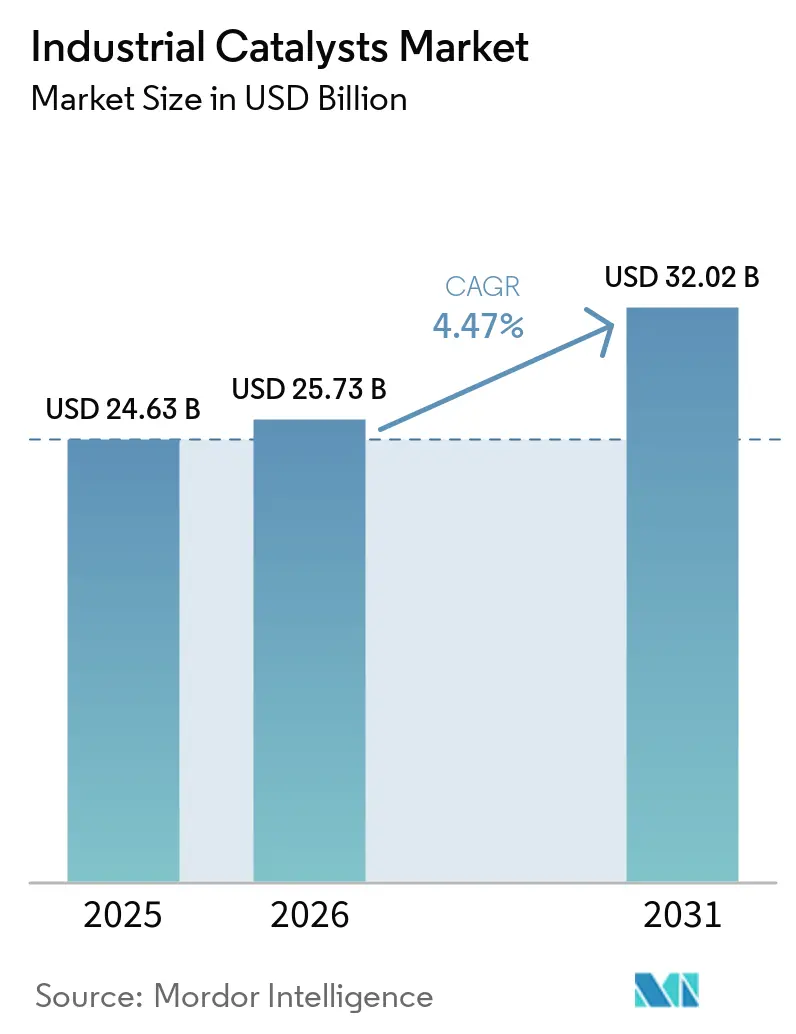
The Industrial Catalysts Market size was valued at USD 24.63 billion in 2025 and is estimated to grow from USD 25.73 billion in 2026 to reach USD 32.02 billion by 2031, at a CAGR of 4.47% during the forecast period (2026-2031). New refinery and petrochemical units in Asia-Pacific and the Middle East and Africa create initial catalyst charges and recurring replacement demand over their operating lives. Tighter limits on fuel and industrial emissions also increase demand for formulations used in hydrotreating, reforming, and exhaust treatment. Investment in low-carbon hydrogen, ammonia, renewable fuels, and circular feedstocks broadens the industrial catalysts market beyond conventional refining. Suppliers are placing greater weight on catalyst geometry, selectivity, digital monitoring, and service contracts because plant operators need better yields and longer operating cycles. Higher platinum-group-metal costs, lengthy plant qualification, and feedstock variability remain important constraints for the industrial catalysts market.
Key Report Takeaways
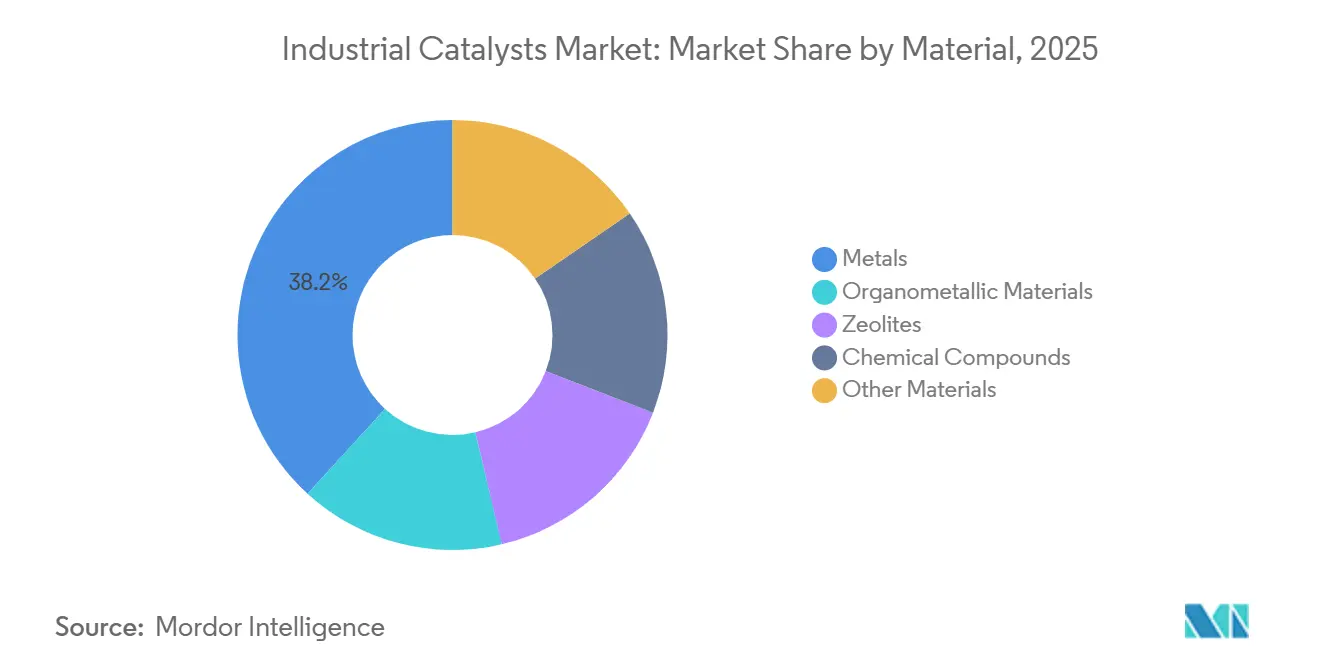
- By material, metals held 38.23% of the industrial catalysts market share in 2025, while organometallic materials are projected to advance at a 5.32% CAGR through 2031.
- By type, heterogeneous catalysts held 73.56% of the industrial catalysts market share in 2025, while homogeneous catalysts are projected to advance at a 5.78% CAGR through 2031.
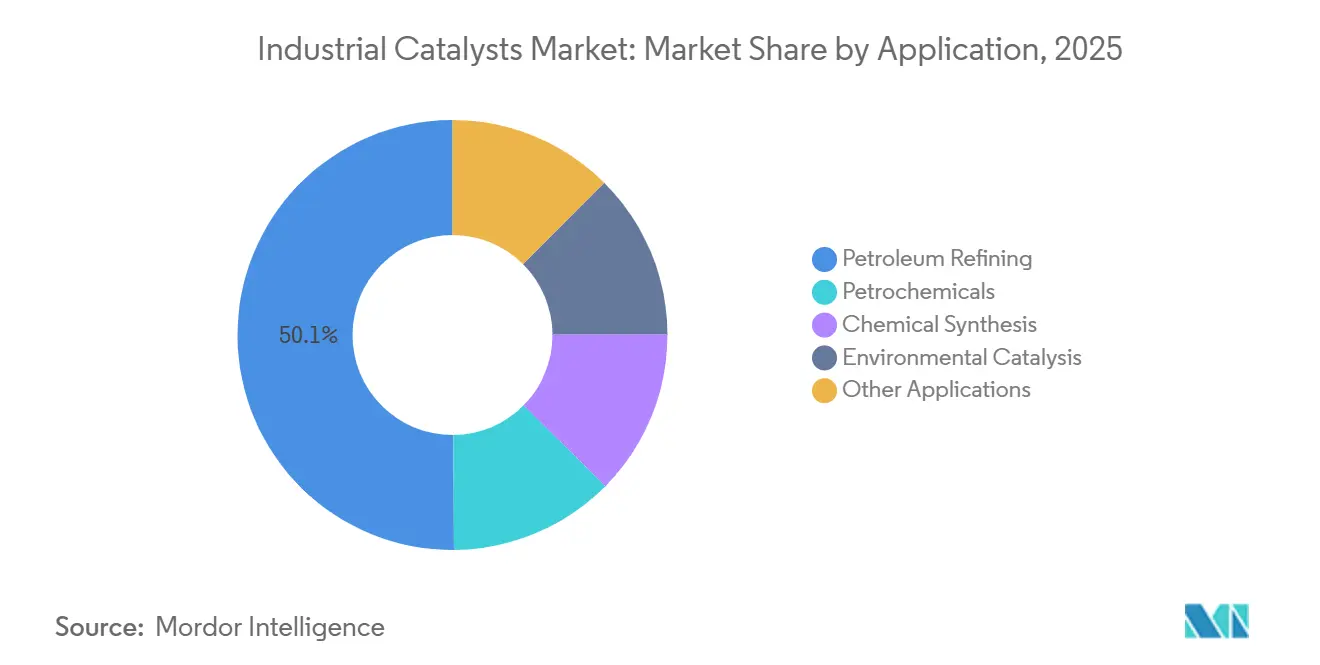
- By application, petroleum refining held 50.12% of the industrial catalysts market in 2025, while environmental catalysis is projected to advance at a 5.92% CAGR through 2031.
- By geography, Asia-Pacific held 35.67% of the industrial catalysts market in 2025 and is projected to advance at a 5.45% CAGR through 2031.
Note: Market size and forecast figures in this report are generated using Mordor Intelligence’s proprietary estimation framework, updated with the latest available data and insights as of January 2026.
Market Trends and Insights
Drivers Impact Analysis of Industrial Catalysts Market*
| Driver | (~) % Impact on CAGR Forecast | Geographic Relevance | Impact Timeline |
|---|---|---|---|
| Refinery and Petrochemical Capacity Expansion | +1.5% | Global; highest concentration in Asia-Pacific and Middle East and Africa | Long term (≥ 4 years) |
| Tightening Fuel and Industrial Emission Standards | +1.1% | North America and EU core; spillover to MEA via maritime Emission Control Areas | Medium term (2-4 years) |
| Process Intensification and Higher Catalyst Selectivity | +0.8% | Global | Medium term (2-4 years) |
| Low-Carbon Hydrogen, Ammonia, and Circular Chemistry Investment | +0.6% | Asia-Pacific, North America, Europe | Long term (≥ 4 years) |
| Digital Catalyst Monitoring and Performance-Based Services | +0.3% | Global | Short term (≤ 2 years) |
| Source: Mordor Intelligence | |||
Refinery and Petrochemical Capacity Expansion
New greenfield units support the industrial catalysts market because each process unit needs a fresh catalyst charge at start-up. Those units also create recurring demand through regeneration and replacement cycles over the life of the plant. Projects in China, India, and the Gulf require catalyst systems for fluid catalytic cracking, hydrotreating, hydrocracking, and propylene production. Honeywell International Inc secured a catalyst and technology contract for Dangote’s Lekki complex in April 2026, covering 750,000 metric tons per year of propylene capacity. Petrochemical-integrated refineries designed to maximize propylene yield use more catalyst per unit of feedstock than conventional gasoline-focused operations. This makes the current project pipeline an important source of sustained demand for the industrial catalysts market.
Tightening Fuel and Industrial Emission Standards
Emission rules increase the required catalyst loading in industrial equipment and fuel-processing systems. The U.S. Environmental Protection Agency finalized amendments to New Source Performance Standards for stationary combustion turbines on January 9, 2026, requiring selective catalytic reduction for nitrogen oxide control in specified turbine subcategories[1]. The International Maritime Organization designated the North-East Atlantic as an Emission Control Area for nitrogen oxides, sulfur oxides, and particulate matter on May 1, 2026. These requirements extend demand for selective catalytic reduction and related exhaust-treatment technologies. Operators must meet performance thresholds even when input costs are high. This compliance need supports the industrial catalysts market because spending cannot be deferred as easily as discretionary capital projects.
Process Intensification and Higher Catalyst Selectivity
Catalyst performance affects conversion, product yield, cycle length, and plant operating costs. BASF started the first commercial production plant for 3D-printed catalysts in Ludwigshafen in March 2026, with its X3D technology delivering 25% higher reactor efficiency. Evonik Industries AG launched high-performance isodewaxing catalysts in April 2026 using mesoporized zeolite technology that reduced product losses fivefold during diesel dewaxing[2]. Digital monitoring adds another performance tool, as it allows suppliers and customers to track catalyst health and respond to process upsets. CLARIANT’s CLARITY Prime service agreement with SECCO Petrochemicals in China uses health alerts, virtual hydrogen analyzers, and upset prediction for ethylene operations. These capabilities help suppliers protect customer relationships at reload decisions and strengthen the industrial catalysts market.
Low-Carbon Hydrogen, Ammonia, and Circular Chemistry Investment
Low-carbon projects are creating catalyst demand outside traditional refinery and bulk-chemical processes. CF Industries commenced construction on its USD 4 billion Blue Point low-carbon ammonia facility in Louisiana in August 2026, with a targeted capacity of 1.4 million metric tons per year and a 2029 start-up. Topsoe provides technology and catalysts for ACWA Power’s Yanbu Green Hydrogen Project in Saudi Arabia. CLARIANT’s MegaMax methanol synthesis catalysts and syngas purification portfolio were selected for Repsol’s Ecoplanta project in Spain, which is expected to process 400,000 metric tons of municipal waste each year into 240,000 metric tons of renewable methanol after completion in 2029. These projects require reliable performance with nonstandard or variable-carbon feedstocks. Suppliers with proven qualification data for these applications have a clear opportunity in the industrial catalysts market.
Restraints Impact Analysis of Industrial Catalysts Market*
| Restraint | (~) % Impact on CAGR Forecast | Geographic Relevance | Impact Timeline |
|---|---|---|---|
| Precious-Metal and Critical-Mineral Price Volatility | -0.9% | Global; most acute in North America and Asia-Pacific | Short term (≤ 2 years) |
| Long Qualification and Plant-Validation Cycles | -0.6% | Global | Long term (≥ 4 years) |
| Deactivation Risk from Variable Biofeeds and Co-Processing Streams | -0.4% | EU, North America, Asia-Pacific | Medium term (2-4 years) |
| Source: Mordor Intelligence | |||
Precious-Metal and Critical-Mineral Price Volatility
Platinum, palladium, and rhodium are essential active components in many high-performance heterogeneous formulations. Price movements for these materials can quickly raise manufacturing costs and pressure supplier margins. Johnson Matthey reported that the platinum market remained in structural deficit for a third consecutive year in 2025, while industrial consumption in chemicals, glass, and synthetic-fuels applications grew modestly. Higher metal prices can prompt customers to extend regeneration cycles to defer replacement purchases. This may reduce selectivity and raise the risk of process losses at the operating plant. The effect restrains the industrial catalysts market by making purchasing decisions more sensitive to short-term input costs.
Long Qualification and Plant-Validation Cycles
A new formulation typically needs bench-scale evaluation, pilot-plant work, and a sustained 12-to-24-month industrial trial before commercial adoption. The process is more difficult when a catalyst processes hydrotreated vegetable oil, pyrolysis oil, bio-naphtha, or another variable feedstock. Operators need on-stream data because an unplanned deactivation event can reduce throughput and create off-specification output. This makes cautious adoption economically rational even when laboratory results are favorable. It also gives incumbent suppliers a time advantage because their catalysts already have an operating record. The industrial catalysts market, therefore, converts laboratory advances into revenue more slowly than many other specialty chemical categories.
*Our forecasts treat driver/restraint impacts as directional, not additive. The impact forecasts reflect baseline growth, mix effects, and variable interactions.
Industrial Catalysts Market Segment Analysis
By Material:
Metals Lead Current Demand, While Organometallic Materials Grow FasterMetals held 38.23% of the industrial catalysts market in 2025, supported by their role in hydrotreating, steam methane reforming, and catalytic reforming. Nickel, cobalt, molybdenum, and platinum-group metals provide the activity and stability required in continuous industrial processes. Zeolites are important in fluid catalytic cracking and hydrocracking because they determine conversion and product distribution. Zeolyst International’s hydrocracking catalyst portfolio addresses 30% of global hydrocracking catalyst requirements, and its Opal Renew zeolites serve renewable diesel and sustainable aviation fuel applications. Chemical compounds support acid-catalyzed alkylation and isomerization, where replacement timing depends heavily on plant economics.
Organometallic materials are projected to advance at a 5.32% CAGR through 2031. Demand is linked to active pharmaceutical ingredient synthesis, specialty polymers, and carbon dioxide utilization pathways. A 2025 Journal of the American Chemical Society study by researchers from the Leibniz Institute for Catalysis, Ruhr University Bochum, and Evonik Industries AG described a bimetallic iridium-palladium system that directly converts carbon dioxide and green hydrogen into chemical intermediates. Umicore is constructing a Grubbs catalyst production facility at Catoosa, Oklahoma, with production targeted for early 2027. Mixed-metal oxides and bimetallic systems also have a role in electrochemical and environmental uses.

By Type:
Heterogeneous Catalysts Retain Scale, While Homogeneous Catalysts Gain in Fine ChemicalsHeterogeneous catalysts held 73.56% of the industrial catalysts market in 2025 because they are well-suited to large, continuous reactors. Their use in petroleum refining, ammonia production, and bulk petrochemical synthesis allows operators to separate products from catalyst materials more easily. Topsoe’s KM-series iron-based ammonia synthesis catalysts support more than 50% of ammonia converters worldwide. Fluid catalytic cracking suppliers compete through formulation changes within a heterogeneous system. Reactor downtime risk makes customers reluctant to change catalyst brands during operating cycles.
Homogeneous catalysts are projected to advance at a 5.78% CAGR through 2031. Pharmaceutical and fine-chemical producers use these systems for enantioselective and cross-coupling reactions. Continuous flow chemistry supports their adoption because it can improve throughput, safety, and waste management. Evonik Industries AG completed the global launch of its NOBLYST F catalyst family at the end of 2025, with customer interest across Asia, the United States, and Europe. Higher demand for precise chemical transformations supports the industrial catalysts market.
By Application:
Petroleum Refining Holds the Largest Position, While Environmental Catalysis ExpandsPetroleum refining held 50.12% of the industrial catalysts market in 2025, reflecting demand for clean fuels and the processing of heavy and bio-derived feedstocks. Fluid catalytic cracking, hydrotreating, and hydrocracking remain central to refinery performance and fuel-quality compliance. BASF opened a refinery catalyst research and development center in Attapulgus, Georgia, in May 2026 at its largest global refinery catalyst production site. The facility focuses on next-generation fluid catalytic cracking catalysts and faster scale-up through digital tools. Petrochemical and chemical synthesis applications also require catalysts for expanding propylene and ethylene capacity.
Environmental catalysis is projected to advance at a 5.92% CAGR through 2031. Selective catalytic reduction requirements for industrial boilers, power-generation units, and marine vessels support this growth. CLARIANT announced that its catalysts helped customers avoid 45 million metric tons of carbon dioxide equivalent (CO₂e) in 2025 through direct-reduced iron reforming, nitrous oxide abatement, and syngas applications. Sustainable aviation fuel production adds an application that has expanded since 2024. This mix gives the industrial catalysts market exposure to established industrial operations and decarbonization projects.
Geography Analysis
APAC Industrial Catalysts Market
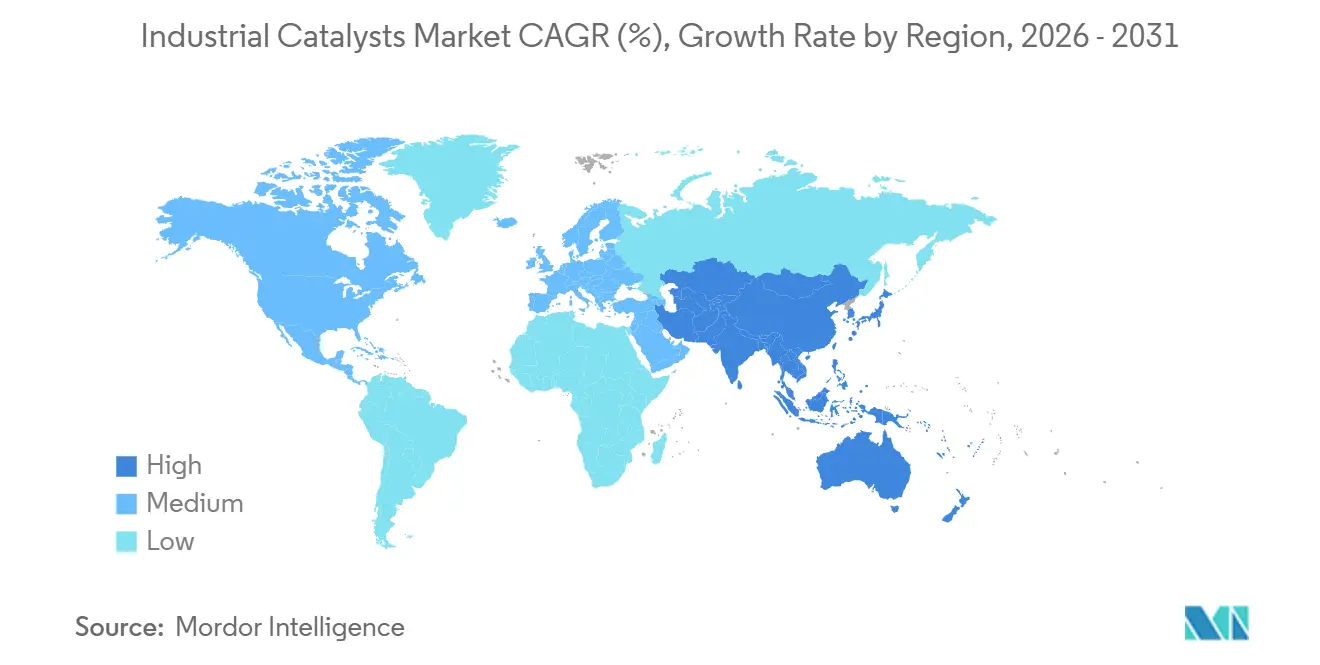
Asia-Pacific held 35.67% of the industrial catalysts market in 2025 and is projected to advance at a 5.45% CAGR through 2031. China’s large refining system supports demand for fluid catalytic cracking, hydrotreating, and reforming catalysts. India’s refinery and petrochemical expansion adds demand for processing catalysts. Topsoe reported strong Asia-Pacific catalyst sales in 2025, with India emerging as a key growth driver, and 3 sustainable aviation fuel projects secured in China. South Korea, Japan, Vietnam, and Indonesia add demand through petrochemical clusters, fuel-quality requirements, and refinery self-sufficiency programs.
North America and Europe Industrial Catalysts Market
North America and Europe form a major demand base for replacement catalysts, low-sulfur fuel processing, and environmental control systems. In North America, complex refinery configurations create a continued need for specialized hydrocracking and hydrotreating formulations. Incentives for low-carbon hydrogen and ammonia also create catalyst demand outside conventional refinery operations. Europe is focused on reducing industrial carbon intensity through bio-derived feedstock co-processing and refinery-petrochemical integration. The industrial catalysts market in both regions is shaped more by replacement, compliance, and process upgrades than by large new refinery construction.
South America and MEA Industrial Catalysts Market
South America and Middle East and Africa represent a smaller but distinct part of the industrial catalysts market. Brazil requires specialized solutions for sugarcane ethanol processing and hydrotreated vegetable oil production. Topsoe supports the Yanbu Green Hydrogen Project in Saudi Arabia, while Honeywell International Inc’s contract for Dangote’s Lekki complex adds petrochemical catalyst demand in Nigeria. Economic volatility in some markets can delay procurement and catalyst replacement cycles.
Competitive Landscape
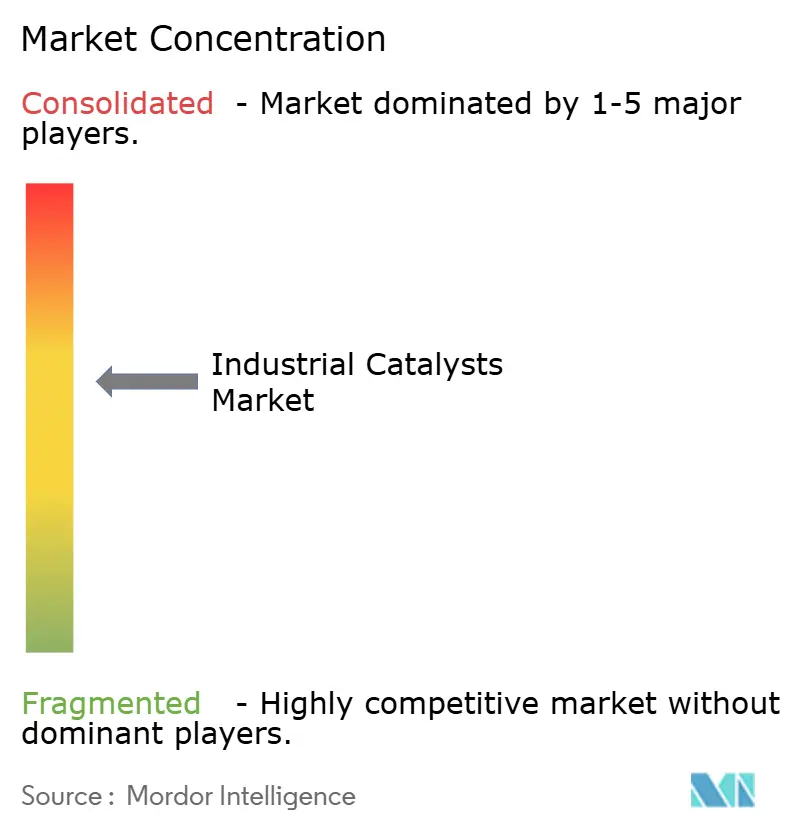
The industrial catalysts market is moderately concentrated, with the top five players including BASF, Johnson Matthey, CLARIANT, W. R. Grace & Co.-Conn, and Albemarle Corporation. Other suppliers, including NIPPON KETJEN Co., Ltd., Zeolyst International, and Shell plc’s catalyst operations, compete in specialized process niches. Qualification records at operating plants create meaningful barriers for new entrants. Suppliers increasingly compete on feedstock flexibility, lifecycle analytics, and digital monitoring rather than on product supply alone. Chinese state-affiliated producers, including Sinopec Catalyst Co., Ltd., continue to narrow the gap in more standardized catalyst applications.
Honeywell International Inc completed its acquisition of Johnson Matthey’s Catalyst Technologies business in July 2026, adding refining, renewable fuels, and blue-hydrogen catalyst capabilities. Technip Energies completed the acquisition of Ecovyst’s Advanced Materials and Catalysts division, including its stake in Zeolyst International, for USD 556 million in January 2026. Albemarle Corporation completed the sale of a controlling stake in Ketjen to KPS Capital Partners in March 2026, and related transactions generated USD 670 million in pre-tax proceeds. These transactions reduced the number of independent technology owners in refining and petrochemical catalyst categories. They placed greater value on technology portfolios with established customer qualification.
The most open opportunities are in formulations for renewable feedstock co-processing, service models linked to yield improvements, and organometallic systems for green chemistry. BASF’s new Attapulgus research and development center gives it a platform for refinery catalyst development and scale-up. CLARIANT’s 10-year SECCO agreement shows how digital services can become part of a long-term customer relationship. Umicore’s planned Catoosa facility expands capacity for industrial-scale organometallic catalyst production. These strategies reflect the need to support customers across formulation, qualification, and operating performance.
Industrial Catalysts Industry Leaders
-
BASF
-
Johnson Matthey
-
CLARIANT
-
W. R. Grace & Co.-Conn
-
Albemarle Corporation
- *Disclaimer: Major Players sorted in no particular order
Industrial Catalysts Market Companies Covered in this Report
- BASF
- Albemarle Corporation
- Axens
- CLARIANT
- Evonik Industries AG
- Honeywell International Inc.
- JGC C&C
- Johnson Matthey
- NIPPON KETJEN Co.,Ltd.
- Shell plc
- Sinopec Catalyst CO.,LTD.
- Topsoe A/S
- Umicore
- W. R. Grace & Co.-Conn
- Zeolyst International
Recent Industry Developments in Industrial Catalysts Market
- July 2026: Honeywell International Inc completed the acquisition of Johnson Matthey’s Catalyst Technologies business, strengthening its catalyst and process-technology portfolio across refining, petrochemicals, and renewable fuels. The acquisition expanded Honeywell International Inc’s industrial catalyst capabilities and strengthened its position across major chemical and energy-processing applications.
- April 2026: Evonik Industries AG launched a new generation of isodewaxing catalysts based on Zeopore’s mesoporized zeolite technology, improving fuel yields, cold-flow properties, and conversion efficiency. The catalysts support refinery and renewable-fuel applications, including sustainable aviation fuel and renewable diesel, expanding advanced catalyst adoption in industrial processing.
Global Industrial Catalysts Market Report Scope
Industrial catalysts are substances that accelerate chemical reactions without being consumed in the overall reaction, enabling industrial processes to operate at practical temperatures, pressures, and reaction rates. They help improve process efficiency, product selectivity, energy utilization, and resource efficiency across chemical and processing industries.
The Industrial Catalysts Market is segmented by material, type, application, and geography. By material, the market is segmented into metals, zeolites, chemical compounds, organometallic materials, and other materials. By type, the market is segmented into heterogeneous catalysts and homogeneous catalysts. By application, the market is segmented into petroleum refining, petrochemicals, chemical synthesis, environmental catalysis, and other applications. The report also covers the market size and forecasts for industrial catalysts in 15 countries across major regions. For each segment, the market sizing and forecasts have been done on the basis of value (USD).
Segmentation Overview
| Metals |
| Zeolites |
| Chemical Compounds |
| Organometallic Materials |
| Other Materials |
| Heterogeneous Catalysts |
| Homogeneous Catalysts |
| Petroleum Refining |
| Petrochemicals |
| Chemical Synthesis |
| Environmental Catalysis |
| Other Applications |
| Asia-Pacific | China |
| India | |
| Japan | |
| South Korea | |
| ASEAN Countries | |
| Rest of Asia-Pacific | |
| North America | United States |
| Canada | |
| Mexico | |
| Europe | Germany |
| United Kingdom | |
| France | |
| Italy | |
| NORDIC Countries | |
| Rest of Europe | |
| South America | Brazil |
| Argentina | |
| Rest of South America | |
| Middle East and Africa | Saudi Arabia |
| South Africa | |
| Rest of Middle East and Africa |
| By Material | Metals | |
| Zeolites | ||
| Chemical Compounds | ||
| Organometallic Materials | ||
| Other Materials | ||
| By Type | Heterogeneous Catalysts | |
| Homogeneous Catalysts | ||
| By Application | Petroleum Refining | |
| Petrochemicals | ||
| Chemical Synthesis | ||
| Environmental Catalysis | ||
| Other Applications | ||
| By Geography | Asia-Pacific | China |
| India | ||
| Japan | ||
| South Korea | ||
| ASEAN Countries | ||
| Rest of Asia-Pacific | ||
| North America | United States | |
| Canada | ||
| Mexico | ||
| Europe | Germany | |
| United Kingdom | ||
| France | ||
| Italy | ||
| NORDIC Countries | ||
| Rest of Europe | ||
| South America | Brazil | |
| Argentina | ||
| Rest of South America | ||
| Middle East and Africa | Saudi Arabia | |
| South Africa | ||
| Rest of Middle East and Africa | ||
Key Questions Answered in the Report
What is the size of the industrial catalysts market?
The industrial catalysts market stands at USD 25.73 billion in 2026 and is projected to reach USD 32.02 billion by 2031.
What is driving demand for industrial catalysts?
Refinery and petrochemical expansion, tighter emission standards, higher catalyst selectivity, and low-carbon hydrogen and ammonia projects support demand.
Which material led the market demand in 2025?
Metals held 38.23% of demand in 2025 because of their use in hydrotreating, reforming, and other large-scale conversion processes.
Which type is expected to grow fastest through 2031?
Homogeneous catalysts are projected to advance at a 5.78% CAGR through 2031, supported by pharmaceutical and fine-chemical applications.