
Hydrogen Pipeline Market Size and Share
Market Overview
| Study Period | 2021 - 2031 |
|---|---|
| Market Size (2026) | USD 13.74 Billion |
| Market Size (2031) | USD 28.05 Billion |
| Growth Rate (2026 - 2031) | 15.34 % |
| Fastest Growing Market | Asia-Pacific |
| Largest Market | Europe |
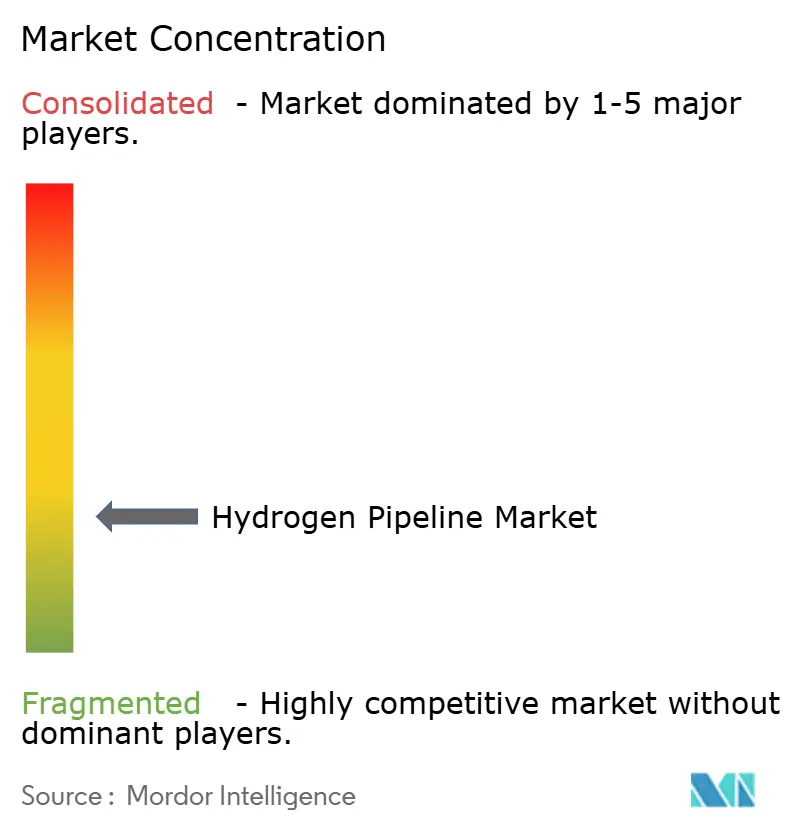
| Market Concentration | Low |
Major Players *Disclaimer: Major Players sorted in no particular order Image © Mordor Intelligence. Reuse requires attribution under CC BY 4.0. | |
Hydrogen Pipeline Market Analysis by Mordor Intelligence
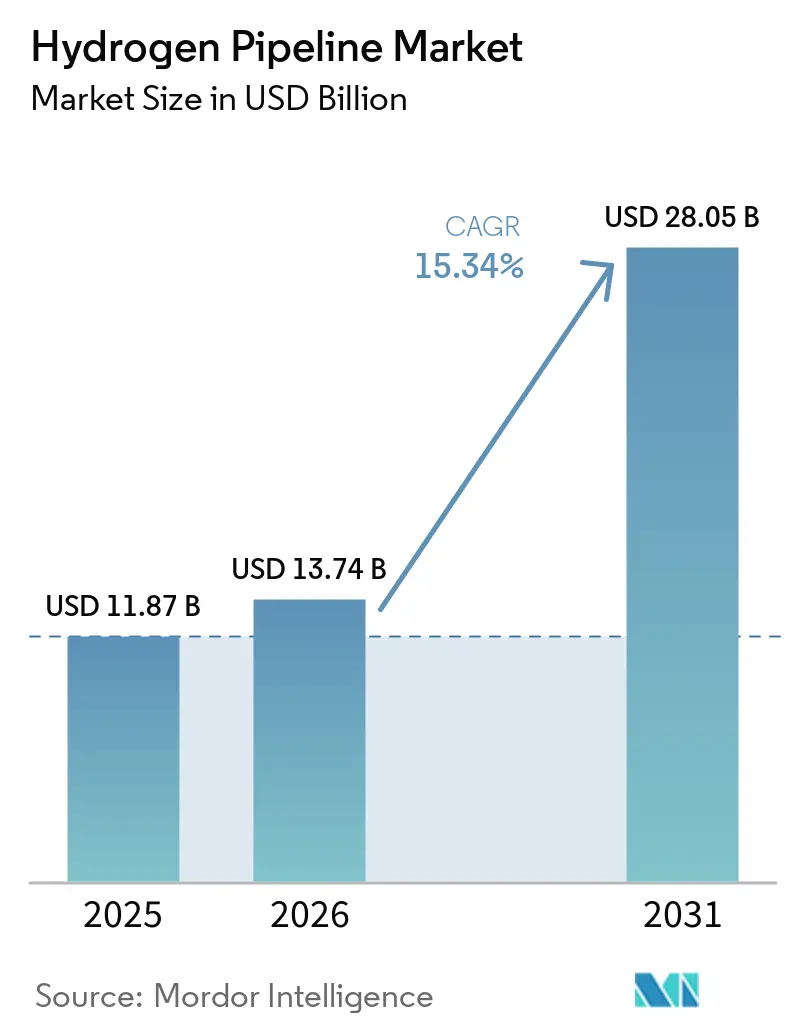
The hydrogen pipeline market size was estimated at USD 11.87 billion in 2025 and is estimated to grow from USD 13.74 billion in 2026 to USD 28.05 billion by 2031, at a CAGR of 15.34% during the forecast period (2026-2031). The hydrogen pipeline market is evolving beyond its historical role as a supplier of industrial feedstock and is becoming part of broader energy and industrial decarbonization plans. Investment is increasingly focused on connecting production sites to demand centers in steel, chemicals, refining, transport, and ports. Government-backed network plans are enabling operators to advance large projects before all customer quantities are contracted. This sequencing creates opportunities for pipe suppliers, conversion specialists, and integrity-monitoring providers, while also exposing project economics to delayed offtake commitments. The hydrogen pipeline market is therefore shaped by the balance between the urgency of planned networks and the slower pace of commercially binding demand.
Key Report Takeaways
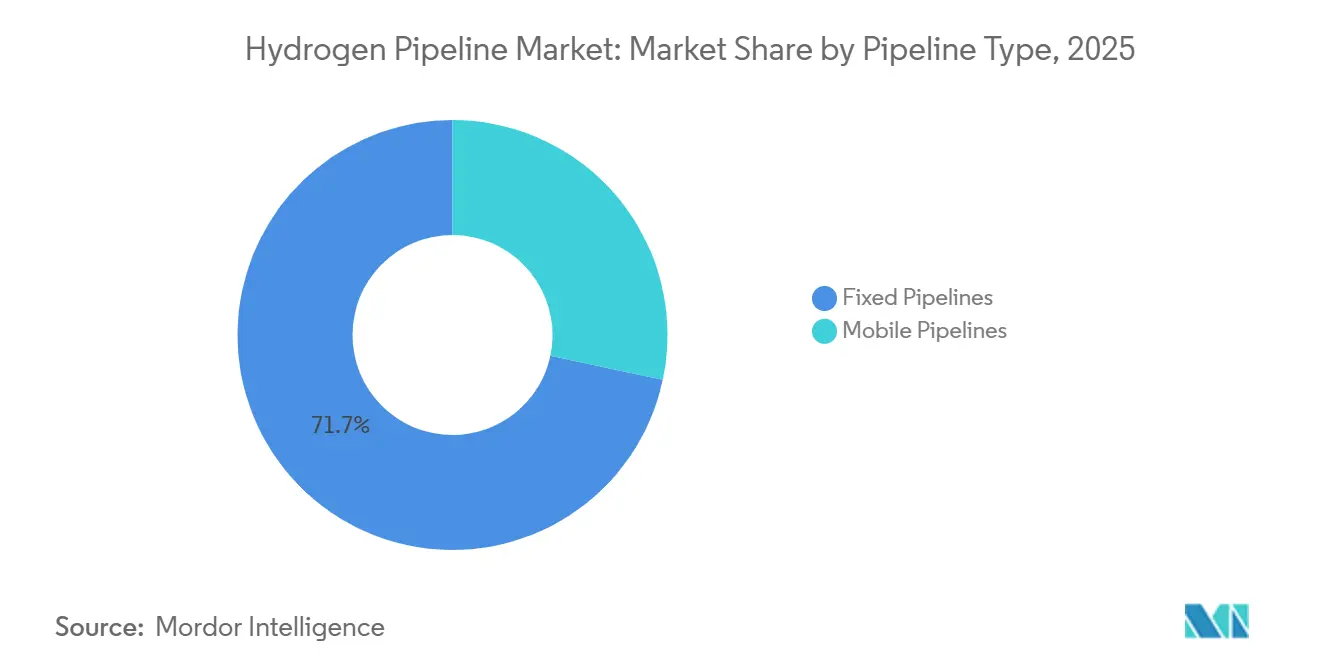
- By pipeline type, fixed pipelines held 71.67% of the hydrogen pipeline market share in 2025, while mobile pipelines are forecast to grow at a 17.67% CAGR through 2031.
- By pipeline structure, metal pipelines accounted for 67.34% of the hydrogen pipeline market share in 2025, while plastics and composites are projected to expand at a 19.24% CAGR through 2031.
- By pipeline status, new-build pipelines held 58.58% of the hydrogen pipeline market share in 2025, while repurposed natural-gas pipelines are forecast to record an 18.38% CAGR through 2031.
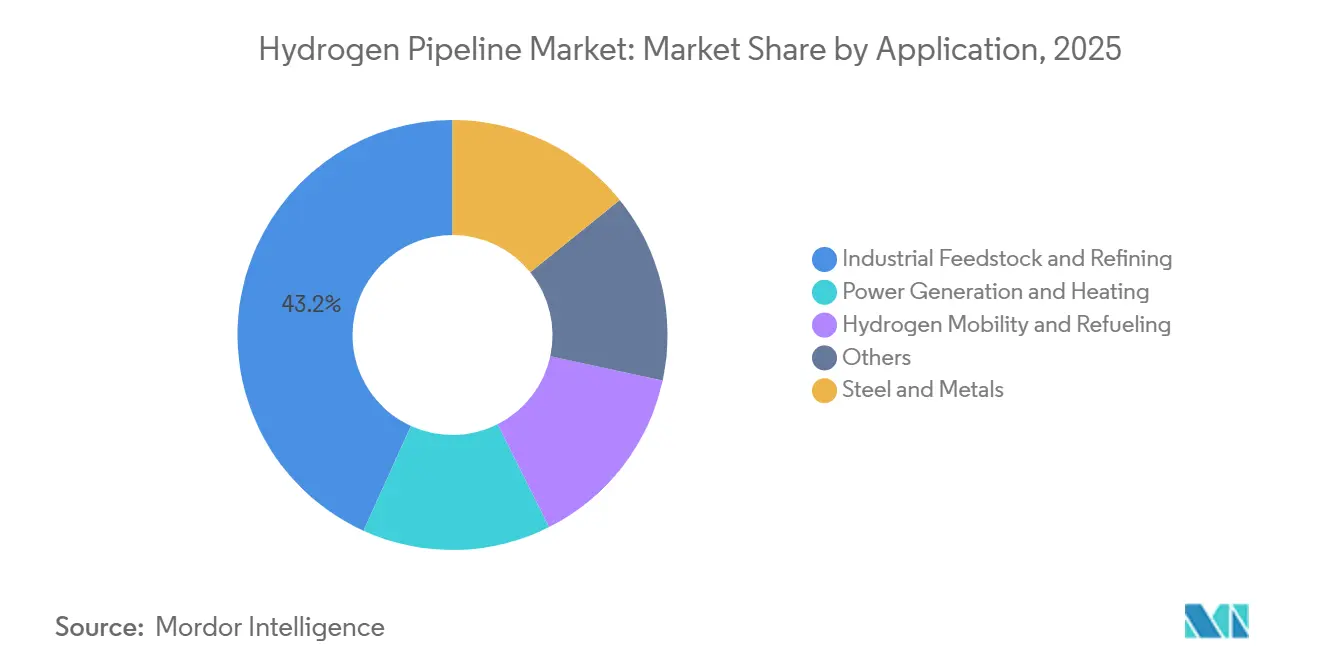
- By application, industrial feedstock and refining represented 43.21% of the hydrogen pipeline market share in 2025, while hydrogen mobility and refueling are projected to grow at a 17.93% CAGR through 2031.
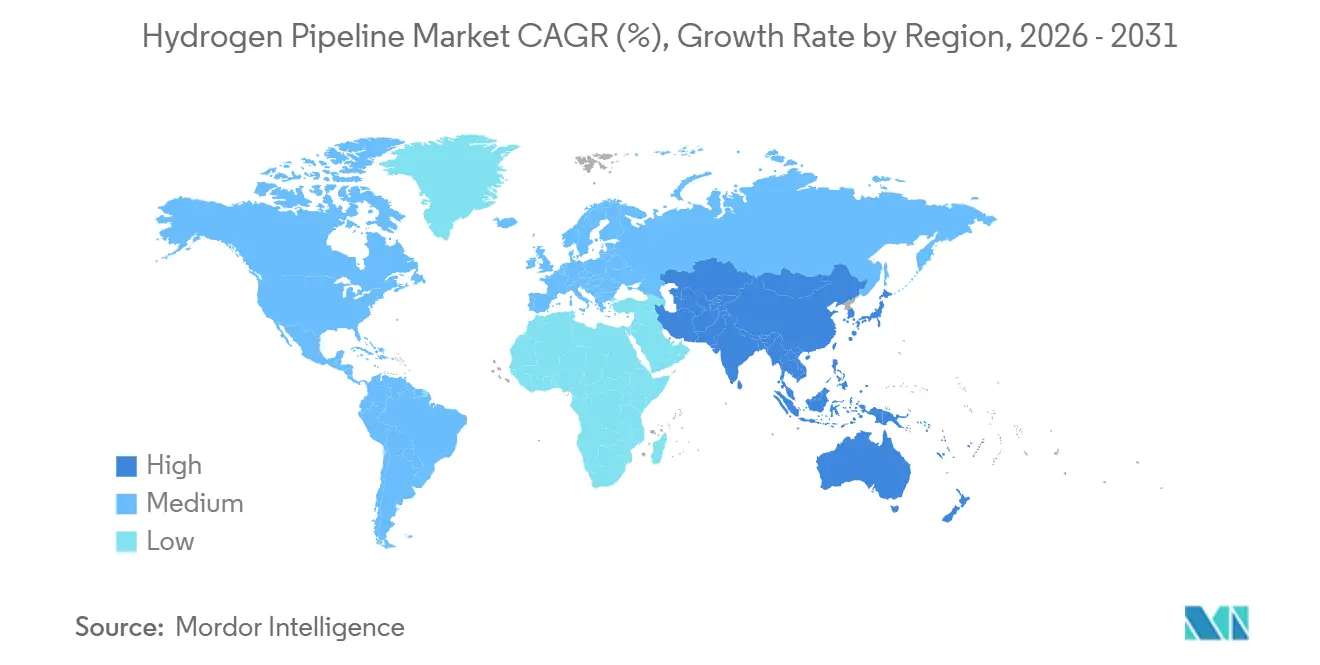
- By geography, Europe held 38.45% of the hydrogen pipeline market share in 2025, while Asia-Pacific is forecast to grow at an 18.12% CAGR through 2031.
Note: Market size and forecast figures in this report are generated using Mordor Intelligence’s proprietary estimation framework, updated with the latest available data and insights as of January 2026.
Market Trends and Insights
Drivers Impact Analysis of Hydrogen Pipeline Market*
| Drivers | (~) % Impact on CAGR Forecast | Geographic Relevance | Impact Timeline |
|---|---|---|---|
| Industrial Decarbonization and Hydrogen Demand | +4.5% | Global, with concentrated impact in the EU27, China, Japan, South Korea, India | Long term (≥ 4 years) |
| Government Hydrogen Infrastructure Funding and Regulation | +3.5% | EU, Germany, UK, Netherlands, Japan, South Korea | Short to medium term (≤ 4 years) |
| Repurposing of Natural-Gas Transmission Assets | +2.5% | Germany, Netherlands, Italy, Australia, North America | Medium term (2–4 years) |
| Cross-Border Hydrogen Corridors and Import Infrastructure | +2.0% | EU (H2Med, SouthH2, Nordic-Baltic), Middle-East to Europe, Oman to Northwest Europe | Medium to long term (≥ 2 years) |
| Binding Offtake-Led Infrastructure Financing | +1.5% | Germany, Netherlands, UK, Japan | Medium term (2–4 years) |
| Hydrogen Network Conversion Design Platforms and Digital Integrity Monitoring | +0.8% | North America, Europe, and APAC industrial clusters | Short to medium term (≤ 4 years) |
| Source: Mordor Intelligence | |||
Industrial Decarbonization and Hydrogen Demand
Hard-to-abate sectors are establishing hydrogen as a long-term industrial input rather than a pilot fuel. This shift is bringing pipeline investment closer to demand from steel, chemical, refining, and industrial clusters. Complete decarbonization of EU crude steel production would require 6 million to 8 million tons of hydrogen per year, comparable to current global hydrogen demand. Germany's steel sector alone could require 850,000 tons per year of hydrogen via the national grid by 2030. Salzgitter AG finalized a 7-year agreement with EWE for 10,000 tons of green hydrogen per year starting in 2030, with delivery planned via the German core network. Research published in 2025 found that green hydrogen direct-reduced iron pathways could become cost-competitive in the European Union by 2035, supporting longer-term network planning.
Government Hydrogen Infrastructure Funding and Regulation
Public funding is supporting hydrogen supply while also seeking to provide transport projects with a clearer revenue base. The UK government confirmed more than GBP 500 million in June 2025 for its first regional hydrogen transport and storage network, intended to connect producers and industrial users in Merseyside, Teesside, and the Humber. KfW committed a EUR 24 billion (USD 27.76 billion) loan facility for Germany's hydrogen core network amortization account, with the federal government covering 76% of the repayment risk[1]. In June 2026, the Bundesnetzagentur consulted on a plan for a 9,241 km hydrogen network by 2037, with total costs of EUR 24.3 billion (USD 28.11 billion). Uneven adoption of the European Union gas and hydrogen framework can create tariff differences across borders and delay final investment decisions. The UK's July 2025 consultation on an economic framework for 100% hydrogen pipeline networks indicates that the regulatory framework remains under development.
Repurposing of Natural-Gas Transmission Assets
Repurposing natural gas assets is central to the hydrogen pipeline market, as it offers a route to expand network coverage without having to construct every section from the ground up. A 2025 article in Hydrogen Safety reported that conversion can reduce transmission costs by 80% compared with new construction. The European Hydrogen Backbone expects repurposed assets to account for 60% of its planned 53,000 km network by 2040. GASCADE converted 400 km of high-pressure natural gas pipelines in northeast Germany in 2025, creating the first large-scale transmission conversion of its kind. A 2026 study outlined a probabilistic integrity assessment framework to qualify older gas pipelines for hydrogen service. Existing grid owners hold a practical advantage, as their pipelines, inspection histories, and rights-of-way can be assessed for conversion before a greenfield project reaches the same stage.
Cross-Border Hydrogen Corridors and Import Infrastructure
Cross-border corridors link low-cost supply areas with industrial demand centers, but require aligned decisions across multiple regulatory systems. In July 2026, the BarMar subsea pipeline between Barcelona and Marseille entered the front-end engineering design stage, with commercial operations targeted for 2032. The H2Med corridor aims to meet 10% of Europe's hydrogen consumption by 2030 and has received more than EUR 35.56 million (USD 41.14 million) in Connecting Europe Facility support. Gasunie, Open Grid Europe, and Thyssengas signed an agreement in May 2026 to develop a Netherlands-Germany interconnector at Zevenaar-Elten by 2031 using repurposed infrastructure. The SoutH2 Corridor commissioned its first 15 km section in Bavaria, while a study of the SunsHyne corridor found no technical or economic barriers to further development. Progress in the hydrogen pipeline market will depend on coordinated tariff approvals, certification rules, and binding shipper commitments across these routes.
Restraints Impact Analysis of Hydrogen Pipeline Market*
| Restraints | (~) % Impact on CAGR Forecast | Geographic Relevance | Impact Timeline |
|---|---|---|---|
| High Capital Cost and Slow Permitting | -2.5% | Global, acute in the EU, North America | Short to medium term (≤ 4 years) |
| Hydrogen Embrittlement, Permeation, and Leakage Risk | -1.5% | Global, particularly high-pressure metal-pipeline deployments | Medium to long term (2–5 years) |
| Non-Uniform Qualification of Repurposed Natural-Gas Assets | -0.8% | EU, North America | Medium term (2–4 years) |
| Low-Density Utilization and Uncertain Corridor Load Factors | -0.7% | Germany, Netherlands, early-stage APAC corridors | Short to medium term (≤ 4 years) |
| Source: Mordor Intelligence | |||
High Capital Cost and Slow Permitting
Capital costs and long permitting periods remain immediate constraints for project delivery. The Netherlands Court of Audit reported in December 2025 that the national hydrogen network experienced low initial throughput and potential startup losses, despite a state grant mechanism of up to EUR 750 million (~USD 867.72 million)[2]. The court found the mechanism ineffective under the then-current demand conditions, raising the risk of underused infrastructure. Many sections of Germany's 9,040 km core network still require permits, tariff approvals, and certification before operation. Hydrogen projects are often assessed under processes designed for natural gas, even though hydrogen has distinct ignition, buoyancy, material, and leakage characteristics. Standards such as ASME B31.12 and Nederlands Normalisatie Instituut (NEN) 3650 are advancing, but their implementation remains uneven across jurisdictions.
Hydrogen Embrittlement, Permeation, and Leakage Risk
Material performance in high-pressure hydrogen service affects safety, inspection schedules, operating costs, and asset availability. Research published in 2025 found that X70 pipeline steel can experience ductility losses of 20% to 80% under hydrogen exposure, while fracture toughness can fall by more than 50% in pure hydrogen at 10 MPa. A 2026 review noted that hydrogen can accelerate crack growth and may require more frequent inspection intervals than those used for natural gas pipelines. The qualification task is more difficult for repurposed assets where weld records, alloy composition, and past inspection data are incomplete. These uncertainties strengthen the case for material screening and probabilistic fracture assessment before conversion, and also support demand for composite pipe in applications where the risk of steel embrittlement is difficult to manage.
*Our forecasts treat driver/restraint impacts as directional, not additive. The impact forecasts reflect baseline growth, mix effects, and variable interactions.
Hydrogen Pipeline Market Segment Analysis
By Pipeline Type:
Fixed Networks Command Scale, Mobile Delivery Supports Last-Mile AccessFixed pipelines held 71.67% of the hydrogen pipeline market share in 2025, reflecting their role in high-pressure transmission and regional distribution. Hydrogen moves primarily from centralized production sites to industrial clusters, favoring permanent networks. GASCADE's 400 km conversion in Germany demonstrated the scale achievable when existing transmission infrastructure is available. Fixed infrastructure provides a direct route between supply and large industrial users, though it requires capital commitments before each customer connection is fully utilized.
Mobile pipelines are forecast to grow at a 17.67% CAGR through 2031. They primarily use high-pressure tube trailers carrying compressed hydrogen at 200-500 bar. This model serves refueling stations and smaller industrial customers outside the fixed network's coverage. Japan's plan for 30 large-scale hydrogen refueling stations along expressways will require trailer distribution until dedicated links reach those locations. Mobile delivery can also be used to test demand before a permanent connection is built. Once trailer quantities establish steady use on a corridor, operators have a clearer basis for investing in a fixed pipeline. ASME B31.12 remains a key design and pressure-rating reference for fixed hydrogen pipelines in North America. DNV-RP-F318 and ISO 19880 guide offshore and international deployments, while standards for composite tubes are still being finalized.

By Pipeline Structure:
Metal Pipelines Anchor Transmission, Composites Expand in DistributionMetal pipelines accounted for 67.34% of the hydrogen pipeline market share in 2025. API 5L and ISO 3183-qualified carbon and low-alloy steels remain the primary materials for high-pressure, long-distance transmission. Tenaris, Vallourec, JFE Steel, and voestalpine Tubulars maintain hydrogen-service portfolios supported by ASME B31.12 design data. Established installation methods and lower cost per kilometer at large diameters support the use of metal in backbone routes, and existing qualification records make metal a familiar choice for major transmission operators.
Plastics and composites are projected to grow at a 19.24% CAGR through 2031. Their resistance to hydrogen embrittlement and continuous-length installation make them useful for urban crossings and constrained rights-of-way. SoluForce deployed a flexible composite pipe under the Oosterhornkanaal canal crossing in the Netherlands in a single pull, eliminating weld joints at that crossing. A 2025 peer-reviewed study validated thermoplastic composite pipelines with a PA12 liner and carbon-fiber reinforcement at pressures up to 10 MPa. The tested system recorded burst pressure above 60 MPa and low hydrogen permeation. Gas Networks Ireland began testing Purapipe International's composite technology in 2025, with results expected in late 2026. Metal remains suited to large, high-pressure corridors, while composites are gaining relevance in distribution, crossings, and marine applications.
By Pipeline Status:
New Build Leads Current Spending, Repurposing Speeds Network ExpansionNew-build pipelines accounted for 58.58% of the hydrogen pipeline market in 2025. Purpose-built systems are important in countries where gas networks are absent or are not located near emerging supply and demand centers. China is constructing the 1,000 km Kangbao-Caofeidian pipeline and the 400 km Inner Mongolia-Beijing pipeline as early steps toward a planned 6,600 km long-distance hydrogen grid. New construction gives operators direct control over materials, operating pressure, and route selection.
Repurposed natural-gas pipelines are forecast to grow at an 18.38% CAGR through 2031. The European Hydrogen Backbone expects converted assets to represent 60% of its planned 53,000 km network by 2040. Gasunie, through Hynetwork, structured 75% of the Netherlands' national network around converted natural-gas pipelines and developed a generic assessment framework based on NEN 3650 to qualify high-pressure assets. The EU-funded PilgrHYm project is developing a pre-normative framework for integrity assessment of gas pipes repurposed for hydrogen. In Hamburg, a 13 km pipeline built in 1973 was repurposed for hydrogen at 25 bar, with upgrades planned to 70 bar. Consistent qualification methods can reduce both certification time and conversion costs.
By Application:
Industrial Feedstock Anchors Demand, Mobility, and Refueling Build MomentumIndustrial feedstock and refining accounted for 43.21% of the hydrogen pipeline market in 2025. Chemical and petrochemical facilities are established consumers of hydrogen and can be served via dedicated links within industrial clusters. Rotterdam and Germany's chemical centers around Ludwigshafen and Leverkusen illustrate this concentrated demand pattern. Steel production is becoming an increasingly important application as decarbonization programs require greater quantities of hydrogen. Green steel demand is projected to reach 4.49 million tons by 2030, and steelmaking could require 5 million tons of hydrogen by then. Power generation and heating remain emerging uses, as a firm pipeline offtake has not yet been established at the scale seen in feedstock applications.
Hydrogen mobility and refueling are forecast to grow at a 17.93% CAGR through 2031. Decarbonization requirements in heavy-duty freight, maritime, and aviation are increasing the need for a reliable supply of refueling. A 2026 study found that pipeline delivery on major United States freight routes could offer cost advantages over truck delivery. The study identified a model that combines pipeline delivery from a production hub to a reservoir with tube trailers for final delivery, resulting in dispensed costs of USD 6.87-7.26/kg. Hexagon Purus delivered 13 hydrogen distribution modules in Q1 2026 and secured an order from Europe for distribution units supporting central European refueling. Ports in Rotterdam, Hamburg, and Singapore are also formalizing supply corridors for ammonia, industrial heat, and maritime bunkering.
Geography Analysis
Europe Hydrogen Pipeline Market
Europe held 38.45% of the hydrogen pipeline market share in 2025. This position reflects regional policy targets, national backbone plans, and early infrastructure development in Dutch and German hydrogen grids. Germany's June 2026 development plan consultation covered a 9,241 km network by 2037, with costs estimated at EUR 24.3 billion (USD 28.11 billion). Snam allocated EUR 200 million to a hydrogen backbone as part of its EUR 14 billion (USD 16.19 billion) investment plan for 2026-2030. Enagás launched a public consultation on its 2,600-km Spanish hydrogen backbone in 2025. The Nordic-Baltic Hydrogen Corridor secured a EUR 6.8 million(USD 7.86 million) European Union grant in July 2025 for feasibility work on a 2,500 km link connecting Finland, Estonia, Latvia, Lithuania, Poland, and Germany. Compliance with the European Union's hydrogen and decarbonized gas framework remains important for permits and tariff-setting.
APAC and North America Hydrogen Pipeline Market
Asia-Pacific is projected to record an 18.12% CAGR through 2031, making it the fastest-growing region in the hydrogen pipeline market. Japan plans to increase hydrogen supply from 4 million tons per year to 12 million tons per year by 2040 and is advancing a USD 2.7 billion program for liquid hydrogen terminals, carriers, and a 4 km pipeline in Kawasaki capable of transporting 1 million tons per year. South Korea confirmed state funding for a 37.2 km pipeline serving the Saemangeum industrial complex at a cost above KRW 160 billion (USD 0.11 billion). China is building dedicated routes and planning a larger grid. The Energy Industries Council tracked 221 regional hydrogen projects with a potential capital expenditure of USD 407 billion, although only 6.46 GW of 56.35 GW of green hydrogen capacity was under construction as of 2026. In North America, the PIPES Act of 2025 established a dedicated United States hydrogen pipeline safety framework. Cadiz and RIC Energy are evaluating a 220-mile corridor in California under a July 2026 memorandum of understanding.
EMEA and South America Hydrogen Pipeline Market
South America, the Middle East, and Africa are at earlier stages of infrastructure development. Brazil and Argentina have wind and solar resources that could support green hydrogen production for export, with planning in South America centered on port clusters such as Pecém in Brazil. The Middle-East is more strongly positioned around export projects, including Saudi Arabia's NEOM project and Oman's planned corridor from the Port of Duqm. Gasunie signed a joint development agreement in April 2025 for a liquid hydrogen import corridor from Oman to the Netherlands and Germany. African markets, particularly South Africa and Morocco, are attracting investment linked to European import demand. Domestic pipeline development in these regions will depend on stronger local industrial offtake.
Competitive Landscape
The hydrogen pipeline market is fragmented. Tenaris, Vallourec, JFE Steel Corporation, Jindal SAW, TMK Group, voestalpine Tubulars, and Welspun compete in the steel pipe market on hydrogen-grade certifications, diameter coverage, and coatings. Their product strategies increasingly include lower-strength and higher-toughness materials for American Society of Mechanical Engineers (ASME) B31.12 service. Qualification documentation can create switching costs for pipeline operators. Enagás, Snam, and Hynetwork compete differently, as they hold network franchises and seek development mandates, European Union funding, and anchor-shipper agreements.
Composite and non-metallic specialists such as SoluForce B.V. and CENERGY HOLDINGS compete on installation, inspection, and material performance. Their offerings focus on lower total ownership costs in applications where corrosion protection, welds, or embrittlement are difficult to manage. The Oosterhornkanaal installation illustrates how a flexible composite design can reduce weld-related risk points. GASCADE's conversion of 400 km of pipeline illustrates the strategic value of an operator's existing network footprint. Enagás, NaTran, and Teréga advanced BarMar into the detailed engineering phase in July 2026, progressing a major cross-border project.
Digital integrity and conversion services are becoming an important area of competition. Operators are using distributed acoustic sensing, digital-twin modeling, and real-time transient simulation to manage hydrogen-specific degradation risks. Providers that combine conversion engineering, material qualification, and ongoing monitoring can address multiple operator needs through a single service. The Hy2Infra Important Projects of Common European Interest (IPCEI) supports 2,700 km of new and repurposed hydrogen transmission pipelines planned between 2027 and 2029. ASME B31.12, DNV-RP-F318, and ISO 19880 remain important technical references for product qualification. Early multi-standard certification can be valuable for suppliers serving projects that span multiple regulatory jurisdictions.
Hydrogen Pipeline Industry Leaders
-
CENERGY HOLDINGS
-
Welspun
-
Snam SPA
-
Hynetwork
-
Enagás, S.A.
- *Disclaimer: Major Players sorted in no particular order
Hydrogen Pipeline Market Companies Covered in this Report
- ArcelorMittal
- CENERGY HOLDINGS
- Enagás, S.A.
- Hexagon Purus
- Hynetwork
- JFE Steel Corporation
- Jindal SAW Limited
- NPROXX
- Salzgitter AG
- Salzgitter AG
- Snam SPA
- SoluForce B.V.
- Tenaris
- TMK Group
- Vallourec
- voestalpine Tubulars GmbH & Co KG
- Welspun
Recent Industry Developments in Hydrogen Pipeline Market
- July 2026: Enagás, NaTran (France), and Teréga launched the Front-End Engineering Design (FEED) phase for BarMar, a 400 km subsea hydrogen pipeline connecting Barcelona and Marseille that forms part of the H2Med corridor; commercial operations are targeted for 2032.
- July 2026: GASCADE commenced soil and environmental surveys for AquaDuctus, an approximately 200 km offshore hydrogen import pipeline connecting offshore wind-powered green hydrogen production in the German North Sea to the national hydrogen core network, with a planned onward route to the Dutch border.
Global Hydrogen Pipeline Market Report Scope
A hydrogen pipeline is a specialized infrastructure system used to transport hydrogen gas safely over long distances at high pressures. Similar to natural gas networks, these systems connect production sites to industrial plants, refineries, and clean energy distribution hubs.
The hydrogen pipeline market is segmented by pipeline type, pipeline structure, pipeline status, application, and geography. By pipeline type, the market is segmented into fixed pipelines and mobile pipelines. By pipeline structure, the market is segmented into metal, plastics, and composites. By pipeline status, the market is segmented into new-build pipelines and repurposed natural-gas pipelines. By application, the market is segmented into industrial feedstock and refining, steel and metals, power generation and heating, hydrogen mobility and refueling, and others. The report also covers market size and forecasts for the hydrogen pipeline across 15 countries in major regions. The market sizes and forecasts are provided in terms of value (USD).
Segmentation Overview
| Fixed Pipelines |
| Mobile Pipelines |
| Metal |
| Plastics and Composites |
| New-Build Pipelines |
| Repurposed Natural-Gas Pipelines |
| Industrial Feedstock and Refining |
| Steel and Metals |
| Power Generation and Heating |
| Hydrogen Mobility and Refueling |
| Others |
| Asia-Pacific | China |
| India | |
| Japan | |
| South Korea | |
| ASEAN Countries | |
| Rest of Asia-Pacific | |
| North America | United States |
| Canada | |
| Mexico | |
| Europe | Germany |
| United Kingdom | |
| France | |
| Italy | |
| NORDIC Countries | |
| Rest of Europe | |
| South America | Brazil |
| Argentina | |
| Rest of South America | |
| Middle East and Africa | Saudi Arabia |
| South Africa | |
| Rest of Middle East and Africa |
| By Pipeline Type | Fixed Pipelines | |
| Mobile Pipelines | ||
| By Pipeline Structure | Metal | |
| Plastics and Composites | ||
| By Pipeline Status | New-Build Pipelines | |
| Repurposed Natural-Gas Pipelines | ||
| By Application | Industrial Feedstock and Refining | |
| Steel and Metals | ||
| Power Generation and Heating | ||
| Hydrogen Mobility and Refueling | ||
| Others | ||
| By Geography | Asia-Pacific | China |
| India | ||
| Japan | ||
| South Korea | ||
| ASEAN Countries | ||
| Rest of Asia-Pacific | ||
| North America | United States | |
| Canada | ||
| Mexico | ||
| Europe | Germany | |
| United Kingdom | ||
| France | ||
| Italy | ||
| NORDIC Countries | ||
| Rest of Europe | ||
| South America | Brazil | |
| Argentina | ||
| Rest of South America | ||
| Middle East and Africa | Saudi Arabia | |
| South Africa | ||
| Rest of Middle East and Africa | ||
Key Questions Answered in the Report
What is current market size of Hydrogen Pipeline Market?
The hydrogen pipeline market size was estimated at USD 11.87 billion in 2025 and is estimated to grow from USD 13.74 billion in 2026 to USD 28.05 billion by 2031, at a CAGR of 15.34% during the forecast period (2026-2031).
Which pipeline type held the largest share in 2025?
In the hydrogen pipeline market, fixed pipelines accounted for 71.67% of the total value in 2025 because they enable high-pressure transmission between production sites and industrial clusters.
Why are repurposed natural-gas pipelines growing quickly?
In the hydrogen pipeline market, repurposed assets are forecast to grow at an 18.38% CAGR through 2031, as existing routes can reduce construction needs, subject to rigorous integrity assessments.
Which material category is expected to grow fastest?
Within the hydrogen pipeline market, plastics and composites are projected to grow at a 19.24% CAGR through 2031, supported by their resistance to hydrogen embrittlement and use in constrained routes.