
Hydrochloric Acid Electrolysis Market Size and Share
Market Overview
| Study Period | 2021 - 2031 |
|---|---|
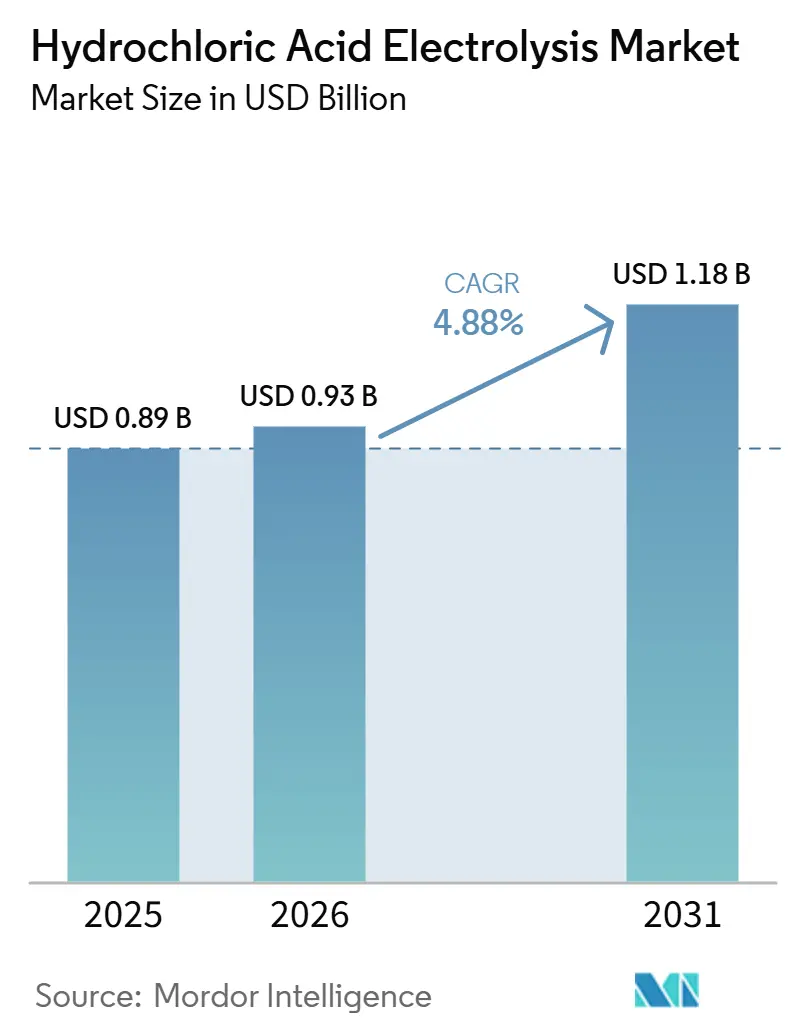
| Market Size (2026) | USD 0.93 Billion |
| Market Size (2031) | USD 1.18 Billion |
| Growth Rate (2026 - 2031) | 4.88 % |
| Fastest Growing Market | Asia-Pacific |
| Largest Market | Asia-Pacific |
| Market Concentration | Medium |
Major Players *Disclaimer: Major Players sorted in no particular order Image © Mordor Intelligence. Reuse requires attribution under CC BY 4.0. | |
Hydrochloric Acid Electrolysis Market Analysis by Mordor Intelligence
The Hydrochloric Acid Electrolysis Market size is expected to grow from USD 0.89 billion in 2025 to USD 0.93 billion in 2026 and is forecast to reach USD 1.18 billion by 2031 at 4.88% CAGR over 2026-2031. Large chemical sites continue to generate hydrogen chloride as a byproduct in phosgenation and related chlorine-based processes, and neutralization now carries a higher cost and environmental burden than recovery in many integrated plants. The market is also benefiting from oxygen-depolarized cathode and membrane systems that can reduce energy use by up to 30% compared with conventional aqueous configurations, making on-site chlorine recovery more practical for a wider range of producers than only the largest complexes. However, the market still favors larger operators because project timelines can stretch to 24 months from kickoff to chlorine production, keeping capital tied up for an extended period before sites see operational returns. The market is further supported by tighter environmental compliance, salt- and water-recovery programs within chemical parks, and a broader push toward circular feedstock use in Europe and Asia-Pacific. The main constraint on the market remains electricity costs, as each installation depends on stable power pricing to preserve the economics of replacing purchased chlorine with internally recovered output.
Key Report Takeaways
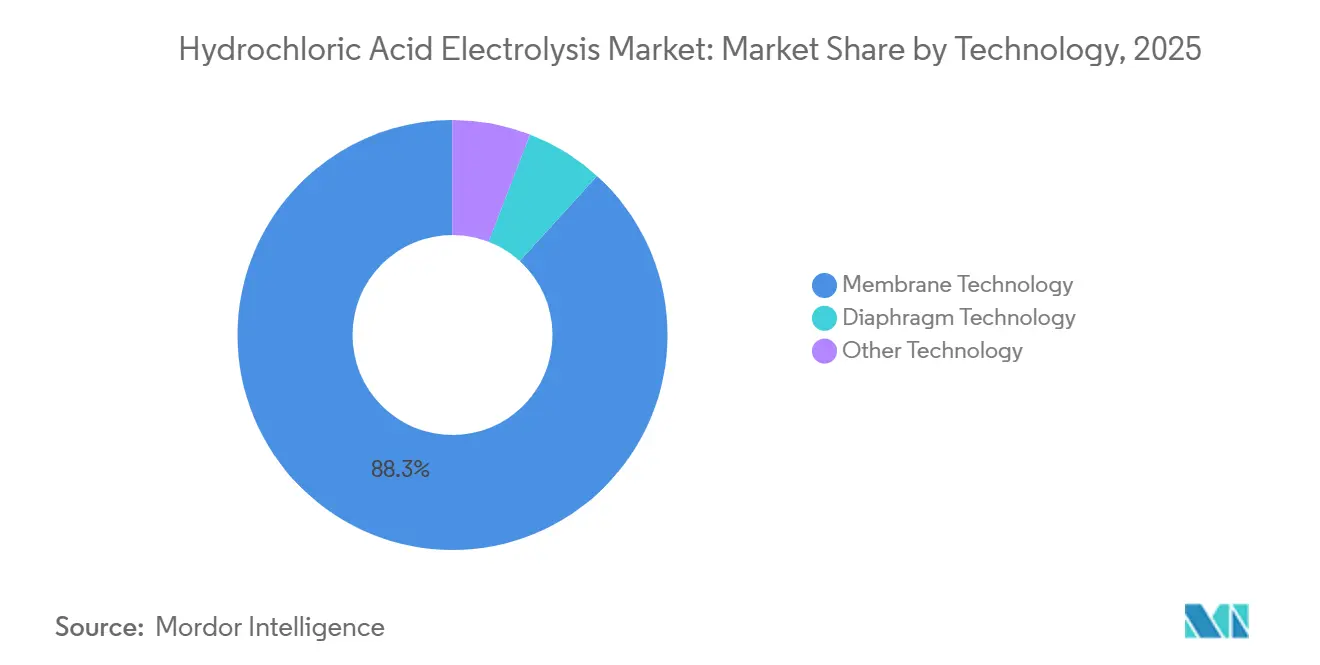
- By technology, membrane technology held 88.26% of the hydrochloric acid electrolysis market share in 2025 and is projected to grow at a CAGR of 5.12% through 2031.
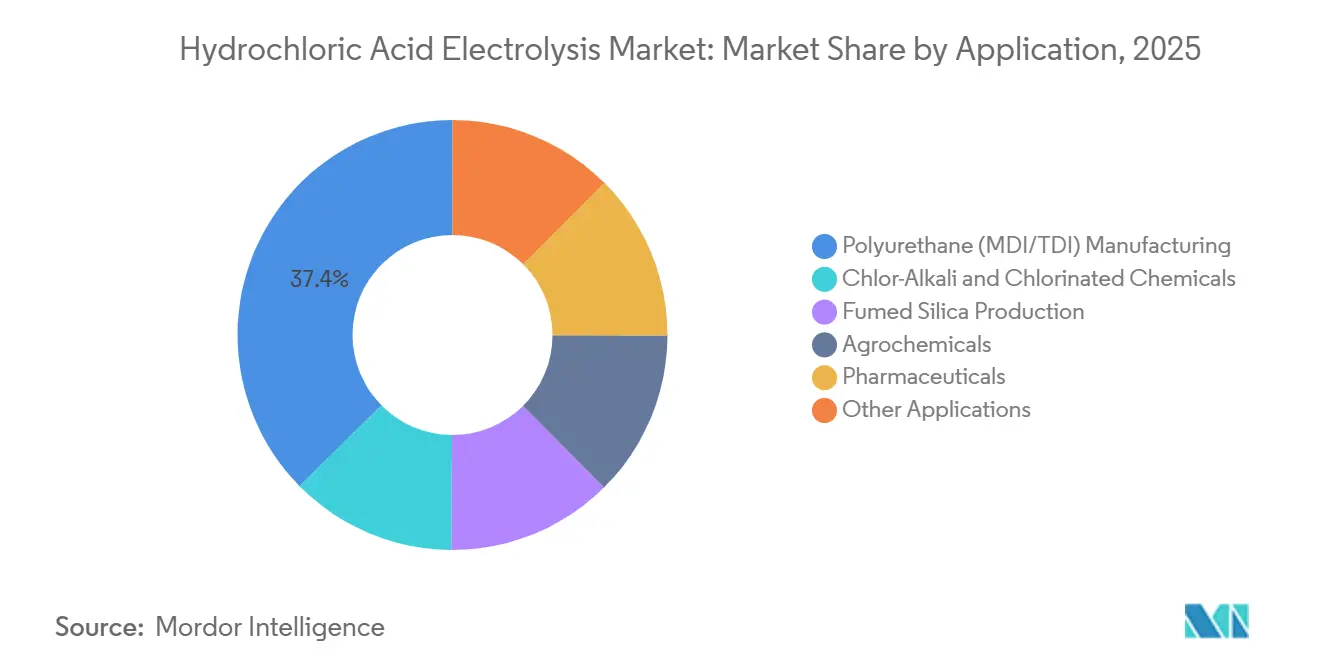
- By application, polyurethane (MDI/TDI) accounted for 37.41% of the hydrochloric acid electrolysis market size in 2025, while pharmaceuticals are projected to expand at a 5.64% CAGR through 2031.
- By geography, Asia-Pacific held 42.18% of the hydrochloric acid electrolysis market share in 2025 and is projected to record the fastest regional CAGR at 5.36% through 2031.
Note: Market size and forecast figures in this report are generated using Mordor Intelligence’s proprietary estimation framework, updated with the latest available data and insights as of January 2026.
Market Trends and Insights
Drivers Impact Analysis of Hydrochloric Acid Electrolysis Market*
| Drivers | (~) % Impact on CAGR Forecast | Geographic Relevance | Impact Timeline |
|---|---|---|---|
| Increasing Adoption of ODC and Membrane Technologies for On-Site Chlorine Recovery | +1.0% | Global, led by Europe and Asia-Pacific | Medium term (2-4 years) |
| Rising Demand for Sustainable Chlorine Production in Polyurethane and Chemical Manufacturing | +1.2% | Global, strongest in Asia-Pacific and Europe | Medium term (2-4 years) |
| Growing Use of HCl Electrolysis in Agrochemicals and High-Value Industrial Sectors | +0.7% | Asia-Pacific core, spillover to North America and Middle East, and Africa | Long term (≥ 4 years) |
| Expansion of High-Purity Chlorine Use in Pharmaceuticals and Electronics | +0.5% | Asia-Pacific and North America | Long term (≥ 4 years) |
| Stringent Environmental Rules Phasing Out Mercury-Cell and Diaphragm Processes | +0.8% | Europe primary, China secondary, with global spillover | Short term (≤ 2 years) |
| Source: Mordor Intelligence | |||
Increasing Adoption of ODC and Membrane Technologies Redefines Electrolysis Economics
Oxygen-depolarized cathode (ODC) systems have moved beyond the pilot stage and now offer a measurable operating case for industrial chlorine recovery. thyssenkrupp Nucera states that its ODC configuration reduces energy consumption by up to 30% compared with conventional aqueous hydrochloric acid electrolysis, while avoiding hydrogen byproduct formation, thereby improving feedstock efficiency for sites that require only chlorine recovery. This performance improvement is notable because electricity is one of the few operating variables that can quickly alter project economics in the hydrochloric acid electrolysis market. The technology shift also creates a replacement cycle within the installed base, as older membrane units, electrodes, and associated stack components become less competitive in terms of efficiency and maintenance. As a result, the hydrochloric acid electrolysis market is supported not only by new plant additions but also by recurring service, retrofit, and upgrade demand from existing chemical sites. A steady aftermarket for membranes and electrodes strengthens revenue visibility for established suppliers and explains why technical expertise continues to carry pricing power in this market.
Rising Demand for Sustainable Chlorine Recovery Reshapes MDI/TDI Value Chains
The hydrochloric acid electrolysis market is closely tied to how MDI and TDI plants manage stoichiometric hydrogen chloride generated during phosgenation, as recovery is increasingly more efficient than disposal when chlorine can be reused on site. This is why the market remains anchored by integrated chemical complexes seeking tighter control over both feedstock balance and environmental performance. Covestro's Krefeld-Uerdingen site illustrates this approach, as its recycling program recovers 19,000 tons of salt and 223,200 tons of demineralized water each year from process streams and channels those resources back into chlor-alkali operations[1]European Chemical Industry Council, “Innovative Salt Recycling, Reducing Water Waste and Preserving Resources in Chemical Production,” cefic.org. This level of site integration reduces dependence on externally sourced inputs and makes circularity a practical operating model rather than a separate sustainability initiative. The hydrochloric acid electrolysis market is therefore supported by producers seeking to reduce exposure to merchant chlorine purchases while improving waste handling and utility efficiency within the same asset base. As more polyurethane producers compare recovery costs with neutralization costs, the market should continue to benefit from projects designed around self-supply and lower process losses.
Growing Utilization in Agrochemicals Driven by Chlorinated Intermediate Demand
The hydrochloric acid electrolysis market is finding additional support in agrochemicals, where chlorine-based intermediate synthesis generates recurring hydrogen chloride streams that can be recycled at sufficient plant scale. This provides another industrial outlet beyond polyurethane and base chlor-alkali production, reducing dependence on a single end-use chain. Once plant operators begin treating recovery as part of supply assurance and waste reduction, electrolysis becomes easier to justify even when chlorine prices are not particularly high. The same pattern applies in other high-value industrial settings, where controlled chlorine recovery can improve site efficiency and reduce treatment loads. The hydrochloric acid electrolysis market benefits from this shift because demand is driven by steady process chemistry rather than short-lived discretionary spending. Over time, wider adoption across agrochemicals and specialty industrial production could broaden the customer mix without altering the market's core link to integrated chemical manufacturing.
Stringent Environmental Regulations Accelerating the Mercury-Cell Phase-Out
The hydrochloric acid electrolysis market is benefiting from environmental pressure, as legacy mercury-cell and diaphragm routes face increasing scrutiny over emissions, waste streams, and energy use. A 2024 review in the Journal of Materials Chemistry A noted that membrane-based ODC systems reduce energy requirements and better align with cleaner chlorine production goals than conventional alternatives. This technology direction is already visible in plant upgrades, including Kem One's modernization of its Fos-sur-Mer chlor-alkali site from diaphragm to bipolar membrane electrolysis, which the company reported was progressing in late 2024 and moving toward a more energy-efficient configuration in 2025. The hydrochloric acid electrolysis market benefits from these conversions because regulations are discouraging legacy process routes and directing capital toward assets that produce lower waste and operate more efficiently. The same pressure is also strengthening demand for high-purity chlorine in pharmaceutical and electronics applications, where compliance requirements are more stringent and quality control carries greater commercial weight. This combination of environmental pressure and purity-sensitive demand provides the hydrochloric acid electrolysis market with a more stable long-range base than a simple chlorine price cycle would suggest.
Restraints Impact Analysis of Hydrochloric Acid Electrolysis Market*
| Restraints | (~) % Impact on CAGR Forecast | Geographic Relevance | Impact Timeline |
|---|---|---|---|
| High Capital Investment for Specialized Electrolysis Infrastructure | -0.4% | Global, most acute in the Middle East and Africa, and parts of South America | Long term (≥ 4 years) |
| Significant Energy Consumption Raising Operating Costs in Carbon-Intensive Grids | -0.3% | Global, most acute in Europe and energy-constrained emerging markets | Medium term (2-4 years) |
| Dependence on High-Specification Membrane and Electrode Materials Limits Supply Flexibility | -0.2% | Global | Long term (≥ 4 years) |
| Source: Mordor Intelligence | |||
High Capital Investment Requirements Constrain Adoption Among Mid-Scale Operators
The hydrochloric acid electrolysis market remains challenging for mid-scale operators because full installation requires corrosion-resistant stacks, gas handling, acid conditioning, power systems, and safety infrastructure before any chlorine is produced. The capital burden is further amplified by long commissioning cycles; thyssenkrupp nucera indicates that projects can take up to 24 months from kickoff to chlorine production, which delays cash recovery and increases execution risk for smaller buyers. The market therefore favors large integrated producers that can spread project costs across broader chemical value chains and maintain high unit utilization from the start. The U.S. EPA ENERGY STAR guide for chlor-alkali operations also shows how oversized rectifiers, pumps, and fan systems can increase both initial capital costs and long-run maintenance needs when facility design is not tightly optimized[2]U.S. Environmental Protection Agency Energy Star, “Energy Efficiency and Cost-Saving Opportunities for the Chlor-Alkali Industry,” energystar.gov. Sites without stable hydrogen chloride volumes retain an incentive to continue with neutralization or external treatment, as the fixed investment threshold remains difficult to justify. Until modular formats scale more convincingly, the hydrochloric acid electrolysis market will continue to show a structural bias toward larger facilities with consistent internal chlorine demand.
Significant Energy Consumption Remains the Core Operational Vulnerability
The hydrochloric acid electrolysis market is highly sensitive to power economics because, while electrolysis performance may improve over time, the process still depends on large, reliable electricity inputs. This is especially relevant where grid tariffs are high or carbon intensity remains elevated, as those conditions can reduce the cost savings that make chlorine recovery attractive. BASF's 54 MW water electrolyzer commissioning at Ludwigshafen in March 2025 illustrates the scale of industrial electrochemical infrastructure and the importance of financing support, with the project receiving up to EUR 124.3 million (USD 134 million) in public co-financing. The hydrochloric acid electrolysis market faces similar economic pressures as industrial buyers compare self-generation, grid power, and purchased chlorine amid shifting tariff conditions. Supply dependence on high-specification membranes and electrodes adds another layer of exposure, as replacement planning becomes more difficult when specialized materials are concentrated among a limited number of vendors. The hydrochloric acid electrolysis market can grow steadily while remaining exposed to power price volatility, equipment lead times, and uneven access to supportive industrial policy.
*Our forecasts treat driver/restraint impacts as directional, not additive. The impact forecasts reflect baseline growth, mix effects, and variable interactions.
Hydrochloric Acid Electrolysis Market Segment Analysis
By Technology:
Membrane Architecture Holds Structural Dominance, Diaphragm Finds Specialty RoleMembrane technology accounted for 88.26% of revenue in 2025, reflecting the shift in the hydrochloric acid electrolysis industry toward high-purity, lower-maintenance configurations over legacy diaphragm systems. Membrane technology is also projected to record a 5.12% CAGR through 2031, keeping it ahead of the overall hydrochloric acid electrolysis market and confirming that replacement demand continues to reinforce its installed base. The segment's strength lies in higher product purity, lower maintenance requirements, and alignment with current environmental standards in large chemical parks. A 2024 review in the Journal of Materials Chemistry A supports this direction by showing that Oxygen Depolarized Cathode (ODC) electrolysis, as a membrane-based pathway, can reduce energy consumption by replacing cathodic hydrogen evolution with oxygen reduction. In practical terms, membrane systems are well-suited to applications within the hydrochloric acid electrolysis market where chlorine recovery must be dependable, efficient, and compatible with circular process design.
Diaphragm technology accounts for the remaining share, and its continued role is linked to cases where hydrogen byproduct retains site-level value. This means diaphragm systems remain present in the hydrochloric acid electrolysis industry, but are increasingly confined to narrower operating requirements rather than being the preferred choice for mainstream new builds. A 2025 comparative study in the International Journal of Hydrogen Energy found that anhydrous HCl electrolysis at 80% conversion efficiency can be more economically attractive than current aqueous routes due to simpler post-processing and high-purity hydrogen output. This finding does not alter the current share structure in the 2026-2031 window, but it does indicate that future technology competition may extend beyond the current membrane-versus-diaphragm split. Other technology formats, including more modular concepts for remote acid regeneration, remain small today but are relevant because they could lower entry barriers in parts of the hydrochloric acid electrolysis market that cannot support a full, large-site installation. Currently, membrane systems maintain their position in the hydrochloric acid electrolysis market, as they meet the prevailing requirements for purity, efficiency, and regulatory compliance.



By Application:
MDI/TDI Chemistry Anchors Volume, Pharmaceuticals Reshape Value TrajectoryPolyurethane (Methylene Diphenyl Diisocyanate/Toluene Diisocyanate [MDI/TDI]) manufacturing accounted for 37.41% of revenue in 2025, making it the single largest application and the primary volume anchor for the hydrochloric acid electrolysis market. This share reflects a straightforward operating reality: phosgenation produces hydrogen chloride in every cycle, and large isocyanate plants require a dependable method to recover or manage that stream at scale. As a result, suppliers often size projects in the hydrochloric acid electrolysis market around polyurethane complexes first, then assess how additional downstream chlorine use can improve returns. Chlor-alkali and chlorination applications remain important alongside polyurethane, as they allow sites to supplement or replace purchased chlorine with internally recovered output, improving feedstock control and reducing exposure to external price fluctuations. Consequently, the hydrochloric acid electrolysis market continues to derive most of its current volume from large integrated facilities, where chlorine reuse is embedded in plant design rather than treated as an optional addition.
Pharmaceuticals are projected to grow at a 5.64% CAGR through 2031, making the segment the fastest-growing application in the hydrochloric acid electrolysis market. The segment is distinguished by the importance of purity assurance, traceability, and documentation over commodity chemical channels, which supports a higher value-per-ton profile for electrolytically derived output. This is where the hydrochloric acid electrolysis market shows a different growth pattern: the strongest value expansion does not depend solely on bulk volume, but also on applications that require tighter quality control. Agrochemicals contribute a steady demand layer through chlorine-based intermediate chemistry, while other applications, such as water treatment and specialty synthesis, provide smaller but useful balancing volumes. Together, these uses reduce the hydrochloric acid electrolysis market's exposure to a single downstream vertical, even though polyurethane continues to lead on current scale. The application mix therefore reflects a market anchored by industrial necessity today and gradually supported by higher-purity demand as the forecast period progresses.
Geography Analysis
APAC Hydrochloric Acid Electrolysis Market
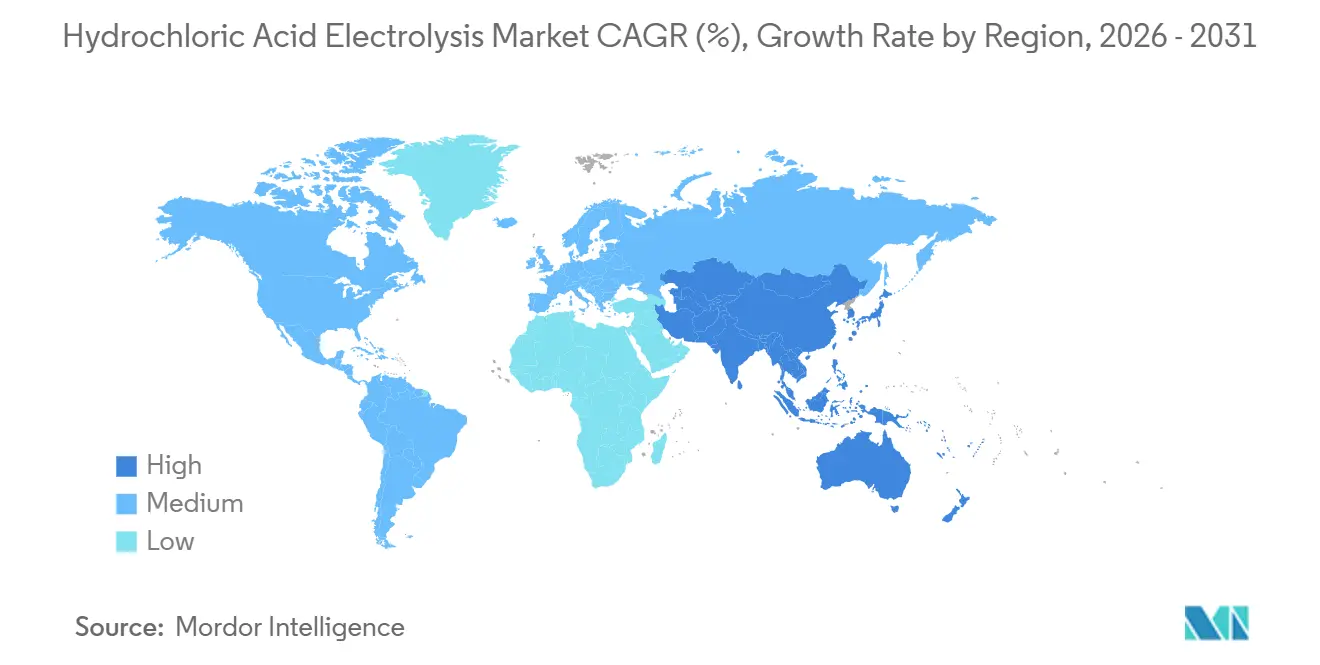
Asia-Pacific accounted for 42.18% of revenue in 2025, making it the largest regional market and the fastest-growing geography at a 5.36% CAGR through 2031 in the hydrochloric acid electrolysis market. The regional position reflects the concentration of polyurethane production, chlor-alkali clusters, and integrated polyvinyl chloride (PVC) chains across the main manufacturing economies of East and South Asia. This part of the market benefits from large plant scale, tighter supplier ecosystems, and the ability to connect byproduct recovery with direct downstream chlorine use within the same industrial zones. The region also benefits from a broad mix of industrial demand, as commodity chemicals, higher-purity applications, and export-oriented manufacturing all operate within the same production network.
Europe and North America Hydrochloric Acid Electrolysis Market
Europe is one of the most technologically intensive parts of the hydrochloric acid electrolysis market, where environmental compliance and efficiency pressures are more defined than in many other regions. Regional demand is anchored by integrated chemical sites seeking lower-emission chlorine recovery, reduced utility consumption, and alignment with circular manufacturing goals. Covestro's Krefeld-Uerdingen facility recovers 19,000 tons of salt and 223,200 tons of demineralized water each year for reuse, directly linking process circularity with chlor-alkali operations. Kem One's move toward bipolar membrane electrolysis at Fos-sur-Mer is another example of asset modernization reinforcing membrane adoption in the region. North America follows a similar approach across its integrated vinyls and specialty chemical base, although the pace of adoption remains closely tied to plant-specific power economics and internal chlorine reuse needs.
South America and MEA Hydrochloric Acid Electrolysis Market
South America, the Middle East, and Africa remain smaller markets, but all three regions are becoming more relevant to the hydrochloric acid electrolysis market as industrial chlorine use broadens. South America has support from agrochemical and petrochemical activity, where recurring hydrogen chloride streams could eventually justify more recovery projects once utilization levels become more predictable. The Middle East and Africa have different dynamics, as lower-cost electricity in some Gulf locations could improve the long-run economics of large electrolysis assets if local isocyanate- and chlorine-linked manufacturing capacity expands. At present, both regions remain earlier in the adoption cycle than Asia-Pacific or Europe, and growth is likely to come first from selected industrial parks rather than a broad regional rollout.

Competitive Landscape
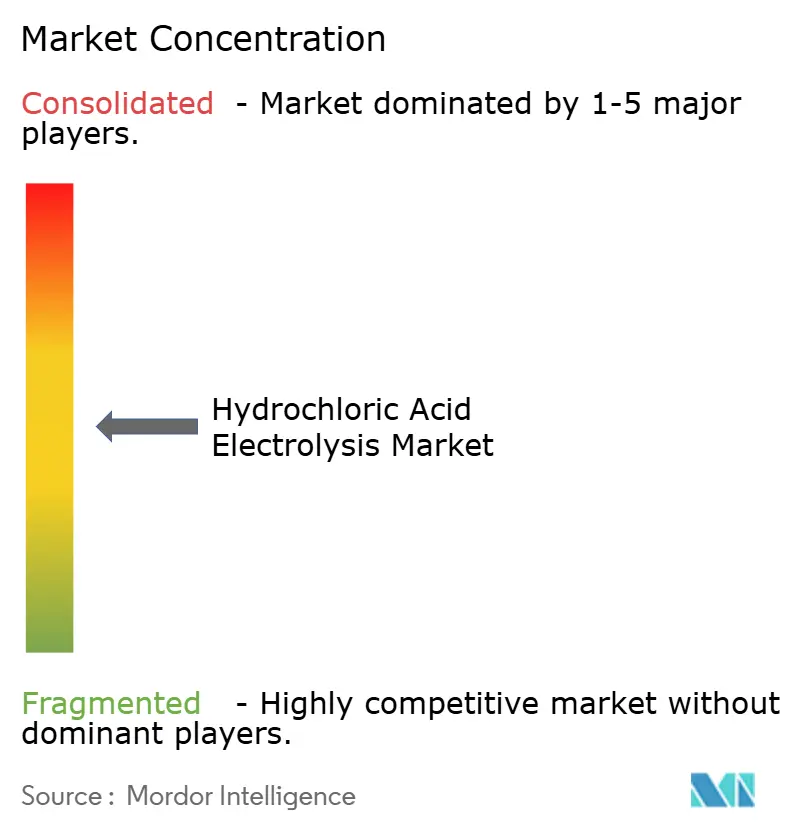
The hydrochloric acid electrolysis market is moderately fragmented. A small group of licensors controls key membrane, electrode, and engineering capabilities that are difficult for new entrants to replicate quickly. At the same time, the broader market includes many end-user chemical producers that buy and operate equipment rather than compete directly as open-market technology vendors. This split gives leading licensors strong influence over project design, service contracts, and replacement cycles, while most chemical companies remain focused on operational efficiency within their own production chains. The market therefore shows clear concentration at the technology layer but a wider, less concentrated base at the buyer layer. This structure explains why pricing power is stronger in specialized equipment and lifecycle services than in the downstream ownership base of the market.
Strategic differentiation in the hydrochloric acid electrolysis market increasingly depends on service depth, upgrade pathways, and site integration support rather than on hardware alone. Thyssenkrupp Nucera's technology position is supported by the efficiency case for Oxygen Depolarized Cathode (ODC) and membrane systems, particularly where buyers seek lower energy consumption and reduced waste in chlorine recovery. Kem One's modernization of Fos-sur-Mer illustrates how suppliers benefit when end users transition legacy assets to bipolar membrane electrolysis and higher operating efficiency. Covestro's circular salt and water recovery work demonstrates another route to competitive advantage by improving feedstock loops and utility performance without altering the fundamental requirement for chlorine recovery. BASF's large electrolyzer commissioning at Ludwigshafen further indicates that electrochemical infrastructure decisions are becoming part of broader decarbonization and process efficiency planning across major chemical sites.
The hydrochloric acid electrolysis market still offers opportunities for smaller or regional entrants, but the most realistic prospects lie in modular, mid-scale formats that serve sites too small for the dominant large-project model. This gap is relevant because many prospective users generate steady hydrogen chloride streams but cannot justify a full-scale installation with a long payback period. Barriers remain high, as the market demands corrosion expertise, process safety capability, and reliable access to specialized membranes and electrodes. Market leadership remains with established licensors and major integrated chemical operators that can manage long project cycles and capture value across a wider process chain.
Hydrochloric Acid Electrolysis Industry Leaders
thyssenkrupp nucera AG & Co. KGaA
Covestro AG
Huntsman International LLC
INEOS AG
Solvay
- *Disclaimer: Major Players sorted in no particular order
Hydrochloric Acid Electrolysis Market Companies Covered in this Report
- Asahi Kasei Corporation
- BASF SE
- Covestro AG
- Dow
- Eastman Chemical Company
- Formosa Plastics Corporation
- Huntsman International LLC
- INEOS AG
- Kem One
- Nouryon
- Shin-Etsu Chemical Co., Ltd.
- Solvay
- Sumitomo Chemical Co., Ltd.
- thyssenkrupp nucera AG & Co. KGaA
- Tosoh Corporation
- Westlake Chemical Corporation

Recent Industry Developments in Hydrochloric Acid Electrolysis Market
- February 2026: AGC Vinythai commenced commercial operations at its expanded chlor-alkali plant in Map Ta Phut, Thailand, deploying thyssenkrupp nucera's e-BiTAC v7 bipolar ion exchange membrane electrolyzer. This is one of the largest deployments of this technology in a vinyl production chain in Southeast Asia, supplying chlorine for Vinyl Chloride Monomer (VCM) and PVC production.
- October 2025: thyssenkrupp nucera presented its new-generation BM2.7 v7 and improved e-BiTAC v7 electrolyzers at its Chlorine Symposium in Cologne. The electrolyzers achieve power consumption of less than 1,960 kWh per ton of NaOH at 6 kA/m², and incorporate REES (Resilient Elastic Element Structure) cathode technology for faster maintenance turnarounds, resulting in improved electrolyzer efficiency and operational availability.


Global Hydrochloric Acid Electrolysis Market Report Scope
Hydrochloric acid electrolysis is the process of passing an electric current through an HCl solution to break it down. During this reaction, hydrogen gas (H₂) is produced at the negative cathode and chlorine gas (Cl₂) is produced at the positive anode.
The hydrochloric acid electrolysis market is segmented by technology, application, and geography. By technology, the market is segmented into membrane technology, diaphragm technology, and other technology. By application, the market is segmented into polyurethane (MDI/TDI) manufacturing, chlor-alkali and chlorinated chemicals, fumed silica production, agrochemicals, pharmaceuticals, and other applications. The report also covers market size and forecasts for hydrochloric acid electrolysis across 16 countries in major regions. The market sizes and forecasts are provided in terms of value (USD).
| Membrane Technology |
| Diaphragm Technology |
| Other Technology |
| Polyurethane (MDI/TDI) Manufacturing |
| Chlor-Alkali and Chlorinated Chemicals |
| Fumed Silica Production |
| Agrochemicals |
| Pharmaceuticals |
| Other Applications |
| Asia-Pacific | China |
| India | |
| Japan | |
| South Korea | |
| Rest of Asia-Pacific | |
| North America | United States |
| Canada | |
| Mexico | |
| Europe | Germany |
| United Kingdom | |
| France | |
| Italy | |
| Russia | |
| Rest of Europe | |
| South America | Brazil |
| Argentina | |
| Rest of South America | |
| Middle-East and Africa | Saudi Arabia |
| South Africa | |
| Rest of Middle-East and Africa |
| By Technology | Membrane Technology | |
| Diaphragm Technology | ||
| Other Technology | ||
| By Application | Polyurethane (MDI/TDI) Manufacturing | |
| Chlor-Alkali and Chlorinated Chemicals | ||
| Fumed Silica Production | ||
| Agrochemicals | ||
| Pharmaceuticals | ||
| Other Applications | ||
| By Geography | Asia-Pacific | China |
| India | ||
| Japan | ||
| South Korea | ||
| Rest of Asia-Pacific | ||
| North America | United States | |
| Canada | ||
| Mexico | ||
| Europe | Germany | |
| United Kingdom | ||
| France | ||
| Italy | ||
| Russia | ||
| Rest of Europe | ||
| South America | Brazil | |
| Argentina | ||
| Rest of South America | ||
| Middle-East and Africa | Saudi Arabia | |
| South Africa | ||
| Rest of Middle-East and Africa | ||


Key Questions Answered in the Report
What is current market size of Hydrochloric Acid Electrolysis Market?
The Hydrochloric Acid Electrolysis Market size is expected to grow from USD 0.89 billion in 2025 to USD 0.93 billion in 2026 and is forecast to reach USD 1.18 billion by 2031 at 4.88% CAGR over 2026-2031.
Which technology leads to hydrochloric acid electrolysis?
Membrane technology leads with 88.26% revenue share in 2025 and posts the fastest technology CAGR at 5.12% through 2031.
Why are MDI and TDI plants important in this space?
Polyurethane (MDI/TDI) accounted for 37.41% of revenue in 2025 because phosgenite produces hydrogen chloride, which is more efficiently recovered and reused at large integrated sites.
Which application is growing the fastest through 2031?
Pharmaceuticals are projected to grow at a 5.64% CAGR because high-purity, traceable chlorine-linked inputs command greater value in tightly controlled supply chains.
Page last updated on:





