
Hybrid Excavators Market Size and Share
Market Overview
| Study Period | 2020 - 2032 |
|---|---|
| Market Size (2027) | USD 3.95 Billion |
| Market Size (2032) | USD 6.01 Billion |
| Growth Rate (2027 - 2032) | 8.76 % |
| Fastest Growing Market | Europe |
| Largest Market | Asia-Pacific |
| Market Concentration | Medium |
Major Players *Disclaimer: Major Players sorted in no particular order Image © Mordor Intelligence. Reuse requires attribution under CC BY 4.0. | |
Hybrid Excavators Market Analysis by Mordor Intelligence
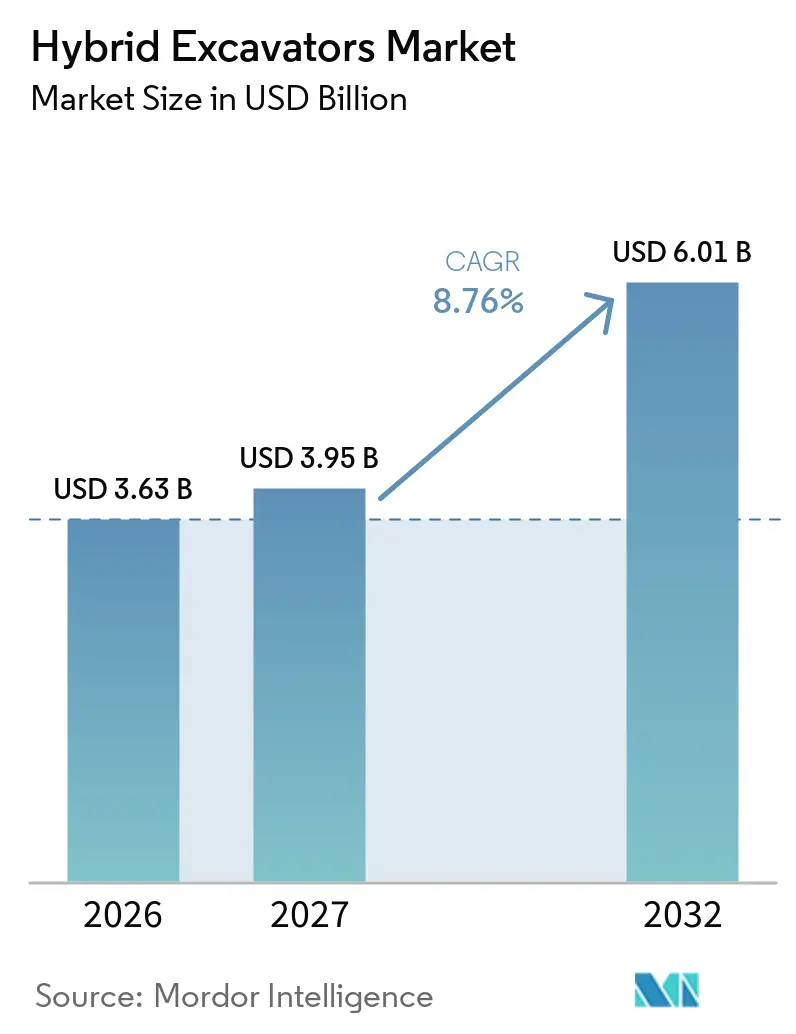
The hybrid excavators market size was valued at USD 3.63 billion in 2026 and is expected to grow from USD 3.95 billion in 2027 to USD 6.01 billion by 2032, at a CAGR of 8.76% during 2027-2032. The hybrid excavators market is moving from early adoption toward planned fleet replacement among contractors, miners, and infrastructure operators with long machine duty cycles. Fuel use has become a central procurement issue because savings accumulate across machines and replacement cycles. Emission rules also create a more predictable reason to replace older non-road equipment. Hybrid models offer a practical option where charging access, range, or site conditions limit the use of fully electric excavators. This gives the hybrid excavators market a role between conventional diesel fleets and fully electric equipment.
Key Report Takeaways
- By type, crawler excavators held 87.42% of the hybrid excavators market share in 2026, while wheeled excavators are projected to grow at a 9.63% CAGR through 2032.
- By hybrid technology, diesel-electric hybrid systems held 71.38% of the hybrid excavators market share in 2026 and are projected to grow at a 9.21% CAGR through 2032.
- By operating weight, the 20 to 40 tons segment held 52.16% of the hybrid excavators market share in 2026, while below 20 tons is projected to grow at a 10.37% CAGR through 2032.
- By engine power, the 100 to 200 HP segment held 43.27% of the hybrid excavators market share in 2026, while below 100 HP is projected to grow at a 10.12% CAGR through 2032.
- By end user, construction contractors held 58.34% of the hybrid excavators market share in 2026, while utilities and energy companies are projected to grow at a 10.84% CAGR through 2032.
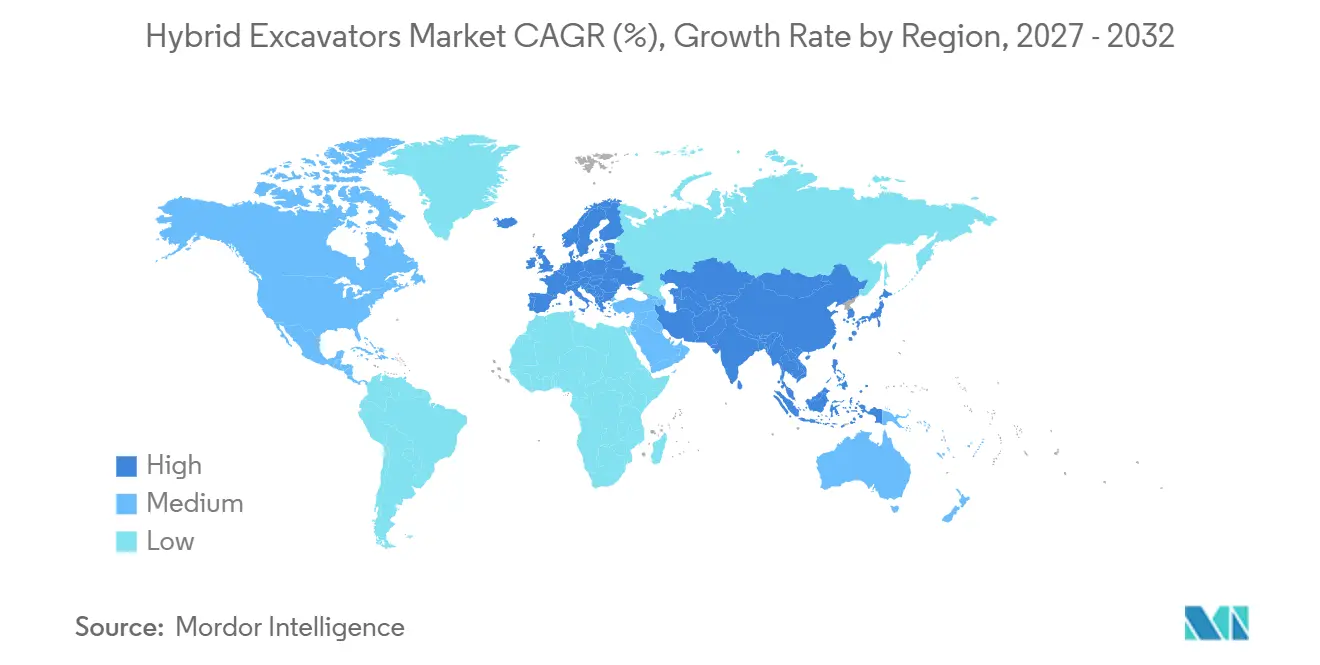
- By geography, Asia-Pacific held 54.27% of the hybrid excavators market share in 2026, while Europe is projected to grow at a 10.18% CAGR through 2032.
Note: Market numbers in this report are based on Mordor Intelligence's proprietary estimation framework, which combines nine months of actuals with Q4 projections for base year 2026.
Market Trends and Insights
Drivers Impact Analysis of Hybrid Excavators Market*
| Driver | (~) % Impact on CAGR Forecast | Geographic Relevance | Impact Timeline |
|---|---|---|---|
| Rising Fuel-Cost Sensitivity in High-Utilization Fleets | +2.8% | Global, strongest in Asia-Pacific and Middle East | Short term (≤ 2 years) |
| Tightening Non-Road Emission Standards | +2.4% | European Union, North America, and China, with spillover to ASEAN | Medium term (2–4 years) |
| Infrastructure and Mining Fleet Modernization | +1.9% | Asia-Pacific, Middle East and Africa | Medium term (2–4 years) |
| Demand for Lower Cost per Ton Without Full Electrification | +1.3% | Global | Short term (≤ 2 years) |
| Energy-Recovery Benefits in Swing- and Boom-Intensive Duty Cycles | +0.8% | Global | Short term (≤ 2 years) |
| Hybrid Availability as a Bridge to Full Electrification | +0.6% | European Union, North America, and Japan | Long term (≥ 4 years) |
| Source: Mordor Intelligence | |||
Rising Fuel-Cost Sensitivity in High-Utilization Fleets
Fuel costs are a major operating expense for fleets that operate excavators for long annual hours. Hybrid systems recover energy during normal machine movements and reduce the fuel exposure of those fleets. Komatsu stated that its PC365LC-11, introduced for North America in December 2025, can reduce fuel consumption by up to 20% against comparable conventional models through an ultracapacitor-backed electric swing system[1]. The system produces stored energy during operation, so operators do not need external charging for that function. Those savings can strengthen the case for replacing high-use fleets because the financial benefit is repeated throughout a machine’s service life. The hybrid excavators market therefore has its clearest immediate case where utilization is high, and fuel savings are visible in operating budgets.
Tightening Non-Road Emission Standards
Emission rules provide an additional reason to replace older equipment, even when fuel prices are stable. Regulation (EU) 2016/1628 establishes gaseous and particulate emission requirements and type-approval rules for non-road mobile machinery in the European Union [2]. The rule has helped make emissions performance a practical fleet planning issue for European equipment buyers. Hybrid configurations can reduce engine loading during repeated swing and boom movements. That operating characteristic aligns with the compliance priorities faced by fleets renewing equipment. The hybrid excavators market benefits when manufacturers can combine emissions hardware and energy-recovery systems in one product development program.
Infrastructure and Mining Fleet Modernization
Infrastructure programs and mining investment support demand for new excavators in regions with large projects. Fleet modernization is increasingly assessed through lifetime cost rather than purchase price alone. Hybrid systems can reduce engine loading during demanding work cycles, which can support longer intervals between major repairs. This matters to mining fleets because downtime and rebuild planning can affect production schedules. The resulting value proposition extends beyond fuel use and includes maintenance planning and machine availability. These conditions support the hybrid excavators market in applications where equipment works consistently at high load.
Demand for Lower Cost per Ton Without Full Electrification
Remote projects and quarry operations often lack the charging access needed for battery-only equipment. Long work shifts and difficult site conditions can also make battery-only deployment less practical. Hybrid machines reduce fuel use without requiring charging infrastructure at the job site. Volvo Construction Equipment introduced five hydraulic hybrid crawler excavators in February 2025, covering the EC260 Hybrid through EC500 Hybrid range. Volvo stated that the models can deliver up to 20% better fuel efficiency and 15% lower CO2 emissions than the prior conventional series[3]. This product expansion supports the view that the hybrid excavators market can serve larger machines without requiring a change to site charging practices.
Restraints Impact Analysis of Hybrid Excavators Market*
| Restraint | (~) % Impact on CAGR Forecast | Geographic Relevance | Impact Timeline |
|---|---|---|---|
| Higher Acquisition Cost and Uncertain Payback for Low-Utilization Fleets | -1.8% | Global, most pronounced in South America and Sub-Saharan Africa | Short term (≤ 2 years) |
| Limited Hybrid-Specific Service and Diagnostic Capability | -1.2% | ASEAN, South America, Sub-Saharan Africa | Medium term (2–4 years) |
| Residual-Value Uncertainty and Battery or Capacitor Replacement Risk | -0.9% | Global | Medium term (2–4 years) |
| Site-Level Duty-Cycle Variability Reducing Energy-Recovery Benefits | -0.6% | Global | Short term (≤ 2 years) |
| Source: Mordor Intelligence | |||
Higher Acquisition Cost and Uncertain Payback for Low-Utilization Fleets
Hybrid powertrains add electric motors, energy-storage components, and power electronics to the machine. Those components increase the initial equipment cost for buyers. Fleets with limited annual hours may not generate sufficient fuel savings over normal ownership cycles to offset that premium. The constraint is stronger in markets with intermittent project pipelines or fuel support policies. Smaller contractors and rental fleets can be more cautious because they carry resale uncertainty alongside the higher acquisition cost. The hybrid excavators market remains more compelling for operators who can spread the premium over substantial working hours.
Limited Hybrid-Specific Service and Diagnostic Capability
Hybrid excavators require technicians who can diagnose high-voltage electronics, electric motors, and energy-storage systems. Many regional dealer networks have not yet made the investments in tools and training needed for these machines. This restricts adoption where original equipment manufacturer service coverage is thin. Independent repair providers may also be less prepared to support hybrid-specific faults after warranty coverage ends. Longer downtime or higher service charges can reduce the appeal of ownership for marginal buyers. Service readiness will therefore influence how widely the hybrid excavators market extends beyond established equipment markets.
*Our forecasts treat driver/restraint impacts as directional, not additive. The impact forecasts reflect baseline growth, mix effects, and variable interactions.
Hybrid Excavators Market Segment Analysis
By Type:
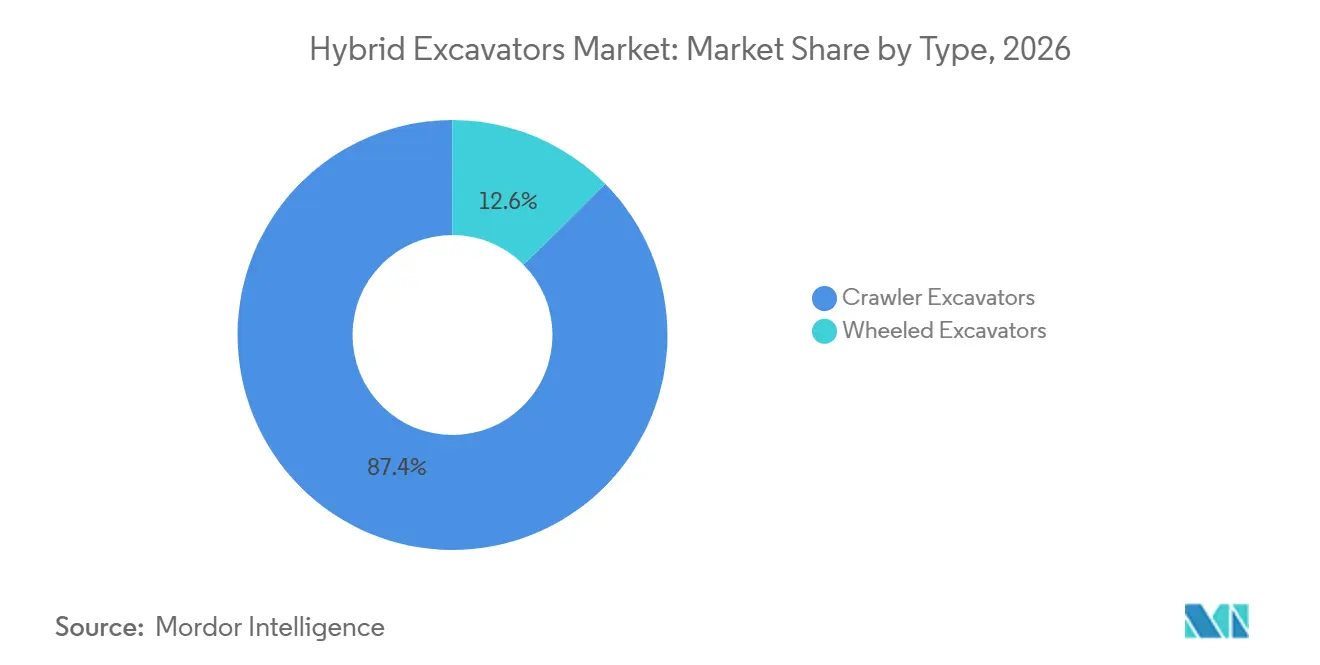
Crawler Models Retain the Core Position While Wheeled Models ExpandCrawler hybrid excavators held 87.42% of value in 2026, reflecting their fit with bulk earthmoving and quarry work. Their operating pattern includes frequent swing cycles, which creates repeated opportunities to recover energy. Crawler machines also serve many high-use construction tasks where fuel savings can influence total ownership cost. Manufacturers have concentrated much of their hybrid product activity in this established application base. Volvo’s February 2025 launch included five crawler hybrid models across its new generation portfolio. The hybrid excavators market continues to rely on this type because the work cycle and hybrid system are closely aligned.
Wheeled hybrid excavators are projected to grow at a 9.63% CAGR through 2032. These machines suit utility work, road maintenance, and site preparation where moving between locations by road can lower repositioning needs. European urban projects provide a notable use case because equipment may need to travel across several restricted areas in one day. Low-emission procurement requirements can further support demand for mobile equipment with lower fuel use. The product category remains smaller than crawler equipment, but it addresses a distinct operating need. Its growth shows that the hybrid excavators market is widening from heavy earthmoving into urban work patterns.
By Hybrid Technology:
Diesel-Electric Systems Remain the Commercial MainstayDiesel-electric hybrid systems held 71.38% of value in 2026. Capacitor and battery storage systems can capture energy from swing deceleration and return it during subsequent movements. Capacitors are particularly suited to rapid charge and discharge cycles in repeated excavation work. The arrangement can reduce fuel use without requiring external electricity at the site. Komatsu’s PC365LC-11 uses an ultracapacitor-backed electric swing system that generates stored energy during normal operation. This operational independence helps explain why diesel-electric technology remains central to the hybrid excavators market.
Diesel-electric hybrid systems are also forecast to grow at a 9.21% CAGR through 2032. The technology has a practical advantage for operators that want fuel savings but cannot plan around charging windows. Hydraulic hybrid systems retain a separate role because they recover energy from boom movement rather than relying on the same electrical storage design. Other configurations, including hydrogen fuel cell and dual-fuel approaches, remain at an earlier commercial stage. Their development shows that manufacturers are testing several pathways to lower-emission excavation. The hybrid excavators market therefore includes both established diesel-electric platforms and emerging alternatives with different operating characteristics.
By Operating Weight:
Mid-Range Equipment Holds Volume While Compact Machines AdvanceThe 20 to 40 tons segment held 52.16% of value in 2026. This class serves general construction, earthmoving, and many infrastructure tasks. It offers a strong fit between machine size and the energy recovered from repetitive swing movements. Leading manufacturers have concentrated hybrid portfolios around this broad application range. The segment also benefits from established dealer support and familiar work practices among contractors. Its position makes it a major foundation for the hybrid excavators market.
Below 20 tons is forecast to grow at a 10.37% CAGR through 2032. Compact equipment is used in dense urban construction, utility work, and smaller site-preparation activities. These applications can favor lower-emission machinery because the work occurs closer to buildings and public spaces. Rental adoption may support access to hybrid equipment for buyers that do not want to own specialized machines. Tightening requirements in cities can encourage contractors to consider lower-emission options for compact fleets. This expansion broadens the hybrid excavators market beyond its traditional focus on larger earthmoving equipment.
By Engine Power:
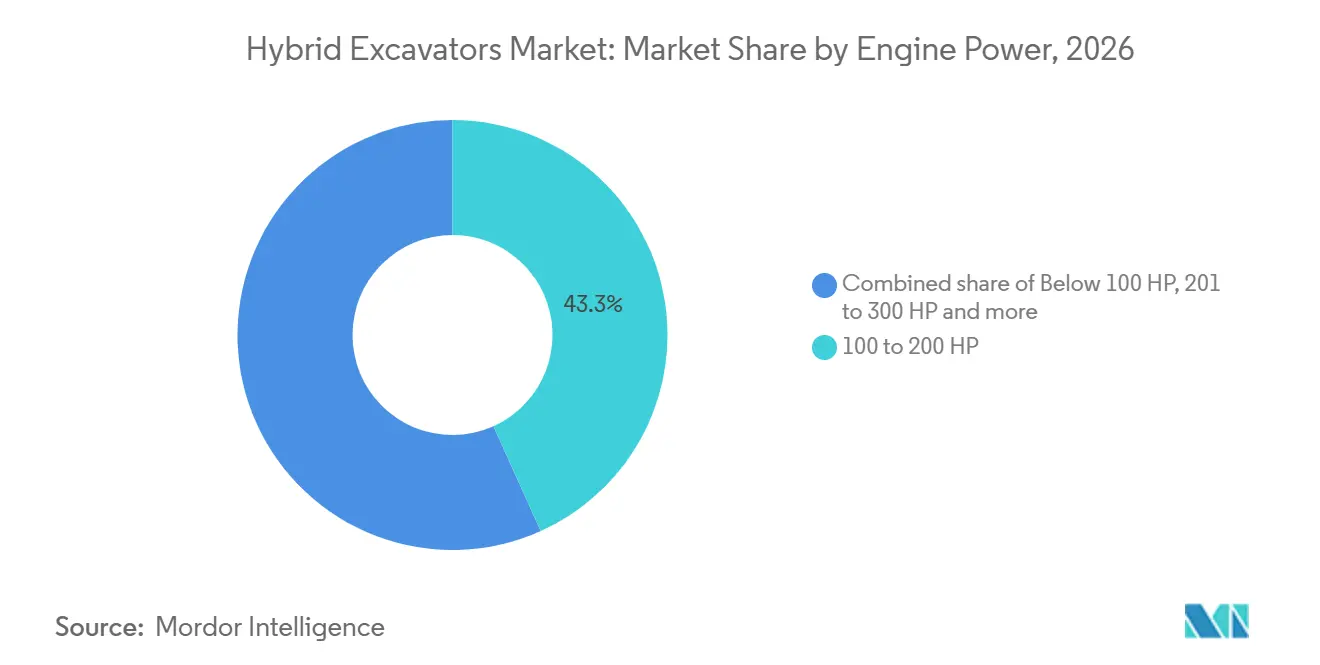
Mid-Power Machines Lead and Lower-Power Equipment Gains PaceThe 100 to 200 HP segment held 43.27% of value in 2026. This range aligns with the core operating needs of general construction and mid-scale excavation. It also corresponds closely to the operating weight class that leads demand. Manufacturers can use established distribution networks and installed equipment bases to support sales in this range. Competitive differentiation depends on energy management, machine control, and service access as much as on engine output. These factors keep the hybrid excavators market centered on versatile mid-power equipment.
Below 100 HP is projected to grow at a 10.12% CAGR through 2032. Demand follows the expansion of compact machines into urban construction and local utility applications. Smaller machines can be more exposed to municipal requirements for lower-emission work near populated areas. Their role in short-duration projects also supports rental-based procurement. The category gives equipment makers a way to introduce hybrid features to customers with different ownership models. Growth in this range adds another entry point to the hybrid excavators market.

By End User:
Contractors Lead While Utilities and Energy Companies AccelerateConstruction contractors held 58.34% of demand in 2026. Contractors operate excavators across a wide range of site conditions and frequently manage fuel use at fleet level. High-use construction fleets can place a clear value on lower fuel consumption and predictable operating costs. Public tender requirements can also make lower-emission equipment more relevant to contractor bids. Their broad equipment needs and high utilization explain their leading position. Construction activity remains the largest direct source of demand in the hybrid excavators market.
Utilities and energy companies are forecast to grow at a 10.84% CAGR through 2032. Grid expansion, renewable energy construction, and utility network upgrades require repeated excavation work. These operators are increasingly focused on fleet planning and lifecycle cost. Manufacturers are also widening utility-focused excavator lineups, as shown by SANY America's four utility and grade-control models at ConExpo-Con/AGG 2026, which creates a base for future hybrid variants in this customer group. Utility projects can have sustained work hours and formal procurement requirements, which support consideration of lower-emission machines. This makes utilities an important expansion area for the hybrid excavators market.
Geography Analysis
Asia-Pacific held 54.27% of global value in 2026. China and Japan are the main regional contributors. China’s equipment replacement cycle is supported by non-road emissions compliance requirements. Japan has a deep original equipment manufacturer base and a long history of hybrid excavator development. India, Indonesia, Vietnam, and Thailand are at earlier stages of adoption, where dealer coverage and project scale shape the pace of demand. Demand in Australia is supported by mining work that requires durable equipment for long operating hours.
Europe is projected to grow at a 10.18% CAGR through 2032. Regulation (EU) 2016/1628 provides a common emissions framework for non-road machinery across the European Union. Public procurement rules in several cities add stronger pressure for construction equipment with lower emissions. Hybrid machines can meet near-term project needs while retaining operating flexibility on sites where battery charging remains difficult. This makes the region important for product deployment and tender-led adoption. European demand gives the hybrid excavators market a policy-led growth path distinct from fuel-driven purchasing.
North America has an established base of compliant construction equipment and continuing infrastructure work. Komatsu introduced the PC365LC-11 in North America in December 2025 with a transferable electric powertrain warranty. South America grows more slowly where projects are less consistent and specialist service support is limited. The Middle East benefits from infrastructure and mining projects with favorable equipment utilization. Sub-Saharan Africa is developing from a low base, with adoption concentrated in mining uses. Australia, within Asia-Pacific, records medium growth led by mining demand, while Russia, within Europe, faces lower growth under infrastructure and supply constraints.
Competitive Landscape
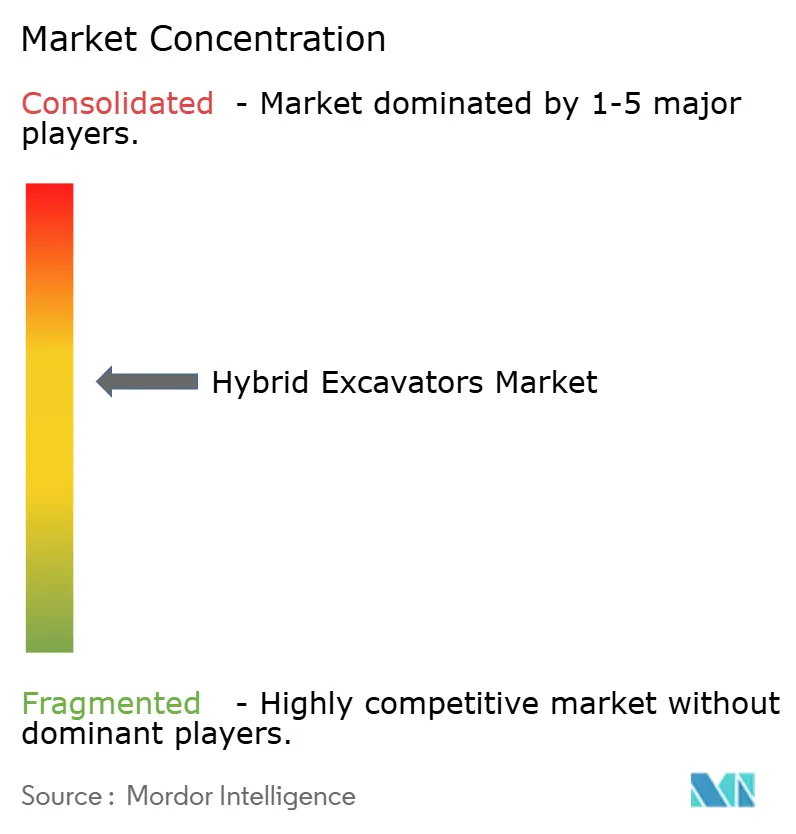
The hybrid excavators market is moderately concentrated. Komatsu, Caterpillar, Hitachi Construction Machinery, Kobelco, and Sumitomo lead hybrid-specific activity through energy management systems, storage designs, and telematics. Their established product development and service capabilities make it harder for newer entrants to compete on more than price. These companies use hybrid systems as a route toward broader electrification and lower-emission product programs. Komatsu’s April 2026 global launch of the PC9000-12, offered with diesel or fully electric drive, illustrates continued investment in large electrified mining excavator platforms. The leading group has significant influence, but the market remains open to several active competitors.
Chinese manufacturers, including SANY, XCMG, Zoomlion, and LiuGong, compete actively through price, expanding portfolios, and investment in electrified equipment. SANY’s rollout of its 1,000th electric excavator in May 2026 signals the scale of its investment in adjacent electrified equipment. Their progress raises competition in equipment categories adjacent to hybrid models. European access also depends on meeting emissions and procurement requirements. This creates a compliance threshold for manufacturers seeking public project work in the region. The hybrid excavators market is therefore competitive across technology capability, service access, and equipment price.
Rental fleets represent an important commercial opportunity because they can distribute a machine’s higher purchase cost across several customers. Early investment in lower-emission equipment can help rental operators serve urban projects and public tenders. Equipment manufacturers are responding with products that address utility, construction, mining, and compact-equipment use cases. The value of hybrid ownership is strongest where machines work long hours and recover energy frequently. Low-use owners remain less likely to accept higher upfront cost because payback and resale value are less certain.
Hybrid Excavators Industry Leaders
-
Caterpillar Inc.
-
Komatsu Ltd.
-
Hitachi Construction Machinery Co., Ltd.
-
Sumitomo Heavy Industries, Ltd.
-
Kobelco Construction Machinery Co., Ltd.
- *Disclaimer: Major Players sorted in no particular order
Hybrid Excavators Market Companies Covered in this Report
- Caterpillar Inc.
- Komatsu Ltd.
- Hitachi Construction Machinery Co., Ltd.
- AB Volvo
- Kobelco Construction Machinery Co., Ltd.
- Sumitomo Heavy Industries, Ltd.
- Liebherr-International AG
- SANY Heavy Industry Co., Ltd.
- Deere & Company
- J.C. Bamford Excavators Ltd.
- HD Hyundai Co., Ltd.
- Doosan Bobcat Inc.
- XCMG Construction Machinery Co., Ltd.
- CNH Industrial N.V.
- Zoomlion Heavy Industry Science & Technology Co., Ltd.
- Guangxi LiuGong Machinery Co., Ltd.
- Takeuchi Mfg. Co., Ltd.
- Kubota Corporation
- Yanmar Holdings Co., Ltd.
- Sunward Intelligent Equipment Group Co., Ltd.
Recent Industry Developments in Hybrid Excavators Market
- September 2026: Huddig launched the Huddig 1370 Tigon G2 hybrid backhoe loader, raising battery capacity from 44 kWh to 61 kWh.
- December 2025: Komatsu America introduced the PC365LC-11 hybrid excavator in North America, featuring an ultracapacitor-powered electric swing system that Komatsu says can cut fuel consumption by up to 20%.
- December 2025: Infra Engineers India Pvt. Ltd. (IEPL) introduced a dual electric and diesel hybrid excavator that allows operators to switch between power sources from the cab.
- February 2025: Volvo Construction Equipment launched five hydraulic hybrid crawler excavators, the EC260, EC300, EC370, EC400, and EC500 Hybrid.
Global Hybrid Excavators Market Report Scope
The Hybrid Excavators Market is segmented by Type, Hybrid Technology, Operating Weight, Engine Power, End User, and Geography. By Type, the market is segmented into Crawler Excavators and Wheeled Excavators. By Hybrid Technology, the market is segmented into Diesel-Electric Hybrid (Capacitor/Battery Storage), Hydraulic Hybrid (Accumulator-Based), and Others. By Operating Weight, the market is segmented into Below 20 Tons, 20 to 40 Tons, and Above 40 Tons. By Engine Power, the market is segmented into Below 100 HP, 100 to 200 HP, 201 to 300 HP, and Above 300 HP. By End User, the market is segmented into Construction Contractors, Mining Operators, Government and Infrastructure Agencies, Utilities and Energy Companies, and Others (Forestry and Defense Engineering). By Geography, the market is segmented into North America (United States, Canada, and Mexico), Europe (Germany, United Kingdom, France, Italy, Spain, Russia, and Rest of Europe), Asia-Pacific (China, Japan, India, South Korea, Australia, Indonesia, Vietnam, Thailand, and Rest of Asia-Pacific), South America (Brazil, Argentina, Chile, Colombia, and Rest of South America), and Middle East and Africa (Saudi Arabia, United Arab Emirates, Qatar, Israel, South Africa, Egypt, Nigeria, and Rest of Middle East and Africa). Market forecasts are provided in terms of Value (USD) and Volume (Units).
Segmentation Overview
| Crawler Excavators |
| Wheeled Excavators |
| Diesel-Electric Hybrid (Capacitor/Battery Storage) |
| Hydraulic Hybrid (Accumulator-Based) |
| Others |
| Below 20 Tons |
| 20 to 40 Tons |
| Above 40 Tons |
| Below 100 HP |
| 100 to 200 HP |
| 201 to 300 HP |
| Above 300 HP |
| Construction Contractors |
| Mining Operators |
| Government and Infrastructure Agencies |
| Utilities and Energy Companies |
| Others (Forestry and Defense Engineering) |
| North America | United States |
| Canada | |
| Mexico | |
| Europe | Germany |
| United Kingdom | |
| France | |
| Italy | |
| Spain | |
| Russia | |
| Rest of Europe | |
| Asia-Pacific | China |
| Japan | |
| India | |
| South Korea | |
| Australia | |
| Indonesia | |
| Vietnam | |
| Thailand | |
| Rest of Asia-Pacific | |
| South America | Brazil |
| Argentina | |
| Chile | |
| Colombia | |
| Rest of South America | |
| Middle East and Africa | Saudi Arabia |
| United Arab Emirates | |
| Qatar | |
| Israel | |
| South Africa | |
| Egypt | |
| Nigeria | |
| Rest of Middle East and Africa |
| By Type | Crawler Excavators | |
| Wheeled Excavators | ||
| By Hybrid Technology | Diesel-Electric Hybrid (Capacitor/Battery Storage) | |
| Hydraulic Hybrid (Accumulator-Based) | ||
| Others | ||
| By Operating Weight | Below 20 Tons | |
| 20 to 40 Tons | ||
| Above 40 Tons | ||
| By Engine Power | Below 100 HP | |
| 100 to 200 HP | ||
| 201 to 300 HP | ||
| Above 300 HP | ||
| By End User | Construction Contractors | |
| Mining Operators | ||
| Government and Infrastructure Agencies | ||
| Utilities and Energy Companies | ||
| Others (Forestry and Defense Engineering) | ||
| By Geography | North America | United States |
| Canada | ||
| Mexico | ||
| Europe | Germany | |
| United Kingdom | ||
| France | ||
| Italy | ||
| Spain | ||
| Russia | ||
| Rest of Europe | ||
| Asia-Pacific | China | |
| Japan | ||
| India | ||
| South Korea | ||
| Australia | ||
| Indonesia | ||
| Vietnam | ||
| Thailand | ||
| Rest of Asia-Pacific | ||
| South America | Brazil | |
| Argentina | ||
| Chile | ||
| Colombia | ||
| Rest of South America | ||
| Middle East and Africa | Saudi Arabia | |
| United Arab Emirates | ||
| Qatar | ||
| Israel | ||
| South Africa | ||
| Egypt | ||
| Nigeria | ||
| Rest of Middle East and Africa | ||
Key Questions Answered in the Report
What is the hybrid excavators market size?
The hybrid excavators market size was valued at USD 3.63 billion in 2026 and is expected to grow from USD 3.95 billion in 2027 to USD 6.01 billion by 2032, at a CAGR of 8.76% during 2027-2032.
Which excavator type leads hybrid equipment demand?
Crawler hybrid excavators lead with 87.42% of 2026 value because they suit repeated swing-intensive earthmoving and quarry work.
Why are hybrid excavators used instead of fully electric models?
They can reduce fuel use while avoiding the charging constraints that can affect remote, large, or long-duration projects.
Which hybrid excavator technology is most widely used?
Diesel-electric hybrid systems lead with 71.38% of 2026 value, supported by commercially established capacitor and battery storage designs.