
Human-in-the-Loop Visual Inspection Systems Market Size and Share
Market Overview
| Study Period | 2020 - 2031 |
|---|---|
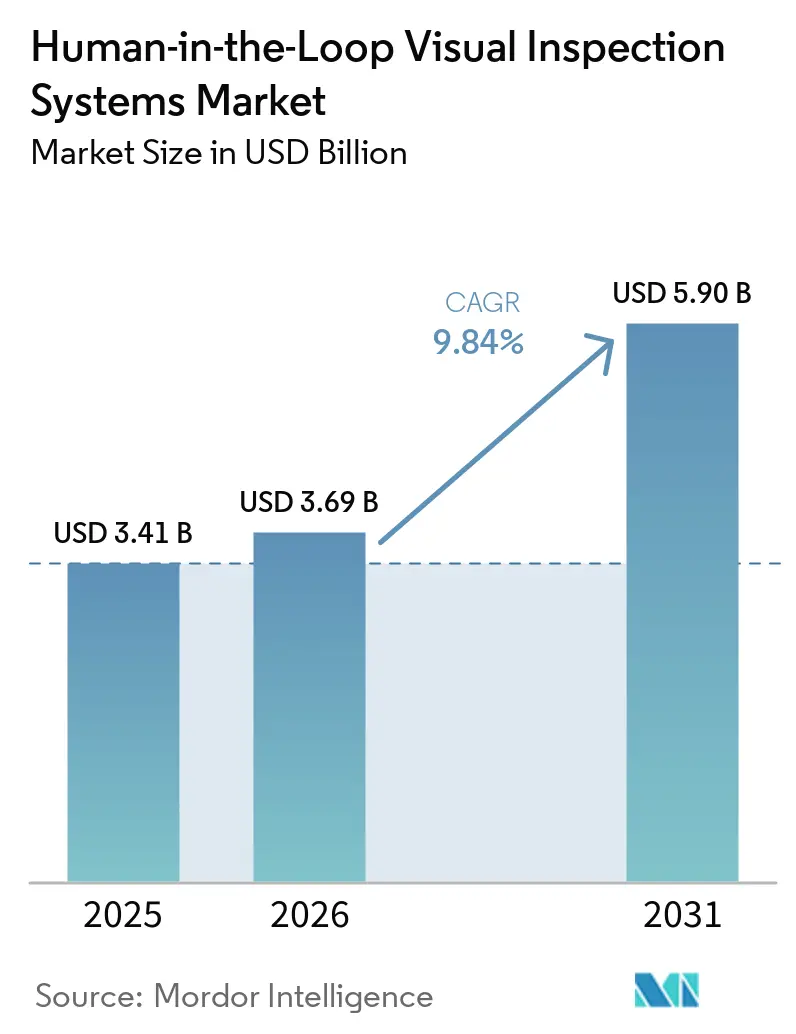
| Market Size (2026) | USD 3.69 Billion |
| Market Size (2031) | USD 5.90 Billion |
| Growth Rate (2026 - 2031) | 9.84 % |
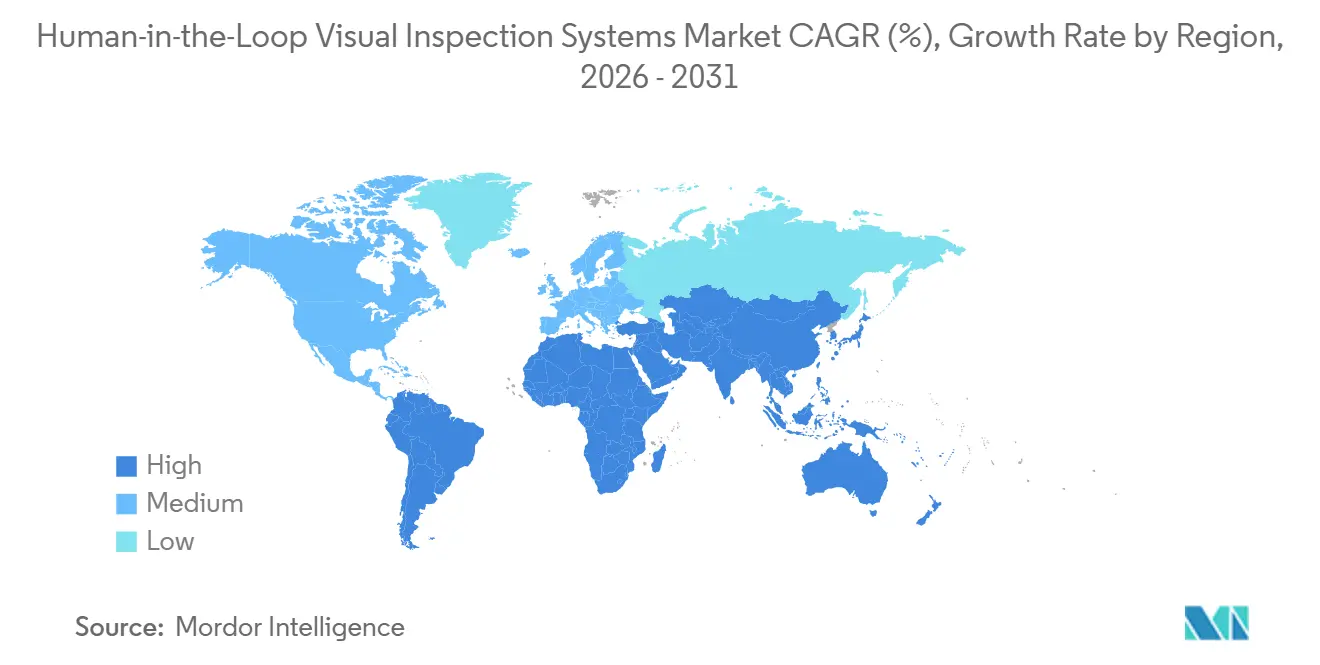
| Fastest Growing Market | Middle East and Africa |
| Largest Market | Asia-Pacific |
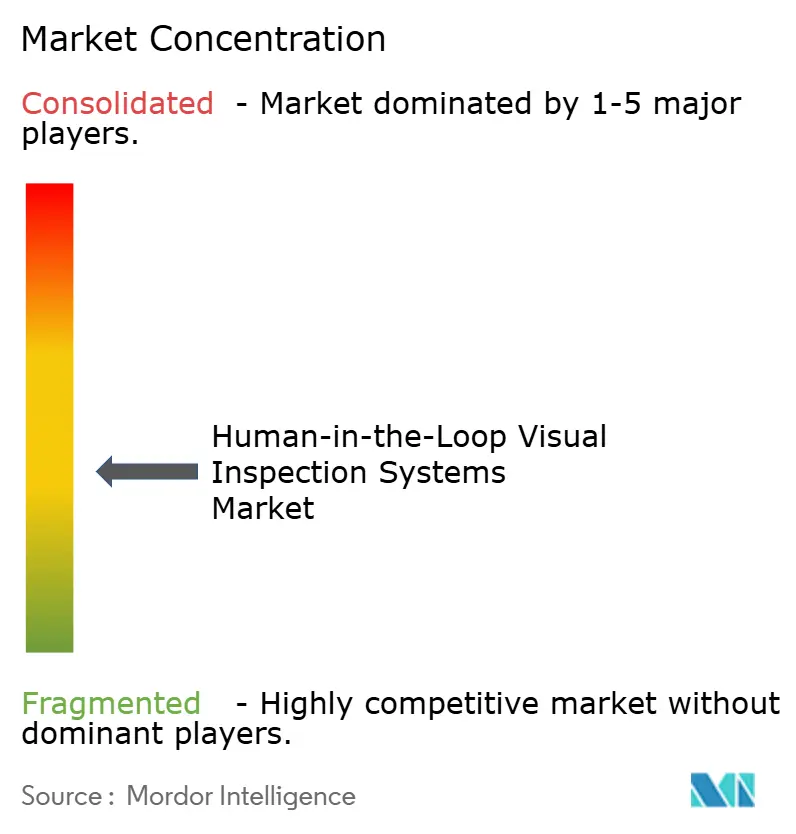
| Market Concentration | Medium |
Major Players *Disclaimer: Major Players sorted in no particular order Image © Mordor Intelligence. Reuse requires attribution under CC BY 4.0. | |
Human-in-the-Loop Visual Inspection Systems Market Analysis by Mordor Intelligence
The Human-in-the-Loop Visual Inspection Systems Market size is expected to increase from USD 3.41 billion in 2025 to USD 3.69 billion in 2026 and reach USD 5.90 billion by 2031, registering a CAGR of 9.84% over 2026-2031. The Human-in-the-Loop Visual Inspection Systems Market is moving toward hybrid quality systems in which software screens large volumes of images and trained inspectors review uncertain cases. This structure supports decisions about rare or ambiguous defects that automated models may still misclassify. A 2026 Cognex survey found that 57% of more than 500 manufacturing, OEM, and system-integrator respondents used AI in machine vision, while 30% planned near-term adoption. Automotive, electronics, and logistics showed the strongest uptake in that survey. The Human-in-the-Loop Visual Inspection Systems Market also benefits when review decisions are incorporated into an auditable quality record, particularly in regulated production settings.
Key Report Takeaways
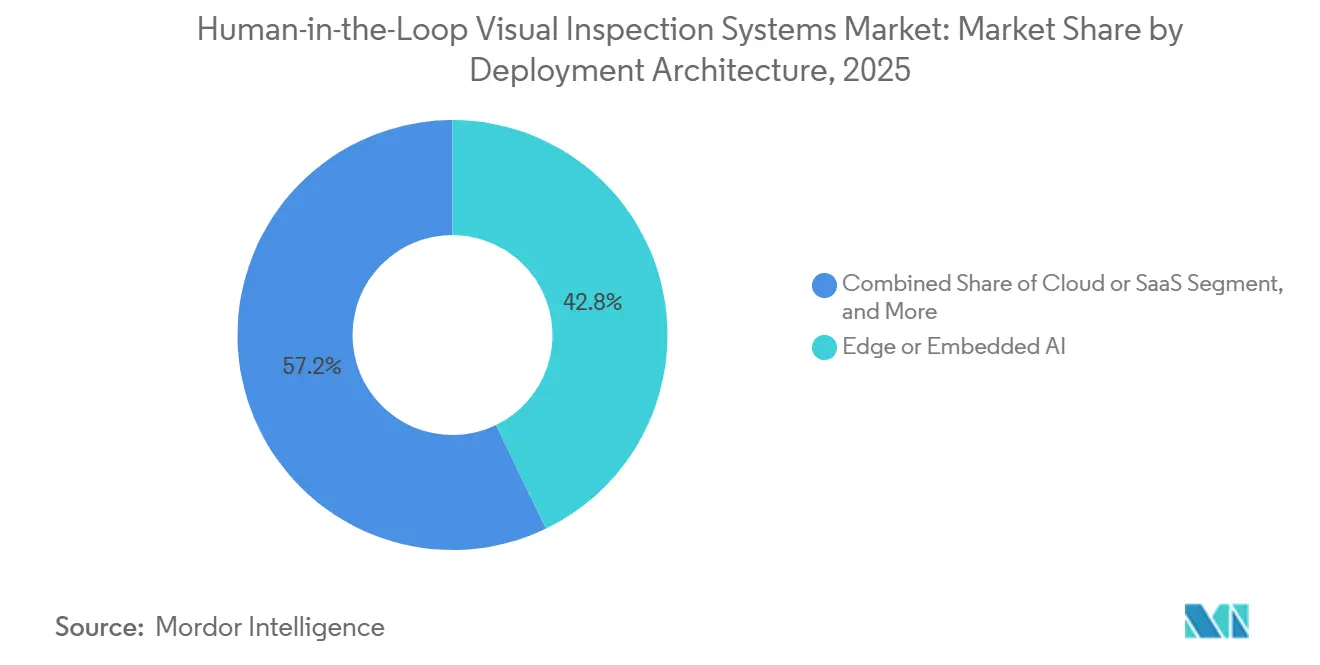
- By deployment architecture, edge or embedded AI held 42.83% Human-In-The-Loop Visual Inspection Systems Market share in 2025, while cloud or SaaS is projected to expand at a 12.73% CAGR through 2031.
- By inspection mode, inline or in-process inspection held 61.74% share in 2025, while portable or handheld inspection is projected to expand at a 12.87% CAGR through 2031.
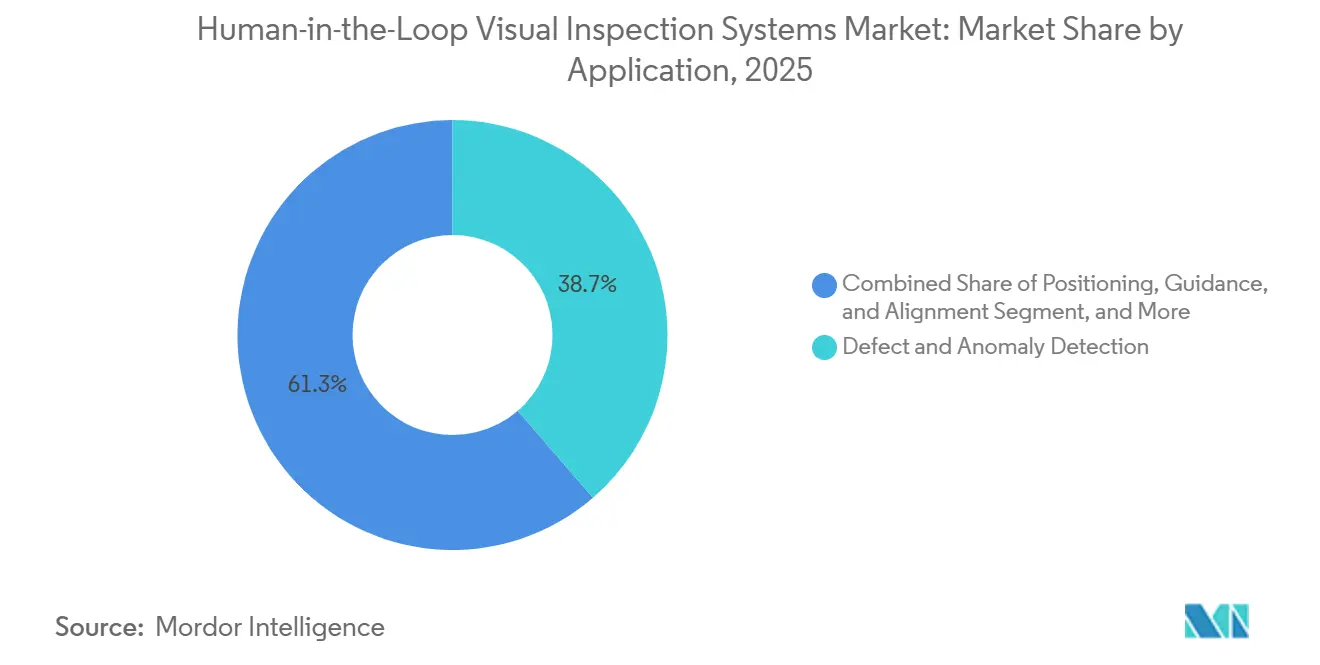
- By application, defect and anomaly detection held 38.67% Human-In-The-Loop Visual Inspection Systems Market share in 2025, while positioning, guidance, and alignment are projected to expand at a 12.59% CAGR through 2031.
- By end-user industry, electronics and semiconductor manufacturers held 25.93% share in 2025, while logistics and warehousing is projected to expand at a 12.92% CAGR through 2031.
- By geography, Asia-Pacific held 37.46% share of the Human-In-The-Loop Visual Inspection Systems Market in 2025, while the Middle East and Africa is projected to expand at a 12.74% CAGR through 2031.
Note: Market size and forecast figures in this report are generated using Mordor Intelligence’s proprietary estimation framework, updated with the latest available data and insights as of January 2026.
Global Human-in-the-Loop Visual Inspection Systems Market Trends and Insights
Drivers Impact Analysis*
| Driver | (~) % Impact on CAGR Forecast | Geographic Relevance | Impact Timeline |
|---|---|---|---|
| AI Adoption for Variable-Defect Detection | +3.2% | Global, concentrated in Asia-Pacific and North America | Short term (≤ 2 years) |
| EV and Battery Quality Escalation | +2.0% | Asia-Pacific, Europe, and North America | Medium term (2-4 years) |
| Labor Shortages in Quality Inspection | +1.6% | North America and Europe, emerging in Asia-Pacific and Middle East and Africa | Short term (≤ 2 years) |
| Regulatory Traceability and Zero-Defect Requirements | +1.0% | Global, with urgency in North America and Europe | Medium term (2-4 years) |
| Synthetic Data for Rare-Defect Coverage | +0.7% | Global, with early activity in Asia-Pacific and North America semiconductor fabs | Medium term (2-4 years) |
| Human Feedback as a Production Data Moat | +0.5% | Global, strongest in automotive and consumer electronics | Long term (≥ 4 years) |
| Source: Mordor Intelligence | |||
AI Adoption for Variable-Defect Detection
Manufacturers face challenging inspection conditions when defect shapes vary across product runs, lighting conditions, or material batches, especially when a small number of abnormal images can affect yield decisions. Rule-based tools and fully autonomous models can lose consistency in these settings because they rely on patterns established in earlier operating conditions. A 2026 peer-reviewed framework combined Population Stability Index and Kolmogorov-Smirnov drift tests with selective human annotation and restored model AUC above 0.97 on the MVTec AD dataset after simulated brightness, contrast, and noise changes. SK hynix disclosed in April 2026 that it plans to reduce equipment maintenance and defect analysis processing times by more than 50% through the deployment of AI.[1]Self-Healing Human-in-the-Loop PatchCore Framework for Drift-Robust Anomaly Detection in Manufacturing Quality Inspection, IEEE, doi.org. Its super-resolution wafer TEM model exceeded 9 competing models by an average of 10.3 percentage points in mean Intersection over Union. The Human-in-the-Loop Visual Inspection Systems Market benefits from each model update, as it creates new cases that require review and labeled feedback, leaving manufacturers with a decision record that purchased models cannot replicate.
EV and Battery Quality Escalation
EV battery modules require inspection methods that differ from those used for conventional automotive components because their surfaces are variable and defect localization may need to be 3-dimensional. A missed electrode flaw can affect cell performance and may contribute to module-level failure or thermal runaway. A 2024 study described a hybrid process that used calibrated dual-view geometry, single-image neural-network 3D shape inference, and synthetic rare-defect images to create millimeter-level maps of EV battery module defects. A 2025 study found that optical cameras and laser thermography have different strengths in battery electrode inspection, with optical systems performing better for particle contamination and laser thermography for line defects. Human reviewers remain important when these signals conflict or when new cell chemistries have limited training data. LandingLens has targeted EV battery inspection and supports faster model iteration than conventional vision software, which is relevant when manufacturers introduce new cell formats.[2]Detection of Anode Coating Defects in Batteries Electrode Production and Their Effect on Cell Performance, Journal of Nondestructive Evaluation, springer.com.
Labor Shortages in Quality Inspection
Labor shortages make continuous manual inspection difficult for many discrete manufacturers, particularly where staff must monitor fast-moving production lines for extended periods. They also make a fully autonomous approach riskier when sites cannot maintain reliable model oversight or respond properly to uncertain results. In a 2025 ETQ survey of 752 quality leaders in the United States, the United Kingdom, and Germany, 70% of U.S. respondents and 72% of U.K. respondents reported organizational effects from labor shortages. The same survey found that 88% of U.S. respondents and 90% of U.K. respondents said shortages had affected product or service quality. It also reported that 75% had at least 1 recall in the preceding 5 years, and 48% reported rectification costs of USD 10 million to USD 49.99 million per recall. A Nagoya Institute of Technology case study showed that an inspection design can shift inspectors from constant visual monitoring to validation of software-flagged anomalies, reducing the sustained vigilance burden.[3]A Human-in-the-Loop Automated Fabric Inspection System: A Case Study on Retrofit Implementation and Work Efficiency, Nagoya Institute of Technology, nitech.ac.jp.
Regulatory Traceability and Zero-Defect Requirements
Documented quality decisions are becoming more important across medical devices, pharmaceuticals, aerospace, and other controlled production environments. The FDA Quality Management System Regulation became effective on February 2, 2026, and incorporates ISO 13485:2016 by reference into 21 CFR Part 820. ISO 13485:2016 Clause 7.3.3 requires traceability between design inputs and outputs.[4]Medical Devices; Quality System Regulation Amendments, U.S. Food and Drug Administration, federalregister.gov. Inspection platforms can record reviewer identity, decision rationale, and override history, which supports an audit trail during regulatory review and links the result to the person who approved it. This need positions the Human-in-the-Loop Visual Inspection Systems Market as part of compliance workflows rather than only a production quality tool. Pharmaceutical producers also need inspection and traceability systems that can operate alongside serialization requirements and maintain records across multiple production steps.
Restraints Impact Analysis*
| Restraint | (~) % Impact on CAGR Forecast | Geographic Relevance | Impact Timeline |
|---|---|---|---|
| High Initial System and Integration Cost | -1.5% | Global, most acute in South America, Middle East and Africa, and Southeast Asia | Short term (≤ 2 years) |
| Training Data and Model Validation Burden | -0.9% | Global, with a higher burden for SMEs and low-volume specialty manufacturers | Medium term (2-4 years) |
| Operator Trust in Borderline Decisions | -0.6% | Global, with variation in human-AI authority structures | Long term (≥ 4 years) |
| Model Drift Across Product Variants and Lighting Conditions | -0.4% | Global, most severe in high-mix, low-volume environments | Medium term (2-4 years) |
| Source: Mordor Intelligence | |||
High Initial System and Integration Cost
These systems require imaging hardware, AI inference tools, operator interfaces, annotation functions, and links to manufacturing execution or quality management systems. The cost and project risk increase in brownfield plants because sensors, networks, and computing equipment must be added without reducing throughput or disrupting established quality procedures. The 2025 ETQ survey reported that 60% of respondents planned to increase spending on higher-quality products, although many prioritized generative AI and quality management software. Smaller companies in South America, Southeast Asia, and sub-Saharan Africa often have longer capital approval cycles, limited integration expertise, and fewer nearby vendor support resources. Cloud-to-edge subscriptions can reduce upfront equipment spending. However, recurring software costs can be unfamiliar to quality teams that traditionally amortize hardware over 5-7 years and may compare these subscriptions with other software priorities.
Training Data and Model Validation Burden
Rare, high-consequence defects are often underrepresented in production image libraries, even at facilities that collect large volumes of inspection images. Good parts greatly outnumber defective parts, while infrequent failure modes may occur only once in thousands of cycles and can be missed during early model development. Synthetic data can help address this shortage, but teams must still show that simulated images transfer reliably to actual production conditions. A 2025 IEEE study found that automotive defect models trained with synthetic data achieved accuracy comparable to models trained with real images when lighting, camera movement, and surface reflectance were carefully randomized. Organizations must also validate the model after feedback-driven updates, creating a continuing quality-assurance task that is often not fully considered at procurement. ISO 13485:2016 further formalizes this work for inspection equipment used in quality-critical manufacturing.
*Our forecasts treat driver/restraint impacts as directional, not additive. The impact forecasts reflect baseline growth, mix effects, and variable interactions.
Segment Analysis
By Deployment Architecture: Edge Leads While Cloud Governance Changes the Stack
Edge or embedded AI held 42.83% of the Human-in-the-Loop Visual Inspection Systems Market share in 2025. The Human-in-the-Loop Visual Inspection Systems Market relies on rapid, local decisions because cloud inference can introduce delays when cycle times are measured in milliseconds. Cognex launched the In-Sight 3900 Vision System in May 2026, which processes inspections up to 4 times faster than its prior generation and supports resolutions up to 25 megapixels without an external PC. On-premise servers and workstations support high-resolution offline or near-line tasks where latency is less critical. These deployments also suit sites that manage model updates through internal technical teams.
Cloud or SaaS is projected to expand at a 12.73% CAGR through 2031. Hybrid edge-and-cloud designs train, version, and govern models centrally while keeping inference at the production line. Cognex stated that its OneVision platform can reduce multi-site scaling costs by up to 50%. This structure helps manufacturing networks use identical approved model versions across locations. AI-native vendors also offer subscriptions that include model maintenance, retraining, and human-feedback workflows.



By Inspection Mode: Inline Remains Central as Portable Systems Expand Field Use
Inline or in-process inspection held 61.74% share in 2025. The Human-in-the-Loop Visual Inspection Systems Market employs inline inspection to identify defects near the production source before additional value is added downstream. Electronics, semiconductor, and automotive lines produce continuous image streams that can be reviewed in real time. At-line or near-line inspection provides a second verification step for pharmaceutical batch release and precision machining. Offline or laboratory inspection supports destructive testing, material characterization, and failure analysis, in which measurement accuracy takes priority over throughput.
Portable or handheld inspection is projected to expand at a 12.87% CAGR through 2031. This mode supports pipeline and pressure-vessel checks, aerostructure surface audits, and inventory condition reviews that fixed production systems cannot address. KEYENCE launched the IV4 sensor series in April 2025 with built-in AI Identify, AI Count, and AI OCR functions. The system can detect up to 15,000 parts per minute without a dedicated PC. Digital and audit-ready records are increasingly relevant in the pharmaceutical and aerospace field inspection.
By Application: Defect Detection Leads While Guidance Gains Use in Precision Work
Defect and anomaly detection accounted for 38.67% share in 2025. The Human-in-the-Loop Visual Inspection Systems Market retains defect detection as its largest application because quality escapes pose direct operational and financial risks for manufacturers. A 2026 study of the CHIPS collaborative AI-human framework reported 45.93% mIoU in 7-shot industrial defect segmentation. The method exceeded a state-of-the-art baseline by 1.88% while using human expertise when segmentation uncertainty exceeded defined thresholds. Assembly verification and poka-yoke use vision to confirm placement, orientation, and connection sequence. Dimensional gauging, OCR and traceability, and surface inspection address different production quality needs.
Positioning, guidance, and alignment are projected to expand at a 12.59% CAGR through 2031. The application is increasingly used in collaborative robot cells where the system must decide whether the robot proceeds or requests operator confirmation. A 2025 study created 45,000 labeled synthetic images from 1 CAD configuration through a human-in-the-loop semantic-twin pipeline. It reduced manual annotation from 4 hours per 3,000 images to 4-6 minutes of configuration. This capability addresses a deployment bottleneck in guidance applications.
By End-User Industry: Electronics Leads as Logistics Broadens Demand
Electronics and semiconductor manufacturers held 25.93% share in 2025. Within the Human-in-the-Loop Visual Inspection Systems Market, the segment combines high image volumes, sub-micron defect tolerances, and established use of AI-assisted classification. Semiconductor fabs generate millions of defect images each week. AI can automatically classify many images, but engineers must validate systematic excursion patterns before making process changes. Automotive and EV manufacturing follows, supported by battery cell and module quality requirements in OEM supply chains.
Logistics and warehousing are projected to expand at a 12.92% CAGR through 2031. Parcel sorting, damage detection, and inventory condition monitoring use confidence scores and human escalation pathways to replace slower manual triage. Pharmaceutical and medical device manufacturers are also advancing because documented human review supports regulatory traceability. Food and beverage, aerospace and defense, industrial equipment, and packaging producers use these systems for appearance checks, gauging, and label verification. The Human-in-the-Loop Visual Inspection Systems industry is extending beyond precision production through lighter configurations such as tablet interfaces, commodity cameras, and cloud-hosted models.
Geography Analysis
Asia-Pacific held 37.46% of the Human-in-the-Loop Visual Inspection Systems Market share in 2025. China, Japan, South Korea, and India bring together demand for semiconductors, electronics, EV batteries, pharmaceuticals, and automotive production. SK hynix disclosed in April 2026 that it aims to reduce defect-analysis processing times by more than 50% at its Yongin and Icheon sites through the deployment of AI. China’s smart manufacturing standards and Japan’s Industry 4.0 programs support domestic adoption. Vietnam, Thailand, and Indonesia are developing demand as electronics contract manufacturers replace manual inspection at scale.
The Human-in-the-Loop Visual Inspection Systems Market is the second-largest in North America, led by the United States. Electronics reshoring, EV battery plant construction, and pharmaceutical compliance needs support demand. The 2025 ETQ survey found that 70% of U.S. manufacturers reported labor shortages affecting quality inspection, and 88% reported downstream quality effects. Europe follows North America, with Germany, the United Kingdom, France, Italy, and Spain hosting established machine vision suppliers and industrial equipment manufacturers. South America remains smaller, with Brazil driving demand in automotive and food and beverage production, while Argentina and other markets develop more slowly due to fragmented industrial capacity.
The Middle East and Africa are projected to expand at a 12.74% CAGR through 2031, making it the fastest-growing geography. Saudi Arabia’s Vision 2030 program and the United Arab Emirates' smart manufacturing investments direct capital toward petrochemical, food, and pharmaceutical production. Africa’s contribution remains early and is centered on South Africa’s automotive clusters and Nigeria’s food and beverage production base. Cloud-hosted model management can reduce the need for extensive on-site technical expertise and expand the customer base accessible to the Human-in-the-Loop Visual Inspection Systems Market.

Competitive Landscape
The Human-in-the-Loop Visual Inspection Systems Market is moderately fragmented at the system-integration level. Established machine vision suppliers benefit from combined hardware and software portfolios, channel coverage, and long customer relationships. Cognex released the In-Sight 3900 in May 2026 and the In-Sight 6900 in April 2026, while making OneVision available for cloud-to-edge model governance. This approach links local inference hardware with centralized lifecycle management and can increase switching costs for users operating several manufacturing sites.
AI-native vendors, including Landing AI, UnitX, Matroid, Visionify, and Zetamotion, compete on faster model training, more efficient annotation, and simpler cloud deployment. ABB Robotics invested in LandingAI in September 2025 and integrated LandingLens into its robotics software suite. The companies stated that the integration can reduce the time for robot vision AI training and deployment by up to 80%. Antares Vision introduced AI-GO in June 2025, combining AI-GO Studio for cloud-based training with AI-GO Runtime for offline edge deployment. These moves combine centralized model development with local production execution.
Opportunities remain in regulated platforms that connect reviewer records with pharmaceutical, medical device, and aerospace documentation. Portable configurations also create scope beyond fixed manufacturing lines, while multi-vendor standards could allow feedback annotations from one platform to be used by another. KEYENCE received U.S. Patent 12,315,132 in May 2025 for an appearance inspection method that manages learning networks when noise and defect patterns occur together. Few-shot and synthetic-data workflows target the continuing burden of limited defect images. The Human-in-the-Loop Visual Inspection Systems Market remains balanced between established integrated suppliers and newer software-focused firms.
Human-in-the-Loop Visual Inspection Systems Industry Leaders
Cognex Corporation
Keyence Corporation
Omron Corporation
Teledyne Technologies Incorporated
Basler AG
- *Disclaimer: Major Players sorted in no particular order

Recent Industry Developments
- May 2026: Cognex Corporation released the In-Sight 3900 Vision System, an embedded AI platform powered by Qualcomm Dragonwing that processes inspections up to 4 times faster than previous-generation systems and supports 25-megapixel resolution, while enabling PC-free operation. Combined with OneVision's cloud-to-edge model governance, it positions Cognex as a vertically integrated AI inspection stack vendor rather than a hardware supplier.
- May 2026: Cognex Corporation announced general availability of OneVision, its collaborative AI vision development environment. Since its June 2025 beta, more than 100 customers have adopted it, with customers such as Schneider Electric reporting doubled yield and dramatically reduced false rejects. Essity reduced a sealing-inspection solution development timeline from over one year to less than one day.
- May 2026: MVTec Software GmbH released HALCON 26.05, featuring a new generation of deep learning-based object detection with significantly faster inference and maintained detection accuracy for small and size-variable objects. The release also introduced automated contour optimization for shape matching, directly reducing manual tuning requirements in HITL deployment workflows.
- April 2026: Cognex Corporation launched the In-Sight 6900 Vision Controller, powered by NVIDIA Jetson technology, enabling high-capacity AI processing at the edge for manufacturers requiring modular camera and optics configurations without external PC architectures.


Global Human-in-the-Loop Visual Inspection Systems Market Report Scope
Human-in-the-Loop Visual Inspection Systems integrate advanced computer vision algorithms with human oversight to enhance the accuracy and reliability of quality control processes, allowing operators to validate automated decisions, handle edge cases, and continuously improve AI models through active learning and feedback mechanisms.
The Human-in-the-Loop Visual Inspection Systems Market Report is Segmented by Deployment Architecture (Edge or Embedded AI, On-Premise Server or Workstation, Cloud or SaaS, and Hybrid Edge and Cloud), Inspection Mode (Inline or In-Process Inspection, At-Line or Near-Line Inspection, Offline or Laboratory Inspection, and Portable or Handheld Inspection), Application (Defect and Anomaly Detection, Assembly Verification and Poka-Yoke, Dimensional Measurement and Gauging, Identification, OCR, and Traceability, Positioning, Guidance, and Alignment, Surface, Texture, and Appearance Inspection, and Other Applications), End-User Industry (Electronics and Semiconductor, Automotive and EV Manufacturing, Pharmaceutical and Medical Devices, Food and Beverage, Aerospace and Defense, Industrial Equipment and Machinery Manufacturing, Metals, Plastics, Paper, and Packaging Manufacturing, Logistics and Warehousing, and Other End-User Industry), and Geography (North America, South America, Europe, Asia-Pacific, Middle East and Africa). The Market Forecasts are Provided in Terms of Value (USD).
| Edge or Embedded AI |
| On-Premise Server or Workstation |
| Cloud or SaaS |
| Hybrid Edge and Cloud |
| Inline or In-Process Inspection |
| At-Line or Near-Line Inspection |
| Offline or Laboratory Inspection |
| Portable or Handheld Inspection |
| Defect and Anomaly Detection |
| Assembly Verification and Poka-Yoke |
| Dimensional Measurement and Gauging |
| Identification, OCR, and Traceability |
| Positioning, Guidance, and Alignment |
| Other Applications |
| Electronics and Semiconductor |
| Automotive and EV Manufacturing |
| Pharmaceutical and Medical Devices |
| Food and Beverage |
| Aerospace and Defense |
| Metals, Plastics, Paper, and Packaging Manufacturing |
| Logistics and Warehousing |
| Other End-User Industries |
| North America | United States | |
| Canada | ||
| Mexico | ||
| South America | Brazil | |
| Argentina | ||
| Rest of South America | ||
| Europe | Germany | |
| United Kingdom | ||
| France | ||
| Italy | ||
| Spain | ||
| Rest of Europe | ||
| Asia-Pacific | China | |
| Japan | ||
| India | ||
| South Korea | ||
| Rest of Asia-Pacific | ||
| Middle East and Africa | Middle East | Saudi Arabia |
| United Arab Emirates | ||
| Turkey | ||
| Rest of the Middle East | ||
| Africa | South Africa | |
| Nigeria | ||
| Rest of Africa | ||
| By Deployment Architecture | Edge or Embedded AI | ||
| On-Premise Server or Workstation | |||
| Cloud or SaaS | |||
| Hybrid Edge and Cloud | |||
| By Inspection Mode | Inline or In-Process Inspection | ||
| At-Line or Near-Line Inspection | |||
| Offline or Laboratory Inspection | |||
| Portable or Handheld Inspection | |||
| By Application | Defect and Anomaly Detection | ||
| Assembly Verification and Poka-Yoke | |||
| Dimensional Measurement and Gauging | |||
| Identification, OCR, and Traceability | |||
| Positioning, Guidance, and Alignment | |||
| Other Applications | |||
| By End-User Industry | Electronics and Semiconductor | ||
| Automotive and EV Manufacturing | |||
| Pharmaceutical and Medical Devices | |||
| Food and Beverage | |||
| Aerospace and Defense | |||
| Metals, Plastics, Paper, and Packaging Manufacturing | |||
| Logistics and Warehousing | |||
| Other End-User Industries | |||
| By Geography | North America | United States | |
| Canada | |||
| Mexico | |||
| South America | Brazil | ||
| Argentina | |||
| Rest of South America | |||
| Europe | Germany | ||
| United Kingdom | |||
| France | |||
| Italy | |||
| Spain | |||
| Rest of Europe | |||
| Asia-Pacific | China | ||
| Japan | |||
| India | |||
| South Korea | |||
| Rest of Asia-Pacific | |||
| Middle East and Africa | Middle East | Saudi Arabia | |
| United Arab Emirates | |||
| Turkey | |||
| Rest of the Middle East | |||
| Africa | South Africa | ||
| Nigeria | |||
| Rest of Africa | |||


Key Questions Answered in the Report
What is the Human-in-the-Loop Visual Inspection Systems Market size?
The Human-in-the-Loop Visual Inspection Systems Market is expected to increase from USD 3.41 billion in 2025 to USD 3.69 billion in 2026 and reach USD 5.90 billion by 2031 at a 9.84% CAGR.
Why are manufacturers adopting human-in-the-loop visual inspection systems?
The systems pair high-volume AI screening with human review of uncertain defects, helping manufacturers manage variable conditions and retain auditable decisions.
Which deployment architecture led in 2025?
Edge or embedded AI led with 42.83% share because high-speed inline inspection requires local processing with minimal delay.
Which end-user segment is expanding fastest?
Logistics and warehousing is projected to expand at a 12.92% CAGR through 2031 as operators automate parcel, damage, and inventory condition checks.
Which region is expanding fastest through 2031?
Middle East and Africa is projected to expand at a 12.74% CAGR, supported by industrial investment in Saudi Arabia and the United Arab Emirates.
What limits wider adoption of these inspection systems?
Initial integration costs, limited labeled defect data, model validation work, operator trust, and model drift can slow deployment.
Page last updated on:


 Your data is secure and never sold or shared.


