
HR Analytics Software Market Size and Share
Market Overview
| Study Period | 2020 - 2031 |
|---|---|
| Market Size (2026) | USD 5.02 Billion |
| Market Size (2031) | USD 9.27 Billion |
| Growth Rate (2026 - 2031) | 13.06 % |
| Fastest Growing Market | Asia-Pacific |
| Largest Market | North America |
| Market Concentration | Medium |
Major Players *Disclaimer: Major Players sorted in no particular order Image © Mordor Intelligence. Reuse requires attribution under CC BY 4.0. | |
HR Analytics Software Market Analysis by Mordor Intelligence
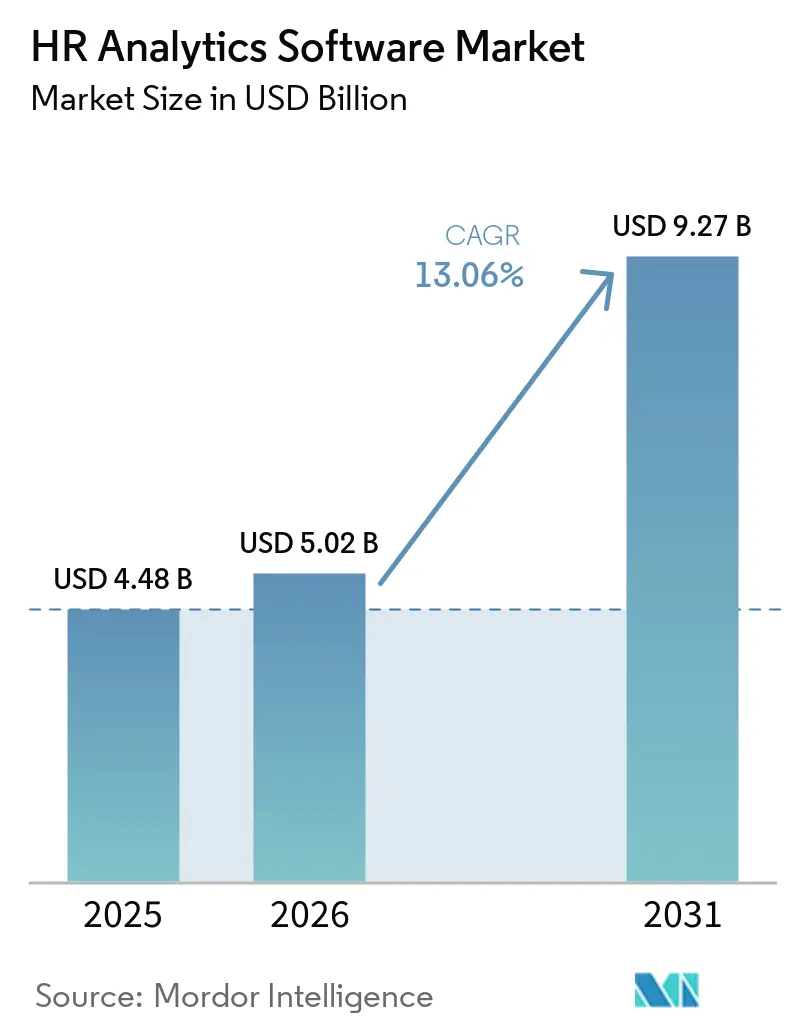
The HR analytics software market size is expected to increase from USD 4.48 billion in 2025 to USD 5.02 billion in 2026 and reach USD 9.27 billion by 2031, growing at a CAGR of 13.06% over 2026-2031. The market is expanding as enterprises increasingly use AI in workforce decisions, while new disclosure requirements are making governed people data a compliance requirement rather than an optional reporting layer. Organizations now expect HR systems to support pay equity reviews, headcount risk monitoring, and skills supply planning as part of standard governance. The market is also benefiting from a shift away from descriptive dashboards toward predictive and prescriptive decision support that can be used by HR, finance, and line managers together. Competition is intensifying as specialist vendors focus on analytical depth and large HCM providers respond with embedded AI copilots and bundled pricing. Even with strong demand, adoption still depends on data governance, explainability, and deployment support because privacy rules, fragmented skills data, and implementation burden continue to shape buying decisions across the HR analytics software market.
Key Report Takeaways
- By component, software led the HR analytics software market with 72.88% revenue share in 2025, while services are projected to expand at a 14.12% CAGR through 2031.
- By deployment mode, cloud held 67.24% of the Human Resources (HR) analytics software market share in 2025, while hybrid is projected to grow at a 14.46% CAGR through 2031.
- By organization size, large enterprises accounted for 69.82% of revenue share in 2025, while SMEs are projected to expand at a 14.08% CAGR through 2031.
- By analytics type, descriptive analytics led with 33.14% revenue share in 2025, while predictive analytics is projected to grow at a 15.18% CAGR through 2031.
- By end-user, information technology and telecommunications accounted for 23.76% of revenue in 2025, while healthcare and life sciences are projected to expand at a 14.74% CAGR through 2031.
- By geography, North America held 39.84% of the HR analytics software market share in 2025, while Asia-Pacific is projected to grow at a 15.42% CAGR through 2031.
Note: Market size and forecast figures in this report are generated using Mordor Intelligence’s proprietary estimation framework, updated with the latest available data and insights as of January 2026.
Global HR Analytics Software Market Trends and Insights
Drivers Impact Analysis*
| Driver | (~) % Impact on CAGR Forecast | Geographic Relevance | Impact Timeline |
|---|---|---|---|
| Rising Adoption of AI-Enabled Predictive People Analytics | +3.2% | Global, led by North America and the Asia-Pacific | Medium term (2-4 years) |
| Growing Need to Reduce Attrition and Optimize Workforce Costs | +2.5% | Global | Short term (≤ 2 years) |
| Cloud-Based Deployment Expanding Access to Self-Service Human Resources Analytics | +1.8% | Asia-Pacific, South America, the Middle East, and Africa, emerging adoption frontier | Short term (≤ 2 years) |
| Data-Driven Talent Acquisition and Workforce Planning Becoming Standard | +1.5% | North America and Europe | Medium term (2-4 years) |
| Europe Pay Transparency Compliance Driving Audit-Ready Compensation Analytics | +1.0% | Europe, spill-over to North America and Asia-Pacific multinationals | Short term (≤ 2 years) |
| Skills-Based Workforce Planning and Agentic AI Raising Demand for Governed Skills Intelligence | +0.8% | North America and Europe, early adoption in the Asia-Pacific | Long term (≥ 4 years) |
| Source: Mordor Intelligence | |||
Rising Adoption of AI-Enabled Predictive People Analytics
Predictive people analytics is moving from a specialist capability into a standard enterprise requirement in the HR analytics software market. Employers are using AI models to surface flight-risk scores, skills-gap probabilities, and succession exposure before workforce decisions are made rather than after outcomes appear. Natural-language interfaces are also gaining wider adoption because managers can now query workforce information directly without depending on a separate analytics team for each request.
Growing Need to Reduce Attrition and Optimize Workforce Costs
The HR analytics software market is gaining support from stronger enterprise pressure to control labor costs and reduce unwanted turnover. Employers increasingly use predictive attrition models to compare the cost of replacing employees with the cost of proactive retention programs, making analytics spending easier to defend internally. This shift is also changing internal ownership because finance leaders are becoming more involved in workforce planning decisions that were once handled mainly by HR teams. As that happens, demand is shifting toward tools that connect headcount scenarios with live financial planning outputs rather than annual workforce reviews. That broader decision role is helping the Human Resources (HR) analytics software market move closer to core enterprise planning rather than remaining a reporting layer inside HR systems.
Cloud-Based Deployment Expanding Access to Self-Service Human Resources Analytics
Cloud deployment has changed access economics across the HR analytics software market by removing much of the infrastructure burden that once limited advanced analytics to large enterprises. Subscription-based delivery now allows organizations to add analytics layers without replacing their existing payroll or HRIS systems. This model makes adoption easier for mid-sized organizations by reducing the need for lengthy implementation cycles and dedicated data engineering resources. It also supports best-of-breed procurement because buyers can deploy analytics on top of legacy systems rather than replacing entire HCM environments at once. As a result, the HR analytics software market is reaching a wider customer base than it could under earlier on-premises deployment models.
Data-Driven Talent Acquisition and Workforce Planning Becoming Standard
Talent acquisition and workforce planning are becoming more predictive, widening the use case for the HR analytics software market. Organizations increasingly want tools that can show where skills shortages are likely to appear 12 to 18 months before critical hiring needs arise. In Europe, human capital disclosure requirements under the Corporate Sustainability Reporting Directive are pushing workforce planning into a governance and disclosure role rather than keeping it as a purely operational HR task. That regulatory shift is increasing demand for audit-ready data structures that can support talent planning with more consistency and traceability.
Restraints Impact Analysis*
| Restraint | (~) % Impact on CAGR Forecast | Geographic Relevance | Impact Timeline |
|---|---|---|---|
| Data Privacy and Cross-Border Compliance Complexity | -1.5% | Europe, Asia-Pacific and emerging regulation markets | Short term (≤ 2 years) |
| High Implementation Cost and Change-Management Burden | -1.2% | Global, acute in SME segment and emerging markets | Medium term (2-4 years) |
| Artificial Intelligence Act and Works Council Oversight Slowing Rollout of Employee-Monitoring Use Cases | -0.8% | Europe | Medium term (2-4 years) |
| Weak Skills Data Foundations, and Fragmented Human Resources Data Pipelines Reducing Model Reliability | -0.6% | Global, acute in South America, the Middle East, and Africa, and Asia-Pacific emerging markets | Long term (≥ 4 years) |
| Source: Mordor Intelligence | |||
Data Privacy and Cross-Border Compliance Complexity
The regulatory environment for employee data processing is becoming more demanding, slowing adoption across the HR analytics software market. The European Data Protection Board processed 350 cross-border cases in 2024, which shows the level of enforcement attention on data transfers involving multiple jurisdictions.[1] In Germany, the Federal Labor Court ruled on December 19, 2024, that works agreements used as the basis for data processing must comply strictly with GDPR rules on purpose limitation and storage limitation, narrowing the practical room for some HR analytics deployments. Outside Europe, frameworks such as Brazil's LGPD, India's Digital Personal Data Protection Act, and California privacy rules are adding local compliance layers, making monolithic global deployments harder to manage.
High Implementation Cost and Change-Management Burden
High implementation costs remain a practical limit on adoption in the HR analytics software market, especially when data readiness is weak at the start of deployment. Information Services Group identified weak data governance, legacy system complexity, and limited process harmonization among the top barriers to HCM transformation in 2025. Many organizations still have payroll, HRIS, and talent systems that were not designed to share common data structures, so integration work takes longer and costs more than expected. Even after rollout, adoption can remain low if managers continue to rely on intuition rather than algorithm-supported dashboards in day-to-day decision-making. This combination of technical integration and behavioral adjustment keeps the HR analytics software market dependent on strong implementation support as much as on software capability.
*Our forecasts treat driver/restraint impacts as directional, not additive. The impact forecasts reflect baseline growth, mix effects, and variable interactions.
Segment Analysis
By Component: Services Outpace Software Growth as Deployment Complexity Rises
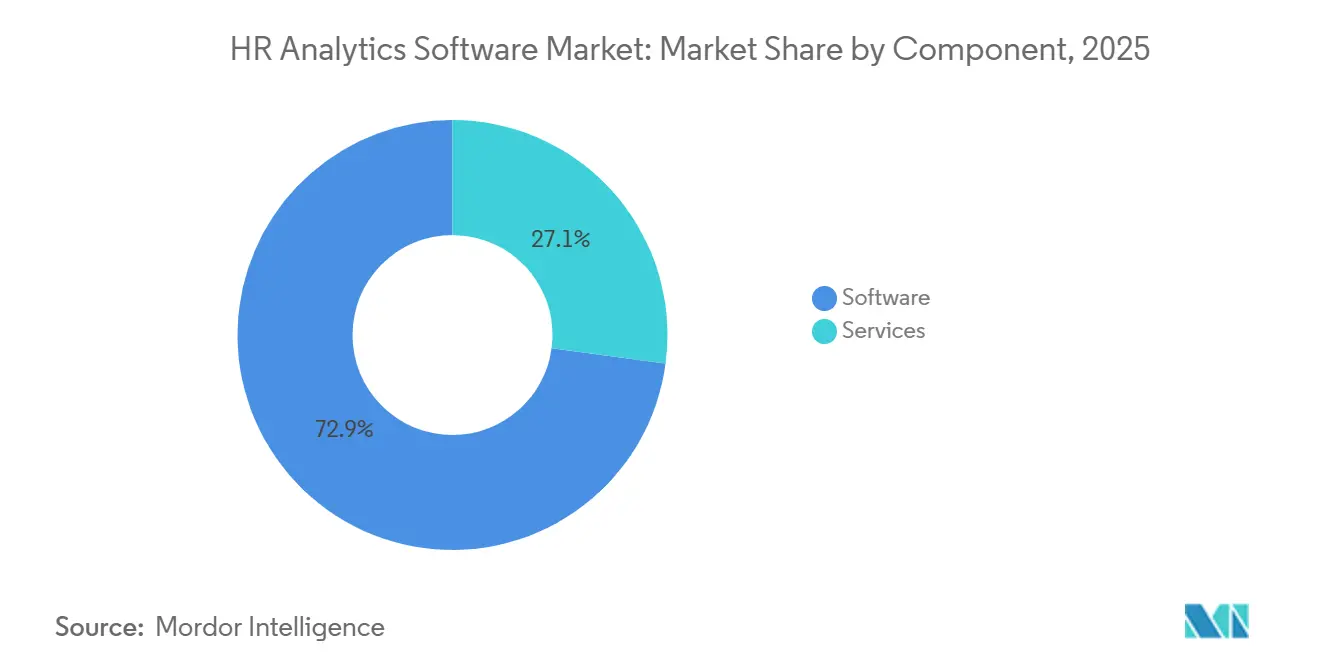
Software accounted for 72.88% of component revenue in 2025, giving it the largest share in the HR analytics software market. This reflected enterprise demand for unified people analytics suites that combine headcount reporting, attrition scoring, compensation analytics, and related workforce intelligence in 1 governed environment. Once those platforms are integrated with HRIS, payroll, and learning systems, migration becomes more difficult due to data continuity risks and the operational costs of switching. That dynamic supports high platform stickiness across the HR analytics software market and keeps software vendors in a strong position. The current structure also shows why buyers often prioritize integration quality and governance depth over isolated feature advantages.
Services are projected to grow at a 14.12% CAGR through 2031, making them the faster-growing component in the market. That shift reflects rising deployment complexity as organizations move from standard dashboards into AI model tuning, skills taxonomy governance, and agentic workflow support. This capability gap is sustaining demand for consulting, implementation, and managed services alongside software licenses. It is also broadening the ecosystem because specialist advisory firms and systems integrators can capture value even when they do not own the core product. That keeps the HR analytics software industry wider than the platform vendor list alone suggests.
By Deployment Mode: Hybrid Architectures Emerge as the Data-Sovereignty Default
Cloud accounted for 67.24% of revenue in 2025, making it the leading deployment model in the HR analytics software market. Its position reflects lower provisioning costs and easier enterprise-scale deployment through SaaS architectures. Cloud has also widened access because organizations can deploy analytics layers without fully replacing legacy payroll or HRIS systems. That flexibility remains one of the main reasons cloud continues to anchor deployment across the market.
Hybrid deployment is the fastest-growing mode and is projected to expand at a 14.46% CAGR through 2031. Growth is being shaped by data residency obligations that require multinationals to use cloud compute while keeping some employee records within sovereign or on-premises boundaries. This makes hybrid architecture a compliance-led deployment choice rather than a transitional technical step. Legal and compliance teams are now more directly involved in deployment design, which is pushing vendors to offer region-specific data residency options as standard capabilities. On-premises systems still matter in government, defense-adjacent, and tightly regulated sectors, but their share is likely to narrow as sovereign cloud options broaden. The Human Resources (HR) analytics software market is therefore moving toward mixed architectures that balance scale with local control.
By Organization Size: SME Adoption Accelerates on Modular SaaS Economics
Large enterprises accounted for 69.82% of revenue in 2025, giving them the leading position by organization size in the HR analytics software market. They benefit from larger internal data volumes, wider compliance obligations, and stronger budgets for multi-module analytics deployments. Large organizations are also under stronger pressure to align workforce planning with pay governance, succession planning, and AI-enabled decision support. That keeps them central to near-term revenue generation across the market.
SMEs are projected to grow at a 14.08% CAGR through 2031, making them the faster-growing buyer group in the HR analytics software market. Modular cloud offerings are helping these organizations start with simpler use cases and expand later as data maturity improves. The appeal is strong because many SME buyers lack dedicated data science or engineering teams. Regulatory developments are also raising the value of workforce analytics for smaller employers. Mayer Brown noted in March 2026 that the EU Pay Transparency Directive requires employers to build high-quality master data, harmonized job classifications, and analytics processes that withstand regulatory scrutiny.[2] That is widening the addressable market for HR analytics software beyond traditional large-enterprise accounts.
By Analytics Type: Predictive Momentum Accelerates as Agentic AI Redefines Delivery
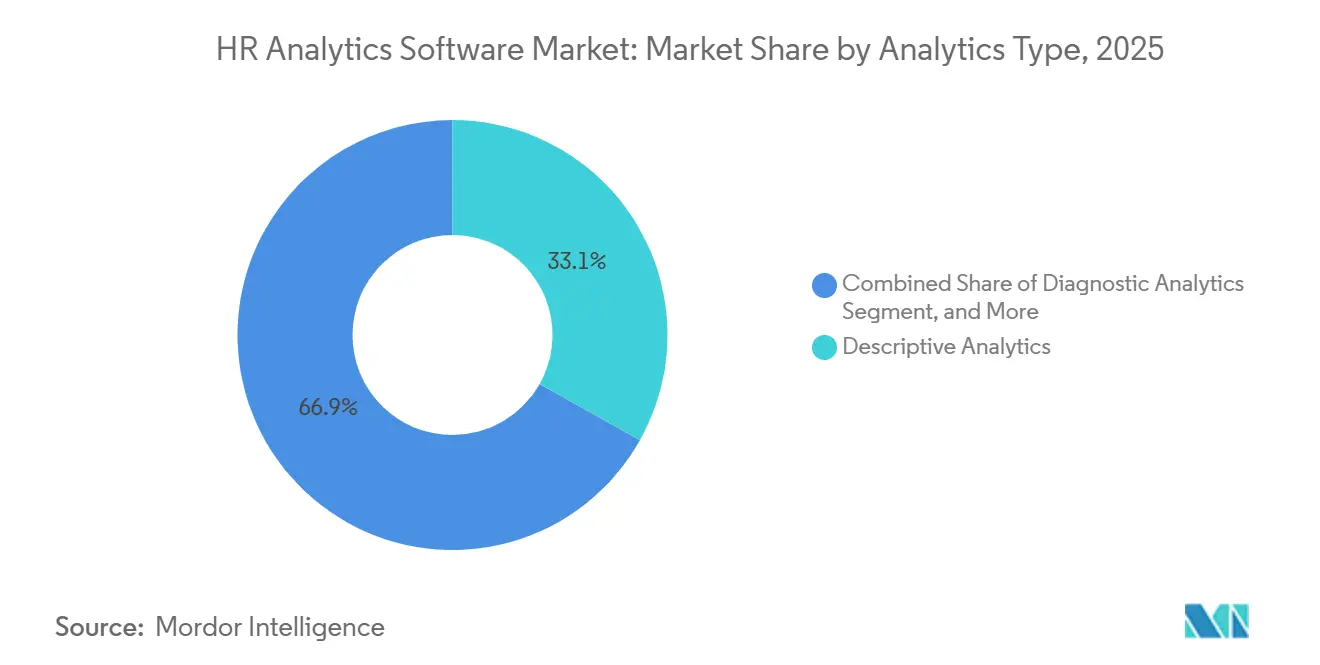
Descriptive analytics held 33.14% of revenue in 2025, making it the largest analytics type in the HR analytics software market. This reflects the fact that many organizations still rely on structured reporting, headcount dashboards, and turnover tracking as their primary sources of analytics. The installed base remains important because descriptive tools often serve as the starting point for broader analytics maturity. At the same time, buyers increasingly view these capabilities as standard platform requirements rather than distinctive product features. That is changing the basis of competition in the market toward more forward-looking analytical capability.
Predictive analytics is projected to grow at a 15.18% CAGR through 2031, making it the fastest-growing analytics type in the HR analytics software market. Employers are increasingly seeking attrition probability models, succession gap forecasts, and hiring-velocity indicators that can support faster workforce decisions. The wider move toward AI-enabled workforce planning and automation is reinforcing this shift. That gap is helping AI-native vendors extend their lead in more predictive use cases. It also shows why the market is shifting from historical reporting toward embedded decision support.

By End-User Industry: Healthcare and Life Sciences Accelerates on Clinical Staffing Urgency
Information technology and telecommunications accounted for 23.76% of end-user revenue in 2025, giving it the largest end-user position in the HR analytics software market. The sector faces intense competition for technical talent and depends on ongoing skills calibration across software, infrastructure, and digital operations roles. Many technology companies are also early adopters of AI-enabled HR tools because they are both platform users and contributors to the wider innovation cycle. This creates strong demand for continuous workforce intelligence rather than occasional reporting. That position has helped keep information technology and telecommunications central to demand across the HR analytics software industry.
Healthcare and life sciences are projected to grow at a 14.74% CAGR through 2031, making it the fastest-growing end-user segment in the HR analytics software market. Clinical staffing constraints are forcing health systems to move from reactive workforce management to more predictive staffing allocation models. Research published in Health Care Management Science in 2025 showed that Bayesian forecasting methods applied to clinical staffing data can improve nurse-to-patient alignment by generating granular daily service-need forecasts at the individual-resident level. That kind of evidence supports wider use of predictive analytics tools in hospital network operations and care delivery planning. BFSI, manufacturing, and retail and e-commerce also remain important demand pools because of disclosure pressure, labor planning requirements, and hourly workforce optimization needs. This gives the HR analytics software market a broad end-user base, even as healthcare and life sciences stand out as growth areas.
Geography Analysis
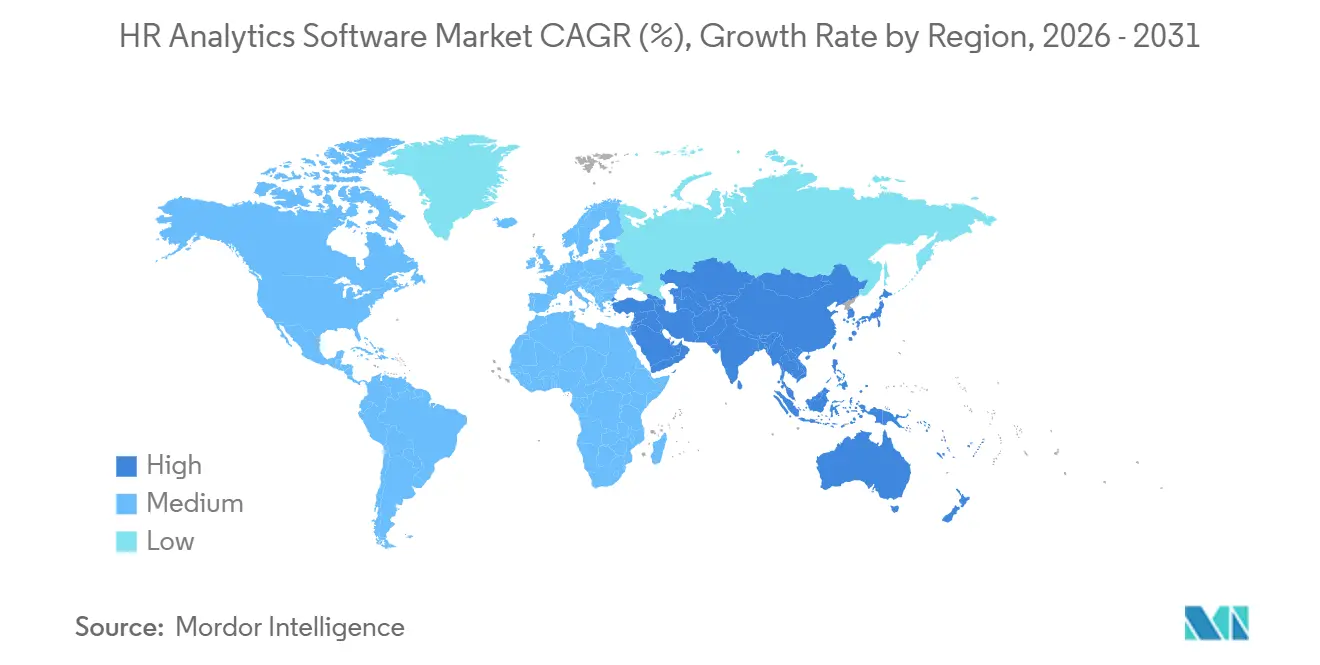
North America accounted for 39.84% of revenue in 2025, making it the largest regional segment in the HR analytics software market. The United States remained the leading country because it combined a dense vendor ecosystem, strong enterprise software penetration, and early use of generative AI inside HR workflows. The region is also seeing stronger demand for compensation analytics as state-level transparency obligations expand across large labor markets. Canada and Mexico are also supporting regional expansion as cloud-based workforce planning becomes more common and multinational subsidiaries align more closely with parent-company analytics standards.
Asia-Pacific is the fastest-growing region, projected to expand at a 15.42% CAGR through 2031 in the HR analytics software market. Growth is centered in India, China, South Korea, and Australia and New Zealand, where digital transformation and skills-based workforce planning are becoming more important. In India, rising talent intensity and skills-focused policy direction are increasing the need for systems that can map talent supply against shifting technical demand. China is also shaping a more compliance-aware deployment model under its Personal Information Protection Law, and that approach is influencing how buyers across the wider region think about workforce analytics rollout. Japan's aging workforce and South Korea's large technology employment base are also supporting demand for predictive talent management tools.
Europe holds a significant share of the HR analytics software market, with Germany, the United Kingdom, and France among the major contributors. The most immediate catalyst for demand in the region is the EU Pay Transparency Directive, which is accelerating spending on compensation analytics, master data quality, and job classification alignment. Mayer Brown stated in March 2026 that compliance requires high-quality master data, harmonized job classifications, and analytics pipelines that can withstand external scrutiny. L&E Global reported in April 2026 that EU member states were still in the process of transposing the Directive, leaving many employers with a compressed implementation timeline.[3] South America, the Middle East, and Africa are smaller but growing markets, supported by privacy-aware digitization, multinational reporting needs, public-sector HR modernization, and workforce composition disclosure requirements.
Competitive Landscape
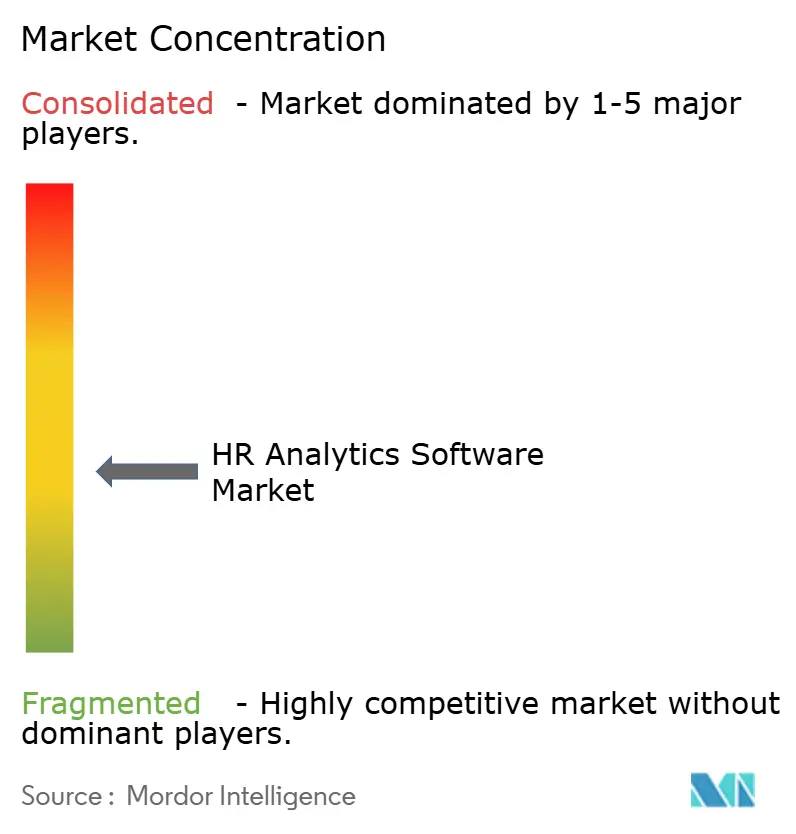
The HR analytics software market is moderately fragmented, with specialized analytics vendors competing alongside embedded analytics offerings from major HCM suite providers. Pure-play vendors such as Visier, Orgvue, and One Model compete on analytical depth, multi-system data ingestion, and dedicated workforce intelligence functionality. Large suite providers respond with switching costs, unified data models, and broader contract structures that keep analytics within larger enterprise software relationships. The competitive center is moving toward skills intelligence and agentic AI because governed skills taxonomies are becoming the foundation for predictive workforce decisions. This is narrowing the room for mid-tier vendors that lack both platform breadth and strong analytical depth.
Visier expanded that competition in May 2026 when it released the next generation of its Workforce AI platform, connecting demand planning, skills planning, action planning, and organizational design in a unified intelligence layer. Eightfold AI also introduced TalentForge in May 2026, an AI application builder that enables HR technology teams to create custom agentic workflows in natural language on top of its talent intelligence platform.[4] Oracle added to the same shift in April 2026 by launching Fusion Agentic Applications for HR inside Oracle Fusion Cloud HCM, allowing AI agents to act within HR workflows using unified enterprise data and approval structures. These launches show that the Human Resources (HR) analytics software market is moving beyond reporting quality alone and toward execution-ready workforce intelligence.
White space is opening in compliance-oriented analytics for mid-market employers, real-time agentic orchestration, and labor market signal integration that connects internal workforce data with external skills trends. Smaller, focused vendors are still proving relevant in this environment. Syndio stated in 2025 that more than half of the Fortune 100 companies trusted its pay-governance platform, showing that deep specialization can still drive enterprise adoption. Gloat also advanced an overlay model in April 2026 by integrating its Agentic HR Platform into Microsoft 365 Copilot and Microsoft Teams, supporting adoption through integration rather than system replacement. Vendors that can show explainable outputs, auditability, and clean integration are gaining an advantage in regulated enterprise environments where algorithmic transparency is becoming a purchasing requirement rather than an added feature.
HR Analytics Software Industry Leaders
-
Visier Solutions Inc.
-
Culture Amp Pty Ltd
-
Eightfold AI, Inc.
-
Perceptyx, Inc.
-
Lattice HQ, Inc.
- *Disclaimer: Major Players sorted in no particular order
Recent Industry Developments
- May 2026: Mercer and Syndio announced a partnership to integrate Syndio's AI-powered pay-governance platform with Mercer's global compensation benchmarking data, enabling enterprises to close the gap between compensation strategy and real-time pay-decision execution at the point of offer, promotion, and merit review.
- May 2026: Visier released the next generation of its Workforce AI platform, connecting demand planning, skills planning, action planning, and organizational design into a unified intelligence layer, and launched a Model Context Protocol integration with the enterprise AI search platform Glean to deliver governed workforce insights directly within Glean's unified assistant, eliminating context switching for enterprise users.
- April 2026: Oracle introduced Fusion Agentic Applications for HR, a suite of outcome-driven AI agents built into Oracle Fusion Cloud Human Capital Management that can make and execute decisions within HR business processes by accessing unified enterprise data, approval hierarchies, and transactional context without manual intervention.
- April 2026: Gloat brought its Agentic HR Platform into Microsoft 365 Copilot and Microsoft Teams by publishing its Copilot Agent to the Microsoft Agent Store and Microsoft Marketplace, enabling organizations to embed Loomra Workforce Context Engine-powered workforce intelligence into employee productivity tools at enterprise scale.
Global HR Analytics Software Market Report Scope
The HR Analytics Software market comprises software platforms and services that enable organizations to collect, integrate, process, analyze, and visualize workforce-related data to support strategic and operational human resource decision-making. These solutions leverage technologies such as artificial intelligence (AI), machine learning (ML), predictive analytics, natural language processing (NLP), statistical modeling, and business intelligence tools to generate actionable insights across workforce planning, employee performance, talent acquisition, retention, compensation, productivity, diversity and inclusion, employee engagement, and organizational effectiveness.
The HR Analytics Software Market Report is Segmented by Component (Software, and Services), Deployment Mode (Cloud, On-Premises, and Hybrid), Organization Size (Large Enterprises, and SMEs), Analytics Type (Descriptive Analytics, Diagnostic Analytics, Predictive Analytics, and Prescriptive Analytics), End-User (BFSI, Healthcare and Life Sciences, Information Technology and Telecom, Retail and E-Commerce, Manufacturing, Government and Public Sector, Energy and Utilities, and Other End-user Industries), and Geography (North America, South America, Europe, Asia-Pacific, Middle East, and Africa). The Market Forecasts are Provided in Terms of Value (USD).
| Software |
| Services |
| Cloud |
| On-premises |
| Hybrid |
| Large Enterprises |
| SMEs |
| Descriptive Analytics |
| Diagnostic Analytics |
| Predictive Analytics |
| Prescriptive Analytics |
| BFSI |
| Healthcare and Life Sciences |
| Information Technology and Telecom |
| Retail and E-Commerce |
| Manufacturing |
| Government and Public Sector |
| Energy and Utilities |
| Other End-user Industries |
| North America | United States |
| Canada | |
| Mexico | |
| South America | Brazil |
| Argentina | |
| Chile | |
| Rest of South America | |
| Europe | Germany |
| United Kingdom | |
| France | |
| Italy | |
| Spain | |
| Russia | |
| Rest of Europe | |
| Asia-Pacific | China |
| Japan | |
| India | |
| South Korea | |
| Australia and New Zealand | |
| Rest of Asia-Pacific | |
| Middle East | Saudi Arabia |
| United Arab Emirates | |
| Turkey | |
| Rest of Middle East | |
| Africa | South Africa |
| Egypt | |
| Nigeria | |
| Rest of Africa |
| By Component | Software | |
| Services | ||
| By Deployment Mode | Cloud | |
| On-premises | ||
| Hybrid | ||
| By Organization Size | Large Enterprises | |
| SMEs | ||
| By Analytics Type | Descriptive Analytics | |
| Diagnostic Analytics | ||
| Predictive Analytics | ||
| Prescriptive Analytics | ||
| By End-User Industry | BFSI | |
| Healthcare and Life Sciences | ||
| Information Technology and Telecom | ||
| Retail and E-Commerce | ||
| Manufacturing | ||
| Government and Public Sector | ||
| Energy and Utilities | ||
| Other End-user Industries | ||
| By Geography | North America | United States |
| Canada | ||
| Mexico | ||
| South America | Brazil | |
| Argentina | ||
| Chile | ||
| Rest of South America | ||
| Europe | Germany | |
| United Kingdom | ||
| France | ||
| Italy | ||
| Spain | ||
| Russia | ||
| Rest of Europe | ||
| Asia-Pacific | China | |
| Japan | ||
| India | ||
| South Korea | ||
| Australia and New Zealand | ||
| Rest of Asia-Pacific | ||
| Middle East | Saudi Arabia | |
| United Arab Emirates | ||
| Turkey | ||
| Rest of Middle East | ||
| Africa | South Africa | |
| Egypt | ||
| Nigeria | ||
| Rest of Africa | ||
Key Questions Answered in the Report
What is the current HR analytics software market size?
The HR analytics software market was valued at USD 4.48 billion in 2025 and is estimated at USD 5.02 billion in 2026, with projections reaching USD 9.27 billion by 2031 at a 13.06% CAGR.
Which deployment model is growing the fastest in HR analytics software?
Hybrid deployment is projected to grow the fastest at a 14.46% CAGR through 2031 because enterprises are balancing cloud scale with data residency and localization needs.
Which analytics type is expanding the fastest in workforce intelligence platforms?
Predictive analytics is projected to record the highest growth at a 15.18% CAGR through 2031 as organizations seek attrition forecasting, succession modeling, and hiring velocity insights.
Which end-user segment leads spending on HR analytics software?
Information technology and telecommunications led end-user revenue with a 23.76% share in 2025 because the sector faces intense competition for specialized talent and relies on continuous skills tracking.
Why is healthcare and life sciences adopting HR analytics software more quickly?
Healthcare and life sciences is projected to grow at a 14.74% CAGR through 2031 because clinical staffing pressure is pushing providers toward predictive staffing and workforce allocation tools.
Which region offers the strongest future growth opportunity?
Asia-Pacific is expected to post the fastest regional growth at a 15.42% CAGR through 2031, supported by digital transformation investment and rising demand for skills-based workforce planning.