
Hospital Software As A Medical Device (SaMD) Market Size and Share
Market Overview
| Study Period | 2020 - 2031 |
|---|---|
| Market Size (2026) | USD 12.49 Billion |
| Market Size (2031) | USD 29.06 Billion |
| Growth Rate (2026 - 2031) | 18.40 % |
| Fastest Growing Market | Asia-Pacific |
| Largest Market | North America |
| Market Concentration | Medium |
Major Players *Disclaimer: Major Players sorted in no particular order Image © Mordor Intelligence. Reuse requires attribution under CC BY 4.0. | |
Hospital Software As A Medical Device (SaMD) Market Analysis by Mordor Intelligence
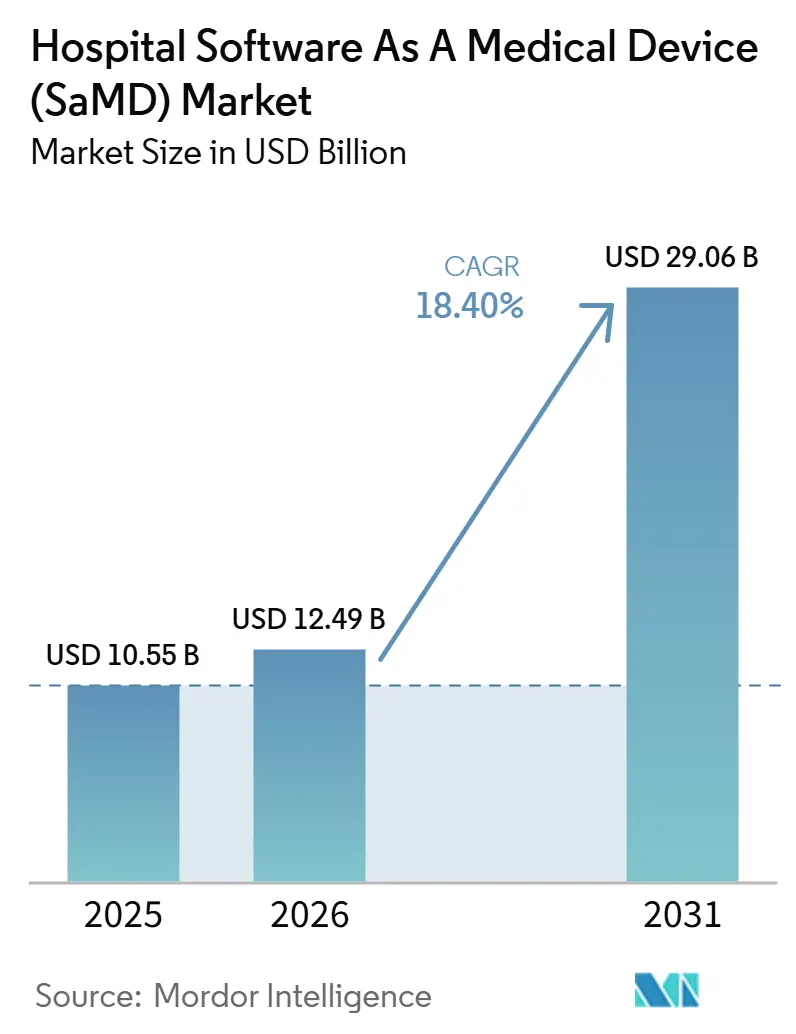
The Hospital Software As A Medical Device Market size is expected to increase from USD 10.55 billion in 2025 to USD 12.49 billion in 2026 and reach USD 29.06 billion by 2031, growing at a CAGR of 18.40% over 2026-2031.
Hospitals no longer treat software-led diagnostics and care tools as limited pilots. The hospital software as a medical device (SaMD) market is now closely linked to routine clinical use across imaging, monitoring, and care coordination. Demand is rising as hospitals seek solutions that integrate into clinical workflows, reduce response times, and support staff amid growing throughput pressure. The FDA’s Predetermined Change Control Plan (PCCP) guidance has made post-clearance model updates more practical for eligible products, while reimbursement progress and enterprise deployment models are helping validated solutions move into larger contracts. Competition remains balanced between global imaging companies and specialist software firms, while regulatory complexity, cybersecurity reviews, and integration requirements continue to shape purchasing decisions.
Key Report Takeaways
- By delivery mode, cloud-based deployment held 69.55% share in 2025, and it is also projected to expand at a 21.93% CAGR through 2031.
- By software type, diagnostic SaMD held 44.22% share in 2025, while monitoring and alerting SaMD is forecast to grow at the fastest 22.67% CAGR through 2031.
- By application, radiology and medical imaging accounted for 47.66% share in 2025, while neurology is projected to advance at a 29.35% CAGR through 2031.
- By technology, rules-based software held 52.33% share in 2025, while AI and machine learning are expected to grow at a 22.33% CAGR through 2031.
- By geography, North America held 40.25% share in 2025, while Asia-Pacific is projected to record the fastest 21.95% CAGR through 2031.
Note: Market size and forecast figures in this report are generated using Mordor Intelligence’s proprietary estimation framework, updated with the latest available data and insights as of January 2026.
Market Trends and Insights
Drivers Impact Analysis of Hospital Software As A Medical Device (SaMD) Market*
| DRIVER | (~) % IMPACT ON CAGR FORECAST | GEOGRAPHIC RELEVANCE | IMPACT TIMELINE |
|---|---|---|---|
| Rising hospital adoption of AI-based clinical decision making | +4.2% | Global, led by North America and Europe | Short term (≤ 2 years) |
| Expansion of remote monitoring and virtual ward workflows | +3.5% | North America, Europe, and Asia-Pacific | Medium term (2-4 years) |
| Hospital pressure to reduce length of stay and readmissions | +2.9% | Global, with early gains in the United States, the United Kingdom, and Australia | Short term (≤ 2 years) |
| Increasing integration of SaMD with PACS, RIS, LIS, and other imaging systems | +2.4% | Global, with concentration in North America and Asia-Pacific imaging hubs | Medium term (2-4 years) |
| Growth of image-AI triage for time-critical specialties | +2.1% | North America and Europe, with spillover into Asia-Pacific | Short term (≤ 2 years) |
| PCCP-enabled iteration of AI models after market clearance | +1.7% | North America, with regulatory influence extending into Europe | Long term (≥ 4 years) |
| Source: Mordor Intelligence | |||
Rising Hospital Adoption of AI-Based Clinical Decision Making
The hospital software as a medical device (SaMD) market is benefiting from the rising adoption of AI tools that integrate directly into daily care pathways. Hospitals are prioritizing platforms that flag risk, support clinical prioritization, and fit into clinician workflows without adding extra steps. Procurement teams are also seeking evidence that software can influence treatment decisions, not just improve technical accuracy. Tempus AI reported that its ALERT trial across 35 hospitals and five US health systems improved treatment rates for significant valvular heart disease, with patients in the alert group 27% more likely to receive a multidisciplinary heart team evaluation and valve procedures increasing by 40% compared with usual care.
Expansion of Remote Monitoring and Virtual Ward Workflows
The hospital software as a medical device (SaMD) market is also gaining from the expansion of hospital-at-home and virtual ward models. These programs require software that can process remote patient data, detect deterioration early, and send timely alerts to care teams. A 2025 longitudinal analysis showed that NHS England had expanded virtual ward capacity to more than 12,600 beds by January 2025, with occupancy nearing 80%, indicating a larger installed need for monitoring software in formal care pathways. A multicenter UK cardiac study also found that remote monitoring for pre-surgical coronary artery bypass patients maintained clinical outcomes while reducing preoperative bed occupancy.
Hospital Pressure to Reduce Length of Stay and Readmissions
Hospitals face increasing pressure to improve patient throughput without compromising safety, which is supporting the hospital software as a medical device (SaMD) market. Software that triages scans, pre-fills reports, or detects deterioration earlier can influence bed use, discharge timing, and escalation decisions. This capability is critical in emergency care, imaging, and high-acuity settings, where delayed findings can slow patient flow. Vendors that can link their software to shorter stays or fewer readmissions are likely to gain stronger traction in hospital buying decisions.
PCCP-Enabled Iteration of AI Models After Market Clearance
The hospital software as a medical device (SaMD) market is also benefiting from a more usable pathway for post-clearance model updates in the United States. The FDA’s Predetermined Change Control Plan (PCCP) guidance allows manufacturers to propose certain future modifications in advance, reducing the need for a new marketing submission for each eligible update. This is important as hospitals do not want software to become outdated during repeated review cycles. Over time, this is expected to widen the gap between vendors that support continuous upgrades and those operating on slower release cycles.
Restraints Impact Analysis of Hospital Software As A Medical Device (SaMD) Market*
| RESTRAINT | (~) % IMPACT ON CAGR FORECAST | GEOGRAPHIC RELEVANCE | IMPACT TIMELINE |
|---|---|---|---|
| Complex and fragmented regulatory classification pathways | -1.4% | Europe and Asia-Pacific multi-market environments | Long term (≥ 4 years) |
| Hospital IT interoperability and cybersecurity burden | -1.0% | Global, with acute pressure in North America and Europe | Medium term (2-4 years) |
| Limited clinical evidence for real-world workflow impact | -0.8% | Global | Medium term (2-4 years) |
| Reimbursement uncertainty for standalone software billing | -0.7% | North America first, Europe second | Short term (≤ 2 years) to Medium term (2-4 years) |
| Source: Mordor Intelligence | |||
Complex and Fragmented Regulatory Classification Pathways
The hospital software as a medical device (SaMD) market continues to face complex and fragmented regulatory pathways across major regions. In Europe, vendors must manage medical device regulations and AI-specific obligations, increasing documentation requirements and extending approval timelines. Germany’s Federal Commissioner for Data Protection and Freedom of Information and the Bundesnetzagentur issued a joint roadmap in July 2026 to help manufacturers navigate AI in medical devices, underscoring the compliance burden for vendors. Multi-country suppliers also face challenges as data handling, quality management, and clinical evidence expectations vary by market, slowing launches and favoring vendors with larger regulatory teams and stronger local partnerships.
Hospital IT Interoperability and Cybersecurity Burden
The hospital software as a medical device (SaMD) market also faces deployment challenges within hospital IT environments. Many hospitals operate PACS, RIS, LIS, EHR, and monitoring systems implemented at different times, making integration complex even for cleared products. Cybersecurity reviews further extend deployment timelines as hospitals require assurance on software updates, data flows, user access, and vendor support obligations. As a result, adoption moves faster in hospitals with stronger digital infrastructure and slower where integration represents a significant share of project costs.
*Our forecasts treat driver/restraint impacts as directional, not additive. The impact forecasts reflect baseline growth, mix effects, and variable interactions.
Hospital Software As A Medical Device (SaMD) Market Segment Analysis
By Delivery Mode:
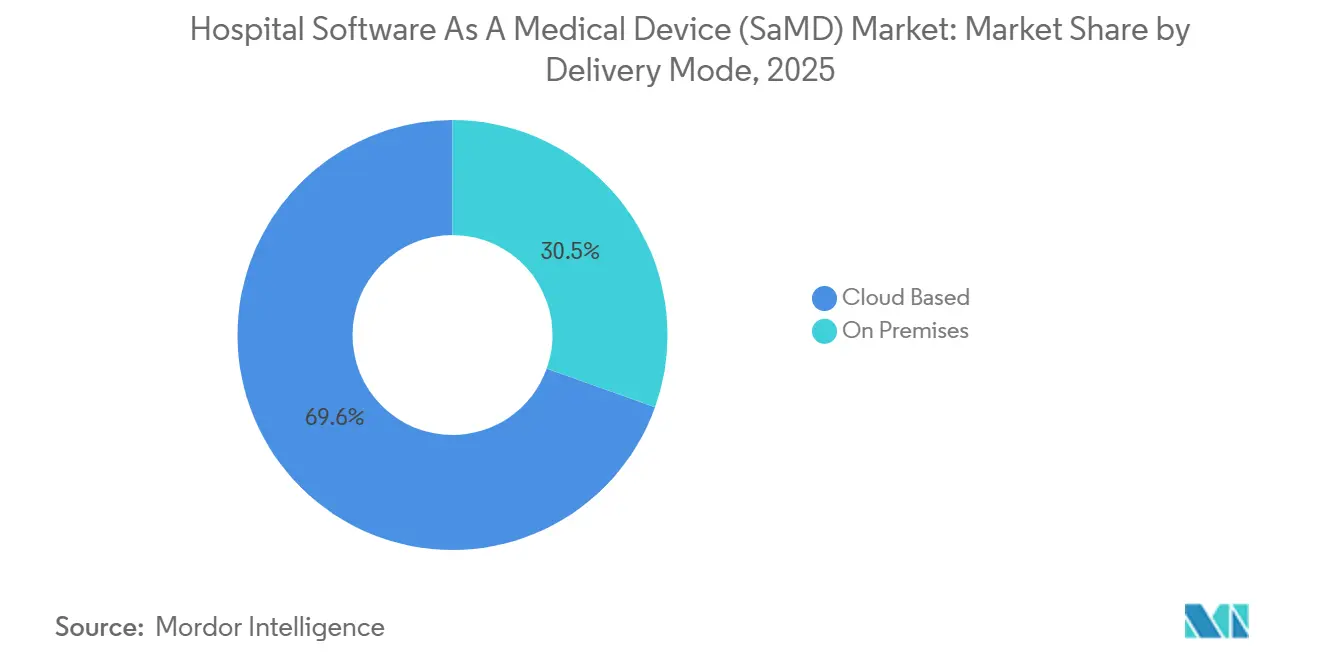
Cloud Consolidation Accelerates Enterprise SaMD AdoptionCloud-based deployment accounted for 69.55% of the hospital software as a medical device (SaMD) market size in 2025, highlighting hospitals’ strong shift toward vendor-managed delivery. Cloud platforms reduced local infrastructure needs, simplified software updates across care sites, and supported heavier computing workloads for imaging and model retraining. As a result, the hospital software as a medical device (SaMD) market continued to favor enterprise subscriptions over isolated departmental installations. The cloud-based deployment segment is projected to expand at a CAGR of 21.93% through 2031, reflecting platform consolidation across hospital networks.
Aidoc’s April 2026 Series E funding round of USD 150 million brought its total funding above USD 500 million and supported wider deployment of its aiOS enterprise platform and further development of its CARE clinical foundation model. This move showed that suppliers were building for scale rather than single-use deployment within the hospital software as a medical device (SaMD) industry. However, on-premises deployment remained relevant for hospitals with stricter data residency rules or local control requirements for time-sensitive use cases.


By Software Type:
Diagnostic SaMD Leads but Monitoring Builds FastestDiagnostic SaMD held 44.22% of the hospital software as a medical device (SaMD) market share in 2025, maintaining its leading position across software categories. Imaging gave diagnostic tools a strong base, as hospitals already relied on software-assisted review, prioritization, and reporting in high-volume departments. These products also fit more naturally into existing clinical processes than newer categories that required new protocols or staffing adjustments. Monitoring and alerting SaMD is projected to be the fastest-growing software type, registering a CAGR of 22.67% through 2031, as hospitals expand remote observation and early warning use cases.
Reimbursement support also improved for selected use cases. CMS added HCPCS code G0680 in its April 2026 Hospital Outpatient Prospective Payment System update for software analysis of coronary artery calcium from chest CT scans, showing how payment pathways started aligning with validated clinical software. Clinical decision support software also advanced in cardiology and oncology, where hospitals sought more actionable guidance within record systems. This trend created a broader growth pathway for the hospital software as a medical device (SaMD) market beyond diagnostic interpretation alone.
By Application:
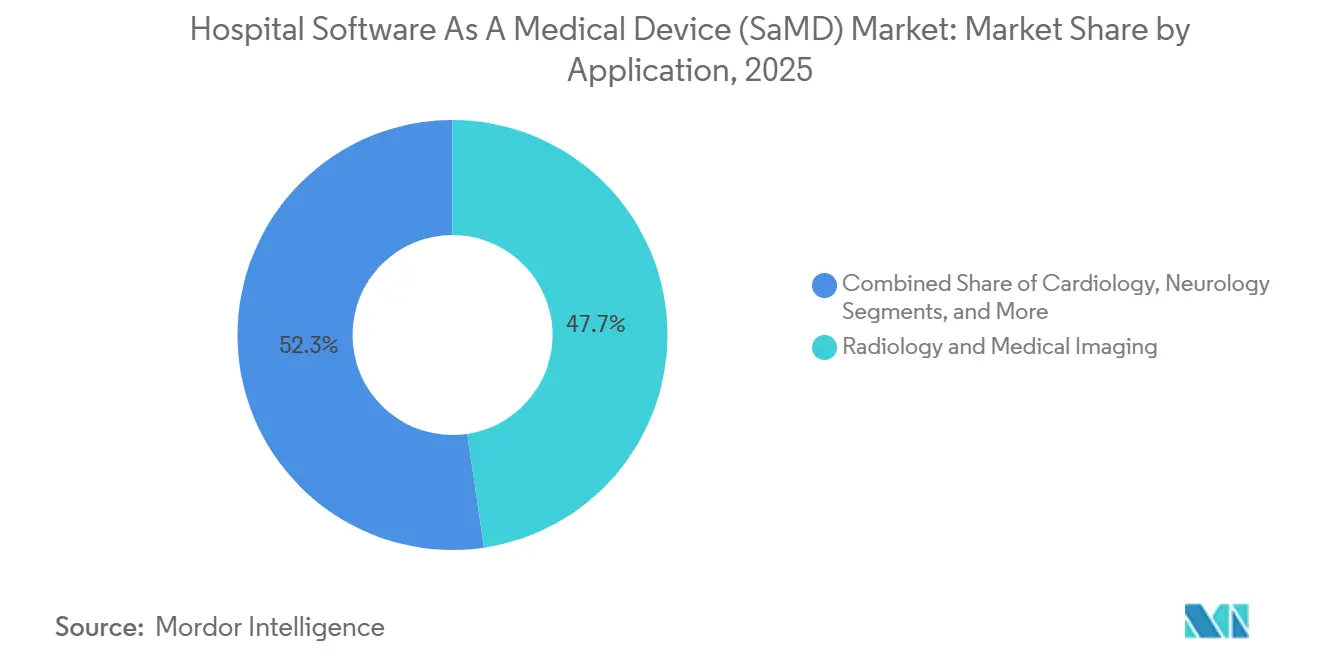
Radiology Leads, Neurology Commands the Fastest GrowthRadiology and medical imaging accounted for 47.66% of the hospital software as a medical device (SaMD) market size in 2025, making it the largest application area. Imaging departments generated high data volumes, followed standardized workflows, and faced early staffing pressure, which pushed software adoption ahead of many other specialties. Hospitals also trusted tools that supported prioritization, contouring, planning, and scan setup because these use cases aligned with existing operating routines. This kept radiology at the center of the hospital software as a medical device (SaMD) market as other specialties advanced.
GE HealthCare received FDA 510(k) clearance in June 2026 for MIM Contour ProtégéAI+ 2.0, and Philips received FDA 510(k) clearance in 2026 for SmartHeart, which supported faster AI-enabled cardiac MR planning. Neurology is projected to record the fastest CAGR of 29.35% through 2031, supported by demand for stroke coordination, quantitative neuroimaging, and neurodegenerative disease analysis. This part of the hospital software as a medical device (SaMD) market expanded as hospitals sought faster response pathways for acute neurological events and longer-term tools for chronic disease management.

By Technology:
Rules-Based Software Dominant, AI/ML Closes the GapRules-based software held 52.33% of the hospital software as a medical device (SaMD) market share in 2025, reflecting the large installed base of alert logic, structured pathways, and clinical support rules within hospital systems. Hospitals continued to use these tools because they were familiar, easier to validate, and less disruptive to existing governance models. In many environments, simple rules still managed a large share of routine checking, routing, and escalation tasks. At the same time, AI and machine learning are projected to expand at a CAGR of 22.33% through 2031.
The next phase of competition is likely to center on platforms that can move from narrow, single-task use cases toward broader clinical reasoning and orchestration. Aidoc said its CARE clinical foundation model received FDA clearance in 2026 for a multi-disease triage system in clinical imaging, marking an important step for broader model-based software deployment. Hybrid architectures will remain important because many hospitals still want a visible rules layer alongside machine-learning outputs.
Geography Analysis
North America Hospital Software As a Medical Device (SaMD) Market
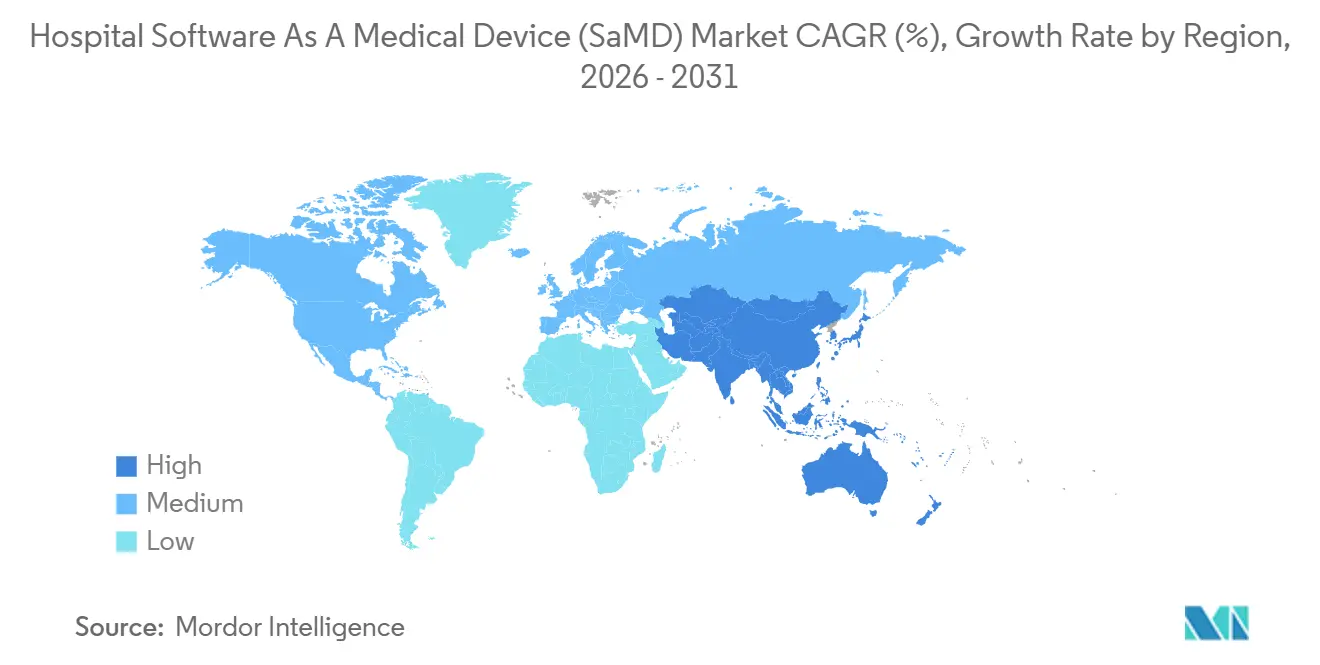
North America held 40.25% of the hospital software as a medical device (SaMD) market size in 2025, maintaining its leading regional position. The region benefited from a large base of cleared products, mature hospital IT systems, and strong commercial readiness for enterprise software deployment. Reimbursement was still evolving, but the outlook became more constructive for certain validated use cases. CMS added HCPCS code G0680 in April 2026 for software analysis of coronary artery calcium from chest CT scans, showing that payment frameworks started recognizing software as part of reimbursable clinical activity.
Europe Hospital Software As a Medical Device (SaMD) Market
Europe remained a significant part of the hospital software as a medical device (SaMD) market, but a stricter compliance environment shaped its growth path. Hospitals and vendors had to address both device regulation and AI-related obligations, which increased market entry costs and slowed deployment in some cases. Germany’s joint July 2026 roadmap from the BfDI and Bundesnetzagentur gave manufacturers clearer guidance on how AI in medical devices would be treated in practice. Large suppliers such as Philips remained well positioned in Europe by combining hardware relationships, clinical workflow tools, and certified software offerings across multiple hospital departments.
APAC, MEA and South America Hospital Software As a Medical Device (SaMD) Market
Asia-Pacific is the fastest-growing region in the hospital software as a medical device (SaMD) market, with a projected 21.95% CAGR through 2031. Digital health investment, large patient volumes, and rising interest in cloud-native hospital systems support growth. Japan’s SaMD review pathway and India’s expanding digital health infrastructure are helping software adoption move beyond early pilots in selected hospital networks. This regional trend is also expanding into the Middle East and Africa, where GCC healthcare modernization programs support procurement interest, while South America remains at an earlier stage, with Brazil and Argentina as the main entry points.

Competitive Landscape
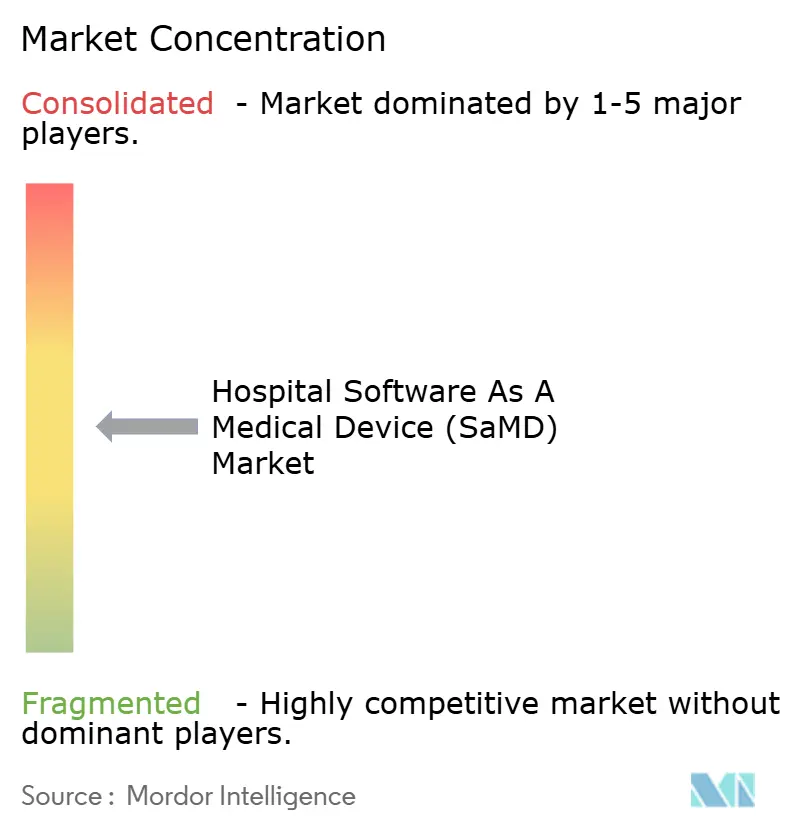
The hospital software as a medical device (SaMD) market shows moderate concentration. Large imaging and healthcare technology companies, such as Siemens Healthineers, GE HealthCare, and Philips, retain a strong advantage through installed equipment, enterprise service relationships, and integrated software layers within hospital workflows. This position helps them expand SaMD across imaging, planning, and operational use cases. Specialist software firms continue to gain traction as hospitals seek vendor-neutral orchestration, faster product iteration, and broader clinical AI coverage.
GE HealthCare’s February 2026 FDA clearances for next-generation SIGNA MRI technology showed how larger vendors strengthened workflow integration rather than positioned software as a disconnected add-on. Philips followed a similar approach by expanding AI-enabled workflow products, including SmartHeart and the Alturion ultrasound system, across clinical environments where hospitals needed faster throughput and more standardized scan setup. These moves supported a bundled strategy that kept software closely tied to existing equipment and service contracts in the hospital software as a medical device (SaMD) market.
AI-native firms responded with platform models designed to serve as the control layer across multiple applications. Aidoc’s April 2026 funding round supported the scaling of its aiOS enterprise platform, which was already deployed across nearly 2,000 hospitals and processed more than 60 million patient cases each year. Tempus AI also upgraded Tempus Hub in May 2026 with next-generation agentic AI architecture, signaling a shift toward embedded clinical workflow support rather than isolated model outputs. The hospital software as a medical device (SaMD) market is likely to remain moderately concentrated, with leading incumbents maintaining strong hospital access while specialist vendors expand where software performance, evidence, and interoperability matter most.
Hospital Software As A Medical Device (SaMD) Industry Leaders
GE HealthCare Technologies Inc.
Koninklijke Philips N.V.
Medtronic plc
Siemens Healthineers AG
Tempus AI, Inc.
- *Disclaimer: Major Players sorted in no particular order
Hospital Software As A Medical Device (SaMD) Market Companies Covered in this Report
- Abbott Laboratories
- Aidoc Medical Ltd.
- Baxter
- BrightInsight, Inc.
- Butterfly Network, Inc.
- Canon
- Digital Diagnostics
- FUJIFILM
- GE HealthCare Technologies Inc.
- iCAD, Inc.
- Intuitive Surgical, Inc.
- Johnson & Johnson
- Koninklijke Philips
- Medtronic
- Qure.ai Technologies Private Limited
- RadNet, Inc.
- Siemens Healthineers
- Stryker
- Tempus AI, Inc.
- Viz.ai, Inc.

Recent Industry Developments in Hospital Software As A Medical Device (SaMD) Market
- April 2026: Aidoc Medical Ltd. raised USD 150 million in Series E funding led by Goldman Sachs Alternatives Growth Equity, with participation from SoftBank Vision Fund 2 and NVentures, bringing its total funding to over USD 500 million.
- July 2026: Viz.ai partnered with Cortechs.ai to integrate NeuroQuant MS neuroimaging quantification into its platform, expanding its SaMD coverage to neurodegenerative disease management, including multiple sclerosis.
- July 2026: CliniComp received FDA 510(k) clearance for its PACS Viewer (MIMPS), integrating diagnostic imaging, enterprise EHR, and native AI into a unified longitudinal patient record.
- June 2026: GE HealthCare received FDA 510(k) clearance for MIM Contour ProtégéAI+ 2.0, an AI-enabled auto-contouring software for radiation oncology treatment planning.


Global Hospital Software As A Medical Device (SaMD) Market Report Scope
As per the scope of the report, Hospital Software as a Medical Device (Hospital SaMD) refers to standalone clinical software deployed within hospital settings that performs one or more medical purposes such as diagnosis, clinical decision support, disease monitoring, treatment planning, or patient management without being part of a physical medical device. These software solutions integrate with hospital information systems, electronic health records (EHRs), laboratory information systems, and medical imaging platforms to assist clinicians in making evidence-based decisions, improving workflow efficiency, enhancing patient safety, and delivering personalized care.
The hospital software as a medical device (SaMD) market is segmented by delivery mode, software type, application, technology, and geography. By delivery mode, the market is segmented into cloud-based and on-premises. By software type, the market is segmented into diagnostic SaMD, monitoring and alerting SaMD, clinical decision support SaMD, therapeutic SaMD, and administrative and workflow SaMD. By application, the market is segmented into radiology and medical imaging, cardiology, neurology, oncology, critical care and emergency medicine, pathology and laboratory medicine, and other hospital applications. By technology, the market is segmented into AI and machine learning, rules-based software, and hybrid human-AI workflow software. By geography, the market is analyzed across North America, Europe, Asia-Pacific, the Middle East and Africa, and South America. The report also covers the estimated market sizes and trends for 17 countries across major regions globally. The report offers the market sizes and forecasts in terms of value (USD) for the above segments.
| Cloud Based |
| On Premises |
| Diagnostic SaMD |
| Monitoring and Alerting SaMD |
| Clinical Decision Support SaMD |
| Therapeutic SaMD |
| Administrative and Workflow SaMD |
| Radiology and Medical Imaging |
| Cardiology |
| Neurology |
| Oncology |
| Critical Care and Emergency Medicine |
| Pathology and Laboratory Medicine |
| Other Hospital Applications |
| AI and Machine Learning |
| Rules Based Software |
| Hybrid Human AI Workflow Software |
| North America | United States |
| Canada | |
| Mexico | |
| Europe | Germany |
| United Kingdom | |
| France | |
| Italy | |
| Spain | |
| Rest of Europe | |
| Asia-Pacific | China |
| India | |
| Japan | |
| Australia | |
| South Korea | |
| Rest of Asia-Pacific | |
| Middle East and Africa | GCC |
| South Africa | |
| Rest of Middle East and Africa | |
| South America | Brazil |
| Argentina | |
| Rest of South America |
| By Delivery Mode | Cloud Based | |
| On Premises | ||
| By Software Type | Diagnostic SaMD | |
| Monitoring and Alerting SaMD | ||
| Clinical Decision Support SaMD | ||
| Therapeutic SaMD | ||
| Administrative and Workflow SaMD | ||
| By Application | Radiology and Medical Imaging | |
| Cardiology | ||
| Neurology | ||
| Oncology | ||
| Critical Care and Emergency Medicine | ||
| Pathology and Laboratory Medicine | ||
| Other Hospital Applications | ||
| By Technology | AI and Machine Learning | |
| Rules Based Software | ||
| Hybrid Human AI Workflow Software | ||
| By Geography | North America | United States |
| Canada | ||
| Mexico | ||
| Europe | Germany | |
| United Kingdom | ||
| France | ||
| Italy | ||
| Spain | ||
| Rest of Europe | ||
| Asia-Pacific | China | |
| India | ||
| Japan | ||
| Australia | ||
| South Korea | ||
| Rest of Asia-Pacific | ||
| Middle East and Africa | GCC | |
| South Africa | ||
| Rest of Middle East and Africa | ||
| South America | Brazil | |
| Argentina | ||
| Rest of South America | ||


Key Questions Answered in the Report
What is the current value of the hospital software as a medical device (SaMD) market?
The hospital software as a medical device (SaMD) market stands at USD 12.49 billion in 2026 and is projected to reach USD 29.06 billion by 2031 at an 18.40% CAGR.
What is driving growth in the hospital software as a medical device (SaMD) market?
Growth is being supported by deeper AI adoption in clinical workflows, expansion of remote monitoring and virtual wards, and hospital pressure to reduce length of stay and readmissions.
Which delivery model leads hospital software as a medical device (SaMD) market adoption?
Cloud-based deployment led with 69.55% share in 2025 and is also the fastest-growing delivery model with a 21.93% CAGR through 2031.
Which application area is largest in the hospital software as a medical device (SaMD) market?
Radiology and medical imaging held the largest application share at 47.66% in 2025 because imaging workflows are already highly digital and easier to integrate with clinical software.
Which region is growing fastest for hospital software as a medical device (SaMD) solutions?
Asia-Pacific is the fastest-growing region with a projected 21.95% CAGR through 2031, supported by digital health investment and wider hospital software adoption.
How competitive is the hospital software as a medical device (SaMD) market?
The market is moderately concentrated, with large players such as Siemens Healthineers, GE HealthCare, and Philips competing alongside specialist software firms such as Aidoc, Viz.ai, and Tempus AI.
Page last updated on:





