
Horizontal Directional Drilling Market Size and Share
Market Overview
| Study Period | 2022 - 2032 |
|---|---|
| Market Size (2027) | USD 11.97 Billion |
| Market Size (2032) | USD 18.66 Billion |
| Growth Rate (2027 - 2032) | 9.29 % |
| Fastest Growing Market | Asia-Pacific |
| Largest Market | North America |
| Market Concentration | Medium |
Major Players *Disclaimer: Major Players sorted in no particular order Image © Mordor Intelligence. Reuse requires attribution under CC BY 4.0. | |
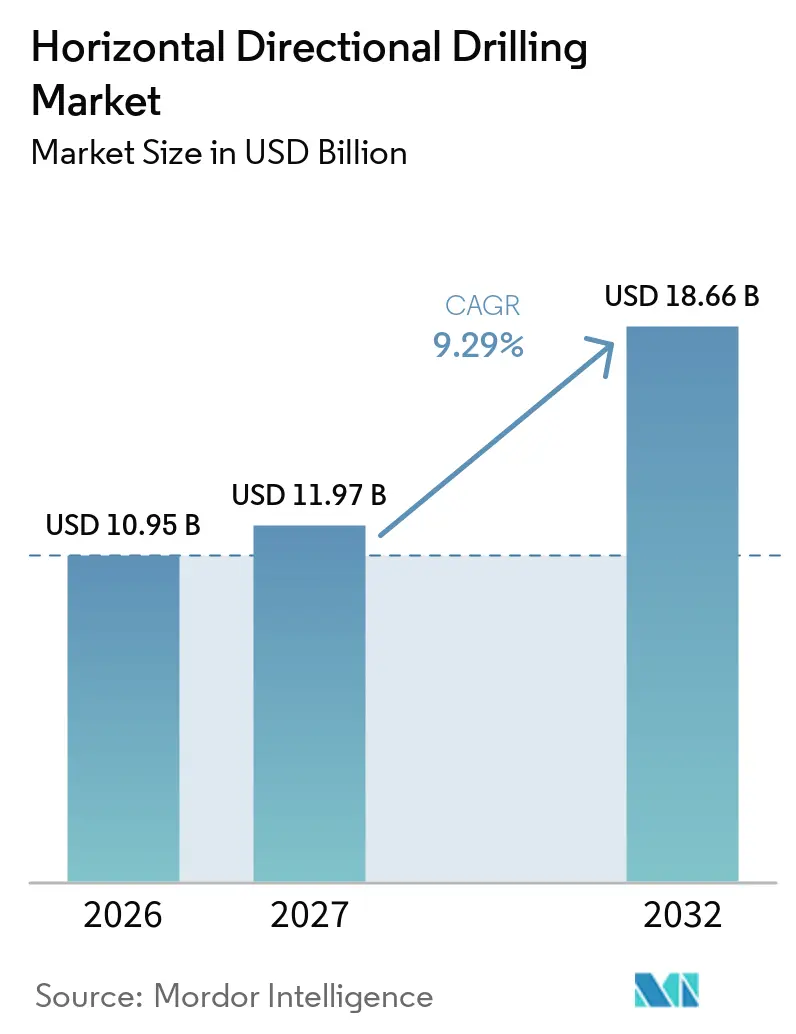
Horizontal Directional Drilling Market Analysis by Mordor Intelligence
The Horizontal Directional Drilling Market size was valued at USD 10.95 billion in 2026 and is estimated to grow from USD 11.97 billion in 2027 to reach USD 18.66 billion by 2032, at a CAGR of 9.29% during the forecast period (2027-2032). The horizontal directional drilling market is supported by infrastructure projects that need to preserve roads, waterways, and other surface assets during construction. Broadband networks, grid undergrounding, water-system renewal, data-center utilities, and offshore cable connections are creating work across several types of customers. This mix gives the horizontal directional drilling market a broader demand base than the fiber-led cycle seen earlier in the decade, since no one customer group determines equipment use or contractor scheduling across all regions. Contractors are also competing on trained crews, environmental controls, reliable location practices, and the ability to complete long and complex bores without disrupting a client’s operating assets, while equipment suppliers are responding with larger rigs, electric-drive platforms, specialized tooling, remote diagnostics, and dealer-based service support because uptime can be decisive when projects are subject to fixed utility or civil-work schedules. Delays in public-funding releases and the shortage of qualified operators can slow project starts, even where long-term demand remains established.
Key Report Takeaways
- By machine type, Boring Machines held 43.4% of the global horizontal directional drilling market share in 2026, while Foundation Machines are forecast to grow at a 9.7% CAGR through 2032.
- By location, Onshore accounted for 74.3% of the global horizontal directional drilling market size in 2026, while Offshore is forecast to grow at a 10.3% CAGR through 2032.
- By end use, Oil & Gas held 39.1% of the global horizontal directional drilling market share in 2026, while Telecommunications is forecast to grow at a 9.8% CAGR through 2032.
- By geography, North America held 32.6% of the global horizontal directional drilling market in 2026, while the Asia-Pacific is forecast to grow at a 9.4% CAGR through 2032.
Note: Market numbers in this report are based on Mordor Intelligence's proprietary estimation framework, which combines nine months of actuals with Q4 projections for base year 2026.
Market Trends and Insights
Drivers Impact Analysis of Horizontal Directional Drilling Market*
| Driver | (~) % Impact on CAGR Forecast | Geographic Relevance | Impact Timeline |
|---|---|---|---|
| Fiber and 5G Network Expansion | +2.5% | North America, Europe, Asia-Pacific | Short term (≤ 2 years) |
| Grid Hardening and Underground Power Investment | +2.0% | North America, Europe | Medium term (2-4 years) |
| Aging Water and Wastewater Infrastructure Replacement | +1.4% | North America, Europe, APAC core | Medium term (2-4 years) |
| Trenchless Construction Preference in Dense Corridors | +0.7% | Global, concentrated in urban Asia and Europe | Short term (≤ 2 years) |
| Data-Center Utility and Energy Build-Out | +1.0% | North America, APAC, spillover to MEA | Short term (≤ 2 years) |
| Offshore Renewable-Energy Cable Landfalls | +0.6% | Europe, Asia-Pacific, North America | Long term (≥ 4 years) |
| Source: Mordor Intelligence | |||
Fiber and 5G Network Expansion
Fiber deployment remains a major source of demand for compact and mid-sized rigs in the horizontal directional drilling market, particularly where contractors must install conduit with limited space for surface construction. The Bipartisan Infrastructure Law allocated USD 42.45 billion to the BEAD program, which targets broadband availability across the United States. The program’s phased release means that rural construction volumes are accumulating in contractor pipelines rather than being completed at once. Fiber projects also require contractors to work in streets and built-up corridors where open excavation can disrupt traffic, businesses, and existing utilities. These conditions support the use of directional drilling for conduit installation beneath surface obstacles. Demand is also strengthened when campus and backbone connections require new fiber routes beside power and water services.
Grid Hardening and Underground Power Investment
Weather-related damage has moved undergrounding from a planning option to an active part of utility capital programs. PG&E is continuing its system-hardening and undergrounding program in high-fire-risk areas during 2026.[1] Utility resilience programs can generate multi-year construction work where distribution networks need to be moved underground. Longer utility crossings require more pullback capacity, better bore planning, and stronger drilling-fluid control than basic conduit installation. This shifts work toward contractors that can manage larger rigs, detailed utility coordination, and more demanding site conditions, including crossings where operating reliability is more important than a low initial bid. Grid upgrades therefore support both equipment demand and higher-value service work in the horizontal directional drilling market.
Data-Center Utility and Energy Build-Out
Data-center development is creating demand for utility corridors that combine fiber, power, and water connections. Vermeer identifies utility installation as an important part of supplying power to AI-related infrastructure.[2] These projects often have congested sites and fixed construction schedules, which can favor trenchless installation methods. Large campuses need multiple underground routes before buildings become operational. The same projects can require substantial foundation work before vertical construction begins. This combination supports demand for high-capacity rigs and foundation equipment in the horizontal directional drilling market, while creating work that can involve several underground systems at the same site.
Offshore Renewable-Energy Cable Landfalls
Offshore wind projects need export cables to pass beneath beaches, dunes, and near-shore areas before reaching onshore grid connections. Offshore cable programs can require several HDD installations where the route must pass beneath sensitive coastal landscapes. The work is relevant because the route crosses the Wadden Sea landscape, where surface disturbance must be managed carefully. Research on submarine cable pullback also identifies crossing length and entry angle as important engineering factors. These requirements increase the value of detailed planning, pressure monitoring, environmental response preparation, and experienced crews that understand local coastal conditions before work begins. Offshore cable landfalls can therefore provide long-duration work for the specialist end of the horizontal directional drilling market.
Restraints Impact Analysis of Horizontal Directional Drilling Market*
| Restraint | (~) % Impact on CAGR Forecast | Geographic Relevance | Impact Timeline |
|---|---|---|---|
| Skilled-Operator Shortage and Safety Learning Curve | -1.5% | North America, Europe, Australia | Short term (≤ 2 years) |
| Inadvertent-Return and Drilling-Fluid Compliance Risk | -0.8% | North America, Europe, APAC core | Medium term (2-4 years) |
| High Equipment, Tooling and Mobilization Costs | -0.6% | Global, concentrated in offshore and remote markets | Long term (≥ 4 years) |
| BEAD and Large-Project Funding-Release Delays | -0.7% | North America | Short term (≤ 2 years) |
| Source: Mordor Intelligence | |||
Skilled-Operator Shortage and Safety Learning Curve
The availability of qualified drill operators can constrain project delivery even when equipment and funding are available. The Horizontal Directional Drilling Association was developing online training material for drilling functions and safety protocols in 2026. Operating a rig requires practical control of alignment, drilling fluid, tooling, and utility-location risk. Inexperienced crews can create strikes or alignment failures that delay projects and raise compliance costs. Contractors with structured training and experienced supervision can use this capability to protect delivery reliability. The shortage remains a near-term constraint for the horizontal directional drilling market, particularly on complex crossings where a small error can result in lost time, damaged infrastructure, or added environmental controls.
Inadvertent-Return and Drilling-Fluid Compliance Risk
Inadvertent returns occur when drilling fluid reaches the surface through fractures or other pathways in the ground. The U.S. Environmental Protection Agency notes that drilling methods can require environmental review where sensitive resources may be affected. FERC guidance sets expectations for monitoring, response planning, and notification for HDD activity associated with regulated projects. The risk is especially important near wetlands, streams, tidal areas, and other environmentally sensitive locations. Contractors must prepare containment plans, monitor annular pressure, and coordinate with agencies when a release occurs. These obligations can favor firms with established environmental procedures and reduce the addressable work for less experienced providers.
*Our forecasts treat driver/restraint impacts as directional, not additive. The impact forecasts reflect baseline growth, mix effects, and variable interactions.
Horizontal Directional Drilling Market Segment Analysis
By Machine Type:
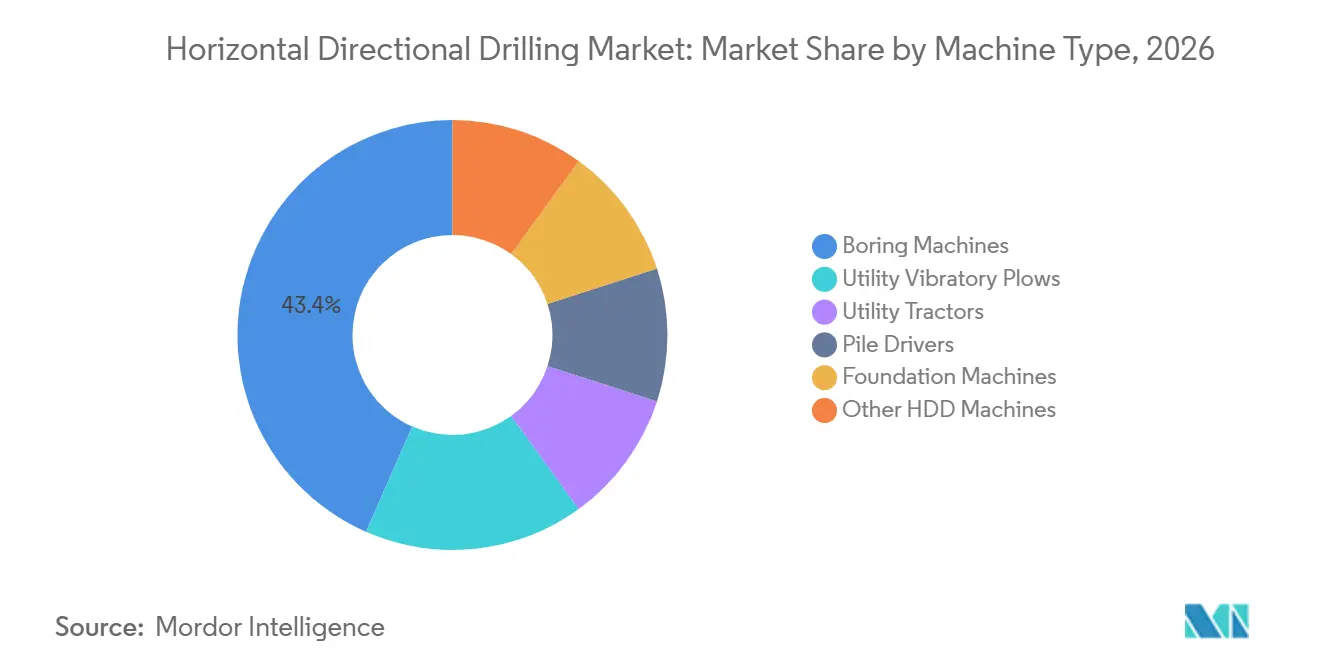
Data Centers and Transmission Cables Reshape the Machine MixBoring Machines held 43.4% of the horizontal directional drilling market in 2026 and remained the largest machine type. Their pullback range and compatibility with HDPE pipe support fiber, water, and utility installations across varied site conditions, including projects that must work around established services. Foundation Machines are expected to expand at a 9.7% CAGR through 2032 because data-center construction requires extensive deep-foundation work before superstructure construction can begin. Utility Vibratory Plows and Utility Tractors serve shallow-burial and softer-soil applications that can complement directional drilling on mixed-terrain projects, while Pile Drivers remain relevant for offshore substations and port infrastructure. Other HDD Machines address harder formations and specialized jobs that need tooling outside standard boring-machine configurations, giving contractors options when ground conditions change across a long route or when standard tooling cannot deliver the required bore path.
Fleet renewal is directing procurement toward machines with stronger capacity, improved controls, and lower operating impact across demanding project locations. Global output reached 2,750 rigs in 2025 and 2026 production is forecast to exceed 2,877 units, while 39.2% of active rigs are 2-5 years old and 29.4% are less than 2 years old. Planned purchases of rigs above 100,000 lb pullback increased from 3.6% to 3.8% in 2026, while medium-rig purchase intent increased from 37% to 37.3%. Goodeng reported that its pure-electric equipment delivered energy savings above 60% on a large-diameter gas-pipeline crossing in China, illustrating why buyers are weighing energy use, downhole data, operating control, and service availability beside basic rig capacity, especially on complex routes. The horizontal directional drilling industry is moving toward higher-specification fleets where difficult routes, long pullbacks, and environmental conditions can justify the investment through better control and more consistent operating performance.

By Location:
Offshore Acceleration Opens a New Technical Premium SegmentOnshore accounted for 74.3% of the global horizontal directional drilling market in 2026 because it serves the widest range of installation needs. Work includes residential fiber conduit, water-main replacement, underground electric distribution, and pipeline crossings, which creates a diverse project base for contractors. Omaha’s Metropolitan Utilities District is replacing 17 miles of cast-iron mains each year with HDD and HDPE pipe in 2026 and targets 18 miles in 2027. Garney Construction completed the James River Crossing in July 2025, installing 5,700 feet of 42-inch HDPE force main beneath the Newport News Shipping Channel. These examples show how water infrastructure can provide steady onshore work beside telecom and energy projects, while dense corridors favor trenchless installation where surface disruption would be difficult to manage and where asset owners need streets, waterways, and other public spaces to remain functional during construction.
Offshore is forecast to grow at a 10.3% CAGR through 2032, exceeding the overall growth rate for the horizontal directional drilling market. Export cables need to cross the beach, foreshore, and near-shore seabed before connecting to land-based transmission systems, often through geologically variable coastal conditions. The International Society for Soil Mechanics and Geotechnical Engineering describes early site selection and geotechnical assessment as central to trenchless submarine cable installation. NEC also describes HDD cable landfall installation as a means of reducing environmental impact in offshore wind development. Specialized rigs, environmental contingency planning, and multi-agency permits make offshore work harder for general contractors to enter, which can support a technical premium for experienced providers.
By End Use:
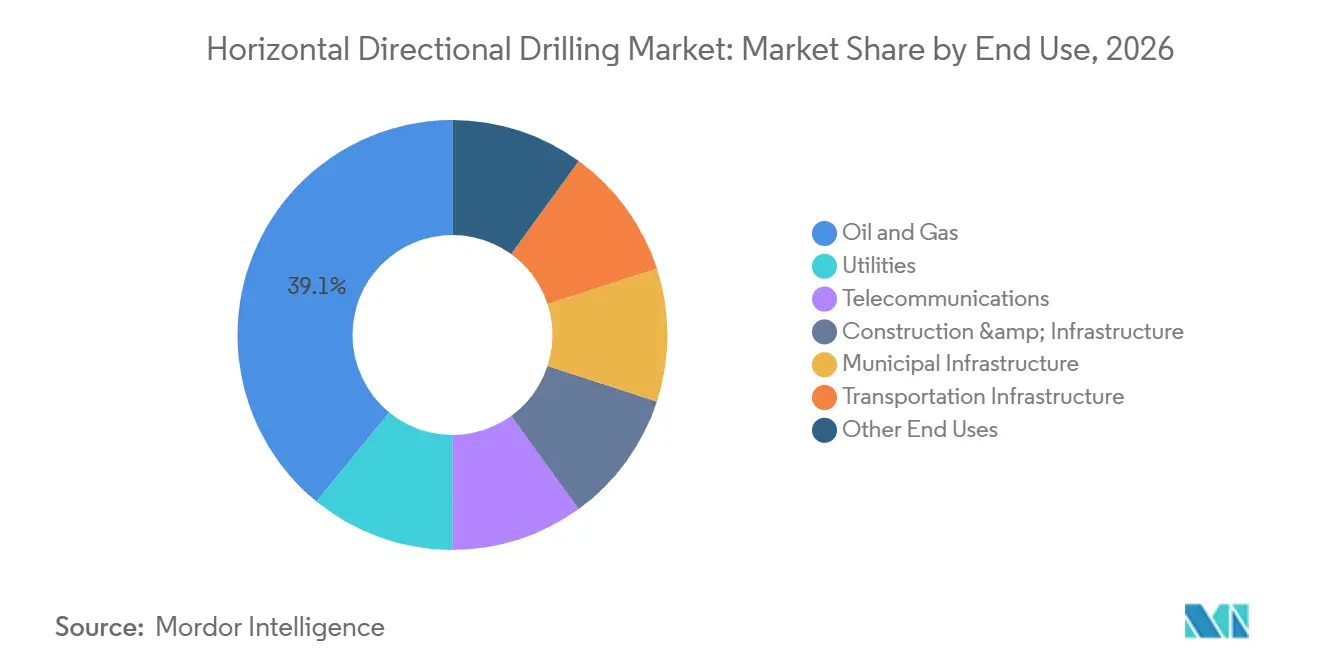
Telecom Pushes Above Market CAGR While Oil & Gas Remains the Largest VerticalOil & Gas retained 39.1% of the horizontal directional drilling market in 2026 and remained the largest end-use segment. Natural-gas transmission crossings, LNG-related feeder lines, and power-related energy corridors support demand for larger bores and equipment with greater pullback capability. The utilities segment follows through grid-hardening programs that move distribution assets underground, often in areas where reliability needs and public safety concerns make repeated repairs to overhead assets less acceptable. Electric work represented 17.1% of U.S. HDD applications in 2026, while water applications represented 21.7%, and fiber and 5G work represented 32.7%. Construction and municipal infrastructure add recurring work from water and wastewater replacement, which can moderate exposure to changes in energy-sector investment.
Telecommunications is projected to grow at a 9.8% CAGR through 2032, placing it above the overall horizontal directional drilling market growth rate. Compact rigs are useful for neighborhood broadband work where pavement restoration, existing utilities, and local disruption affect construction choices. Federal Communications Commission broadband mapping supports accountability for reported coverage and planned deployment. Transportation infrastructure and other end uses include renewable-energy cable routes and utility connections for data centers, which can require careful route selection and constrained-space execution. The horizontal directional drilling industry benefits when contractors can shift crews across telecom, utility, water, and energy programs as project schedules change, which helps firms use trained teams and specialized equipment more consistently.
Geography Analysis
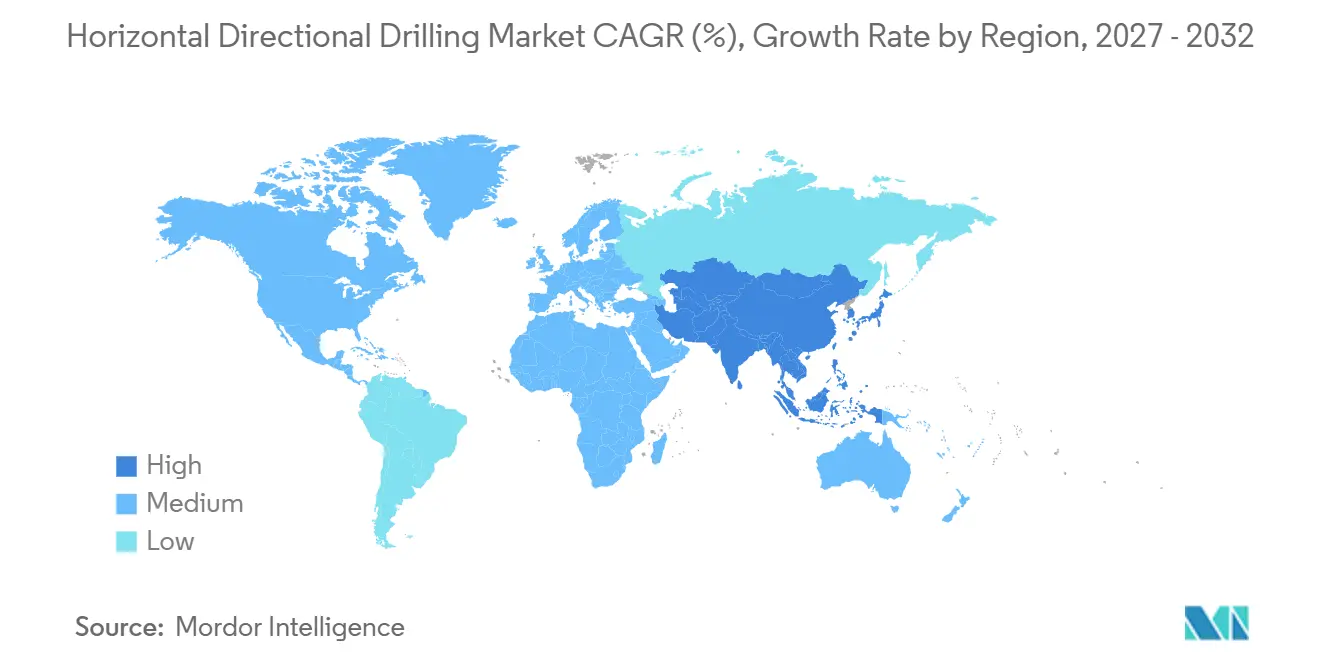
North America held 32.6% of the global horizontal directional drilling market in 2026 and remained the largest regional contributor. The region combines fiber deployment, grid hardening, natural-gas construction, water infrastructure, and data-center utility work across a wide set of public and private customers, giving contractors several types of projects that require similar crews, rigs, and planning capabilities. The United States represented 36% of worldwide HDD applications, and domestic activity was described as strong through the first half of 2026. PG&E’s undergrounding activity provides visible utility work over several years. Canada adds pipeline activity in Alberta and British Columbia, while Mexico is increasing the use of trenchless methods in congested urban corridors where surface access is more constrained.
Europe remains a major regional market because protected areas, grid modernization, urban renewal, and offshore wind projects require controlled underground installation, often under planning conditions that limit surface disruption and increase the importance of documented construction methods. The region’s demand profile differs from North America because environmental permitting and renewable-energy infrastructure have a larger role in project selection. European grid projects can use HDD as a core civil method where a route needs to pass beneath established infrastructure or environmentally sensitive land. The United Kingdom’s rural broadband program leaves a construction backlog as contracted projects continue into later years, while Germany’s energy transition supports longer bores for high-voltage transmission routes. France and the United Kingdom add fiber and urban utility renewal, increasing the importance of equipment capacity, site knowledge, and environmental management.
Asia-Pacific is the fastest-growing region at a 9.4% CAGR through 2032, supported by telecom, municipal pipeline, water, and energy programs that vary widely in project scale, local supply conditions, and technical requirements. China’s directional drilling fleet was expanding as equipment replacement and lower-emission technologies gained attention, while India, Vietnam, Indonesia, and Australia contribute demand from urban utility, water, and communications work. Japan and South Korea support specialized equipment use through established infrastructure standards, while South America and the Middle East and Africa remain smaller in the horizontal directional drilling market, but Brazil has pipeline and municipal-water opportunities, Argentina and Chile add mining and energy crossings, and XCMG shipped 10 HDD rigs to South America in 2026. Saudi Arabia and the United Arab Emirates are investing in utility undergrounding through smart-city programs, while Egypt and Morocco are advancing water-supply infrastructure, and regional growth depends on local service capacity, project financing, and equipment suited to difficult ground conditions.
Competitive Landscape
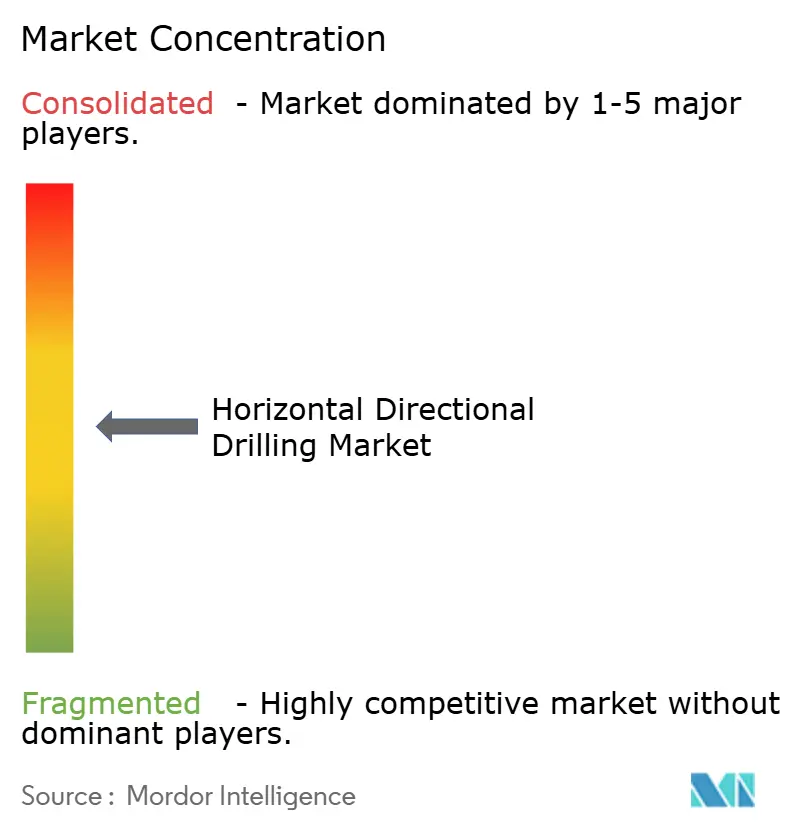
The horizontal directional drilling market is moderately fragmented across equipment categories, rig sizes, and regions, with suppliers serving different parts of the contractor base rather than a single uniform buyer group. Vermeer Corporation, TRACTO-TECHNIK, Herrenknecht AG, and The Toro Company, through Ditch Witch, compete with Chinese manufacturers including Goodeng Machine, XCMG, and SANY. No manufacturer is presented as dominant across every machine type or geography, which leaves room for regional suppliers and specialists that understand the needs of specific contractors and ground conditions. Dealer proximity, after-sales response, financing, and operator support can determine equipment selection as much as rig specifications, giving established Western suppliers an advantage where service coverage is important. Chinese suppliers are increasing their export presence by pairing large-tonnage capability with lower unit costs, which can appeal to buyers who place a strong weight on initial equipment outlay and available capacity.
Goodeng and XCMG have added intelligent-control functions that include automated rod handling, torque-based operating controls, and remote diagnostic capability. Goodeng’s GSE10000-LS electric HDD rig has 10,000 kN pullback, 260,000 N·m torque, and 1,000 kW rated power. The launch makes electric-drive design a factor for large-rig buyers on difficult and environmentally sensitive projects, where energy use, local restrictions, and control of the work site can influence the equipment decision. Vermeer formed an exclusive global distribution partnership with Tecniwell in December 2025 for high-pressure pump packages, expanding the equipment package available through its dealer network and strengthening the role of parts, pumps, tooling, and field support in customer retention.
Vermeer introduced the D60S horizontal directional drill for European contractors in April 2026, with improved hydraulic efficiency and operator-focused design. Suppliers are also developing machines for mixed geology and lower-impact operation, where contractors need equipment that is suited to urban work and controlled construction environments. The strongest opportunity remains in emerging markets that need supported mid-range rigs, particularly in the 30-100 tonne range, where service, tooling, maintenance, and ready access to replacement parts create recurring revenue over the working life of a machine. This favors suppliers that establish local dealers and parts availability rather than competing only on initial machine price, while competitive position depends on machine reliability, qualified support, and a clear understanding of the local contractor base in target regions.
Horizontal Directional Drilling Industry Leaders
-
The Toro Company
-
Vermeer Corporation
-
XCMG Group
-
Herrenknecht AG
-
Goodeng Machine Co. Ltd.
- *Disclaimer: Major Players sorted in no particular order
Horizontal Directional Drilling Market Companies Covered in this Report
- American Augers, Inc.
- Barbco, Inc.
- BAUER Maschinen GmbH
- Digital Control Incorporated (DCI)
- Drillto Trenchless Co., Ltd.
- Goodeng Machine Co., Ltd.
- Hebei Huayuan Science & Industry Co., Ltd.
- Herrenknecht AG
- Hunan ZLCONN Machinery Co., Ltd.
- KLEMM Bohrtechnik GmbH
- Prime Drilling GmbH
- SANY Group
- SUNWARD Intelligent Equipment Group
- Terra AG
- The Toro Company
- TRACTO-TECHNIK GmbH & Co. KG
- TT Technologies, Inc.
- Universal HDD
- Vermeer Corporation
- XCMG Group
Recent Industry Developments in Horizontal Directional Drilling Market
- August 2026: Goodeng Machine launched the GSE10000-LS Electric HDD with 10,000 kN pullback, 260,000 N·m torque, and 1,000 kW rated power, targeting crossings up to 3,000 meters.
- April 2026: Vermeer launched the D60S horizontal directional drill for European markets, featuring improved hydraulic efficiency and enhanced operator ergonomics designed for dense urban utility installation.
- March 2026: Goodeng Machine deployed the GSE12000-L pure-electric HDD on the Sichuan-East Gas Pipeline II project in China, completing crossings up to 4,000 meters at a 2-meter pipe diameter with over 60% energy savings versus diesel equipment.
Global Horizontal Directional Drilling Market Report Scope
Directional boring, also referred to as horizontal directional drilling (HDD), is a trenchless method of installing underground utilities such as pipes, conduits, or cables along a prescribed underground path using a surface-launched drilling rig. The installation follows a relatively shallow arc or radius with minimal surface impact. Directional boring offers significant environmental advantages over traditional cut-and-cover pipeline and utility installations. The technique is commonly used when conventional trenching or excavation is not practical or when minimal surface disturbance is required.
The global horizontal directional drilling market is segmented by machine type, location, end use, and geography. By machine type, the market is segmented into boring machines, utility vibratory plows, utility tractors, pile drivers, foundation machines, and other HDD machines. By location, the market is segmented into onshore and offshore. By end use, the market is segmented into oil and gas, utilities, telecommunications, construction & infrastructure, municipal infrastructure, transportation infrastructure, and other end uses. The report also covers the market size and forecasts for the global horizontal directional drilling market across 26 countries in the key regions. For each segment, market sizing and forecasts are provided in terms of value (USD).
Segmentation Overview
| Boring Machines |
| Utility Vibratory Plows |
| Utility Tractors |
| Pile Drivers |
| Foundation Machines |
| Other HDD Machines |
| Onshore |
| Offshore |
| Oil and Gas |
| Utilities |
| Telecommunications |
| Construction & Infrastructure |
| Municipal Infrastructure |
| Transportation Infrastructure |
| Other End Uses |
| North America | United States |
| Canada | |
| Mexico | |
| Europe | Germany |
| France | |
| Italy | |
| Spain | |
| United Kingdom | |
| Poland | |
| Russia | |
| Rest of Europe | |
| Asia-Pacific | China |
| India | |
| Japan | |
| South Korea | |
| Australia | |
| Indonesia | |
| Vietnam | |
| Thailand | |
| Rest of Asia-Pacific | |
| South America | Brazil |
| Argentina | |
| Chile | |
| Rest of South America | |
| Middle East and Africa | Saudi Arabia |
| United Arab Emirates | |
| Egypt | |
| South Africa | |
| Morocco | |
| Rest of Middle East and Africa |
| By Machine Type | Boring Machines | |
| Utility Vibratory Plows | ||
| Utility Tractors | ||
| Pile Drivers | ||
| Foundation Machines | ||
| Other HDD Machines | ||
| By Location | Onshore | |
| Offshore | ||
| By End Use | Oil and Gas | |
| Utilities | ||
| Telecommunications | ||
| Construction & Infrastructure | ||
| Municipal Infrastructure | ||
| Transportation Infrastructure | ||
| Other End Uses | ||
| By Geography | North America | United States |
| Canada | ||
| Mexico | ||
| Europe | Germany | |
| France | ||
| Italy | ||
| Spain | ||
| United Kingdom | ||
| Poland | ||
| Russia | ||
| Rest of Europe | ||
| Asia-Pacific | China | |
| India | ||
| Japan | ||
| South Korea | ||
| Australia | ||
| Indonesia | ||
| Vietnam | ||
| Thailand | ||
| Rest of Asia-Pacific | ||
| South America | Brazil | |
| Argentina | ||
| Chile | ||
| Rest of South America | ||
| Middle East and Africa | Saudi Arabia | |
| United Arab Emirates | ||
| Egypt | ||
| South Africa | ||
| Morocco | ||
| Rest of Middle East and Africa | ||
Key Questions Answered in the Report
What is driving demand for horizontal directional drilling equipment?
Fiber deployment, grid undergrounding, water infrastructure replacement, data-center utilities, and offshore cable landfalls are the main sources of demand. Together, these needs give the horizontal directional drilling market work across communications, utility, municipal, and energy project schedules.
How large is the global horizontal directional drilling market in 2027?
The Horizontal Directional Drilling Market size was valued at USD 10.95 billion in 2026 and is estimated to grow from USD 11.97 billion in 2027 to reach USD 18.66 billion by 2032, at a CAGR of 9.29% during the forecast period (2027-2032).
Which machine type leads horizontal directional drilling equipment sales?
Boring Machines led with 43.4% of the global total in 2026, while Foundation Machines have the highest projected CAGR at 9.7% through 2032.
Which end-use sector grows fastest through 2032?
Telecommunications is forecast to grow at a 9.8% CAGR through 2032, supported by broadband deployment and constrained urban installation conditions.
Why are offshore HDD projects growing faster than onshore projects?
Offshore work is forecast to expand at a 10.3% CAGR because export cables must cross beaches and near-shore areas with limited surface disturbance. The work also requires specialized planning and environmental management where coastal geology and permitting requirements add complexity.
What is the largest constraint facing HDD contractors?
The availability of qualified operators is a leading constraint because complex bores require proven control of alignment, drilling fluid, tooling, and utility risk. Training, supervision, and field experience affect a contractor's ability to complete difficult work safely and consistently.