
High-Purity Boehmite Market Size and Share
Market Overview
| Study Period | 2021 - 2031 |
|---|---|
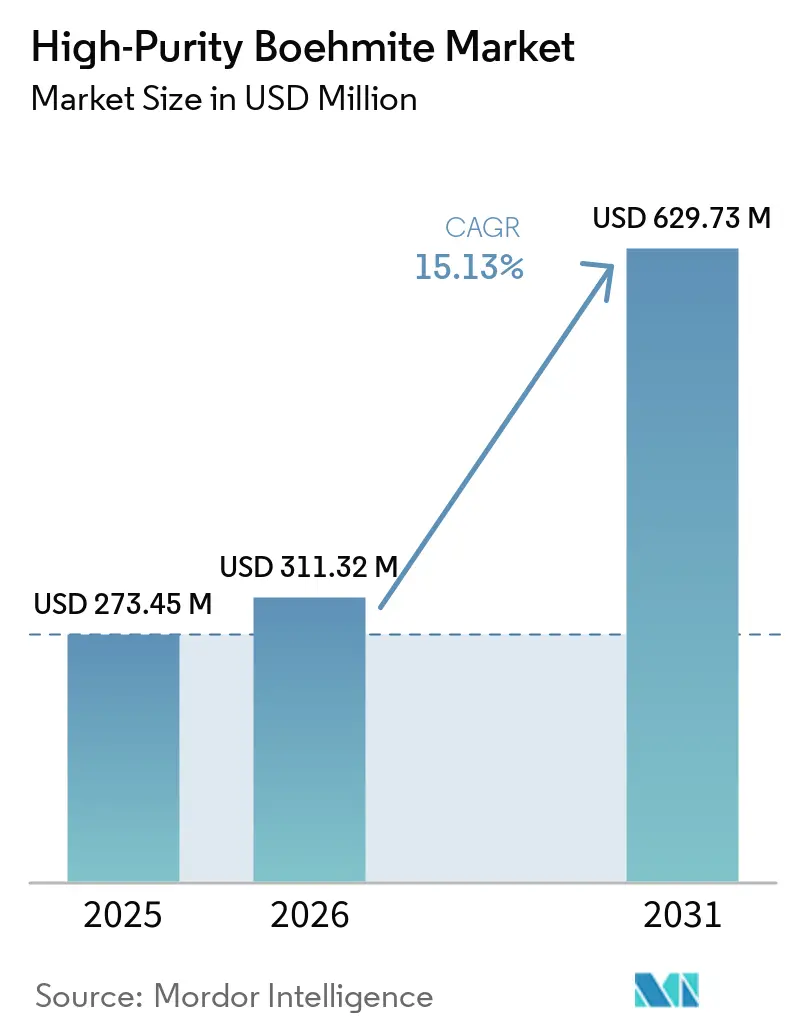
| Market Size (2026) | USD 311.32 Million |
| Market Size (2031) | USD 629.73 Million |
| Growth Rate (2026 - 2031) | 15.13 % |
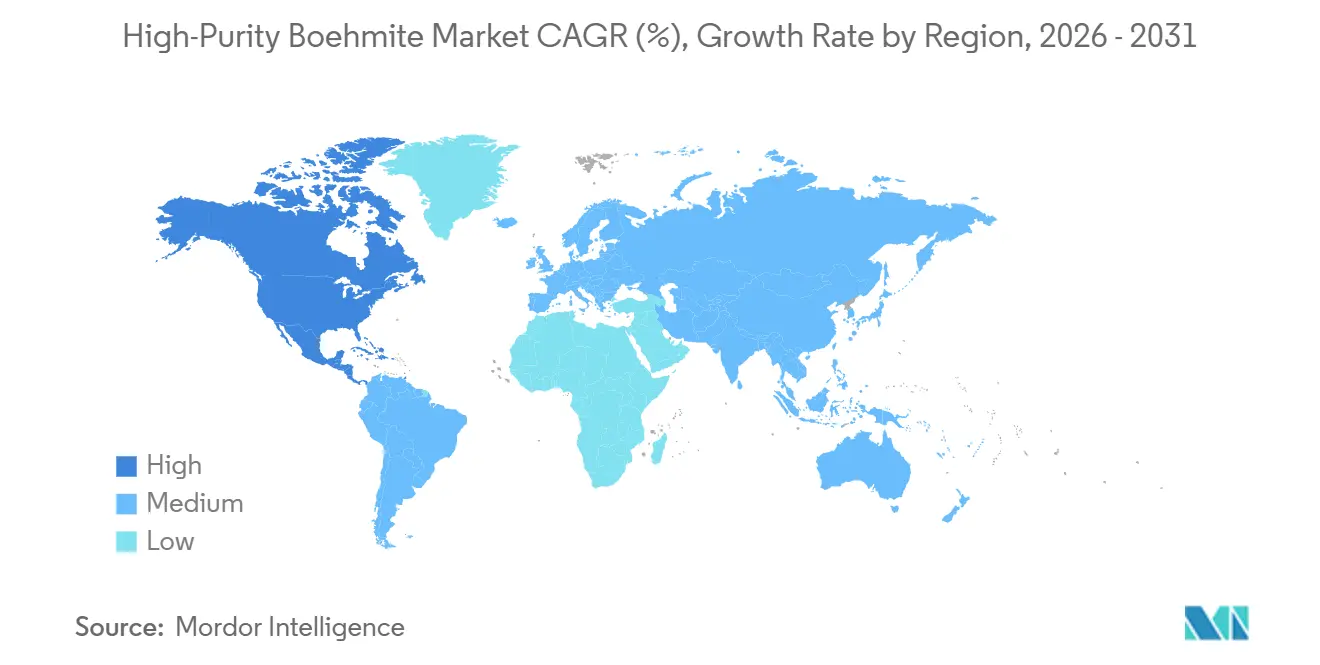
| Fastest Growing Market | North America |
| Largest Market | Asia-Pacific |
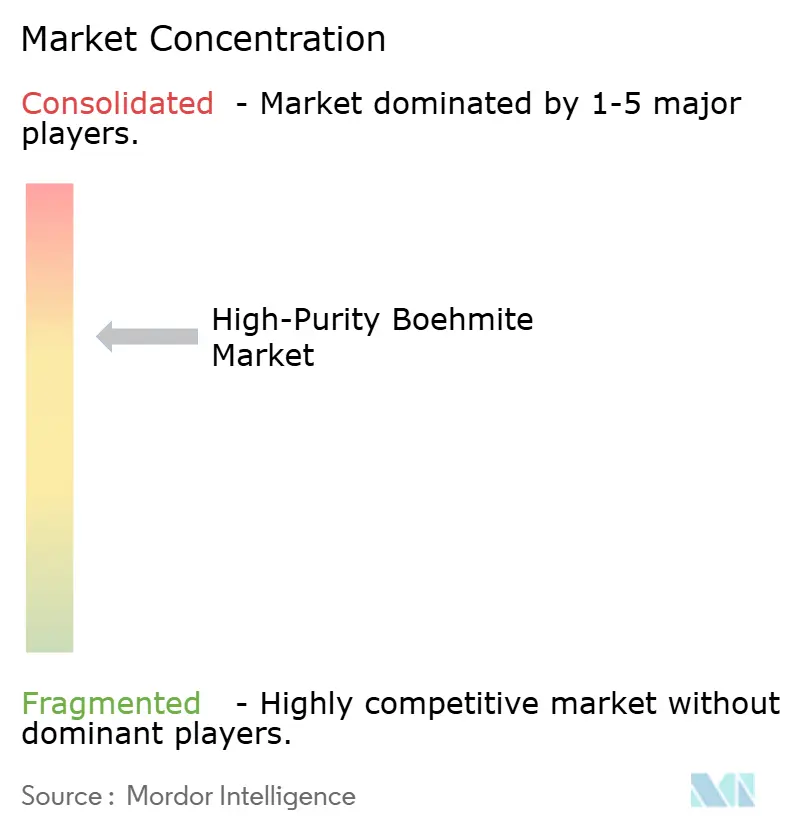
| Market Concentration | Medium |
Major Players *Disclaimer: Major Players sorted in no particular order Image © Mordor Intelligence. Reuse requires attribution under CC BY 4.0. | |
High-Purity Boehmite Market Analysis by Mordor Intelligence
The High-Purity Boehmite Market size was valued at USD 273.45 million in 2025 and is estimated to grow from USD 311.32 million in 2026 to USD 629.73 million by 2031, at a CAGR of 15.13% during the forecast period (2026-2031). The high-purity boehmite market is shaped by wider use of ceramic-coated separators in lithium-ion cells and stricter requirements for halogen-free flame-retardant materials. Global battery manufacturing capacity exceeded 4 TWh at the end of 2025, with China accounting for more than 80% of output, underscoring the importance of Asian supply chains for boehmite demand. High-purity boehmite supports separator performance by enhancing wettability and hydrofluoric acid scavenging, improving electrolyte interaction, and limiting cell degradation. The market faces a timing gap in Europe, where battery cell projects have advanced more slowly than expected, and qualified suppliers retain an advantage. Producers seek growth through finer, surface-modified grades, flame-retardant formulations, and advanced ceramics rather than relying on a single end use, reflecting different purchasing patterns across battery cells, catalysts, electronics, cables, construction products, and specialty polymers. Battery separator customers prioritize particle size, dispersion behavior, purity, and material qualification; flame-retardant customers evaluate fire performance and halogen substitution; catalyst customers require reliable precursor materials for refinery and chemical facility replacement cycles; and electronics customers focus on morphology control, impurity levels, dielectric behavior, and processing conditions. A diversified portfolio allows producers to apply related process capabilities across applications while managing demand timing variations, and the market is influenced by both high-quantity battery demand and smaller specialized applications that support supplier utilization and product development.
Key Report Takeaways
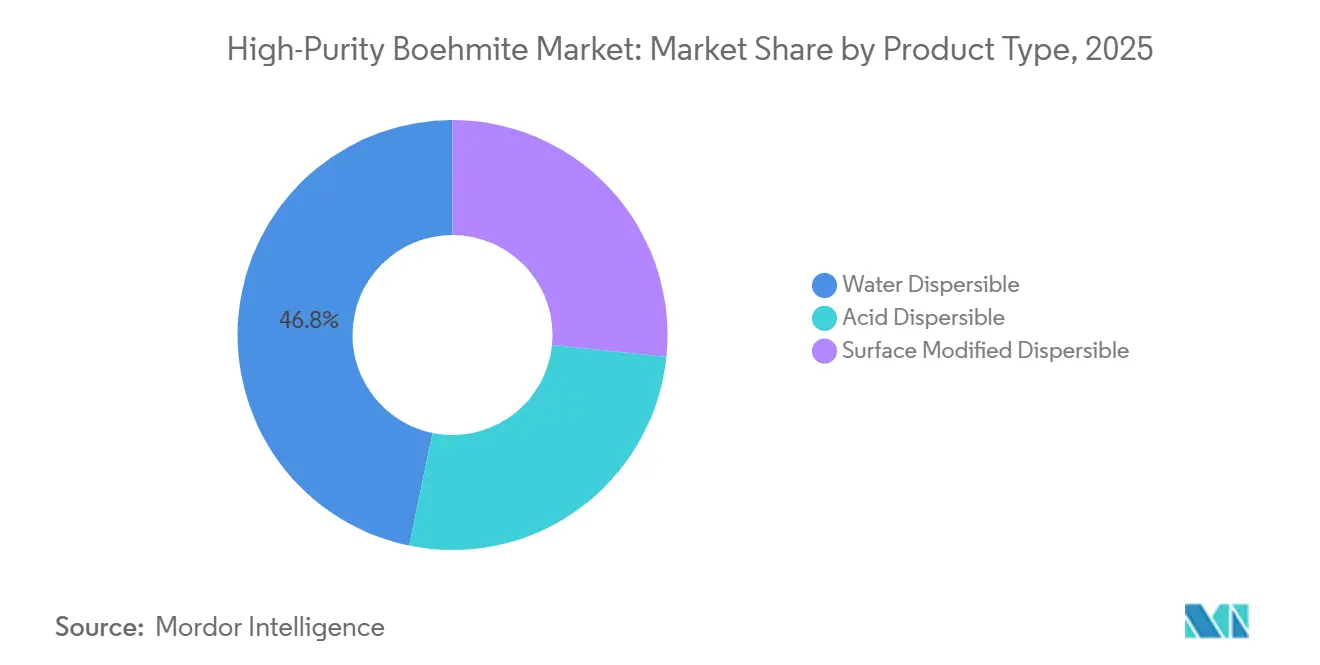
- By product type, Water Dispersible Boehmite held 46.78% of the High-Purity Boehmite Market share in 2025, while Surface Modified Dispersible Boehmite is forecast to grow at a 16.45% CAGR through 2031.
- By application, Lithium-Ion Battery accounted for 49.37% of the High-Purity Boehmite Market size in 2025 and is forecast to grow at a 17.06% CAGR through 2031.
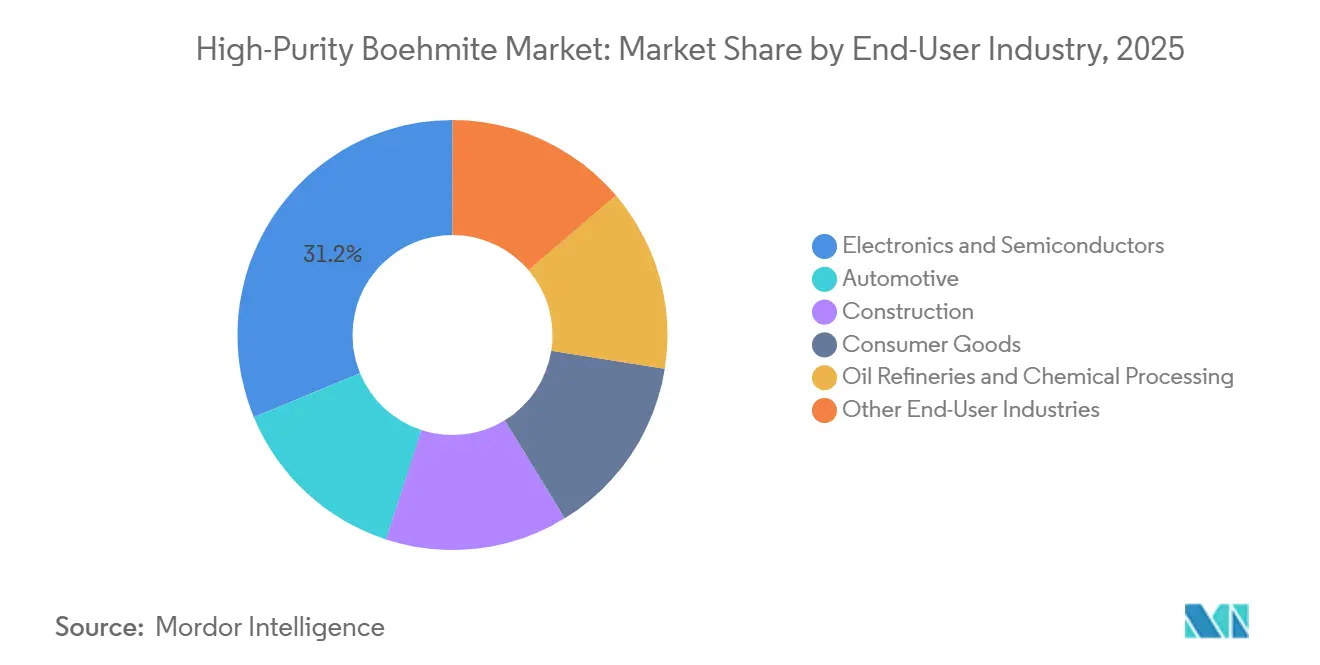
- By end-user industry, Electronics and Semiconductors held 31.24% of the High-Purity Boehmite Market share in 2025, while Automotive is forecast to grow at a CAGR of 18.34% through 2031.
- By geography, Asia-Pacific held 40.29% of the High-Purity Boehmite Market share in 2025, and North America is forecast to expand at a 16.93% CAGR through 2031.
Note: Market size and forecast figures in this report are generated using Mordor Intelligence’s proprietary estimation framework, updated with the latest available data and insights as of January 2026.
Global High-Purity Boehmite Market Trends and Insights
Drivers Impact Analysis*
| Drivers | (~) % Impact on CAGR Forecast | Geographic Relevance | Impact Timeline |
|---|---|---|---|
| EV and Energy-Storage Battery Capacity Expansion | +5.5% | Global, with China, South Korea, and Germany as primary hubs | Medium term (2-4 years) |
| Ceramic-Coated Separator Safety Requirements | +3.2% | Asia-Pacific core, with spillover to Europe | Short term (≤ 2 years) |
| Halogen-Free Flame-Retardant Substitution | +2.0% | European Union-led, with secondary demand from North America and East Asia | Medium term (2-4 years) |
| Semiconductor and Advanced Ceramic Miniaturization | +1.4% | Asia-Pacific core, including Japan, South Korea, and Taiwan, plus North America | Long term (≥ 4 years) |
| Refinery Catalyst-Support Replacement Demand | +0.9% | Middle East, Asia-Pacific, and the U.S. Gulf Coast | Long term (≥ 4 years) |
| Source: Mordor Intelligence | |||
EV and Energy-Storage Battery Capacity Expansion
Battery capacity expansion is the strongest driver of demand for separator-grade material in the high-purity boehmite market because ceramic-coated film is produced alongside cell capacity rather than purchased as an occasional specialty input. Global lithium-ion battery manufacturing capacity exceeded 4 TWh by the end of 2025, with China accounting for more than 80% of total output. This concentration gives Chinese cell and separator manufacturers a central role in setting boehmite purity requirements, particle-size specifications, and purchasing quantities. Global electric-vehicle battery deployment reached 1,187 GWh in 2025. Each increase in ceramic-coated separator output creates recurring demand for compatible boehmite slurries, while higher utilization of existing plants can increase purchases even before a new facility begins operation. Thinner separator coating layers also raise demand for surface-modified grades that can maintain dispersion at lower particle sizes and support a more valuable product mix.
Ceramic-Coated Separator Safety Requirements
Ceramic-coated separators are increasingly treated as a core safety component in high-energy battery cells, particularly where fast charging and high-nickel chemistries increase the importance of thermal and electrochemical control. Boehmite has gained ground against gamma-alumina in applications where producers require flexible coatings and stronger hydrofluoric acid scavenging performance. Its Mohs hardness of 3-3.5 can also reduce equipment wear compared with harder inorganic alternatives. A 2025 Journal of Power Sources study found that plate-shaped boehmite coatings provided higher electrolyte uptake and lower internal resistance than spherical alumina coatings. These attributes are relevant to fast charging and cycle stability, which remain central to vehicle battery validation and to qualification decisions made by cell manufacturers. Water-based boehmite slurry systems can reduce solvent emissions compared with N-methyl-2-pyrrolidone (NMP)-based processes, supporting compliance and production changes at battery plants. As separator designs become thinner, suppliers that can deliver consistent fine-particle distributions are better positioned in the high-purity boehmite market.
Halogen-Free Flame-Retardant Substitution
Restrictions on brominated flame retardants are expanding the use of halogen-free mineral alternatives and shifting material decisions from voluntary preferences to formal compliance requirements. Commission Delegated Regulation (EU) 2025/1482 revised concentration limits for five polybrominated diphenyl ether variants under the Persistent Organic Pollutants (POP) Recast Regulation, effective November 2025. This regulatory shift affects consumer products and can influence material selection in cable, construction, transport, and automotive wire-harness applications. A 2025 study reported that adding 10.2 wt% boehmite to epoxy resin increased the limiting oxygen index from 18.5% to 37.4%, indicating that halogen-free formulations can improve fire performance without using brominated additives or compromising thermal stability. European compliance requirements are likely to influence specifications used by multinational manufacturers in Asia and North America, widening the high-purity boehmite market beyond battery separators.
Semiconductor and Advanced Ceramic Miniaturization
Boehmite-derived alumina is relevant to electronic ceramics that require controlled morphology, low dielectric loss, and low impurity levels for substrate and packaging applications. A February 2026 Ceramics International study showed that hydrothermal boehmite precursors can produce flake-shaped alpha-alumina powders with controlled morphology inheritance, supporting work on microelectronic substrates, advanced packaging, and high-frequency components used in 5G and future 6G equipment. A 2026 Journal of Advanced Ceramics publication described a low-temperature boehmite-ceramic sintering process below 180°C. Lower-temperature processing can reduce energy use during ceramic production and may support qualification by electronics manufacturers that assess manufacturing emissions. Demand from AI data-center infrastructure and advanced chip packaging offers the high-purity boehmite market an additional growth path beyond separator procurement.
Restraints Impact Analysis*
| Restraints | (~) % Impact on CAGR Forecast | Geographic Relevance | Impact Timeline |
|---|---|---|---|
| High Cost of Ultra-High-Purity Processing | -2.8% | Global, most acute in North America and Europe | Long term (≥ 4 years) |
| Qualification Cycles and Switching Costs at Cell Manufacturers | -1.9% | Asia-Pacific core, with secondary effects in Europe and North America | Medium term (2-4 years) |
| Tight Availability of Consistent Feedstock and Fine-Particle Capacity | -1.5% | China, especially the Shandong cluster, and the rest of the world | Medium term (2-4 years) |
| Source: Mordor Intelligence | |||
High Cost of Ultra-High-Purity Processing
Battery and semiconductor grades require production routes that tightly control sodium and metallic impurities, with cell manufacturers often applying impurity thresholds of 50-100 parts per million (ppm) for sodium, calcium, iron, and silicon. Aluminum alkoxide synthesis and controlled hydrothermal conversion of high-purity gibbsite require greater process control than standard-grade production, including tight control over feedstock quality, reaction conditions, and particle-size distribution. A 2025 study identified hydrothermal synthesis at 200°C for 60 minutes as a route to boehmite with 0.03% Na₂O content and a D50 of 4.18 μm[1]“Optimizing Boehmite Synthesis for Advanced Industrial Applications, Insights into Gibbsite Transformation,” Transactions of the Indian Institute of Metals, doi.org. The high-purity boehmite market, therefore, has a cost structure that differs materially across grades and cannot be assessed solely by output growth. Producers must recover investments in purification, particle control, and testing while competing against lower-priced material in some supply channels. This can limit the pace at which high-specification capacity is added outside established production centers.
Qualification Cycles and Switching Costs at Cell Manufacturers
Cell manufacturers use multi-stage qualification procedures before approving a new boehmite supplier, particularly where the material is used in thin separator coatings for high-energy cells. These procedures can include lot-level X-ray diffraction phase checks, trace-metal testing, slurry evaluation, and application-specific electrochemical cycling tests. Qualification can take 12-18 months, making timing and early technical engagement important for suppliers pursuing new battery projects. This process protects existing qualified suppliers when the high-purity boehmite market has excess capacity or price competition, as a lower price does not remove validation requirements. It can also prevent a new supplier from responding quickly when a battery plant raises output or changes separator specifications. In these decisions, technical alignment, consistent lot quality, and support during co-development often matter more than purchase price.
*Our forecasts treat driver/restraint impacts as directional, not additive. The impact forecasts reflect baseline growth, mix effects, and variable interactions.
Segment Analysis
By Product Type: Surface-Modified Grades Accelerate as Separator Specifications Tighten
Water-dispersible boehmite accounted for 46.78% of the market value in 2025, giving it the largest share among product types, as water-based slurry processing has become established in separator-coating applications. Surface-modified dispersible boehmite is forecast to grow at a 16.45% CAGR from 2026 to 2031, the fastest rate across product categories, as battery producers seek thinner coating layers on high-nickel cell substrates. Demand for this grade depends on particles remaining stable in aqueous slurries, which enables uniform coatings and controlled defect rates. Surface treatment can limit aggregation and improve deposition consistency, but it also requires reliable control of particle size and surface chemistry. Separator specifications are moving toward smaller D50 values, which increases the importance of narrow particle distributions and raises capital and research requirements for producers. A 2025 Journal of Alloys and Compounds study reported improved density and mechanical properties in binary alumina ceramics produced from industrial gibbsite and boehmite, supporting material roadmaps for both advanced ceramics and battery applications. Acid-dispersible grades retain specialized demand in catalyst carriers and refractory applications that use acidic media. Together, water-dispersible and acid-dispersible grades give suppliers with multi-grade portfolios a more stable demand base when electric-vehicle production fluctuates.



By Application: Lithium-Ion Battery Demand Anchors the Portfolio
The lithium-ion battery application accounted for 49.37% of market value in 2025 and is projected to grow at a 17.06% CAGR through 2031, making separator coatings the primary driver of demand in the high-purity boehmite market. At elevated temperatures, boehmite can release water and form an alumina barrier that supports separator safety functions. It also plays a role in electrolyte interaction and in controlling harmful species that can reduce cell durability. A 2025 Journal of Energy Storage study found that surface-engineered boehmite separators helped limit the migration of transition-metal ions in high-voltage lithium-metal batteries, situating the material within both electrochemical performance and thermal management. Refractory materials remain the second-largest application, where boehmite serves as a reactive alumina precursor in steel and cement furnace linings. This demand follows industrial output and infrastructure cycles, providing some insulation from shifts in battery demand. Electronic ceramics benefit from rising semiconductor content in electric powertrains and data-processing equipment. Flame retardants benefit from halogen-free requirements, while polymer additives and rheology control serve specialized compounding uses. Sasol's PURAL and CATAPAL product families provide established grades for catalyst producers that use boehmite-derived gamma-alumina[2]Sasol, “PURAL and CATAPAL Product Documentation,” Sasol Chemicals, sasol.com. Refinery catalyst replacement provides an additional application base for suppliers seeking to extend their battery and ceramics portfolios.
By End-User Industry: Automotive Growth Builds on an Electronics Base
Electronics and semiconductors accounted for 31.24% of market value in 2025, making it the largest end-user segment, while automotive is forecast to grow at an 18.34% CAGR from 2026 to 2031. Automotive demand is driving the adoption of battery separator coatings and halogen-free materials for cables and wire harnesses. Higher-voltage powertrains raise thermal requirements for cable insulation and can favor higher-purity, high-surface-area grades. The high-purity boehmite market in automotive is therefore linked to several material pathways within a vehicle, not battery separators alone. Electronics demand remains tied to ceramic capacitors, integrated-circuit substrates, and advanced packaging, all of which require controlled dielectric behavior and low impurity levels. Construction and consumer goods provide intermediate demand that follows building and appliance activity. Oil refineries and chemical processing add more predictable catalyst replacement cycles. A single electric-vehicle platform can use boehmite across separator coatings, thermal interface materials, and cable flame-retardant formulations. This overlap broadens the value of automotive customer relationships for qualified suppliers and rewards portfolios that combine battery, specialty filler, and ceramic grades.
Geography Analysis
Asia-Pacific held 40.29% of the global market value in 2025, making it the largest regional market for high-purity boehmite. China has an integrated supply chain spanning gibbsite refining, boehmite synthesis, separator coating, and battery cell production, enabling close collaboration between material suppliers and downstream manufacturers. The regional position is reinforced by large-scale separator manufacturing, dense battery procurement networks, and the need for frequent technical qualification when cell specifications change. South Korea contributes through battery manufacturing and coating activity, while Japan supplies specialty fine grades for separator applications and advanced electronic ceramics. These capabilities make the region significant for both high-output battery materials and more specialized high-purity applications. India and ASEAN countries are at an earlier stage, although India's production-linked incentive program for advanced chemistry cells is generating demand for upstream materials. Their current role is small relative to China, Japan, and South Korea, but local battery projects could create a more diverse regional purchasing base later in the forecast period. Asia-Pacific suppliers also benefit from proximity to the feedstock, coating, and cell-manufacturing stages that determine material selection.
North America is forecast to grow at a 16.93% CAGR from 2026 to 2031, the fastest regional rate in the high-purity boehmite market. U.S. policy has encouraged investment in domestic battery facilities and increased interest in local separator supply, particularly where domestic-content requirements influence procurement decisions. This is drawing separator manufacturing activity closer to North American cell production and creating demand for local material qualification. Domestic qualification is becoming more important in cases where supply chain disruptions have affected material availability or delivery reliability. Suppliers that can support local testing, consistent lot control, and application development may gain an advantage as new facilities become operational. Canada's critical minerals policies and Mexico's automotive assembly base provide additional regional demand. The regional opportunity depends on the pace at which battery plants move from announced capacity to sustained production, and on whether separator capacity and boehmite availability develop in parallel, since battery investment alone does not create immediate demand for qualified coating materials.
Europe is supported by two separate demand streams: battery cell development and the replacement of halogenated flame retardants. Regulations affecting flame-retardant materials support demand in cables, construction products, transport applications, and automotive wiring, where both compliance and fire performance are material-selection factors. Battery cell projects in Germany, France, Sweden, and Hungary are progressing through separator-material qualification, although the timing of commercial production has been uneven. Nabaltec has expanded boehmite capacity at Schwandorf, but European cell manufacturing has ramped up more gradually than anticipated. This mismatch can delay quantity purchases while increasing the value of established local supply and technical documentation. South America is concentrated in Brazil and Argentina, where refinery activity and construction-related uses remain important. Demand in the Middle East and Africa is linked to Gulf refinery expansions and boehmite-derived catalyst supports used in hydroprocessing for low-sulfur fuels. These demand sources are less dependent on electric vehicle timelines and offer diversified suppliers an alternative route to regional sales.

Competitive Landscape
The high-purity boehmite market is moderately consolidated. Chinese producers have built an advantage through scale, fine-particle development, and proximity to separator manufacturers. Their position is reinforced by ongoing technical qualification at large battery plants, where customer relationships and lot consistency can be as important as nominal capacity. Western specialists compete through documented purity, supply security, and support for customers with strict material requirements. Nabaltec and Sasol hold differentiated positions, particularly in European applications where local supply and traceable quality records are valued. The competitive structure favors suppliers that can maintain consistent quality through long qualification cycles and support customers as coating requirements become more demanding. Scale alone is insufficient where customers require ultra-high-purity grades, stable dispersion, or specialized technical support.
Particle size and surface modification are central to product differentiation, as battery manufacturers require uniform, fine grades that can form thin coatings without causing defects. Producers also pursue adjacent opportunities in catalyst supports, flame retardants, and electronic ceramics to reduce reliance on a single demand cycle. In June 2026, Sasol announced a EUR 60 million (USD 69.58 million) investment at Brunsbüttel, Germany, to expand advanced-materials alumina capacity, with completion targeted for 2029. The project targets energy optimization, which could reduce the product's carbon footprint by up to 15% per ton. This investment reflects an integrated approach to purity, supply security, and production efficiency, rather than treating these as separate product features. It also brings capacity closer to European customers seeking alternatives to concentrated supply chains. For battery-focused producers, the ability to meet smaller particle-size requirements offers a practical route to differentiation as separator coatings become thinner.
Nabaltec has invested in boehmite and viscosity-optimized hydroxide capacity at Schwandorf in preparation for a gradual recovery in European battery demand. Its approach also extends to flame-retardant applications for cable and construction uses, allowing the company to address demand streams beyond battery cells. Sasol's product portfolio continues to serve catalyst customers while supporting opportunities in advanced materials. Competitive opportunities remain tied to ultra-high-purity grades for future battery designs and low-loss ceramic substrates for advanced electronics. Geographic diversification is important, as dependence on concentrated feedstock and fine-particle capacity creates sourcing risk for both customers and suppliers. The high-purity boehmite market favors companies that can combine process control with customer-specific qualification support over those competing on price alone. A broader product portfolio can also provide resilience when battery-cell projects progress more slowly than expected in individual regions.
High-Purity Boehmite Industry Leaders
Nabaltec AG
Anhui Estone Material Technology Co., Ltd.
Zhengzhou Research Institute of Chalco
Sasol
Shandong Sinocera Functional Material Co., Ltd.
- *Disclaimer: Major Players sorted in no particular order

Recent Industry Developments
- June 2026: Sasol announced a EUR 60 million (USD 69.58 million) investment at its Brunsbüttel, Germany, site to debottleneck and expand its alumina asset base, targeting high-purity and ultra-high-purity alumina for catalyst systems and related applications.
- October 2025: Nabaltec AG presented its APYRAL flame-retardant boehmite at the K 2025 trade fair in Düsseldorf, Germany. The company highlighted its approach to e-mobility separator applications and cable and construction flame retardants, supported by its boehmite production capacity of 20,000 tons per year.


Global High-Purity Boehmite Market Report Scope
High-purity boehmite is a specialized aluminum oxide hydroxide powder known for its thermal stability, controlled particle size, and chemical inertness. These properties make it suitable for use across a range of industrial applications, including lithium-ion battery separators, flame retardants, and advanced ceramics.
The high-purity boehmite market is segmented by product type, application, end-user industry, and geography. By product type, the market is segmented into water dispersible, acid dispersible, and surface modified dispersible. By application, the market is segmented into lithium-ion battery, refractory materials, electronics ceramics, flame retardants, catalysis, polymer additives, rheology control, and other applications. By end-user industry, the market is segmented into automotive, electronics and semiconductors, construction, consumer goods, oil refineries and chemical processing, and other end-user industries. The report also covers market size and forecasts for high-purity boehmite across 15 countries in major regions. The market sizes and forecasts are provided in terms of value (USD).
| Water Dispersible |
| Acid Dispersible |
| Surface Modified Dispersible |
| Lithium-Ion Battery |
| Refractory Materials |
| Electronics Ceramics |
| Flame Retardants |
| Catalysis |
| Polymer Additives |
| Rheology Control |
| Other Applications |
| Automotive |
| Electronics and Semiconductors |
| Construction |
| Consumer Goods |
| Oil Refineries and Chemical Processing |
| Other End-User Industries |
| Asia-Pacific | China |
| India | |
| Japan | |
| South Korea | |
| ASEAN Countries | |
| Rest of Asia-Pacific | |
| North America | United States |
| Canada | |
| Mexico | |
| Europe | Germany |
| United Kingdom | |
| France | |
| Italy | |
| NORDIC Countries | |
| Rest of Europe | |
| South America | Brazil |
| Argentina | |
| Rest of South America | |
| Middle East and Africa | Saudi Arabia |
| South Africa | |
| Rest of Middle East and Africa |
| By Product Type | Water Dispersible | |
| Acid Dispersible | ||
| Surface Modified Dispersible | ||
| By Application | Lithium-Ion Battery | |
| Refractory Materials | ||
| Electronics Ceramics | ||
| Flame Retardants | ||
| Catalysis | ||
| Polymer Additives | ||
| Rheology Control | ||
| Other Applications | ||
| By End-User Industry | Automotive | |
| Electronics and Semiconductors | ||
| Construction | ||
| Consumer Goods | ||
| Oil Refineries and Chemical Processing | ||
| Other End-User Industries | ||
| By Geography | Asia-Pacific | China |
| India | ||
| Japan | ||
| South Korea | ||
| ASEAN Countries | ||
| Rest of Asia-Pacific | ||
| North America | United States | |
| Canada | ||
| Mexico | ||
| Europe | Germany | |
| United Kingdom | ||
| France | ||
| Italy | ||
| NORDIC Countries | ||
| Rest of Europe | ||
| South America | Brazil | |
| Argentina | ||
| Rest of South America | ||
| Middle East and Africa | Saudi Arabia | |
| South Africa | ||
| Rest of Middle East and Africa | ||


Key Questions Answered in the Report
What is current market size of High-Purity Boehmite Market?
The High-Purity Boehmite Market size was valued at USD 273.45 million in 2025 and is estimated to grow from USD 311.32 million in 2026 to USD 629.73 million by 2031, at a CAGR of 15.13% during the forecast period (2026-2031).
Which application uses the most high-purity boehmite?
Lithium-Ion Battery was the largest application, accounting for 49.37% of market value in 2025, and is expected to grow at a 17.06% CAGR.
Which product grade is growing fastest?
Surface-modified dispersible boehmite is the fastest-growing product type, with a projected 16.45% CAGR through 2031.
Which end-user sector is expanding most quickly?
Automotive is forecast to grow at an 18.34% CAGR through 2031. Electric vehicles use high-purity boehmite separator coatings, cable flame-retardant systems, and thermal interface applications, increasing the material’s relevance within the vehicle.
Page last updated on:





