
High Performance Elastomer Market Size and Share
Market Overview
| Study Period | 2021 - 2031 |
|---|---|
| Market Size (2026) | USD 19.91 Billion |
| Market Size (2031) | USD 28.12 Billion |
| Growth Rate (2026 - 2031) | 7.15 % |
| Fastest Growing Market | Asia-Pacific |
| Largest Market | Asia-Pacific |
| Market Concentration | Medium |
Major Players *Disclaimer: Major Players sorted in no particular order Image © Mordor Intelligence. Reuse requires attribution under CC BY 4.0. | |
High Performance Elastomer Market Analysis by Mordor Intelligence
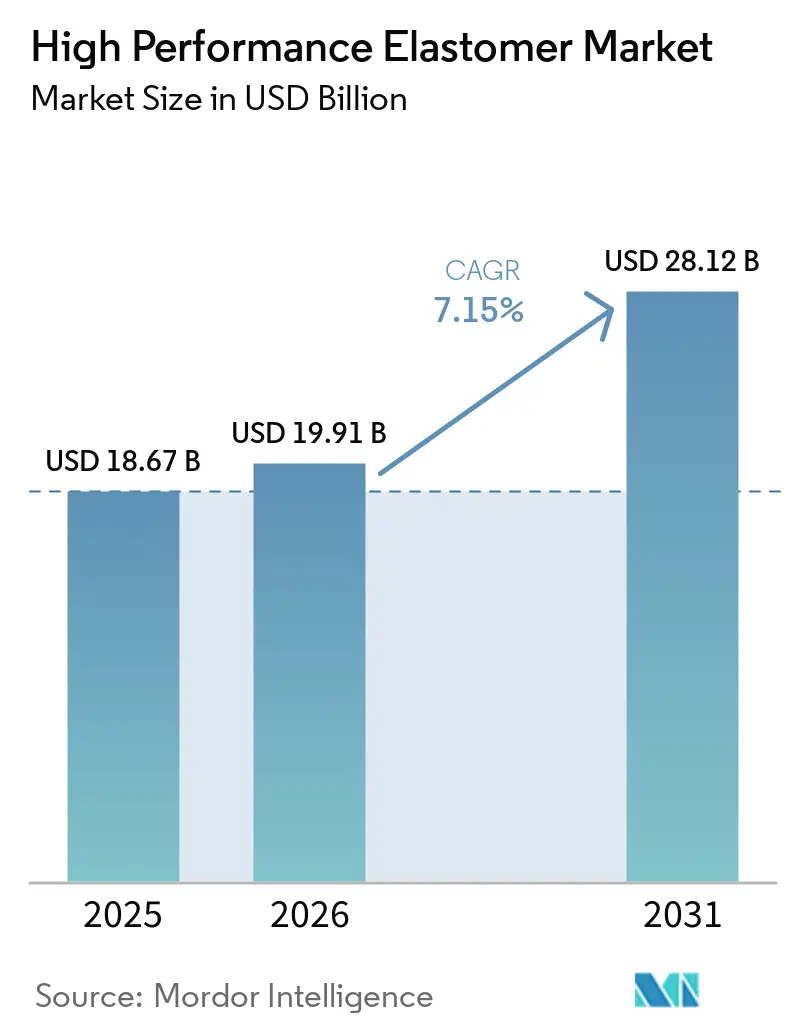
The high performance elastomer market size was valued at USD 18.67 billion in 2025 and is estimated to grow from USD 19.91 billion in 2026 to USD 28.12 billion by 2031, at a CAGR of 7.15% during the forecast period (2026-2031). The high performance elastomer market is driven by vehicle electrification, semiconductor capacity expansions, and the adoption of single-use systems in pharmaceutical manufacturing. These applications require materials that maintain sealing, electrical, and mechanical properties under demanding operating conditions. Demand is shifting from standard grades toward application-specific compounds, enabling sales of higher-value products. However, customers often require longer approval cycles for new formulations. The high performance elastomer market also faces cost exposure to specialty raw materials and increasing requirements to demonstrate compliance with fluorochemical regulations.
Key Report Takeaways
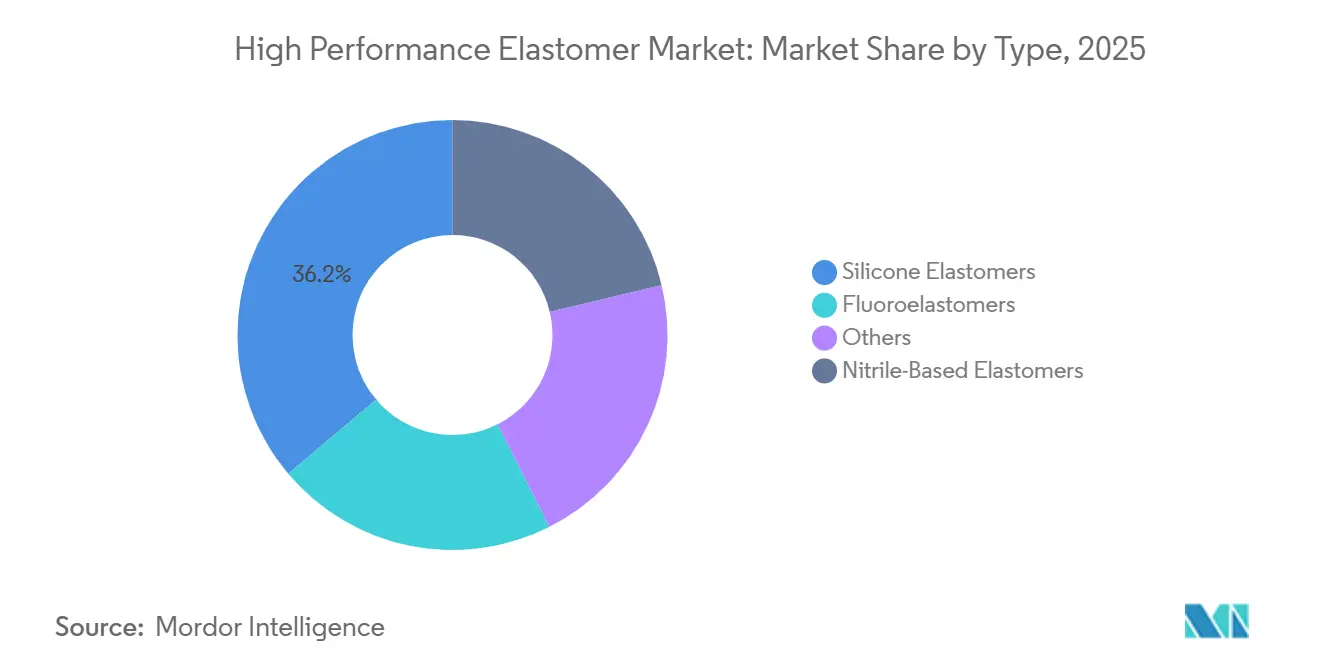
- By type, silicone elastomers held 36.17% of revenue in 2025, while fluoroelastomers are forecast to grow at a CAGR of 7.78% through 2031.
- By application, seals and gaskets held 38.56% of revenue in 2025, while wires and cables are forecast to grow at a CAGR of 8.06% through 2031.
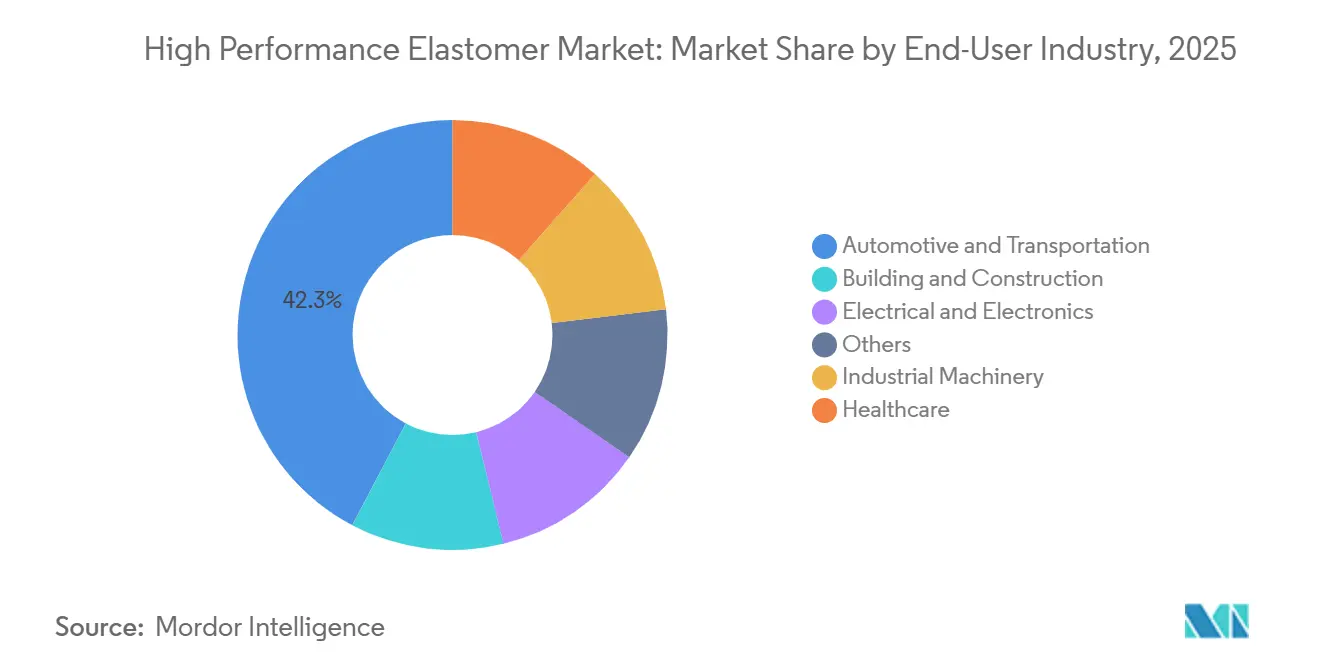
- By end-user industry, automotive and transportation held 42.27% of revenue in 2025, while healthcare is forecast to grow at a CAGR of 8.27% through 2031.
- By geography, Asia-Pacific held 45.03% of revenue in 2025 and is forecast to grow at a CAGR of 7.93% through 2031.
Note: Market size and forecast figures in this report are generated using Mordor Intelligence’s proprietary estimation framework, updated with the latest available data and insights as of January 2026.
Global High Performance Elastomer Market Trends and Insights
Drivers Impact Analysis*
| Drivers | (~) % Impact on CAGR Forecast | Geographic Relevance | Impact Timeline |
|---|---|---|---|
| Electrification and Higher Thermal Loads in Vehicles | +2.1% | Global, with early concentration in China, Germany, and South Korea | Medium term (2-4 years) |
| Demand for Extreme Condition Sealing Solutions | +0.7% | Global, strongest pull in oil and gas-heavy Middle East and Africa (MEA) and industrial-machinery-dense Asia-Pacific (APAC) | Short term (≤ 2 years) |
| Semiconductor and High-Purity Electronics Expansion | +1.5% | Asia-Pacific (APAC) core, with spillover to the United States and Europe | Short term (≤ 2 years) |
| Increasing Medical Device and Pharmaceutical Manufacturing | +1.0% | North America and Europe, with growth in India and China | Medium term (2-4 years) |
| Application-Specific Elastomer Qualification for New Energy Systems | +0.5% | Global, led by EU hydrogen infrastructure and U.S. offshore wind corridors | Long term (≥ 4 years) |
| Source: Mordor Intelligence | |||
Electrification and Higher Thermal Loads in Vehicles
Battery-electric vehicle platforms have changed the thermal and chemical requirements for elastomer seals. High-voltage vehicle systems require insulation and sealing materials that operate in the presence of batteries, motors, and charging components. Battery packs also require gap-filling materials that support heat transfer and performance during thermal cycling. The European Union Battery Regulation introduces material considerations for the end-of-life treatment of battery components. Wacker Chemie AG introduced ELASTOSIL RT 7616 TC and ELASTOSIL RT 7624 TC for battery potting and gap-filling applications, with rheological properties designed to reduce filler sedimentation[1]Wacker Chemie AG, “Wacker to Present Ceramifying Silicone for Optimizing Thermal Barrier Performance at the Battery Show in Stuttgart,” Wacker Chemie AG, wacker.com. The high performance elastomer market is supported as vehicle programs shift toward compounds that combine electrical insulation, thermal management, and durable sealing.
Demand for Extreme Condition Sealing Solutions
Sealing materials are required for applications involving high temperatures, pressure fluctuations, chemical exposure, and long service intervals. Semiconductor equipment, industrial pumps, chemical processing equipment, and vehicle systems operate under varying conditions, requiring suppliers to tailor materials and validation methods accordingly. Conventional rubbers may not be suitable when seals must maintain performance under demanding operating conditions. This trend supports specialty formulations with controlled cleanliness, chemical resistance, and compression-set performance. The high performance elastomer market also requires technical support in addition to material supply, as customers often need guidance on compound selection and qualification. These requirements can make it more difficult for suppliers to replace established materials after approval for critical applications.
Semiconductor and High-Purity Electronics Expansion
Semiconductor fabrication uses seals in processes where chemical resistance and cleanliness are required. Perfluoroelastomer seals are used in applications where process conditions expose components to aggressive chemicals and high temperatures. Seals that shed particles can disrupt wafer processing, making material reliability important for equipment operators. Syensqo expanded its non-fluorosurfactant perfluoroelastomer portfolio in 2025 to address high-temperature, high-purity semiconductor applications. The company stated that these grades support continuous operating temperatures of up to 320°C and are intended for semiconductor gate and isolation valves. The high performance elastomer market is supported by new fabrication facilities, as qualification requirements may favor suppliers with specialized production capabilities.
Increasing Medical Device and Pharmaceutical Manufacturing
Medical device and pharmaceutical manufacturers use silicone and other elastomer components in tubing, gaskets, ports, and fluid-transfer assemblies. These components must meet application requirements for biocompatibility, chemical resistance, and control of extractables. Single-use processing systems increase the need for materials that can be manufactured consistently and validated for contact with sensitive fluids. DuPont launched the Liveo C6-8XX liquid silicone rubber series in February 2026 for healthcare applications. DuPont stated that the series includes United States Pharmacopeia (USP) Class VI materials with lower viscosity, faster molding potential, and compatibility with multiple sterilization methods. The high performance elastomer market is supported by manufacturers seeking qualified materials for medical devices and pharmaceutical processing equipment.
Restraints Impact Analysis*
| Restraints | (~) % Impact on CAGR Forecast | Geographic Relevance | Impact Timeline |
|---|---|---|---|
| Specialty Feedstock Price Volatility | -1.2% | Global, most acute in North America and Europe due to propylene and fluorspar constraints | Short term (≤ 2 years) |
| Fluorochemical Restrictions and Per- and Polyfluoroalkyl Substances (PFAS) Compliance Uncertainty | -0.9% | Europe, with secondary effects in North America and global supply chains | Medium term (2-4 years) |
| Qualification Delays for New Elastomer Formulations | -0.4% | Global, especially automotive and medical manufacturing clusters | Long term (≥ 4 years) |
| Source: Mordor Intelligence | |||
Specialty Feedstock Price Volatility
High performance elastomer formulations rely on specialty chemical inputs that standard materials cannot always replace. Nitrile formulations are exposed to acrylonitrile price fluctuations, while fluoroelastomers depend on specialized fluorinated monomers. Supply disruptions can increase compound prices and complicate contract negotiations between suppliers and buyers. These price fluctuations can affect materials already specified in automotive and industrial equipment programs. In price-sensitive applications, higher input costs can delay customer purchasing decisions in the high performance elastomer market. Suppliers with access to feedstock or long-term procurement agreements may maintain supply continuity during disruptions.
Fluorochemical Restrictions and PFAS Compliance Uncertainty
European PFAS restrictions are increasing compliance requirements for fluorochemical users and suppliers. Fluoroelastomer applications in semiconductor equipment, pharmaceutical processing, and vehicle systems may require supporting documentation and traceability. Certain uses may remain permitted under specific conditions when technically viable alternatives are unavailable. This process can increase costs related to customer qualification and supplier management. The high performance elastomer market must balance the continued need for fluorinated materials in demanding applications with interest in alternative compounds. Companies that provide product documentation and application-specific support may address changing regulatory requirements.
*Our forecasts treat driver/restraint impacts as directional, not additive. The impact forecasts reflect baseline growth, mix effects, and variable interactions.
Segment Analysis
By Type: Silicone Grade Dominance with Fluoroelastomers Accelerating Fast
Silicone elastomers accounted for 36.17% of revenue in 2025, representing the largest share of the high performance elastomer market. These materials are used in automotive thermal management systems, medical devices, and high-voltage electrical insulation. Liquid silicone rubber, high-temperature vulcanized silicone, and room-temperature vulcanized silicone serve distinct processing requirements. DuPont introduced Liveo C6-8XX LSR for healthcare devices in February 2026, offering five Shore A hardness options ranging from 30 to 70.
Dow announced targeted specialty silicone investments of USD 100 million in June 2026, including liquid silicone rubber manufacturing lines in Kentucky and China. Fluoroelastomers are projected to grow at a CAGR of 7.78% through 2031, the highest rate among type segments. Semiconductor sales and chemical processing activities support demand for applications in which fluorocarbon performance remains difficult to replace. 3M’s 2025 exit from per- and polyfluoroalkyl substances (PFAS) and Dyneon manufacturing shifted customer qualification activity toward alternative suppliers. Other specialty grades, including hydrogenated nitrile-butadiene rubber (HNBR) and ethylene-propylene-monomer (EPM), continue to serve automotive and renewable energy applications.



By Application: Seals and Gaskets Hold the Largest Share, While Wires and Cables Record the Highest Growth Rate
Seals and gaskets accounted for 38.56% of revenue in 2025, making them the largest application segment. This high performance elastomer market share reflects demand from vehicles, semiconductor manufacturing, biopharmaceutical production, and industrial equipment. Each end-use application requires materials that can withstand specific chemical, thermal, and pressure conditions. Electrification is changing the material mix in vehicles by reducing demand for certain fuel-system seals while increasing requirements for battery cooling, motor, and connector sealing applications.
Hoses and tubing support thermal management and pharmaceutical fluid-transfer applications. Molded parts are used in aircraft seals, industrial valves, and wearable-device housings. Wires and cables are projected to grow at a CAGR of 8.06% through 2031, the highest growth rate among application segments. Dow’s 525 kV high-voltage direct current (HVDC) insulation system indicates the performance requirements for long-distance grid and offshore wind connections. The high performance elastomer market size for wires and cables is supported by EV charging infrastructure, grid connectors, and high-voltage transmission requirements.
By End-User Industry: Automotive Anchors Today, Healthcare Shapes Tomorrow
Automotive and transportation accounted for 42.27% of revenue in 2025, making the segment the largest end-user category. This high performance elastomer market share includes internal combustion engine components, hybrid drivetrains, and EV-specific applications. While fuel-system elastomer content may decline as EV adoption increases, battery cooling systems, thermal protection structures, and motor assemblies create sealing requirements. Industrial machinery also represents an end-use industry for compressor diaphragms, chemical pump seals, and robotics components.
Healthcare is projected to expand at a CAGR of 8.27% through 2031, the highest rate among end-user industries. Biocompatible silicone, low-extractable fluoroelastomers, and pharmaceutical-grade nitrile are used in medical devices and drug-delivery applications. Single-use bioreactor tubing and port seals require continuous supplies of qualified elastomer components. Building and construction applications use these materials in heating, ventilation, and air conditioning (HVAC) systems and utility piping seals. Electrical and electronics applications use thermally conductive compounds and insulation grades in power electronics and telecommunications equipment.
Geography Analysis
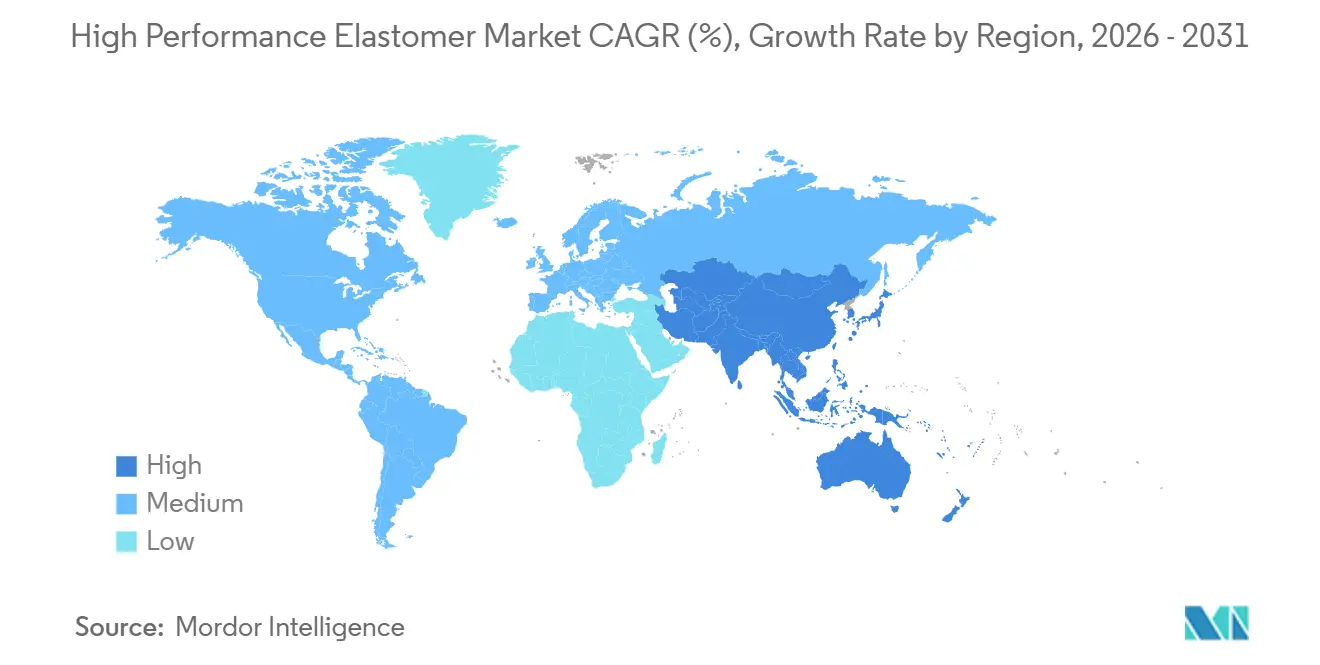
Asia-Pacific accounted for 45.03% of revenue in 2025 and is forecast to grow at a CAGR of 7.93% through 2031. Growth is supported by automotive supply chains in China and South Korea, semiconductor production in Japan and Taiwan, and medical device assembly across ASEAN countries. ARLANXEO inaugurated its Therban Hydrogenated Nitrile Butadiene Rubber (HNBR) plant in Changzhou in February 2026, following the commencement of Phase 1 operations in October 2025. The facility has an annual Phase 1 capacity of 2,500 tons and is designed for future expansion.
North America serves high-value applications in semiconductor fabrication, aerospace, and pharmaceutical manufacturing. New semiconductor fabrication projects in Arizona, Texas, and New York support demand for specialized seals. Mexico’s role in automotive nearshoring also supports demand for sealing materials. Premium product requirements, rather than demand alone, influence the size of the high performance elastomer market in the region.
Europe combines automotive and industrial machinery demand with higher regulatory compliance and qualification costs. Wacker Chemie AG opened a specialty silicones production site in Karlovy Vary, Czech Republic, in 2026. South America has demand from Brazil’s automotive and petroleum activities. The Middle East and Africa have demand from petrochemical, gas processing, and mining applications.

Competitive Landscape
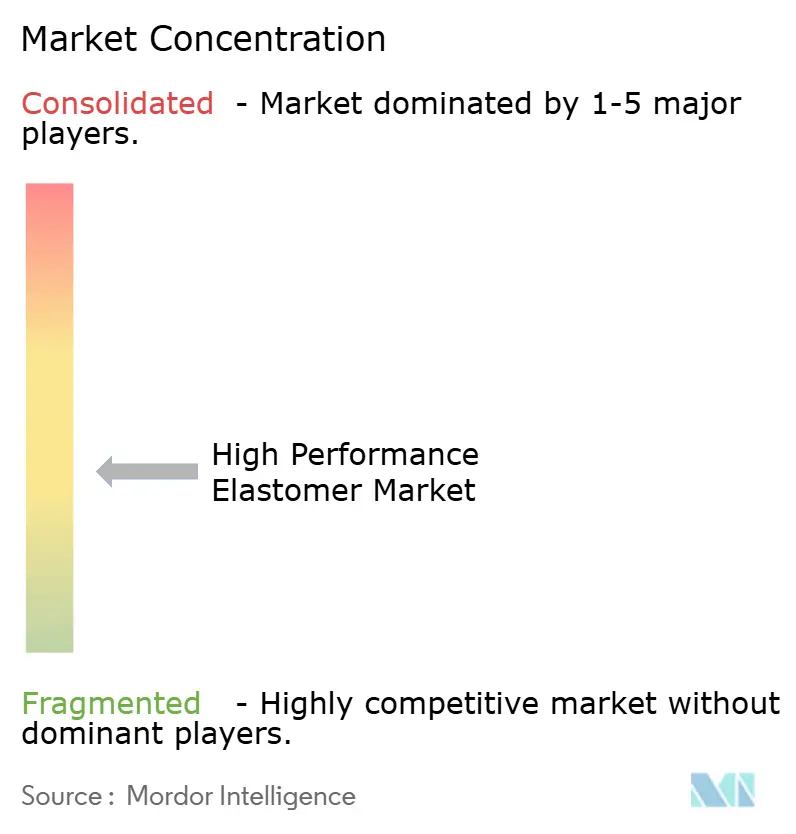
The high performance elastomer market is moderately fragmented. Large suppliers compete through access to fluorine chemistry, silicone monomers, curing systems, and application expertise. These capabilities support products for stringent operating conditions and extended customer approval processes. Standard nitrile grades face price-based competition from regional compounders, particularly in Asia.
Syensqo will expand its non-fluorosurfactant perfluoroelastomer portfolio in October 2025 for semiconductor gate and isolation valve applications. The company states that these grades support continuous operating temperatures of up to 320°C without particle-generating fillers. Dow announced USD 100 million in specialty silicone investments in June 2026 across facilities in the United States, China, and Japan. Daikin completed construction of a perfluoroelastomer rubber (FFKM) production facility at its Kashima Plant in Japan in August 2026, with commercial supply scheduled to begin in 2027 [2]Daikin Industries, Ltd., “Daikin to Expand FFKM Production Capacity at Kashima Plant to Meet Growing Semiconductor Demand,” Daikin Industries, Ltd., daikinchemicals.com.
The high performance elastomer market offers opportunities for application-specific compounds, recyclable silicone formulations, and alternatives for lower-criticality sealing applications. Product development must account for reliability requirements, regulatory compliance, and extended qualification periods. Supplier changes can prompt customers to evaluate alternative materials, particularly when a manufacturer exits a product line. The high performance elastomer market remains differentiated by technical capabilities rather than scale alone.
High Performance Elastomer Industry Leaders
DuPont
The Chemours Company
Solvay
Dow
Wacker Chemie AG
- *Disclaimer: Major Players sorted in no particular order

Recent Industry Developments
- February 2026: DuPont launched the Liveo C6-8XX liquid silicone rubber (LSR) series, a United States Pharmacopeia (USP) Class VI medical-grade high performance elastomer. The series offers five Shore A hardness options, ranging from 30 to 70, improved rheology, lower viscosity, and compatibility with multiple sterilization methods for non-implantable and short-term implantable healthcare devices.
- October 2025: Syensqo expanded its non-fluorosurfactant (NFS) perfluoroelastomer portfolio with high performance elastomer grades that support continuous operating temperatures of up to 320°C. Manufactured in Spinetta, Italy, the grades are designed for high-purity, high-temperature vacuum applications, including semiconductor gate and isolation valves.


Global High Performance Elastomer Market Report Scope
A high performance elastomer (HPE) is an advanced rubber-like polymer designed to maintain elasticity, strength, and structural integrity under extreme operating conditions.
The high performance elastomer market is segmented by type, application, end-user industry, and geography. By type, the market is segmented into nitrile-based elastomers, silicone elastomers, fluoroelastomers, and others. By application, the market is segmented into seals and gaskets, hoses and tubing, molded parts, wires and cables, and others. By end-user industry, the market is segmented into automotive and transportation, industrial machinery, healthcare, building and construction, electrical and electronics, and others. The report also covers market size and forecasts for high performance elastomer across 15 countries in major regions. The market sizes and forecasts are provided in terms of value (USD).
| Nitrile-Based Elastomers |
| Silicone Elastomers |
| Fluoroelastomers |
| Others |
| Seals and Gaskets |
| Hoses and Tubing |
| Molded Parts |
| Wires and Cables |
| Others |
| Automotive and Transportation |
| Industrial Machinery |
| Healthcare |
| Building and Construction |
| Electrical and Electronics |
| Others |
| Asia-Pacific | China |
| India | |
| Japan | |
| South Korea | |
| ASEAN Countries | |
| Rest of Asia-Pacific | |
| North America | United States |
| Canada | |
| Mexico | |
| Europe | Germany |
| United Kingdom | |
| France | |
| Italy | |
| NORDIC Countries | |
| Rest of Europe | |
| South America | Brazil |
| Argentina | |
| Rest of South America | |
| Middle East and Africa | Saudi Arabia |
| South Africa | |
| Rest of Middle East and Africa |
| By Type | Nitrile-Based Elastomers | |
| Silicone Elastomers | ||
| Fluoroelastomers | ||
| Others | ||
| By Application | Seals and Gaskets | |
| Hoses and Tubing | ||
| Molded Parts | ||
| Wires and Cables | ||
| Others | ||
| By End-User Industry | Automotive and Transportation | |
| Industrial Machinery | ||
| Healthcare | ||
| Building and Construction | ||
| Electrical and Electronics | ||
| Others | ||
| By Geography | Asia-Pacific | China |
| India | ||
| Japan | ||
| South Korea | ||
| ASEAN Countries | ||
| Rest of Asia-Pacific | ||
| North America | United States | |
| Canada | ||
| Mexico | ||
| Europe | Germany | |
| United Kingdom | ||
| France | ||
| Italy | ||
| NORDIC Countries | ||
| Rest of Europe | ||
| South America | Brazil | |
| Argentina | ||
| Rest of South America | ||
| Middle East and Africa | Saudi Arabia | |
| South Africa | ||
| Rest of Middle East and Africa | ||


Key Questions Answered in the Report
What is current market size of High Performance Elastomer Market?
The high performance elastomer market size was valued at USD 18.67 billion in 2025 and is estimated to grow from USD 19.91 billion in 2026 to USD 28.12 billion by 2031, at a CAGR of 7.15% during the forecast period (2026-2031).
Which type leads to high performance elastomer demand?
Silicone elastomers led with 36.17% of 2025 revenue. The high performance elastomer market uses silicone across automotive thermal management, medical devices, and high-voltage electrical insulation.
Which application is expanding fastest?
Wires and cables are forecast to grow at 8.06% CAGR through 2031. The high performance elastomer market is supported by grid connections, offshore wind systems, electric vehicle (EV) charging cables, and high-voltage connectors.
Which end-user sector is growing fastest?
Healthcare is forecast to grow at 8.27% CAGR through 2031. Device makers and pharmaceutical processors require qualified materials for tubing, gaskets, ports, and fluid-transfer assemblies.
Page last updated on:





