
Heat Stabilizers Market Size and Share
Market Overview
| Study Period | 2022 - 2032 |
|---|---|
| Market Size (2027) | USD 4.68 Billion |
| Market Size (2032) | USD 5.99 Billion |
| Growth Rate (2027 - 2032) | 5.06 % |
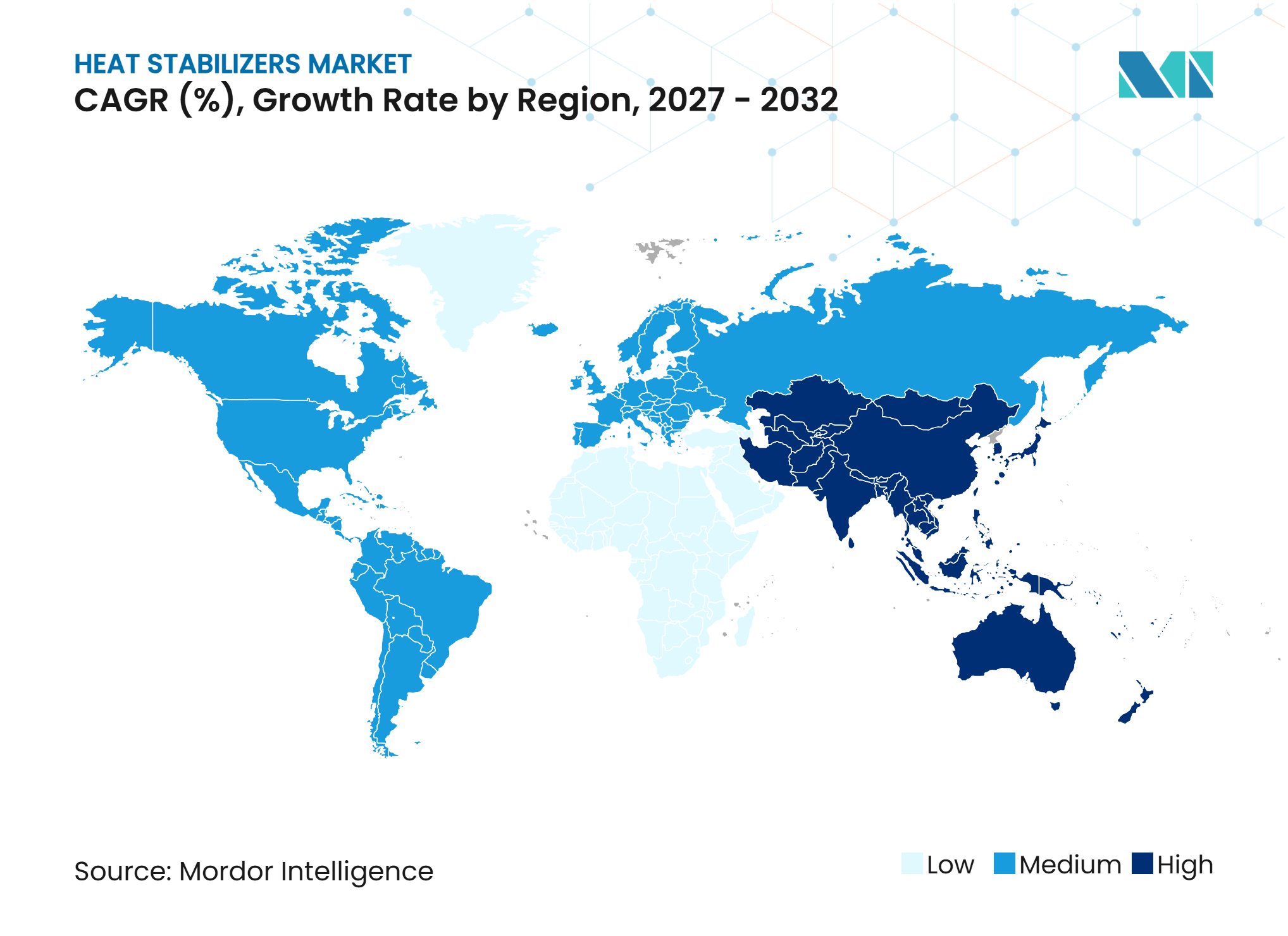
| Fastest Growing Market | Asia-Pacific |
| Largest Market | Asia-Pacific |
| Market Concentration | Medium |
Major Players *Disclaimer: Major Players sorted in no particular order Image © Mordor Intelligence. Reuse requires attribution under CC BY 4.0. | |
Heat Stabilizers Market Analysis by Mordor Intelligence
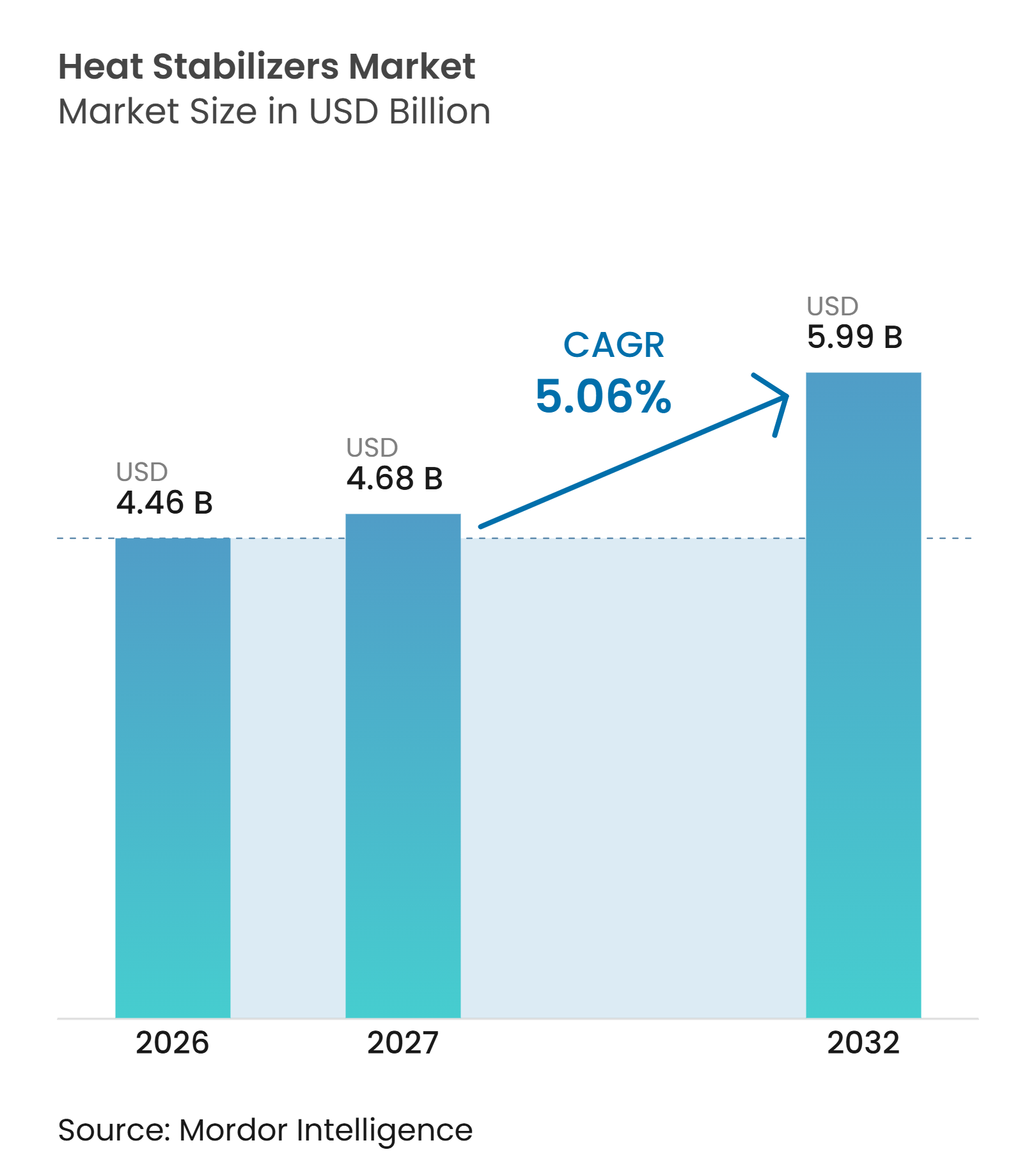
The Heat Stabilizers Market size was valued at USD 4.46 billion in 2026 and is estimated to grow from USD 4.68 billion in 2027 to USD 5.99 billion by 2032, at a CAGR of 5.06% during the forecast period (2027-2032). Polyvinyl chloride (PVC) processing remains a key demand base for the heat stabilizers market, as stabilizer packages protect the polymer during extrusion, molding, and other heat-intensive processes. Construction activity, water systems, power networks, and cable installations influence purchasing patterns more directly than overall economic activity. Metal-based products maintain an established position; however, regulatory controls are shifting demand toward calcium-zinc and organic alternatives. Producers support formulation changes, local supply, and application testing to serve customers globally and manage these transitions.
Key Report Takeaways
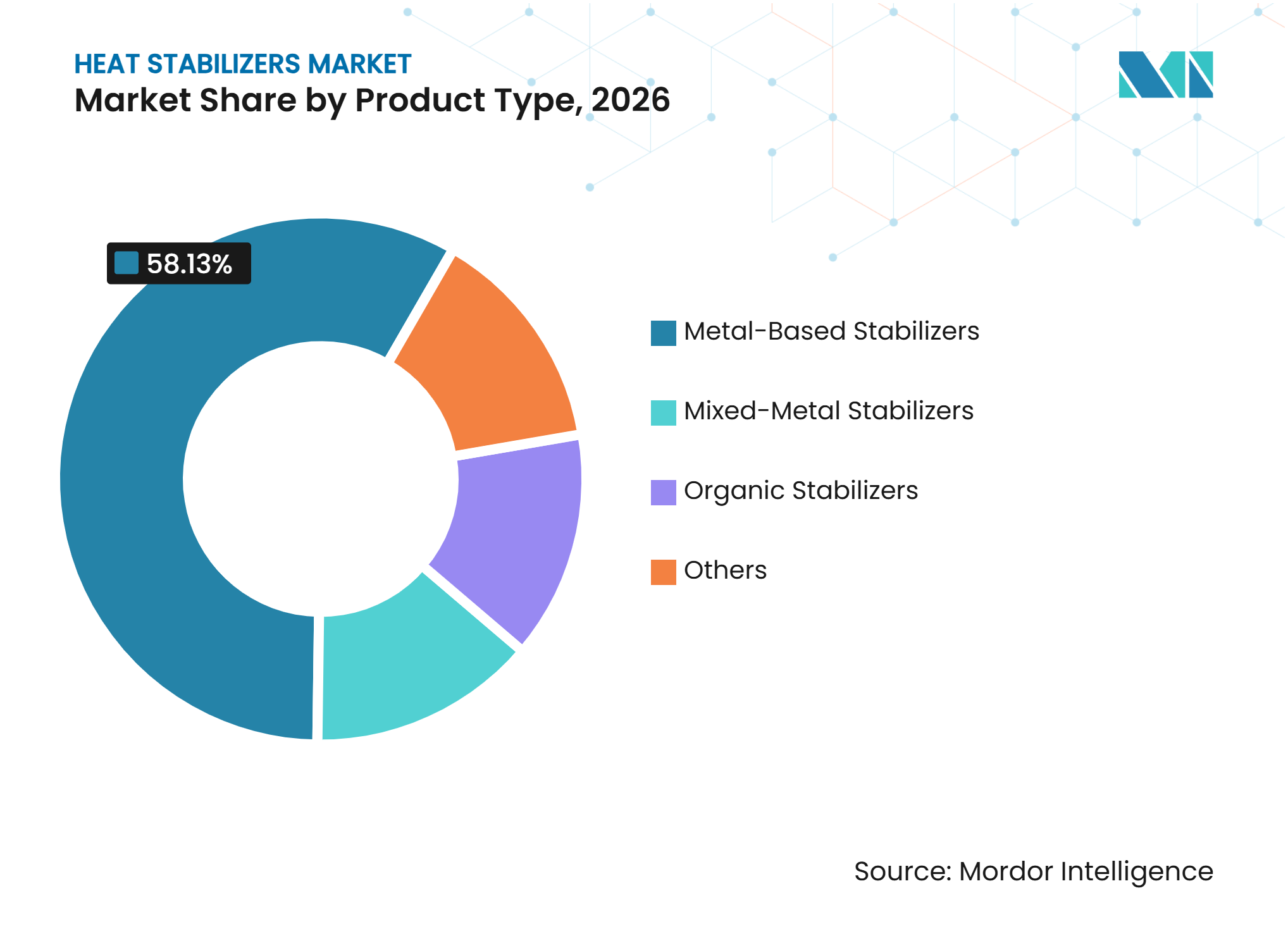
- By product type, metal-based stabilizers held a 58.13% market share in 2026, while organic stabilizers are forecast to grow at a 5.67% CAGR through 2032.
- By form, liquid heat stabilizers accounted for a 42.67% market share in 2026 and are forecast to expand at a 5.81% CAGR through 2032.
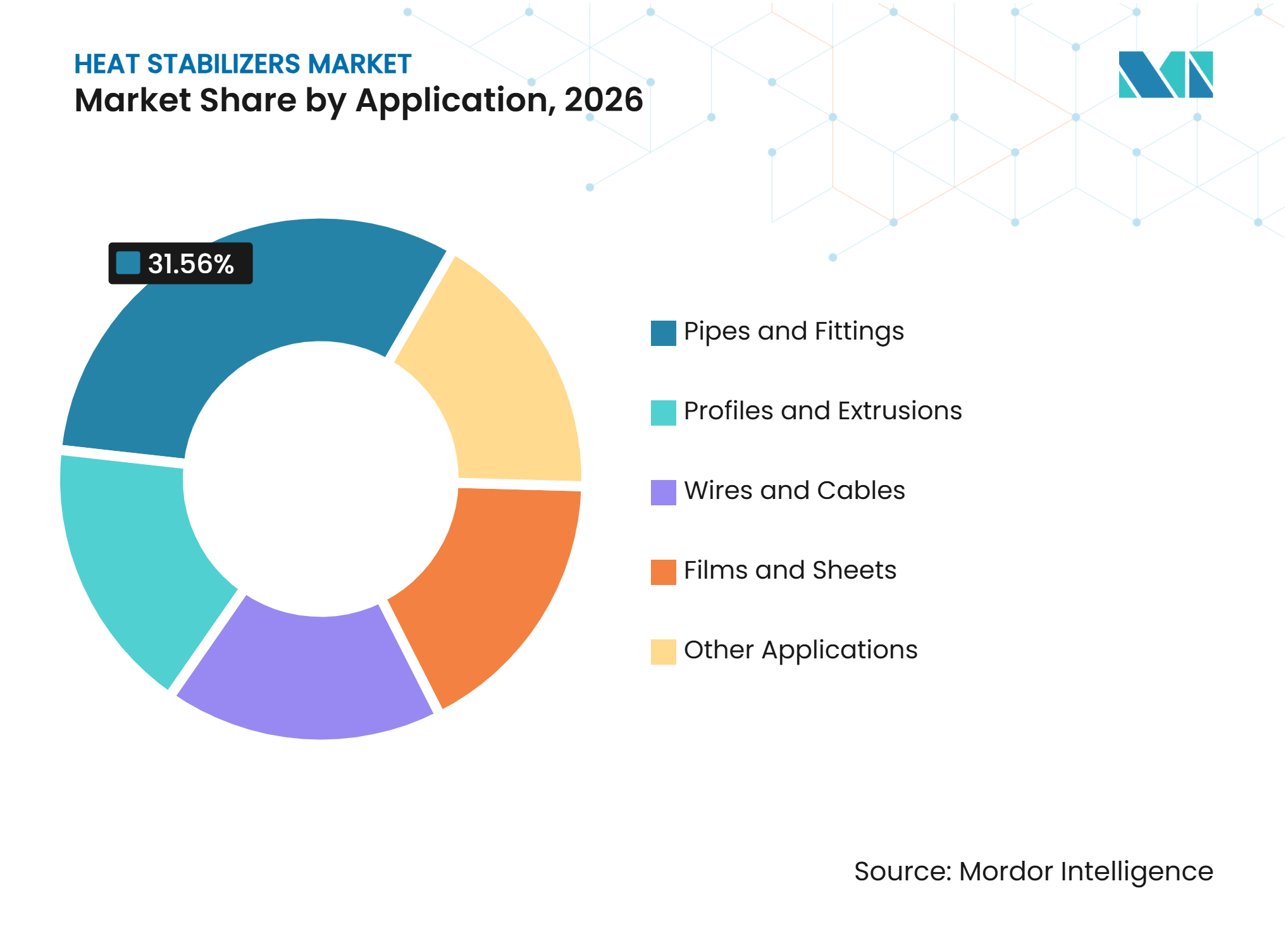
- By application, pipes and fittings held a 31.56% market share in 2026, while wires and cables are forecast to grow at a 6.05% CAGR through 2032.
- By geography, Asia-Pacific held a 34.71% market share in 2026 and is forecast to expand at a 5.79% CAGR through 2032.
Note: Market numbers in this report are based on Mordor Intelligence's proprietary estimation framework, which combines nine months of actuals with Q4 projections for base year 2026.
Market Trends and Insights
Drivers Impact Analysis of Heat Stabilizers Market*
| Drivers | (~) % Impact on CAGR Forecast | Geographic Relevance | Impact Timeline |
|---|---|---|---|
| Polyvinyl Chloride (PVC) Demand in Pipes, Profiles, and Cables | +2.0% | Global, with Asia-Pacific concentration in China, India, and ASEAN, plus spillover to the Middle East, Africa, and South America | Medium term (2-4 years) |
| Construction and Infrastructure Investment | +1.3% | Asia-Pacific, Middle East and Africa, and South America | Medium term (2-4 years) |
| Lead and Cadmium Stabilizer Replacement | +1.1% | European Union, India, and compliance-led markets | Short term (≤ 2 years) |
| Automotive, Electrical, and Packaging Applications | +0.7% | Global, with strongest activity in Germany, South Korea, and China | Medium term (2-4 years) |
| Recycled PVC Qualification and Reprocessing Demand | +0.4% | European Union and North America, with early growth in Asia-Pacific | Long term (≥ 4 years) |
| Source: Mordor Intelligence | |||
PVC Demand in Pipes, Profiles, and Cables
PVC pipes, profiles, and cables generate recurring demand for stabilizer packages, as processors must control thermal degradation during each production run. Infrastructure programs increase resin consumption while expanding the installed base that requires reliable compounding solutions and replacement products. China issued GB/T 8815-2026 for flexible PVC cable compounds in July 2026, with implementation scheduled for February 2027. The standard requires suppliers to meet updated thermal stability and electrical insulation requirements. This standards cycle also affects PVC window and door profiles and thermoplastic pipe systems, placing several major end-use applications within a common requalification period. SONGWON offers calcium-zinc cable stabilizer grades with thermal ratings ranging from 70°C to 125°C, addressing the performance requirements of cable producers. These standards and product requirements support replacement demand in addition to new PVC consumption in the Heat Stabilizers Market.
Construction and Infrastructure Investment
Construction drives stabilizer consumption, as water lines, sewage networks, irrigation systems, building profiles, and roofing products rely heavily on PVC processing. Demand varies by region: pipe replacement and renovation support consumption in mature economies, while new utility networks drive demand in developing markets. VinylPlus recycled 508,109 tons of PVC within its European framework in 2025, representing a 5.7% increase from 2024. Recycled material requires careful stabilization because prior processing can leave degradation residues that affect color, processing behavior, and final-product quality. Therefore, circularity requirements create an additional source of technical demand beyond construction activity. The long service life and corrosion resistance of PVC pipes support their use in water distribution and wastewater systems, sustaining construction-related consumption throughout the Heat Stabilizers Market forecast period.
Lead and Cadmium Stabilizer Replacement
The replacement of lead- and cadmium-based stabilizer systems is reshaping product selection for pipe, profile, and cable compounds. This transition favors calcium-zinc and organic formulations that meet regulatory requirements while maintaining processing consistency. Manufacturers must validate color retention, early color stability, long-term heat stability, and mechanical performance before converting a production line to a new stabilizer package. Baerlocher presented its tin-replacement initiative at K 2025, highlighting the industry focus on alternatives for polyvinyl chloride (PVC) applications. These transitions support specialized suppliers because qualification processes require formulation expertise and customer support. Consequently, the Heat Stabilizers Market is undergoing a chemical transition driven by compliance requirements and customer specifications.
Automotive, Electrical, and Packaging Applications
Automotive interiors, electrical components, flexible cable insulation, and packaging applications generate demand for formulations that balance thermal stability with appearance, flexibility, and safety requirements. Electrical applications support demand, as grid upgrades, renewable energy connections, and charging infrastructure increase cable demand across several regions. Cable producers also require stabilizers that support multiple temperature classes and transparent wire grades without compromising processing performance. SONGWON’s cable stabilizer range supports 70°C, 90°C, 105°C, and 125°C applications, reflecting conditions in modern cable systems. Food-contact applications introduce additional requirements, as additive selection must comply with applicable regulations across the Heat Stabilizers Market. Clariant received a Food Contact Notification for its bio-based Licocare RBW additives for rigid PVC applications, effective May 7, 2026[1].
Restraints Impact Analysis of Heat Stabilizers Market*
| Restraints | (~) % Impact on CAGR Forecast | Geographic Relevance | Impact Timeline |
|---|---|---|---|
| Raw-Material Price Volatility | -0.9% | Global, with higher exposure in cost-sensitive Asia-Pacific and South America | Short term (≤ 2 years) |
| Regulatory Scrutiny of Organotin and Legacy Metal Chemistries | -0.5% | European Union, with spillover to global import standards | Medium term (2-4 years) |
| Formulation Requalification and Processing Trade-Offs | -0.3% | Global, especially mid-sized compounders without in-house research capacity | Long term (≥ 4 years) |
| Source: Mordor Intelligence | |||
Raw-Material Price Volatility
Zinc, calcium, and tin intermediates are inputs for mixed-metal and organotin stabilizer systems. Price fluctuations can affect supplier margins, contract pricing, and the timing of investments in conversion lines. SONGWON reported that higher tin ingot prices affected its tin intermediates business in its 2025 annual report. The company also reported that tin prices declined during the first quarter of 2026 but remained above its expectations, complicating forward pricing. Smaller producers may face pressure when they cannot pass cost increases on to customers promptly. As a result, raw material price volatility can delay conversion investments across the Heat Stabilizers Market, even when buyers seek to adopt calcium-zinc or organic products.
Regulatory Scrutiny of Organotin and Legacy Metal Chemistries
Regulatory scrutiny creates uncertainty for suppliers that rely on organotin or legacy metal chemistries. Customers may delay investment decisions while assessing the costs of reformulation, testing, and documentation. European chemical regulations make authorization and product stewardship important considerations for PVC additive suppliers. However, specialized applications may continue to require organotin products because they offer performance characteristics that are difficult to replace fully. PMC Organometallix continues to offer organotin stabilizers for rigid PVC applications, indicating that this chemistry remains relevant in select product areas[2].
*Our forecasts treat driver/restraint impacts as directional, not additive. The impact forecasts reflect baseline growth, mix effects, and variable interactions.
Heat Stabilizers Market Segment Analysis
By Product Type:
Metal Stability Coexists with Organic Chemistry GainsMetal-based stabilizers are projected to account for 58.13% of the global Heat Stabilizers Market in 2026. Their position reflects established use in rigid PVC pipes, profiles, cable sheathing, and other applications that require consistent processing windows. Many compounders use formulations and production equipment designed for metal-based systems, making a complete transition time-consuming. Within this category, calcium-zinc formulations are gaining importance as users replace lead-containing products and adopt systems that align with evolving compliance requirements. Suppliers provide mixed-metal products in liquid, powder, or one-pack forms, enabling formulators to meet the requirements of different processing methods. Galata Chemicals offers calcium-zinc, barium-zinc, and OBS stabilizer lines for flexible and rigid PVC processing, demonstrating the product range required in a mixed-metal portfolio. Recycled-content requirements also support the adoption of heavy-metal-free systems, as customers must document their additive selections. Metal-based systems will remain a key part of the Heat Stabilizers Market as their chemical composition evolves.
Organic stabilizers are forecast to register the highest CAGR among product types, at 5.67% through 2032. Their growth is supported by their regulatory profile, increasing compatibility with recycled PVC feedstock, and suitability for applications requiring lower-risk additive options. Research published in 2025 identifies rare-earth carboxylates, metal alkoxides, and HCl scavengers as potential routes for improving PVC thermal stabilization. However, organic stabilizers do not replace all metal-based chemistries because application requirements vary across pipes, profiles, films, and transparent products. Specialty systems remain relevant in applications with specified clarity, food-contact performance, or weathering requirements. ISO 182-3:2025 provides a conductometric method for determining the thermal stability of PVC, offering laboratories a standardized approach for comparative testing. Greater testing consistency may help processors compare new product types with established formulations. Organic chemistry is becoming more prominent across the Heat Stabilizers Market without eliminating the need for application-specific stabilizer systems.



By Form:
Liquid Systems Lead on Both Share and GrowthLiquid heat stabilizers are projected to account for 42.67% of global heat stabilizer demand in 2026. These products enable controlled dosing on continuous extrusion lines and can reduce particulate handling relative to powder systems. Their use is suited to flexible PVC, flooring, wire and cable, wall coverings, roofing membranes, and other applications that benefit from uniform additive distribution. The category also benefits from the continued shift toward calcium-zinc and barium-zinc chemistries. AM Stabilizers supplies liquid calcium-zinc and barium-zinc stabilizers for flooring, wire and cable, roofing membranes, and wall coverings. Such portfolios demonstrate how liquid products can serve multiple PVC end uses through formulation-specific grades. Processors also consider occupational handling conditions when selecting liquid or solid formats. Liquid systems represent a component of current demand in the Heat Stabilizers Market.
Liquid heat stabilizers are forecast to expand at a 5.81% CAGR through 2032, making them the largest and fastest-growing form segment. Their growth reflects demand for dosing precision, cleaner handling, and flexible product design during compound production. Solid stabilizers will continue to serve rigid PVC pipe one-pack systems and window profile extrusion, where batch consistency and storage characteristics matter. Akdeniz Chemson supplies both solid and liquid systems through manufacturing operations in Turkey, Austria, the United States, Brazil, China, and Australia. Pastes, dispersions, and other specialty forms have a smaller market presence but remain relevant for plastisols, flooring, and medical-grade PVC applications. Valtris also offers nonylphenol-free, compliance-oriented PVC additive solutions for processors serving demanding applications. Form selection will remain linked to equipment configuration, worker handling practices, and end-use specifications.
By Application:
Infrastructure Pipes Dominate, Cables AcceleratePipes and fittings are projected to account for 31.56% of global heat stabilizer demand in 2026. Water distribution, sewage systems, irrigation, and housing construction support this position, as PVC pipes require stabilizer protection throughout the processing chain. PVC pipe is used in water and wastewater networks because of its corrosion resistance, low weight, and service life. These characteristics support its use in new infrastructure developments and replacement projects. Pressure fittings may require wider processing windows because their complex geometries place additional demands on melt behavior and color stability. Reagens has highlighted calcium-organic stabilizer systems for PVC pressure fittings to improve processing performance. Profiles and extrusions represent another application area, including windows, doors, and construction panels. Films and sheets use a range of stabilizer types depending on requirements for clarity, food contact, medical use, and agricultural applications.
Wires and cables are forecast to expand at a CAGR of 6.05% through 2032, the highest growth rate among application segments. Power-grid expansion, renewable energy connections, electric vehicle charging infrastructure, and broader electrification are increasing demand for PVC cable insulation and sheathing. Updated Chinese cable standards require compounders to validate thermal stability and electrical performance against new testing requirements. These requirements create a requalification cycle that supports suppliers offering tested calcium-zinc and organic alternatives. SONGWON's temperature-rated cable stabilizer range demonstrates how suppliers address varying insulation requirements. Flooring, roofing membranes, coated fabrics, and automotive components also generate demand for liquid mixed-metal and organic formulations. This application mix enables suppliers to tailor chemistry, form, and thermal performance to converters' requirements in the Heat Stabilizers Market.

Geography Analysis
Asia-Pacific
Asia-Pacific holds a 34.71% share of the Heat Stabilizers Market in 2026 and is forecast to grow at a CAGR of 5.79% through 2032. Urbanization, water and sanitation projects, construction activity, power grid investments, and a broad base of PVC conversion support regional consumption. China is updating standards for flexible cable compounds, uPVC windows and doors, and thermoplastic pipe systems. These requirements increase the need for local technical support, as processors must test new or revised formulations across multiple end-use applications. Regional producers also serve export markets, increasing the importance of application expertise and reliable local supply. SONGWON reported stable sales in Japan and Southeast Asia and improving demand in Korea during the first quarter of 2026. The company identified Africa and the Middle East as developing markets within its expanded distribution network. Compliance requirements and infrastructure demand support Asia-Pacific’s position in the Heat Stabilizers Market.
North America
North America has a demand profile centered on organotin use in rigid PVC pipes, window profiles, cellular PVC, and food-contact applications. Methyltin and butyltin systems continue to serve processors that require established performance in rigid and weatherable products. PMC Organometallix offers its Thermolite and Advastab products for organotin-stabilized PVC applications, including pipes, siding, and related products. Aging water infrastructure drives replacement demand, particularly as municipalities upgrade pipe systems. Customer sustainability requirements are creating opportunities for calcium-zinc alternatives. AM Stabilizers operates a solar-powered facility and supplies calcium-zinc and barium-zinc products for several PVC applications. Food-contact compliance also shapes the competitive environment, as products in this segment must meet specific regulatory requirements. Infrastructure needs support North American demand in the Heat Stabilizers Market, while chemistry transitions are progressing more gradually than in compliance-driven European markets.
Europe, South America, and the Middle East and Africa
Europe has a compliance environment that supports calcium-zinc and organic systems in profiles, pipes, wire and cable, and recycling applications. Baerlocher established Baerlocher Germany GmbH & Co. KG for the European sales region, effective July 1, 2026, reflecting the importance of alignment with regional customers and regulatory requirements. VinylPlus reported increased recycling activity in 2025, supporting demand for solutions that manage recycled PVC quality. In South America, water treatment projects, urban housing development, and local production capacity support demand, particularly in Brazil and Argentina. Akdeniz Chemson’s manufacturing footprint includes Brazil, highlighting the importance of regional supply for converters. Construction activity, water infrastructure investment, and distribution expansion in developing markets support demand across the Middle East and Africa. Across these regions, local technical service, circularity credentials, and regulatory requirements influence supplier selection in the Heat Stabilizers Market.
Competitive Landscape
Market Concentration
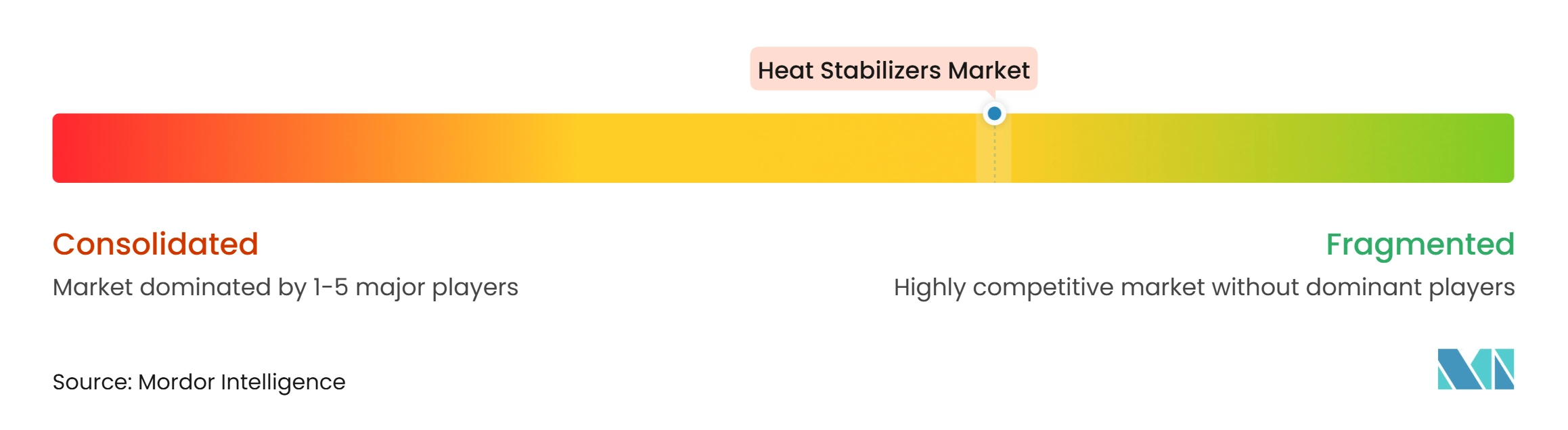
The heat stabilizers market is moderately fragmented. Akdeniz Chemson, Baerlocher, Galata Chemicals, and ADEKA Corporation are suppliers with diverse product portfolios and geographic presence. According to OYAK, Akdeniz Chemson operates production facilities across five continents and exports to more than 110 countries. This footprint supports local supply and technical support for converters. Baerlocher reorganized its European operating business under Baerlocher Germany GmbH & Co. KG in July 2026. Other global suppliers are expanding product portfolios and regional capabilities to address changing formulation requirements. These initiatives reflect the role of scale, regional access, and product range in competition.
Supplier strategies focus on calcium-zinc product development, recycled PVC capabilities, and compliance-driven product differentiation. The transition away from legacy chemistries requires producers to support customers through trials, certifications, and production changes. Clariant received FDA authorization for its bio-based Licocare RBW additives for rigid PVC food-contact applications in 2026. Regulatory approvals can differentiate products in higher-value applications. Reagens reports sustainability and additive-footprint initiatives at its San Giorgio di Piano site. These factors are relevant for customers that must document material selections. Innovation continues in specialized stabilizer and co-stabilizer systems, while demand shifts toward calcium-zinc products.
Competition also depends on suppliers’ ability to serve regional compounders and converters, particularly as new standards and recycled-content requirements alter formulations. SONGWON strengthened its distribution arrangements in Australia, New Zealand, and southeastern Europe during 2025. Local distribution networks can reduce response times and support application testing. ADEKA operates through its additives business, while AM Stabilizers provides North American customers with liquid calcium-zinc and barium-zinc products. Regional producers in India and Taiwan may gain export opportunities if they meet performance and documentation requirements. The competitive environment includes multiple suppliers, as product approvals, customer relationships, and regional production capabilities influence competition alongside scale.
Heat Stabilizers Industry Leaders
-
Akdeniz Chemson
-
Baerlocher GmbH
-
SONGWON
-
Valtris Specialty Chemicals
-
Galata Chemicals
- *Disclaimer: Major Players sorted in no particular order
Heat Stabilizers Market Companies Covered in this Report
- ADEKA CORPORATION
- Akdeniz Chemson
- AM Stabilizers Corporation
- Asúa Products, S.A.
- Baerlocher GmbH
- CLARIANT
- Galata Chemicals
- GOLDSTAB ORGANICS PVT LTD
- Kisuma Chemicals
- Pau Tai Industrial Corp.
- PMC Group, Inc.
- Reagens SPA
- SONGWON
- Valtris Specialty Chemicals
- Vikas Ecotech Ltd.
Recent Industry Developments in Heat Stabilizers Market
- June 2026: Baerlocher Group transferred its European operational business to Baerlocher Germany GmbH & Co. KG, a newly established independent entity headquartered in Lingen, effective July 1, 2026. The company manages PVC heat stabilizers and specialty additives across the European sales region, while Baerlocher GmbH transitioned to a holding company function.
- May 2026: OYAK Group highlighted Akdeniz Chemson’s presence in the PVC heat stabilizers market, supported by its production network across five continents, exports to more than 110 countries, and the commissioning of the second phase of its zinc borate production line in 2025. Akdeniz Chemson also expanded its portfolio of flame retardants and benzoate-based plasticizers.
Global Heat Stabilizers Market Report Scope
Heat stabilizers support polymer processing and product performance, particularly for PVC, by mitigating thermal, UV, and mechanical degradation. They neutralize hydrogen chloride (HCl) released during processing and use and help limit dehydrohalogenation.
The heat stabilizers market is segmented by product type, form, application, and geography. By product type, the market is segmented into metal-based stabilizers, organic stabilizers, mixed-metal stabilizers, and others. By form, the market is segmented into solid heat stabilizers, liquid heat stabilizers, and others. By application, the market is segmented into pipes and fittings, profiles and extrusions, wires and cables, films and sheets, and other applications. The report also covers market sizes and forecasts for heat stabilizers across 15 countries in major regions. The market sizes and forecasts are provided in terms of value (USD).
Segmentation Overview
| Metal-Based Stabilizers |
| Organic Stabilizers |
| Mixed-Metal Stabilizers |
| Others |
| Solid Heat Stabilizers |
| Liquid Heat Stabilizers |
| Others |
| Pipes and Fittings |
| Profiles and Extrusions |
| Wires and Cables |
| Films and Sheets |
| Other Applications |
| Asia-Pacific | China |
| India | |
| Japan | |
| South Korea | |
| ASEAN Countries | |
| Rest of Asia-Pacific | |
| North America | United States |
| Canada | |
| Mexico | |
| Europe | Germany |
| United Kingdom | |
| France | |
| Italy | |
| NORDIC Countries | |
| Rest of Europe | |
| South America | Brazil |
| Argentina | |
| Rest of South America | |
| Middle East and Africa | Saudi Arabia |
| South Africa | |
| Rest of Middle East and Africa |
| By Product Type | Metal-Based Stabilizers | |
| Organic Stabilizers | ||
| Mixed-Metal Stabilizers | ||
| Others | ||
| By Form | Solid Heat Stabilizers | |
| Liquid Heat Stabilizers | ||
| Others | ||
| By Application | Pipes and Fittings | |
| Profiles and Extrusions | ||
| Wires and Cables | ||
| Films and Sheets | ||
| Other Applications | ||
| By Geography | Asia-Pacific | China |
| India | ||
| Japan | ||
| South Korea | ||
| ASEAN Countries | ||
| Rest of Asia-Pacific | ||
| North America | United States | |
| Canada | ||
| Mexico | ||
| Europe | Germany | |
| United Kingdom | ||
| France | ||
| Italy | ||
| NORDIC Countries | ||
| Rest of Europe | ||
| South America | Brazil | |
| Argentina | ||
| Rest of South America | ||
| Middle East and Africa | Saudi Arabia | |
| South Africa | ||
| Rest of Middle East and Africa | ||
Key Questions Answered in the Report
What is current market size of Heat Stabilizers Market?
The Heat Stabilizers Market size was valued at USD 4.46 billion in 2026 and is estimated to grow from USD 4.68 billion in 2027 to USD 5.99 billion by 2032, at a CAGR of 5.06% during the forecast period (2027-2032).
Which heat stabilizer form is growing fastest?
Liquid heat stabilizers are forecast to grow at a 5.81% CAGR through 2032. They also held a 42.67% share in 2026.
What application is expected to grow fastest through 2032?
Wires and cables are forecast to grow at a 6.05% CAGR, supported by grid expansion, renewable energy links, and charging infrastructure.
Which region leads in heat stabilizer demand?
Asia-Pacific held a 34.71% share in 2026 and is forecast to expand at a 5.79% CAGR through 2032.