
GPU Cooling Solutions Market Size and Share
Market Overview
| Study Period | 2020 - 2031 |
|---|---|
| Market Size (2026) | USD 11.86 Billion |
| Market Size (2031) | USD 35.60 Billion |
| Growth Rate (2026 - 2031) | 24.59 % |
| Fastest Growing Market | Asia-Pacific |
| Largest Market | Asia-Pacific |
| Market Concentration | Medium |
Major Players *Disclaimer: Major Players sorted in no particular order Image © Mordor Intelligence. Reuse requires attribution under CC BY 4.0. | |
GPU Cooling Solutions Market Analysis by Mordor Intelligence
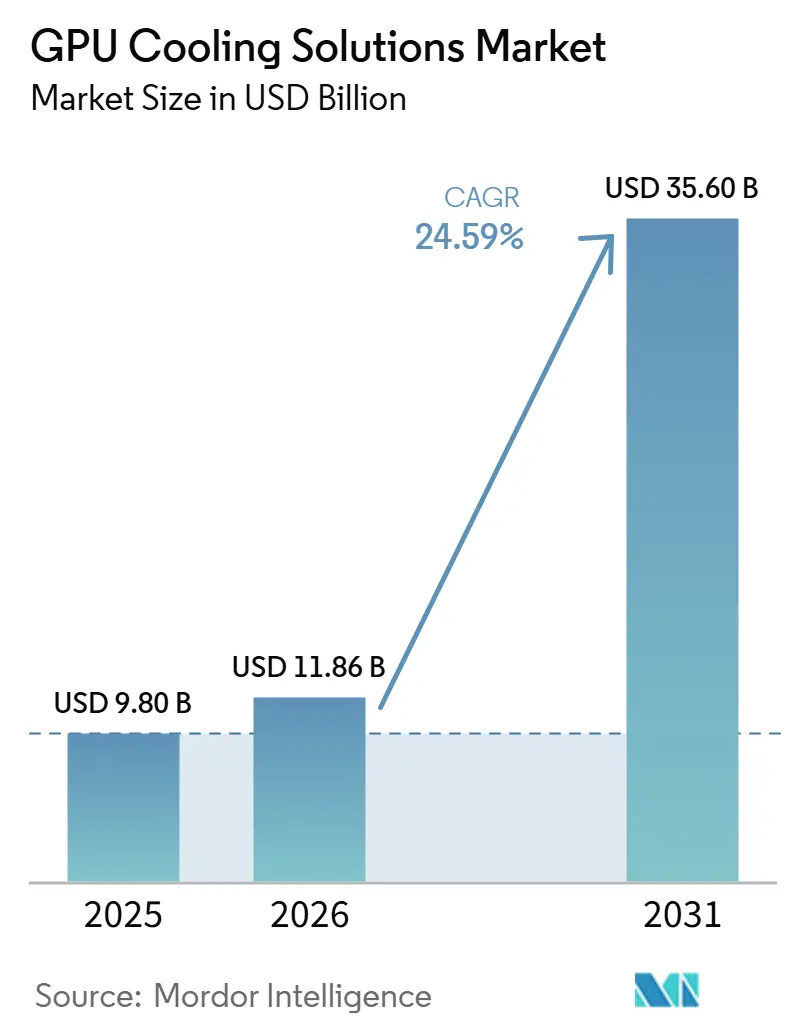
The GPU Cooling Solutions Market size is projected to expand from USD 9.80 billion in 2025 and USD 11.86 billion in 2026 to USD 35.60 billion by 2031, registering a CAGR of 24.59% between 2026 and 2031. Spiraling GPU power densities, tighter energy-efficiency mandates, and the rising adoption of artificial-intelligence workloads are accelerating the transition from legacy air-cooled heat sinks to direct-to-chip liquid and immersion architectures. Operators that once managed 300 W accelerators now confront Nvidia Blackwell Ultra devices rated at 1,400 W, forcing a wholesale redesign of data-center white space. Regulatory pressure is equally decisive; European, Singaporean, and North American standards now reward power-usage-effectiveness (PUE) targets below 1.5, effectively disqualifying conventional air flow designs. In response, hyperscalers prioritize rack-level liquid cooling, while edge providers gravitate toward modular immersion pods that bypass the need for raised floors.
Key Report Takeaways
- By cooling technology, air cooling led with 45.50% of the GPU cooling solutions market share in 2025, whereas immersion cooling is forecast to post a 25.50% CAGR through 2031.
- By cooling level, server and rack-level systems captured 60.10% of the GPU cooling solutions market size in 2025 and are projected to expand at a 26.10% CAGR.
- By deployment, hyperscale and cloud installations held 62.30% share of the GPU cooling solutions market in 2025, while the enterprise segment is set to grow at a 26.30% CAGR over 2026-2031.
- By GPU power density, the 300 W-700 W bracket commanded 51.70% share of the GPU cooling solutions market in 2025; accelerators above 700 W are expected to progress at a 27.80% CAGR.
- By geography, Asia-Pacific dominated the graphics processing unit (GPU) cooling solutions market with a 66.90% share in 2025 and is anticipated to grow at a 28.20% CAGR, the fastest among all regions.
Note: Market size and forecast figures in this report are generated using Mordor Intelligence’s proprietary estimation framework, updated with the latest available data and insights as of January 2026.
Market Trends and Insights
Drivers Impact Analysis of GPU Cooling Solutions Market*
| Driver | (~) % Impact on CAGR Forecast | Geographic Relevance | Impact Timeline |
|---|---|---|---|
| Growing GPU Power Densities Requiring Advanced Thermal Management | +6.8% | Global, especially North America and Asia-Pacific hyperscale clusters | Medium term (2-4 years) |
| Expansion of Hyperscale Data Centers with GPU-Accelerated Workloads | +5.2% | North America, Asia-Pacific, Europe | Short term (≤ 2 years) |
| Increasing Adoption of Liquid Cooling in HPC and AI Clusters | +4.9% | North America, Europe, Asia-Pacific government research facilities | Medium term (2-4 years) |
| Government Energy Efficiency Regulations for Data Centers | +3.7% | Europe, North America, Singapore, South Korea | Long term (≥ 4 years) |
| Emergence of Modular Immersion Cooling Pods for Edge Micro-DCs | +2.6% | Global, early adoption in North America and Asia-Pacific edge deployments | Medium term (2-4 years) |
| Integration of AI-Based Thermal Telemetry Driving Predictive Cooling Optimization | +2.3% | North America and Europe, expanding to Asia-Pacific | Long term (≥ 4 years) |
| Source: Mordor Intelligence | |||
Growing GPU Power Densities Requiring Advanced Thermal Management
NVIDIA’s Blackwell Ultra pushes 1,400 W TDP per device, and the forthcoming Rubin series targets 1,950 W, eclipsing the 400 W ceiling long assumed for air-cooled heat sinks. Rack-level densities climbed from 15 kW in 2024 to projections above 240 kW by 2028, leaving retrofit windows razor-thin and turning liquid cooling from an option to a mandate.[1]Microsoft Corporation, “Azure AI Infrastructure Expansion,” microsoft.com Microsoft’s 750 W Maia 200 accelerator already relies on closed-loop plates to stay below 85 °C, a technical inflection likely to push air cooling into CPU-only or storage lanes by the decade’s close.
Expansion of Hyperscale Data Centers with GPU-Accelerated Workloads
Meta’s 4 million ft² Hyperion campus in Louisiana and Microsoft’s 1 GW Azure AI superfactory in Atlanta are purpose-built for liquid racks and will deliver a combined 1.3 GW of GPU capacity by 2028. Public programs mirror the trend, for instance, Canada’s Sovereign Compute Initiative set aside CAD 2 billion (USD 1.48 billion) in 2025 with a mandate for liquid cooling, and the UK’s DAWN upgrade achieved a 1.12 PUE through immersion cooling. These builds guarantee multi-year demand for coolant-distribution units, custom plates, and dielectric fluids.
Increasing Adoption of Liquid Cooling in HPC and AI Clusters
EuroHPC’s HammerHAI supercomputer specified direct-to-chip loops to hit exascale performance inside a 20 MW envelope, epitomizing policy alignment between compute sovereignty and sustainability.[2]EuroHPC Joint Undertaking, “HammerHAI Supercomputer Project,” eurohpc-ju.europa.eu Japan’s 50 MW KDDI cluster, commissioned in January 2026, posted PUE 1.15 with Nvidia GB200 NVL72 servers,[3]KDDI Corporation, “50 MW Osaka GPU Cluster Deployment,” kddi.comwhile Singapore’s 58 MW Nxera facility achieved PUE 1.25 in a tropical environment. Interoperability gaps remain. KDDI requires bespoke plate geometries that diverge from Open Compute Project dimensions, underscoring ongoing vendor-lock risks.
Government Energy Efficiency Regulations for Data Centers
The EU’s Delegated Regulation 2024/1364 forces new sites above 1 MW to hit PUE ≤ 1.5 by 2030 and water-usage-effectiveness ≤ 0.4 L/kWh.[4]European Commission, “EU Delegated Regulation 2024/1364 on Data Center Energy Efficiency,” EUR-LEX, eur-lex.europa.eu Singapore’s SS 715:2025 standard mandates energy audits and offers accelerated depreciation for immersion investments. Updated US federal guidelines incorporate thermal-efficiency metrics, enabling agencies to justify liquid deployments based on lifecycle cost savings. Enforcement timelines vary, yet the regulatory arc unmistakably disfavors air-cooled GPU clusters.
Restraints Impact Analysis of GPU Cooling Solutions Market*
| Restraint | (~) % Impact on CAGR Forecast | Geographic Relevance | Impact Timeline |
|---|---|---|---|
| High Capital Expenditure of Liquid and Immersion Cooling Infrastructure | -3.4% | Global, acute among enterprise and mid-tier operators | Short term (≤ 2 years) |
| Compatibility Issues with Legacy Server Racks and Facility Layouts | -2.8% | North America and Europe enterprise facilities | Medium term (2-4 years) |
| Limited Industry Standards for Coolant Fluids | -1.9% | Global, multi-vendor procurement scenarios | Long term (≥ 4 years) |
| Supply Chain Constraints for Advanced Cold Plates and Pump Components | -1.5% | Global shortages, especially North America and Europe | Short term (≤ 2 years) |
| Source: Mordor Intelligence | |||
High Capital Expenditure of Liquid and Immersion Cooling Infrastructure
Turnkey immersion systems typically cost between USD 800 and 1,200 per kW, which is approximately double the cost of air-cooled systems. Additionally, direct-to-chip cooling kits increase server pricing by 20% to 40%. Despite these higher upfront costs, the five-year total cost of ownership savings often exceed 15%. However, many mid-tier operators face challenges in accessing affordable financing options. This financial barrier delays the adoption of these advanced cooling solutions until more reliable payback models are established. As a result, the market's growth is hindered by the lack of widespread affordability and financing mechanisms.
Compatibility Issues with Legacy Server Racks and Facility Layouts
Immersion pods can weigh 10-15 times as much as traditional racks, often exceeding the 1,200 kg/m² load capacity that is standard in data centers built before 2020. Retrofitting a 10 MW hall to accommodate these systems may require structural reinforcements costing between USD 2-5 million. Additionally, the process involves approximately 72 hours of downtime per rack for installing plates and manifolds. These factors contribute to significant operational risks, which can deter companies from adopting immersion cooling systems. Even when energy savings are substantial, the high upfront costs and potential disruptions slow the pace of implementation. As a result, many operators remain cautious despite the long-term benefits.
*Our forecasts treat driver/restraint impacts as directional, not additive. The impact forecasts reflect baseline growth, mix effects, and variable interactions.
GPU Cooling Solutions Market Segment Analysis
By Cooling Technology:
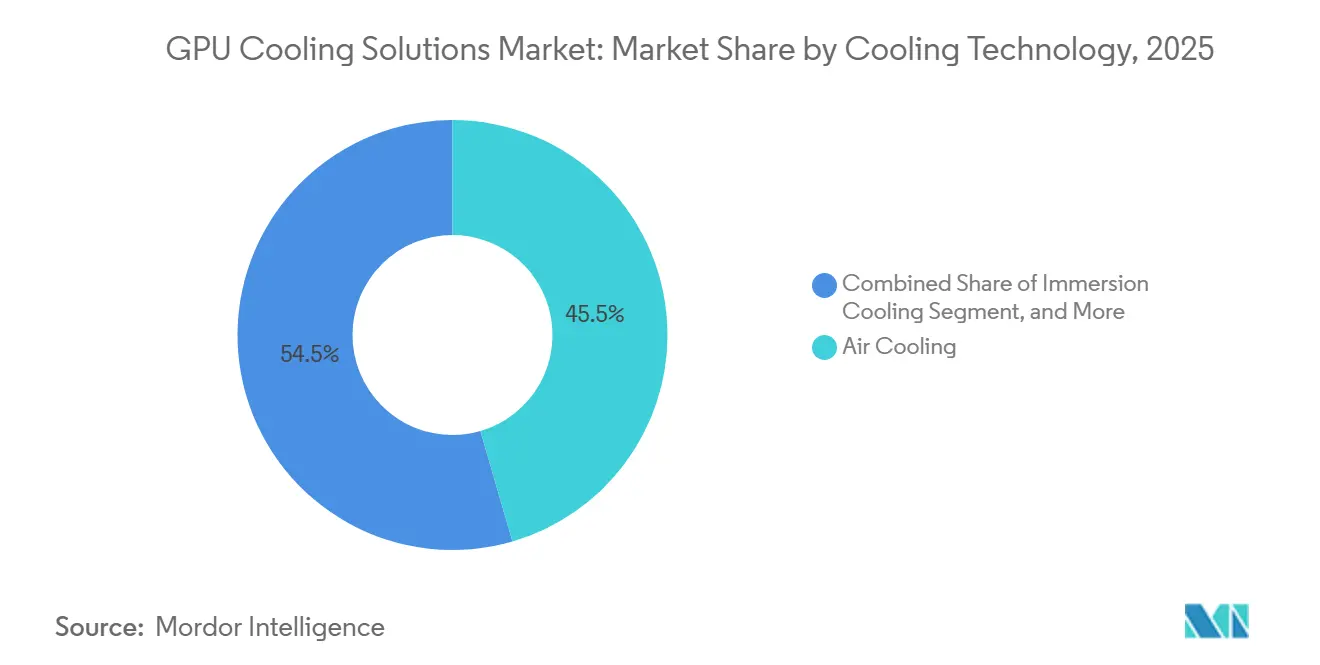
Immersion Systems Gain Traction Despite Air-Cooling DominanceAir cooling held 45.50% of the Graphics Processing Unit (GPU) cooling solutions market share in 2025 because it leverages existing facilities and carries lower upfront capital. This method remains a preferred choice for enterprises looking to optimize costs while utilizing existing infrastructure. However, the segment’s growth lags behind the overall GPU cooling solutions market as immersion solutions gain traction. Immersion solutions are projected to grow at a 25.50% CAGR through 2031, driven by their ability to eliminate hot aisles and reduce the data center footprint by up to 60%. Submer’s 2025 SmartPod rollout in India demonstrated these advantages effectively. Despite these benefits, challenges such as fluid-disposal regulations and the absence of unified dielectric standards continue to hinder widespread adoption, though ongoing R&D efforts aim to address these issues.
Rack-level cold plates are expanding fastest because they integrate neatly with Open Compute Project racks and consolidate plumbing into fewer hose assemblies, slashing installation time by 30%. These systems are increasingly favored for their efficiency and compatibility with modern data center designs. Hybrid designs, which use air cooling for CPUs and liquid cooling for GPUs, are also gaining traction. This approach appeals to enterprises that prefer a phased migration of workloads, balancing innovation with risk management. The adoption of such hybrid systems reflects a cautious yet progressive strategy among enterprises. As the market evolves, these solutions are expected to play a critical role in addressing the growing demand for efficient GPU cooling technologies.



By Cooling Level:
Rack-Level Solutions Dominate as Component Cooling Gains Niche TractionServer and rack-level cooling accounted for 60.10% of the graphics processing unit (GPU) cooling solutions market in 2025 and is poised for a 26.10% CAGR, as operators increasingly favor modular coolant distribution units that align with Open Compute Project racks. These systems support rack-level deployment and help data center operators manage higher thermal loads more efficiently. Cost savings result from serving up to 40 servers per coolant distribution unit, reducing the need for extensive plumbing infrastructure and lowering ongoing maintenance overhead.
Component-level cold plates remain vital in deployments where sub-millisecond latency is paramount and precise device-level thermal control is required. Technologies such as Frore Systems’ generatively designed plates for 1,950 W GPUs enable localized thermal optimization, helping extend hardware lifespan while supporting high-performance GPU operation, although they introduce higher per-node complexity. Long-term growth depends on IEEE interoperability standards scheduled for late 2026, which may support multi-vendor interchangeability for cold-plate interfaces and improve adoption across heterogeneous infrastructure environments.
By Deployment:
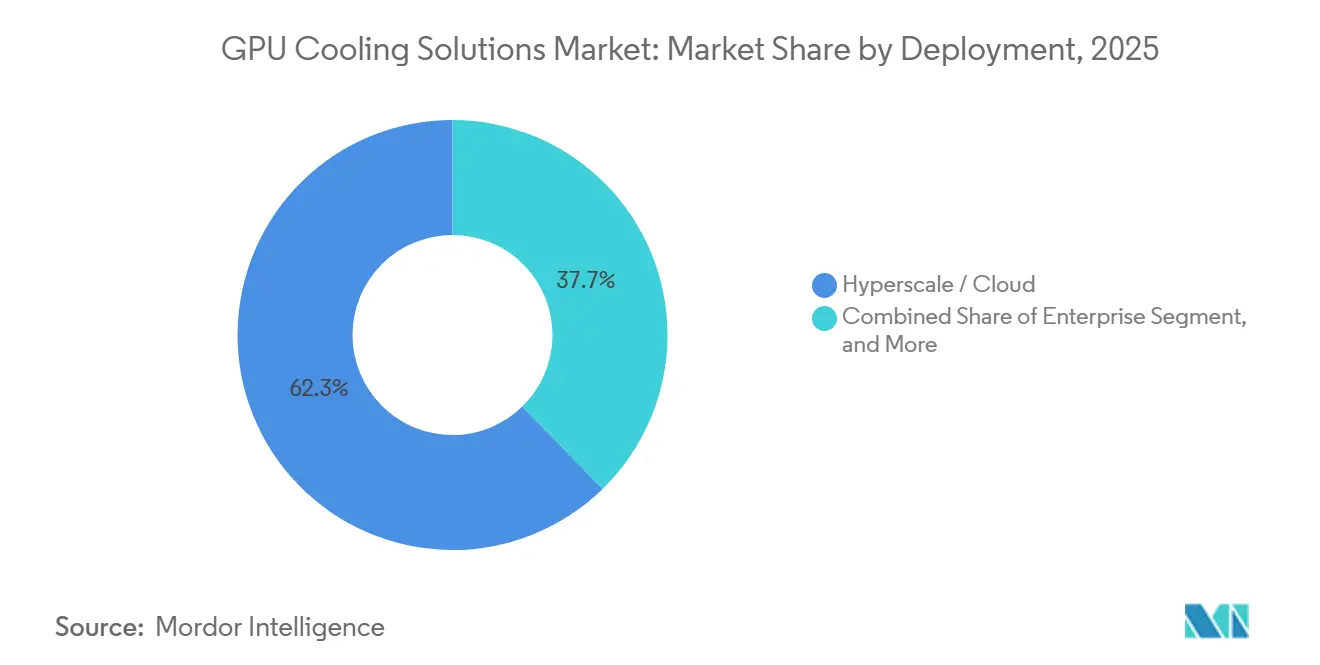
Enterprise Segment Accelerates as Hyperscale Maintains LeadHyperscale and cloud operators held 62.30% of the GPU cooling solutions market share in 2025, supported by their ability to use vertical integration, large-scale procurement, and custom coolant formulations to reduce per-watt cooling costs. These operators continue to benefit from tighter control over infrastructure design, rack configurations, and thermal management systems, thereby improving operating efficiency across high-density GPU environments. Looking ahead, enterprise deployments are projected to outpace the broader GPU cooling solutions market with a 26.30% CAGR through 2031, as mid-tier firms retrofit existing data center infrastructure to support AI workloads and higher compute densities.
Vendor lock-in remains a hurdle for wider enterprise adoption. Incompatible coolant distribution architectures from Dell, HPE, and Lenovo hinder mixed-rack configurations, forcing enterprises to either single-source equipment from a single vendor or duplicate plumbing to support multiple platforms. This limitation can increase deployment complexity, capital expenditure, and maintenance requirements. Edge deployments, though small in overall market share, represent a high-growth niche. Containerized pods that can be installed in 48 hours appeal to telecom operators because they support rapid rollouts, place compute capacity closer to users, improve geographic proximity, and enable latency-sensitive applications.
By GPU Power Density:
Ultra-High-Wattage Accelerators Drive Cooling InnovationThe 300 W-700 W bracket represented 51.70% of the graphics processing unit (GPU) cooling solutions market size in 2025, supported by large-scale Nvidia H100 and AMD MI300 installations across data center environments. This wattage range remained a major deployment category because it aligned with the thermal and performance requirements of current AI and high-performance computing workloads. However, accelerators above 700 W are following a 27.80% CAGR trajectory through 2031 as GPU power densities continue to rise. Direct-to-chip cooling is mandatory for these higher-wattage devices, as conventional air cooling cannot sustain 1,000 W thermal envelopes within ASHRAE guidelines.
Technologies such as diamond-enhanced cold plates demonstrate thermal-conductivity improvements that reduce junction temperatures by double digits, giving operators additional headroom to over-provision power without breaching silicon limits. These thermal gains support denser GPU configurations and help operators manage rising heat loads more effectively. The sub-300 W segment continues to shrink each year as package-level cooling integration reduces demand for external thermal-management solutions. This trend reinforces the market’s pivot toward high-density cooling solutions designed for next-generation GPU deployments.
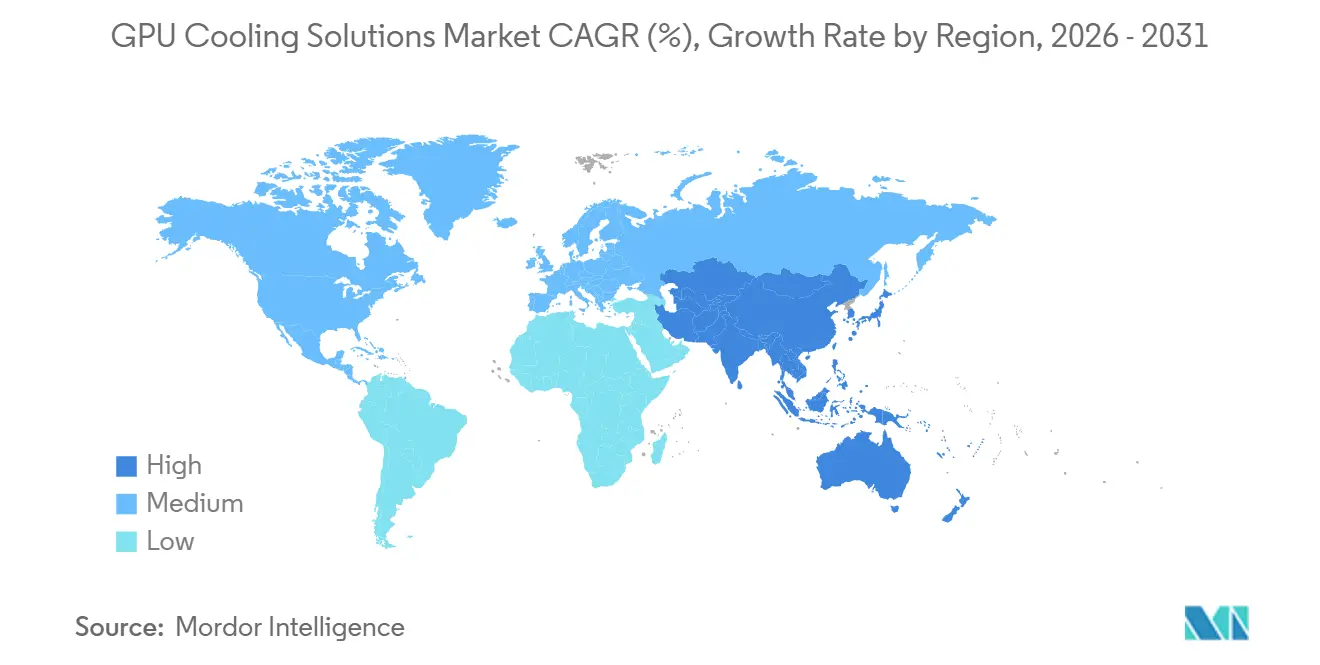
Geography Analysis
APAC GPU Cooling Solutions Market
Asia-Pacific retained 66.90% of global revenue in 2025, and its 28.20% CAGR through 2031 outstrips every other region, underscoring the region’s leading role in GPU cooling solutions demand. National AI mandates in Japan, South Korea, and Singapore continue to fund domestic GPU clusters that must satisfy strict energy-efficiency targets, effectively making liquid cooling a preferred best practice for large-scale AI infrastructure. Japan’s NTT pledged 1 GW of GPU capacity at Shinagawa using immersion cooling, while Singapore’s 58 MW Nxera deployment validated PUE 1.25 operation in a humid tropical climate, demonstrating that advanced cooling systems can support high-density compute environments under challenging weather conditions.
North America GPU Cooling Solutions Market
North America ranks second by revenue, supported by hyperscale projects such as Meta Hyperion and Microsoft’s Atlanta superfactory, which together are expected to add over 1.5 GW of GPU capacity before 2028. These projects continue to strengthen regional demand for high-performance cooling architectures capable of supporting dense AI and accelerated computing workloads. Government initiatives, including Canada’s Sovereign Compute Initiative, add another layer of demand, but 24-week lead times for cold plates and pumps remain a supply-side constraint and may defer revenue recognition into late 2027.
EMEA GPU Cooling Solutions Market
Europe trails Asia-Pacific and North America but continues to gain momentum under Delegated Regulation 2024/1364, which sets a PUE ceiling of 1.5 by 2030 and pushes operators toward more efficient thermal management. Exascale programs such as EuroHPC’s HammerHAI reinforce liquid cooling’s role in next-generation high-performance computing infrastructure, while district-heating incentives in Germany allow operators to monetize waste heat and improve return on investment. The Middle East and Africa remain nascent, though sovereign AI projects in the United Arab Emirates and Saudi Arabia are planning purpose-built facilities for 2027 and beyond, indicating potential upside as regional AI infrastructure investment scales.

Competitive Landscape
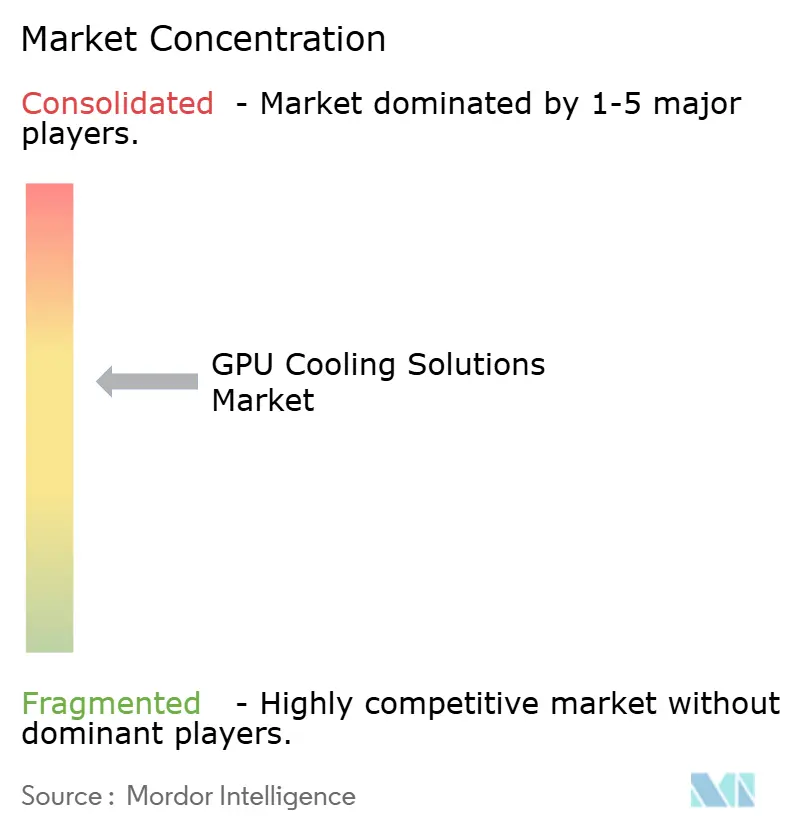
The Graphics Processing Unit (GPU) cooling solutions market is moderately concentrated, with air-cooling incumbents such as Noctua and Corsair maintaining dominance in consumer and small-enterprise niches. Meanwhile, liquid-cooling specialists like Asetek, CoolIT, and LiquidStack are capturing significant market share in the hyperscale segment. The industry witnessed intensified consolidation in 2026, with Trane Technologies acquiring LiquidStack and Ecolab purchasing CoolIT Systems for USD 4.75 billion. These acquisitions highlight a shift in the industry from one-off hardware sales to recurring service contracts, particularly for coolant monitoring and disposal, which offer gross margins exceeding 40%.
Market disruptors are leveraging AI-driven telemetry to gain a competitive edge. For instance, Siemens Building X, updated in 2025, can predict thermal loads up to 72 hours in advance, reducing energy consumption by up to 18%. However, inconsistencies within the Open Compute Project continue to hinder the adoption of multi-vendor racks, creating friction that established players exploit to maintain their market position. This competitive intensity is further underscored by intellectual-property filings, such as Frore Systems’ 14 patents in 2025 on generative cold-plate design and Nvidia’s Blackwell specification, which mandates liquid cooling, thereby shifting bargaining power toward GPU manufacturers that can designate preferred thermal partners.
Technological advancements and regulatory challenges are shaping the future of the GPU cooling solutions market. While liquid cooling is gaining traction due to its efficiency and ability to handle higher thermal loads, obstacles such as fluid-disposal regulations and the absence of unified dielectric standards remain significant. Ongoing research and development efforts aim to address these challenges, potentially reducing costs and regulatory hurdles. As the market evolves, hybrid designs that combine air cooling for CPUs and liquid cooling for GPUs are gaining popularity among enterprises transitioning workloads incrementally. These developments indicate a dynamic market landscape driven by innovation and strategic partnerships.
GPU Cooling Solutions Industry Leaders
CoolIT Systems Inc.
Asetek A/S
Nvidia Corporation
Noctua GmbH
Advanced Micro Devices, Inc.
- *Disclaimer: Major Players sorted in no particular order
GPU Cooling Solutions Market Companies Covered in this Report
- CoolIT Systems Inc.
- Asetek A/S
- Noctua GmbH
- EKWB d.o.o.
- Nvidia Corporation
- Advanced Micro Devices, Inc.
- Dell Technologies Inc.
- Hewlett Packard Enterprise Company
- Lenovo Group Limited
- Super Micro Computer, Inc.
- Corsair Gaming, Inc.
- Arctic GmbH
- ASUStek Computer Inc.
- Giga-Byte Technology Co., Ltd.
- Alphacool International GmbH
- Phanteks Company B.V.
- Thermaltake Technology Co., Ltd.
- Fujitsu Limited
- Inspur Systems Inc.
- LiquidStack Inc.
- Submer Technologies S.L.

Recent Industry Developments in GPU Cooling Solutions Market
- June 2026: Supermicro collaborated with Intel to validate liquid-cooled AI server platforms supporting Intel Gaudi accelerators and advanced GPU configurations, expanding the adoption of liquid cooling across AI infrastructure.
- June 2026: Asetek introduced new rack-scale liquid cooling technologies designed for enterprise AI servers utilizing next-generation NVIDIA and AMD GPUs, focusing on improved energy efficiency and reduced cooling power consumption.
- May 2026: Schneider Electric unveiled an expanded portfolio of prefabricated liquid-cooled AI data center solutions, integrating CDUs, leak detection, and thermal monitoring to support high-density GPU deployments.
- March 2026: Vertiv expanded its collaboration with NVIDIA by introducing AI-ready liquid cooling infrastructure validated for NVIDIA Blackwell Ultra deployments, including coolant distribution units (CDUs), rear-door heat exchangers, and integrated thermal management systems.


Global GPU Cooling Solutions Market Report Scope
The GPU Cooling Solutions Market comprises the design, manufacturing, integration, and deployment of thermal management technologies and systems used to dissipate heat generated by graphics processing units (GPUs) in high-performance computing environments. These solutions are essential for maintaining optimal GPU performance, energy efficiency, reliability, and operational lifespan across AI, machine learning, cloud computing, data centers, scientific computing, and edge infrastructure.
The GPU Cooling Solutions Market Report is Segmented by Cooling Technology (Air Cooling, Liquid Cooling, Immersion Cooling, and Hybrid Cooling), Cooling Level (Component-Level Cooling, and Server and Rack-Level Cooling), Deployment (Hyperscale and Cloud, Enterprise, Government and Research HPC, and Edge), GPU Power Density (Below 300W, 300W-700W, and Above 700W), and Geography (North America, Europe, Asia-Pacific, and Middle East and Africa). The Market Forecasts are Provided in Terms of Value (USD).
| Air Cooling |
| Liquid Cooling (Direct-to-Chip) |
| Immersion Cooling |
| Hybrid Cooling |
| Component-Level Cooling |
| Server and Rack-Level Cooling |
| Hyperscale and Cloud |
| Enterprise |
| Government and Research (HPC) |
| Edge |
| Below 300W |
| 300W - 700W |
| Above 700W |
| North America | United States |
| Canada | |
| Mexico | |
| Europe | Germany |
| United Kingdom | |
| France | |
| Italy | |
| Rest of Europe | |
| Asia-Pacific | China |
| Japan | |
| South Korea | |
| India | |
| Southeast Asia | |
| Rest of Asia-Pacific | |
| Middle East and Africa |
| By Cooling Technology | Air Cooling | |
| Liquid Cooling (Direct-to-Chip) | ||
| Immersion Cooling | ||
| Hybrid Cooling | ||
| By Cooling Level | Component-Level Cooling | |
| Server and Rack-Level Cooling | ||
| By Deployment | Hyperscale and Cloud | |
| Enterprise | ||
| Government and Research (HPC) | ||
| Edge | ||
| By GPU Power Density | Below 300W | |
| 300W - 700W | ||
| Above 700W | ||
| By Geography | North America | United States |
| Canada | ||
| Mexico | ||
| Europe | Germany | |
| United Kingdom | ||
| France | ||
| Italy | ||
| Rest of Europe | ||
| Asia-Pacific | China | |
| Japan | ||
| South Korea | ||
| India | ||
| Southeast Asia | ||
| Rest of Asia-Pacific | ||
| Middle East and Africa | ||


Key Questions Answered in the Report
What is the current GPU cooling solutions market size and how fast is it growing?
The GPU cooling solutions market size reached USD 11.86 billion in 2026 and is forecast to climb to USD 35.60 billion by 2031 at a 24.59% CAGR, according to Mordor Intelligence.
Which cooling technology is expanding the quickest?
Immersion cooling is the fastest-growing technology, projected to advance at 25.50% CAGR as operators pursue edge and high-density deployments.
Why are Asia-Pacific data centers adopting liquid cooling so aggressively?
Sovereign AI mandates in Japan, South Korea, and Singapore require sub-1.5 PUE, pushing operators toward liquid and immersion solutions that meet efficiency thresholds in hot-humid climates.
How do capital costs compare between liquid and air cooling?
Immersion systems range from USD 800-1,200 per kW, roughly double the USD 400-600 per kW cost of air-cooled builds, though five-year energy savings can offset the premium.
What are the main supply-chain risks for GPU cooling solutions providers?
Lead times of up to 24 weeks for custom cold plates and 28 weeks for pump components pose deployment delays, particularly in North America and Europe.
Which companies are shaping competitive dynamics?
Asetek, CoolIT, and LiquidStack lead liquid solutions, while recent acquisitions by Trane Technologies and Ecolab indicate conglomerates are positioning for end-to-end thermal-services revenue.
Page last updated on:





