
Ski Resorts Market Size and Share
Market Overview
| Study Period | 2022 - 2032 |
|---|---|
| Market Size (2027) | USD 38.46 Billion |
| Market Size (2032) | USD 47.63 Billion |
| Growth Rate (2027 - 2032) | 4.37 % |
| Fastest Growing Market | Asia-Pacific |
| Largest Market | Europe |
| Market Concentration | Medium |
Major Players *Disclaimer: Major Players sorted in no particular order Image © Mordor Intelligence. Reuse requires attribution under CC BY 4.0. | |
Ski Resorts Market Analysis by Mordor Intelligence
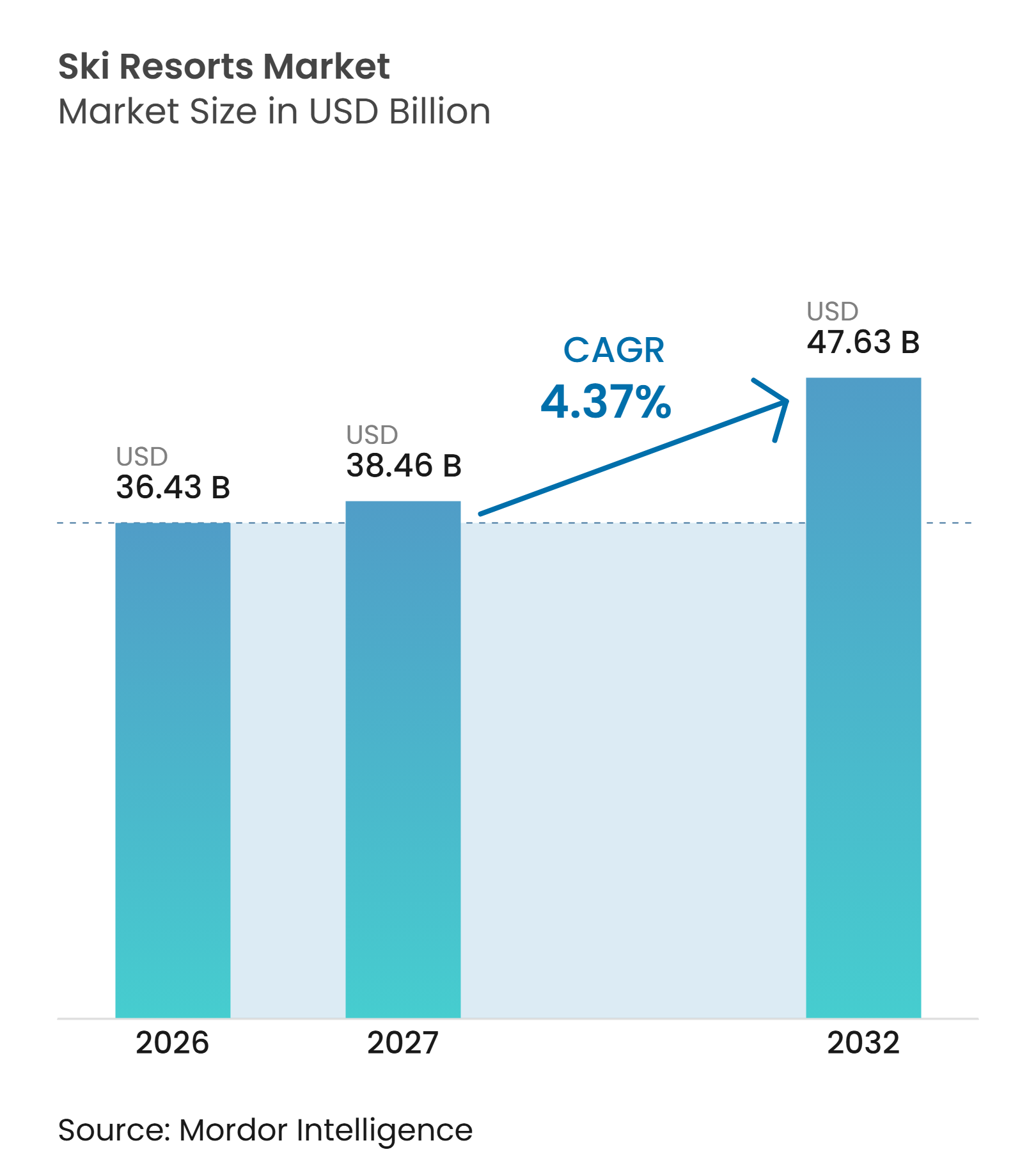
The global ski resorts market size was valued at USD 36.43 billion in 2026 and is estimated to grow from USD 38.46 billion in 2027 to reach USD 47.63 billion by 2032, at a CAGR of 4.37% during the forecast period (2027-2032). Mountain operators are reducing dependence on winter lift access by expanding lodging, dining, wellness, instruction, and summer activities around ski visits. Demand remains strongest at established destination resorts with reliable terrain and hospitality capacity, while indoor and hybrid formats expand access where natural slopes are unavailable. Season-pass programs shift revenue collection earlier, as guests commit before the season and visit more frequently. Climate exposure and higher snowmaking, energy, labor, insurance, and lift-renewal costs favor operators that can fund long-term infrastructure programs.
Key Report Takeaways
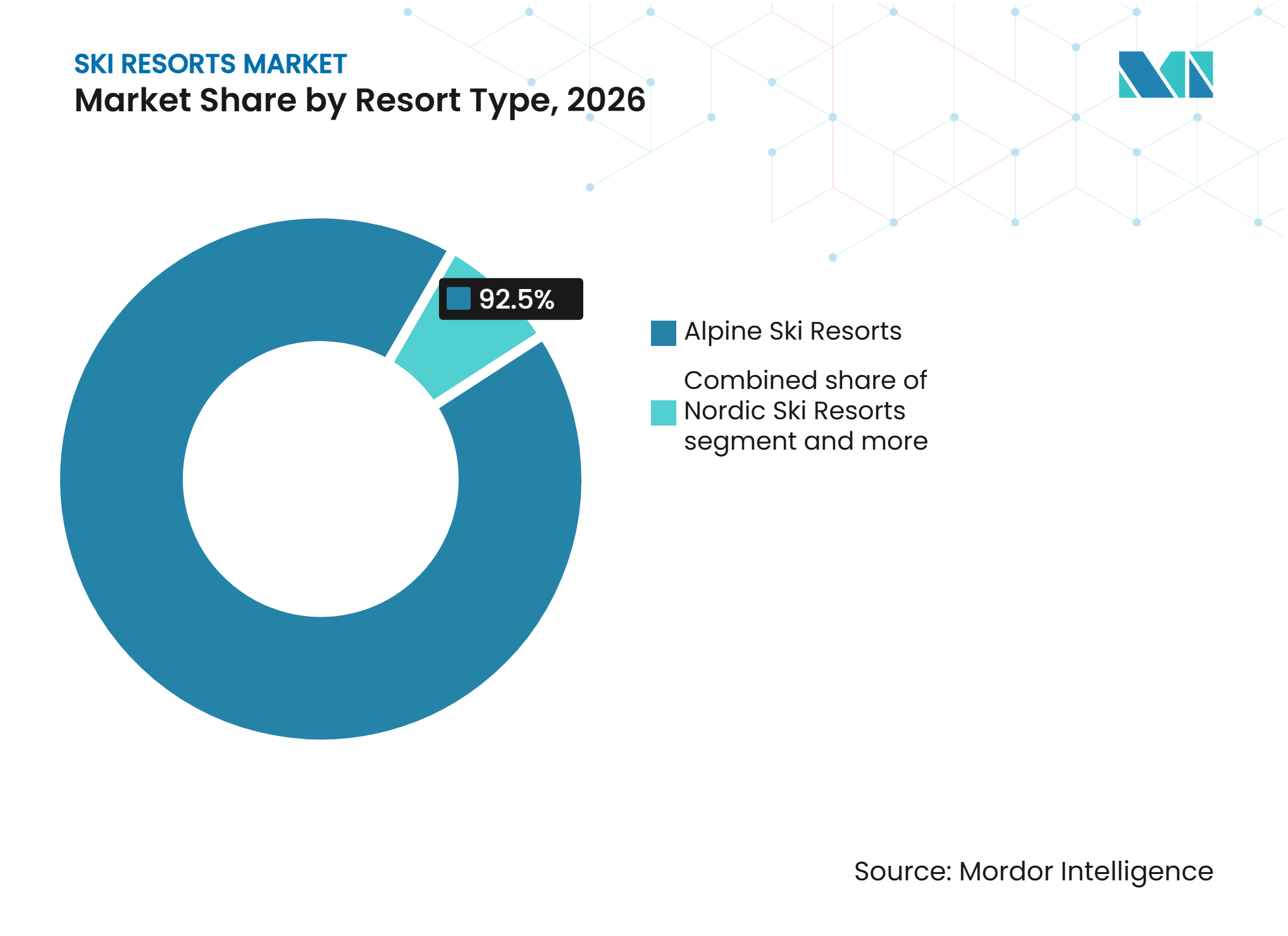
- By resort type, Alpine Ski Resorts accounted for 92.50% of the global ski resorts market share in 2026, while Others are projected to grow at a 6.40% CAGR through 2032.
- By service type, Lift Tickets and Passes accounted for 48.90% of the global ski resorts market size in 2026, while Ski Schools and Instruction are projected to grow at a 5.80% CAGR through 2032.
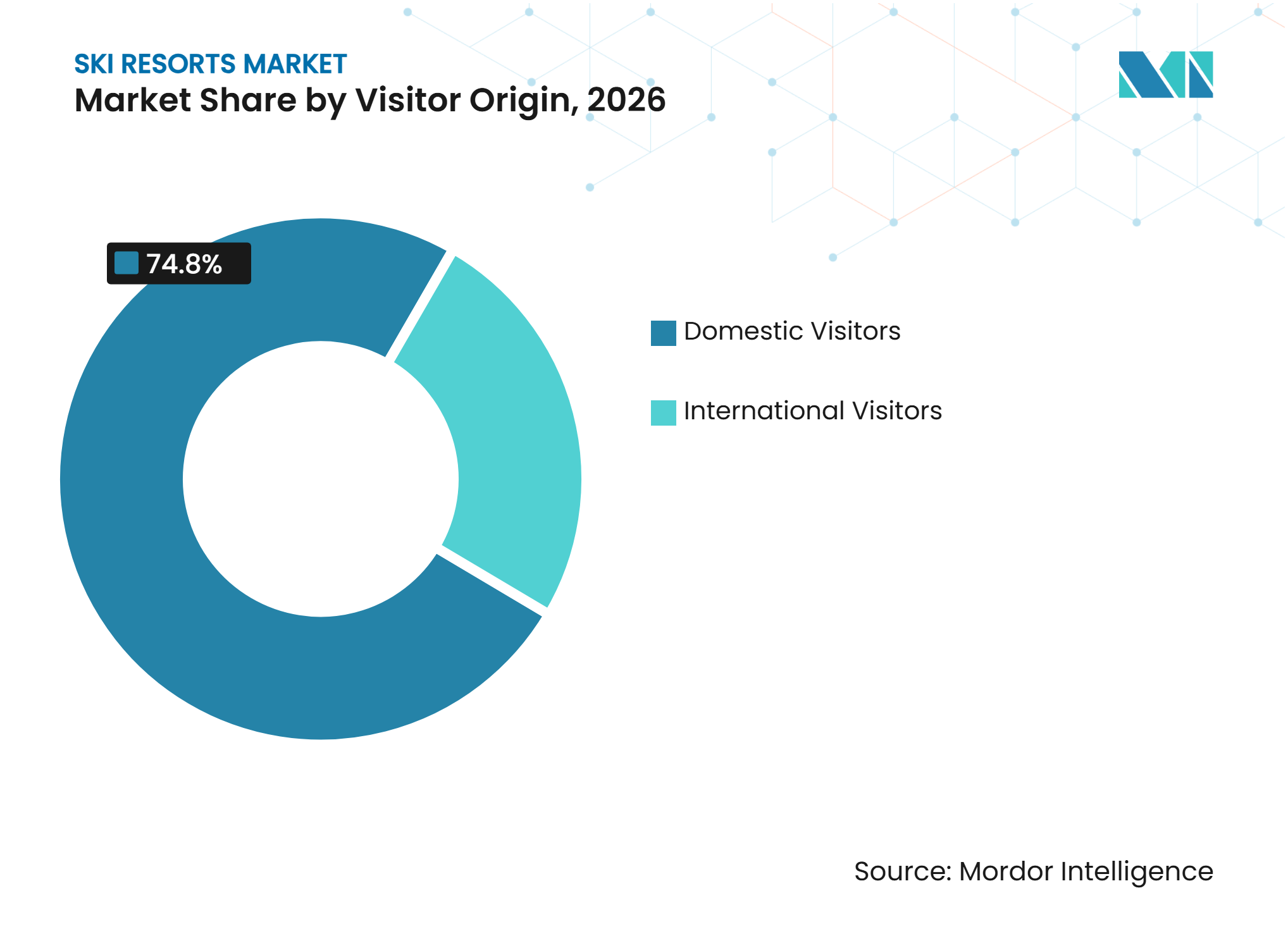
- By visitor origin, Domestic Visitors accounted for 74.80% of the global ski resorts market share in 2026 and are projected to grow at a 4.80% CAGR through 2032.
- By booking channel, Direct Booking accounted for 78.50% of the global ski resorts market revenue in 2026, while Travel Agents and Tour Operators are projected to grow at a 4.70% CAGR through 2032.
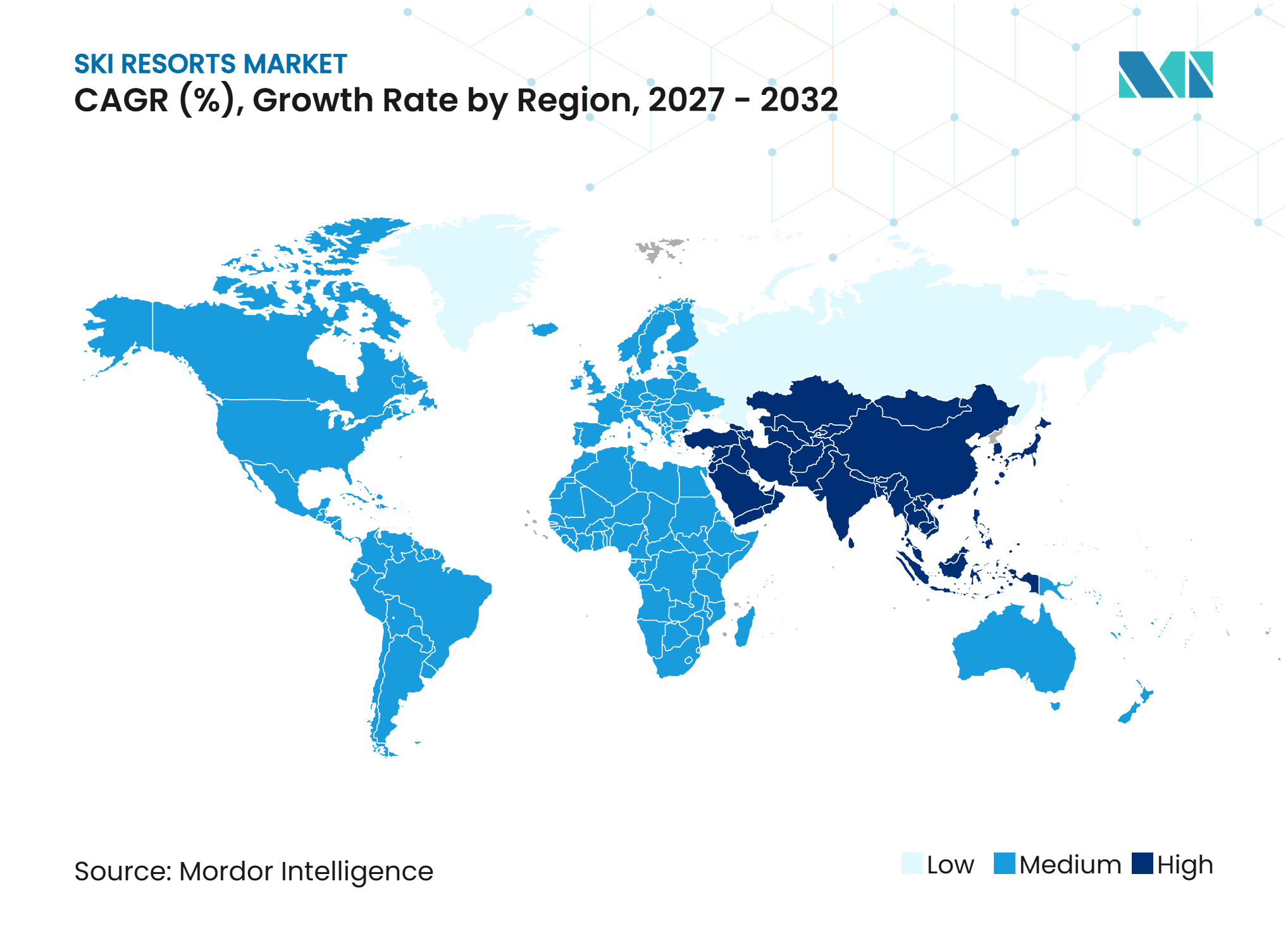
- By geography, Europe accounted for 52.70% of the global ski resorts market revenue in 2026, while Asia-Pacific is projected to grow at a 6.70% CAGR through 2032.
Note: Market numbers in this report are based on Mordor Intelligence's proprietary estimation framework, which combines nine months of actuals with Q4 projections for base year 2026.
Market Trends and Insights
Drivers Impact Analysis of Ski Resorts Market*
| Driver | (~) % Impact on CAGR Forecast | Geographic Relevance | Impact Timeline |
|---|---|---|---|
| Premium Ski and Mountain Experiences | +1.0% | Global, strongest in North America, Western Europe, and Japan | Long term (≥ 4 years) |
| Multi-Resort Pass Networks | +0.9% | North America, with spillover to Europe and Japan | Medium term (2-4 years) |
| Four-Season Resort Diversification | +0.7% | Global, strongest in Europe and North America | Medium term (2-4 years) |
| Digital Booking and Personalized Guest Experiences | +0.5% | Global, with early adoption in North America and Europe and growing adoption in Asia-Pacific | Short term (≤ 2 years) |
| Wellness and Family-Oriented Mountain Experiences | +0.5% | North America, Europe, and Japan, with emerging activity in the UAE and Saudi Arabia | Long term (≥ 4 years) |
| International Ski Tourism | +0.6% | Asia-Pacific, South America, and the European Alps | Medium term (2-4 years) |
| Source: Mordor Intelligence | |||
Premiumization of Ski and Mountain Experiences
Vail Resorts generated USD 2.96 billion in resort net revenue in fiscal 2025, demonstrating spending beyond basic lift access. Revenue from ski schools and dining grew faster than lift revenue, supporting investment in high-yield guest services. Six Senses Myoko opened in Japan with private onsen facilities, hydrotherapy services, and eight treatment rooms, highlighting the role of wellness-focused accommodations in mountain travel. Following the La Plagne award, Compagnie des Alpes reported a EUR 10.7 billion (USD 12.59 billion) ski-area concession backlog, indicating continued institutional commitment to established Alpine destinations[1]. These investments favor high-altitude resorts with established demand while increasing financial pressure on lower-elevation independent facilities.
Expansion of Multi-Resort Pass Networks
The Epic Pass and Ikon Pass are reshaping the global ski resorts market by linking multiple resorts through a single access product. For the 2025–26 season, the Epic Pass cost USD 1,051, while the Ikon Pass cost USD 1,329 and provided access to more than 62 destinations across five continents. Season-pass holders accounted for 49% of United States ski visits, helping operators secure revenue before snowfall patterns became clear. Partnerships with resorts in Europe and Japan also enabled pass holders to include international trips in their ski travel plans. This model increased customer loyalty and improved demand visibility but concentrated bargaining power among large destination networks.
Four-Season Resort Diversification
Four-season development is becoming a revenue-generating strategy rather than merely a response to variable snowfall. The National Ski Areas Association reported that 88% of United States ski areas offer summer attractions, with resorts operating these programs generating an average of 11.4% of their annual revenue from warm-weather activities. SkiStar reported summer-season net sales of SEK 292 million (USD 31.78 million) in the fourth quarter of fiscal 2025-26, representing a 29% year-over-year increase. Its mountain biking, hiking packages, and events in Åre, Sälen, and Trysil extend the use of assets previously focused on winter operations. Year-round operations can also support employee retention in resort communities facing housing constraints and a limited seasonal labor pool.
Digital Booking and Personalized Guest Experiences
Digital distribution is evolving from a service feature into a direct revenue tool in the global ski resorts market. Axess reports that its WEBSTORE enables guests to purchase lift passes, rentals, lockers, and ski lessons in a single transaction across more than 300 resorts in over 20 countries. Aspenware’s 2025 e-commerce update introduced Apple Pay, Google Pay, and bundling capabilities, allowing guests to combine lift, rental, and lesson products before arrival. These platforms streamline bookings and help operators retain customer data previously controlled by intermediaries. SkiStar recorded 13% growth in digital platform visits during Q2 FY2025-26, while international guests accounted for around 40% of overnight stays and more than 50% of revenue in FY2024-25, highlighting the importance of digital engagement and international demand.
Restraints Impact Analysis of Ski Resorts Market*
| Restraint | (~) % Impact on CAGR Forecast | Geographic Relevance | Impact Timeline |
|---|---|---|---|
| Climate-Driven Snow Unreliability | -1.2% | Global, most acute in low-altitude Central European resorts, the Western United States, and Andean South America | Long term (≥ 4 years) |
| Rising Snowmaking, Energy, Labor, and Insurance Costs | -0.8% | North America and Europe, with emerging relevance in China and Japan | Medium term (2-4 years) |
| Seasonal Workforce and Resort-Town Housing Constraints | -0.5% | North America and Western Europe | Medium term (2-4 years) |
| High Capital Requirements for Resort Infrastructure | -0.6% | Global, with the highest barrier in Asia, South America, and the Middle East and Africa | Long term (≥ 4 years) |
| Source: Mordor Intelligence | |||
Climate-Driven Snow Unreliability
Average snowfall in the United States reached 112 inches in the 2025-26 season, compared with the 10-year average of 169 inches[2]. United States ski areas recorded 53.1 million skier visits in 2025-26, approximately 8.5 million fewer than the 61.6 million visits recorded in 2024-25. The decline highlights the industry’s exposure to weather variability, particularly the exceptionally low snowfall across Western regions. This risk is particularly significant for resorts serving price-sensitive domestic customers, who have limited capacity to absorb higher operating costs. Snow reliability is influencing investment decisions, destination positioning, and the long-term viability of independent facilities.
Rising Snowmaking, Energy, Labor, and Insurance Costs
Snowmaking increases capital and operating costs for ski operators. Austrian research found that snowmaking consumed 260-309 GWh of electricity and 48.9-53.4 million m³ of water per season. During the 2025-26 season, United States ski areas invested USD 569.3 million, or USD 22.24 per skier visit, in 45 new lifts and 52 lift upgrades. Rising energy, skilled labor, insurance, and environmental reporting costs burden independent resorts more than multi-resort groups. The European Union’s Corporate Sustainability Reporting Directive also adds planning and reporting requirements for operators with European activities.
*Our forecasts treat driver/restraint impacts as directional, not additive. The impact forecasts reflect baseline growth, mix effects, and variable interactions.
Consumer Behavior Analysis
Consumer behavior in the global ski resort market is primarily driven by snow reliability, resort accessibility, and value for money. According to the Iglu Ski Survey 2025, 87% of respondents considered snow reliability a key factor in resort selection, followed by value for money (63%) and the availability of a high number of ski runs (60%). Additionally, 82% relied on online research to discover ski destinations, while 64% considered previous travel experience, highlighting the importance of digital information and familiarity in consumer decision-making.
Ski holidays are predominantly planned as group and package-based experiences, with 67% of Iglu Ski Survey 2025 respondents preferring package holidays, while 35% typically traveled with family and another 35% with small groups of friends. Equipment ownership also influences purchasing behavior, as 52% preferred not to own skis or snowboards due to transportation inconvenience, indicating continued reliance on rental services. Furthermore, Visa's 2026 analysis found that approximately one in four ski travelers displayed premium spending behavior, spending around 56% more per trip than other ski travelers.
Ski Resort Performance Intelligence
Accommodation demand varies with snow conditions, holidays, and booking lead times, but skier visits do not indicate room occupancy. NSAA reported 53.1 million United States skier visits and 112 inches of snowfall in 2025-26, highlighting weather exposure. Tirol recorded 26.4 million overnight stays in winter 2024-25, up 1.4%, while arrivals rose 2.7% to 6.1 million, reducing the average stay to 4.3 days. By October 2025, SkiStar had reported that 85% of mediated Christmas and New Year accommodation was booked, 3% above the prior year. These trends supported early booking and short-stay packages, but occupancy required accommodation-specific data.
Switzerland’s winter 2024-25 cable-car revenue rose 8.9% to CHF 902 million (USD 1,141.81 million), while skier days increased 13.7% to 26.3 million. Revenue per skier day declined due to dynamic pricing and season-pass use. Vail Resorts’ FY2025 resort net revenue rose 2.9% to USD 2.96 billion despite a 3% decline in skier visits, supported by 4% growth in season-pass revenue and higher ancillary spending per guest. SkiStar reported a 17% operating margin, while Compagnie des Alpes reported a 36.9% EBITDA margin in Ski Areas and Outdoor Activities. Hotel-specific room-rate data were needed to assess lodging Average Daily Rate (ADR).
Ski Resorts Market Segment Analysis
By Resort Type:
Alpine Resorts Retain Their Scale While Indoor Formats ExpandAlpine ski resorts accounted for 92.50% of the global ski resorts market in 2026, supported by established lift systems, integrated hotels, and destination infrastructure. During the 2024-25 season, the United States recorded 61.5 million skier visits, France recorded 54.8 million skier days, and Austria recorded 51.8 million visits. These mature Alpine markets support investment in lifts, lodging, and visitor services. Nordic resorts serve domestic, endurance-oriented customers across Scandinavia, Finland, and parts of North America. Scandinavian destinations use multi-day Nordic and cross-country packages to link lodging revenue with mountain visits.
Other resort types are forecast to grow at a 6.40% CAGR through 2032. China hosts 7 of the world’s 10 largest indoor ski areas. In 2024-25, indoor facilities accounted for 21.61% of national ski attendance, or 5.63 million visits. Majid Al Futtaim operates indoor snow destinations in Dubai and Abu Dhabi (UAE), Egypt, and Oman. Fédération Internationale de Ski (FIS) has supported certified indoor facilities in Guangzhou, Shenzhen, and Shanghai.



By Service Type:
Pass Products Lead Revenue While Instruction Grows FastestLift tickets and passes accounted for 48.90% of the global ski resorts market size in 2026. Epic and Ikon pass prices for the 2025-26 season were USD 1,051 and USD 1,329, respectively, reflecting demand for multi-resort access. The pass model strengthens relationships with repeat visitors and secures revenue before the season begins. Accommodation and lodging drive demand for transportation, dining, rentals, and other guest services. Switzerland generated CHF 902 million (USD 1,141.81 million) in cableway passenger transport revenue during the 2024-25 winter season, up 9% year over year, while Tirol recorded 26.4 million winter overnight stays, an increase of 1.5%[3].
The ski schools and instruction segment is forecast to grow at a CAGR of 5.80% through 2032. First-time visitors from Japan, China, and South Korea, along with family groups, require instruction, equipment support, and introductory programs. Operators are investing in food and beverage, wellness, retail, and other resort services. Compagnie des Alpes reported a 36.9% ski-area EBITDA margin in FY2024-25, up 1.9 percentage points year over year, supported by electricity costs falling by more than 30%. Environmental frameworks such as ISO 14001 can guide procurement and operating practices, although company-specific adoption requires verification.
By Visitor Origin:
Domestic Guests Provide the Largest and Fastest-Growing Revenue BaseDomestic visitors represent 74.80% of global revenue in 2026 and are forecast to grow at a 4.80% CAGR through 2032. This is the only segment in which the same visitor cohort is both the largest and fastest growing. Season-pass holders purchase access in advance, visit more frequently, and support repeat spending on dining, lessons, and other services. The Rocky Mountain region accounted for 42.9% of United States skier visits in 2024-25, with 26.4 million visits across six states. This substantial domestic market provides a strong visitation base, although resort performance remains sensitive to snowfall, season-pass demand, and broader travel spending.
International guests represent 25.20% of global revenue in 2026 and generate high per-trip spending at destination resorts. International visitors accounted for 35% of skier days in France and 66% in Austria[4]. In Chile, Brazilian visitors represented 37% of international ski resort visitors, while Argentine visitors accounted for 25%. During the 2025 snow season, nearly 40% of foreign visitors in Chile spent more than USD 600 per day. Demand from this group is more exposed to currency movements and relative destination prices.

By Booking Channel:
Direct Sales Dominate, While Packaged Travel ExpandsDirect Booking accounted for 78.50% of global booking channel revenue in 2026. Resorts primarily sell season passes through owned digital channels, supporting the high share of direct revenue. Direct sales reduce commission costs and enable resorts to bundle lift access, rentals, instruction, and food services. Axess WEBSTORE enables guests to purchase passes and other services in a single transaction across a global resort base. Aspenware’s 2025 product update emphasized mobile payments and bundled purchases.
Travel Agents and Tour Operators are forecast to grow at a CAGR of 4.70% through 2032. International ski trips often combine flights, transfers, lodging, equipment rentals, lessons, and multiple resort visits, increasing the value of packaged travel. Online travel agencies remain important for accommodation discovery in major Asia-Pacific destinations. Growing international demand in Japan highlights the need for both direct distribution and intermediary reach. Other channels include corporate groups and event-linked reservations that benefit from major snow sports competitions.
Geography Analysis
Europe accounted for 52.70% of the global ski resorts market in 2026, supported by Alpine terrain, established lodging, and international visitors. France recorded 54.8 million skier days in 2024-25, with international visitors accounting for 35%. Austria’s cable-car sector recorded EUR 1.96 billion (USD 2.31 billion) in cash turnover during winter 2024-25, while Tirol generated EUR 3.6 billion (USD 4.23 billion) in tourism value from 26.4 million winter overnight stays. Switzerland recorded 26.3 million first-time ski-area entries and CHF 902 million (USD 1,141.81 million) in passenger transport revenue during the same winter season. The European Union Corporate Sustainability Reporting Directive introduced sustainability-reporting obligations for companies within its scope, although applicability depends on company size and the rules in force. Compagnie des Alpes reported a 73% reduction in Scope 1 and 2 greenhouse gas emissions against its 2018-19 reference year relative to its announced decarbonization trajectory; the actual-basis reduction was 66%.
Asia-Pacific is forecast to grow at a 6.70% CAGR through 2032. China recorded 26.05 million skier days across 748 active resorts in 2024-25. Destination resorts represented 4% of resorts but generated 28.6% of visits, while indoor facilities accounted for 21.61% of attendance. Japan attracted international ski travelers and hospitality investment, including Six Senses Myoko. Fédération Internationale de Ski (FIS) agreements with Hong Kong and Shanghai Pudong associations extended snow sports infrastructure into urban Chinese markets.
North America remains important to the global ski resorts market. United States visits declined from 61.5 million in 2024-25 to 53.1 million in 2025-26 due to weather volatility. Alterra committed over USD 400 million for 2025-26 and over USD 350 million for 2026-27. Chile’s Valle Nevado attracted 305,000 visitors in 2025, while La Parva exceeded 145,000. Majid Al Futtaim’s entertainment operations generated AED 891 million (USD 242.55 million) in the first half of 2025.
Ski Resort Supply & Development Intelligence
Supply expansion increasingly prioritizes lift modernization, snowmaking efficiency, safety systems, and year-round activities over new terrain. In September 2026, Alterra Mountain Company announced more than USD 350 million for 2026-27, including snowmaking upgrades at Solitude and Winter Park and remote avalanche-control systems at Palisades Tahoe and Mammoth Mountain. Winter Park’s upgrades are expected to double snowmaking capacity on Lower Hughes, supporting earlier openings. Compagnie des Alpes is modernizing artificial-snow systems, improving energy efficiency, and deploying electric snow groomers at Serre-Chevalier, Val d’Isère, and La Plagne. These investments address weather risks and energy costs but may increase financing pressure on smaller operators.
Capacity depends on uphill transport, snowmaking coverage, lift reliability, and terrain access. Vail Resorts invested over USD 500 million in lifts and more than USD 100 million in snowmaking since 2015. Its 2026 capital plan allocated USD 215-220 million for lift and snowmaking upgrades, including at Okemo. Compagnie des Alpes’ La Plagne gondola nearly halves travel time, while its Tignes upgrade increases throughput. Tatry Mountain Resorts added a 2,400-passenger-per-hour chairlift at Štrbské Pleso.
Competitive Landscape
Market Concentration

The global ski resorts market is moderately fragmented. Large operators exert significant influence in North America, while established concession holders shape competition in Europe. During the 2023-24 season, Vail Resorts and Alterra Mountain Company collectively controlled more than 52% of US lift capacity. Vail Resorts reported USD 2.96 billion in resort net revenue and USD 844.1 million in resort EBITDA for fiscal 2025. Alterra committed more than USD 400 million for the 2025-26 season. A consumer class-action lawsuit against Vail Resorts and Alterra, filed in 2026, reflects regulatory scrutiny over market consolidation and lift-ticket prices.
In Europe, competition centers on concessions, destination systems, and long-term infrastructure programs. Compagnie des Alpes reported a EUR 10.7 billion (USD 2.91 billion) ski-area concession backlog following the award of the 25-year La Plagne public service delegation, which represents approximately EUR 5 billion (USD 1.36 billion) in cumulative turnover. SkiStar recorded SEK 4,631 million (USD 503.97 million) in net sales and a 17% operating margin in FY2024-25. In November 2025, Tatry Mountain Resorts acquired a 50% stake in Národné lyžiarske centrum and commissioned a new eight-seat chairlift at Štrbské Pleso in December, with a reported investment value of EUR 11.5 million (USD 13.53 million).
Asia-Pacific and the Middle East support new operating formats and strategic partnerships. Majid Al Futtaim operates indoor snow destinations in Dubai and Abu Dhabi (UAE), Egypt, and Oman. In July 2025, Mountain Capital Partners announced its intention to acquire a controlling stake in Andacor in Chile. Despite regional concentration, the market remains globally fragmented.
Ski Resorts Industry Leaders
-
Vail Resorts, Inc.
-
Alterra Mountain Company
-
Compagnie des Alpes
-
SkiStar AB
-
Boyne Resorts
- *Disclaimer: Major Players sorted in no particular order
Ski Resorts Market Companies Covered in this Report
- Vail Resorts, Inc.
- Alterra Mountain Company
- Boyne Resorts
- POWDR Corporation
- Aspen Skiing Company
- Mountain Capital Partners
- Pacific Group Resorts, Inc.
- Resorts of the Canadian Rockies Inc.
- Compagnie des Alpes
- SkiStar AB
- Tatry Mountain Resorts, a.s.
- Seibu Prince Hotels and Resorts
- Nippon Cable Co., Ltd.
- Jungfraubahn Holding AG
- Zermatt Bergbahnen AG
- Mont Saint-Sauveur International Inc.
- Kamori Kanko Co., Ltd.
- ULEN AD
- KitzSki Bergbahnen AG
- Majid Al Futtaim
Recent Industry Developments in Ski Resorts Market
- October 2026: Sun Peaks Resort expanded its snow-storage program to three times its initial size and added two snowcats through a CAD 1.35 million (USD 0.99 million) investment. The upgrades aim to improve snow reliability, resource efficiency, and operating-season resilience.
- September 2026: Alterra Mountain Company committed over USD 350 million for 2026-27, targeting terrain expansion, snowmaking, lift capacity, and guest facilities to strengthen resort competitiveness and operational resilience.
- December 2025: Tatry Mountain Resorts commissioned a EUR 11 million (USD 12.93 million) Pininfarina-designed eight-seat chairlift at Štrbské Pleso, carrying 2,400 passengers hourly and improving skier throughput while reducing queues. Tatry Mountain Resorts (TMR) later reported the investment at EUR 11.5 million (USD 13.53 million).
- November 2025: Tatry Mountain Resorts acquired a 50% stake in Národné lyžiarske centrum for EUR 2,500 (USD 2,940.78), expanding its involvement in Slovakia’s snow-sports infrastructure and development ecosystem.
Global Ski Resorts Market Report Scope
The global ski resorts market report analyzes ski resort facilities and services worldwide. The market is segmented by resort type, service type, visitor origin, booking channel, and geography. The study examines key drivers, including premiumization of ski and mountain experiences, expansion of multi-resort pass networks, four-season resort diversification, digital booking and personalized guest experiences, growing demand for wellness and family-oriented mountain experiences, and international ski tourism. It also assesses restraints such as climate-driven snow unreliability, rising snowmaking, energy, labor, and insurance costs, seasonal workforce and resort-town housing constraints, and high capital requirements for resort infrastructure. The report evaluates resort development, skiable terrain capacity, occupancy rates, average daily rates, traveler preferences, booking behavior, and spending patterns. It provides market size and growth forecasts, competitive landscape analysis, market share assessment, strategic developments, and profiles of leading resort operators. It also explores opportunities in climate-resilient and energy-efficient resort infrastructure and the expansion of four-season mountain destination platforms. Market estimates and forecasts are presented in value (USD) across all covered segments.
Segmentation Overview
Key Questions Answered in the Report
What is the projected value of the global ski resorts market by 2032?
The global ski resorts market is projected to reach USD 47.63 billion by 2032, growing at a 4.37% CAGR from 2027.
Which resort format holds the largest share?
Alpine Ski Resorts held 92.50% of revenue in 2026 because of their established terrain, lift systems, hospitality, and international destination appeal.
Which service category is growing fastest?
Ski Schools and Instruction are forecast to grow at a 5.80% CAGR through 2032, supported by family demand and first-time participants.
Why do direct channels account for most bookings?
Direct Booking held 78.50% of revenue in 2026 because season-pass pre-sales are primarily transacted through resort-owned channels.
Which region is expected to grow fastest?
Asia-Pacific is forecast to grow at a 6.70% CAGR through 2032, supported by China’s expanding ski participation and Japan’s international tourism.
What are the main risks for ski-resort operators?
Climate-driven snow variability and rising costs for snowmaking, energy, labor, insurance, and infrastructure are the main risks.