
Residential Artificial Flower Retail Market Size and Share
Market Overview
| Study Period | 2021 - 2031 |
|---|---|
| Market Size (2026) | USD 3.08 Billion |
| Market Size (2031) | USD 4.13 Billion |
| Growth Rate (2026 - 2031) | 6.04 % |
| Fastest Growing Market | Asia-Pacific |
| Largest Market | Asia-Pacific |
| Market Concentration | Low |
Major Players *Disclaimer: Major Players sorted in no particular order Image © Mordor Intelligence. Reuse requires attribution under CC BY 4.0. | |
Residential Artificial Flower Retail Market Analysis by Mordor Intelligence
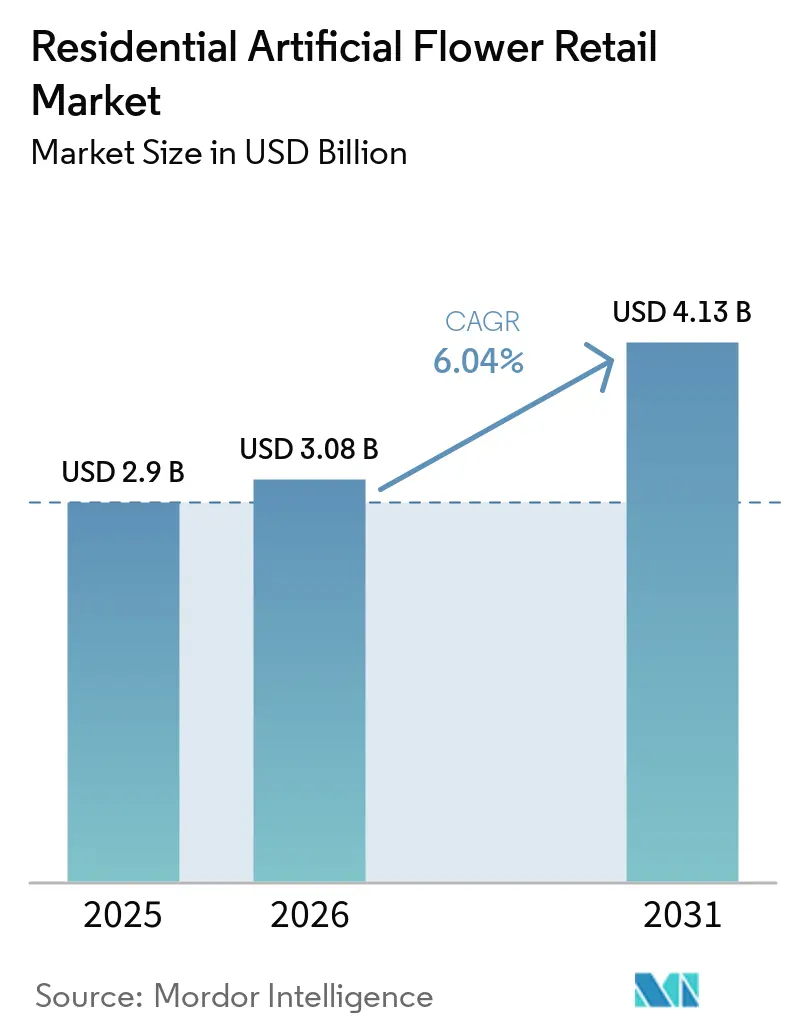
The global residential artificial flower retail market was valued at USD 2.90 billion in 2025 and estimated to grow from USD 3.08 billion in 2026 to reach USD 4.13 billion by 2031, at a CAGR of 6.04% during the forecast period (2026-2031). This growth reflects a shift in consumer preferences toward durable home décor over short-lived fresh flowers. Reusable floral décor appeals to budget-conscious households by spreading costs across multiple seasons rather than on a single occasion. Despite selective discretionary spending, demand remains steady, highlighting the value of artificial flowers in home décor. Social commerce, urbanization, and interest in reusable decorative products are expanding the market’s reach. The fragmented competitive landscape enables specialist brands to scale rapidly through digital channels without relying on extensive physical store networks.
Key Report Takeaways
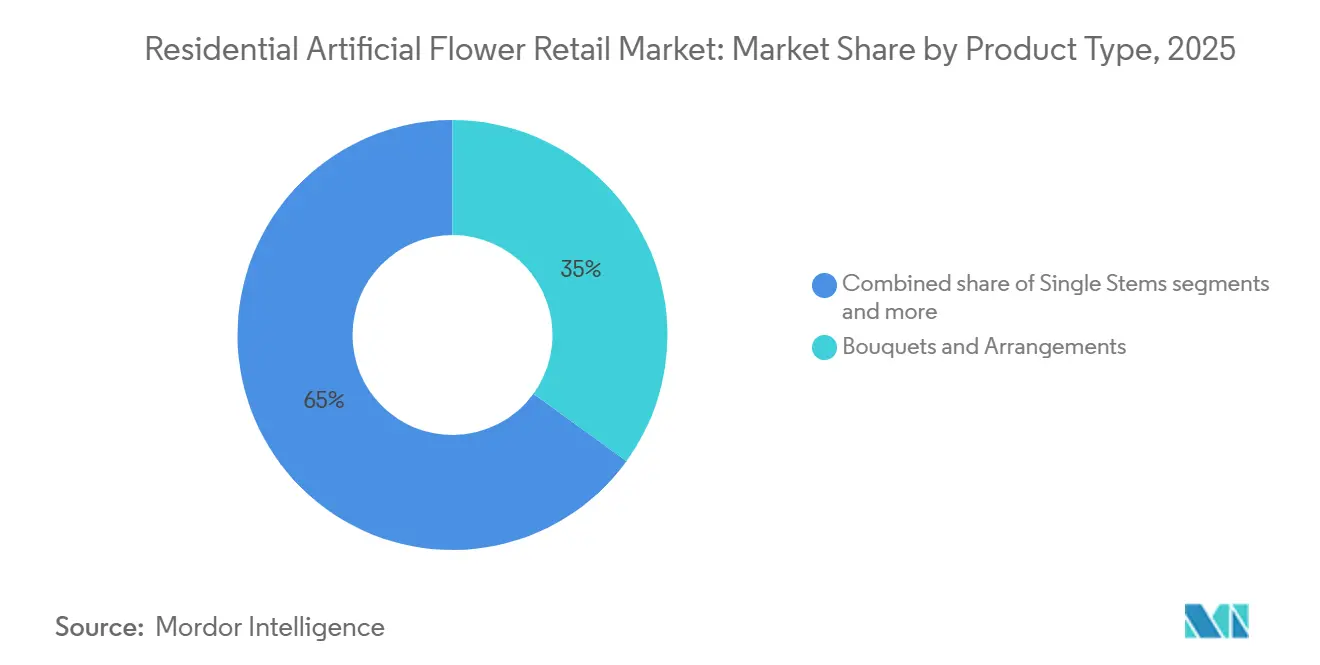
- By product type, Bouquets and Arrangements held 35% of the Global Residential Artificial Flower Retail Market in 2025, while Wall and Hanging Floral Decor is projected to expand at an 8.50% CAGR by 2031.
- By material, Fabric Blends accounted for 36% of the Global Residential Artificial Flower Retail Market in 2025, while Foam and Mixed Materials are forecast to grow at an 8.80% CAGR by 2031.
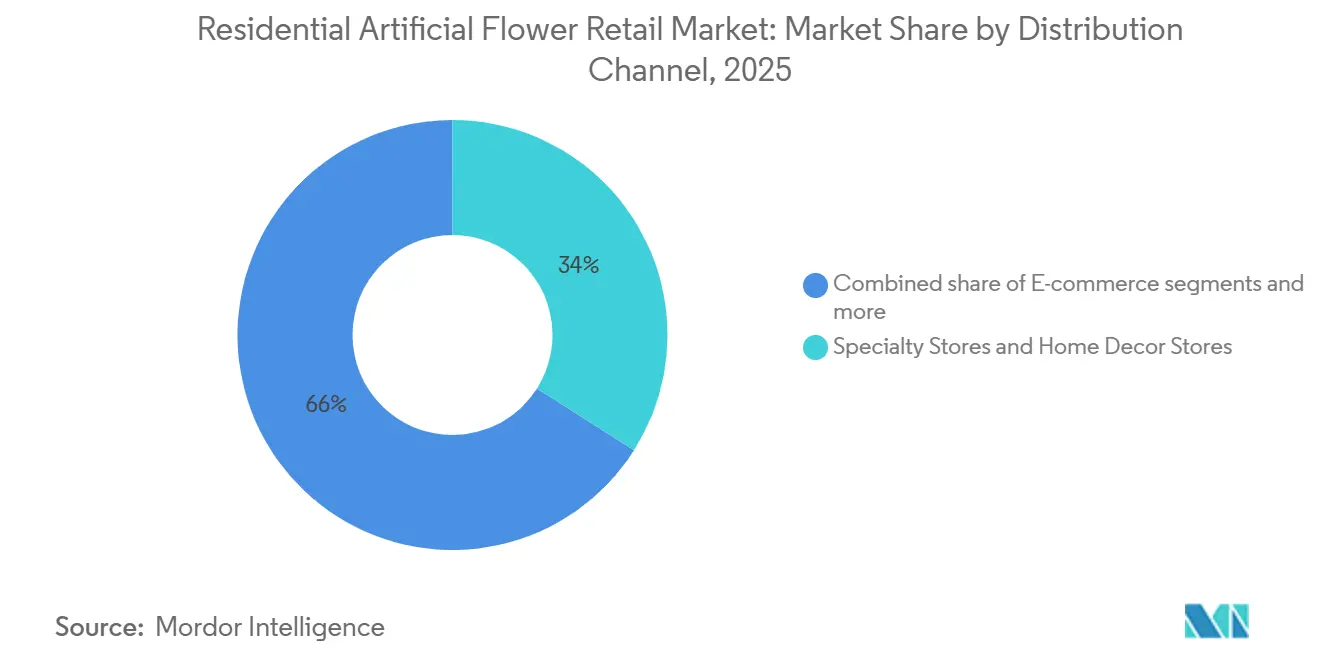
- By distribution channel, Specialty Stores and Home Décor Stores held 34% of the Global Residential Artificial Flower Retail Market in 2025, while Direct-to-Consumer Brands are projected to advance at an 11.00% CAGR by 2031.
- By geography, Asia-Pacific represented 30% of the Global Residential Artificial Flower Retail Market in 2025 and is expected to record the fastest regional CAGR of 8.00% by 2031.
Note: Market size and forecast figures in this report are generated using Mordor Intelligence’s proprietary estimation framework, updated with the latest available data and insights as of January 2026.
Global Residential Artificial Flower Retail Market Trends and Insights
Drivers Impact Analysis*
| Driver | (~) % Impact on CAGR Forecast | Geographic Relevance | Impact Timeline |
|---|---|---|---|
| Shift Toward Low-Maintenance and Long-Lasting Home Décor Solutions | +1.4% | Global, with concentration in North America, Western Europe, and urban Asia-Pacific | Short term (≤ 2 years) |
| Rising Premiumization of Interior Styling and Aesthetic Gifting | +1.1% | North America, the United Kingdom, Germany, South Korea, and Australia | Medium term (2-4 years) |
| Growth of Seasonal, Event-Based, and DIY Personalization Trends | +0.9% | North America, Western Europe, South-East Asia | Short term (≤ 2 years) |
| Expansion of E-Commerce and Social Commerce Platforms | +1.0% | Global, intensity highest in Asia-Pacific and North America | Short term (≤ 2 years) |
| Increasing Adoption of Sustainable and Reusable Decorative Products | +0.6% | European Union, North America, Japan, Australia | Medium term (2-4 years) |
| Rising Urbanization and Compact Living Spaces Driving Artificial Décor Demand | +0.8% | Asia, Africa, South America, the Middle East | Long term (≥ 4 years) |
| Source: Mordor Intelligence | |||
Shift Toward Low-Maintenance and Long-Lasting Home Décor Solutions
The global residential artificial flower retail market is growing due to a lasting consumer preference for low-maintenance décor items. Households are increasingly selecting furnishings and decorations that remain functional during moves and room redesigns, a trend reinforced by smaller living spaces. A decline in the average home size in the United States underscores the rising demand for compact, practical decorative solutions. Consumers now prioritize durability as a key factor in purchasing decisions, shifting away from viewing it as a secondary feature. This has led to a clear distinction between low-cost disposable products and higher-quality options designed for extended use and outdoor suitability. Companies focusing on product lifespan, material safety, and quality assurance are effectively meeting this demand, driving increased residential sales[1].
Rising Premiumization of Interior Styling and Aesthetic Gifting
The global residential artificial flower retail market is growing as consumers increasingly incorporate artificial botanicals into coordinated interior designs rather than using them as simple décor. Arrangements with aesthetic appeal and low maintenance are becoming popular for gifting. Williams-Sonoma introduced Pottery Barn’s first United Kingdom digital storefront in September 2025, featuring artificial botanicals alongside furniture and home décor. This development highlights the growing demand for design-focused retail outside North America[2]. Such presentations help establish higher price points for realistic floral décor and promote faux floral arrangements as occasion gifts. Formats combining flowers with ceramic pots, woven containers, or styled vessels are particularly appealing. This trend is narrowing the gap between artificial decorative products and fresh floral gifting.
Growth of Seasonal, Event-Based, and DIY Personalization Trends
Seasonal styling and DIY content are driving repeat purchases in the global residential artificial flower retail market. Consumers are moving away from buying single arrangements for occasional use, as many households now rotate decorative themes throughout the year, including spring, autumn, holidays, and celebrations. Nearly Natural recently introduced its Spring 2026 collection, featuring UV-resistant hydrangea bushes, hibiscus topiaries, and seasonal accents designed for durability and aesthetic appeal in both indoor and outdoor spaces. These launches encourage households to update their decor seasonally rather than relying on permanent arrangements. Single stems are also gaining traction, as DIY buyers create custom displays that align with changing interior themes. This trend is expanding the revenue base by fostering recurring style updates alongside new customer acquisitions.
Expansion of E-Commerce and Social Commerce Platforms
The global residential artificial flower retail market is increasingly shifting toward digital platforms, where product discovery and purchase occur almost simultaneously compared to traditional store-led journeys. Artificial botanicals excel in visual commerce, allowing consumers to evaluate shape, color, room fit, and styling ideas through short videos and curated images. This capability enables direct-to-consumer (DTC) brands to offer niche designs without requiring extensive physical shelf space. As a result, DTC is expected to grow steadily in this market. Social-first selling proves particularly effective for wall décor, centerpieces, and styled room sets, as brief demonstrations address key concerns about realism and placement. This approach allows smaller brands to expand nationally through creator partnerships, avoiding the high costs associated with physical store rollouts. At the same time, this trend is increasing competition for specialty retailers, whose volume advantages do not always translate into comparable profit margins as those achieved by online-focused brands.
Restraints Impact Analysis*
| Restraint | (~) % Impact on CAGR Forecast | Geographic Relevance | Impact Timeline |
|---|---|---|---|
| Perceived Lack of Natural Aesthetic Compared to Fresh Flowers | -0.9% | Western Europe, North America, Japan | Medium term (2-4 years) |
| Price Sensitivity in Mass-Market Home Décor Segments | -0.7% | South America, Africa, South and South-East Asia | Medium term (2-4 years) |
| Quality Variation and Durability Concerns in Low-Cost Imports | -0.6% | Global, concentrated in price-sensitive e-commerce channels | Short term (≤ 2 years) |
| Storage, Dust Accumulation, and Maintenance Challenges | -0.4% | North America, Western Europe, Urban Asia-Pacific | Long term (≥ 4 years) |
| Source: Mordor Intelligence | |||
Perceived Lack of Natural Aesthetic Compared to Fresh Flowers
The appeal of fresh flowers continues to challenge the global residential artificial flower retail market, particularly in regions where live botanicals hold cultural significance in gifting and home decor. Even high-quality artificial flowers face skepticism as consumers often prioritizes fragrance, natural variations, and tactile authenticity. This challenge is more pronounced in segments where buyers seek products with an organic feel, such as preserved or dried flowers. Manufacturers have made advancements using real-touch latex, improved polyester surfaces, and detailed petal designs to narrow the visual gap. However, the mass market still struggles to replicate the sensory experience of fresh flowers, making it difficult to convert consumers who value authenticity over convenience. Brands that integrate realistic materials with tailored designs are better positioned to address this challenge, though the restraint is expected to persist throughout the forecast period.
Price Sensitivity in Mass-Market Home Décor Segments
Price sensitivity significantly impacts the global residential artificial flower retail market, especially in value-conscious and lower-income segments. In many regions, fresh flowers are often more affordable than artificial ones, particularly when buyers focus on immediate decorative appeal rather than long-term usability. This creates challenges for branded products attempting to differentiate from low-cost imports without entering higher price ranges. The issue extends beyond initial purchases, as low-quality products that fade or deform quickly can undermine consumer trust and reduce the likelihood of future upgrades. Brands relying solely on low pricing may achieve higher unit sales but often fail to build sustained demand. A more effective approach is to maintain affordable pricing while ensuring minimum standards for realism, durability, and material safety.
*Our forecasts treat driver/restraint impacts as directional, not additive. The impact forecasts reflect baseline growth, mix effects, and variable interactions.
Segment Analysis
By Product Type: Arrangements Lead While Vertical Formats Accelerate in Compact Homes
Bouquets and Arrangements accounted for 35% of the Global residential artificial flower retail market in 2025, making them the largest product category for residential purchases. Their popularity stems from their ready-to-display convenience, which allows them to be placed on dining tables, shelves, or as gifts without assembly. This convenience supports both personal and occasion-driven spending. Their broad aesthetic compatibility ensures they suit modern, traditional, and seasonal decor with minimal effort. Single Stems appealed to DIY buyers, Garlands and Wreaths saw seasonal demand, and Potted Artificial Flowers remained popular for apartment-friendly decor.
Wall and Hanging Floral Decor is expected to grow at an 8.50% CAGR through 2031, making it the fastest-growing segment in the Global residential artificial flower retail market. Shrinking home sizes are driving a shift in decorative focus from floor spaces to walls, balconies, and suspended features. The median United States home size decreased to 2,150 sq ft in 2024, highlighting the need for space-efficient decor. Nearly Natural’s Spring 2026 collection introduced UV-resistant hanging hydrangea and hibiscus formats for indoor and outdoor use, reflecting this trend. As urban households prioritize visual impact while conserving floor space, vertical floral decor is set to remain a preferred choice in the market[3].

By Material: Fabric Blends Hold the Lead While Foam and Mixed Inputs Gain Speed
Fabric Blends accounted for 36% of revenue in the global residential artificial flower retail market in 2025, leading across material categories. Silk and polyester blends balance realism, texture, and cost, meeting broad residential demand. Silk-heavy variants command higher prices due to their better translucency and layered visual depth compared to lower-cost alternatives. Plastic remains relevant for seasonal and outdoor use, prioritizing cost efficiency, while Latex supports real-touch products for higher-end buyers. The material mix highlights the market's preference for realism and affordability over reliance on a single substrate.
Foam and Mixed Materials are projected to grow at 8.80% through 2031, making them the fastest-growing segment in the market. Hybrid polyurethane and mixed structures improve petal drape, softness, and weight, narrowing the gap with live botanicals. Yiwu, a key artificial floral production hub, recorded USD 4.19 billion in artificial flower exports in 2025, reflecting material advancements in the supply chain. IKEA’s requirement for at least 50% recycled plastic content in the SMYCKA range, effective from October 2024, indicates stricter procurement standards[4]. Compliance with EU REACH and RoHS regulations adds pressure on low-cost producers. The faster-growing segment is expected to favor manufacturers with stronger chemical management, traceability, and compliance capabilities.
By Distribution Channel: Specialty Stores Still Lead While DTC Brands Reshape Growth
Specialty Stores and Home Décor Stores accounted for 34% of revenue in the global residential artificial flower retail market in 2025, maintaining their position as the top channel. Their significance stems from tactile evaluation, visual merchandising, and the placement of artificial botanicals alongside décor items such as vases, furniture, and table accessories. Physical curation remains important for consumers assessing realism before making higher-priced purchases. Supermarkets and Hypermarkets addressed price-sensitive and seasonal buying needs, while E-commerce platforms expanded access to niche assortments that physical stores cannot stock on scale. The market continues to rely on physical stores for trust, even as online sales grow.
Direct-to-Consumer (DTC) Brands are projected to grow at 11.00% through 2031, making them the fastest-growing channel in the global residential artificial flower retail market. DTC brands integrate inspiration, product discovery, and checkout into a single digital experience. They collect first-party data to re-engage households during seasonal updates, gifting occasions, and style-specific needs. This model improves margins by focusing on curated assortments rather than broad, low-cost options. Creator-led discovery also enables regional specialists to gain national visibility without significant store investments. While specialty stores currently hold the largest share of revenue, the channel mix in the market is shifting.
Geography Analysis
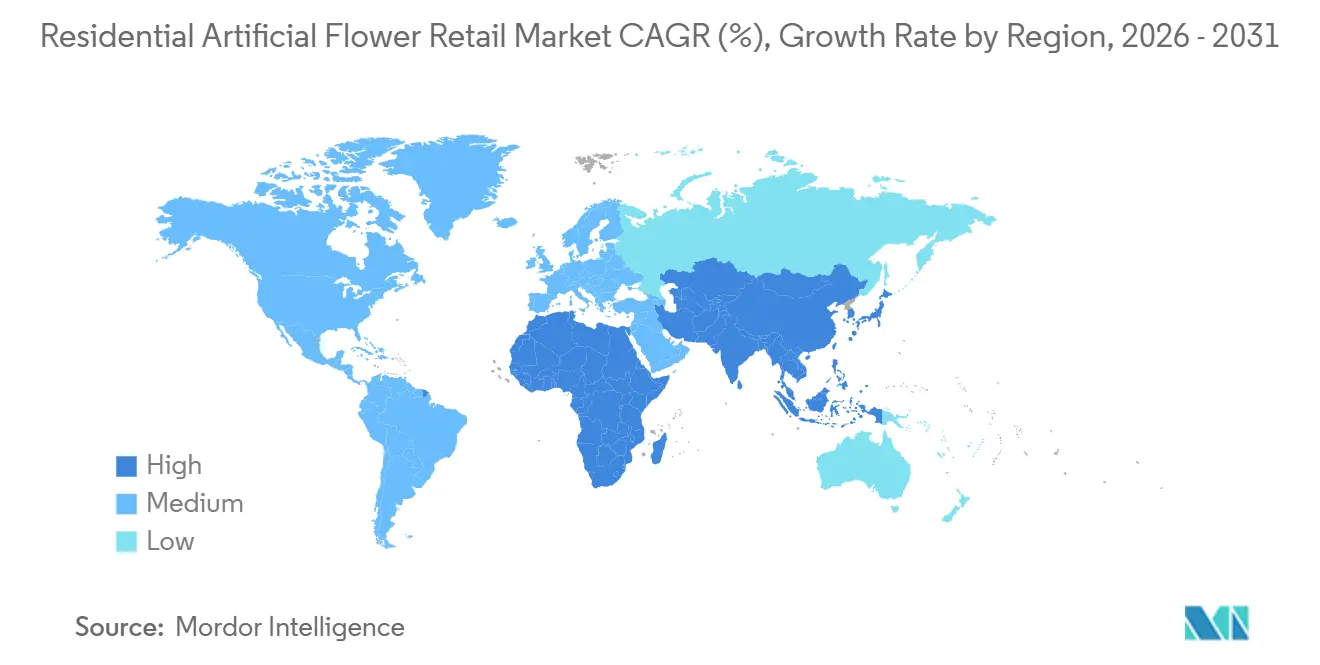
Asia-Pacific accounted for 30% of the global residential artificial flower retail market share in 2025 and is expected to grow at a regional CAGR of 8.00% through 2031. The region benefits from large-scale manufacturing and rising residential demand in China, India, and Southeast Asia. China plays a key role in supply and category development, with China's national artificial vegetation exports reaching USD 4.19 billion, anchored heavily by manufacturing hubs like Yiwu. India’s urban household growth and the rise of compact homes drive demand for low-maintenance decorative products. The United Nations projects India’s urban population to grow from 483 million in 2020 to 675 million by 2035, supporting long-term demand.
Southeast Asia contributes through increased middle-class spending and the adoption of personalized interior décor by urban households. Vietnam, Indonesia, and Thailand see rising demand for decorative accessories. Oceania, though smaller, is projected to grow at 5.60% through 2031, supported by design-focused demand in Australia. North America is expected to grow at 5.80% through 2031, with the United States dominating due to strong retail infrastructure and seasonal decorating trends. The reduction in median United States home size to 2,150 sq ft in 2024 supports demand for compact floral formats.
Europe is projected to grow at 5.20% through 2031, driven by demand for high-quality materials and designer assortments in the United Kingdom, Germany, and France. Russia’s growth remains slower at 4.10% CAGR due to challenging import conditions. South America is expected to grow at 6.40% through 2031, led by urban middle-class spending in Brazil. The Middle East and Africa show growth rates of 6.70% and 7.10%, respectively, driven by urbanization, climate-related constraints on plant growth, and fragmented retail structures. The market offers opportunities for companies with localized strategies and efficient digital distribution.
Competitive Landscape
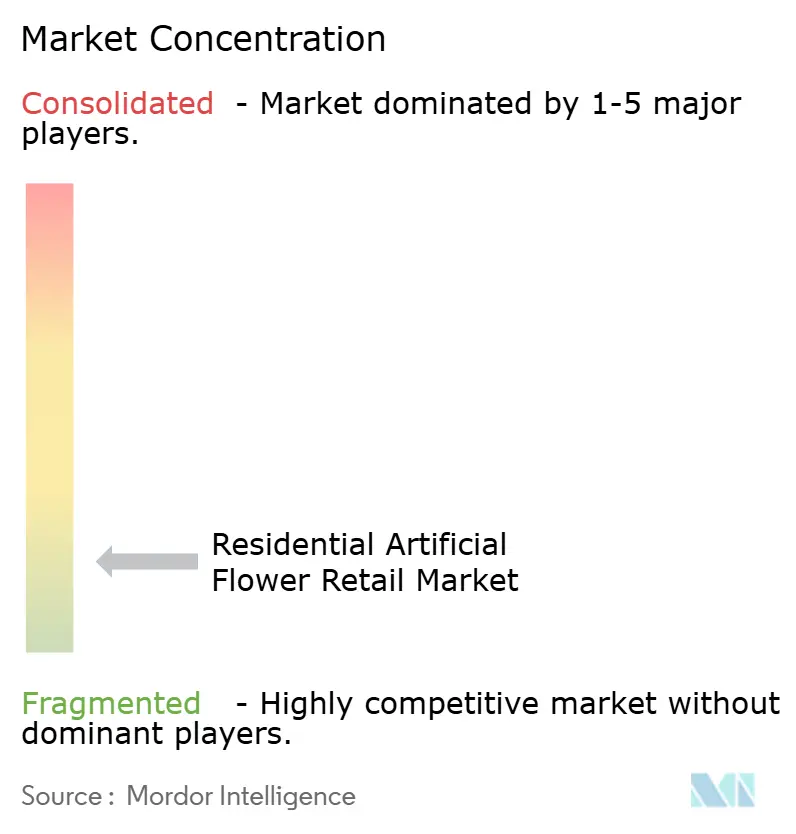
The global residential artificial flower retail market remains fragmented, with no single company controlling pricing, aesthetics, or trends across regions. Companies such as FLORALSILK, Nearly Natural, Afloral, Sullivans Home Decor, and Vickerman Company compete through product variety, realism, and styling. Mass retailers, including Target, Walmart, and IKEA, focus on price-sensitive segments. This structure allows specialists to maintain margins through design and quality, while larger retailers emphasize accessibility and affordability. Brand strength is important, but scale alone does not ensure influence across regions, styles, and price ranges.
Channel strategies differentiate players in the market. Nearly Natural emphasizes seasonal launches and direct selling, as seen in its UV-resistant décor products for indoor and outdoor use. Williams-Sonoma expanded its digital reach by launching Pottery Barn’s United Kingdom site, and by passing physical store rollouts. IKEA influences the mass market through procurement and compliance standards, including recycled material requirements for its artificial flowers. These approaches highlight the importance of channel design, sourcing, and aligning products with consumer expectations.
Competition is shifting toward reducing friction in trust and styling. Hyper-realistic materials, curated room-based selling, and improved repeat-purchase mechanisms are gaining importance over product variety. Direct-to-consumer specialists benefit from integrating content, curation, and checkout, while physical retailers offer tactile experiences. Rising compliance expectations, such as traceability and safer materials, are pressuring undercapitalized suppliers. The market remains fragmented but dynamic, offering opportunities for smaller players to combine strong design with reliable supply chains and effective digital strategies.
Residential Artificial Flower Retail Industry Leaders
-
FLORALSILK
-
Nearly Natural
-
Afloral
-
Sullivans Home Decor
-
Vickerman Company
- *Disclaimer: Major Players sorted in no particular order
Recent Industry Developments
- March 2026: Nearly Natural introduced its Spring 2026 décor collection, featuring UV-resistant hanging hydrangeas, hibiscus topiaries, and seasonal garland sets. Designed for indoor and outdoor balconies, the collection targets the compact-living vertical décor segment.
- September 2025: Williams-Sonoma, Inc. launched Pottery Barn's first United Kingdom digital storefront (potterybarn.co.uk), offering artificial botanicals, furniture, and home décor. This marks its first direct-channel entry into the European market, targeting residential consumers in the United Kingdom.
- May 2025: BloomNation expanded its United States florist technology platform into Europe by acquiring Floom. The integration combines Floom's United Kingdom marketplace with BloomNation's tools, including custom websites, point-of-sale systems, and marketing tools, enhancing digital infrastructure for florists offering artificial and fresh-cut flowers.
- October 2024: IKEA Systems B.V. mandated at least 50% recycled plastic content in its global SMYCKA artificial flowers and plants range, establishing an industry compliance standard and aligning with circular product design principles.
Global Residential Artificial Flower Retail Market Report Scope
| Single Stems |
| Bouquets and Arrangements |
| Garlands and Wreaths |
| Potted Artificial Flowers |
| Wall and Hanging Floral Decor |
| Silk |
| Plastic |
| Latex |
| Fabric Blends |
| Foam and Mixed Materials |
| Specialty Stores and Home Decor Stores |
| Supermarkets and Hypermarkets |
| E-commerce |
| Direct-to-Consumer Brands |
| North America | United States |
| Canada | |
| Mexico | |
| South America | Brazil |
| Peru | |
| Chile | |
| Argentina | |
| Rest of South America | |
| Europe | United Kingdom |
| Germany | |
| France | |
| Spain | |
| Italy | |
| BENELUX (Belgium, Netherlands, and Luxembourg) | |
| NORDICS (Denmark, Finland, Iceland, Norway, and Sweden) | |
| Rest of Europe | |
| Asia-Pacific | India |
| China | |
| Japan | |
| Australia | |
| South Korea | |
| South East Asia (Singapore, Malaysia, Thailand, Indonesia, Vietnam, and Philippines) | |
| Rest of Asia-Pacific | |
| Middle East and Africa | United Arab Emirates |
| Saudi Arabia | |
| South Africa | |
| Nigeria | |
| Rest of Middle East and Africa |
| By Product Type | Single Stems | |
| Bouquets and Arrangements | ||
| Garlands and Wreaths | ||
| Potted Artificial Flowers | ||
| Wall and Hanging Floral Decor | ||
| By Material | Silk | |
| Plastic | ||
| Latex | ||
| Fabric Blends | ||
| Foam and Mixed Materials | ||
| By Distribution Channel | Specialty Stores and Home Decor Stores | |
| Supermarkets and Hypermarkets | ||
| E-commerce | ||
| Direct-to-Consumer Brands | ||
| By Geography | North America | United States |
| Canada | ||
| Mexico | ||
| South America | Brazil | |
| Peru | ||
| Chile | ||
| Argentina | ||
| Rest of South America | ||
| Europe | United Kingdom | |
| Germany | ||
| France | ||
| Spain | ||
| Italy | ||
| BENELUX (Belgium, Netherlands, and Luxembourg) | ||
| NORDICS (Denmark, Finland, Iceland, Norway, and Sweden) | ||
| Rest of Europe | ||
| Asia-Pacific | India | |
| China | ||
| Japan | ||
| Australia | ||
| South Korea | ||
| South East Asia (Singapore, Malaysia, Thailand, Indonesia, Vietnam, and Philippines) | ||
| Rest of Asia-Pacific | ||
| Middle East and Africa | United Arab Emirates | |
| Saudi Arabia | ||
| South Africa | ||
| Nigeria | ||
| Rest of Middle East and Africa | ||
Key Questions Answered in the Report
What is the 2031 outlook for residential artificial flower retail worldwide?
The Global residential artificial flower retail market is projected to reach USD 4.13 billion by 2031 from USD 3.08 billion in 2026, at a 6.04% CAGR over 2026-2031.
Which product category leads revenue today?
Bouquets and Arrangements led the market in 2025 with a 35% revenue share because they are easy to place, gift, and use across multiple home settings.
Which product type is growing the fastest through 2031?
Wall and Hanging Floral Decor is the fastest-growing product segment, with an 8.50% CAGR through 2031, supported by compact homes and vertical styling preferences.
Why are direct-to-consumer brands gaining traction so quickly?
DTC brands are forecast to grow at 11.00% through 2031 because they combine digital discovery, creator-led inspiration, targeted curation, and direct checkout in one buying path.
Which region is strongest in this category?
Asia-Pacific held 30% share in 2025 and is also the fastest-growing region at an 8.00% CAGR through 2031, supported by manufacturing depth and rising residential demand.
What is the main challenge for premium brand conversion?
A key challenge is the persistent comparison with fresh flowers, especially where consumers still value fragrance, natural variation, and tactile authenticity more than convenience.