
Professional Beauty Services Market Size and Share
Market Overview
| Study Period | 2022 - 2031 |
|---|---|
| Market Size (2026) | USD 178.93 Billion |
| Market Size (2031) | USD 230.56 Billion |
| Growth Rate (2026 - 2031) | 5.20 % |
| Fastest Growing Market | Asia-Pacific |
| Largest Market | Asia-Pacific |
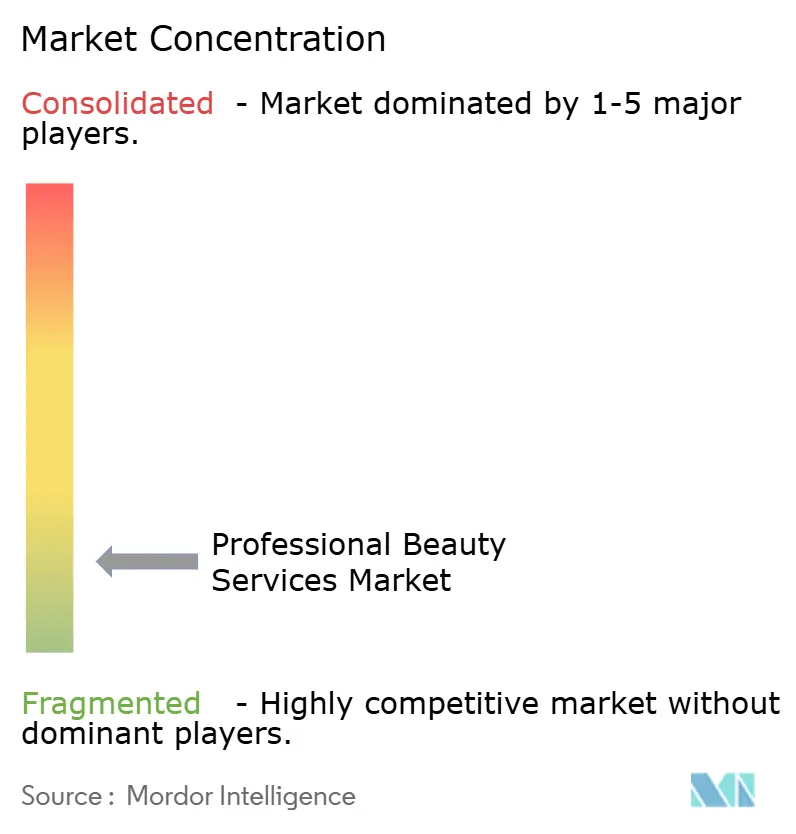
| Market Concentration | Low |
Major Players *Disclaimer: Major Players sorted in no particular order Image © Mordor Intelligence. Reuse requires attribution under CC BY 4.0. | |
Professional Beauty Services Market Analysis by Mordor Intelligence
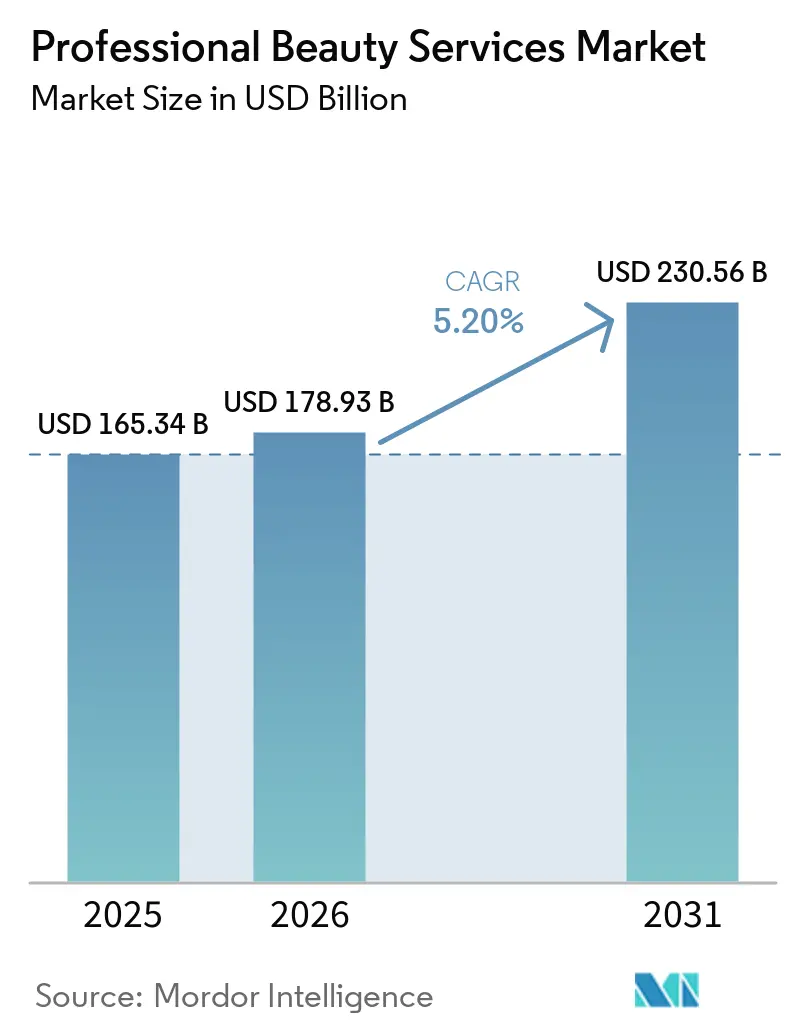
The Professional Beauty Services Market size is expected to grow from USD 165.34 billion in 2025 to USD 178.93 billion in 2026 and is forecast to reach USD 230.56 billion by 2031 at 5.20% CAGR over 2026-2031.
The professional beauty services market is expanding on the back of steady consumer spending on grooming, wider acceptance of routine salon visits across income groups, and stronger preference for expert-led services over home-based care in emerging economies. Demand is also shifting toward more frequent use of specialized treatments, helping service providers raise average ticket values without relying solely on footfall growth. The professional beauty services market is also being reshaped by digital discovery, online booking, and faster service adoption cycles, which are changing how salons attract and retain clients. Competitive activity remains fragmented, but organized chains, franchise systems, and platform-led operators are using standardization, technology, and broader service menus to build stronger positions in the professional beauty services market. India remains important to this longer-term growth pattern because rising urban incomes, broader beauty awareness, and the spread of organized salon formats are strengthening Asia-Pacific demand.[1]
Key Report Takeaways
- By service type, hair care services held 34.42% of revenue in 2025, while skin care and facial services are forecast to grow at a 6.34% CAGR through 2031.
- By end user, women accounted for 68.73% of revenue in 2025, while the men’s segment is projected to expand at a 6.86% CAGR through 2031.
- By booking channel, offline booking accounted for 71.82% of revenue in 2025, while online booking platforms are forecast to grow at a 7.46% CAGR through 2031.
- By business structure, independent salons accounted for 62.71% of revenue in 2025, while franchise and enterprise chains are projected to grow at a 6.23% CAGR through 2031.
- By geography, Asia-Pacific accounted for 36.46% of global revenue in 2025 and is also expected to record the fastest regional CAGR at 6.12% through 2031.
Note: Market size and forecast figures in this report are generated using Mordor Intelligence’s proprietary estimation framework, updated with the latest available data and insights as of January 2026.
Market Trends and Insights
Drivers Impact Analysis of Professional Beauty Services Market*
| Drivers | (~) % Impact on CAGR Forecast | Geographic Relevance | Impact Timeline |
|---|---|---|---|
| Rising Disposable Income and Premium Grooming Spend | +1.5% | Global, concentrated in Asia-Pacific, North America, and the Middle East | Medium term (2-4 years) |
| Influence of Social Media and Trend Discovery | +0.8% | Global, particularly Asia-Pacific, North America, and Europe | Short term (≤ 2 years) |
| Expansion of Organized Salon Chains and Franchise Models | +0.7% | Asia-Pacific, Middle East and Africa, North America | Medium term (2-4 years) |
| Growth in Male Grooming Normalization | +0.6% | Global, particularly North America, the United Kingdom, and India | Short term (≤ 2 years) |
| Integration of Digital Technologies in Operations | +0.5% | Global, with higher adoption in North America and the Asia-Pacific | Medium term (2-4 years) |
| Convergence of Beauty and Holistic Wellness | +0.7% | Global, particularly North America and Europe | Long term (≥ 4 years) |
| Source: Mordor Intelligence | |||
Rising Disposable Income and Premium Grooming Spend
Improving household incomes are supporting stronger demand across the professional beauty services market, especially in urban centers where grooming and wellness spending is becoming more routine. Consumers are booking more frequently, also moving toward higher-value treatments across hair, skin, and wellness categories. This shift matters because premium services generally carry better margins and create more repeat traffic than basic maintenance visits. The professional beauty services market is therefore benefiting from both volume growth and a richer service mix. In the Asia-Pacific, including India, rising middle-class participation is widening the addressable customer base and supporting organized salon expansion.[2]
Influence of Social Media and Trend Discovery
Social media has changed how demand forms across the professional beauty services market by shortening the time between trend discovery and salon booking. Consumers now respond faster to new looks, formats, and treatment ideas, which pushes salons to refresh menus more often than before. This has raised the value of agility, because operators who quickly introduce new services can capture demand while interest is still high. The effect is strongest in urban markets where digital discovery, peer validation, and app-based booking work together. The professional beauty services market is therefore seeing a faster feedback loop between online beauty culture and offline service consumption.
Expansion of Organized Salon Chains and Franchise Models
The spread of organized chains and franchise networks is bringing more structure to the professional beauty services market. Standardized operating procedures, stronger brand recognition, and multi-location purchasing advantages are helping chains scale in a sector long dominated by local independents. This model also makes it easier to maintain service consistency, roll out training programs, and introduce common technology platforms across locations. The professional beauty services market is likely to see further consolidation because franchised systems can expand faster than standalone salons when capital, talent, and digital tools are aligned. Expansion activity by branded operators and franchise platforms in 2025 and 2026 supports this direction.
Growth in Male Grooming Normalization
The normalization of professional grooming among men is opening a meaningful demand pocket within the professional beauty services market. What started with grooming basics is moving toward a wider mix that includes skin care, scalp care, and higher-ticket premium treatments. This matters because male demand adds new revenue without depending on the same visit patterns seen in the women’s segment. It also encourages salons and barbershops to redesign service menus, store layouts, and communication to attract a broader client base. In India as well, growing comfort with salon-led grooming among younger men is supporting a more diversified professional beauty services market.
Restraints Impact Analysis of Professional Beauty Services Market*
| Restraints | (~) % Impact on CAGR Forecast | Geographic Relevance | Impact Timeline |
|---|---|---|---|
| Safety Concerns Regarding Hazardous Chemicals | -0.3% | North America and the EU, with spillover to the Asia-Pacific | Medium term (2-4 years) |
| Shortage of Skilled Professionals and Training Costs | -0.4% | Global, acute in North America and Southeast Asia | Long term (≥ 4 years) |
| Intense Competition and Market Saturation | -0.3% | North America and Europe | Short term (≤ 2 years) |
| Rising Operating and Compliance Costs | -0.3% | Global, pronounced in North America and Europe | Short term (≤ 2 years) |
| Source: Mordor Intelligence | |||
Safety Concerns Regarding Hazardous Chemicals
Chemical safety is becoming a more material operating issue in the professional beauty services market. Regulatory scrutiny is increasing for products used in salon treatments, especially those that may contain formaldehyde, phthalates, or other hazardous ingredients. The Safer Beauty Bill Package, introduced in the United States in July 2025, proposed restrictions on 18 hazardous substances, which shows that policy pressure is moving closer to salon-use formulations. California’s Toxic-Free Cosmetics framework also tightened expectations around chemical safety, adding further pressure on manufacturers and service providers. For the professional beauty services market, the result is a mix of reformulation costs, product substitution needs, and more careful compliance management at the salon level.
Shortage of Skilled Professionals and Training Costs
The shortage of trained and licensed personnel remains a structural restraint on the professional beauty services market. Demand can expand faster than service capacity when salons struggle to recruit stylists, skin therapists, or instructors with the right technical depth. Training pipelines also matter because premium services require skill consistency, safety awareness, and customer trust. When training quality or availability falls behind demand, service expansion becomes harder for both independent salons and branded chains. The professional beauty services market, therefore, faces a longer-term supply-side constraint that can limit outlet productivity even when consumer demand remains healthy.
*Our forecasts treat driver/restraint impacts as directional, not additive. The impact forecasts reflect baseline growth, mix effects, and variable interactions.
Professional Beauty Services Market Segment Analysis
By Service Type:
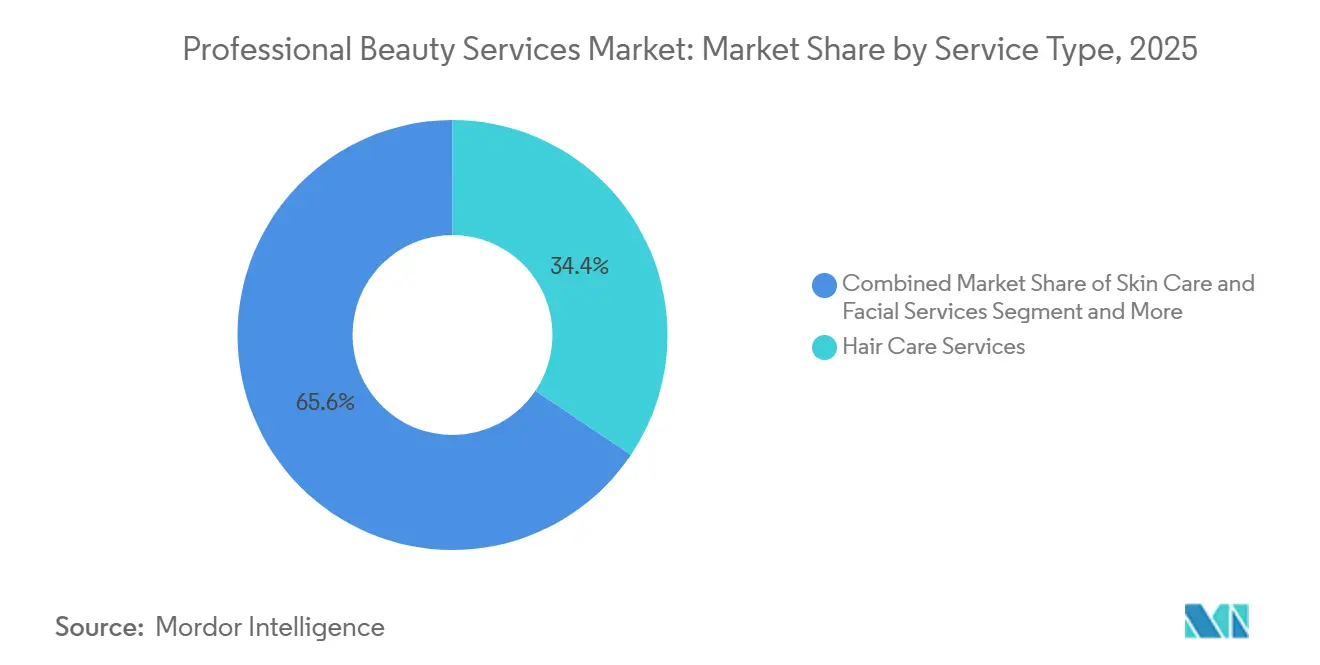
Hair Care Leads as Skin Care Closes the GapHair care services held 34.42% of the professional beauty services market share in 2025, making it the largest service category by revenue. The segment benefits from high visit frequency, wide demographic relevance, and a service base that remains essential across both premium and value formats. Color services, scalp treatments, hair repair, and styling continue to help providers maintain pricing power even when consumers become more selective in other discretionary spends. The professional beauty services market still relies heavily on hair care, as it drives recurring traffic and supports cross-selling into adjacent treatments. This leadership position is likely to remain intact in the medium term because hair care combines familiarity, frequency, and broad acceptance across age groups.
Skin care and facial services are forecast to grow at a 6.34% CAGR through 2031, making them the fastest-growing service type in the professional beauty services market. Growth is being supported by greater awareness of preventive skin care and a broader shift toward professional-grade treatments that fall between daily home care and clinic-led procedures. This category is also attracting more informed consumers who want ingredient-led services and visible outcomes in a supervised setting. Nail care, makeup and cosmetic services, and spa and wellness offerings continue to support multiservice salons by driving repeat visits and higher spend. Across the professional beauty services market, the service mix is gradually broadening from appearance-only care toward routines that combine maintenance, treatment, and personal well-being.

By End User:
Female Clientele Anchors Revenue as Male Segment SurgesWomen accounted for 68.73% of revenue in 2025, making them the core demand base in the professional beauty services market. This large share reflects deeper engagement across multiple service lines, including hair, skin, nails, and wellness, within the same customer relationship. The breadth of use also makes women the main anchor for memberships, repeat bookings, and bundled service models. For most operators, this segment remains central to revenue stability because visit depth is often as important as visit frequency. The professional beauty services market, therefore, continues to depend on women’s spending patterns for its current revenue base.
The men’s segment is forecast to grow at a 6.86% CAGR through 2031, making it the fastest-growing end-user segment in the professional beauty services market. Growth is being driven by wider acceptance of premium grooming, stronger interest in appearance-linked self-care, and broader adoption of services beyond routine haircuts. This is encouraging salons and barbershops to add facials, scalp care, beard care, and targeted treatment packages that raise average order values. The children’s segment remains smaller and steadier, with demand centered on family salons and periodic traffic peaks. Over time, the professional beauty services market is likely to benefit from a more balanced gender mix, particularly in urban centers where experimentation with services is higher.
By Booking Channel:
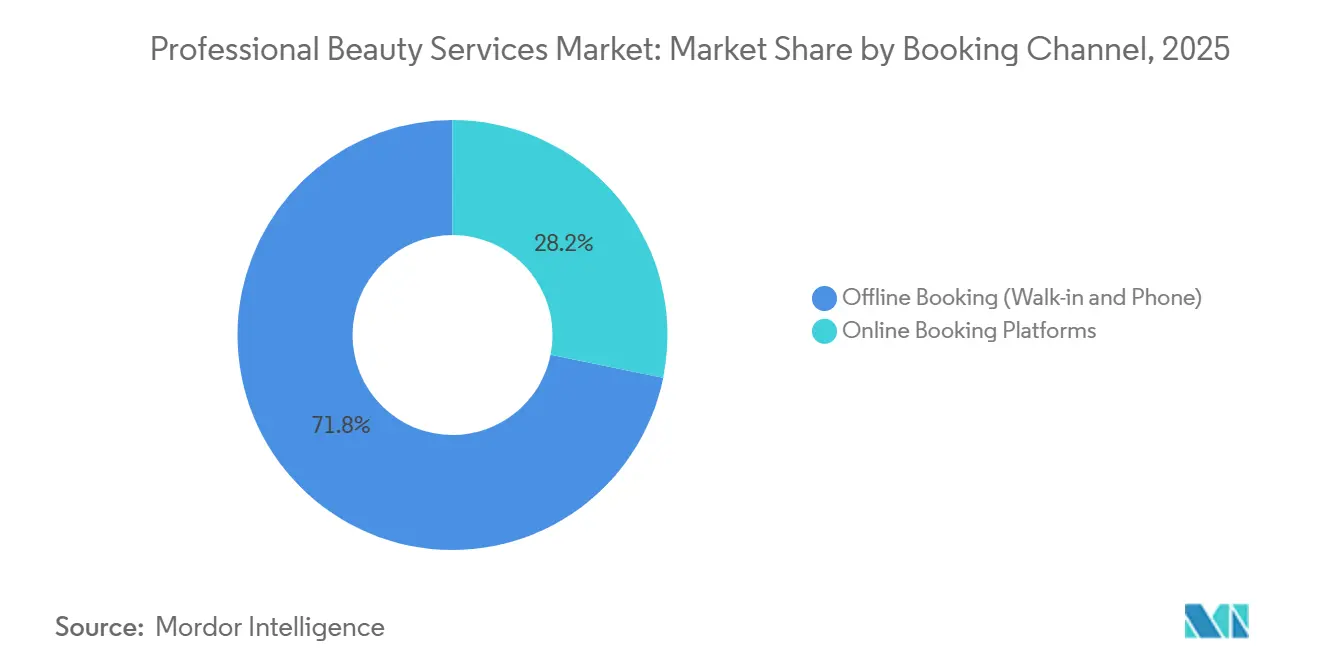
Offline Channels Hold Ground While Digital Reshapes DiscoveryOffline booking accounted for 71.82% of revenue in 2025, which shows that direct contact and relationship-led scheduling still matter across the professional beauty services market. Many repeat customers continue to rely on walk-ins or phone-based appointments, especially when loyalty is closely tied to a familiar stylist or therapist. This channel also remains strong among older consumers and in local markets where digital booking habits are less established. Even so, offline dominance increasingly reflects existing behavior rather than long-term channel strength. The professional beauty services market is moving toward a more mixed booking model as digital discovery becomes more influential.
Online booking platforms are projected to grow at a 7.46% CAGR through 2031, making them the fastest-growing channel in the professional beauty services market. Their growth is being supported by app convenience, easier comparison, stronger visibility for smaller operators, and better discovery among first-time users. Fresha reported in February 2026 that AI-driven booking referrals were growing 50% month on month, and that 63% of marketplace-acquired clients rebook within 12 months. This indicates that digital platforms are not just trial-generation tools but are also becoming retention channels with measurable value. Within the professional beauty services market, online booking is therefore changing the economics of client acquisition, rebooking, and local competition.
By Business Structure:
Independent Salons Lead While Franchise Chains ConsolidateIndependent salons accounted for 62.71% of revenue in 2025, making them the largest business format in the professional beauty services market. Their strength comes from local trust, stylist-led customer retention, lower structural overhead than some franchise systems, and the ability to adapt quickly to neighborhood demand. In many cities, the owner or lead stylist remains the strongest brand asset, helping independents retain loyalty even in crowded trading areas. This explains why the professional beauty services market still leans heavily toward localized operators despite rising organized competition. Independent salons remain especially relevant where personalization and long-standing customer relationships influence repeat visits.
Franchise and enterprise chains are projected to grow at a 6.23% CAGR through 2031, making them the fastest-growing business structure in the professional beauty services market. Branded networks benefit from process standardization, stronger procurement leverage, better access to capital, and easier rollout of booking and loyalty systems across outlets. Consolidation activity also supports this shift, as larger operators use acquisitions and franchising to scale faster and test improvements across broader portfolios. Regis Corporation’s acquisition of Alline Salon Group expanded its company-owned salon base and strengthened its operating platform. In the professional beauty services market, this is creating a two-track structure in which chains gain scale advantages while differentiated independents defend their local premium positioning.
Geography Analysis
APAC Professional Beauty Services Market
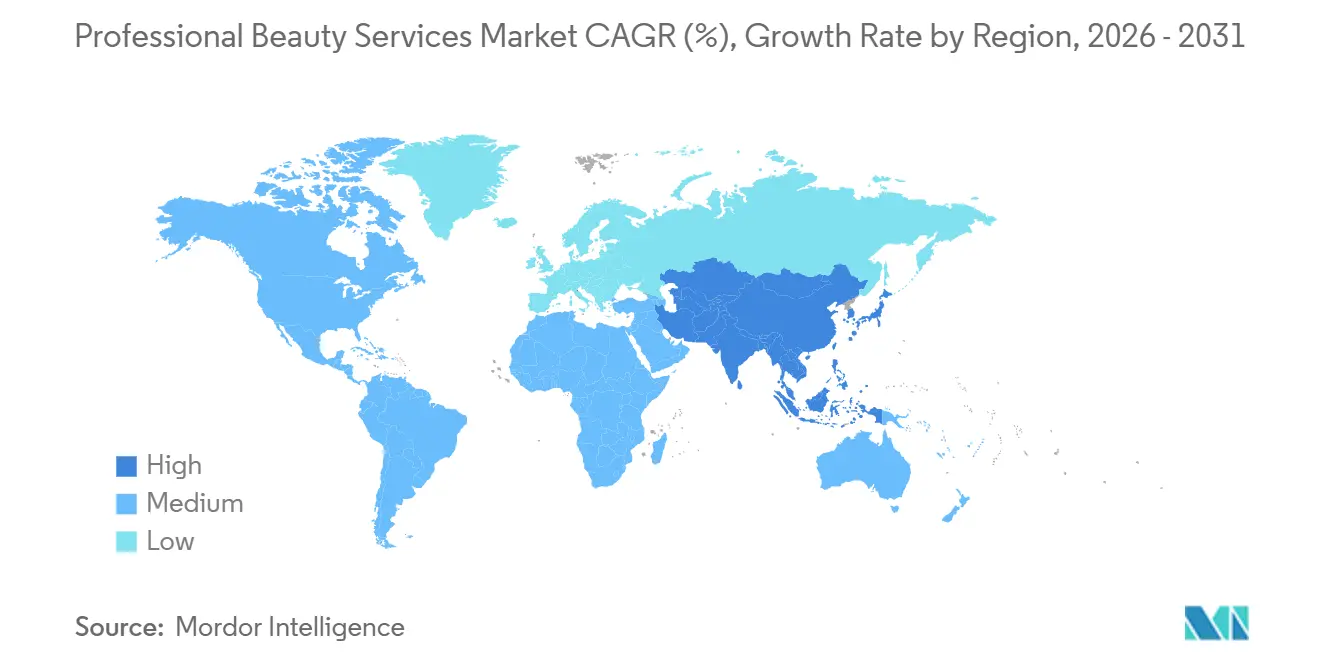
Asia-Pacific accounted for 36.46% of revenue in 2025, making it the leading regional market for professional beauty services. The region is also forecast to grow at a 6.12% CAGR through 2031, making it both the largest and the fastest-growing geography. This dual strength reflects broad demand depth across large population centers, rising urban incomes, and fast adoption of organized salon formats. China remains a major demand engine because premium salon use is stronger in higher-tier cities, and digital beauty discovery is well established. India is emerging as an important growth market within the regional professional beauty services market because urbanization, middle-class expansion, and chain-led salon development are improving category access.
South Korea and ASEAN Professional Beauty Services Market
South Korea also matters to the professional beauty services market because service standards in skin care and hair care often influence broader regional preferences. Across Southeast Asia, demand for beauty services is increasingly linked to digital discovery, app-based appointment behavior, and rising comfort with premiumized routines. These factors are helping the region move beyond basic salon maintenance toward broader service portfolios. Asia-Pacific, therefore, combines scale, growth, and service innovation in a way that few other regions match. For market participants, this makes the region central to both current revenue and future format development.
The Americas and EMEA Professional Beauty Services Market
North America and Europe remain important pillars of the professional beauty services market because they offer dense salon infrastructure and higher organized chain penetration. These regions are more mature, but they continue to evolve through wellness-linked services, specialized formats, and stronger franchise models. Regulatory standards are also higher, which can increase compliance costs but may, over time, improve trust and service quality. South America, the Middle East, and Africa represent developing markets with significant opportunities, where beauty culture, urban concentration, and format expansion support demand growth. In these regions, the professional beauty services market remains more uneven by country, but the long-term runway remains attractive, with digital discovery and organized expansion improving customer access.[3]
Competitive Landscape
The professional beauty services market remains fragmented, with no single operator controlling more than a low single-digit share of global revenue. A large share of business still sits with independent salons and regional operators, which limits overall concentration even as branded players expand. This fragmentation is stronger in Asia-Pacific and South America, while North America and Europe show a higher presence of organized chains. As a result, the professional beauty services market lacks a dominant competitive model, and success varies by format, location, and service mix. Companies are therefore competing through operational scale, booking convenience, service consistency, and broader care offerings.
Acquisition-led growth remains one of the clearer strategies in the professional beauty services market. Regis Corporation acquired Alline Salon Group in December 2024. In January 2026, Transom Capital Group completed its acquisition of WellBiz Brands, the multi-brand beauty and wellness franchisor behind Drybar, Elements Massage, Amazing Lash Studio, and Radiant Waxing. In May 2026, European Wax Center completed its take-private transaction with General Atlantic, which moved a 1,047-center franchise system off public markets. These moves show that scale, recurring revenue, and franchise economics are attracting continued capital in the professional beauty services market.
Technology is becoming a stronger competitive filter in the professional beauty services market because it affects how clients are acquired, booked, and retained. Fresha reported that AI-driven referrals were contributing materially to appointment generation, especially in Asia-Pacific, which shows how digital discovery is starting to influence local service demand. OneSpaWorld also linked part of its Q1 2026 revenue growth to AI-enhanced pre-booking capabilities, showing that technology is already contributing to monetization in service businesses. This means the professional beauty services market is moving toward a model in which platform quality and operating systems matter as much as physical presence. Operators that combine service consistency with digital efficiency are likely to be better positioned as competition intensifies.
Professional Beauty Services Industry Leaders
-
Great Clips, Inc.
-
Regis Corporation
-
Sport Clips, Inc.
-
Ulta Beauty, Inc.
-
WellBiz Brands, Inc.
- *Disclaimer: Major Players sorted in no particular order
Professional Beauty Services Market Companies Covered in this Report
- Great Clips, Inc.
- Regis Corporation
- Sport Clips, Inc.
- Ulta Beauty, Inc.
- WellBiz Brands, Inc.
- European Wax Center, Inc.
- The Lash Lounge
- Floyd's 99 Barbershop
- Gene Juarez Salons & Spas
- Hair Cuttery Family of Brands (HC Salon Holdings, Inc.)
- Provalliance Group
- Dessange International
- Toni & Guy
- Tommy Gun's Original Barbershop
- Lakme Salon (Hindustan Unilever)
- Jawed Habib Hair and Beauty Ltd.
- Enrich Hair and Skin Solutions Pvt. Ltd.
- Naturals Salon and Spa Pvt. Ltd.
- Urban Company
- OneSpaWorld Holdings Limited
Recent Industry Developments in Professional Beauty Services Market
- May 2026: European Wax Center completed its take-private transaction with General Atlantic at an implied enterprise value of approximately USD 640 million. The all-cash deal, at USD 5.80 per share, takes the 1,047-center waxing franchise off public markets, positioning it for an accelerated expansion phase under private capital with reduced reporting obligations.
- April 2026: OneSpaWorld reported record Q1 2026 revenues of USD 247.6 million, up 13% year-on-year, with net income rising 40% to USD 21.3 million. The company raised full-year 2026 revenue guidance to USD 1.014–1.034 billion, driven by fleet expansion to 208 ships and AI-integrated pre-booking uptake.
- April 2026: WellBiz Brands closed Q1 2026 with 56 new franchise agreements across its five brands, Drybar, Elements Massage, Fitness Together, Amazing Lash Studio, and Radiant Waxing, marking one of the strongest new-unit sales quarters in the platform’s history under new ownership.
- February 2026: Fresha announced that AI-driven booking referrals via Google Gemini, ChatGPT, and Claude are growing 50% month-on-month, with 1 in 4 online booking referrals in APAC now originating from AI searches. The platform processes over 30 million appointments per month, valued at more than USD 1.5 billion.
Global Professional Beauty Services Market Report Scope
Segmentation Overview
| Hair Care Services |
| Skin Care & Facial Services |
| Nail Care Services |
| Makeup & Cosmetic Services |
| Spa & Wellness Services |
| Women |
| Men |
| Children |
| Offline Booking (Walk-in & Phone) |
| Online Booking Platforms |
| Independent Salons |
| Franchise and Enterprise Chains |
| North America | United States |
| Canada | |
| Mexico | |
| South America | Brazil |
| Peru | |
| Chile | |
| Argentina | |
| Rest of South America | |
| Europe | United Kingdom |
| Germany | |
| France | |
| Spain | |
| Italy | |
| BENELUX (Belgium, Netherlands, and Luxembourg) | |
| NORDICS (Denmark, Finland, Iceland, Norway, and Sweden) | |
| Russia | |
| Rest of Europe | |
| Asia-Pacific | India |
| China | |
| Japan | |
| Australia | |
| South Korea | |
| South East Asia (Singapore, Malaysia, Thailand, Indonesia, Vietnam, and Philippines) | |
| Rest of Asia-Pacific | |
| Middle East and Africa | United Arab Emirates |
| Saudi Arabia | |
| South Africa | |
| Nigeria | |
| Rest of Middle East and Africa |
| By Service Type | Hair Care Services | |
| Skin Care & Facial Services | ||
| Nail Care Services | ||
| Makeup & Cosmetic Services | ||
| Spa & Wellness Services | ||
| By End User | Women | |
| Men | ||
| Children | ||
| By Booking Channel | Offline Booking (Walk-in & Phone) | |
| Online Booking Platforms | ||
| By Business Structure | Independent Salons | |
| Franchise and Enterprise Chains | ||
| By Geography | North America | United States |
| Canada | ||
| Mexico | ||
| South America | Brazil | |
| Peru | ||
| Chile | ||
| Argentina | ||
| Rest of South America | ||
| Europe | United Kingdom | |
| Germany | ||
| France | ||
| Spain | ||
| Italy | ||
| BENELUX (Belgium, Netherlands, and Luxembourg) | ||
| NORDICS (Denmark, Finland, Iceland, Norway, and Sweden) | ||
| Russia | ||
| Rest of Europe | ||
| Asia-Pacific | India | |
| China | ||
| Japan | ||
| Australia | ||
| South Korea | ||
| South East Asia (Singapore, Malaysia, Thailand, Indonesia, Vietnam, and Philippines) | ||
| Rest of Asia-Pacific | ||
| Middle East and Africa | United Arab Emirates | |
| Saudi Arabia | ||
| South Africa | ||
| Nigeria | ||
| Rest of Middle East and Africa | ||
Key Questions Answered in the Report
What is the 2031 value forecast for professional beauty services worldwide?
The market is forecast to reach USD 230.56 billion by 2031, rising from USD 178.93 billion in 2026 at a CAGR of 5.20%.
Which service category accounts for the most global salon revenue?
Hair care services led revenue with a 34.42% share in 2025, benefiting from high visit frequency and broad consumer relevance.
Which category is growing fastest among salon service types?
Skin care and facial services are projected to grow at a 6.34% CAGR through 2031 as professional treatment demand moves beyond occasional indulgence.
Why is men’s grooming becoming more important for service providers?
The men’s segment is forecast to grow at a 6.86% CAGR through 2031, prompting operators to add premium grooming, scalp care, and skin care services.
How important is online booking for salons and spas now?
Offline booking still held 71.82% of revenue in 2025, but online booking platforms are growing faster at a 7.46% CAGR and are improving both discovery and rebooking.
Which region offers the strongest growth outlook?
Asia-Pacific led with 36.46% revenue share in 2025 and is also the fastest-growing region, with a projected CAGR of 6.12% through 2031.