
Leisure Travel Market Size and Share
Market Overview
| Study Period | 2022 - 2032 |
|---|---|
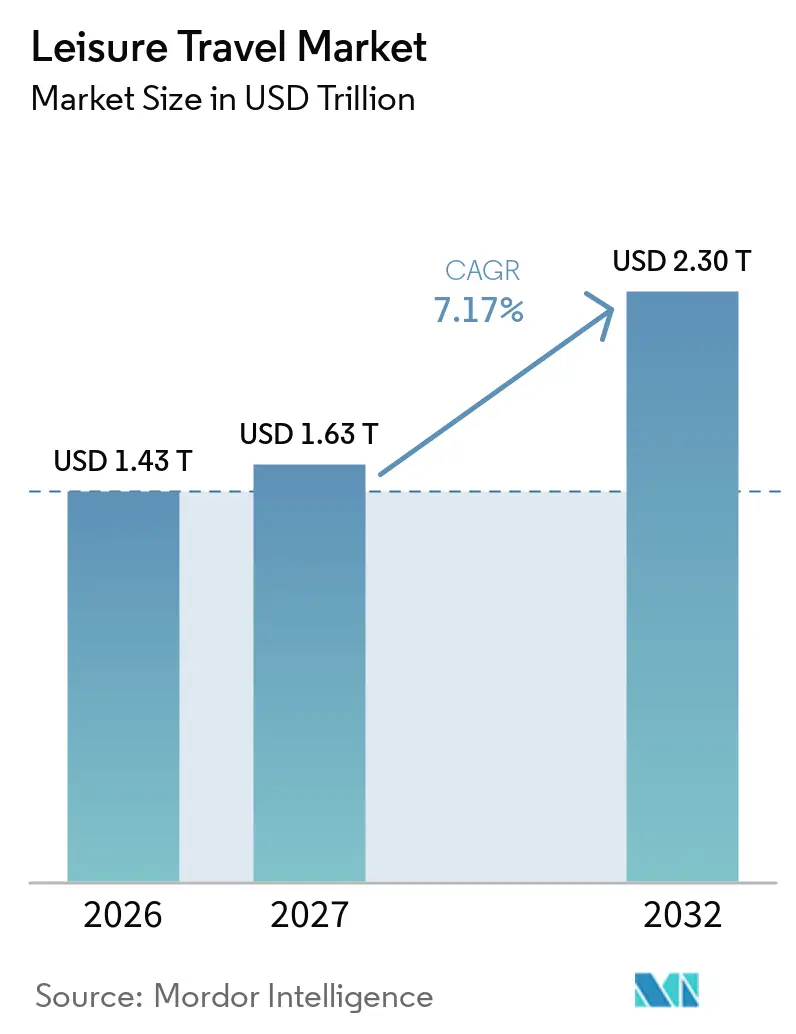
| Market Size (2027) | USD 1.63 Trillion |
| Market Size (2032) | USD 2.30 Trillion |
| Growth Rate (2027 - 2032) | 7.17 % |
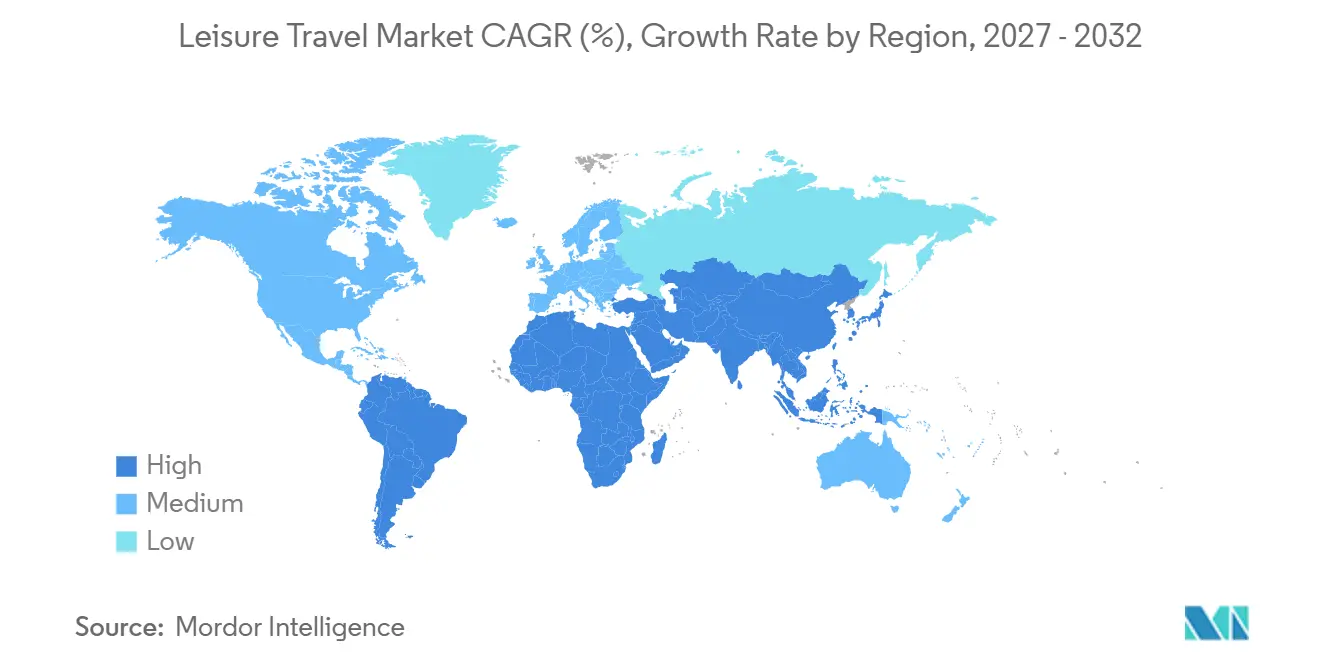
| Fastest Growing Market | Middle East and Africa |
| Largest Market | Asia-Pacific |
| Market Concentration | Low |
Major Players *Disclaimer: Major Players sorted in no particular order Image © Mordor Intelligence. Reuse requires attribution under CC BY 4.0. | |
Leisure Travel Market Analysis by Mordor Intelligence
The global leisure travel market was valued at USD 1.431 trillion in 2026 and is estimated to grow from USD 1.628 trillion in 2027 to reach USD 2.302 trillion by 2032, at a CAGR of 7.17% during the forecast period (2027–2032). Leisure demand remains supported by travelers’ preference for experience-rich trips, local activities, and accommodations that offer more than a conventional stay. Booking platforms continue to expand their service and experience offerings. International tourist arrivals reached 1.52 billion in 2025, a 4% increase from 2024, demonstrating resilient travel demand despite uneven economic and geopolitical conditions. Emerging markets, including India, China, and Southeast Asia, support this trend through expanding domestic travel bases and growing participation in international travel. However, the global leisure travel market faces pressure from higher trip costs, visa requirements, climate-related disruptions, and destination capacity constraints. These conditions favor suppliers and destinations that provide accessible pricing, digital booking, reliable transportation, and differentiated local experiences.
Key Report Takeaways
- By travel type, Domestic Travel accounted for 71.73% of the global leisure travel market share in 2026, while International Travel is projected to grow at an 8.03% CAGR through 2032.
- By traveler type, Family Travelers accounted for 38.42% of the global leisure travel market share in 2026, while Solo Travelers are projected to grow at an 8.64% CAGR through 2032.
- By booking channel, Online Travel Agencies accounted for 38.21% of the global leisure travel market share in 2026, while Direct Booking is projected to grow at a 7.94% CAGR through 2032.
- By accommodation type, Hotels and Resorts accounted for 55.92% of the global leisure travel market share in 2026, while Vacation Rentals and Holiday Homes are projected to grow at an 8.84% CAGR through 2032.
- By geography, Asia-Pacific accounted for 32.84% of the global leisure travel market share in 2026, while the Middle East and Africa are projected to grow at an 8.23% CAGR through 2032.
Note: Market numbers in this report are based on Mordor Intelligence's proprietary estimation framework, which combines nine months of actuals with Q4 projections for base year 2026.
Market Trends and Insights
Drivers Impact Analysis of Leisure Travel Market*
| Driver | (~) % Impact on CAGR Forecast | Geographic Relevance | Impact Timeline |
|---|---|---|---|
| Rising Preference for Experience-Led Travel | +1.4% | Global, strongest in North America, Western Europe, and urban Asia-Pacific | Medium term (2-4 years) |
| Rising Disposable Income and Middle-Class Travel Participation | +1.7% | India, China, Southeast Asia, with spillover to the Middle East, Africa, and South America | Long term (≥ 4 years) |
| Mobile-First Booking and Digital Travel Discovery | +1.0% | Global, with high relevance in South Asia, Southeast Asia, and Latin America | Short term (≤ 2 years) |
| Recovery of International and Regional Leisure Travel | +0.9% | Asia-Pacific, South America, and Africa | Medium term (2-4 years) |
| Expansion of Affordable Air Connectivity and Transport Infrastructure | +0.8% | Middle East, South Asia, Sub-Saharan Africa, and Southeast Asia | Medium term (2-4 years) |
| Growth of Wellness, Adventure, Cultural and Nature-Based Travel | +0.7% | Europe, the Middle East, Africa, and Asia-Pacific nature corridors | Long term (≥ 4 years) |
| Source: Mordor Intelligence | |||
Rising Preference for Experience-Led Travel
Travelers increasingly prioritize activities, local cuisine, wellness, and cultural participation when selecting trips. Expedia’s 2025 Traveler Value Index reported that 88% of consumers planned to take a leisure trip within the following 12 months[1]. This demand supports spending on lodging, tours, dining, and other travel services beyond room nights. In May 2025, Airbnb launched Services in 260 cities and Experiences in 650 cities, offering private chefs, spa treatments, personal training, and cultural activities. The global leisure travel market benefits when platforms enable travelers to arrange multiple trip components in one place. Across destinations, this trend creates opportunities for curated heritage, wellness, culinary, and short-break offerings sold alongside transportation and accommodation.
Rising Disposable Income and Middle-Class Travel Participation
A growing middle-income population is increasing the number of people able to take domestic and international leisure trips. This trend is particularly relevant in India, China, Indonesia, and Brazil, where greater accessibility can convert first-time travelers into repeat customers. In the fourth quarter of 2025, Airbnb reported that nights booked from India increased 50% year over year, while first-time bookers rose by more than 60%[2]. These figures indicate an expanding Indian customer base for domestic short breaks and international holidays. The global leisure travel market benefits from higher participation, as a larger traveler base increases demand for airlines, hotels, travel agencies, and activity providers. Providers serving emerging markets need affordable pricing, regional-language discovery tools, and payment options for both new and frequent travelers.
Mobile-First Booking and Digital Travel Discovery
Mobile devices support trip inspiration, comparison, booking, payment, and customer service throughout a single journey. Expedia reported that 61% of global travelers discovered trip ideas through social media platforms in 2025, up from 35% in 2022. This shift is especially relevant in mobile-first markets, where consumers widely use mobile devices to research destinations and compare prices. Online platforms can convert demand more effectively when content, reviews, availability, and checkout functions work smoothly on small screens. The global leisure travel market is shifting toward platforms that reduce the steps between discovery and booking. Suppliers that rely on offline distribution may need to strengthen direct digital capabilities to maintain visibility and customer relationships.
Recovery of International and Regional Leisure Travel
International travel recovered across major corridors in 2025, although performance varied by destination. UN Tourism reported 1.52 billion international arrivals in 2025, while Asia and the Pacific recorded 6% annual growth. North-East Asia registered 13% growth in arrivals in 2025, reflecting the continued normalization of regional travel flows. India benefited from this trend through expanded outbound travel options and greater opportunities to attract regional visitors. The global leisure travel market benefited when airline capacity, visa processing, and tourism services recovered together.
Restraints Impact Analysis of Leisure Travel Market*
| Restraint | (~) % Impact on CAGR Forecast | Geographic Relevance | Impact Timeline |
|---|---|---|---|
| High Airfare, Accommodation and Destination Costs | -0.6% | North America and Western Europe, with spillover to price-sensitive Asia-Pacific and South America travelers | Medium term (2-4 years) |
| Geopolitical Disruption, Visa Friction and Cross-Border Uncertainty | -0.5% | North America, Russia-adjacent European corridors, and Middle East flashpoints | Short term (≤ 2 years) |
| Climate Risk, Overtourism and Destination Capacity Constraints | -0.4% | Southern Mediterranean Europe, small island states, and coastal Asia-Pacific | Long term (≥ 4 years) |
| Fragmented Regulations and Consumer Protection Requirements | -0.3% | Europe, Asia-Pacific, and the Middle East | Medium term (2-4 years) |
| Source: Mordor Intelligence | |||
High Airfare, Accommodation, and Destination
Higher transportation, hotel, food, and activity costs can reduce trip frequency among price-sensitive households. The U.S. Travel Association, citing U.S. Bureau of Labor Statistics data, reported that travel costs were 20% higher than in 2019, while restaurant prices had increased by more than 30%. These cost pressures can shift demand toward shorter domestic trips, value-oriented accommodation, and early bookings. They can also increase reliance on online comparison tools and promotional offers. The global leisure travel market continues to attract higher-spending travelers; however, middle-market travelers may reduce on-trip spending or choose lower-cost destinations. For price-sensitive travelers, competitive fares, flexible payment options, and transparent pricing remain important for keeping leisure travel affordable.
Geopolitical Disruption, Visa Friction, and Cross-Border Uncertainty
Border regulations, conflict, and visa policy changes can rapidly influence destination choices and airline route economics. Reuters reported that the United States introduced a USD 250 visa integrity fee in 2025 for travelers from countries outside the Visa Waiver Program[3]. The same report noted that visits from India were down 2.4% year to date, driven by a nearly 18% drop in student travel, resulting in demand shifting toward Europe and East Asia. UN Tourism reported a 1.4% decline in international arrivals to North America in 2025. The global leisure travel market may retain some demand as travelers choose more accessible alternatives. However, destinations and travel sellers must respond quickly to changes in routes, documentation requirements, and traveler confidence.
*Our forecasts treat driver/restraint impacts as directional, not additive. The impact forecasts reflect baseline growth, mix effects, and variable interactions.
Travel Demand & Consumer Behavior
Expedia Group’s 2025 Traveler Value Index, based on 11,000 consumers across 11 markets, found that 88% of respondents planned a leisure trip. Additionally, 68% were likely to book international travel, up 19% from 2022. Social media influenced travel discovery, with 61% using it for inspiration, compared with 35% in 2022. Moreover, 73% said influencer recommendations affected their booking decisions.
Although 58% expected to become more price-conscious, approximately 75% were willing to pay more for accommodation with better reviews. These findings indicate demand for travel experiences that combine authenticity, affordability, and trust. Heritage circuits, regional cuisine, wellness retreats, and nature-based activities can attract diverse traveler segments. Suppliers can improve conversion through transparent pricing, verified reviews, mobile-friendly booking, and reliable local services.
Tourism Performance Intelligence
UN Tourism reported that international tourist arrivals reached 1.52 billion in 2025, up 4% year over year. Africa grew 8%, Asia and the Pacific 6%, and South America 7%, while Europe received 793 million arrivals and North America declined 1.4%. These differences supported destination portfolio diversification beyond established markets.
Stronger international connectivity, efficient visitor services, and investment in regional destinations could help translate arrivals into local spending. However, visitor volumes alone do not ensure sustainable returns. The World Bank’s nature-based tourism analysis emphasized community involvement and natural asset protection. Better seasonal and geographic distribution could reduce pressure on crowded attractions and expand income opportunities for smaller tourism businesses.
Trip duration influenced accommodation revenue and ancillary spending. Airbnb’s Spring 2025 data showed that solo travelers averaged 17 nights per trip, versus 9 nights for couples and 8 nights for families, indicating demand for flexible stays and tailored amenities. UN Tourism reported global accommodation occupancy of 69% in June and 71% in July 2025. Linked heritage, wellness, and nature itineraries could extend stays and distribute spending if transport and accommodation support multi-stop travel.
Leisure Travel Market Segment Analysis
By Travel Type:
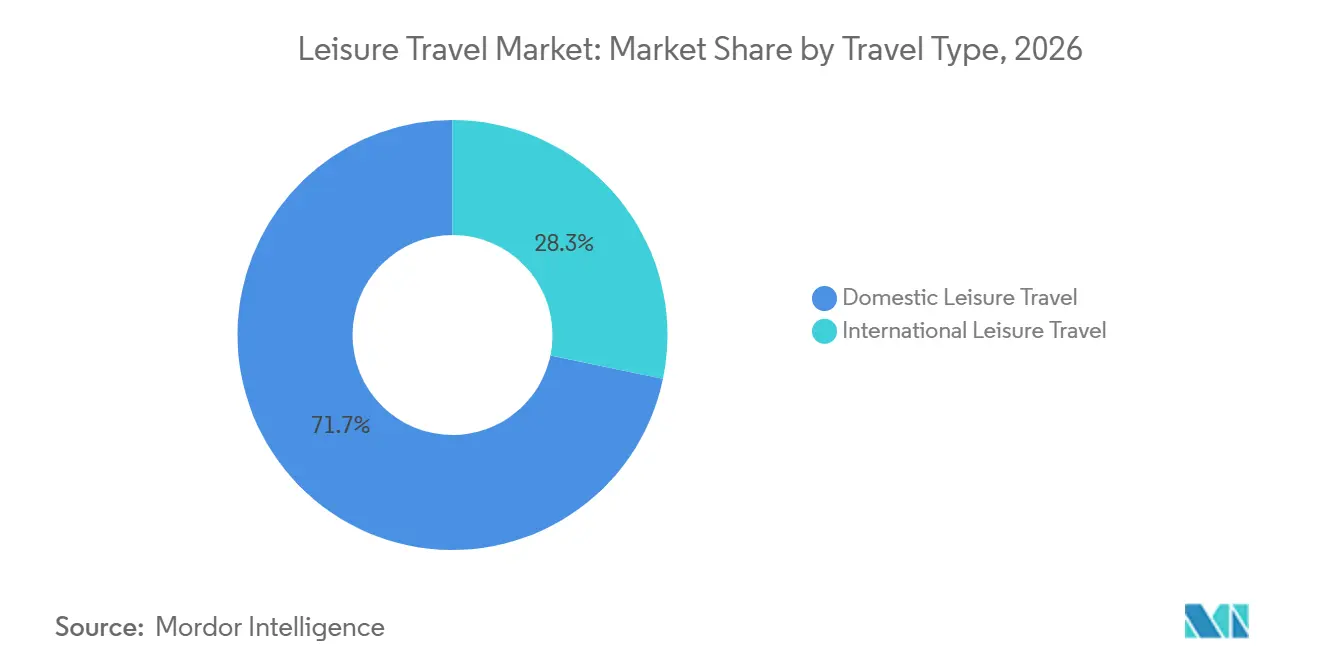
Domestic Travel Anchors Demand While International Travel Expands FasterDomestic travel accounted for 71.73% of the global leisure travel market size in 2026, forming a stable demand base. Domestic trips face less exposure to visa requirements, long-haul airfare fluctuations, and cross-border political uncertainty. Large countries, including India, China, the United States, and Brazil, offer diverse domestic leisure options. In these markets, domestic travel connects urban travelers with religious sites, beaches, wildlife destinations, mountain areas, and heritage locations. The segment also supports short stays and repeated trips, helping hotels and local businesses manage demand throughout the year.
International travel is forecast to grow at a CAGR of 8.03% through 2032, faster than domestic travel. UN Tourism reported 1.52 billion international arrivals in 2025, reflecting the continued recovery in cross-border leisure demand. Regional travel within Asia, the recovery of Chinese outbound travel, and expanded air connectivity to the Middle East and Africa support growth. Travelers from emerging markets, including India, represent a meaningful source of incremental demand as international travel becomes more accessible to new customer groups. However, visa costs, aviation disruptions, and destination regulations can influence demand. Sellers that clearly communicate requirements and offer flexible travel options are better positioned to serve this segment.
By Traveler Type:
Family Travel Leads Revenue While Solo Travel Broadens DemandFamily travelers held 38.42% of the global leisure travel market in 2026. Family trips often require additional rooms, larger accommodation, local transportation, and activities for multiple age groups, increasing booking values despite lower individual travel frequency. Multigenerational travel remains relevant for vacations, festivals, pilgrimages, and celebrations. Hotels, vacation rentals, and tour operators can address this demand with flexible room configurations, child-friendly services, and simplified group planning.
The solo travelers segment is forecast to grow at a CAGR of 8.64% through 2032. Airbnb reported that solo travel searches by United States guests for spring 2025 dates increased 90% year over year in spring 2025 and that solo travelers booked longer stays than family and duo travelers. This segment supports demand for hostels, small hotels, shared experiences, and digital tools that enhance safety and flexibility. It also increases the need for trusted reviews, transparent pricing, and flexible booking changes. Destinations can meet this demand through connected city breaks, cultural routes, and nature destinations with clear safety information. Women-only group travel and guided formats can support travelers seeking independence with organized assistance.
By Booking Channel:
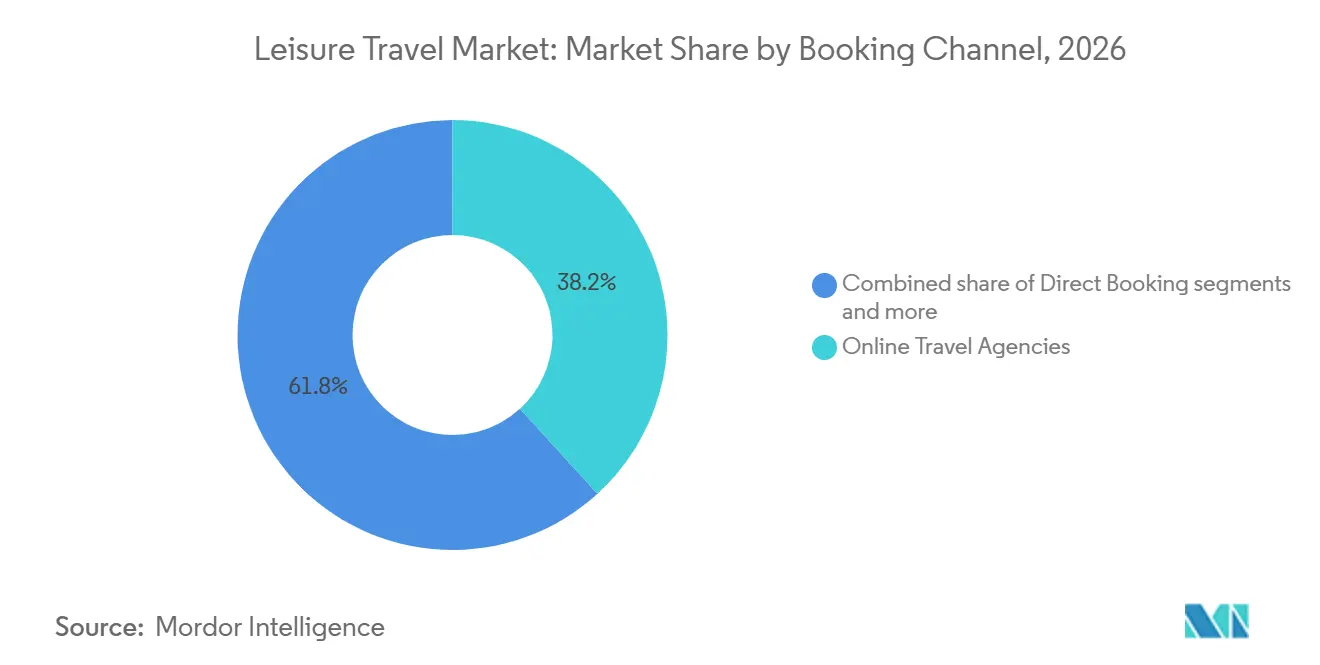
Online Travel Agencies Retain Scale While Direct Booking Gains GroundOnline travel agencies accounted for 38.21% of the global leisure travel market revenue in 2026. Their value proposition includes comparison tools, extensive inventory, customer reviews, payment processing, and bundled flights, accommodations, and activities. In 2025, Booking Holdings reported USD 186.13 billion in gross bookings, while Expedia Group reported USD 119.59 billion. These platforms provide suppliers with international visibility and enable travelers to compare options across destinations. Their reach also makes pricing, inventory accuracy, and service quality more transparent to consumers.
The direct booking segment is projected to grow at a CAGR of 7.94% through 2032. Hotels and other suppliers are investing in loyalty programs, websites, and applications to drive repeat business and reduce customer acquisition costs. Direct channels allow hotels and experience providers to retain customer data and develop targeted offers, subject to data protection requirements. However, they do not replace online travel agencies for travelers seeking broad price comparisons or multi-part itineraries. Instead, they offer suppliers another way to serve returning customers and bundle their services. The global leisure travel market is expected to use both channels, as each supports different stages of the booking process.

By Accommodation Type:
Hotels Hold the Largest Base While Vacation Rentals Grow FasterHotels and resorts accounted for 55.92% of the global leisure travel market in 2026. Their scale reflects established brands, consistent service standards, locations in major cities and leisure destinations, and suitability for family and group travel. In 2025, Marriott added approximately 100,000 rooms globally, while Hilton added a comparable number[4]. This brand-led expansion increases the availability of standardized accommodation across destinations. In emerging markets, it can improve supply in established locations and support the development of secondary leisure cities.
Vacation rentals and holiday homes are forecast to grow at a CAGR of 8.84% through 2032. These formats appeal to long-stay travelers, groups requiring more than one room, and those seeking a residential setting. Airbnb’s 2025 Summer Release expanded its offering beyond accommodation by adding services in 260 cities and experiences in 650 cities. This model can provide more complete trip options by allowing local providers to join a broader platform. It can also increase regulatory scrutiny of listings, local housing, and destination capacity. Hotels, hostels, camping facilities, and vacation rentals remain relevant because they serve distinct traveler needs and price points.
Geography Analysis
APAC Leisure Travel Market
Asia-Pacific held a 32.84% share of the global leisure travel market in 2026, making it the largest regional segment. The region benefits from strong domestic travel markets, a large population, and expanding air connectivity. UN Tourism reported 331 million international arrivals in Asia-Pacific in 2025, up 6%. In 2025, India recorded 4.29 billion domestic tourist visits and 32.83 million Indian national departures. Hotel development in India, China, and Vietnam can expand capacity but must align with transport, skills, and destination management needs.
Europe Leisure Travel Market
Europe recorded 793 million international tourists in 2025, up 4% from 2024. Cultural destinations, rail connectivity, and accommodation capacity continue to attract leisure travelers. Visitor caps, cruise restrictions, taxes, and short-term rental rules may redirect demand to secondary locations. Visa procedures and travel costs influence destination choices and length of stay for long-haul visitors, including those from Asian source markets. Travel companies can promote off-season travel and lesser-known cities.
The Americas and MEA Leisure Travel Market
The Middle East and Africa is forecast to grow at an 8.23% CAGR through 2032, making it the fastest-growing region. Africa recorded 8% growth in international arrivals in 2025, while the Middle East received nearly 100 million visitors, 39% above pre-pandemic levels. North America recorded a 1.4% decline, while South America grew 7%. Demand can shift with changes in costs, visas, and geopolitical conditions.
Tourism Infrastructure & Development Intelligence
As of the third quarter of 2025, the global hotel pipeline showed uneven regional momentum. Europe was the only region to record year-over-year growth in rooms under contract, increasing 3.7% to 428,345 rooms. Asia-Pacific had 951,020 rooms under contract, down 0.3%. China, India, and Vietnam led regional construction activity, creating opportunities beyond established destinations while requiring alignment with transport access, utilities, staffing, and local demand.
Major hotel groups expanded through asset-light models. Marriott ended 2025 with nearly 610,000 rooms in its development pipeline, while Hilton signed nearly 140,000 rooms during the year. Alternative accommodation also added capacity, with Airbnb reporting more than 9 million active listings globally at year-end 2025. This scale broadened options for diverse trip types and increased the need for quality assurance, regulation, and responsible destination management.
Competitive Landscape
The global leisure travel market has concentrated on digital distribution but remains fragmented across experiences, local operators, and accommodation owners. Booking Holdings, Expedia Group, Airbnb, and Trip.com operate as major global platforms, while hotels, cruise lines, tour operators, and activity providers compete across the value chain. Booking Holdings generated USD 26.92 billion in revenue in 2025, while Expedia Group generated USD 14.73 billion. Airbnb reported 16% growth in gross booking value during the fourth quarter of 2025. These companies have scale in traffic, technology, and supplier relationships, but no single platform controls every travel decision. Competition has increasingly focused on activities, loyalty programs, and destination services. Airbnb expanded into services and experiences in May 2025. Expedia Group announced an agreement to acquire Tiqets in December 2025, expanding its attraction and museum ticket inventory. TUI opened its second hotel in Cambodia in August 2025, increasing its Asian portfolio to 25 hotels across eight countries. India-based firms must combine local supply depth with reliable technology, service recovery, and relevant payment options. Hilton announced plans to expand its African portfolio to more than 160 hotels, while Marriott planned to add 50 African properties by 2027. Royal Caribbean generated USD 17.93 billion in revenue in 2025, while Carnival generated USD 26.6 billion in fiscal 2025. Smaller travel businesses can compete through specialized knowledge, local access, and flexible products.
Leisure Travel Industry Leaders
-
Booking Holdings Inc.
-
Expedia Group, Inc.
-
Airbnb, Inc.
-
Trip.com Group Limited
-
TUI AG
- *Disclaimer: Major Players sorted in no particular order

Leisure Travel Market Companies Covered in this Report
- Booking Holdings Inc.
- Expedia Group, Inc.
- Airbnb, Inc.
- Trip.com Group Limited
- TUI AG
- Marriott International, Inc.
- Hilton Worldwide Holdings Inc.
- Accor
- Carnival Corporation & plc
- Royal Caribbean Group
- MakeMyTrip Limited
- Traveloka Group
- GetYourGuide
- Klook
- Tripadvisor, Inc.
- eDreams ODIGEO S.A.
- Despegar.com, Corp.
- Flight Centre Travel Group Limited
- Thomas Cook India Limited
- Hyatt Hotels Corporation
Recent Industry Developments in Leisure Travel Market
- March 2026: MakeMyTrip completed the merger of redBus India into MakeMyTrip India, effective January 1, 2026, consolidating its India brands. It also completed the acquisition of a majority stake in Flamingo Transworld and a strategic minority investment in Atlys, expanding its bus, visa, and group holiday services.
- October 2025: TUI Musement and Travco established a Doha-based joint venture to manage Gulf operations. It provides shore excursions, transfers, meeting and event support, and destination services, expanding TUI’s Middle East presence amid growing Gulf travel demand.
- August 2025: TUI opened TUI Blue Angkor Grace, its second hotel in Cambodia, expanding its Asian portfolio to 25 hotels across eight countries. During the financial year, TUI opened seven hotels across China, Thailand, Cambodia, and Indonesia, increasing capacity in key Asian leisure destinations.
- June 2025: Hilton plans to more than triple its African portfolio to over 160 hotels, including first entries into Angola, Ghana, and Benin. Marriott plans to add 50 African properties by 2027, expanding accommodation options for Indian outbound travelers.
Global Leisure Travel Market Report Scope
The global leisure travel market report analyzes leisure travel demand, spending patterns, and tourism activities across major destinations worldwide. The market is segmented by travel type (Domestic and International Leisure Travel), traveler type (Solo Travelers, Family Travelers, and Friends and Other Group Travelers), booking channel (Online Travel Agencies, Direct Booking, Travel Agents and Tour Operators, and Other Channels), accommodation type (Hotels and Resorts, Vacation Rentals and Holiday Homes, Hostels and Budget Accommodation, and Other Accommodation Types), and geography. The study examines key drivers, including rising preference for experience-led travel, disposable income growth, mobile-first booking, recovery of leisure travel, affordable transport connectivity, and demand for wellness, adventure, cultural, and nature-based experiences, alongside restraints such as high travel costs, geopolitical disruptions, visa barriers, climate risks, and fragmented regulations. It evaluates tourism infrastructure, accommodation supply, tourist arrivals, length of stay, traveler preferences, booking behavior, spending patterns, regulatory developments, and competitive intensity using Porter’s Five Forces Analysis. The report provides market size and growth forecasts, market share analysis, competitive landscape assessment, strategic developments, and profiles of leading travel platforms, tour operators, accommodation providers, and experience-booking companies. It also explores opportunities in emerging destinations, underserved traveler segments, AI-driven personalization, and experience-based travel packages. Market estimates and forecasts are presented in value (USD) across all covered segments.
Segmentation Overview
Key Questions Answered in the Report
What is the forecast growth rate for leisure travel through 2032?
The sector is projected to grow at a 7.17% CAGR from 2027 to 2032, reaching USD 2.302 trillion by 2032.
Which travel type has the largest share of leisure demand?
Domestic travel led with 71.73% of revenue in 2026, supported by large local trip markets such as India, China, the United States, and Brazil.
What is the forecast growth rate for leisure travel through 2032?
The global leisure travel market was valued at USD 1.431 trillion in 2026 and is projected to grow at a 7.17% CAGR from 2027 to 2032, reaching USD 2.30 trillion by 2032.
Which booking channel is growing fastest?
Direct booking is forecast to grow at a 7.94% CAGR through 2032, while online travel agencies remained the largest channel in 2026.
Which accommodation format is forecast to grow fastest?
Vacation rentals and holiday homes are projected to grow at an 8.84% CAGR through 2032.
Which region will grow fastest through 2032?
The Middle East and Africa are forecast to grow at an 8.23% CAGR, supported by tourism infrastructure investment and improving destination capacity.
Which region holds the largest share of the global leisure travel market?
Asia-Pacific held the largest share at 32.84% in 2026, supported by strong domestic travel markets, a large population, and expanding air connectivity.