
Hotels Market Size and Share
Hotels Market Analysis by Mordor Intelligence
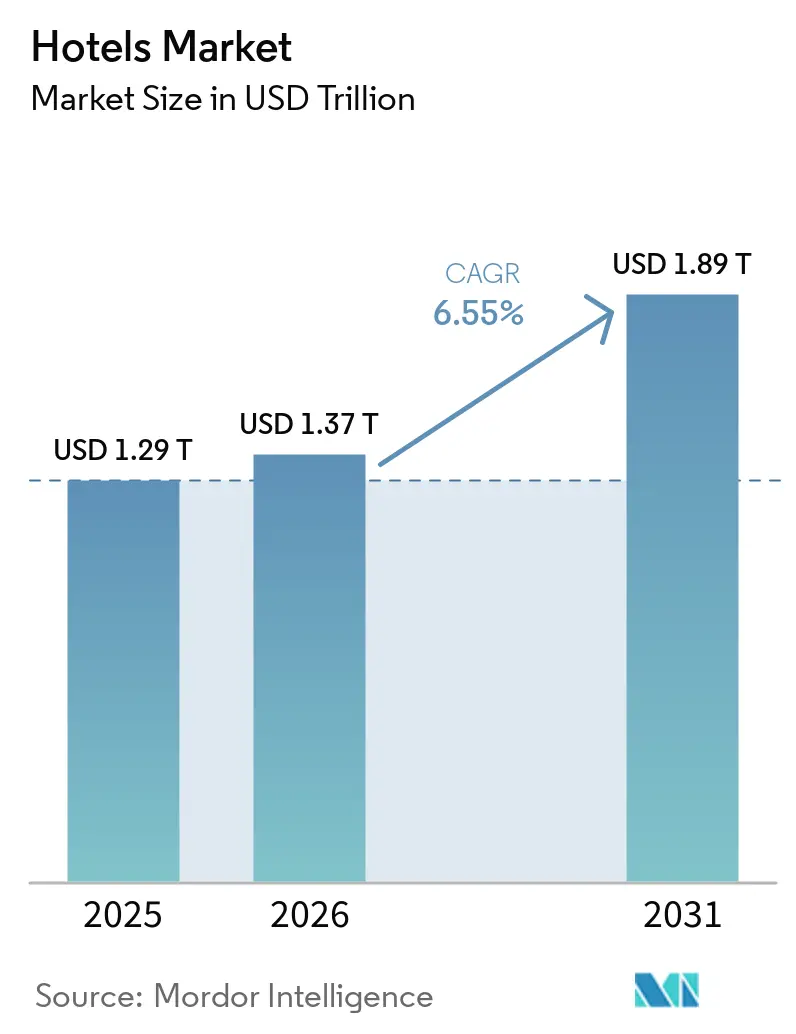
The hotels market size is expected to increase from USD 1.37 trillion in 2026 to USD 1.46 trillion in 2027 and reach USD 1.97 trillion by 2032, growing at a CAGR of 6.15% over 2027-2032.
Rising purchasing power in China broadens potential overnight demand, while corporate and event travel create additional paid-stay opportunities. Modest international arrival growth makes converting travelers into hotel guests more important than assuming a broad volume surge. Broader hotel networks and shared revenue-management tools give operators ways to capture demand through an expanded commercial platform. Resort room additions widen the offer, but development costs and staffing pressures can limit the pace of delivering additional capacity. Income-led demand in China and business travel should therefore favor operators able to sell existing resort and network capacity, while construction and staffing constraints limit how quickly new rooms can capture that demand.
Key Report Takeaways
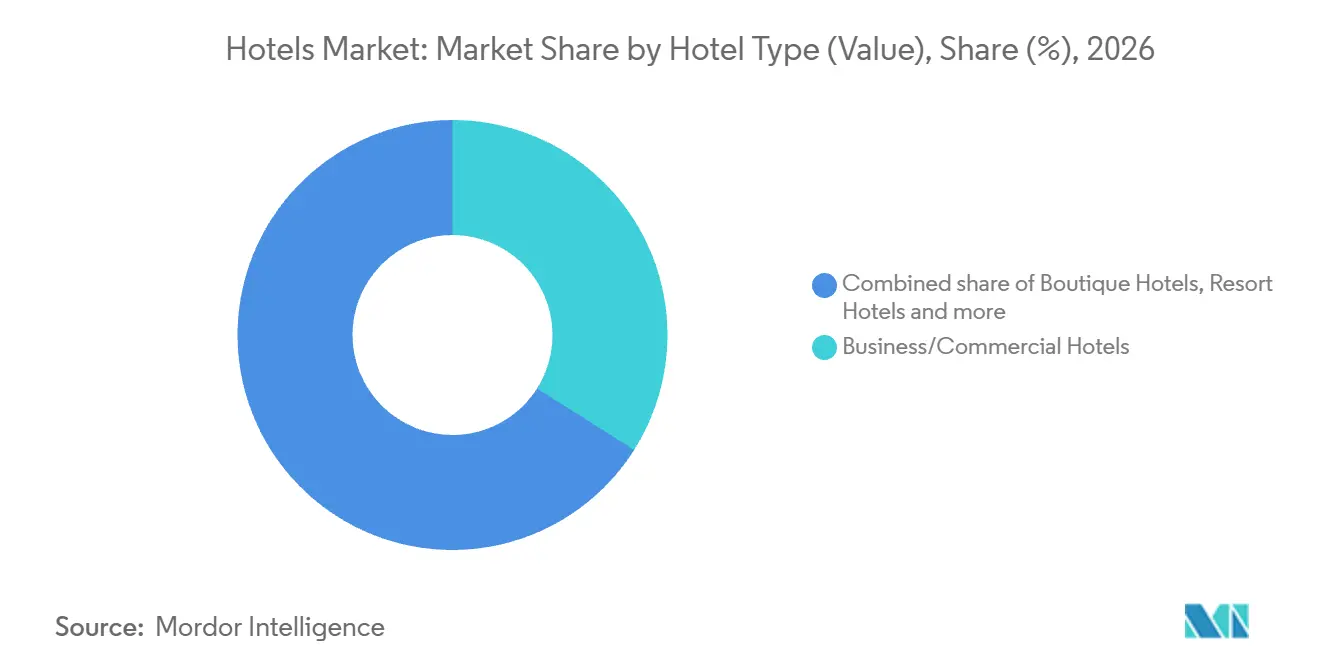
- By hotel type, business/commercial hotels held a 33.98% hotels market share in 2026, while resort hotels are forecast to grow fastest at an 8.5% CAGR over 2027-2032.
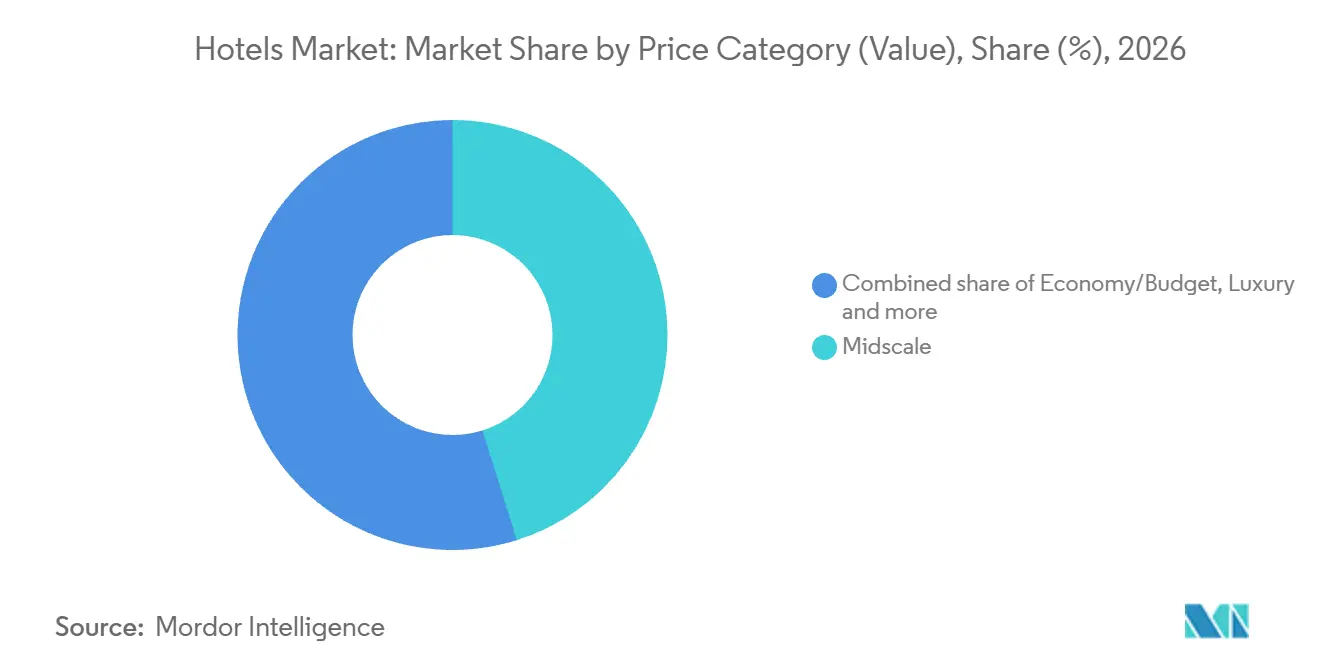
- Midscale led price categories with a 45.16% share of the hotels market size in 2026, while luxury is the fastest-growing segment at a 7.95% CAGR over 2027-2032.
- By rating, 4-star hotels led with 36.86% of hotel revenue in 2026, and 5-star hotels are projected to grow fastest at an 8.75% CAGR over 2027-2032.
- Chain hotels led ownership models with 53.57% of hotel revenue in 2026, with managed hotels forecast to be the fastest-growing segment at an 8.1% CAGR over 2027-2032.
- Online travel agencies led booking channels with 38.99% of hotel revenue in 2026, while direct booking through brand websites and call centers is projected to grow fastest at an 8.4% CAGR over 2027-2032.
- Among end users, leisure led with 57.06% of hotel revenue in 2026, and bleisure is forecast to be the fastest-growing segment at a 9.7% CAGR over 2027-2032.
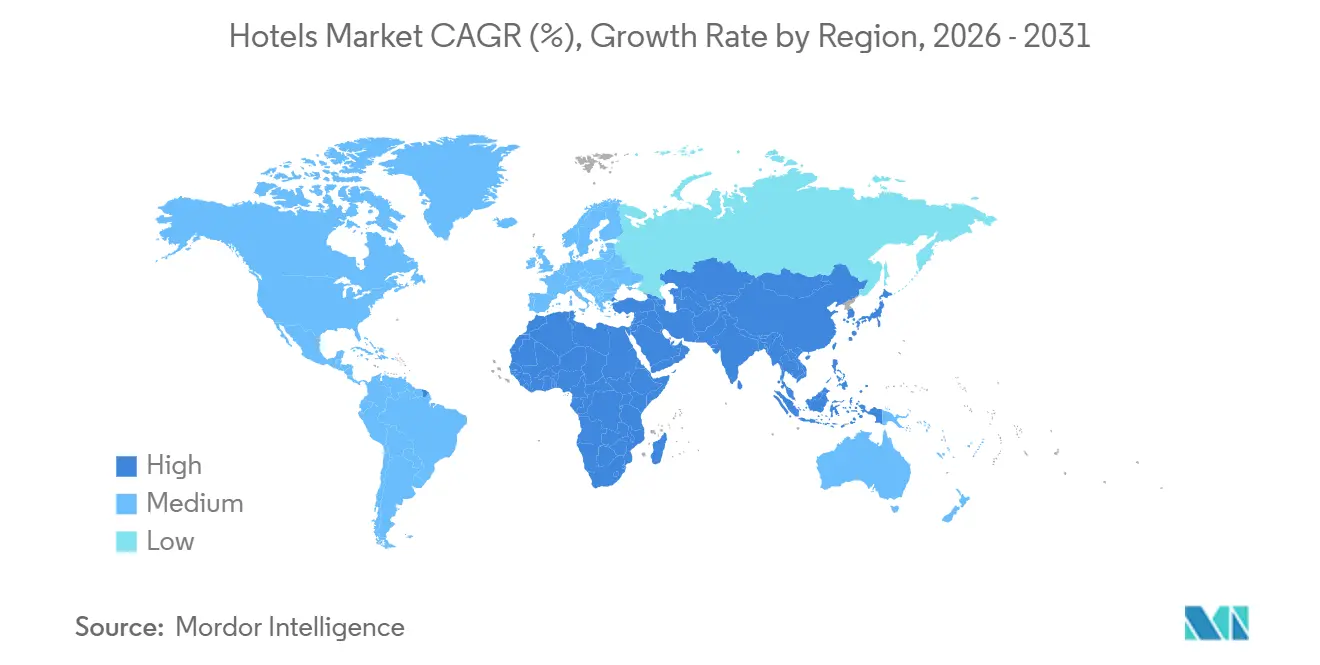
- Across geographies, North America led with 30.83% of hotel revenue in 2026, while Asia-Pacific is projected to grow fastest at an 8.55% CAGR over 2027-2032.
Note: Market numbers in this report are based on Mordor Intelligence's proprietary estimation framework, which combines nine months of actuals with Q4 projections for base year 2026.
Market Trends and Insights
Drivers Impact Analysis of Hotels Market*
| Driver | (~) % Impact on CAGR Forecast | Geographic Relevance | Impact Timeline |
|---|---|---|---|
| Rising international tourist arrivals post-pandemic | +2.4% | North America, Europe and Asia-Pacific | Short term (≤ 2 years) |
| Growing disposable incomes in emerging economies | +2.1% | Urban and rural China | Medium term (2-4 years) |
| Increasing corporate travel & MICE demand | +1.8% | North America, Europe and Asia-Pacific | Medium term (2-4 years) |
| Boom in domestic "staycation" tourism sustaining occupancy | +1.3% | Domestic hotel destinations in Switzerland | Short term (≤ 2 years) |
| Regulatory clamp-downs on alternative lodging spurring hotel innovation | +0.2% | New York City | Medium term (2-4 years) |
| AI-driven dynamic pricing lifting RevPAR | +0.4% | Austria, France, Germany, Greece, Italy and Switzerland | Short term (≤ 2 years) |
| Source: Mordor Intelligence | |||
Rising international tourist arrivals post-pandemic
Additional international arrivals broaden the pool of travelers who may need hotel accommodation at their destination. UN Tourism's provisional data show 1.54 billion international tourist arrivals worldwide in 2025, up 4.7% from 2024. It estimated 690 million arrivals in January-June 2026, about 3 million more than a year earlier, with arrivals up 0.4%. For hotels attracting inbound visitors, those additional trips offer incremental room sales wherever travelers choose paid hotel stays. Arrivals rose 2% in the first quarter but slipped 1% in the second, so inbound-oriented hotels faced uneven visitor growth within that modest half-year gain.
Growing disposable incomes in emerging economies
Higher real disposable income gives households more purchasing capacity for discretionary overnight travel. China's nationwide per-capita disposable income increased 4.4% in real terms and 5.3% nominally in the first three quarters of 2026 compared with the same period in 2025.[1] The price-adjusted increase matters for accommodation providers because it indicates purchasing power beyond a rise in nominal income alone. For hotels targeting Chinese residents, this creates scope to attract an additional trip or a longer stay within household spending limits. The opportunity does not require every traveler to move into a more expensive room category. Affordable offers that turn greater discretionary capacity into an overnight visit can benefit without depending on a universal shift toward premium accommodation.
Increasing corporate travel & MICE demand
Corporate travel and business events support accommodation demand through different booking horizons. The Global Business Travel Association (GBTA) forecast 1.84 billion business trips worldwide in 2026, up 1.3% or roughly 25 million from 2025, while higher transportation and travel costs dampened demand.[2] The Events Industry Council (EIC) reported global requests for proposals for events more than 12 months ahead at 122% of 2019 levels in Q1 2026, up from 115% in Q4 2025. With travel spending rising faster than trips in GBTA's forecast, higher expenditure alone is a weak signal for additional occupied rooms. For convention hotels, forward proposals create an earlier sales opportunity, but their value depends on conversion into contracted accommodation. Negotiating room commitments alongside event business matters more than treating an event inquiry as secured hotel revenue.
Boom in domestic "staycation" tourism sustaining occupancy
Domestic guests provide hotels with overnight demand that does not depend on an international arrival. Swiss hotels recorded a record 21.1 million overnight stays by domestic guests in 2025, up 1.4% from 2024.[3] In July 2025, domestic visitors recorded 2.2 million Swiss hotel overnight stays, the highest monthly domestic total and an increase of 70,000 nights over July 2024. Hotels positioned to attract these travelers can compete for additional nights within an established domestic customer base. Because July 2025 added 70,000 nights to the highest monthly domestic total, resident demand supported peak-month hotel stays as well as the record annual figure.
Restraints Impact Analysis of Hotels Market*
| Restraint | (~) % Impact on CAGR Forecast | Geographic Relevance | Impact Timeline |
|---|---|---|---|
| Macroeconomic & geopolitical volatility dampening travel sentiment | -1% | United States World Cup host markets | Short term (≤ 2 years) |
| High capex requirements with long pay-back periods | -0.7% | Across the United States | Long term (≥ 4 years) |
| Acute labor shortages & wage inflation in tourism hubs | -0.5% | Across the United States | Short term (≤ 2 years) |
| ESG-linked financing headwinds for non-sustainable hotel assets | -0.2% | United States, Brazil and Canada | Short term (≤ 2 years) |
| Source: Mordor Intelligence | |||
Macroeconomic & geopolitical volatility dampening travel sentiment
Visa friction and geopolitical concerns constrained international event demand before guests reached the hotel-booking stage. In an April 2026 AHLA survey across most U.S. host markets for the 2026 World Cup, close to 70% of hotel owner and operator respondents said these factors significantly suppressed international demand. Those reported barriers acted on the trip itself, so accommodation availability alone could not resolve the constraint. For hotels in those host markets, the remaining cost was international room demand that visa barriers and geopolitical concerns held back, as respondents described it.
High capex requirements with long pay-back periods
Hotel development faces a financing threshold before a property can earn its first accommodation revenue. HVS reported that U.S. hotel supply grew 0.7% in 2025 and attributed the development slowdown in recent years jointly to rising construction and debt costs. A higher construction bill increases the capital that future operating income must recover, while debt costs add to the financing burden. For developers considering new rooms, this combination makes the required income more demanding even where customer demand looks attractive. A project can therefore offer a credible sales opportunity yet fail to justify its capital commitment. The resulting constraint is delayed access to additional room capacity and a higher financial hurdle for bringing that capacity into service.
*Our forecasts treat driver/restraint impacts as directional, not additive. The impact forecasts reflect baseline growth, mix effects, and variable interactions.
Hotels Market Segment Analysis
By Hotel Type (Value):
Commercial Networks and Resort Room ExpansionBusiness/commercial hotels accounted for a 33.98% share of the hotels market size in 2026. PLAZA Hotel Group, which operates owned and leased business hotels, has a total company portfolio of 65+ hotels and 8,000+ rooms across 3 countries. Its central management includes sales and marketing, revenue management, human resources, financial control, accounting and payroll, coordinated from Heilbronn and Hamburg. Across IHG's global comparable hotels, room revenue from business bookings rose 2% in the first half of 2026 versus 2025, with flat room nights and a 2% rate increase. For business-hotel operators, higher earnings per business stay can support revenue even when room-night volume holds steady, complementing the operating scale illustrated by PLAZA.
Resort hotels are forecast to be the fastest-growing hotel-type segment, with an 8.5% CAGR over 2027-2032. Marriott's portfolio added 10 luxury resorts with 1,400 rooms in 2025, representing 25% of its luxury room openings that year. JW Marriott Crete Resort & Spa opened in Marathi, near Chania, Greece, in June 2025, adding 160 guest rooms, suites and villas to Marriott's branded resort offering. At that property, revenue can come from several lodging formats within one beach destination, giving Marriott's resort expansion a commercial scope beyond conventional guest rooms.

By Price Category (Value):
Midscale Reach and Luxury Room ProductivityMidscale represented a 45.16% hotels market share in 2026. At June 30, 2026, Accor's global midscale portfolio comprised 1,913 hotels and 299,180 rooms. Because the portfolio spans managed, franchised, owned and leased properties, Accor's midscale network reaches owners through several control models.
Luxury is the fastest-growing price-category segment, with a 7.95% CAGR forecast over 2027-2032. Marriott's comparable company-operated U.S. and Canada luxury composite recorded revenue per available room (RevPAR) of USD 366.9, up 8.4% in constant USD in the first half of 2026 versus the same period in 2025. That performance highlights the earning power of available premium rooms alongside any case for additional physical capacity. Both occupancy and average daily rate increased in that composite over the same period. Premium earnings growth therefore combines room utilization and pricing, making a well-used premium room base more consequential than higher tariffs alone.
By Rating:
Four-Star Utilization and Five-Star Capacity4-star hotels were the largest rating segment, accounting for 36.86% of hotel revenue in 2026. Macao's 4-star hotels recorded 94.4% average guest-room occupancy in August 2026, up 5.4 percentage points from August 2025. Few rooms were unoccupied on average that month, leaving limited room to increase revenue simply by selling more nights. For these properties, pricing the remaining rooms becomes more consequential as occupancy approaches full capacity.
5-star hotels are forecast to be the fastest-growing rating segment, with an 8.75% CAGR over 2027-2032. Qatar reported 20,789 5-star room keys at year-end 2025 and 65.6% average occupancy during 2025, up from 63.6% in 2024. Qatar's existing 5-star inventory therefore offered room to accommodate more overnight demand as occupancy improved. Selling more nights in those hotels could increase accommodation revenue without requiring another property to open.
By Ownership Model (Value):
Chain Reach and Managed Pipeline DeliveryChain hotels were the largest ownership-model segment, representing 53.57% of hotel revenue in 2026. At year-end 2025, Marriott's global portfolio included nearly 1.78 million rooms across more than 9,800 properties in 145 countries and territories. IHG reported that IHG One Rewards members booked approximately 67% of room nights across its global hotel system in the first half of 2026. Alongside geographic reach, that program-linked demand gives chain affiliation a commercial role connecting individual properties to a shared guest base.
Managed hotels are the fastest-growing ownership-model segment, with an 8.1% CAGR forecast over 2027-2032. At June 30, 2026, IHG's global pipeline included 661 managed hotels with 139,706 rooms, 4 more hotels but 1,197 fewer rooms than June 30, 2025. That mix makes room delivery more consequential than an increase in the number of planned hotels alone. Hotel Indigo Torquay opened in the United Kingdom on November 28, 2025 under Fragrance Group's ownership and IHG Hotels & Resorts' management. Separating ownership from operations gives a new managed property an operating route without requiring its hotel manager to acquire the real estate.
By Booking Channel (Value):
OTA Reach and Direct Reservation CapabilityOnline travel agencies were the largest booking-channel segment, with 38.99% of hotel revenue in 2026. HOTREC estimated that OTAs accounted for 29.9% of European hotel overnights in 2025, based on weighted values without aggregated chain data, slightly below their 2023 level. For hotels using these intermediaries, the commercial role is access to an established flow of guests through an external booking channel. That can be useful when an individual property needs wider booking reach than its own guest relationships provide. Moving away from OTAs consequently requires replacing a meaningful source of stays, rather than changing only where a reservation is processed.
Direct booking through brand websites and call centers is the fastest-growing booking-channel segment, with an 8.4% CAGR forecast for 2027-2032. Travelodge estimated that approximately 90% of its bookings in 2025 came through direct channels, including its own website. HOTREC's unweighted European sample excluding chain data also showed real-time bookings through hotels' own websites, with availability checks, rising to 5.9% of bookings in 2025 from 4.8% in 2023. Expanding that subchannel means providing a place where available rooms can be checked and reserved within the hotel's own sales route. The direct-booking growth case is therefore as much about functioning room distribution as it is about hotel brand visibility.
By End-User:
Leisure Earnings and Blended Trip ExtensionsLeisure was the largest end-user segment, with 57.06% of hotel revenue in 2026. Hotel owner Host Hotels & Resorts Inc. reported comparable hotel RevPAR of USD 251.5 in the second quarter of 2026, up 7% year over year. The lodging real estate investment trust attributed the gain primarily to higher rates driven by strong transient leisure business, particularly at resorts and around FIFA World Cup matches, alongside robust group business. The example links leisure travel to realized pricing performance while giving group business a distinct role in the same revenue base. Resort and event timing can therefore matter to the value of leisure business as well as the number of trips taken.
Bleisure is forecast to be the fastest-growing end-user segment, with a 9.7% CAGR over 2027-2032. In Expedia Group's 2025 survey of 11,000 consumers across 11 markets, 42% planned to add a vacation before or after a business trip, compared with 29% in its 2023 Traveler Value Index. Agoda's 2026 Travel Outlook separately found that 76% of surveyed Asia-Pacific business travelers planned to combine work trips with personal leisure. A hotel that captures the personal extension can earn additional nights from a traveler already arriving for work. Operators seeking to retain these travelers can make extra nights around the work dates bookable as one continuous stay.
Geography Analysis
North America Hotels Market
North America held a 30.83% share of the hotels market size in 2026, making it the largest geography. AHLA projected U.S. hotel guest spending to increase 1.7% in 2026 from 2025. Canadian hotels supplied 466,773 rooms in 2025, up 0.7% from 2024, while room-night demand reached approximately 109 million, up 1.2%. Canadian demand growth exceeded room-supply growth, strengthening the case for earning room revenue from the installed base alongside developing additional properties.
Asia-Pacific Hotels Market
Asia-Pacific is the fastest-growing geography, with an 8.55% CAGR forecast over 2027-2032. JLL reported that regional hotel RevPAR in USD increased more than 6% on average during January-May 2026 despite geopolitical tensions in the Middle East. City of Dreams Sri Lanka, built by John Keells Holdings, officially opened in Colombo on August 1, 2025. The resort includes the 687-room Cinnamon Life hotel and 113-room Nüwa hotel, with Melco Resorts & Entertainment operating Nüwa. Sri Lanka's SLTDA-registered classified tourist hotels increased from 16,808 rooms across 167 establishments in 2024 to 18,308 rooms across 170 establishments in 2025, expanding the inventory available to earn accommodation revenue.
In South America, national travelers made up 66.2% of Colombia's hotel guests in 2025 and international guests 33.7%, establishing national travel as the larger customer base. Colombia's broader national accommodation occupancy fell to 49.2% in August 2026 from 52% in August 2025, increasing the unused portion of accommodation capacity. In Europe, Croatia recorded 26.3 million tourist nights in hotels and similar accommodation in 2025, up 2.7% from 2024, showing expanding overnight demand. Within Middle East and Africa, Kenya's hotel occupancy bed-nights increased 12.6% to 11.56 million in 2025, with residents accounting for 45% of occupancy, making domestic stays commercially significant. Foreign tourists accounted for 43% of European hotel stays as of November 2025, whereas Colombian hotel guests were predominantly national travelers, giving international and national demand different commercial weights across these locations.
Regulatory Framework and Outlook
The comparison covers selected jurisdictions from the perspective of a hotel operator selling paid accommodation and handling guest arrivals. France's voluntary star classification and Shanghai's mandatory guest-registration duties create different operating decisions within that common business model. The commercial distinction is between obligations needed to handle guests and a classification process an operator can choose to support its accommodation offering.
Regulatory Table of Hotels Market
| Decision factor | United States | Chile | France | China | Saudi Arabia |
|---|---|---|---|---|---|
| Primary authority | U.S. Department of Justice | Servicio Nacional de Turismo, SERNATUR | Atout France | Shanghai Municipal Public Security Bureau for the local registration rule | Ministry of Tourism |
| Key instruments or direction | Americans with Disabilities Act Title III, 28 CFR Part 36; long-term review without a proposed-rule publication date | Decree No. 19 registration framework; older-people infrastructure bill under first-stage discussion on September 30, 2026 | Voluntary hotel star classification; accredited inspection every 5 years; January 2026 announcement of restricted renewal extensions from September 1, 2026 | Shanghai lodging-registration rule valid through April 27, 2030; national guidance dated September 30, 2025 | Tourist accommodation licensing rules; adopted revised penalty schedule from July 1, 2027 |
| Commercial effect | Covered hotels meet applicable accessibility and nondiscrimination duties; proprietor-occupied residences with 5 or fewer rooms for rent are excluded | Accommodation providers must register; documentation includes a matching municipal license or exemption proof, with exceptional provisional registration for external licensing delays supported by a current document from the competent authority | Operators choose classification; accredited evaluators inspect, with mystery visits for 4-star and 5-star applications; Atout France decides classification and may refuse it despite a favorable evaluation; classified hotels display stars and award year | Shanghai hotels verify ID, record identity information and upload within 2 hours of registration; police or immigration verify guests without valid IDs; national guidance encourages digital transformation | Operation requires a license, specified application and classification conditions, and ministry approval of the inspection report |
| Current policy attractiveness | Medium | Medium | High | Medium | Medium |
| Future direction of policy attractiveness | No change | Hardening | Hardening | No change | No change |
| Source: Mordor Intelligence | |||||
Chilean registration and U.S. accessibility duties support Medium, with Chile's September 30, 2026 committee vote and 3-week amendment period on proposed older-people assistance and safety infrastructure supporting Hardening, while unscheduled U.S. review supports No change. France's voluntary framework supports High attractiveness and No change, incorporating Atout France's January 20, 2026 announcement of extensions limited to renewal time from September 1, 2026 within the established classification process. China's Medium rating balances Shanghai's 2-hour upload workflow with national guidance encouraging digital improvement, while the local rule's validity through April 27, 2030, supports No change. Saudi Arabia's Medium rating reflects licensing and inspection requirements, while No change captures steady penalty and closure terms for specified first-range, category-one unlicensed activity under the July 1, 2027 schedule.
Value Chain Stages
The value chain compares how brand and management providers, distribution platforms, and hotel operators earn from delivering paid stays. Hilton's base management fees generally track hotel gross operating revenue, while applicable incentive fees depend on operating profits and sometimes an owner-return threshold. Marriott's franchising arrangements generally include application fees and room-revenue royalties of 4% to 7%, plus up to 4% of food and beverage revenue for certain brands. These arrangements create different exposures to a property's sales and profitability, so additional room revenue does not benefit every participant on the same basis.
Value Chain Analysis Table of Hotels Market
| Primary activity | Key participants | Value capture | Bottleneck | Resilience response |
|---|---|---|---|---|
| Brand affiliation and management setup | Franchisors such as Marriott International Inc.; hotel managers such as Hilton Worldwide Holdings Inc. and Marriott International Inc. | Application fees, continuing royalties and management fees, with incentive fees when applicable | Fee earnings depend on hotel revenue and, for applicable incentives, operating profit or owner-return conditions | Align management milestones with the property's revenue and profit requirements |
| Booking distribution | Online travel platform groups such as Booking Holdings and Expedia Group | Booking commissions | Commission pressure described by European hotel respondents | Strengthen direct-booking options alongside intermediated sales |
| Accommodation and guest-service delivery | Hotel operators such as Hilton Worldwide Holdings Inc. and Marriott International Inc. | Nightly room sales, food and beverage sales, and other hotel-operated guest services | Balancing accommodation and food-service delivery capacity | Match service staffing to occupied rooms and food-service demand |
| Source: Mordor Intelligence | ||||
In HOTREC's 2025 reference-year study, Booking Holdings and Expedia Group together accounted for 85.4% of European OTA bookings. Analysis of 73 open-ended hotel comments in that European study found that some respondents viewed commissions as reducing profitability and described efforts to strengthen direct bookings. Direct-booking investment can consequently change who captures booking value, even when the same hotel delivers the stay.
Competitive Landscape
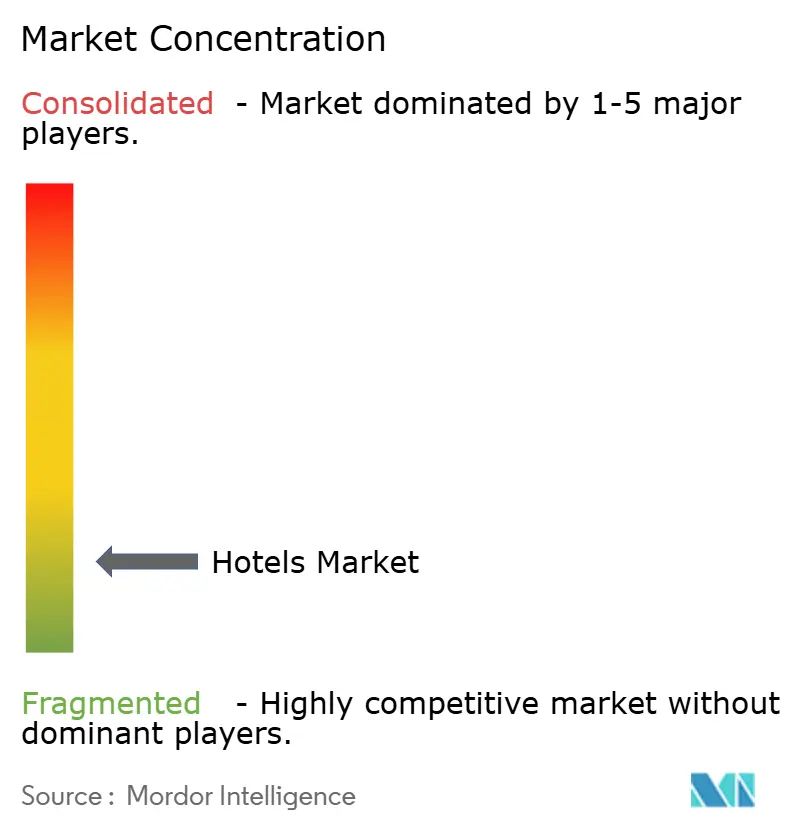
Competition combines large international hotel networks with independent properties, producing a moderately fragmented industry with substantial scale at the brand level. Major players include Marriott International Inc., Jin Jiang International Holdings Co. Ltd., Hilton Worldwide Holdings Inc., InterContinental Hotels Group PLC and Accor S.A. Marriott added nearly 100,000 gross rooms globally in 2025, while its net room count grew more than 4.3% from year-end 2024. The competitive asset in that expansion is access to a growing hotel network, giving property owners an option to join broader commercial infrastructure while managing their own hotel's capital case.
Hilton reported 6.7% net unit growth in 2025 and ended the year with 520,000 rooms under development globally. That combination gives owners a record of network expansion alongside an indication of further capacity planned within the wider system. Pipeline capacity adds a forward dimension to rivalry, because hotels that open will seek paid stays in destinations served by the network. If room additions outpace local paid-stay demand, expansion can sharpen price competition among properties seeking the same guests. A growing chain can therefore strengthen its overall platform while increasing competition for an individual affiliate where new hotels enter the same destination.
In October 2025, Accor reported that its IDeaS revenue-management system was a brand standard used in more than 2,900 hotels, supporting over half its worldwide hotel network. Marriott U.S. and specified U.S. affiliates reported May 2026 certification under the EU-U.S. Data Privacy Framework, UK Extension and Swiss-U.S. Data Privacy Framework for personal data received from the European Economic Area, UK and Switzerland. In 2025, Loyalty Program members booked approximately 68% of Marriott's global hotel room nights. For an owner considering a change of affiliation, that room-night mix makes replacing access to the loyalty guest base part of the revenue decision.
Hotels Industry Leaders
-
Marriott International Inc.
-
Jin Jiang International Holdings Co. Ltd.
-
Hilton Worldwide Holdings Inc.
-
InterContinental Hotels Group PLC
-
Accor S.A.
- *Disclaimer: Major Players sorted in no particular order
Hotels Market Companies Covered in this Report
- Accor S.A.
- Marriott International Inc.
- Hilton Worldwide Holdings Inc.
- InterContinental Hotels Group PLC
- Hyatt Hotels Corporation
- Wyndham Hotels & Resorts Inc.
- Choice Hotels International Inc.
- Jin Jiang International Holdings Co. Ltd.
- OYO Rooms
- Radisson Hotel Group
- Meliá Hotels International SA
- Best Western International Inc.
- Four Seasons Hotels Ltd.
- Mandarin Oriental International Ltd.
- Shangri-La Hotels & Resorts
- Louvre Hotels Group
- Minor Hotels Europe & Americas
- Minor International PCL (Anantara, Avani)
- Whitbread PLC (Premier Inn)
- ESH Hospitality Inc.
- Red Lion Hotels Corp.
- Host Hotels & Resorts Inc.
- MGM Resorts International
- Kerzner International Ltd.
- Kempinski Hotels
Key Opportunities for Market Participants
The opportunities compare existing-hotel brand conversions, guest revenue from Saudi capacity additions, and continuity of EU room sales during building upgrades. Wyndham's late-2025 survey covered 325 hotel owners and developers at vice president level or higher across multiple brands in the United States, Canada and the Caribbean. Among respondents, 79% planned portfolio expansion over the following 5 years, while 97% were open to joining or switching brands if the right opportunity arose. That combination favors offers that connect an owner's development or brand decision with a credible path to paid guest stays.
Market Opportunities Table of Hotels Market
| Opportunity | Why now | Buyer / lead segment | Recommended play | Main barrier | Likely beneficiaries |
|---|---|---|---|---|---|
| Convert existing hotels to a branded room offering | Conditional owner openness to brand changes in the surveyed United States, Canada and Caribbean population | Owners of operating hotels considering affiliation | Link conversion terms to distribution support and the property's room-revenue case | Operating costs, talent shortages and competition identified by surveyed owners | Converting hotel owners and franchisors such as Wyndham Hotels & Resorts Inc. |
| Build guest demand for incoming Saudi hotel capacity | A batch approved in October 2026 includes 19 hospitality projects expected to add more than 3,000 hotel rooms, with first operations scheduled by end-2026 and later openings through 2029 | Guests of hotels entering operation in Saudi Arabia | Phase accommodation sales around verified property opening dates | Delivery of approved but unfinished capacity | Operators of the incoming hotels and their accommodation customers |
| Preserve available hotel rooms through energy upgrades | The in-force EU directive targets the worst-performing 16% of non-residential buildings by 2030 and 26% by 2033 using nationally determined thresholds | Operators of EU hotels within affected building stock | Coordinate phased building upgrades with continued accommodation delivery | Renovation capital commitments | Hotel operators able to keep rooms available through the upgrade cycle |
| Source: Mordor Intelligence | |||||
Conversion of operating hotels is the central opening, because affiliation can change around rooms already in service. Its constraint is the surveyed owners' openness only if the right opportunity arises, which requires a suitable offer before interest becomes a brand agreement. Operating costs and talent shortages were reported obstacles for that surveyed population, making operating support a concrete basis on which franchisors can shape the conversion offer.
Recent Industry Developments in Hotels Market
- Oct 2026: IHG Hotels & Resorts opened InterContinental Taipei in Taiwan, developed in partnership with Farglory Group.
- Oct 2026: Rimrock Banff, Emblems Collection, opened in Banff National Park in Canada, marking the North American debut of Accor's Emblems Collection.
- Sep 2026: Hilton opened DoubleTree by Hilton Singapore Robertson Quay, the brand's first hotel in Singapore.
Hotels Market Report Scope and Research Methodology
Market Definition and Coverage
The global hotels market measures annual revenue earned by hotels worldwide from paid guest accommodation and hotel-operated guest services. It covers hotel spending across property types, price categories, ratings, ownership and booking channels, end-user purposes, and all global regions.
Scope exclusions: Short-term rentals in private homes and apartments that are not operated as hotels, standalone businesses not operated as part of a hotel, online travel agency and travel agent commissions or booking fees, and hotel property construction, land, and asset-sale transactions are excluded.
Segments Covered in This Report
- By Hotel Type (Value)
- Business/Commercial Hotels
- Boutique Hotels
- Resort Hotels
- Casino Hotels
- Transit Hotels
- Bed & Breakfast Hotels
- Others
- By Price Category (Value)
- Economy/Budget
- Midscale
- Luxury
- By Rating
- 1 Star
- 2 Star
- 3 Star
- 4 Star
- 5 Star
- By Ownership Model (Value)
- Chain Hotels
- Independent Hotels
- Managed Hotels
- Others
- By Booking Channel (Value)
- Direct Booking (Brand Website, Call Center)
- Online Travel Agencies (OTA)
- Travel Agents / Tour Operators
- Corporate Contracts
- By End-User
- Leisure
- Bleisure
- Business
- By Geography
- North America
- United States
- Canada
- Mexico
- South America
- Brazil
- Peru
- Chile
- Argentina
- Rest of South America
- Europe
- United Kingdom
- Germany
- France
- Spain
- Italy
- BENELUX (Belgium, Netherlands, Luxembourg)
- NORDICS (Denmark, Finland, Iceland, Norway, Sweden)
- Rest of Europe
- Asia-Pacific
- India
- China
- Japan
- Australia
- South Korea
- South-East Asia (Singapore, Malaysia, Thailand, Indonesia, Vietnam, and Philippines)
- Rest of Asia-Pacific
- Middle East and Africa
- United Arab Emirates
- Saudi Arabia
- South Africa
- Nigeria
- Rest of Middle East and Africa
- North America
Data Sources, Market Sizing, and Validation
Desk Research
To distinguish room-night demand from dollar receipts, sources such as Eurostat tourism statistics and Statistics Canada's accommodation survey provide official measures of accommodation nights, revenue categories, room supply, and booking methods. Sources such as the Global Business Travel Association's forecast add corporate travel context, while InterContinental Hotels Group's public annual report provides hotel operating performance. Since travel spending can include transport and other purchases, national statistical programs and tourism authorities help analysts cross-check travel activity against hotel sales.
Alongside these indicators, company filings, investor materials, and reputable business and travel press provide supplementary evidence on room portfolios, revenue mix, openings, and operating conditions, and can clarify whether reported activity belongs to hotel operations. These sources are not exhaustive, and further sources inform collection, validation, and clarification.
Primary Interviews and Surveys
Interviews would cover hotel owners and operators, general managers, revenue-management and finance leaders, travel buyers, and tourism officials across APAC, EMEA, and the Americas. Questions would test secondary estimates of room demand, occupancy, average room rates, hotel-operated guest-service revenue, channel mix, and regional differences, with particular attention to whether each figure measures hotel revenue or adjacent travel activity. Where records or expert explanations diverge, analysts would trace the gap to its year, boundary, or source definition, seek clarification from relevant respondents, and triangulate it against independent operating and travel indicators.
Distribution of primary research fieldwork respondents
| Company type | Respondent position | Region |
|---|---|---|
| Top tier: 30% | CXOs: 15% | APAC: 38% |
| Mid tier: 55% | Functional/Unit leaders: 40% | EMEA: 33% |
| Smaller Players: 15% | Managers: 45% | Americas: 29% |
Market-Sizing & Forecasting
The model estimates global annual hotel revenue from a top-down view of paid accommodation and hotel-operated guest services, using available room supply, occupied room nights or occupancy, average daily room rates, hotel service revenue per guest, and travel activity by leisure, business, and event purpose. Those indicators connect capacity and paid demand to hotel sales, while company and official statistics help distribute the total across hotel type, price category, rating, ownership, booking channel, end user, and region according to each source's reported categories.
For the 2027-2032 outlook, scenario analysis adjusts room demand and room rates for travel growth, income, corporate and event travel, regional capacity additions, and operating constraints. Primary respondents can check whether each variable and its direction fit local operating conditions. Selective bottom-up checks compare representative room-night and rate observations or disclosed hotel portfolios with the global total. When a representative observation is unavailable, analysts use the closest documented regional or property-type evidence and test the resulting check against independent indicators rather than treating it as an observed value.
Data Validation & Update Cycle
Analysts triangulate hotel revenue estimates against room supply, occupancy, room-rate trends, tourism nights, travel indicators, and hotel-company disclosures, then investigate material differences in year, geography, or revenue boundary. Anomalies are checked against the originating source and an independent signal, reviewed by a second analyst, and resolved through documented source reconciliation before sign-off. Respondents are re-contacted when definitions remain unclear or a material operating input conflicts with the supporting evidence. The model is refreshed annually, reassessed between cycles when material travel, regulatory, supply, or economic events alter an input, and given a fresh source and calculation review immediately before delivery.
Mordor Intelligence's Global Hotels Market Size Compared With Other Published Estimates
Published estimates can differ in the transactions and products they count and the inputs used to model demand. The global hotels market measures annual revenue earned by hotels worldwide from paid guest accommodation and hotel-operated guest services.
Key Gap Drivers include the study's defined coverage and market-specific modeling choices. The model estimates global annual hotel revenue from a top-down view of paid accommodation and hotel-operated guest services, using available room supply, occupied room nights or occupancy, average daily room rates, hotel service revenue per guest, and travel activity by leisure, business, and event purpose. Those indicators connect capacity and paid demand to hotel sales, while company and official statistics help distribute the total across hotel type, price category, rating, ownership, booking channel, end user, and region according to each source's reported categories.
Benchmark comparison
| Source | Market Size | Gaps in Research Methodology |
|---|---|---|
| Mordor Intelligence | USD 1.46 T (2027) | |
| Global Research Firm A | USD 1.09 T (2025) | At its 2025 base, this estimate is 25.3% below this report's 2027 value of USD 1.46 T, 2 years later. Its published series begins from an earlier global estimate and forecasts continued expansion, so the older measurement year contributes to the lower comparison. |
| Global Research Firm B | USD 870 B (2025) | At its 2025 base, this estimate is 40.4% below this report's 2027 value of USD 1.46 T, 2 years later. Its published estimate is for an earlier year and the page projects market growth, which can place that value below a later-year measure. |
Mordor Intelligence's analysts triangulate hotel revenue estimates against room supply, occupancy, room-rate trends, tourism nights, travel indicators, and hotel-company disclosures, then investigate material differences in year, geography, or revenue boundary.
Key Questions Answered in the Report
What is the hotels market size and growth outlook?
The size is projected at USD 1.46 trillion in 2027 and USD 1.97 trillion by 2032, with a 6.15% CAGR over 2027-2032.
What is supporting demand for hotel stays?
Rising purchasing power in China, corporate travel and domestic overnight demand support paid-stay opportunities. Swiss domestic hotel nights increased in 2025.
Which hotel type leads revenue?
Business/commercial hotels led with 33.98% of hotel revenue in 2026. Resort hotels are forecast to grow fastest at an 8.5% CAGR over 2027-2032.
Which companies are major hotel competitors?
Major competitors include Marriott International Inc., Jin Jiang International Holdings Co. Ltd., Hilton Worldwide Holdings Inc., InterContinental Hotels Group PLC and Accor S.A.
What challenge can slow hotel capacity growth?
Construction and debt costs can slow new capacity. HVS reported 0.7% U.S. hotel supply growth in 2025 and identified these combined costs as development constraints.
Which regions lead hotel revenue and forecast growth?
North America led with 30.83% of hotel revenue in 2026. Asia-Pacific is forecast to grow fastest at an 8.55% CAGR over 2027-2032.