
Hotel Franchise Market Size and Share
Market Overview
| Study Period | 2022 - 2032 |
|---|---|
| Market Size (2027) | USD 48.13 Billion |
| Market Size (2032) | USD 67.92 Billion |
| Growth Rate (2027 - 2032) | 7.13 % |
| Fastest Growing Market | Asia-Pacific |
| Largest Market | North America |
| Market Concentration | Low |
Major Players *Disclaimer: Major Players sorted in no particular order Image © Mordor Intelligence. Reuse requires attribution under CC BY 4.0. | |
Hotel Franchise Market Analysis by Mordor Intelligence
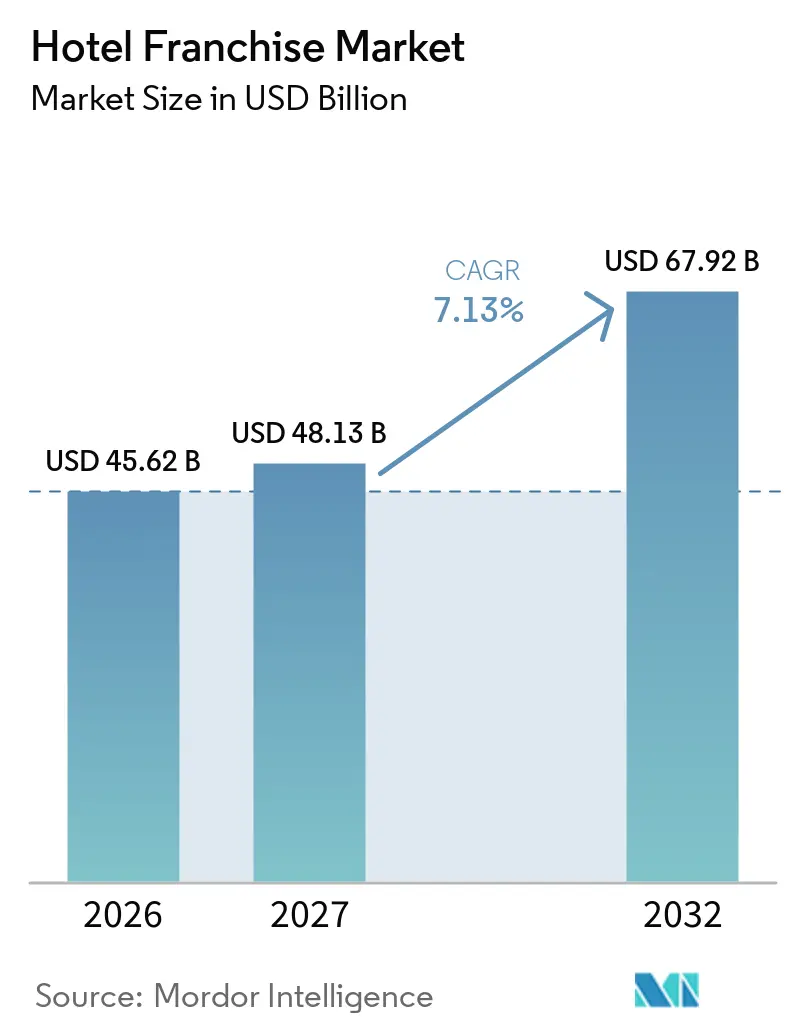
The global hotel franchise market size was valued at USD 45.62 billion in 2026 and is estimated to grow from USD 48.13 billion in 2027 to reach USD 67.92 billion by 2032, at a CAGR of 7.13% during the forecast period (2027-2032). Hotel owners increasingly rely on established brands, global distribution systems, and loyalty programs to support bookings and occupancy. Asset-light franchising enables operators to expand networks while limiting property ownership. North America remains a mature franchise market, while Europe, the Middle East, and Asia-Pacific offer opportunities through new construction, conversions, and brand expansion. At year-end 2025, Hilton reported a development pipeline of 3,703 hotels, representing 520,500 rooms across 129 countries and territories. More than half of these pipeline rooms were outside the United States, indicating international expansion opportunities. In Asia-Pacific markets, branded supply is expanding beyond major cities, while conversion agreements and limited-service, extended-stay, and lifestyle formats broaden franchise options.
Key Report Takeaways
- By hotel class, midscale accounted for 36.50% of the global hotel franchise market share in 2026 and is forecast to grow at an 8.67% CAGR through 2032.
- By hotel type, limited-service accounted for 38.90% of the global hotel franchise market share in 2026, while extended-stay is forecast to expand at an 8.12% CAGR through 2032.
- By franchise agreement type, traditional agreements accounted for 58.20% of the global hotel franchise market share in 2026, while soft-brand franchises are forecast to grow at an 8.56% CAGR through 2032.
- By brand category, international brands accounted for 70.20% of the global hotel franchise market share in 2026, while domestic and regional brands are forecast to expand at an 8.76% CAGR through 2032.
- By geography, North America accounted for 39.40% of the global hotel franchise market share in 2026, while Asia-Pacific is forecast to grow at an 8.96% CAGR through 2032.
Note: Market numbers in this report are based on Mordor Intelligence's proprietary estimation framework, which combines nine months of actuals with Q4 projections for base year 2026.
Market Trends and Insights
Drivers Impact Analysis of Hotel Franchise Market*
| Driver | (~) % Impact on CAGR Forecast | Geographic Relevance | Impact Timeline |
|---|---|---|---|
| Brand Recognition and Loyalty Program Reach | +2.0% | Global, strongest in North America and Asia-Pacific | Long term (≥ 4 years) |
| Rising Hotel Development Demand in Secondary and Emerging Markets | +1.5% | Asia-Pacific core, with spillover to the Middle East, Africa, and South America | Medium term (2-4 years) |
| Asset-Light Expansion and Fee-Based Economics | +1.2% | Global, led by North America and Europe | Long term (≥ 4 years) |
| Affordable Limited Service and Extended-Stay Demand | +1.0% | North America and Asia-Pacific | Medium term (2-4 years) |
| Conversion-Led Growth and Adaptive Reuse | +0.8% | North America and Europe | Short term (≤ 2 years) |
| Data-Rich Revenue Management and Direct Booking Enablement | +0.6% | Global, with early adoption in Asia-Pacific | Medium term (2-4 years) |
| Source: Mordor Intelligence | |||
Brand Recognition and Loyalty Program Reach
Loyalty programs provide franchisees with access to repeat guests and established booking channels that many independent hotels cannot develop independently. Wyndham licenses its brands to more than 6,200 franchises globally and provides access to Wyndham Rewards, which had more than 122 million enrolled members in 2025. Marriott generated USD 3,325 million in franchise fee revenue in 2025, a 7% increase from the prior year, demonstrating the value of a large branded system even when hotel performance growth is moderate[1]. Loyalty platforms also support direct bookings, reduce reliance on third-party channels, and help properties retain guest data. In emerging markets, international hotel chains can use these networks to attract inbound travelers, while domestic guests can access familiar rewards across multiple cities. These benefits strengthen franchisee renewal incentives by providing a stable demand source across travel cycles.
Rising Hotel Development Demand in Secondary and Emerging Markets
Hotel franchising is expanding beyond established gateway cities as brands target emerging destinations across Asia-Pacific, the Middle East, South America, and Europe. Marriott signed nearly 1,200 global development agreements in 2025, covering 163,000 rooms, including 187 agreements in Asia-Pacific excluding China and 201 in Greater China. Conversions accounted for more than 30% of globally signed rooms, enabling owners to adopt established brands without developing new properties. In the Caribbean and Latin America, Marriott signed a record 94 agreements and added more than 10,000 rooms to its regional portfolio. These developments highlight opportunities in secondary cities and emerging leisure destinations, where brand recognition, distribution access, and conversion-friendly models support expansion while reducing development costs.
Asset-Light Expansion and Fee-Based Economics
The asset-light model enables hotel companies to expand their brand networks without acquiring each property. IHG reported USD 1,897 million in fee-based revenue in 2025, while its global RevPAR increased by 1.5%. During 2025, Hilton added nearly 800 hotels and 97,000 rooms, and its management and franchise fee revenue increased by 6.4%. These results demonstrate why operators prioritize signings, conversions, and pipeline execution alongside hotel-level performance. In emerging markets, this structure allows owners to retain real estate ownership while using brand standards, distribution networks, and operating systems. It also enables international operators to enter diverse markets without bearing the capital costs of each new property. The hotel franchise market remains attractive where separate parties provide real estate capital and operating expertise.
Affordable Limited-Service and Extended-Stay Demand
Limited-service and extended-stay formats cater to travelers seeking practical accommodation and owners aiming to reduce operational complexity. Choice Hotels International reported 12% growth in the United States extended-stay net rooms in 2025. Extended-stay properties accounted for approximately 17% of Wyndham’s 259,000-room development pipeline in 2025[2]. These formats serve project workers, relocating households, medical travelers, and long-stay corporate guests. In emerging markets, they can support demand in industrial corridors, airport zones, education hubs, and emerging tier-2 business destinations. Their simplified service model can improve unit economics, although operators must manage local labor costs and brand requirements carefully.
Restraints Impact Analysis of Hotel Franchise Market*
| Restraint | (~) % Impact on CAGR Forecast | Geographic Relevance | Impact Timeline |
|---|---|---|---|
| Franchise Development and Property Improvement Costs | -0.7% | North America and Europe | Short term (≤ 2 years) |
| Labor Availability and Service-Quality Pressure | -0.5% | Global | Medium term (2-4 years) |
| Channel, Loyalty, and Technology Fee Escalation | -0.4% | Global, concentrated in North America | Medium term (2-4 years) |
| Brand-Standard Rigidity in Local Operating Contexts | -0.3% | Asia-Pacific, the Middle East, Africa and South America | Long term (≥ 4 years) |
| Source: Mordor Intelligence | |||
Franchise Development and Property Improvement Costs
Property improvement plans can impose high initial or renewal costs on franchisees. Requirements often include guest room upgrades, public-area renovations, safety enhancements, accessibility improvements, and technology updates. Construction financing, material prices, and labor costs can further increase project expenses and complicate approval decisions. Owners must also meet local construction approval, fire safety, and building compliance requirements before opening or relaunching a property. Owners may therefore pursue conversions only when anticipated revenue gains justify capital investment. The hotel franchise market depends on owners’ ability to fund upgrades without compromising property cash flow. These requirements can also delay expansion in locations where smaller owners have limited access to long-term financing.
Labor Availability and Service-Quality Pressure
Hotel franchises rely on individual owners to recruit, retain, and train staff, while guests associate service quality with the brand. American Hotel & Lodging Association (AHLA) identified workforce conditions as an ongoing challenge in its 2025 industry report. Limited-service and economy hotels may face difficulty offering higher wages while maintaining brand-name service standards. This challenge also applies in emerging markets, where staff availability and training quality vary by city and hotel format. Poor service experiences can negatively affect guest reviews, loyalty program participation, and repeat bookings. Franchise systems need practical training support and standards that reflect local operating conditions.
*Our forecasts treat driver/restraint impacts as directional, not additive. The impact forecasts reflect baseline growth, mix effects, and variable interactions.
Consumer Behavior Analysis
Travelers increasingly assess hotels based on trust, pricing transparency, rewards, and meaningful experiences rather than room rates alone. According to a 2026 Choice Hotels survey of U.S. adults, 83% of respondents said trust was critical to perceived value, 64% said rewards enhanced value, and 57% reported encountering offers undermined by hidden fees or inconsistent quality. For franchisees, consistent service delivery, transparent fees, and easily accessible rewards can strengthen guest confidence and encourage repeat bookings.
Hotel discovery is also shifting across digital channels. SiteMinder’s 2026 study of 12,000 travelers across 14 countries found that 26% began their hotel research on online travel agencies (OTAs), up from 18%, while the share using search engines declined from 36% to 21%. The study also found that 65% of respondents supported demand-based pricing. Meanwhile, a Global Hotel Alliance survey of its loyalty members found that 87% preferred hotels with global loyalty programs, with this share rising to 93% in India. Franchise owners should balance OTA visibility with direct-booking incentives and transparent, demand-responsive pricing.
Hotel Performance Intelligence
Hotel performance data indicate stronger global growth, with significant regional variation. Hilton reported system-wide RevPAR growth of 5.8% in Q3 2026, including 7.0% growth in the United States and 6.5% in Europe. In contrast, RevPAR declined by 0.5% in Asia-Pacific and 5.6% in the Middle East and Africa. From January through September 2026, global RevPAR increased by 4.7%, compared with 6.0% growth in Europe and a 12.3% decline in the Middle East and Africa. These differences highlight the need for regional diversification and market-specific pricing.
Brand-level results also showed varied performance. Hilton’s LXR portfolio recorded RevPAR of USD 329.67 in Q3 2026, up 14.3%, compared with USD 103.49 for Hampton by Hilton, up 4.4%. The rate differential supports luxury segment growth in markets with strong consumer spending power, while midscale brands provide broader market reach. Franchisees should align brand positioning, investment, and pricing with local demand rather than assume uniform returns across markets.
Hotel Franchise Market Segment Analysis
By Hotel Class:
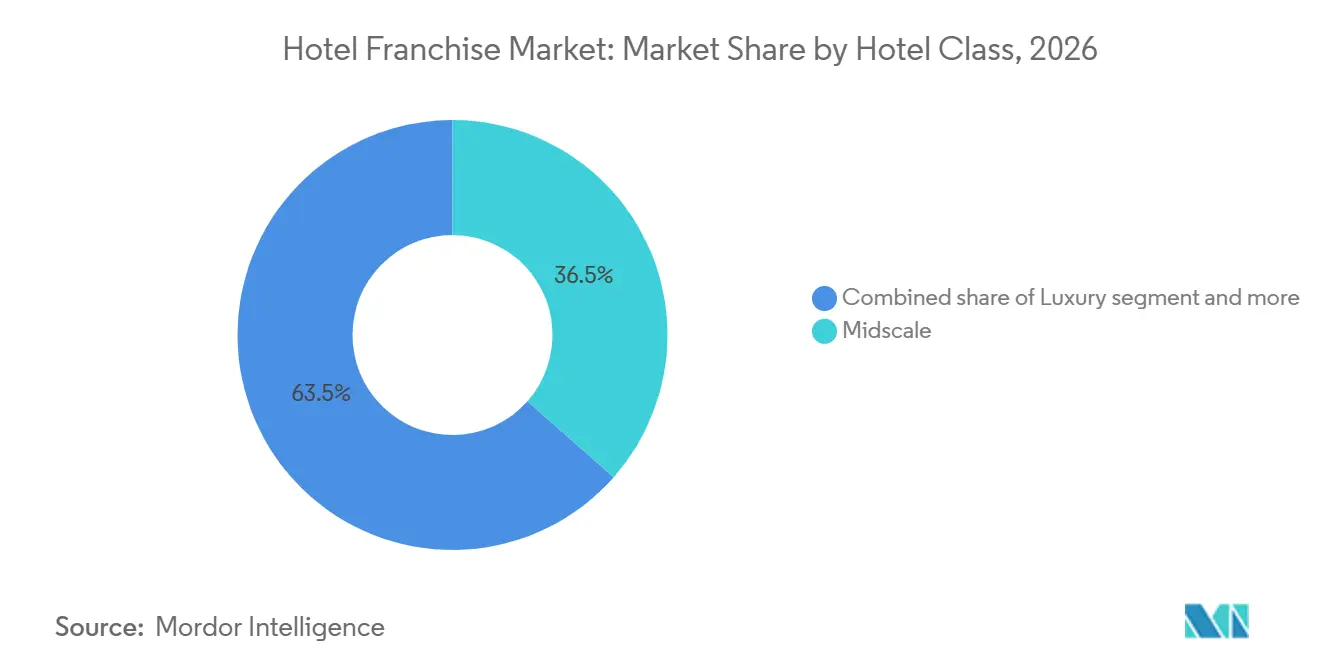
Midscale Anchors Franchise Growth at Both EndsMidscale hotels accounted for a 36.5% revenue share of the global hotel franchise market in 2026 and are projected to grow at an 8.67% CAGR through 2032. Their position reflects demand for accommodation that is affordable for guests and financially viable for property owners. Midscale hotels require less capital than luxury properties and can be developed in secondary markets. They serve domestic leisure, business, and small-group travelers without the operating costs of full-service models. This format is relevant to emerging markets, where travelers seek familiar standards at value-oriented price points.
Luxury properties can generate higher fees per room when room rates and guest spending are strong. Hilton reported Waldorf Astoria RevPAR of USD 304.14 in 2025, up 9.7% from 2024[3]. However, luxury franchising has a smaller addressable owner base because of higher development, staffing, and brand-standard compliance costs. Economy hotels offer volume and conversion opportunities but face pressure from labor and renovation costs. The hotel franchise market benefits operators that maintain balanced portfolios across hotel classes rather than relying on a single traveler segment.

By Hotel Type:
Limited-Service Leads While Extended-Stay ExpandsLimited-Service Hotels accounted for 38.9% of the global hotel franchise market size in 2026. Their operating model requires smaller teams and more standardized processes than many full-service hotels. This structure can improve owner economics and support faster expansion across suburban, highway, airport, and business locations. Limited-service properties are also easier for first-time owners to operate within an established brand framework. In emerging markets, the format aligns with demand in business corridors and emerging city markets that require predictable accommodation without extensive amenities.
Extended-Stay Hotels are projected to grow at a CAGR of 8.12% through 2032. The format serves long-duration demand from project workers, remote professionals, relocating households, and medical travelers. Choice Hotels reported a 12% increase in United States extended-stay net rooms in 2025[4]. Resorts, boutiques, and lifestyle hotels also support soft-brand growth, as owners seek distribution benefits while retaining local character. Full-Service Hotels remain important; however, complex staffing and food-and-beverage operations can make management contracts more suitable than franchise agreements.
By Franchise Agreement Type:
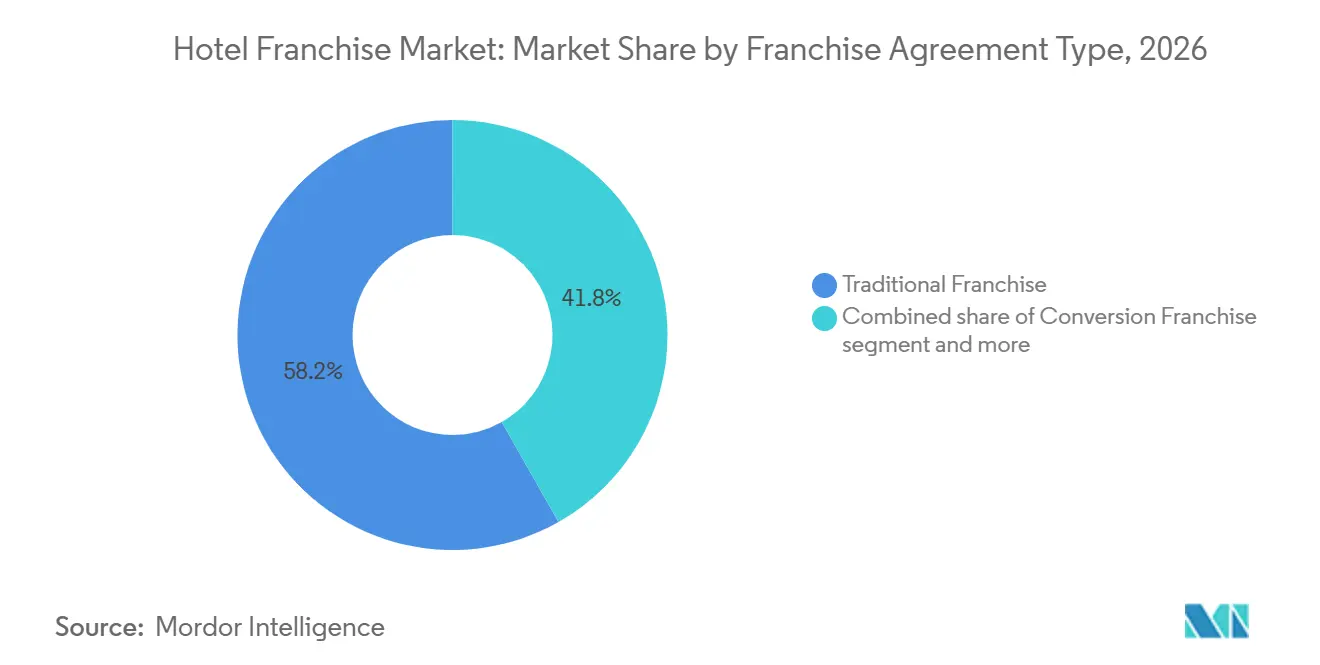
Traditional Framework Persists While Soft Brands GrowTraditional Franchise agreements accounted for 58.2% of global hotel franchise market revenue in 2026. They provide owners with a defined brand package that typically includes operating standards, marketing, reservation systems, training, and quality monitoring. Wyndham Hotels & Resorts reported that its franchise agreements typically run for 10 to 20 years, supporting long-term planning for owners and brands. This model provides operators with recurring fee visibility and owners with access to an established commercial platform. Traditional agreements can suit owners seeking a complete brand system and accepting a defined level of standardization.
Soft-Brand Franchise agreements are forecast to grow at a CAGR of 8.56% through 2032. They enable independent properties to access a major hotel group's distribution network, loyalty programs, and technology services while retaining much of their identity. Hilton reported 3.8% Revenue Per Available Room (RevPAR) growth for Curio Collection by Hilton in 2025, indicating demand for soft-brand formats. Conversion agreements can help existing hotels access established brand recognition, distribution networks, and loyalty programs without the time required for new construction. New-build franchise agreements will remain relevant, although their pace will depend on financing conditions and owners' willingness to fund projects with higher upfront capital requirements.
By Brand Category:
International Brands Lead While Regional Names Gain GroundInternational Hotel Brands accounted for a 70.2% revenue share of the global hotel franchise market in 2026. Their advantage stems from established reservation systems, loyalty programs, corporate travel relationships, and their ability to support owners across multiple countries. As of year-end 2025, franchised hotels accounted for approximately 85% of IHG’s properties, totaling 5,886 hotels and 748,178 rooms worldwide. Franchising is more prevalent in the Americas and Europe, while managed models are more common in Greater China, reflecting market maturity and owner preferences.
Domestic and Regional Hotel Brands are forecast to grow at a CAGR of 8.76% through 2032. They often better understand local consumer preferences, pricing expectations, regional distribution channels, and regulatory requirements. In emerging markets, regional brands increase competition by offering flexible contracts and locally relevant service models. International companies may respond through partnerships, conversions, and selective localization instead of applying a uniform strategy across cities. A stronger regional brand presence diversifies the hotel franchise market and gives owners more options during negotiations. This trend supports commercial terms shaped by meaningful local alternatives.
Geography Analysis
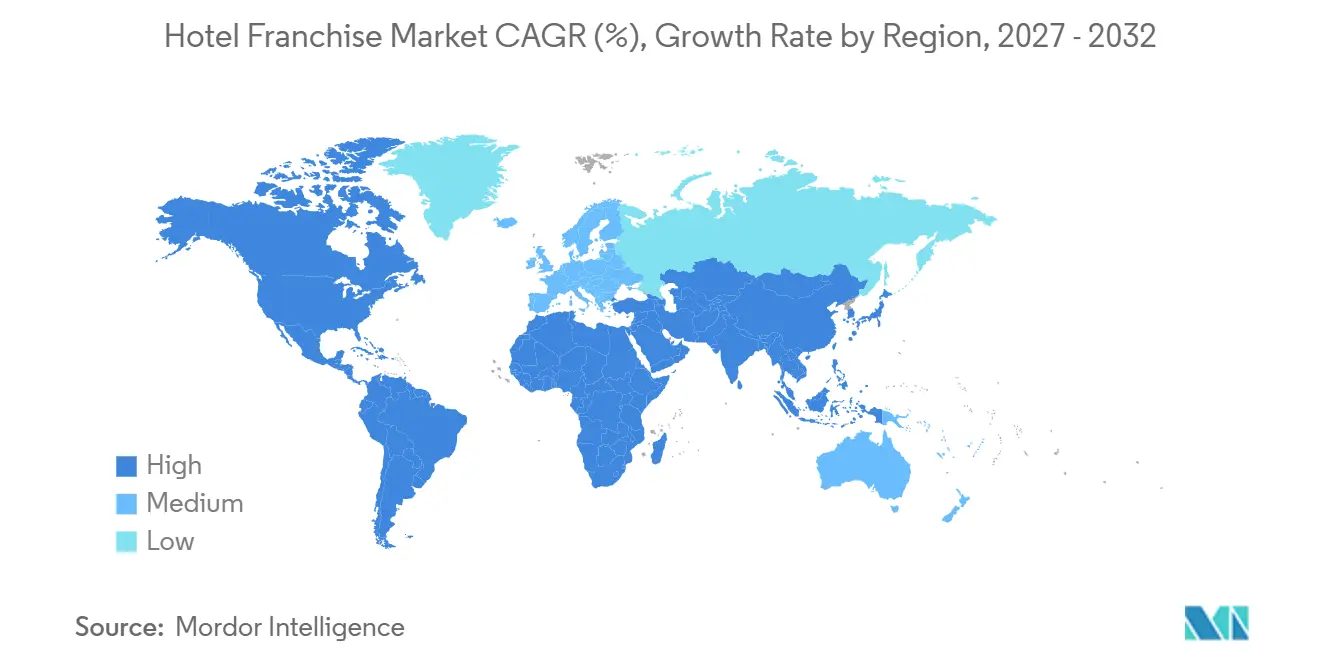
North America held a 39.4% revenue share of the global hotel franchise market in 2026. Established regulations, owner networks, loyalty programs, and branded hotels support the region. AHLA identifies franchising as central to the United States hotel operating model. Choice Hotels acquired the remaining 50% stake in Choice Hotels Canada in July 2025, transitioning to a direct-franchise model. The region provides a reference for emerging markets in balancing brand standards, owner returns, and technology fees under long-term contracts.
Asia-Pacific is forecast to grow at an 8.96% CAGR through 2032, the fastest among regions. Markets such as India, Vietnam, and Japan support this growth as hotel development expands into secondary cities amid stronger domestic travel and improved access. Marriott reported 8.0% RevPAR growth, 71.4% occupancy, and USD 182.35 ADR in Asia-Pacific excluding China in 2025. BWH Hotels identified India, Vietnam, and Japan as key growth markets for 2026, reflecting opportunities for international hotel-franchise expansion. Flexible franchise structures and locally informed site selection remain important across the region.
Europe and emerging markets offer franchise opportunities as owners seek distribution support and established brands. IHG reported over 1,100 open and pipeline hotels in Europe in 2025. High construction and financing costs support conversions. Government-backed tourism projects drive luxury and upper-upscale development in the Middle East. Marriott signed 94 deals and added nearly 40 properties in the Caribbean and Latin America in 2025.
Supply & Infrastructure Intelligence
At year-end 2025, global hotel development reached a record 15,922 projects and 2.44 million rooms, including 6,140 projects with 1.06 million rooms under construction. During 2025, Hilton added 796 hotels and 97,000 rooms, achieving 6.7% net unit growth. Its pipeline totaled 520,500 rooms across 129 countries and territories. These figures reflected continued branded hotel supply expansion, although financing, construction costs, and infrastructure readiness affected project delivery.
Regional pipelines showed varied opportunities. In Q2 2025, Asia-Pacific recorded 957,254 rooms under contract, up 4.2%, compared with 431,736 rooms in Europe, up 2.9%, and 902,952 rooms in the Americas, up 1.1%. India had 40,950 rooms under construction, supporting selected new-build projects and conversions. Marriott conversions accounted for more than 30% of rooms signed in 2025, demonstrating the value of upgrading existing assets rather than relying only on new construction.
Competitive Landscape
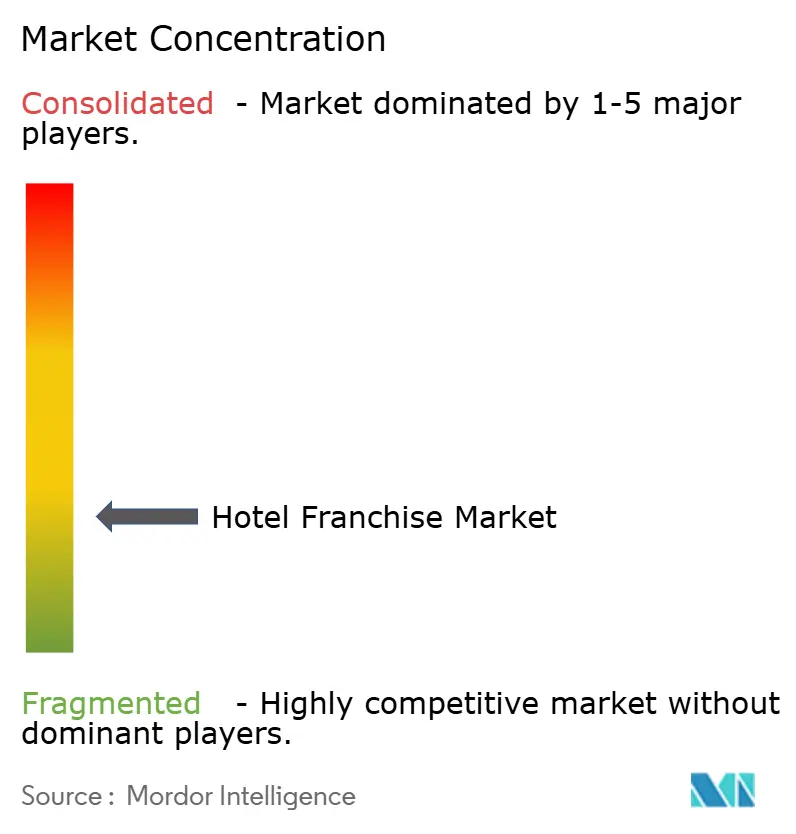
The global hotel franchise market has a moderately fragmented competitive structure. Marriott International, Hilton Worldwide, IHG Hotels & Resorts (IHG), Wyndham Hotels & Resorts, and Choice Hotels International operate broad franchise networks. They compete to sign owners, increase conversions, strengthen loyalty engagement, and expand across hotel formats. Marriott reported USD 3,325 million in franchise fee revenue in 2025, while IHG reported USD 1,897 million in fee-business revenue. This environment provides owners with meaningful options for conversions and renewals.
Acquisitions and new brand launches have helped hotel groups target adjacent demand segments. Marriott acquired citizenM for USD 355 million in July 2025, adding 37 hotels across more than 20 cities in the United States, Europe, and Asia-Pacific. IHG acquired Ruby Hotels for EUR 110.5 million (USD 116 million) in February 2025, supporting expansion through franchise agreements. Hilton launched Apartment Collection by Hilton in January 2026 to target furnished apartment-style stays. These moves reflect diversification across lifestyle, urban micro-format, and extended-stay accommodation.
Franchisee selection also depends on brand reach and owner support. Wyndham awarded 870 development contracts in 2025 and ended the year with 868,900 rooms. Hilton reported a pipeline of 520,500 rooms. In emerging markets, commercial support, technology costs, conversion flexibility, local execution, and loyalty-driven demand can influence franchise partnerships.
Hotel Franchise Industry Leaders
-
Marriott International, Inc.
-
Hilton Worldwide Holdings Inc.
-
InterContinental Hotels Group plc
-
Wyndham Hotels & Resorts, Inc.
-
Choice Hotels International, Inc.
- *Disclaimer: Major Players sorted in no particular order
Hotel Franchise Market Companies Covered in this Report
- Marriott International, Inc.
- Hilton Worldwide Holdings Inc.
- InterContinental Hotels Group plc
- Wyndham Hotels & Resorts, Inc.
- Choice Hotels International, Inc.
- Accor S.A.
- Hyatt Hotels Corporation
- Jin Jiang International Holdings Co., Ltd.
- H World Group Limited
- Meliá Hotels International, S.A.
- Minor International Public Company Limited
- Sonesta International Hotels Corporation
- Extended Stay America, Inc.
- Radisson Hotel Group
- G6 Hospitality LLC
- Lemon Tree Hotels Limited
- Magnuson Hotels
- OYO Hotels & Homes
- Dusit International
- Red Roof
Recent Industry Developments in Hotel Franchise Market
- March 2026: Marriott International reported a record 94 signed deals in its Caribbean and Latin America region during 2025, adding nearly 40 properties, and expects to reach 555 open properties across 37 countries and territories by the end of 2026. Conversions accounted for approximately 30% of new rooms added, highlighting the role of existing-property conversions in franchise-led expansion.
- January 2026: Hilton launched Apartment Collection by Hilton, an extended-stay lifestyle brand that expands its franchise addressable market into furnished apartment-style accommodations. The brand competes with serviced apartment operators and narrows the distinction between traditional hotel and residential franchise models.
- July 2025: Choice Hotels International announced the acquisition of the remaining 50% stake in Choice Hotels Canada from InnVest Hotels LP, completing its transition from a master-franchise to a direct-franchise model. The transaction enables Canadian owners to access Choice’s full portfolio of 22 brands through its Owner Success System, supporting broader franchise opportunities and expansion.
- June 2025: Hyatt Hotels Corporation completed its acquisition of Playa Hotels & Resorts, strengthening its position in the high-end all-inclusive resort segment across Mexico and the Caribbean.
Global Hotel Franchise Market Report Scope
The global hotel franchise market report analyzes hotel franchising models and brand-led expansion across global hospitality markets. The market is segmented by hotel class, hotel type, franchise agreement type, brand category, and geography. The study examines key drivers, including brand recognition, loyalty program reach, hotel development in emerging markets, asset-light expansion, conversion-led growth, and demand for limited-service and extended-stay hotels, alongside restraints such as development costs, labor constraints, rising technology and distribution fees, and rigid brand standards. It evaluates hotel supply, room inventory, occupancy rates, average daily rates, traveler preferences, booking channels, and spending patterns. The report provides market size and growth forecasts, competitive landscape analysis, market share assessment, strategic developments, and profiles of leading hotel groups. It also explores opportunities in secondary cities, adaptive reuse, and franchise conversions. Market estimates and forecasts are presented in value (USD) across all covered segments.
Segmentation Overview
Key Questions Answered in the Report
What is the projected value of the global hotel franchise market by 2032?
The global hotel franchise market is projected to reach USD 67.92 billion by 2032, growing at a 7.13% CAGR from 2027.
Which hotel class leads hotel franchising?
Midscale led with 36.5% revenue share in 2026 and is forecast to grow at an 8.67% CAGR through 2032.
Why are hotel owners choosing franchise agreements?
Owners can retain property ownership while gaining brand standards, loyalty programs, reservation systems, training, and wider distribution.
Which region leads the global hotel franchise market?
North America accounted for 39.4% of the global hotel franchise market in 2026, while Asia-Pacific is forecast to grow at the fastest CAGR of 8.96% through 2032.
Which hotel type is growing fastest?
Extended-Stay Hotels are forecast to grow at an 8.12% CAGR through 2032, supported by long-stay work, relocation, and project travel demand.
What costs should hotel franchisees evaluate before signing?
Franchisees should assess royalties, marketing, reservation, loyalty, technology, property improvement, staffing, and local compliance costs.