
Gas Hydrates Market Size and Share
Market Overview
| Study Period | 2022 - 2032 |
|---|---|
| Market Size (2027) | USD 3.53 Billion |
| Market Size (2032) | USD 4.54 Billion |
| Growth Rate (2027 - 2032) | 5.15 % |
| Fastest Growing Market | Asia-Pacific |
| Largest Market | Asia-Pacific |
| Market Concentration | Low |
Major Players *Disclaimer: Major Players sorted in no particular order Image © Mordor Intelligence. Reuse requires attribution under CC BY 4.0. | |
Gas Hydrates Market Analysis by Mordor Intelligence
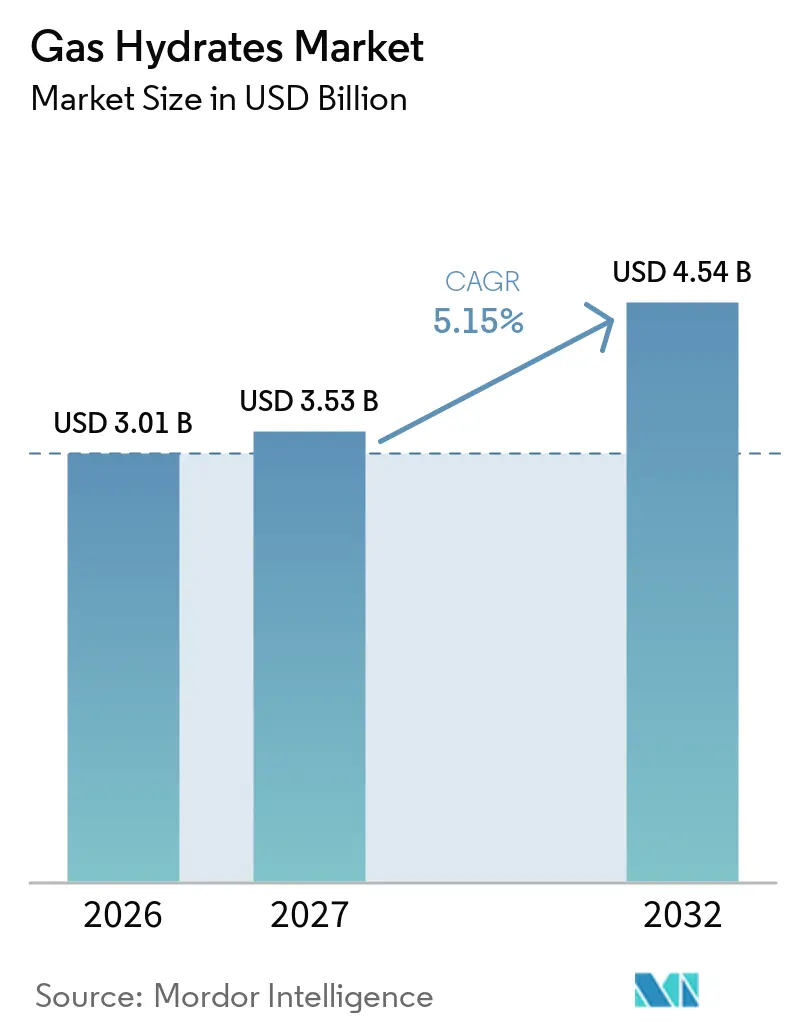
The gas hydrates market size is projected to be USD 3.01 billion in 2026, USD 3.53 billion in 2027, and reach USD 4.54 billion by 2032, at a CAGR of 5.15% from 2027 to 2032. Energy security programs in Asia-Pacific, where importing countries continue to assess domestic offshore resources, support market growth. Methane hydrates contain substantial volumes of natural gas, but most projects remain at the pilot stage and focus on building technical readiness. As a result, capital is directed toward reservoir mapping, pressure monitoring, and production testing rather than rapid field development. Carbon storage, desalination, gas separation, and thermal storage applications broaden the scope of hydrate research beyond natural gas production. This wider application base provides additional avenues for spending and technology development while commercial methane production remains limited.
Key Report Takeaways
- By type, methane hydrates held 94.3% of the Gas Hydrates Market share in 2026, while carbon dioxide hydrates are forecast to grow at a 6.2% CAGR through 2032.
- By occurrence, marine gas hydrates accounted for 98.2% of the Gas Hydrates Market share in 2026 and are projected to expand at a 5.9% CAGR through 2032.
- By end use, energy and power held 55.6% of the Gas Hydrates Market share in 2026, while industrial applications are projected to grow at a 6.8% CAGR through 2032.
- By geography, Asia-Pacific led with 46.9% of the Gas Hydrates Market share in 2026 and is forecast to grow at a 5.6% CAGR through 2032.
Note: Market numbers in this report are based on Mordor Intelligence's proprietary estimation framework, which combines nine months of actuals with Q4 projections for base year 2026.
Market Trends and Insights
Drivers Impact Analysis of Gas Hydrates Market*
| Driver | (~) % Impact on CAGR Forecast | Geographic Relevance | Impact Timeline |
|---|---|---|---|
| Rising Energy-Security Requirements | +1.3% | Asia-Pacific, including Japan, India, and South Korea, with secondary gains in Middle East and Africa | Short term (≤ 2 years) |
| Government-Led Commercialization Programs | +0.9% | Asia-Pacific, with spillover to North America and Middle East and Africa | Medium term (2-4 years) |
| Advances in Depressurization and Offshore Reservoir Monitoring | +0.8% | Global, with the strongest near-term effect in Japan and China | Medium term (2-4 years) |
| Discovery of High-Saturation Sand-Rich Reservoirs | +0.6% | Asia-Pacific, including the South China Sea, Bay of Bengal, and Nankai Trough | Long term (≥ 4 years) |
| Demand for Lower-Carbon Transitional Gas Resources | +0.5% | North America, Europe, and Asia-Pacific countries with net-zero commitments | Medium term (2-4 years) |
| Hydrate-Based Carbon Management and Gas Storage Research | +0.4% | Global, concentrated in Europe, Japan, and coastal China | Long term (≥ 4 years) |
| Source: Mordor Intelligence | |||
Rising Energy-Security Requirements
Gas-import-dependent countries view methane hydrates as a potential domestic resource during periods of unstable liquefied natural gas supply. Japan's Ministry of Economy, Trade and Industry and Japan Oil, Gas and Metals National Corporation MH21-S program continues to preserve production knowledge for possible future deployment rather than near-term commercial production. India's Ministry of Petroleum and Natural Gas estimated gas hydrate potential of 1,894 trillion cubic meters in its waters, and the Krishna-Godavari Basin contains dense sand-rich accumulations identified through the NGHP-02 expedition. These programs shift work in the gas hydrates market toward characterizing deposits, measuring reservoir conditions, and retaining operating capability. Such activity sustains demand for surveys, drilling, and monitoring even when production does not begin. The resource option has strategic value because it can be assessed and preserved before a country decides whether future supply conditions justify extraction.
Government-Led Commercialization Programs
Public programs remain central to the gas hydrates market because offshore tests require long timelines, specialized vessels, and extensive environmental monitoring. Japan, China, India, and the United States have supported field work through national research institutions, energy ministries, or government-linked operators. The Alaska North Slope test involved the U.S. Department of Energy, Japan Oil, Gas and Metals National Corporation, United States Geological Survey, and industry partners, demonstrating that large production experiments depend on coordinated public and private participation.[1] Government support also maintains technical teams between field tests, which is important when pilots do not generate commercial cash flow. In Asia-Pacific, national programs are concentrated in locations with known offshore deposits and high interest in supply security. These programs keep the gas hydrates market focused on evidence gathering, reservoir appraisal, and equipment development.
Advances in Depressurization and Offshore Reservoir Monitoring
Depressurization remains the main production method under evaluation because lowering reservoir pressure can dissociate hydrate into gas and water. The Alaska North Slope experiment ran from September 2023 through July 2024 and collected continuous pressure-core and logging data from B1 and D1 sand reservoirs. Hydrate saturation in these reservoirs ranged from 50% to 91% of pore space, adding field evidence for reservoir-response models. Offshore monitoring helps operators identify changes in pressure, water movement, sand behavior, and formation stability before they become costly failures. The gas hydrates market benefits from these measurements because dependable operating data are needed before developers can design longer production tests.
Discovery of High-Saturation Sand-Rich Reservoirs
Sand-rich deposits receive priority because they generally offer better permeability and gas-water behavior than hydrate occurrences in clay-rich fractures. Work in China's Qiongdongnan Basin confirmed sand-rich accumulations in coarse-silt and fine-sand turbidite systems using seismic data, well logs, and core analysis. India's NGHP-02 program also identified extensive sand-rich systems in the Krishna-Godavari and Mahanadi Basins.[2] Research on framboidal pyrite in South China Sea drill sites found that these mineral aggregates can raise local porosity from 8.1% to 80.2%, which may add gas-storage pathways. These findings can refine estimates of producible volumes within deposits already known to national programs. The gas hydrates market therefore favors field areas where sand-rich reservoir data reduce uncertainty around well placement and production design.
Restraints Impact Analysis of Gas Hydrates Market*
| Restraint | (~) % Impact on CAGR Forecast | Geographic Relevance | Impact Timeline |
|---|---|---|---|
| High Offshore Production and Well-Completion Costs | -1.8% | Global, with the strongest effect in deepwater Asia-Pacific and the Gulf of America | Long term (≥ 4 years) |
| Sand Production, Water Influx, and Flow-Assurance Failures | -0.7% | Offshore Japan, South China Sea, and Bay of Bengal | Medium term (2-4 years) |
| Methane-Leakage and Seafloor-Geohazard Exposure | -0.5% | Marine environments globally, especially the Korea East Sea and South China Sea | Long term (≥ 4 years) |
| Lack of Commercial-Scale Production and Standardized Regulation | -0.8% | Global | Medium term (2-4 years) |
| Source: Mordor Intelligence | |||
High Offshore Production and Well-Completion Costs
Offshore gas hydrate projects require expensive wells, subsea systems, specialized measurements, and extended monitoring periods. A techno-economic analysis of fracturing-assisted thermal stimulation found that a positive net present value required heat-source costs below CNY 0.20 per kWh and horizontal well sections longer than 1,500 m. Many offshore sites cannot access the geothermal or industrial waste-heat sources needed to meet these conditions. Pipeline hydrate remediation can cost USD 30 million for a single offshore plug and can exceed USD 100 million when abandonment and downtime are included. Modeling for hydrate-based desalination also found that using HFC-152a in place of methane hydrate formers reduced fixed capital investment by 57.4%. These cost pressures keep much of the gas hydrates market within government-backed research programs rather than standalone commercial projects.
Lack of Commercial-Scale Production and Standardized Regulation
No gas hydrate deposit has progressed to commercial production. The highest sustained trial output referenced was China's Shenhu 2020 test at 28,700 cubic meters per day, which remained well below mature conventional gas well production levels, limiting the evidence available to investors and insurers. Production rights, environmental permits, and methane-emission monitoring are still generally handled under petroleum regulations that were not written specifically for hydrate extraction. The absence of common international standards adds uncertainty to joint ventures and cross-border technology programs. Developers also face concerns over methane leakage, seabed stability, water influx, and sand production during production tests. The gas hydrates market remains centered on pilot projects, as commercial operating data and resource-specific regulation have not yet developed in parallel.
*Our forecasts treat driver/restraint impacts as directional, not additive. The impact forecasts reflect baseline growth, mix effects, and variable interactions.
Gas Hydrates Market Segment Analysis
By Type:
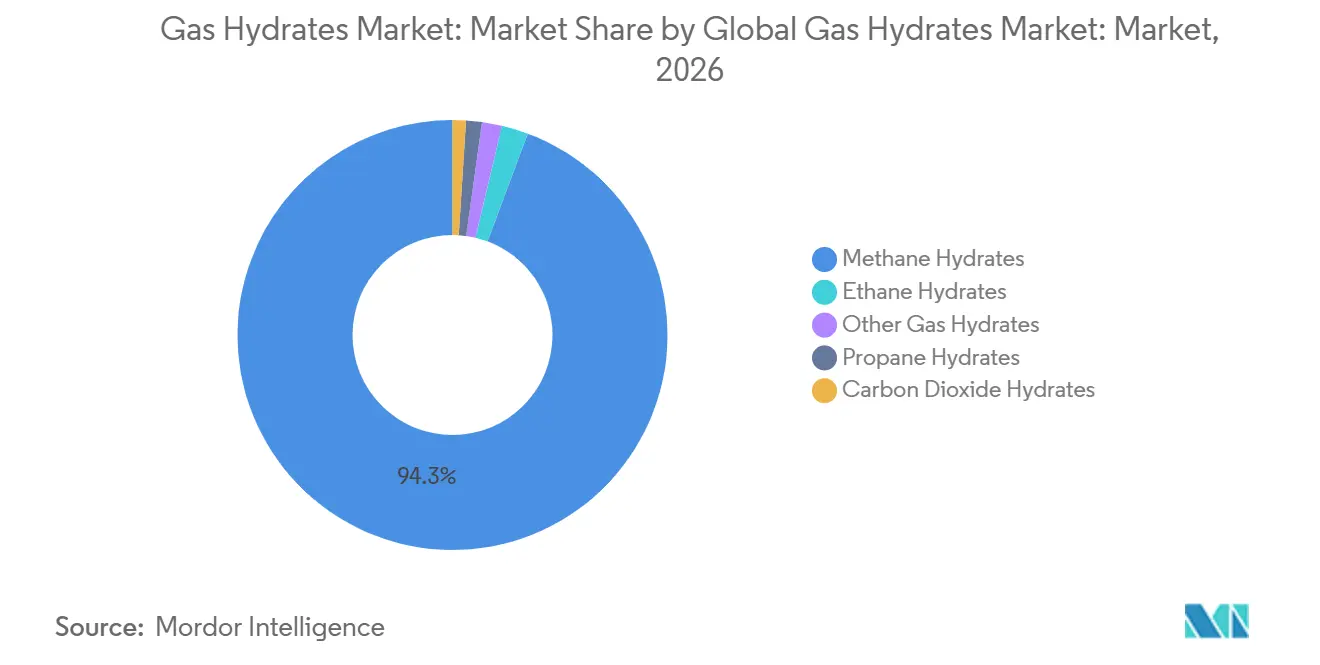
Methane Hydrates Lead Current Activity While Carbon Dioxide Hydrates Expand FasterMethane hydrates held 94.3% of the gas hydrates market share in 2026. Their position reflects global abundance and the focus of national production programs on methane extraction from marine and permafrost deposits. Global in-place methane is estimated at 1.2 × 10¹⁷ cubic meters, which supports continued scientific interest in these formations. Methane hydrates form across a wide range of pressure and temperature conditions beneath the seafloor and within permafrost regions. Field programs from Japan's Nankai Trough to Alaska's North Slope have therefore treated methane hydrates as the primary production target. Ethane and propane hydrates represent a smaller part of the gas hydrates market and are more relevant to mixed-gas flow assurance than to dedicated production programs.
Other gas hydrate types include nitrogen, hydrogen sulfide, and mixed-guest formulations. These types remain mainly within laboratory research or limited industrial applications and are not expected to make a material contribution through 2031. Carbon dioxide hydrates are the fastest-growing type, with the market size for this segment projected to increase at a 6.2% CAGR from 2027 to 2032. Their growth is linked to carbon management and industrial processing rather than methane production. Laboratory work reported concentration of apple juice to 45°Brix, coffee extracts to 40 wt% total solids, and orange juice dehydration ratios of 57.2% at 4.1 MPa.[3] A 2025 study also reported carbon dioxide (CO2) hydrate formation in mesoporous zeolite ZMQ-1 at 1.3 MPa and 275 K, with a storage capacity of 151 wt% and a 2-minute induction time.

By Occurrence:
Marine Hydrates Retain the Largest Role in Development ProgramsMarine gas hydrates accounted for 98.2% of the gas hydrates market size in 2026 and are forecast to grow at a 5.9% CAGR through 2032. Offshore deposits dominate because active national programs are concentrated in the South China Sea, Nankai Trough, Bay of Bengal, and offshore Alaska. The South China Sea is estimated to contain 4.0 to 6.5 × 10¹² cubic meters of technically recoverable gas hydrate resources. China's Shenhu area produced 861,400 cubic meters of cumulative gas during its 2020 trial at 1,225 m water depth. Numerical studies of the Shenhu area found that horizontal wells in three-phase zones can improve gas production efficiency and hydrate dissociation rates compared with vertical wells.
Marine development also aligns with the drilling resources and offshore operating experience of the countries conducting the largest programs. Japan, China, and India have prioritized offshore sand-rich systems because these deposits offer more favorable reservoir characteristics for depressurization. The gas hydrates market size for marine projects is supported by spending on seismic interpretation, coring, well logging, and flow-assurance studies. Permafrost hydrates held the remaining 1.8% share in 2025. Their current contribution is mainly scientific, as the Alaska North Slope B1 sand recorded hydrate saturation of 68% to 91% and post-dissociation permeability of 1 mD in the HYDRATE-02 geo-data well. These field data help refine reservoir models, although commercial permafrost development remains unlikely under current cost conditions.
By End Use:
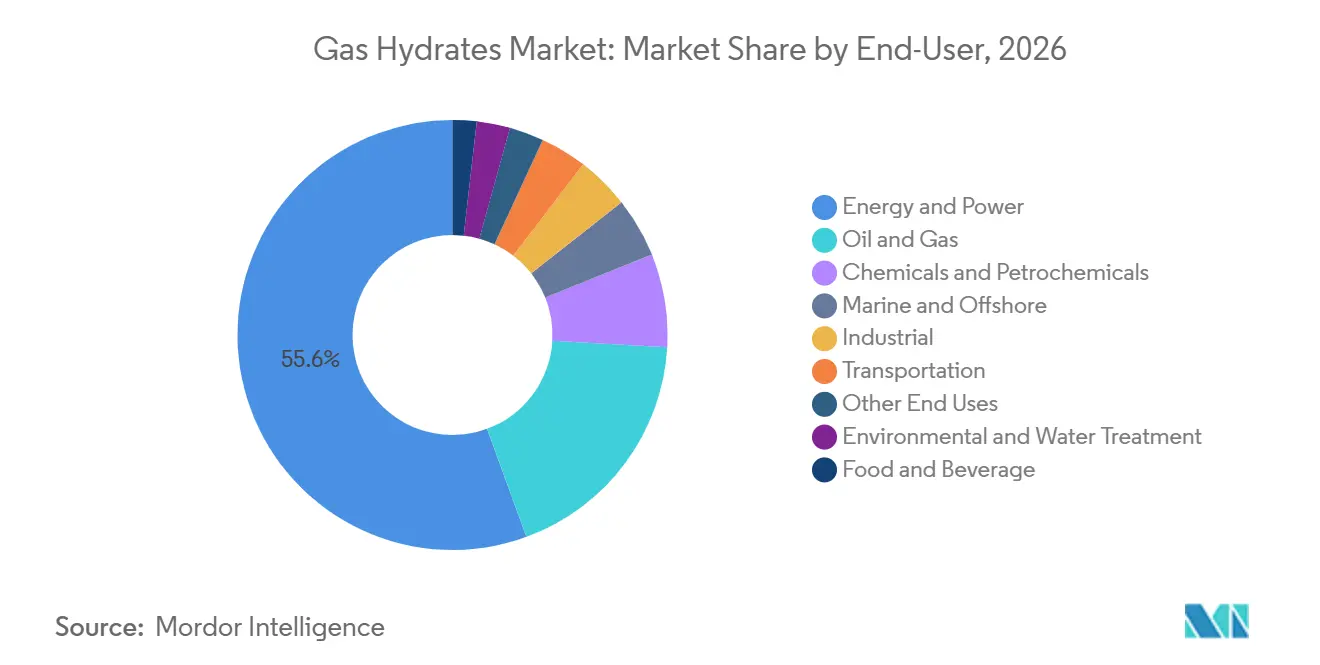
Energy and Power Holds the Largest Position While Industrial Uses Grow FasterEnergy and power held 55.6% of the gas hydrates market share in 2026. The segment includes government-funded production pilots, offshore reservoir assessment, and service contracts for exploration in the South China Sea, Bay of Bengal, and Nankai Trough. Its position reflects the original purpose of methane hydrate development, which is to assess a supplementary natural gas source for power generation and heating. Energy-import-dependent economies have funded these activities to evaluate whether domestic deposits could support future energy security. Oil and gas is the next-largest end use because conventional deepwater systems already require hydrate-management services. This work includes thermodynamic inhibitors, kinetic hydrate inhibitors, subsea infrastructure support, and flow-assurance management.
Industrial applications are forecast to record the fastest growth at a 6.8% CAGR through 2032. The gas hydrates market size for industrial uses is supported by research in desalination, cold-chain thermal storage, gas separation, and environmental water treatment. A hydrate-based desalination configuration using cyclopentane and LNG cold energy reported specific energy consumption of 0.35 kWh per cubic meter and a levelized water cost as low as USD 1.66 per cubic meter.[4] Hydrate slurry systems may also transport natural gas at moderate pressures, reducing the need for pipelines in island and remote settings. Environmental and water treatment applications include concentration of industrial wastewater with salinity of 100,000 to 300,000 mg/L. Food and beverage uses remain at the laboratory stage but support the broader research base of the gas hydrates market.
Geography Analysis
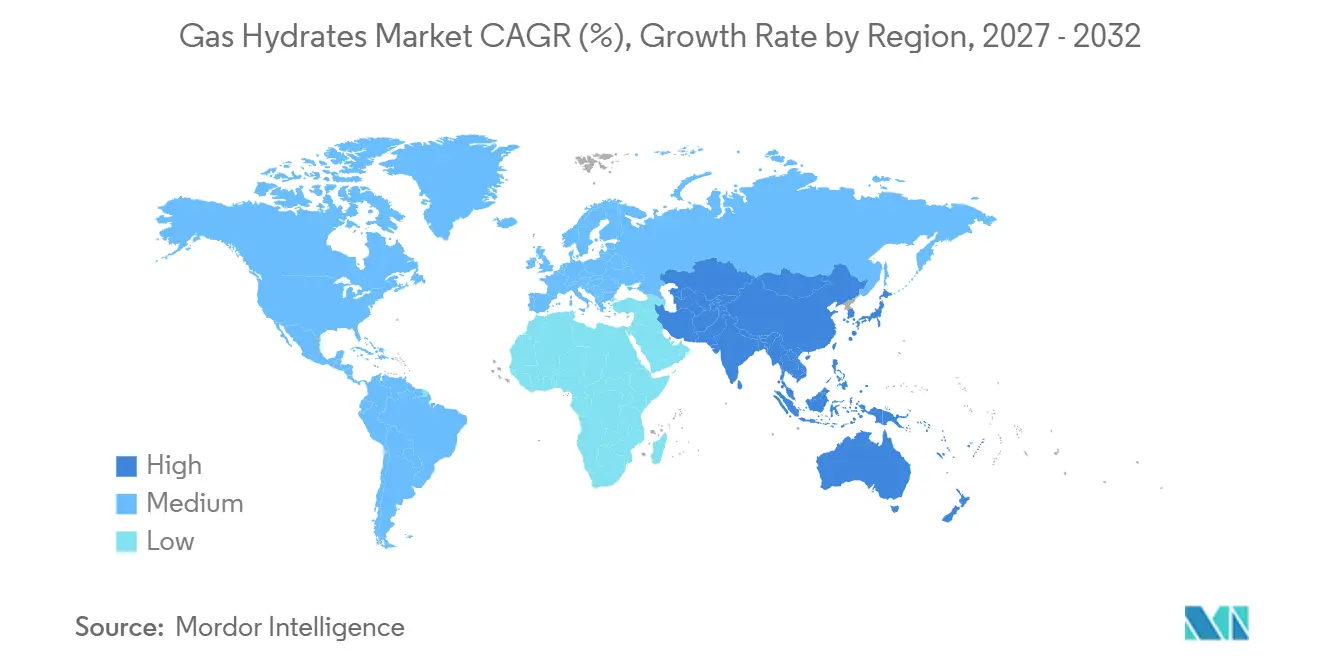
Asia-Pacific held 46.9% of the gas hydrates market share in 2026 and is projected to grow at a 5.6% CAGR through 2032. China, Japan, and India operate national programs at different stages of technical development. China's Shenhu trial averaged 28,700 cubic meters of gas per day during its extended 2020 run. In September 2024, China National Offshore Oil Corporation brought Shenhai-1 Phase II online in the Qiongdongnan Basin with 12 development wells and a plateau target of 162 million cubic feet per day. This conventional gas development demonstrates deepwater operating capability in the same basin as China National Offshore Oil Corporation's gas hydrate exploration.
North America is the second-largest region, with activity centered on U.S. government-supported research. The gas hydrates market size in the region is supported by the Alaska North Slope production test completed in July 2024. The test brought together the U.S. Department of Energy, National Energy Technology Laboratory, Japan Oil, Gas and Metals National Corporation, U.S. Geological Survey, ASRC Energy Services, and Prudhoe Bay Unit working-interest owners. It produced an extended field-response dataset from B1 and D1 sand reservoirs that is useful for commercial production design. The Gulf of America remains active in research through the University of Texas UT-GOM2-2 deepwater coring expedition at Walker Ridge Block 313.
Europe has a modest role, with Norway and Russia holding geological relevance for Arctic shelf and permafrost occurrences. South America is linked primarily to conventional deepwater operations in Brazil's Santos and Campos Basins, where gas hydrates are monitored as a flow-assurance issue rather than an extraction target. Middle East and Africa activity is more closely tied to offshore exploration and water technology than to methane hydrate production. China National Offshore Oil Corporation's June 2024 Lingshui 36-1 discovery recorded an open-flow gas test above 10 million cubic meters per day at 1,500 m water depth.
Competitive Landscape
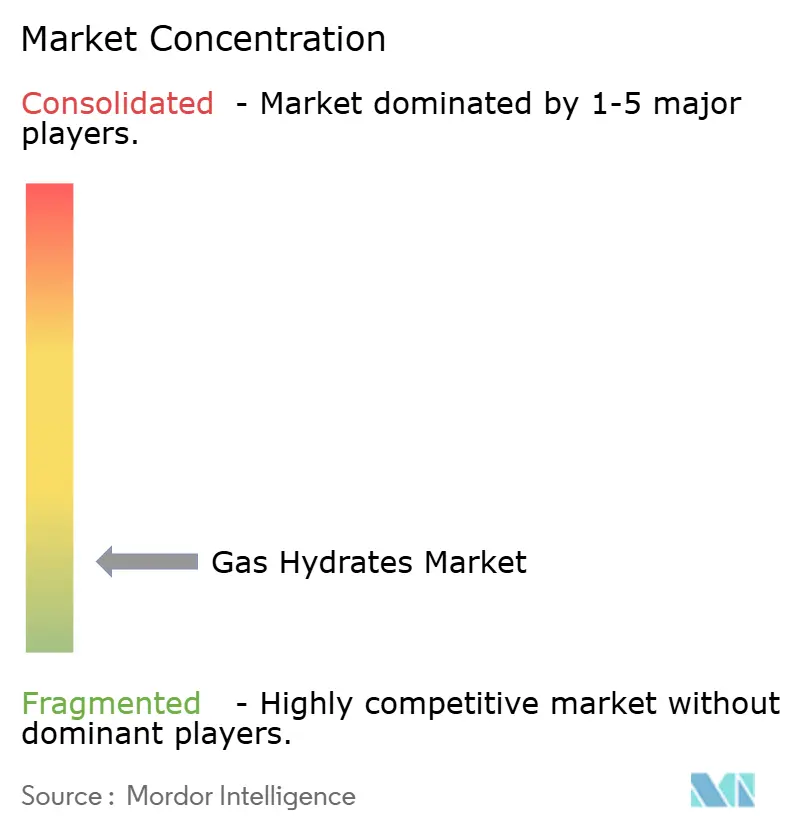
The gas hydrates market is fragmented because no company has established commercial production. State-backed national oil companies such as China National Offshore Oil Corporation, China National Petroleum Corporation, Japan Petroleum Exploration Company, Inpex Corporation, and Oil and Natural Gas Corporation conduct much of the active field work through national programs. ExxonMobil, Chevron, ConocoPhillips, and Shell participate in government-linked research consortia rather than operating independent hydrate production projects. Service providers such as SLB and Halliburton supply logging-while-drilling tools, pressure coring, and flow-assurance technology that support field tests. SLB conducted logging work in the Alaska North Slope test and India's NGHP-02 program. The absence of commercial output means competition currently centers on research access, offshore equipment, reservoir data, and operating knowledge.
Chinese institutions are increasing their role in depressurization and wellbore technology. China University of Petroleum filed a 2024 U.S. patent focused on secondary hydrate prevention in wellbores. This work addresses hydrate blockage, an operational problem reported during Japan's 2017 offshore test. Materials and chemical technology participants are also developing kinetic promoters, reactor designs, and continuous-flow systems for carbon dioxide (CO2) hydrate applications. Competition in these applications focuses on lower separation costs, faster formation, and reliable operation.
MODEC is applying offshore platform design and operating experience to shallow methane hydrate harvesting in Japan's exclusive economic zone. A University of Louisiana at Lafayette 2024 patent covers simultaneous methane extraction and carbon dioxide (CO2) storage in the same marine formation. Shell and TotalEnergies have offshore infrastructure and carbon-market experience relevant to integrated projects, but neither has established commercial hydrate development.
Gas Hydrates Industry Leaders
-
Japan Oil, Gas and Metals National Corporation (JOGMEC)
-
China Geological Survey (CGS)
-
China National Offshore Oil Corporation Limited (CNOOC Limited)
-
Oil and Natural Gas Corporation Limited
-
Japan Petroleum Exploration Co., Ltd. (JAPEX)
- *Disclaimer: Major Players sorted in no particular order
Gas Hydrates Market Companies Covered in this Report
- bp p.l.c.
- Chevron Corporation
- China Geological Survey (CGS)
- China National Offshore Oil Corporation Limited (CNOOC Limited)
- China National Petroleum Corporation (CNPC)
- China Petroleum and Chemical Corporation (Sinopec)
- ConocoPhillips Company
- Equinor ASA
- Exxon Mobil Corporation
- GAIL Limited
- Halliburton Company
- INPEX CORPORATION
- Japan Drilling Co., Ltd.
- Japan Petroleum Exploration Co., Ltd. (JAPEX)
- Korea Gas Corporation (KOGAS)
- MODEC, Inc.
- Oil and Natural Gas Corporation Limited
- Oil India Limited
- Petrobras
- PetroChina Company Limited
- Schlumberger Limited (SLB)
- Shell plc
- TotalEnergies SE
- Woodside Energy Group Ltd.
Recent Industry Developments in Gas Hydrates Market
- November 2025: China used methane hydrate sourced from the South China Sea to fuel the ceremonial flame of the 15th National Games, demonstrating growing confidence in hydrate-derived energy.
- October 2025: China used methane hydrate sourced from the South China Sea to fuel the ceremonial flame of the 15th National Games, demonstrating growing confidence in hydrate-derived energy.
- March 2025: The U.S. Department of Energy's National Energy Technology Laboratory (NETL) published its 2025 Methane Hydrate R&D Program update. The update highlighted ongoing analysis of data gathered from the Alaska North Slope extended-duration production test and continued research into hydrate reservoir behavior, recovery rates, wellbore stability, and commercial production pathways.
Global Gas Hydrates Market Report Scope
Gas hydrates are ice-like crystalline compounds formed when gas molecules, primarily methane, are trapped within a lattice of water molecules under conditions of high pressure and low temperature. These deposits are commonly found in deep-ocean sediments and Arctic permafrost regions. Gas hydrates contain significant amounts of natural gas and are considered a promising unconventional energy resource. They are also being explored for applications in carbon dioxide (CO2) sequestration, gas storage, transportation, and environmental management.
The global gas hydrates market is segmented by type into methane hydrates, ethane hydrates, propane hydrates, carbon dioxide (CO2) hydrates, and other gas hydrates. By occurrence, the market is segmented into marine gas hydrates and permafrost gas hydrates. By end use, the market is segmented into oil and gas, energy and power, chemicals and petrochemicals, marine and offshore, transportation, industrial, environmental and water treatment, food and beverage, and other end uses. The report also covers the market size and forecasts for the global gas hydrates market across 26 countries in key regions. For each segment, the market sizing and forecasts are provided on the basis of value (USD).
Segmentation Overview
| Methane Hydrates |
| Ethane Hydrates |
| Propane Hydrates |
| Carbon Dioxide Hydrates |
| Other Gas Hydrates |
| Marine Gas Hydrates |
| Permafrost Gas Hydrates |
| Oil and Gas |
| Energy and Power |
| Chemicals and Petrochemicals |
| Marine and Offshore |
| Transportation |
| Industrial |
| Environmental and Water Treatment |
| Food and Beverage |
| Other End Uses |
| North America | United States |
| Canada | |
| Mexico | |
| Europe | Norway |
| United Kingdom | |
| Germany | |
| France | |
| Russia | |
| Rest of Europe | |
| Asia-Pacific | China |
| Japan | |
| India | |
| South Korea | |
| Australia | |
| New Zealand | |
| Rest of Asia Pacific | |
| South America | Brazil |
| Argentina | |
| Rest of South America | |
| Middle East and Africa | Saudi Arabia |
| United Arab Emirates | |
| Egypt | |
| Oman | |
| Rest of Middle East and Africa |
| By Type | Methane Hydrates | |
| Ethane Hydrates | ||
| Propane Hydrates | ||
| Carbon Dioxide Hydrates | ||
| Other Gas Hydrates | ||
| By Occurrence | Marine Gas Hydrates | |
| Permafrost Gas Hydrates | ||
| By End Use | Oil and Gas | |
| Energy and Power | ||
| Chemicals and Petrochemicals | ||
| Marine and Offshore | ||
| Transportation | ||
| Industrial | ||
| Environmental and Water Treatment | ||
| Food and Beverage | ||
| Other End Uses | ||
| By Geography | North America | United States |
| Canada | ||
| Mexico | ||
| Europe | Norway | |
| United Kingdom | ||
| Germany | ||
| France | ||
| Russia | ||
| Rest of Europe | ||
| Asia-Pacific | China | |
| Japan | ||
| India | ||
| South Korea | ||
| Australia | ||
| New Zealand | ||
| Rest of Asia Pacific | ||
| South America | Brazil | |
| Argentina | ||
| Rest of South America | ||
| Middle East and Africa | Saudi Arabia | |
| United Arab Emirates | ||
| Egypt | ||
| Oman | ||
| Rest of Middle East and Africa | ||
Key Questions Answered in the Report
What is the expected growth rate for the gas hydrates market through 2032?
The gas hydrates market is expected to grow at a CAGR of 5.15% from 2027 to 2032, reaching USD 4.54 billion by 2032. It was valued at USD 3.01 billion in 2025 and is estimated at USD 3.53 billion in 2027.
Which gas hydrate type holds the largest market share?
Methane hydrates held 94.3% of revenue in 2026, driven by national pilot programs focused on methane extraction. Carbon dioxide hydrates are the fastest-growing type, at a CAGR of 6.2% through 2032.
Why are marine gas hydrate deposits significant?
Marine deposits held 98.2% of the 2026 total and are the focus of active programs in the South China Sea, Nankai Trough, and Bay of Bengal. They are forecast to grow at a CAGR of 5.9% through 2032.
Which end-use segment is expected to grow the fastest?
Industrial applications are projected to expand at a CAGR of 6.8% through 2032, supported by research in desalination, thermal storage, gas separation, and water treatment. Energy and power remained the largest end-use segment, with a 55.6% share in 2026.
Which region leads gas hydrate development?
Asia-Pacific led with a 46.9% share in 2026 and is forecast to grow at a CAGR of 5.6% through 2032. China, Japan, and India are the primary locations for national programs in the region.
Has commercial gas hydrate production begun?
No deposit has reached commercial production. Current spending remains concentrated on pilot tests, reservoir monitoring, technology development, and resource characterization.