
Experiential Events Market Size and Share
Market Overview
| Study Period | 2022 - 2032 |
|---|---|
| Market Size (2027) | USD 160.98 Billion |
| Market Size (2032) | USD 233.78 Billion |
| Growth Rate (2027 - 2032) | 7.75 % |
| Fastest Growing Market | Asia-Pacific |
| Largest Market | North America |
| Market Concentration | Low |
Major Players *Disclaimer: Major Players sorted in no particular order Image © Mordor Intelligence. Reuse requires attribution under CC BY 4.0. | |
Experiential Events Market Analysis by Mordor Intelligence
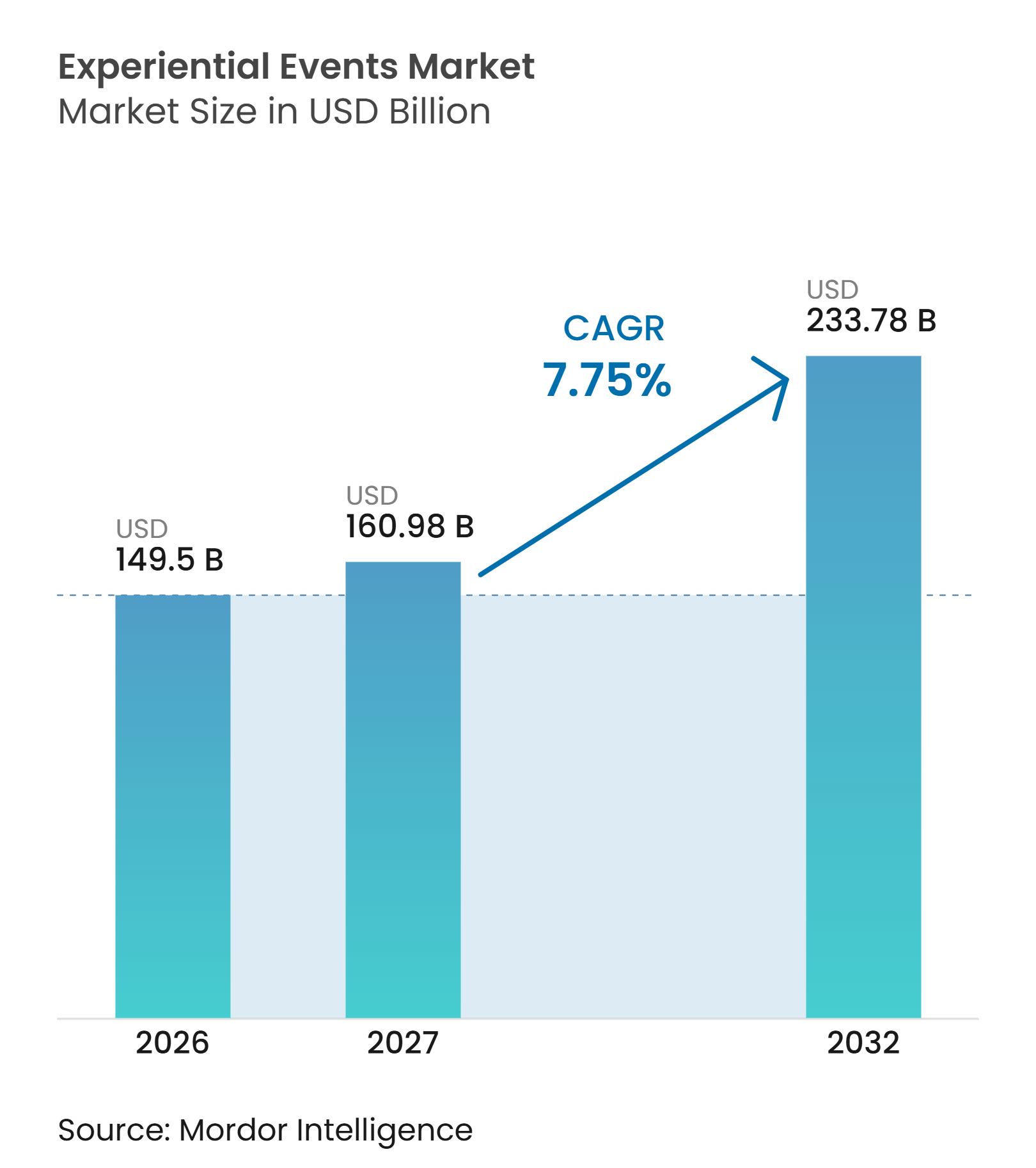
The global experiential events market size was valued at USD 149.50 billion in 2026 and is estimated to grow from USD 160.98 billion in 2027 to reach USD 233.78 billion by 2032, at a CAGR of 7.75% during the forecast period (2027-2032). The global experiential events market is supported by marketers that view events as a channel for business growth, brand differentiation, and measurable customer engagement. Major international sports programming in 2026 is attracting activation budgets from consumer goods, automotive, and technology brands to host markets. The market is shifting toward fewer, higher-value programs as organizations emphasize measurement, audience quality, and follow-up activities. Demand increasingly favors providers that demonstrate commercial value alongside creative delivery. However, cost inflation, incomplete attribution, data compliance requirements, and weather-related disruptions remain significant constraints on event delivery and profit margins.
Key Report Takeaways
- By event type, Public Live Events accounted for 42.10% of the global experiential events market share in 2026, and Product Launches and Brand Activation Events are projected to grow at an 8.75% CAGR through 2032.
- By event format, In-Person Events accounted for 86.30% of the global experiential events market share in 2026, and Hybrid Events are projected to grow at a 10.30% CAGR through 2032.
- By service type, Event Production and Execution accounted for 32.50% of the global experiential events market share in 2026, and Strategy and Experience Design is projected to grow at a 9.62% CAGR through 2032.
- By geography, North America accounted for 49.70% of the global experiential events market share in 2026, and Asia-Pacific is projected to grow at a 10.25% CAGR through 2032.
Note: Market numbers in this report are based on Mordor Intelligence's proprietary estimation framework, which combines nine months of actuals with Q4 projections for base year 2026.
Market Trends and Insights
Drivers Impact Analysis of Experiential Events Market*
| Driver | (~) % Impact on CAGR Forecast | Geographic Relevance | Impact Timeline |
|---|---|---|---|
| Rising Demand for Measurable Brand Experiences | +1.8% | Global | Medium term (2-4 years) |
| Corporate Shift to Event-Led Growth and Community Building | +1.5% | Global | Medium term (2-4 years) |
| Expansion of Hybrid and Digital Amplification Layers | +1.3% | Global, North America and Europe lead | Short term (≤ 2 years) |
| AI-Enabled Personalization and Event ROI Analytics | +1.0% | Global, North America core and Asia-Pacific spillover | Short term (≤ 2 years) |
| Short-Lead Micro-Events and Modular Pop-Up Replication | +0.7% | Global, Asia-Pacific and emerging markets accelerating | Medium term (2-4 years) |
| Venue-Embedded Commerce and Retail Media Convergence | +0.5% | North America and Europe | Long term (≥ 4 years) |
| Source: Mordor Intelligence | |||
Rising Demand for Measurable Brand Experiences
Marketing accountability is reshaping how organizations evaluate event spending. Cvent reports that more marketers link event activity to business growth and use live programming to differentiate their brands. As a result, pipeline contribution, lead quality, and conversion are more important than attendance alone. Providers that integrate registration data, on-site engagement, and customer relationship management records help clients justify spending during internal budget reviews. Consequently, the global experiential events market favors agencies and platforms that incorporate measurement into program design rather than adding it after an event concludes.
Corporate Shift to Event-Led Growth and Community Building
Companies are increasingly integrating experiential events into their marketing strategies to strengthen brand visibility, generate leads, and deepen customer relationships. Splash’s 2025 Outlook on Events report found that 57% of marketers planned to organize more partner events, while 44% expected to host more owned events[1]. This trend supports demand for product launches, branded activations, immersive experiences, and interactive customer engagements. Corporate clients increasingly require events that link audience participation with measurable marketing and business objectives. For experiential event providers, recurring corporate programs create opportunities to secure repeat contracts and build long-term client relationships.
Expansion of Hybrid and Digital Amplification Layers
Beyond physical attendance, digital platforms expand campaign reach through livestreaming, interactive content, virtual networking, and post-event engagement. Swapcard’s 2025 event engagement research covered more than 600 events organized by trade show organizers and media companies and found that over 40% of leads were generated before events began[2]. This highlights the importance of digital engagement throughout the event lifecycle. These capabilities enable experiential marketing agencies to engage audiences before on-site activations, maintain contact after events, and provide sponsors with additional lead-generation and audience-interaction opportunities. Integrating digital touchpoints with physical experiences can improve campaign continuity and help organizers demonstrate commercial outcomes beyond attendance.
AI-Enabled Personalization and Event Return on Investment (ROI) Analytics
Artificial intelligence is increasingly adopted across planning and audience engagement workflows in the events sector. Professional Convention Management Association (PCMA) reported widespread AI use among event planners, highlighting its role in planning, content selection, and workflow management. AI is most effective when it helps teams identify likely attendance patterns, personalize session recommendations, and flag low engagement during events. These capabilities can improve resource allocation for staffing, catering, event spaces, and sponsor activities. In the global experiential events market, AI also increases the value of consented first-party data, as effective personalization relies on reliable customer and attendee information.
Restraints Impact Analysis of Experiential Events Market*
| Restraint | (~) % Impact on CAGR Forecast | Geographic Relevance | Impact Timeline |
|---|---|---|---|
| Venue, Labor, and Production Cost Inflation | -1.5% | Global, most acute in North America and Europe | Short term (≤ 2 years) |
| Fragmented ROI Attribution Across Live and Digital Touchpoints | -0.8% | Global | Medium term (2-4 years) |
| Privacy, Consent, and Biometric Data Compliance Friction | -0.5% | Europe and North America core | Medium term (2-4 years) |
| Climate-Volatility and Destination-Disruption Exposure for Outdoor Events | -0.4% | Global, highest effect in outdoor and Asia-Pacific events | Long term (≥ 4 years) |
| Source: Mordor Intelligence | |||
Venue, Labor, and Production Cost Inflation
Cost inflation remains the primary operational constraint for organizers, agencies, and suppliers. The Meetings Industry Association (MIA) reported that 89% of United Kingdom event organizations experienced cost increases averaging 12%, while price increases averaged 7%. These pressures affect venue rentals, technical labor, scenic construction, transportation, and temporary staffing[3]. The Event Supplier and Services Association (ESSA) also reported recruitment challenges among United Kingdom event suppliers, which may constrain capacity during peak periods. Providers are responding by using modular assets, applying selective price increases, procuring earlier, and prioritizing programs with repeatable components.
Fragmented ROI Attribution Across Live and Digital Touchpoints
Attribution remains challenging when the customer journey begins at an event and concludes through other channels weeks or months later. Cvent reported that many exhibitors lack a clear path to achieving a reasonable return before participating in an event. On-site data, including badge scans, attendance, and session participation, does not automatically reveal subsequent purchase behavior. The challenge intensifies when organizers, exhibitors, agencies, and digital platforms each control separate portions of the data. As a result, companies may delay approval of sponsorships and multiyear programs, even when event activities generate positive customer engagement.
*Our forecasts treat driver/restraint impacts as directional, not additive. The impact forecasts reflect baseline growth, mix effects, and variable interactions.
Consumer Preferences & Spending Patterns
Consumer preferences are shifting toward distinctive, socially engaging experiences. Younger audiences value spontaneous gatherings and activities that reflect local culture. Eventbrite’s 2025 Social Study found that 79% of respondents were interested in events that connected them with their local community, highlighting opportunities for neighborhood festivals, pop-ups, and culturally specific activations. Priorities differed for professional events. Freeman’s 2025 research identified learning, networking, and meaningful industry connections as key drivers of attendee value. Organizers can tailor formats to audience intent by emphasizing social discovery for consumer events and valuable connections for business gatherings rather than spectacle across all experiences.
Spending intentions supported repeat-event programming. Eventbrite found that 76% of consumers planned to maintain or increase event spending, while 36% of Gen Z respondents expected to increase their budgets. Luminate reported that United States Gen Z consumers spent an average of USD 101 per month on live music in Q1 2026, compared with USD 94 among Millennials. These trends supported varied ticket prices, repeatable experiences, and targeted promotions to encourage return attendance.
Service Market Performance Intelligence
Experiential event pricing faces pressure from rising production costs and greater client scrutiny of campaign returns. Cvent’s 2026 Global Planner Sourcing Report found that 72% of planners expected event costs to rise by up to 20%, while 69% anticipated budget increases. This gap challenges agencies to maintain production quality amid supplier and venue inflation. In 2025, 89% of event professionals surveyed by BizBash and Czarnowski Collective identified budget constraints as their primary challenge. Modular installations, reusable assets, and transparent cost breakdowns can help clients prioritize high-impact creative elements while controlling expenditure. Cost discipline is therefore a competitive factor rather than a basis for uniform price increases across the market.
Experiential campaigns are increasingly evaluated by their contribution to pipeline, revenue, and customer conversion. Cvent’s 2026 Event-Led Growth Report found that 74% of marketers could attribute pipeline directly to event touchpoints, while 72% reported faster deal closures when prospects attended events. Measurement remains a constraint: the 2025 Splash Outlook on Events found that 41% of marketers struggled to measure event return on investment (ROI) or develop competitive events. This gap drives demand for integrated registration, lead capture, customer relationship management (CRM) attribution, and post-event sales tracking. Providers that link engagement to qualified leads and sales outcomes can justify client budgets, while brands can allocate spending to events with stronger commercial results.
Experiential Events Market Segment Analysis
By Event Type:
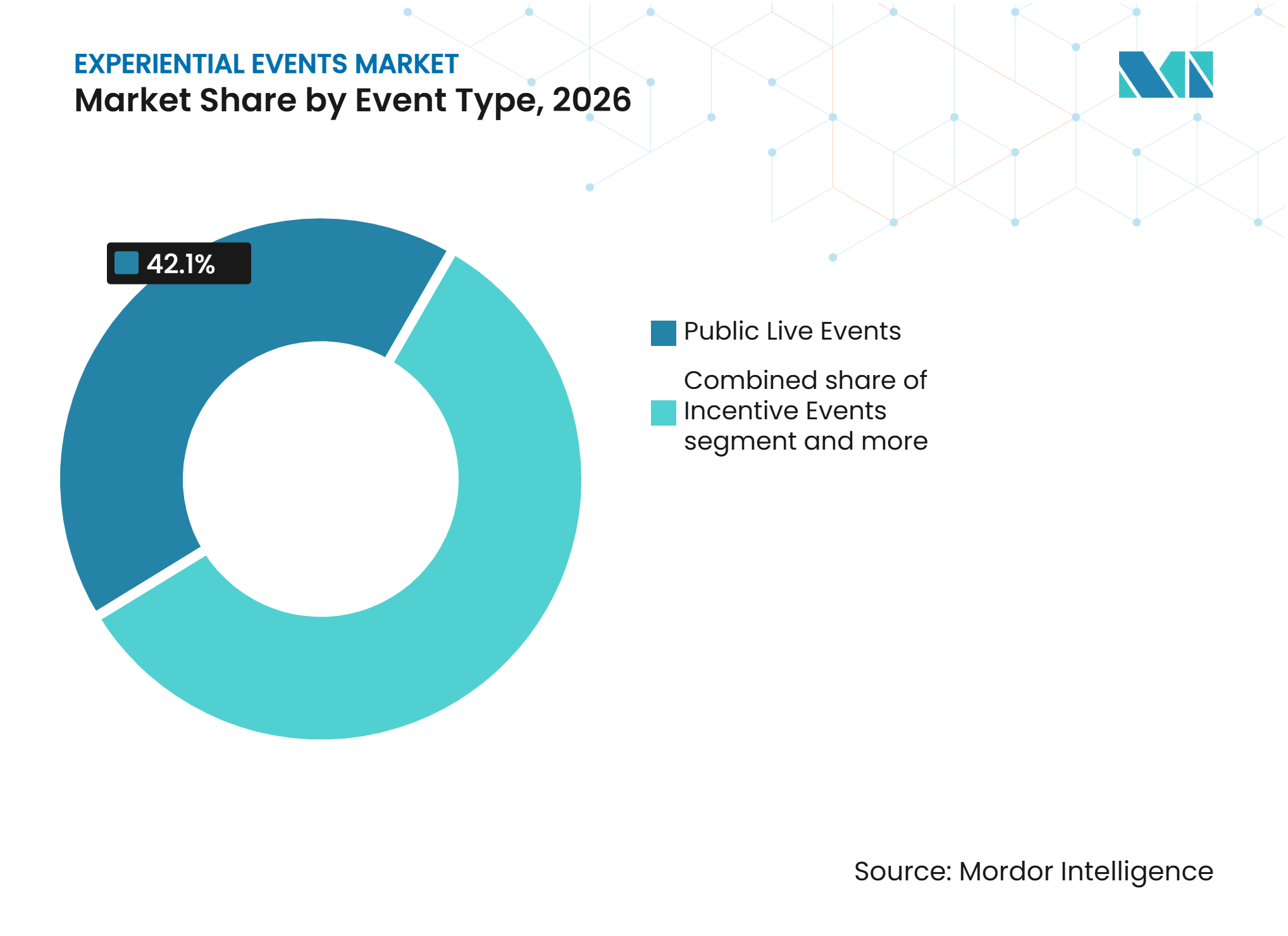
Public Events Lead Volume While Product Launches Drive GrowthPublic Live Events accounted for 42.10% of the global experiential events market in 2026. The segment includes concert tours, sports activations, festivals, and civic programs that attract large audiences and create sponsorship inventory. Its scale reflects the sustained appeal of live entertainment and major sports programming that attracts international brand participation. Live Nation reported that non-English-language artists accounted for twice as many of its top 50 touring acts as in 2019, indicating broader audience representation in touring activity. Public programs also generate revenue through ticketing, food and beverages, merchandise, and partner activations.
Product Launches and Brand Activation Events are forecast to grow at a CAGR of 8.75% through 2032. Brands use these programs to enable direct product interaction, collect consented first-party data, and create content for follow-up marketing. This format allows customers, channel partners, and media representatives to experience products directly. Shorter activation cycles around product updates can distribute investment throughout the year and reduce reliance on a single major launch. These factors support demand for agencies that combine creative services, logistics, content capture, and measurable follow-up across the experiential events industry.



By Event Format:
Physical Presence Remains Central While Hybrid Expands ReachIn-person events accounted for 86.30% of global market value in 2026. Physical formats remain essential where trust-building, networking, product demonstrations, and shared audience experiences influence program quality. They are particularly relevant for exhibitions, corporate gatherings, live entertainment, and incentive travel. Freeman noted that association participants prioritize learning, networking, and vendor relationships, which direct interactions often support more effectively. The scale of in-person events sustains demand for venues, audiovisual production, staging, catering, transportation, and on-site personnel.
Hybrid events are projected to grow at a CAGR of 10.30% through 2032. This format combines in-person programming with digital distribution to engage remote participants. It also extends content availability through recorded sessions, post-event viewing, digital sponsor engagement, and online follow-up. Professional Convention Management Association (PCMA) reported widespread AI adoption in event planning, which can strengthen hybrid programs when organizers integrate physical and digital engagement data. Demand for hybrid formats in the global experiential events market is supported by buyers seeking personal interaction and broader access without viewing virtual programming as a complete substitute for live attendance.
By Service Type:
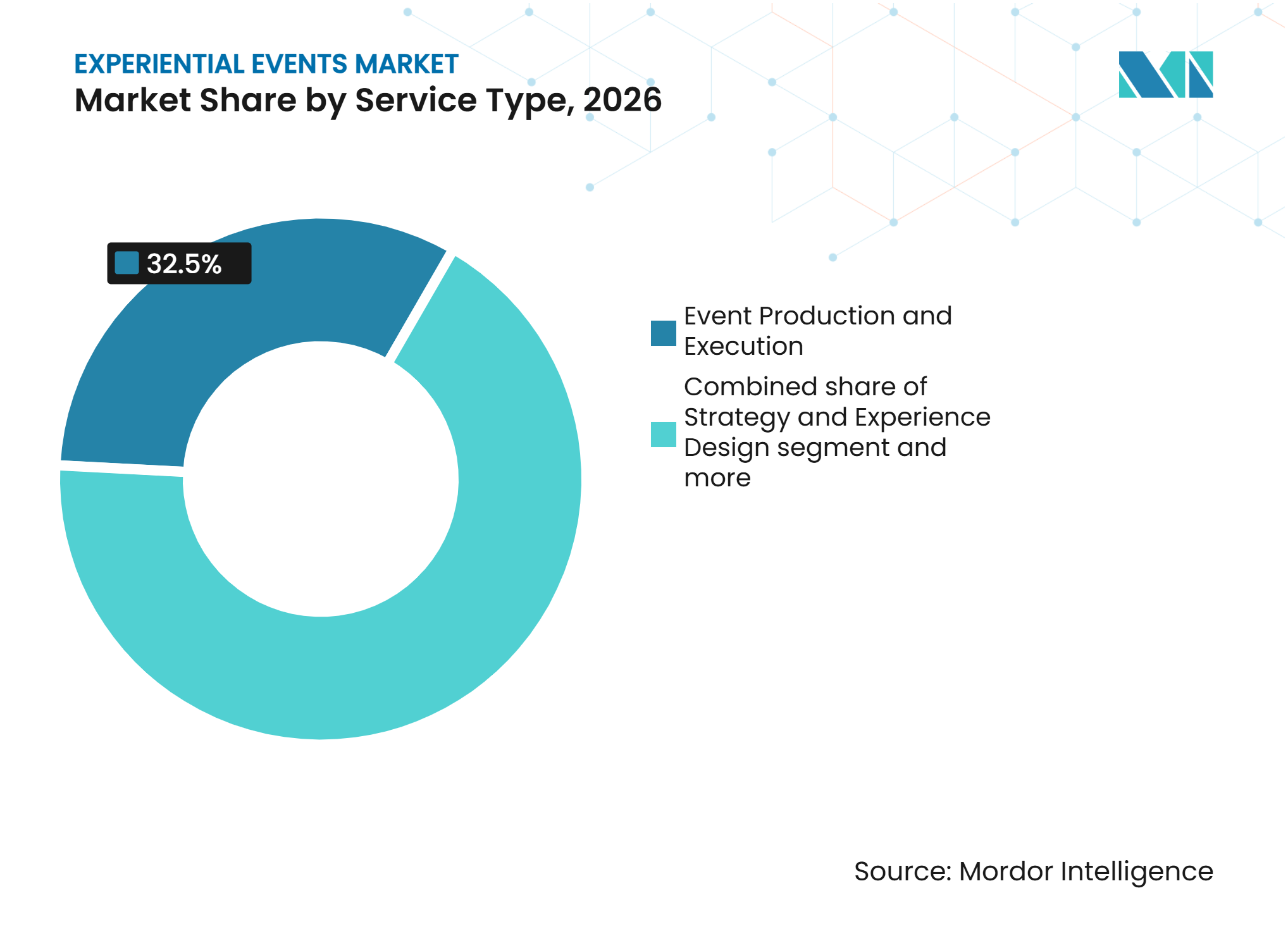
Production Holds Scale While Strategy and Design Gain ValueEvent Production and Execution accounted for 32.50% of the global experiential events market share in 2026. This service area includes audiovisual delivery, staging, building work, event operations, technical direction, show control, and on-site management. It requires specialized labor, equipment, venue coordination, and strict delivery schedules. Cost pressures are particularly high in this part of the value chain, as providers must secure staff and equipment before an event opens. The Meetings Industry Association’s cost findings show why production partners increasingly negotiate project scope, booking timelines, and client change requests.
Strategy and Experience Design is forecast to grow at a CAGR of 9.62% through 2032. Clients are allocating more work to partners that define objectives, audience journeys, content themes, measurement plans, and commercial follow-up before production begins. This approach strengthens the connection between creative decisions and business outcomes. Encore’s acquisition of FIRST illustrates production-led groups’ interest in expanding into brand experience and strategic services. The experiential events industry is likely to reward providers that combine disciplined planning with reliable execution.

Geography Analysis
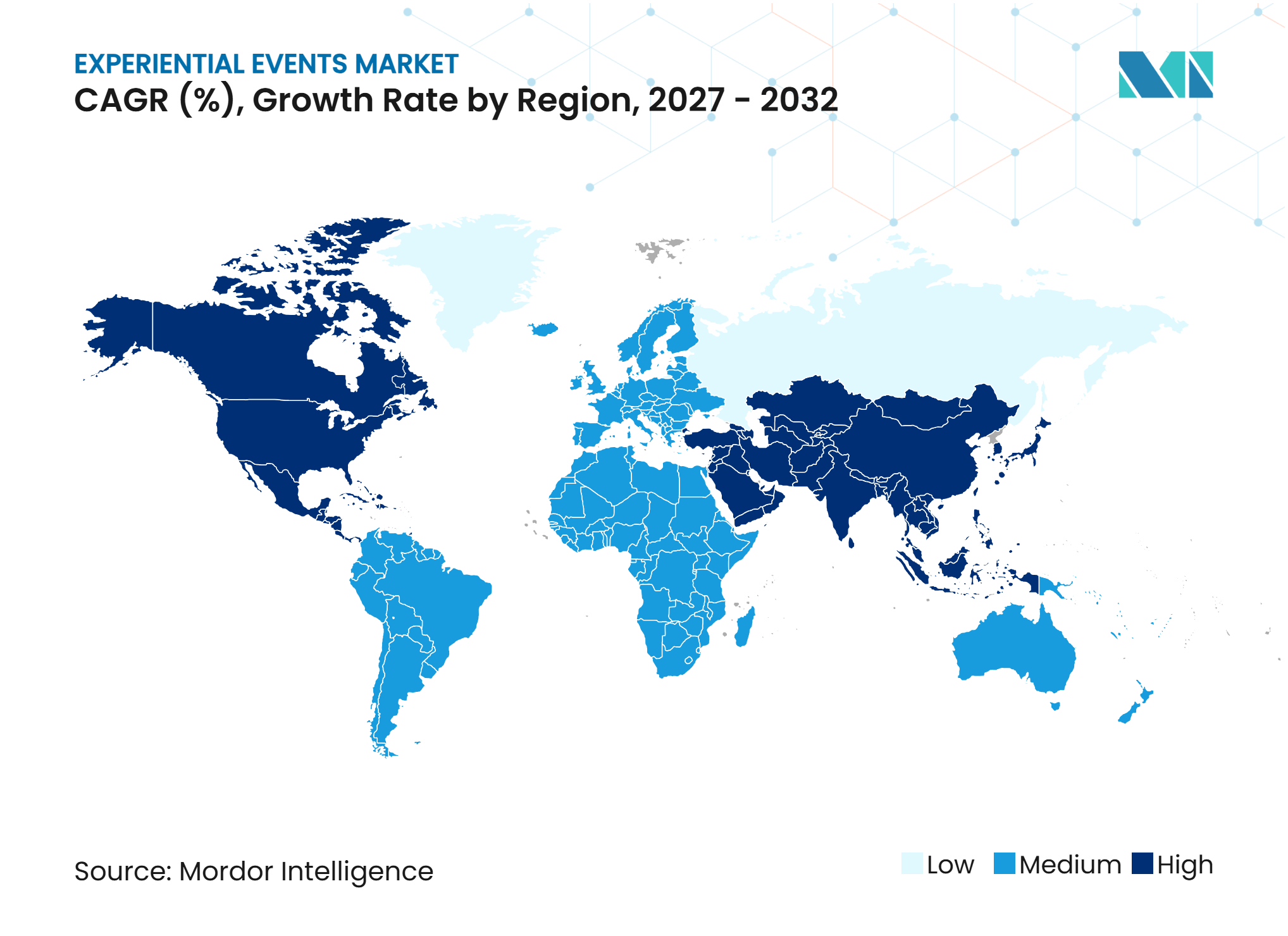
North America accounted for 49.70% of the global experiential events market in 2026. Mature venues, production suppliers, agencies, ticketing networks, and corporate buyers support the region. Sports and entertainment programming in the United States, Canada, and Mexico creates brand activation opportunities. Live Nation’s acquisition of Dominican Republic-based promoter SD Concerts in May 2025 expanded its regional reach across South America and the Caribbean, including markets such as Chile, Colombia, and Puerto Rico. CCPA and related state privacy frameworks govern attendee-data use. The region remains a test bed for AI-enabled personalization, hybrid delivery, and consent-based measurement.
Asia-Pacific is projected to grow at a CAGR of 10.25% through 2032, supported by domestic demand, international business activity, and demand for exhibitions, launches, and activations. India’s exhibition revenue reached 133% of its 2019 level, highlighting expansion potential. UFI (Global Association of the Exhibition Industry) tracks exhibition-market development[4]. China’s key exhibition cities retain capacity, while Vietnam and Singapore offer opportunities for organizers partnering locally. Technical talent and supplier capacity remain constraints.
Europe remains a dense exhibition region, although slower growth and cross-border complexity persist in the United Kingdom. Informa’s inD joint venture with Dubai World Trade Centre combines more than 40 B2B brands across healthcare, energy, aviation, food, and ICT. It reflects the UAE’s growing role as a regional event hub. Africa is attracting organized event activity, while South America benefits from touring demand. Partnerships, local suppliers, and country-specific compliance remain essential.
Service Provider Network & Expansion Intelligence
The global experiential events market relies on integrated production companies, venue-based providers, specialist brand-experience agencies, and local suppliers. In 2024, Encore delivered more than 400,000 events across 21 countries, serving approximately 2,200 venues and nearly 100,000 customers globally, demonstrating the scale required for multi-location programs. Its acquisition of FIRST added an agency managing more than 15,000 events annually, strengthening outsourced corporate event delivery. These networks support recurring contracts and consistent execution, while local technical talent, equipment availability, and supplier reliability remain critical to service coverage.
Providers are expanding through acquisitions and partnerships that combine event portfolios with regional market access. Informa and Dubai World Trade Centre launched inD in January 2026, combining more than 40 B2B event brands, approximately 1,000 employees, and projected revenue exceeding USD 650 million. The Dubai Exhibition Centre expansion is expected to add 140,000 m² of event capacity in 2026. Live Nation acquired SD Concerts in May 2025, expanding its presence in the Dominican Republic and other South American and Caribbean markets. These developments create opportunities for providers with regional partnerships, scalable production, and local execution capabilities.
Competitive Landscape
Market Concentration
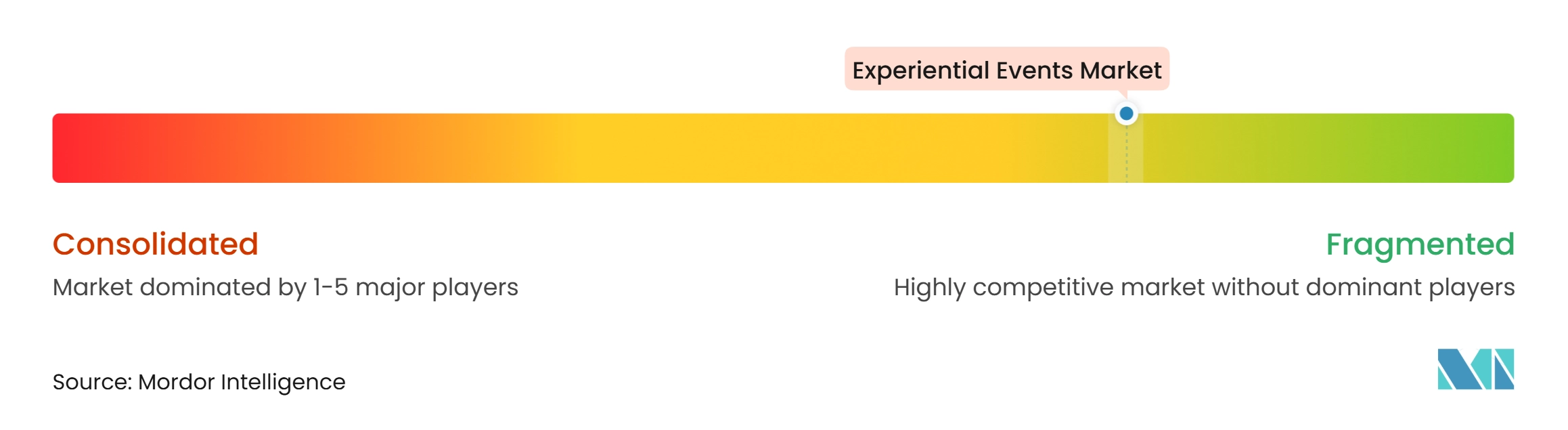
The global experiential events market has a low overall concentration. Informa PLC, Freeman, Live Nation Entertainment, Encore, and GL events operate across exhibitions, production, ticketing, venues, and agency services. No company has pricing authority across all event formats, geographies, and services. Competitive advantages stem from network reach, customer relationships, technical execution, data capabilities, and sector specialization. This structure supports specialist agencies and local providers, particularly when global suppliers require regional execution partners.
Targeted acquisitions have expanded major suppliers’ service portfolios and geographic reach. Encore acquired FIRST in December 2025, adding a global brand-experience agency and corporate-campus managed-services relationships. It acquired Eclipse in March 2026, expanding scenic services and creative production capabilities in the United Kingdom. Informa launched inD with Dubai World Trade Centre in January 2026, adding institutional scale to its B2B events platform in India, the Middle East, and Africa (IMEA).
Sustainable operations, data management, and service capabilities in underdeveloped local markets also shape competition. ISO 20121 can influence public-sector and multinational procurement. Clients seek partners that combine creative work, measurement, and permitted attendee-data use. Mid-sized brands and emerging cities in South Asia and Africa offer opportunities where demand may outpace specialist agency supply. Local teams, dependable suppliers, and consistent service standards enable companies to compete without global scale.
Experiential Events Industry Leaders
-
Informa PLC
-
Freeman Company, LLC
-
Live Nation Entertainment, Inc.
-
Encore Global
-
GL events SA
- *Disclaimer: Major Players sorted in no particular order
Experiential Events Market Companies Covered in this Report
- Informa PLC
- Freeman Company, LLC
- Encore Global
- GL events SA
- RX Global Ltd.
- BCD Group
- Project Worldwide
- Impact XM
- Legends Global
- CTS Eventim AG & Co. KGaA
- Live Nation Entertainment, Inc.
- Forge
- Maritz Holdings Inc.
- Comexposium Group SAS
- Deutsche Messe AG
- DRPG Group Ltd.
- ATPI Ltd.
- MCI Group
- Omnicom Group
- Production Resource Group (PRG)
Recent Industry Developments in Experiential Events Market
- January 2026: Informa completed its partnership with Dubai World Trade Centre to launch inD, a 52%-owned joint venture combining Informa's B2B Live Events business across IMEA with Dubai World Trade Centre's (DWTC) events portfolio, creating an institutional-scale player in the Gulf region's B2B events market.
- December 2025: Encore acquired FIRST, a global brand-experience agency with offices in New York, London, and Singapore that manages more than 15,000 events annually. The acquisition strengthens Encore’s corporate-campus event delivery and project-based production capabilities, particularly for technology, financial services, and professional services clients.
- November 2025: Encore announced the acquisition of Eclipse, a United Kingdom-based event production company with expertise in scenic services and creative production, further expanding Encore's production capability and high-profile venue relationships in London and across the United Kingdom.
- May 2025: Live Nation acquired SD Concerts, the Dominican Republic's leading live entertainment company and a promoter across 8 countries in South America and the Caribbean, integrating SD's ticketing platform into the Ticketmaster ecosystem and strengthening its South American touring infrastructure.
Global Experiential Events Market Report Scope
The global experiential events market report analyzes live, hybrid, and virtual experiences designed to engage audiences, build brands, and drive participation across corporate events, exhibitions and trade shows, product launches and brand activations, incentive events, and public live events worldwide. The market is segmented by event type, event format, service type, and geography. The study examines key drivers, including demand for measurable brand experiences, event-led growth, hybrid engagement, AI-enabled personalization, modular pop-ups, and venue-based commerce, alongside restraints such as venue and production cost inflation, fragmented ROI measurement, data-privacy requirements, and climate-related disruptions. It evaluates provider networks, geographic expansion, event pricing, customer acquisition costs, audience preferences, spending patterns, and engagement frequency. The report provides market size and growth forecasts, regional and country-level analysis, competitive landscape and market share assessments, strategic developments, and profiles of leading experiential event providers. It also explores opportunities in modular activation systems, event data solutions, and outcome-linked sponsorships. Market estimates and forecasts are presented in value (USD) across all covered segments.
Segmentation Overview
Key Questions Answered in the Report
What is the projected value of the experiential events sector by 2032?
The sector is projected to reach USD 233.78 billion by 2032, growing at a 7.75% CAGR from 2027.
Which event type has the largest share of global value?
Public Live Events lead with 42.10% of global value in 2026, supported by concerts, sports activations, festivals, and civic programming.
Which event format is growing fastest?
Hybrid Events are forecast to grow at a 10.30% CAGR through 2032 as buyers combine physical interaction with digital reach and data capture.
Why are brand activation events gaining demand?
Product Launches and Brand Activation Events are expected to grow at an 8.75% CAGR because brands use them for product interaction, permitted first-party data, and follow-up marketing.
Which region will expand fastest through 2032?
Asia-Pacific is projected to record a 10.30% CAGR, supported by domestic demand, business activity, and developing exhibitions and activation capacity.
What is the main operating challenge for event providers?
Venue, labor, and production cost inflation is the leading challenge, with Meetings Industry Association (MIA) reporting 12% average cost increases among surveyed United Kingdom event organizations.