
Container Depot Logistics Market Size and Share
Market Overview
| Study Period | 2020 - 2031 |
|---|---|
| Market Size (2026) | USD 62.07 Billion |
| Market Size (2031) | USD 82.06 Billion |
| Growth Rate (2026 - 2031) | 5.74 % |
| Fastest Growing Market | Middle East and Africa |
| Largest Market | Asia-Pacific |
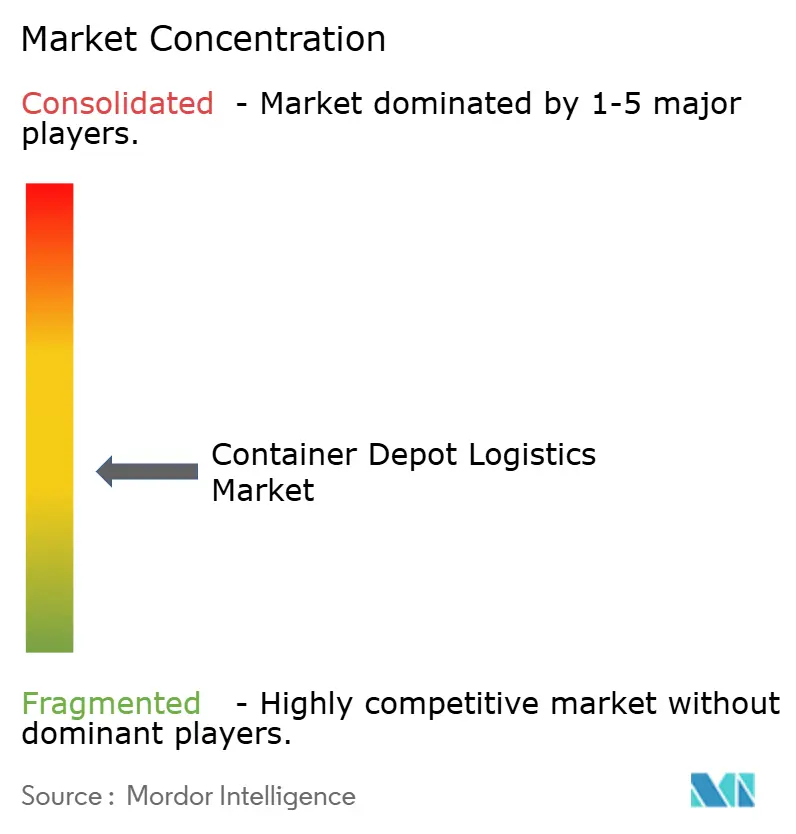
| Market Concentration | Medium |
Major Players *Disclaimer: Major Players sorted in no particular order Image © Mordor Intelligence. Reuse requires attribution under CC BY 4.0. | |
Container Depot Logistics Market Analysis by Mordor Intelligence
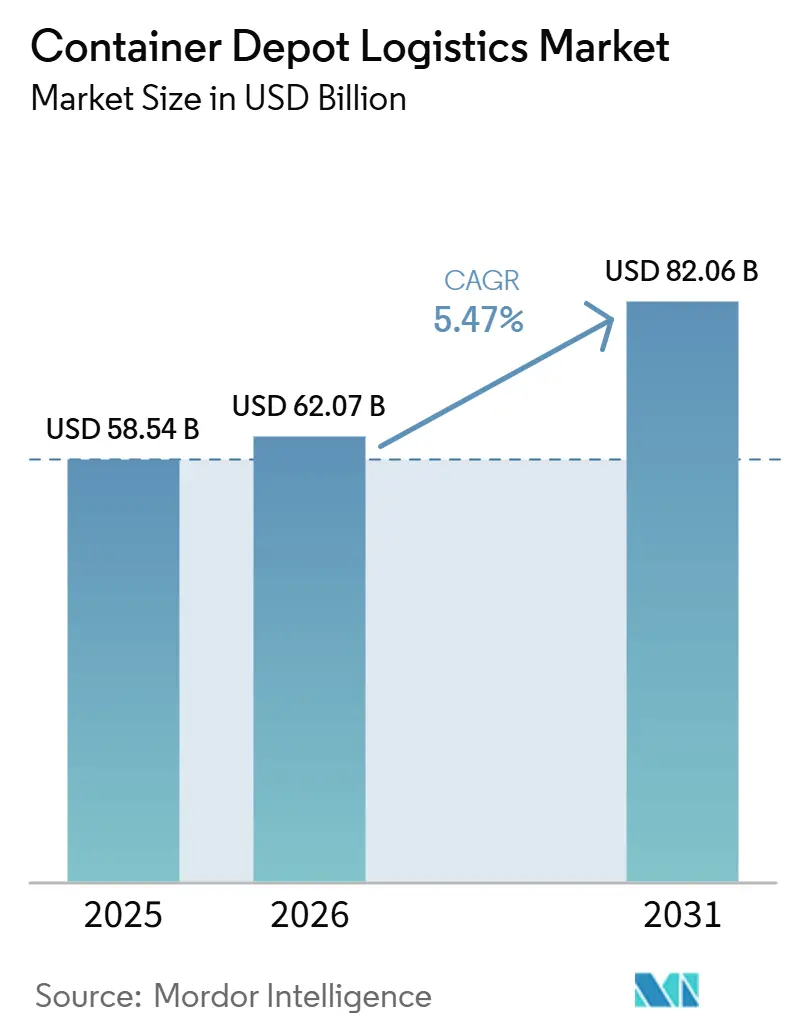
The container depot logistics market size was valued at USD 58.54 billion in 2025 and is projected to reach USD 62.07 billion in 2026, and reach USD 82.06 billion by 2031, growing at a CAGR of 5.74% from 2026 to 2031.
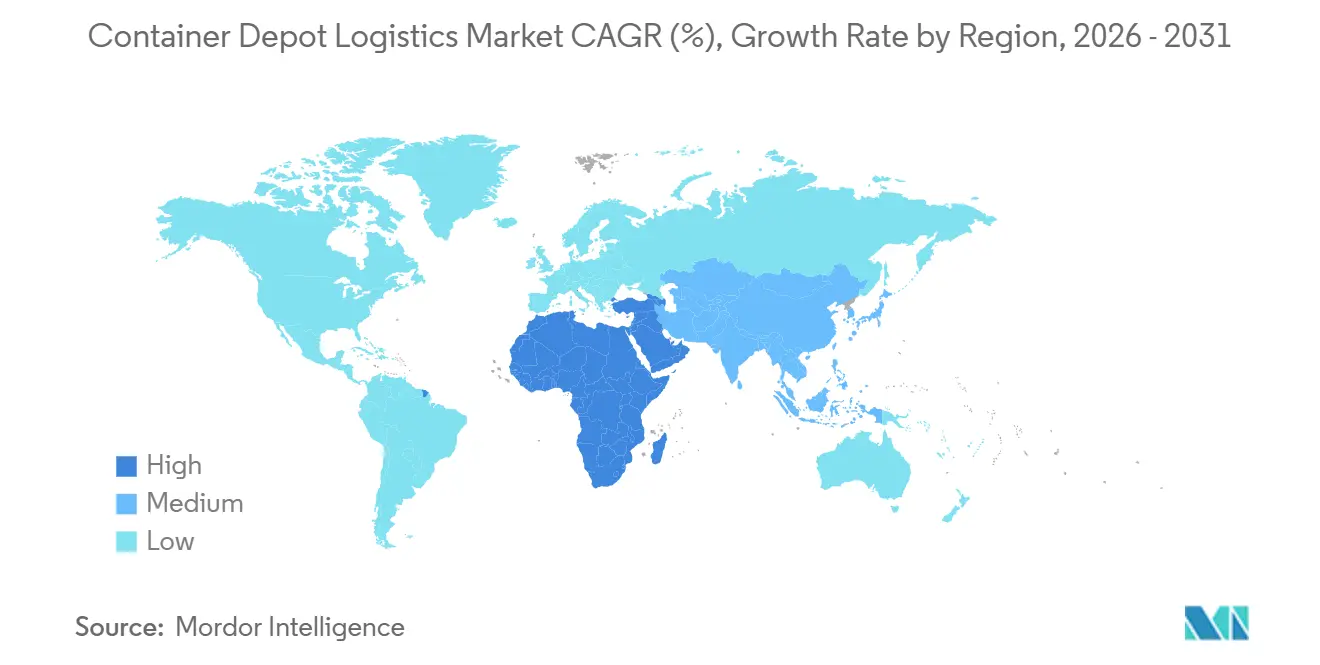
The market is expanding as higher containerized trade volumes drive demand for off-port storage, handling, and repositioning capacity across major shipping corridors. The container depot logistics market is also benefiting from supply chain redesign, as manufacturers and logistics providers place more inventory and equipment at inland nodes to reduce congestion risk and improve transport flexibility. Asia-Pacific remains the largest regional base because export manufacturing, rail-linked inland depots, and coastal gateway traffic are concentrated there, while the Middle East and Africa are growing faster as new logistics corridors and private terminal investment gain pace. The container depot logistics market is also seeing a shift toward outsourced depot operations, as shipping lines and NVOCCs seek variable operating models and stronger service visibility. Growth is still moderated by land scarcity near ports, rising labor and safety costs, and uncertain payback from automation at mid-sized sites.
Key Report Takeaways
- By depot type, inland container depots held 34.16% of the container depot logistics market share in 2025, while empty container depots recorded the highest projected CAGR at 8.60% through 2031.
- By service type, container storage services accounted for 38.92% of the container depot logistics market size in 2025, while container maintenance and repair services are forecast to expand at 9.76% CAGR through 2031.
- By container type, dry containers led with 79.08% of the container depot logistics market share in 2025, while reefer containers are projected to grow at the fastest CAGR of 8.18% through 2031.
- By trade orientation, international and transshipment container handling accounted for 62.47% of the container depot logistics market size in 2025, while domestic container movement is advancing at the highest CAGR of 7.89% through 2031.
- By geography, Asia-Pacific led with 59.99% of the container depot logistics market share in 2025, while the Middle East and Africa are set to expand at 7.61% CAGR through 2031.
Note: Market size and forecast figures in this report are generated using Mordor Intelligence’s proprietary estimation framework, updated with the latest available data and insights as of January 2026.
Market Trends and Insights
Drivers Impact Analysis of Container Depot Logistics Market*
| Driver | (~) % Impact on CAGR Forecast | Geographic Relevance | Impact Timeline |
|---|---|---|---|
| Growth In Containerized Trade Requiring Off-Port Buffer Capacity | +1.5% | Global, concentrated in APAC and North America | Short term (≤ 2 years) |
| Rising Need For Faster Container Turnaround At Congested Ports | +1.1% | APAC core, spill-over to MEA and Europe | Short term (≤ 2 years) |
| Expansion Of Reefer And Specialized Container Handling Needs | +0.8% | APAC, South America, Europe | Medium term (2-4 years) |
| Digital Yard Visibility, Appointment Systems, And Real-Time Slot Allocation | +0.7% | North America and the EU are early adopters in APAC | Medium term (2-4 years) |
| Shift Toward Outsourced Depot Operations By Shipping Lines And NVOCCs | +0.6% | Global, concentrated in APAC and South America | Medium term (2-4 years) |
| Decarbonization Pressure Encouraging Depot-Level Electrification And Idle-Time Reduction | +0.4% | EU, North America, Singapore, Australia | Long term (≥ 4 years) |
| Source: Mordor Intelligence | |||
Growth in Containerized Trade Requiring Off-Port Buffer Capacity
Record trade volumes are creating a structural need for off-port storage and staging space across the container depot logistics market. The World Trade Organization projects global merchandise trade growth of 3% in 2026, providing the sector with a clear demand base even under tariff pressure. UNCTAD also shows that global seaborne trade exceeded 12 billion tons, supporting sustained container circulation and recurring demand for temporary storage at major trade nodes. In the container depot logistics market, this rise in volume does not translate evenly because export-heavy locations absorb peak outbound loads while import-led locations handle return-empty backlogs. That imbalance is making capacity, pricing, and utilization more location-specific than broad global averages suggest.
Rising Need for Faster Container Turnaround at Congested Ports
Port congestion continues to support the container depot logistics market because off-port depots act as relief valves when gateway terminals run short of space. Carriers are placing greater value on depots that can offer guaranteed slots, customs support, and faster truck moves, as these features reduce cycle time and improve asset utilization. The container depot logistics market is also seeing higher occupancy from documentation-hold containers, which are still in transit on paper but remain physically idle until compliance or customs checks are completed. PSA International doubled annual handling capacity at PSA Mumbai to 4.8 million TEUs in September 2025, which shows how operators are pairing port expansion with broader landside throughput planning[1]Source: PSA International, “PSA Inaugurates Phase 2 of PSA Mumbai, India’s Largest Container Terminal,” PSA International, globalpsa.com. Depots with truck appointment systems, OCR-enabled gates, and better yard coordination are therefore gaining a clear service advantage.
Expansion of Reefer and Specialized Container Handling Needs
Cold chain logistics is changing the economics of the container depot market, as reefer depots charge higher fees and require more specialized infrastructure than standard dry yards. These facilities require plug-in capacity, continuous monitoring, and controlled staging areas, which increase capital intensity but also improve yield per unit handled. Maersk announced new inland investments in Southern Brazil in April 2026, including a 70,000 m² multipurpose depot in Rio Grande and a CFS expansion in Paranagua, with a clear focus on agrifood and reefer demand. APM Terminals also opened Suape in Brazil in June 2026, with more than 300 reefer plugs, demonstrating that large operators now treat cold chain capacity as core infrastructure rather than a side offering. In the container depot logistics market, that shift is widening the opportunity for certified handling services tied to food, pharmaceuticals, and other sensitive cargo.
Digital Yard Visibility, Appointment Systems, and Real-Time Slot Allocation
Digitalization is becoming a basic operating requirement in the container depot logistics market rather than an optional upgrade. Shipping lines and NVOCCs are increasingly requesting real-time container status, automated gate bookings, and data links to their own transport systems before approving a depot for regular use. The container depot logistics market is therefore moving away from manual yard control, especially for facilities that want premium cargo and repeat carrier contracts. Electronic records are also becoming more important because certification programs and security audits depend on traceable movement histories and controlled handling procedures. Kuehne+Nagel opened a new 3,500 m² container freight station near JNPA in February 2026, with CTPAT, AEO, and ISO certifications, demonstrating how compliance, energy use, and operational visibility are now more closely linked[2]Source: Kuehne+Nagel, “Kuehne+Nagel Opens New Container Freight Station to Meet India’s Growing Trade Needs,” Kuehne+Nagel Newsroom, newsroom.kuehne-nagel.com.
Restraints Impact Analysis of Container Depot Logistics Market*
| Restraint | (~) % Impact on CAGR Forecast | Geographic Relevance | Impact Timeline |
|---|---|---|---|
| Yard Land Scarcity Near Major Ports And Inland Demand Clusters | -0.5% | APAC core (India, Southeast Asia, China), Europe | Long term (≥ 4 years) |
| Depot Labor Intensity And Safety Compliance Costs | -0.3% | Global, most acute in North America and Europe | Medium term (2-4 years) |
| Volatile Empty Container Flows And Repositioning Inefficiencies | -0.4% | Global, concentrated in intra-Asia and transpacific | Short term (≤ 2 years) |
| Automation Payback Uncertainty In Mid-Sized Depots | -0.3% | Global mid-tier operators, particularly APAC and MEA | Long term (≥ 4 years) |
| Source: Mordor Intelligence | |||
Yard Land Scarcity Near Major Ports and Inland Demand Clusters
Land scarcity remains one of the most significant constraints on the container depot logistics market because capacity cannot expand quickly near the busiest port clusters. High-demand corridors need large plots, truck access, and rail or road connectivity, yet those same locations also face the highest land values and the longest approval timelines. The container depot logistics market shows this clearly around JNPA, where fragmented empty yard operations prompted RSA Global to announce a 62-acre automated facility in Uran, Raigad, with an investment of INR 2,580 crore (USD 307 million). Large projects like that require years of site assembly and infrastructure planning, which means supply response is much slower than demand growth. European logistics corridors face similar pressure because inland terminals near Rotterdam, Antwerp, and Hamburg must compete with other industrial and residential uses.
Volatile Empty Container Flows and Repositioning Inefficiencies
Trade imbalances continue to weigh on the container depot logistics market because empty units do not move in step with cargo demand. Export-heavy regions often accumulate large empty stocks, while import-led markets can still face equipment shortages that delay bookings and distort pricing. In the container depot logistics market, those imbalances reduce the value of occupied space because empty dwell consumes yard capacity without generating the same revenue intensity as full throughput. UNCTAD data support the broader point that container circulation inefficiencies keep temporary storage in demand across the shipping system[3]Source: UNCTAD, “Seaborne Trade Data,” UNCTAD, unctad.org. Recent rerouting through longer corridors has added more time to equipment circulation, further raising pressure on intermediate depots and secondary nodes.
*Our forecasts treat driver/restraint impacts as directional, not additive. The impact forecasts reflect baseline growth, mix effects, and variable interactions.
Container Depot Logistics Market Segment Analysis
By Depot Type:
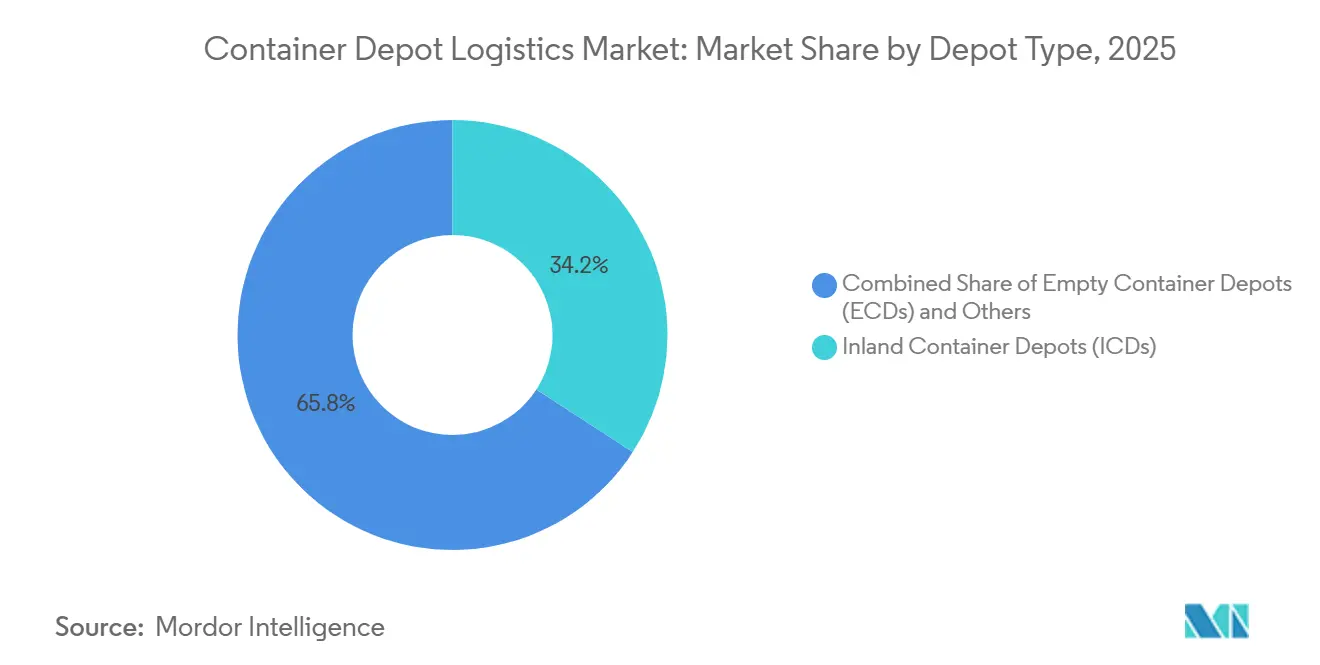
ICDs Anchor Market Share as Empty Depots Drive the Next Growth CycleInland container depots accounted for 34.16% of the container depot logistics market share in 2025, maintaining their leading position across depot formats. Their strength lies in their role as inland customs, consolidation, and dispatch nodes for manufacturing regions that do not want all cargo processing to remain at the port gate. The container depot logistics market continues to favor ICDs along freight rail corridors, national highways, and industrial belts, as these links reduce friction in inland transit and help carriers use port capacity more efficiently. This position also makes ICDs central to trade lanes where production clusters are far from major terminals.
Empty container depots are projected to expand at a 8.60% CAGR through 2031 in the container depot logistics market, making them the fastest-growing depot type. Shipping lines are placing more empty units near export zones to meet bookings faster during seasonal peaks and corridor disruptions. The RSA Global automated yard planned near JNPA shows how the container depot logistics market is moving from fragmented, manual empty-handling to larger, technology-enabled hubs with stronger throughput discipline. Container freight stations still play a role, but direct port delivery policies and land constraints are putting more pressure on their traditional storage function.



By Service Type:
Maintenance and Repair Outpaces the Market as Fleet Age and Standards ConvergeContainer storage services accounted for 38.92% of the container depot logistics market size in 2025, giving them the largest share among service categories. This lead reflects a simple operational fact: each container still needs a temporary holding point at some stage between discharge, clearance, dispatch, and repositioning. The container depot logistics industry also keeps this segment resilient through long-term contracts between carriers, freight forwarders, and depot operators at high-traffic nodes. Allcargo Terminals expanded its CFS capacity near JNPA and secured a 10-year contract extension in January 2026, demonstrating how incumbents leverage long-standing port relationships to maintain utilization and scale.
Container maintenance and repair services are forecast to grow at a 9.76% CAGR through 2031 in the container depot logistics market, well above the overall pace. The main driver is that a larger share of the fleet is moving into scheduled inspection and repair windows after the production surge earlier in the decade. The container depot logistics industry is also seeing stricter condition checks as carriers pay closer attention to compliance, liability exposure, and service quality. Container handling services still move closely with port throughput, while cleaning, washing, fumigation, relabeling, and repackaging offer a more profitable route for operators that want growth without buying more land.
By Container Type:
Dry Container Volumes Lead, Reefer Investment Sets the Margin BenchmarkDry containers accounted for 79.08% of the container depot logistics market size in 2025, maintaining their dominance. They support the largest share of trade in consumer goods, electronics, industrial inputs, and automotive components, so most depot infrastructure is still built around standard 20-ft and 40-ft dry boxes. The container depot logistics market has mature operating practices for this category, but pricing pressure is rising as some gateways promote faster direct delivery, reducing the need for basic storage. That pressure is pushing more dry-focused operators toward value-added services and multi-service layouts.
Reefer containers are projected to expand at an 8.18% CAGR through 2031 in the container depot logistics market, which makes them the fastest-growing container type. Demand is broadening across fresh produce, frozen seafood, pharmaceuticals, and other temperature-sensitive cargo streams that require tighter control between the port and the inland destination. Maersk's new Brazil depot investments and APM Terminals' Suape launch both point to stronger reefer capacity and more deliberate cold chain positioning across the container depot logistics market[4]Source: APM Terminals, “APM Terminals Delivers Suape Brazil,” APM Terminals, apmterminals.com. That makes reefer capability a strategic differentiator for operators that want stronger margins and longer customer relationships.
By Trade Orientation:
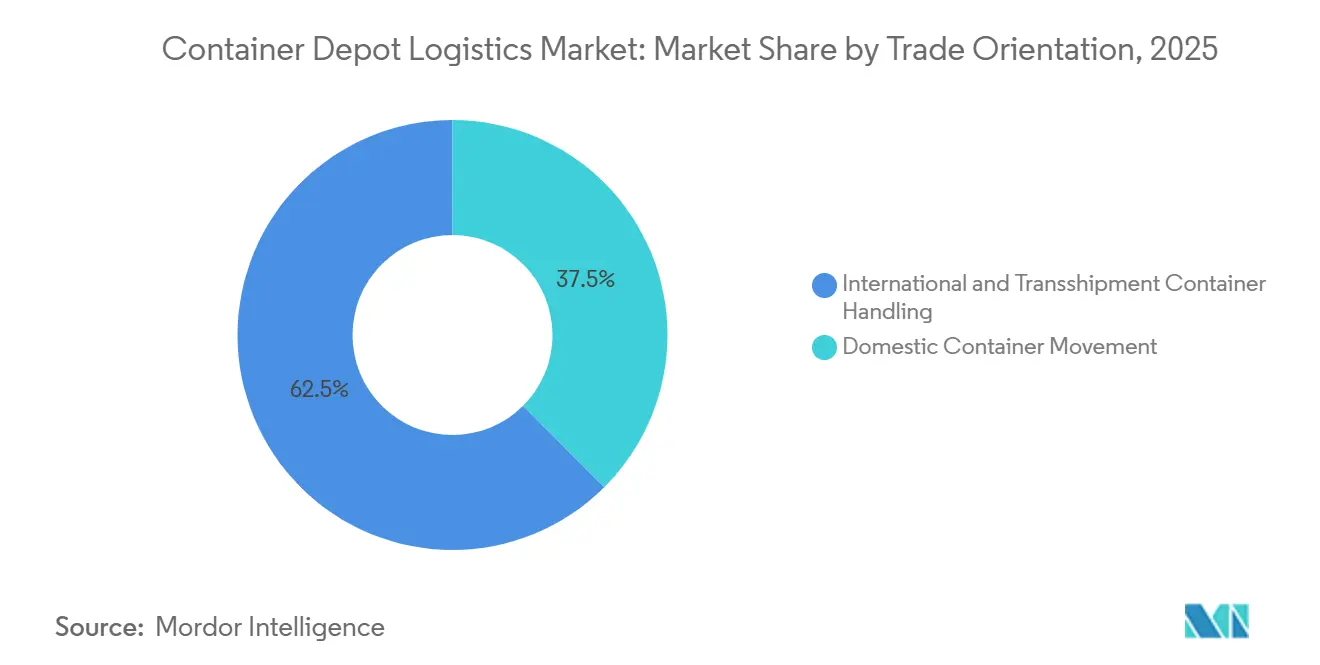
Transshipment Holds Volume Lead While Domestic Trade Redefines the Growth GeographyInternational and transshipment container handling accounted for 62.47% of the container depot logistics market share in 2025, keeping cross-border traffic at the center of depot demand. The largest hubs still need containers to be stored, checked, staged, and repositioned between feeder and mainline calls under tight schedule pressure. The container depot logistics market, therefore, favors operators that can tie depot activity closely to port, customs, and onward transport workflows. This is one reason large integrated terminal groups remain strong at gateway and transshipment nodes.
Domestic container movement is projected to grow at a 7.89% CAGR through 2031 in the container depot logistics market, making it the fastest-growing trade orientation. Rail corridor development and inland manufacturing expansion are turning domestic flows into a more important source of depot demand, especially in large emerging economies. Gateway Distriparks became the first container train operator to run double-stack container trains on the fully operational Western dedicated freight corridor, which highlights how inland rail upgrades are strengthening the domestic side of the container depot logistics market. The same pattern is also visible across Southeast Asia, where supply chain diversification is creating more activity at inland logistics nodes rather than only at coastal gateways.
Geography Analysis
APAC Container Depot Logistics Market
Asia-Pacific accounted for 59.99% of the container depot logistics market share in 2025, making it the leading region. The region remains the main production and export base for global trade, generating persistent demand for ICDs, CFS sites, and empty yards across both coastal and inland corridors. The Container depot logistics market is particularly active in India, where port expansion, inland links, and investment in empty yards are reshaping how cargo and equipment move between factories and maritime gateways. PSA Mumbai's Phase 2 expansion to 4.8 million TEUs and Kuehne+Nagel's new CFS near JNPA both reflect that deeper infrastructure buildout. Japan is also expanding its logistics base, with the Ministry of Land, Infrastructure, Transport and Tourism outlining plans for new logistics facility floor space in the Keihin Port complex and continuing its strategic container port policy.
The Americas and Europe Container Depot Logistics Market
North America and Europe remain high-value revenue pools in the container depot logistics market because service fees are higher, compliance standards are stricter, and infrastructure quality is stronger. Mexico is becoming increasingly important as nearshoring drives more container flows through the Pacific and into inland manufacturing corridors. APM Terminals accelerated expansion at Lázaro Cárdenas after inaugurating Phase II in March 2026, demonstrating how quickly new manufacturing-linked demand is pulling forward port and depot capacity needs. In Europe, resilience planning is supporting investment in inland and coastal infrastructure as operators seek more flexible ways to move cargo across congested corridors. South America is also gaining weight in the container depot logistics market through agrifood exports and cold chain demand, with Suape's fully electrified container terminal setting a new benchmark for reefer-ready, sustainability-linked infrastructure.
MEA Container Depot Logistics Market
The Middle East and Africa are projected to grow at a 7.61% CAGR through 2031, making it the fastest-expanding regional bloc in the container depot logistics market. Saudi Arabia, the UAE, and East African gateways are attracting attention because rerouted flows, logistics corridor development, and private terminal capital are increasing the need for supporting depot capacity. DP World and APM Terminals announced a strategic partnership at Jeddah Islamic Port in February 2026, and the Southern container terminal handled more than 1.3 million TEUs in 2025 as weekly vessel calls rose to 38. The container depot logistics market is therefore opening faster in this region than in many mature geographies, especially where private investors are willing to build ahead of public infrastructure budgets.

Competitive Landscape
The container depot logistics market is moderately consolidated at the top and fragmented across regional and mid-sized operators. A small group of global port and logistics companies, including APM Terminals, DP World, PSA International, CMA CGM Group, and COSCO SHIPPING, controls a large share of the highest-throughput gateway capacity. The container depot logistics market is being reshaped by vertical integration, as carriers and terminal groups now seek to manage port handling, depot operations, inland staging, and logistics services under a single commercial structure. CMA CGM and Stonepeak launched UNITED PORTS LLC in January 2026, with a USD 2.4 billion Stonepeak investment for a 25% minority stake in 10 major terminals, providing CMA CGM with greater capital flexibility for further supply chain expansion. That kind of deal raises the competitive bar for independent operators in the container depot logistics market because scale now matters in financing, technology, and customer retention.
The clearest openings in the container depot logistics market lie in technology-enabled mid-market depots, cold-chain nodes in underbuilt regions, and digital platforms that aggregate fragmented capacity. Mid-sized operators can still compete if they offer reliable slot management, clean compliance records, and better visibility than older manual yards. The container depot logistics market also has room for specialist providers that focus on reefer support, inspection, cleaning, and certified handling for regulated cargo. New digital tools matter because they enable smaller operators to connect to carrier systems and become approved nodes without owning a global footprint. By contrast, depots that lack electronic audit trails, recognized certifications, or service integration are steadily losing ground in higher-value cargo flows.
Large operators are responding with coordinated network investments rather than isolated projects in the container depot logistics market. PSA International expanded in Mumbai in 2025; APM Terminals opened Suape in 2026; DP World accelerated Lazaro Cardenas; and DP World deepened its Red Sea position through the Jeddah partnership. Those moves show that the container depot logistics market is increasingly being managed as a linked network of assets rather than as stand-alone yards. Operators with capital, data visibility, and inland connectivity are therefore in a stronger position to defend margins and win strategic contracts.
Container Depot Logistics Industry Leaders
APM Terminals
DP World
PSA International
Hutchison Ports
COSCO SHIPPING Lines Co., Ltd.
- *Disclaimer: Major Players sorted in no particular order
Container Depot Logistics Market Companies Covered in this Report
- APM Terminals
- DP World
- PSA International
- COSCO SHIPPING Lines Co., Ltd.
- Hutchison Ports
- Shanghai International Port (Group) Co., Ltd.
- CMA CGM Group
- SSA Marine
- International Container Terminal Services, Inc.
- Adani Ports and Special Economic Zone Limited
- Eurogate Container Terminal GmbH
- Mediterranean Shipping Company S.A.
- Container Corporation of India Limited
- Gateway Distriparks Limited
- Qube Holdings Limited
- China Merchants Port Holdings
- Abu Dhabi Ports Group
- Rhenus Group (Including Contargo)
- Allcargo Logistics Limited
- Depot Connect International
- Den Hartogh Logistics
- Bertschi Group

Recent Industry Developments in Container Depot Logistics Market
- June 2026: APM Terminals inaugurated APM Terminals Suape at the Port of Suape, Pernambuco, Brazil, Latin America's first fully electrified container terminal, with an investment exceeding USD 350 million. The facility increases the Suape Port Complex's container-handling capacity by 55%, with an initial capacity of 400,000 TEUs per year, a 430-meter quay length, and more than 300 reefer plugs.
- June 2026: RSA Global unveiled India's largest automated empty container yard at Jawaharlal Nehru Port Authority, Uran, Raigad, with an investment of INR 2,580 crore (USD 307 million). The 62-acre facility targets handling more than 50,000 TEUs per month using ASRS automation, EOT cranes, and an OCR-enabled real-time yard management system, designed to decongest JNPA's fragmented empty container handling operations.
- June 2026: AD Ports Group launched trial operations at Noatum Ports Safaga Terminal in Egypt, ahead of full commercial launch later in 2026, under a 30-year concession agreement, strengthening AD Ports Group's African logistics footprint and adding container capacity to the Red Sea and Mediterranean corridor.
- May 2026: CMA CGM committed EUR 700 million (USD 820 million) to renovate and expand container terminal 1 and Kipevu container terminal at the Port of Mombasa, Kenya. The agreement paves the way for a joint venture to develop logistics and port infrastructure.


Global Container Depot Logistics Market Report Scope
| Inland Container Depots (ICDs) |
| Container Freight Stations (CFS) |
| Empty Container Depots (ECDs) |
| Port-Based Container Depots |
| Container Storage Services |
| Container Handling Services |
| Container Maintenance and Repair (M&R) Services |
| Container Cleaning and Washing Services |
| Other Value-Added Logistics Services |
| Dry Containers |
| Reefer Containers |
| International/Transshipment Container Handling |
| Domestic Container Movement |
| North America | United States |
| Canada | |
| Mexico | |
| South America | Brazil |
| Peru | |
| Chile | |
| Argentina | |
| Rest of South America | |
| Asia-Pacific | China |
| Japan | |
| India | |
| South Korea | |
| Australia | |
| South East Asia | |
| Rest of Asia-Pacific | |
| Europe | United Kingdom |
| Germany | |
| France | |
| Spain | |
| Italy | |
| BENELUX (Belgium, Netherlands, and Luxembourg) | |
| NORDICS (Denmark, Finland, Iceland, Norway, and Sweden) | |
| Rest of Europe | |
| Middle East and Africa | United Arab Emirates |
| Saudi Arabia | |
| South Africa | |
| Nigeria | |
| Rest of the Middle East And Africa |
| By Depot Type | Inland Container Depots (ICDs) | |
| Container Freight Stations (CFS) | ||
| Empty Container Depots (ECDs) | ||
| Port-Based Container Depots | ||
| By Service Type | Container Storage Services | |
| Container Handling Services | ||
| Container Maintenance and Repair (M&R) Services | ||
| Container Cleaning and Washing Services | ||
| Other Value-Added Logistics Services | ||
| By Container Type | Dry Containers | |
| Reefer Containers | ||
| By Trade Orientation | International/Transshipment Container Handling | |
| Domestic Container Movement | ||
| By Region/Country | North America | United States |
| Canada | ||
| Mexico | ||
| South America | Brazil | |
| Peru | ||
| Chile | ||
| Argentina | ||
| Rest of South America | ||
| Asia-Pacific | China | |
| Japan | ||
| India | ||
| South Korea | ||
| Australia | ||
| South East Asia | ||
| Rest of Asia-Pacific | ||
| Europe | United Kingdom | |
| Germany | ||
| France | ||
| Spain | ||
| Italy | ||
| BENELUX (Belgium, Netherlands, and Luxembourg) | ||
| NORDICS (Denmark, Finland, Iceland, Norway, and Sweden) | ||
| Rest of Europe | ||
| Middle East and Africa | United Arab Emirates | |
| Saudi Arabia | ||
| South Africa | ||
| Nigeria | ||
| Rest of the Middle East And Africa | ||


Key Questions Answered in the Report
What is the 2031 value forecast for container depot logistics?
The container depot logistics market is forecast to reach USD 82.06 billion by 2031, up from USD 62.07 billion in 2026, at a 5.74% CAGR.
Which depot type leads today, and which is growing fastest?
Inland Container Depots led with 34.16% of revenue in 2025, while Empty Container Depots are projected to grow fastest at an 8.60% CAGR through 2031.
Why are reefer depots becoming more important in container depot logistics?
Reefer Containers are expanding at a 8.18% CAGR, and operators are adding specialized cold-chain infrastructure, such as plug-in capacity and monitored staging areas, to capture higher-value cargo.
Which service category contributes the most revenue?
Container Storage Services held the largest revenue share at 38.92% in 2025, as every container still requires temporary staging at some point in the transport cycle.
Which region is expanding the fastest?
The Middle East and Africa are the fastest-growing regions, with a projected 7.61% CAGR through 2031, supported by rerouted trade flows and new logistics corridor investment.
What is changing competition in container depot logistics?
Competition is shifting toward vertically integrated operators that combine terminals, depots, inland links, and digital systems, while smaller depots need stronger visibility, certifications, and niche services to stay relevant.
Page last updated on:





