Concrete Water Reducers (Plasticizers) Market Size and Share
Market Overview
| Study Period | 2018 - 2031 |
|---|---|
| Market Size (2026) | USD 6.74 Billion |
| Market Size (2031) | USD 9.29 Billion |
| Growth Rate (2026 - 2031) | 6.63 % |
| Fastest Growing Market | Asia Pacific |
| Largest Market | Asia Pacific |
| Market Concentration | Medium |
Major Players *Disclaimer: Major Players sorted in no particular order Image © Mordor Intelligence. Reuse requires attribution under CC BY 4.0. | |
Concrete Water Reducers (Plasticizers) Market Analysis by Mordor Intelligence
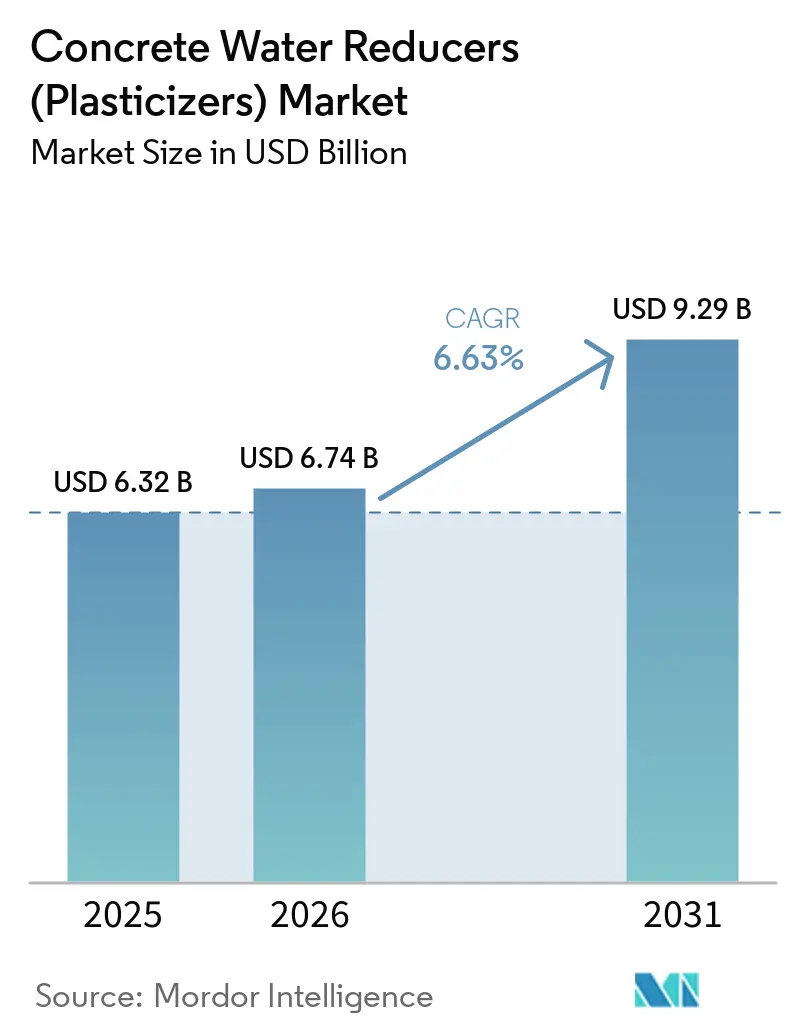
The Concrete Water Reducers (Plasticizers) Market size in 2026 is estimated at USD 6.74 billion, growing from 2025 value of USD 6.32 billion with 2031 projections showing USD 9.29 billion, growing at 6.63% CAGR over 2026-2031. Construction stakeholders are increasingly specifying high-range water-reducing admixtures to lower cement content, enhance workability, and reduce embodied carbon, all while preserving structural performance. Large-scale infrastructure stimulus in emerging economies, stricter public procurement rules that favor green concrete, and the shift toward supplementary cementitious materials (SCMs) reinforce demand. Market leaders differentiate themselves through polycarboxylate ether (PCE) chemistry, which delivers water cuts exceeding 30%, extends slump retention, and interfaces well with AI-enabled mix-design platforms. Moderate consolidation combined with record capital investment by global players signals robust competitive intensity and continuous innovation.
Key Report Takeaways
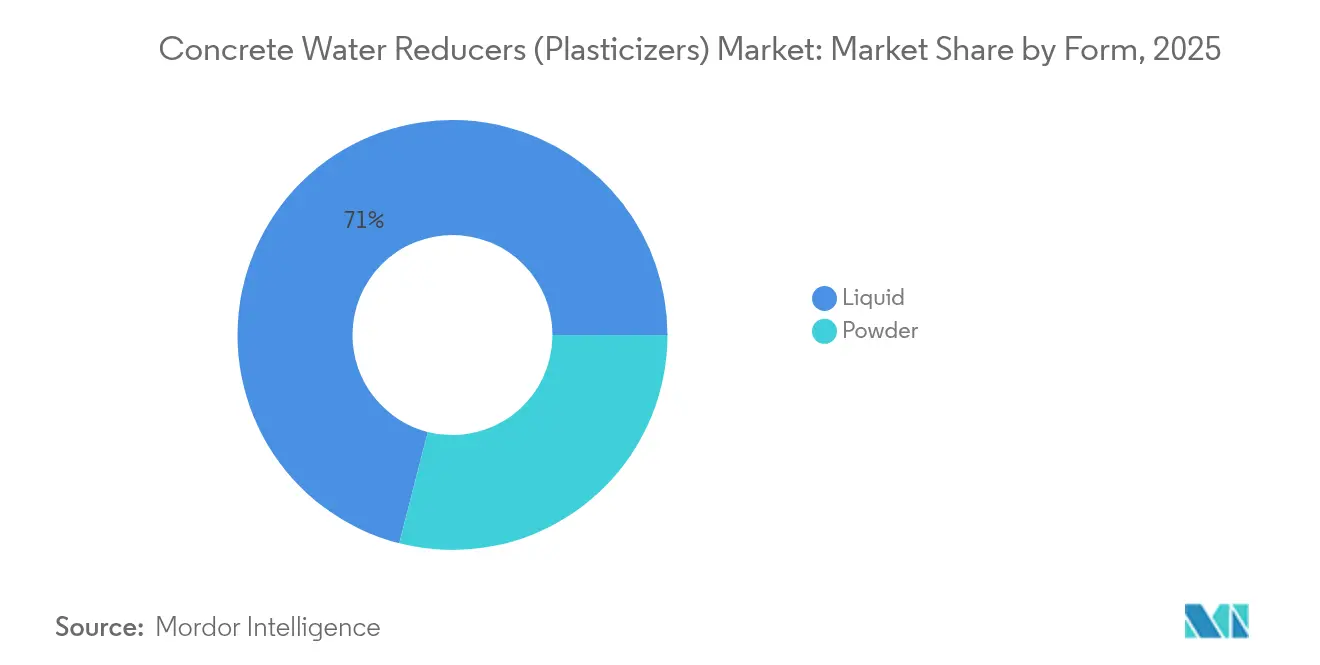
- By form, liquid products held 71.02% of the Concrete Water Reducers (Plasticizers) market share in 2025 and are expected to grow with a CAGR of 7.12% during the forecast period (2026-2031).
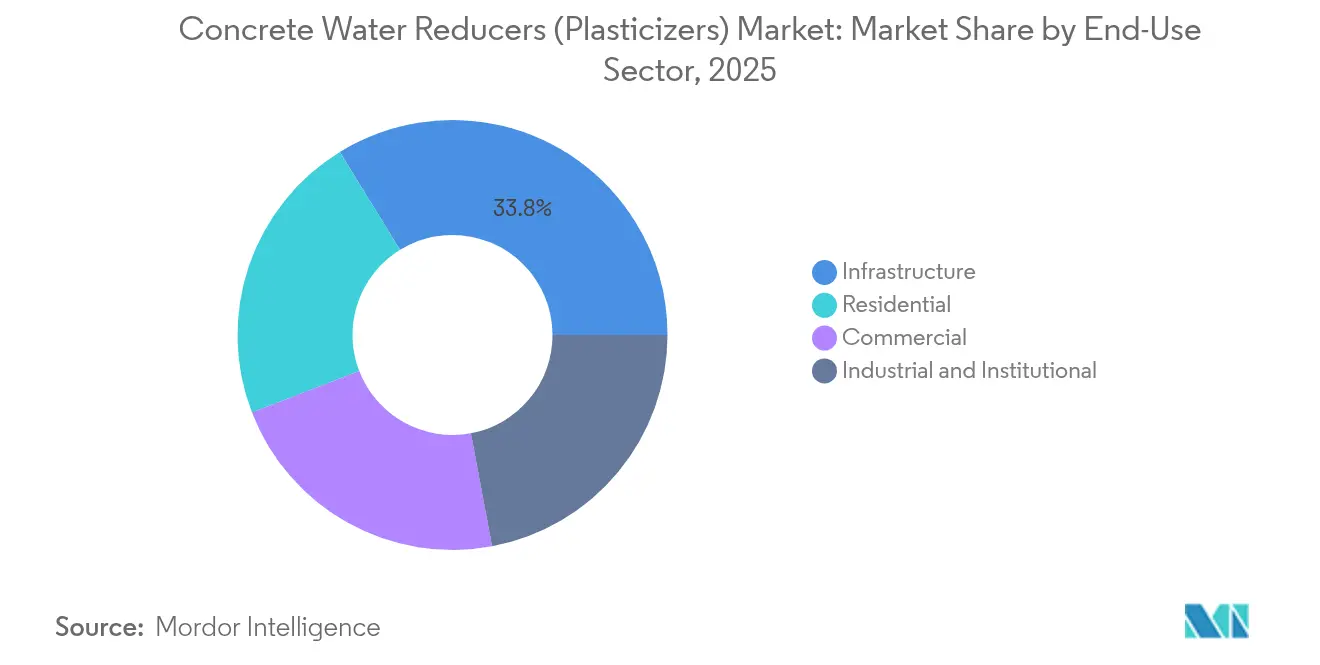
- By end-use sector, infrastructure captured 33.78% revenue share in 2025 while recording the fastest 7.52% CAGR to 2031.
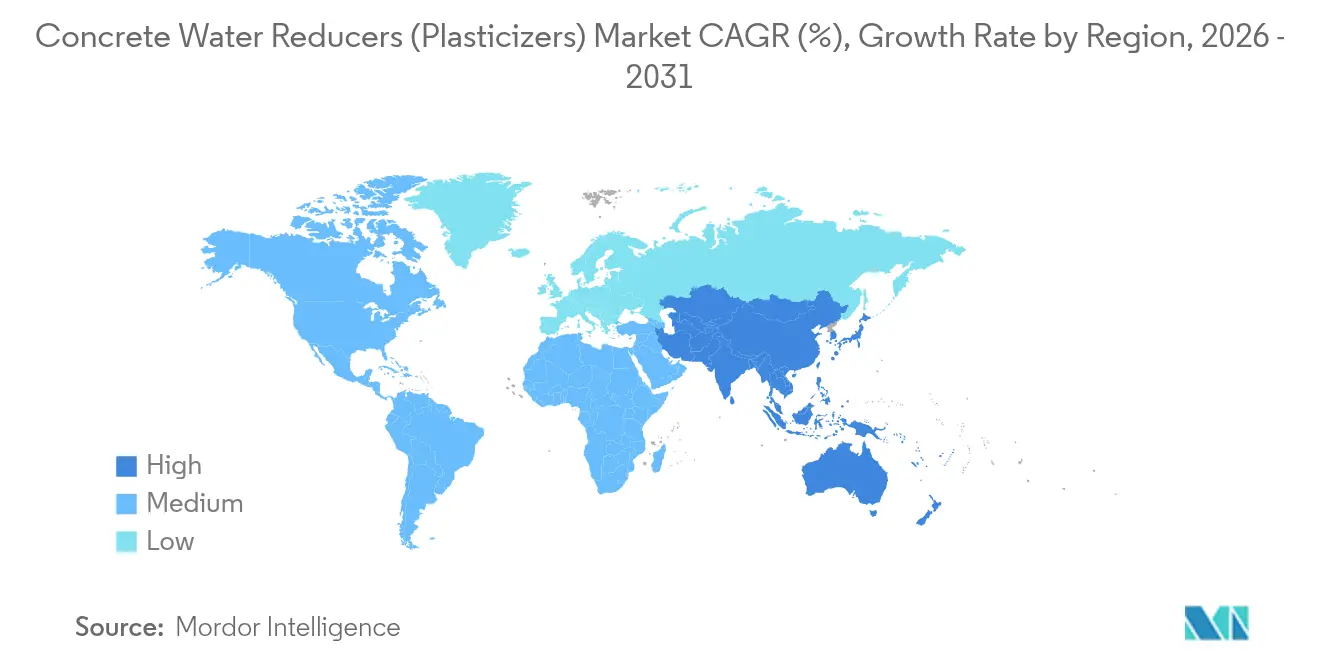
- By geography, the Asia-Pacific region commanded 45.62% of the Concrete Water Reducers (Plasticizers) market size in 2025 and is projected to advance at a 7.22% CAGR through 2031.
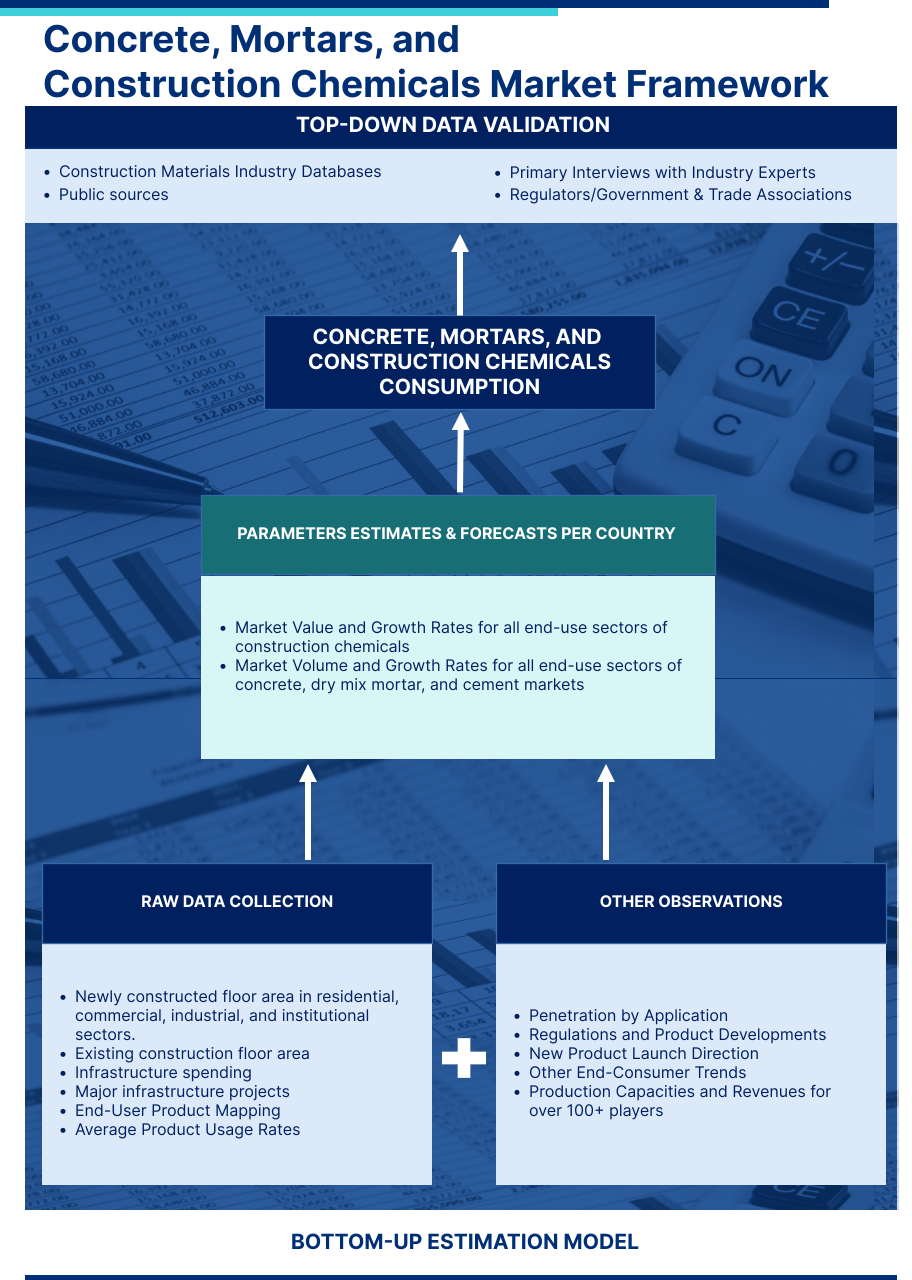
Note: Market size and forecast figures in this report are generated using Mordor Intelligence’s proprietary estimation framework, updated with the latest available data and insights as of 2026.
Market Trends and Insights
Drivers Impact Analysis of Concrete Water Reducers (Plasticizers) Market*
| Driver | (~) % Impact on CAGR Forecast | Geographic Relevance | Impact Timeline |
|---|---|---|---|
| Rapid growth in residential projects | +1.8% | Asia-Pacific, Latin America, Middle East | Medium term (2-4 years) |
| Green concrete mandates in procurement | +1.5% | Global, early gains in North America & Europe | Long term (≥ 4 years) |
| Rising infrastructure spending | +2.1% | Asia-Pacific core, spill-over to MEA | Medium term (2-4 years) |
| CO₂-curing technologies | +0.9% | Global, concentrated in developed markets | Long term (≥ 4 years) |
| AI-optimized mix-design software | +0.7% | Global, technology leaders first | Short term (≤ 2 years) |
| Source: Mordor Intelligence | |||
Rapid Growth in Residential Projects in Emerging Economies
Soaring residential construction across Asia-Pacific and Latin America is enlarging the concrete water reducers (plasticizers) market. Developers prioritize liquid admixtures to slash cement use, accelerate cycle times, and ensure durability under hot, humid climates. India exemplifies the trend as local producers such as MBCC allocate USD 2.4 million toward a new plant to serve high-volume affordable housing. Prefabricated components also lift demand because water reducers guarantee uniform rheology across factory-cast elements. National housing missions embed sustainability clauses, cementing the product’s value proposition in fast-growing suburbs.
Green Concrete Mandates in Public Procurement
Government agencies now require contractors to validate lowered embodied carbon, propelling uptake of water reducers that facilitate SCM usage. New York’s Buy Clean rules oblige concrete plants to publish Environmental Product Declarations showing reduced cement content, often achievable only with PCE-based admixtures. European Green Deal policies apply similar carbon ceilings, influencing private projects that mirror public specifications. EN 934-2 testing standards guarantee performance consistency and accelerate market acceptance[1].
Rising Infrastructure Spending Across the Asia-Pacific Region
Gigantic transport, energy, and urban renewal schemes across China, India, and Southeast Asia are underwriting long-run demand. High-speed rail lines and coastal port expansions require dense, low-permeability concrete, which water reducers enable by allowing water-cement ratios below 0.40. The region’s governments earmark multi-year budgets to modernize bridges and highways, creating predictable procurement pipelines and securing the concrete water reducers (plasticizers) market.
CO₂-Curing Technologies Boosting Reducer Demand
Commercial CO₂-curing systems capture up to 45% of process carbon while increasing compressive strength; however, the method requires tailored admixture packages that maintain workability under rapid carbonation. Producers report that PCE superplasticizers maintain flow even as curing chambers flood with CO₂, forming a dense matrix that locks in carbon. The premium pricing attainable for carbon-neutral concrete incentivizes adoption and widens the market for concrete plasticizers
Restraints Impact Analysis of Concrete Water Reducers (Plasticizers) Market*
| Restraint | (~) % Impact on CAGR Forecast | Geographic Relevance | Impact Timeline |
|---|---|---|---|
| Volatile lignosulfonate prices | -1.2% | Global, concentrated in Asia-Pacific production | Short term (≤ 2 years) |
| Rising capital expenditure | -0.8% | Global, affecting smaller players | Medium term (2-4 years) |
| Import dependency in developing regions | -0.6% | Africa, Latin America, Southeast Asia | Medium term (2-4 years) |
| Source: Mordor Intelligence | |||
Volatile Lignosulfonate Raw-Material Prices
Rising pulp mill energy costs and supply concentration in China have jolted lignosulfonate prices, squeezing producers that rely on the legacy chemistry. Conventional reducers allocate up to 25% of manufacturing cost to lignosulfonate feedstock, so price spikes quickly erode margins for regional formulators with limited hedge instruments. Many shift portfolios toward synthetic PCE routes, but certification and customer qualification cycles slow the transition and dampen near-term sales.
Rising Cap-ex for Water Reducers
State-of-the-art PCE plants require precision polymerization reactors and advanced wastewater controls, driving greenfield investment to exceed USD 50 million. Compliance with REACH and similar regimes adds expensive analytical labs, favoring incumbents with balance-sheet muscle. Smaller participants delay expansion, potentially restraining regional supply growth just as demand accelerates.
*Our forecasts treat driver/restraint impacts as directional, not additive. The impact forecasts reflect baseline growth, mix effects, and variable interactions.
Concrete Water Reducers (Plasticizers) Market Segment Analysis
By Form:
Liquid Dominance Reflects Ready-Mix IntegrationLiquid products represented 71.02% of the Concrete Water Reducers (Plasticizers) market share in 2025, and that slice is projected to widen as centralized batching proliferates. In value terms, the liquid sub-segment contributed USD 4.49 billion to the Concrete Water Reducers (Plasticizers) market size and is projected to grow at a 7.12% CAGR through 2031. Contractors prefer pump-friendly inventory that dispenses accurately under automated controls, driving repeat orders. Liquid PCE formulations stand out for extended slump retention, which is vital for long-haul ready-mix deliveries in sprawling metro areas.
Powder variants maintain a foothold among precast operators and isolation job sites where transport logistics favor dry sacks. Demand is strongest in cold-weather regions and in emerging 3D-printing yards that fine-tune powder dosing to achieve stable build layers. Even so, the rising adoption of volumetric mixers that carry onboard liquid tanks is expected to further tip the balance toward liquids, reinforcing the trajectory of the concrete water reducers (plasticizers) market.

By End-Use Sector:
Infrastructure Leads Through Performance RequirementsInfrastructure accounted for 33.78% of the Concrete Water Reducers (Plasticizers) market size in 2025 and is projected to post a 7.52% CAGR from 2026 to 2031. Bridge decks, tunnels, and marine pilings specify reduced permeability and chloride resistance, needs that PCE systems uniquely satisfy. Public-private partnerships bundle life-cycle cost clauses that reward admixture-enhanced durability, cementing the segment’s primacy.
Commercial buildings account for the second-largest slice, drawn to aesthetic self-consolidating concrete that achieves mirror finishes without vibration. Industrial floors value early-strength gains that expedite equipment placement and installation. Residential uptake in emerging markets remains vigorous, bolstered by housing funds that subsidize energy-efficient materials. Sectoral diversity cushions the concrete water reducers (plasticizers) market against cyclical swings in any single construction domain.
Geography Analysis
APAC Concrete Water Reducers (Plasticizers) Market
The Asia-Pacific region produced 45.62% of global revenue in 2025, a dominance driven by high-speed rail corridors, megacity transit, and coastal port upgrades. The region’s 7.22% CAGR reflects multiyear state budgets and ever-tighter environmental codes, making it the engine of the concrete water reducers (plasticizers) market.
North America, LATAM and EMEA Concrete Water Reducers (Plasticizers) Market
North America sustains mid-single-digit growth as the US IIJA (Infrastructure Investment and Jobs Act) funding cycle revamps highways and bridges with durability clauses that prescribe PCE admixtures. Canada’s resource pipelines deploy CO₂-cured precast segments, expanding the installed base. Mexico’s export-oriented industrial parks spur demand for cost-efficient plasticizers. Europe’s mature yet innovation-driven domain sees green deal regulations drive rapid migration to high SCM mixes. Germany and France favor low-alkali PCE systems to mitigate delayed ettringite formation, while southern nations lean on water reducers to manage high temperatures during extended pour schedules. Latin America and Middle East markets accelerate from industrial diversification and urbanization. Brazil’s sanitation upgrades and Saudi-led giga-projects require consistent, high-performance concrete, opening room for global suppliers to establish local blending units. Africa, though smaller, records the fastest unit growth as transnational highways and energy dams invite modern admixture solutions, signaling long-run uplift for the Concrete Water Reducers (Plasticizers) Market.
Competitive Landscape
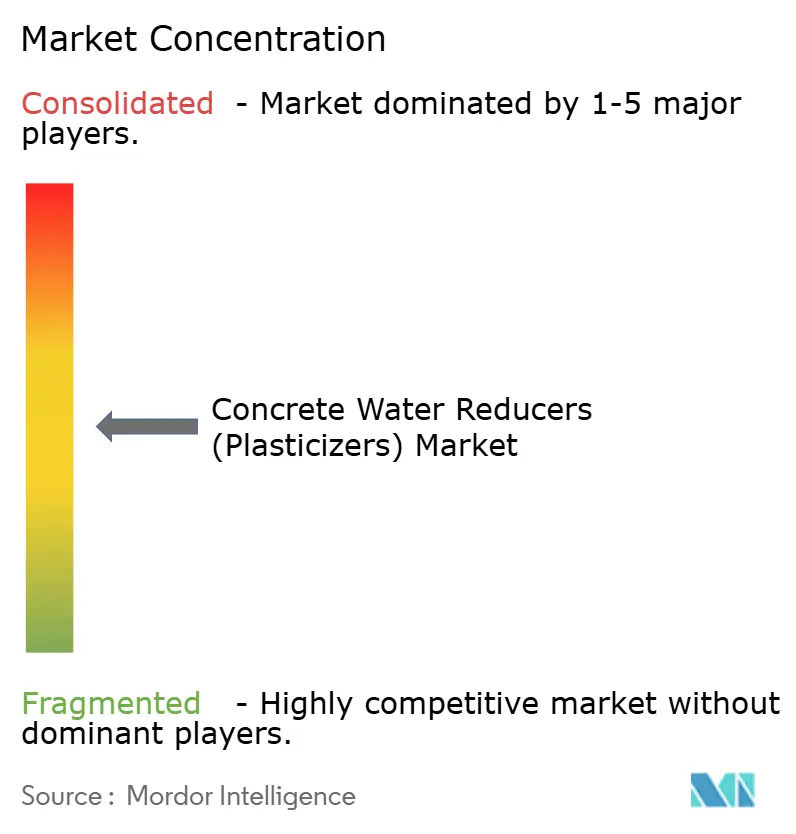
The Concrete Water Reducers (Plasticizers) Market is moderately consolidated. Regional specialists thrive in niches—such as 3D printing blends, ultra-high-performance concrete, and clay-tolerant mixes—leveraging agile formulation labs and local service. However, tightening ESG audits and capital-intensive reactor upgrades will likely prompt further mergers, consolidating the concrete water reducers (plasticizers) market in favor of well-capitalized multinationals.
Concrete Water Reducers (Plasticizers) Industry Leaders
-
Saint-Gobain
-
Sika AG
-
MAPEI S.p.A.
-
Jiangsu Subote New Material Co., Ltd.
-
Kao Corporation
- *Disclaimer: Major Players sorted in no particular order
Concrete Water Reducers (Plasticizers) Market Companies Covered in this Report
- Arkema (Bostik)
- CEMEX S.A.B. de C.V.
- CMB
- HA-BE BETONCHEMIE
- Jiangsu Subote New Material Co. Ltd.
- Kao Corporation
- MAPEI S.p.A.
- MC-Bauchemie
- MUHU (China) Construction Materials Co., Ltd.
- RPM International Inc.
- Saint-Gobain
- Sika AG
- INSUMAT
Recent Industry Developments in Concrete Water Reducers (Plasticizers) Market
- February 2025: BASF launched biomass-balanced (BMB) and Ccycled grades of its plasticizer portfolio from production sites in Texas and Ontario to customers in North America. The sites and mass-balanced products have been certified in accordance with the International Sustainability and Carbon Certification (ISCC) PLUS scheme.
- September 2024: Master Builders Solutions launched MasterEase 5000 water-reducing and conditioning admixture that addresses the workability challenges of concrete mixtures utilizing blended cements, supplementary cementitious materials (SCM), and challenging aggregates.
Global Concrete Water Reducers (Plasticizers) Market Report Scope
Commercial, Industrial and Institutional, Infrastructure, Residential are covered as segments by End Use Sector. Asia-Pacific, Europe, Middle East and Africa, North America, South America are covered as segments by Region.Segmentation Overview
| Liquid |
| Powder |
| Commercial |
| Industrial and Institutional |
| Infrastructure |
| Residential |
| Asia-Pacific | Australia |
| China | |
| India | |
| Indonesia | |
| Japan | |
| Malaysia | |
| South Korea | |
| Thailand | |
| Vietnam | |
| Rest of Asia-Pacific | |
| North America | Canada |
| Mexico | |
| United States | |
| Europe | France |
| Germany | |
| Italy | |
| Russia | |
| Spain | |
| United Kingdom | |
| Rest of Europe | |
| South America | Argentina |
| Brazil | |
| Rest of South America | |
| Middle East and Africa | Saudi Arabia |
| United Arab Emirates | |
| Rest of Middle East and Africa |
| By Form | Liquid | |
| Powder | ||
| By End-Use Sector | Commercial | |
| Industrial and Institutional | ||
| Infrastructure | ||
| Residential | ||
| By Geography | Asia-Pacific | Australia |
| China | ||
| India | ||
| Indonesia | ||
| Japan | ||
| Malaysia | ||
| South Korea | ||
| Thailand | ||
| Vietnam | ||
| Rest of Asia-Pacific | ||
| North America | Canada | |
| Mexico | ||
| United States | ||
| Europe | France | |
| Germany | ||
| Italy | ||
| Russia | ||
| Spain | ||
| United Kingdom | ||
| Rest of Europe | ||
| South America | Argentina | |
| Brazil | ||
| Rest of South America | ||
| Middle East and Africa | Saudi Arabia | |
| United Arab Emirates | ||
| Rest of Middle East and Africa | ||
Market Definition
- END-USE SECTOR - Water reducer concrete admixtures consumed in the construction sectors such as commercial, residential, industrial, institutional, and infrastructure are considered under the scope of the study.
- PRODUCT/APPLICATION - Under the scope of the study, the consumption of low to medium-range water reducers are considered.
| Keyword | Definition |
|---|---|
| Accelerator | Accelerators are admixtures used to fasten the setting time of concrete by increasing the initial rate and speeding up the chemical reaction between cement and the mixing water. These are used to harden and increase the strength of concrete quickly. |
| Acrylic | This synthetic resin is a derivative of acrylic acid. It forms a smooth surface and is mainly used for various indoor applications. The material can also be used for outdoor applications with a special formulation. |
| Adhesives | Adhesives are bonding agents used to join materials by gluing. Adhesives can be used in construction for many applications, such as carpet laying, ceramic tiles, countertop lamination, etc. |
| Air Entraining Admixture | Air-entraining admixtures are used to improve the performance and durability of concrete. Once added, they create uniformly distributed small air bubbles to impart enhanced properties to the fresh and hardened concrete. |
| Alkyd | Alkyds are used in solvent-based paints such as construction and automotive paints, traffic paints, flooring resins, protective coatings for concrete, etc. Alkyd resins are formed by the reaction of an oil (fatty acid), a polyunsaturated alcohol (Polyol), and a polyunsaturated acid or anhydride. |
| Anchors and Grouts | Anchors and grouts are construction chemicals that stabilize and improve the strength and durability of foundations and structures like buildings, bridges, dams, etc. |
| Cementitious Fixing | Cementitious fixing is a process in which a cement-based grout is pumped under pressure to fill forms, voids, and cracks. It can be used in several settings, including bridges, marine applications, dams, and rock anchors. |
| Commercial Construction | Commercial construction comprises new construction of warehouses, malls, shops, offices, hotels, restaurants, cinemas, theatres, etc. |
| Concrete Admixtures | Concrete admixtures comprise water reducers, air entrainers, retarders, accelerators, superplasticizers, etc., added to concrete before or during mixing to modify its properties. |
| Concrete Protective Coatings | To provide specific protection, such as anti-carbonation or chemical resistance, a film-forming protective coat can be applied on the surface. Depending on the applications, different resins like epoxy, polyurethane, and acrylic can be used for concrete protective coatings. |
| Curing Compounds | Curing compounds are used to cure the surface of concrete structures, including columns, beams, slabs, and others. These curing compounds keep the moisture inside the concrete to give maximum strength and durability. |
| Epoxy | Epoxy is known for its strong adhesive qualities, making it a versatile product in many industries. It resists heat and chemical applications, making it an ideal product for anyone needing a stronghold under pressure. It is widely used in adhesives, electrical and electronics, paints, etc. |
| Fiber Wrapping Systems | Fiber Wrapping Systems are a part of construction repair and rehabilitation chemicals. It involves the strengthening of existing structures by wrapping structural members like beams and columns with glass or carbon fiber sheets. |
| Flooring Resins | Flooring resins are synthetic materials applied to floors to enhance their appearance, increase their resistance to wear and tear or provide protection from chemicals, moisture, and stains. Depending on the desired properties and the specific application, flooring resins are available in distinct types, such as epoxy, polyurethane, and acrylic. |
| High-Range Water Reducer (Super Plasticizer) | High-range water reducers are a type of concrete admixture that provides enhanced and improved properties when added to concrete. These are also called superplasticizers and are used to decrease the water-to-cement ratio in concrete. |
| Hot Melt Adhesives | Hot-melt adhesives are thermoplastic bonding materials applied as melts that achieve a solid state and resultant strength on cooling. They are commonly used for packaging, coatings, sanitary products, and tapes. |
| Industrial and Institutional Construction | Industrial and institutional construction includes new construction of hospitals, schools, manufacturing units, energy and power plants, etc. |
| Infrastructure Construction | Infrastructure construction includes new construction of railways, roads, seaways, airports, bridges, highways, etc. |
| Injection Grouting | The process of injecting grout into open joints, cracks, voids, or honeycombs in concrete or masonry structural members is known as injection grouting. It offers several benefits, such as strengthening a structure and preventing water infiltration. |
| Liquid-Applied Waterproofing Membranes | Liquid-Applied membrane is a monolithic, fully bonded, liquid-based coating suitable for many waterproofing applications. The coating cures to form a rubber-like elastomeric waterproof membrane and may be applied over many substrates, including asphalt, bitumen, and concrete. |
| Micro-concrete Mortars | Micro-concrete mortar is made up of cement, water-based resin, additives, mineral pigments, and polymers and can be applied on both horizontal and vertical surfaces. It can be used to refurbish residential complexes, commercial spaces, etc. |
| Modified Mortars | Modified Mortars include Portland cement and sand along with latex/polymer additives. The additives increase adhesion, strength, and shock resistance while also reducing water absorption. |
| Mold Release Agents | Mold release agents are sprayed or coated on the surface of molds to prevent a substrate from bonding to a molding surface. Several types of mold release agents, including silicone, lubricant, wax, fluorocarbons, and others, are used based on the type of substrates, including metals, steel, wood, rubber, plastic, and others. |
| Polyaspartic | Polyaspartic is a subset of polyurea. Polyaspartic floor coatings are typically two-part systems that consist of a resin and a catalyst to ease the curing process. It offers high durability and can withstand harsh environments. |
| Polyurethane | Polyurethane is a plastic material that exists in various forms. It can be tailored to be either rigid or flexible and is the material of choice for a broad range of end-user applications, such as adhesives, coatings, building insulation, etc. |
| Reactive Adhesives | A reactive adhesive is made of monomers that react in the adhesive curing process and do not evaporate from the film during use. Instead, these volatile components become chemically incorporated into the adhesive. |
| Rebar Protectors | In concrete structures, rebar is one of the important components, and its deterioration due to corrosion is a major issue that affects the safety, durability, and life span of buildings and structures. For this reason, rebar protectors are used to protect against degrading effects, especially in infrastructure and industrial construction. |
| Repair and Rehabilitation Chemicals | Repair and Rehabilitation Chemicals include repair mortars, injection grouting materials, fiber wrapping systems, micro-concrete mortars, etc., used to repair and restore existing buildings and structures. |
| Residential Construction | Residential construction involves constructing new houses or spaces like condominiums, villas, and landed homes. |
| Resin Fixing | The process of using resins like epoxy and polyurethane for grouting applications is called resin fixing. Resin fixing offers several advantages, such as high compressive and tensile strength, negligible shrinkage, and greater chemical resistance compared to cementitious fixing. |
| Retarder | Retarders are admixtures used to slow down the setting time of concrete. These are usually added with a dosage rate of around 0.2% -0.6% by weight of cement. These admixtures slow down hydration or lower the rate at which water penetrates the cement particles by making concrete workable for a long time. |
| Sealants | A sealant is a viscous material that has little or no flow qualities, which causes it to remain on surfaces where they are applied. Sealants can also be thinner, enabling penetration to a certain substance through capillary action. |
| Sheet Waterproofing Membranes | Sheet membrane systems are reliable and durable thermoplastic waterproofing solutions that are used for waterproofing applications even in the most demanding below-ground structures, including those exposed to highly aggressive ground conditions and stress. |
| Shrinkage Reducing Admixture | Shrinkage-reducing admixtures are used to reduce concrete shrinkage, whether from drying or self-desiccation. |
| Silicone | Silicone is a polymer that contains silicon combined with carbon, hydrogen, oxygen, and, in some cases, other elements. It is an inert synthetic compound that comes in various forms, such as oil, rubber, and resin. Due to its heat-resistant properties, it finds applications in sealants, adhesives, lubricants, etc. |
| Solvent-borne Adhesives | Solvent-borne adhesives are mixtures of solvents and thermoplastic or slightly cross-linked polymers such as polychloroprene, polyurethane, acrylic, silicone, and natural and synthetic rubbers. |
| Surface Treatment Chemicals | Surface treatment chemicals are chemicals used to treat concrete surfaces, including roofs, vertical surfaces, and others. They act as curing compounds, demolding agents, rust removers, and others. They are cost-effective and can be used on roadways, pavements, parking lots, and others. |
| Viscosity Modifier | Viscosity Modifiers are concrete admixtures used to change various properties of admixtures, including viscosity, workability, cohesiveness, and others. These are usually added with a dosage of around 0.01% to 0.1% by weight of cement. |
| Water Reducer | Water reducers, also called plasticizers, are a type of admixture used to decrease the water-to-cement ratio in the concrete, thereby increasing the durability and strength of concrete. Various water reducers include refined lignosulfonates, gluconates, hydroxycarboxylic acids, sugar acids, and others. |
| Water-borne Adhesives | Water-borne adhesives use water as a carrier or diluting medium to disperse resin. They are set by allowing the water to evaporate or be absorbed by the substrate. These adhesives are compounded with water as a dilutant rather than a volatile organic solvent. |
| Waterproofing Chemicals | Waterproofing chemicals are designed to protect a surface from the perils of leakage. A waterproofing chemical is a protective coating or primer applied to a structure's roof, retaining walls, or basement. |
| Waterproofing Membranes | Waterproofing membranes are liquid-applied or self-adhering layers of water-tight materials that prevent water from penetrating or damaging a structure when applied to roofs, walls, foundations, basements, bathrooms, and other areas exposed to moisture or water. |
Research Methodology
Mordor Intelligence follows a four-step methodology in all our reports.
- Step-1: Identify Key Variables: The quantifiable key variables (industry and extraneous) pertaining to the specific product segment and country are selected from a group of relevant variables & factors based on desk research & literature review; along with primary expert inputs. These variables are further confirmed through regression modeling (wherever required).
- Step-2: Build a Market Model: In order to build a robust forecasting methodology, the variables and factors identified in Step-1 are tested against available historical market numbers. Through an iterative process, the variables required for market forecast are set and the model is built on the basis of these variables.
- Step-3: Validate and Finalize: In this important step, all market numbers, variables and analyst calls are validated through an extensive network of primary research experts from the market studied. The respondents are selected across levels and functions to generate a holistic picture of the market studied.
- Step-4: Research Outputs: Syndicated Reports, Custom Consulting Assignments, Databases & Subscription Platforms