
Boutique Hotel Market Size and Share
Market Overview
| Study Period | 2022 - 2032 |
|---|---|
| Market Size (2027) | USD 32.13 Billion |
| Market Size (2032) | USD 45.16 Billion |
| Growth Rate (2027 - 2032) | 7.05 % |
| Fastest Growing Market | Asia-Pacific |
| Largest Market | North America |
| Market Concentration | Low |
Major Players *Disclaimer: Major Players sorted in no particular order Image © Mordor Intelligence. Reuse requires attribution under CC BY 4.0. | |
Boutique Hotel Market Analysis by Mordor Intelligence
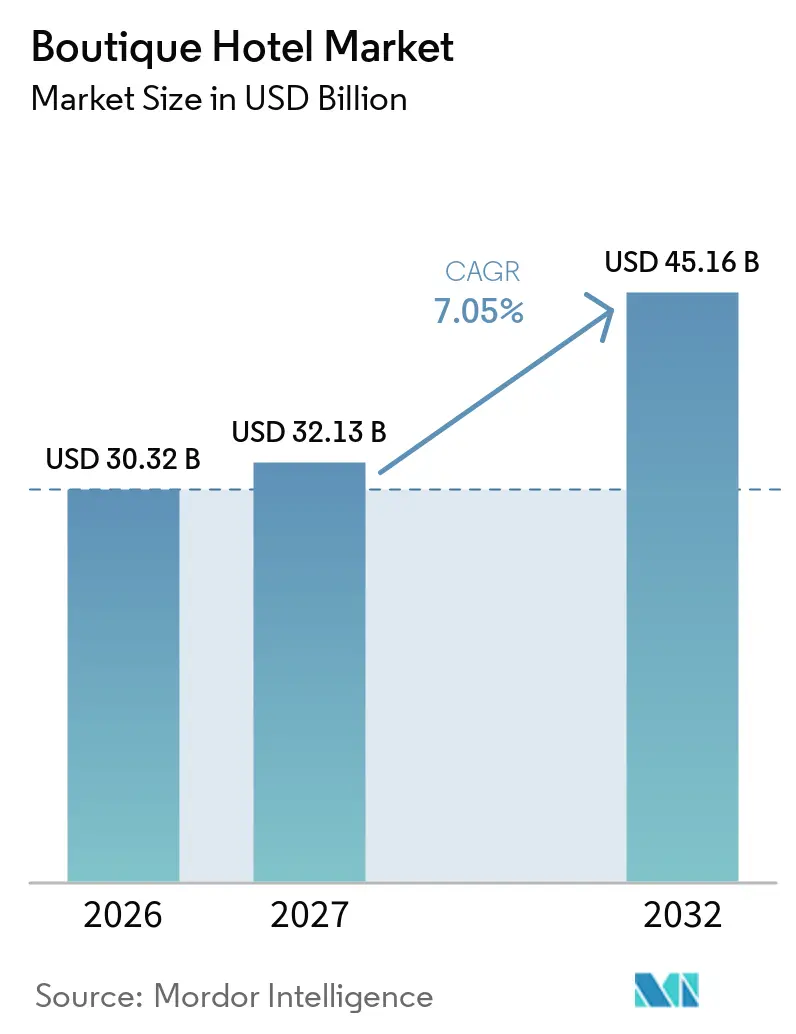
The Global Boutique Hotel Market was valued at USD 30.32 billion in 2026 and is estimated to grow from USD 32.13 billion in 2027 to reach USD 45.16 billion by 2032, at a CAGR of 7.05% during the forecast period (2027–2032). The global boutique hotel market is driven by travelers who consider the property part of the travel experience and value design, local character, and personalized service. United States boutique hotel demand increased by 1.6% in the first half of 2025, compared with 0.6% for comparable conventional hotels[1]. Operators are enhancing food and beverage offerings, wellness spaces, and guest-service tools to create distinctive stays. Market opportunities lie in maintaining local identity while strengthening direct guest relationships and operational discipline. However, cost inflation and reliance on third-party booking channels remain significant constraints, particularly for independent properties without scale.
Key Report Takeaways
- By boutique hotel type, Urban Boutique Hotels accounted for 42.31% of the global boutique hotel market revenue in 2026, while Resort Boutique Hotels are projected to grow at a 9.22% CAGR through 2032.
- By service type, Luxury Boutique Hotels accounted for 46.93% of the global boutique hotel market revenue in 2026, while Upper-Upscale Boutique Hotels are projected to grow at an 8.85% CAGR through 2032.
- By booking channel, Direct Booking accounted for 38.64% of the global boutique hotel market revenue in 2026, while Online Travel Agencies are projected to grow at an 8.64% CAGR through 2032.
- By tourist type, Domestic Tourists accounted for 59.72% of the global boutique hotel market revenue in 2026, while International Tourists are projected to grow at a 9.12% CAGR through 2032.
- By geography, North America accounted for 34.23% of the global boutique hotel market revenue in 2026, while Asia-Pacific is projected to grow at an 8.97% CAGR through 2032.
Note: Market numbers in this report are based on Mordor Intelligence's proprietary estimation framework, which combines nine months of actuals with Q4 projections for base year 2026.
Market Trends and Insights
Drivers Impact Analysis of Boutique Hotel Market*
| Driver | (~) % Impact on CAGR Forecast | Geographic Relevance | Impact Timeline |
|---|---|---|---|
| Demand for Experiential and Authentic Travel | +1.5% | Global, strongest in North America, Europe, and Asia-Pacific urban markets | Long term (≥ 4 years) |
| Lifestyle and Soft-Brand Portfolio Expansion | +1.2% | Global, concentrated in North America and Asia-Pacific | Medium term (2-4 years) |
| Digital Discovery and Online Hotel Bookings | +1.0% | Global, with strong channel migration in Asia-Pacific and South America | Medium term (2-4 years) |
| Spending by Affluent, Millennial, and Gen Z Travelers | +0.8% | North America, Europe, and Asia-Pacific urban corridors | Long term (≥ 4 years) |
| Adaptive Reuse of Heritage and Underutilized Properties | +0.5% | Europe, Middle East, South Asia, and secondary United States cities | Long term (≥ 4 years) |
| Design-Led Food, Beverage, Wellness, and Community Revenue | +0.5% | Global, mainly upper-upscale and luxury boutique tiers | Medium term (2-4 years) |
| Source: Mordor Intelligence | |||
Growing Demand for Experiential and Authentic Travel
The Global Boutique Hotel Market benefits from growing demand for distinctive, experience-driven, and sustainable accommodation. Travelers increasingly prioritize unique design, local character, and personalized services. TakeUp’s 2025 survey of travelers who stay at independent properties found that personalized offers would make 95% of United States respondents more likely to book an independent hotel, while 66% preferred to book directly with the property. Demand for authentic experiences shapes customer acquisition and distribution strategies. Distinctive designs and strong local identities can increase visibility through guest-generated content and social media engagement. While online booking platforms remain important, operators increasingly strengthen their digital presence and direct booking channels. Local cuisine, cultural experiences, and community partnerships further differentiate properties, particularly in heritage cities and leisure destinations, where regional heritage, cuisine, and neighborhood character shape the guest experience.
Expansion of Lifestyle and Soft-Brand Hotel Portfolios
Hotel groups expanded lifestyle and soft-brand portfolios through acquisitions and development agreements. IHG Hotels & Resorts acquired Ruby Hotels in February 2025 for EUR 110.5 million (USD 116 million), and plans to expand the brand to more than 120 hotels within 10 years[2]. Marriott International acquired citizenM for USD 355 million in July 2025, adding 37 hotels and 8,789 rooms across more than 20 cities. Hyatt acquired Standard International and most of its affiliates in October 2024, adding The Standard and Bunkhouse Hotels. Independent operators compete with groups that combine distinct brands, reservation systems, and loyalty programs. IHG announced Ruby signings in Berlin and Copenhagen in March 2025. Independent heritage properties and boutique brands can differentiate through regional architecture, cuisine, and cultural experiences while balancing distribution, service, and local identity.
Growth in Digital Discovery and Online Hotel Bookings
Digital channels play an important role in how travelers discover, compare, and book boutique hotels. Online travel agencies (OTAs) provide access to a broad customer base, while hotel websites support direct bookings. D-EDGE’s 2025 Hotel Direct Distribution Report found that hotels working with its platform incur an average direct distribution cost of 3.5%, compared with OTA commissions of 12% to 28%. Intuitive websites, reliable mobile booking, transparent pricing, and responsive communication can improve conversion and manage distribution costs. AI-enabled search and travel-planning tools influence how travelers evaluate accommodations. Accurate property information, current rates, and consistent listings are therefore important. OTAs help boutique hotels reach international audiences, while direct channels support guest relationships and reduce third-party reliance. An effective digital strategy integrates discovery, booking, and post-stay communication while preserving each property's identity.
Rising Spending by Affluent, Millennial, and Gen Z Travelers
Millennials and Gen Z are shaping travel demand through preferences for experience-led, flexible, and locally immersive trips. They seek accommodations with distinctive design, authentic local culture, and access to food, wellness, and leisure activities. Boutique hotels can meet these preferences through personalized service and stronger connections to local destinations. Attracting younger and affluent travelers requires more than distinctive design. Food and beverage offerings, digital services, consistent service quality, and transparent pricing can encourage repeat visits. The global boutique hotel market offers opportunities for upper-upscale properties with distinctive guest experiences. Boutique hotels can also differentiate through regional architecture, local cuisine, heritage, and curated cultural activities. Consistent service and value remain essential for building guest loyalty.
Restraints Impact Analysis of Boutique Hotel Market*
| Restraint | (~) % Impact on CAGR Forecast | Geographic Relevance | Impact Timeline |
|---|---|---|---|
| Labor, Renovation, and Design-Intensive Operating Costs | -1.2% | Global, most acute in North America, Western Europe, and Australasia | Medium term (2-4 years) |
| Online Travel Agency Commissions and Guest-Acquisition Costs | -0.8% | Global, most acute for independents without loyalty programs | Short term (≤ 2 years) |
| Limited Operating Scale and Inconsistent Service Delivery | -0.6% | Secondary and tertiary markets globally, particularly emerging economies | Long term (≥ 4 years) |
| Brand Dilution from Rapid Lifestyle-Hotel Expansion | -0.4% | North America, Western Europe, and Asia-Pacific gateway cities | Medium term (2-4 years) |
| Source: Mordor Intelligence | |||
High Labor, Renovation, and Design-Intensive Operating Costs
Rising labor costs constrain boutique hotel operations. A report indicates that salaries, wages, and employee benefits across 2,600 United States hotels increased by 4.8% in 2024. Insurance premiums rose by 17.4%, while property taxes increased by 4.3%[3]. Boutique hotels face greater exposure because personalized service requires more labor, and design-led properties may need frequent refurbishment. Limited room inventories also restrict their ability to offset unexpected costs through group bookings or banquet revenue, affecting margins even when room rates remain stable. Independent properties often lack chain-scale purchasing and shared-service systems. Renovation plans must preserve a property’s character while limiting downtime and capital expenditure. Heritage and new-build boutique hotels must also manage wage, energy, maintenance, and restoration costs. Effective staffing, procurement, and asset maintenance are essential to protect guest experience and profitability.
OTA Commission Costs and Rising Guest-Acquisition Expenses
Online travel agency (OTA) dependence can reduce net room revenue for independent hotels. Research indicated that OTAs charged commissions of 15% to 25% per booking, while visibility products and member-rate discounts could raise effective costs above 30%. A peer-reviewed study published in 2025 found that rate parity arrangements limited hotels’ ability to offer lower prices through direct channels. OTA reliance also kept guest preference and repeat-booking data with the platform, limiting personalized service. Many operators still needed third-party reach to maintain occupancy. D-EDGE’s distribution analysis showed a significant cost gap between direct bookings and OTA commissions. Independent boutique hotels can maintain a balanced channel mix, offer clear value for direct guests, provide reliable digital services, and follow applicable data practices while preserving international visibility.
*Our forecasts treat driver/restraint impacts as directional, not additive. The impact forecasts reflect baseline growth, mix effects, and variable interactions.
Consumer Behavior Analysis
Guest preferences in the global boutique hotel market increasingly favor authentic cultural experiences and local community benefits. Booking.com’s 2025 survey of 32,000 travelers across 34 countries found that 77% sought authentic local experiences, while 73% wanted their spending to benefit local communities. Boutique hotels can meet these preferences through regional cuisine, heritage-inspired design, and locally guided activities. Transparent pricing, verified reviews, and clear cancellation policies can strengthen guest confidence.
Distribution strategy helps boutique hotels secure higher-value bookings while retaining OTA reach. SiteMinder’s analysis of over 125 million bookings found that direct website bookings averaged USD 519 in 2024, versus USD 320 through OTAs, a 62% difference. Hotels can use OTAs for discovery and encourage direct bookings through exclusive packages, mobile-friendly booking, and secure payments.
Boutique Hotel Performance Intelligence
Boutique hotel performance depends on balancing occupancy, room pricing, and ancillary revenue while delivering a distinctive guest experience. In the United States, boutique hotels recorded occupancy of 57% to 71% and average daily rates (ADR) of USD 141 to USD 440 across segments in 2024. Boutique properties can increase revenue through differentiated rooms, food and beverage, wellness services, and locally curated experiences during peak leisure and event periods.
Protecting margins remains critical because distribution and operating costs affect profitability. The D-EDGE 2025 Hotel Direct Distribution Report estimated direct distribution costs at 3.5% for partner hotels, versus OTA commissions of 12% to 28% across Europe and Asia-Pacific. Although these figures are not universal benchmarks, they show the value of direct bookings. Hotels can improve net revenue through mobile-friendly websites, repeat-guest offers, efficient staffing, and targeted marketing while using OTAs for customer acquisition.
Boutique Hotel Market Segment Analysis
By Boutique Hotel Type:
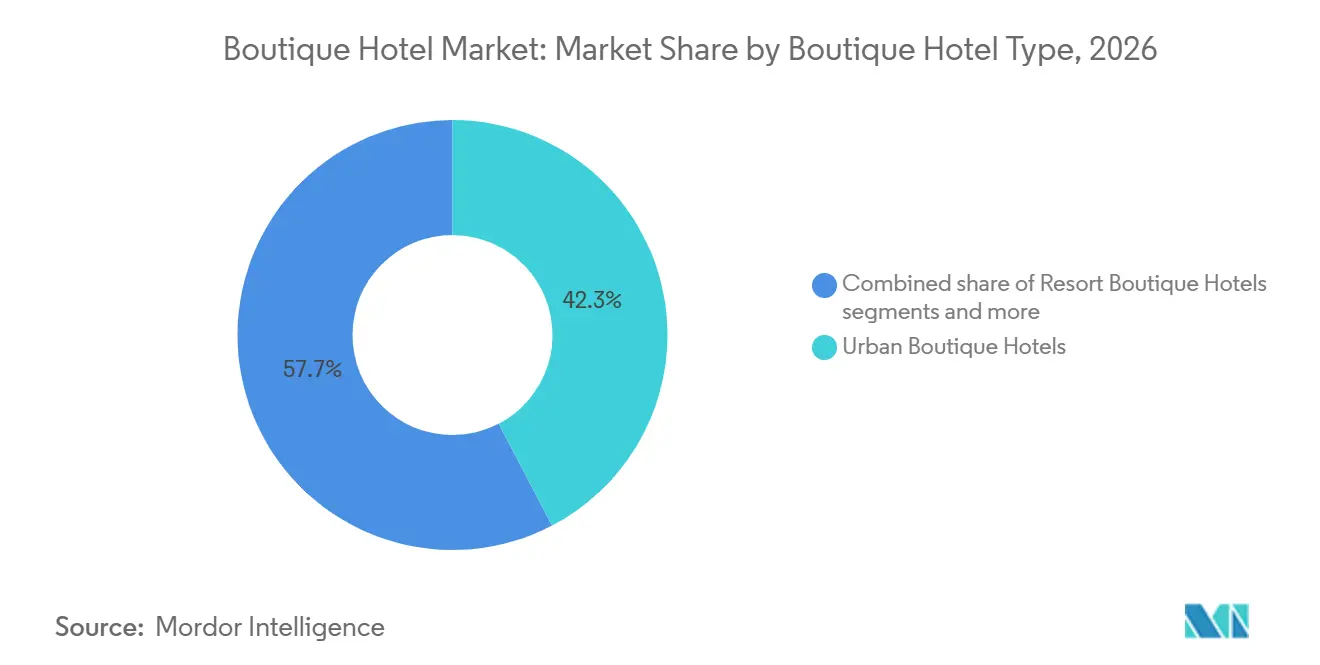
Urban Formats Lead, While Resort Formats Grow FasterUrban Boutique Hotels accounted for 42.31% of the global boutique hotel market in 2026, representing the largest segment. This share reflects year-round demand from corporate and leisure travelers in city-center locations. These properties benefit from proximity to business districts, cultural venues, restaurants, and transportation networks. Suburban town centers are also emerging as a secondary area of developer interest, offering neighborhood settings with access to city demand.
Resort Boutique Hotels are forecast to grow at a CAGR of 9.22% through 2032, driven by demand for immersive stays in nature-adjacent or culturally distinct settings. Historic and Heritage Boutique Hotels support this demand through adaptive reuse and local context. Lifestyle and Design Boutique Hotels can encourage repeat stays through recognizable identities. Other formats remain smaller but reflect demand for differentiated, experience-led accommodations.

By Service Type:
Luxury Leads Revenue, While Upper-Upscale Formats Grow FasterLuxury Boutique Hotels accounted for 46.93% of revenue in 2026 in the Global Boutique Hotel Market. Their position reflects an ability to combine intimate scale, design, and personalized service for guests willing to pay higher rates. These hotels also support greater spending on dining, wellness, and tailored experiences. This tier benefits from resilient average daily rates. Maintaining service quality consistent with pricing remains essential.
Upper-Upscale Boutique Hotels are forecast to grow at a CAGR of 8.85% through 2032. They cater to travelers who value design and food and beverage experiences without requiring a traditional luxury room product. This format appeals to younger guests seeking social and locally connected stays. Midscale and Economy or Budget Boutique Hotels serve cost-conscious domestic leisure and weekend travelers, particularly in secondary markets. These formats show that the boutique hotel market extends beyond luxury while requiring a clear experience proposition.
By Booking Channel:
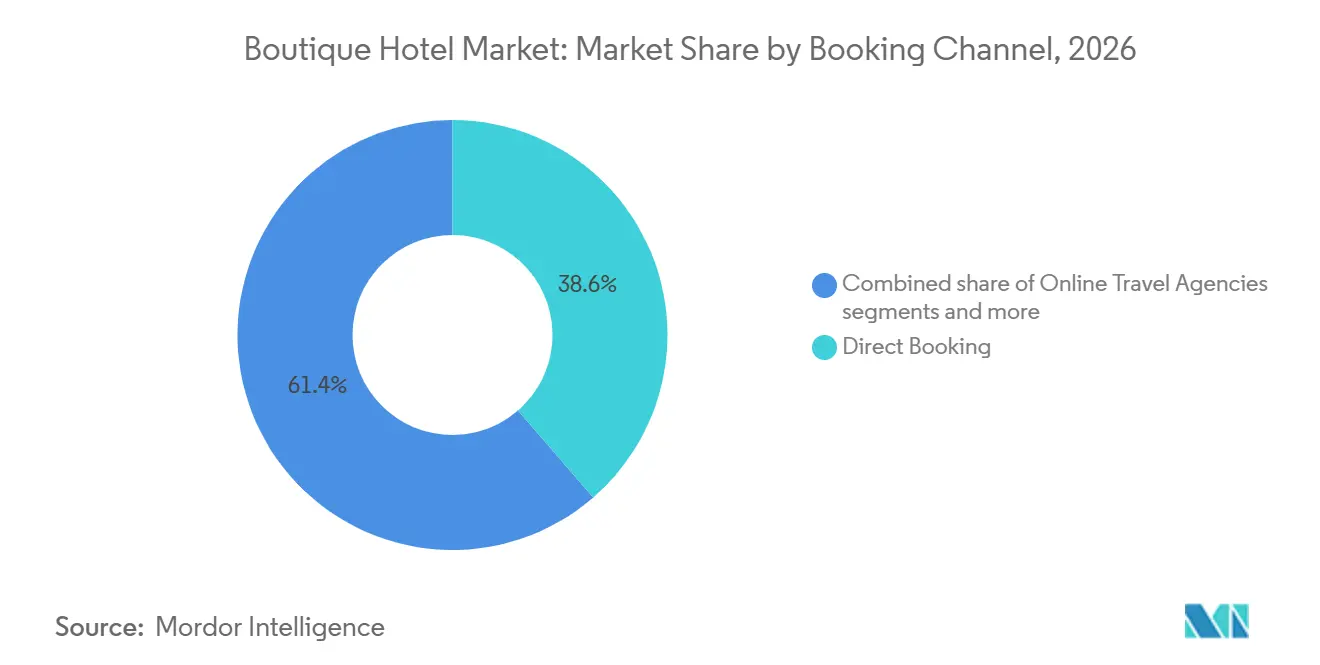
Direct Booking Leads, While Online Travel Agencies Expand FasterDirect Booking accounted for 38.64% of the global boutique hotel market revenue in 2026. This share reflects the value of direct guest relationships and stronger unit economics from direct reservations. Direct channels allow hotels to communicate property details, packages, and services without relying solely on intermediaries. They also give operators greater control over guest data, subject to applicable privacy requirements, and help convert initial discovery into repeat demand.
Online travel agencies are forecast to grow at a CAGR of 8.64% through 2032, supporting discovery, mobile bookings, and international reach. Travel agents and tour operators remain relevant for complex international leisure trips and curated itineraries. Other channels include corporate rate agreements and emerging social commerce booking paths. An effective channel mix protects direct relationships while maintaining visibility to attract new guests.
By Tourist Type:
Domestic Demand Supports Stability, While International Demand Grows FasterDomestic Tourists accounted for 59.72% of the global boutique hotel market revenue in 2026. This demand can help boutique properties mitigate disruptions in international travel flows. It was observed that 78% of boutique hotel users prefer weekend getaways and 65% favor domestic itineraries[4]. Urban and resort boutique formats align with this short-break travel pattern. For operators, nearby leisure travel can support occupancy outside peak international travel periods.
International Tourists segment is forecast to grow at a 9.12% CAGR through 2032. Growth reflects the recovery of long-haul leisure travel, expanding outbound tourism from India and Southeast Asia, and intra-European mobility. High-income travelers represent an increasing share of departures and often prefer international itineraries. Hotels need multilingual information, review management, and distribution across international channels. Properties must clearly communicate their local identity to guests planning from abroad.
Geography Analysis
North America Boutique Hotel Market
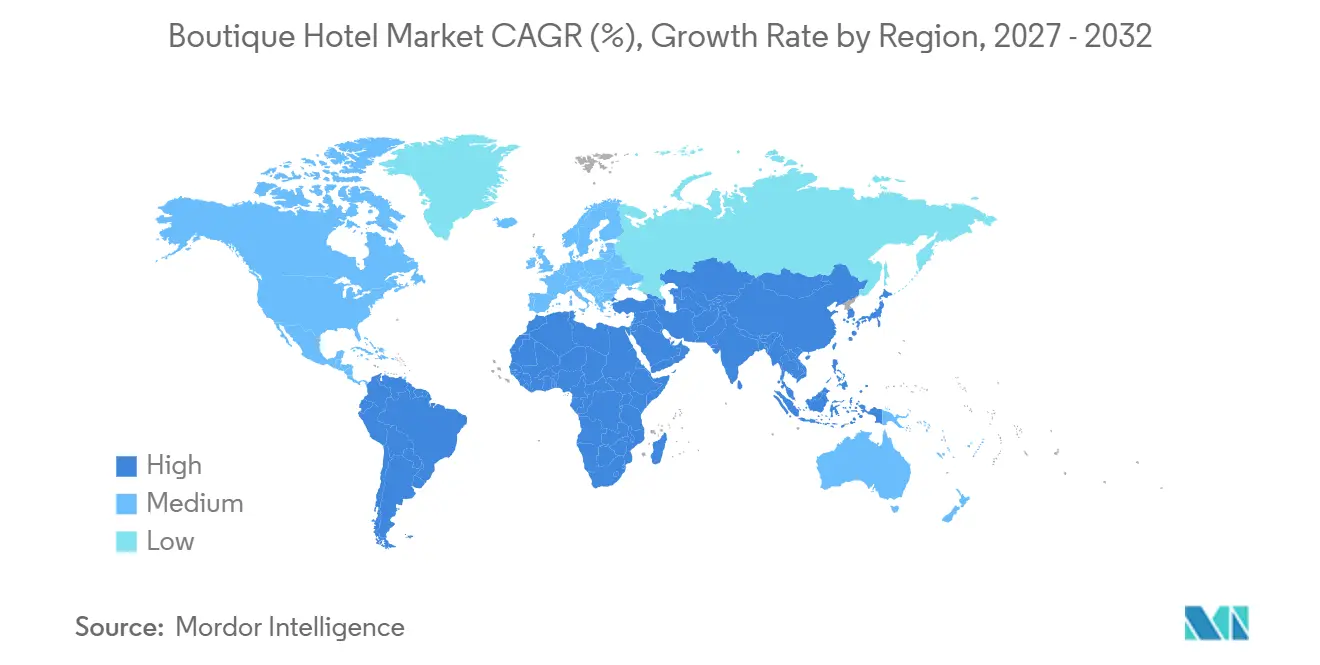
North America held 34.23% of revenue in 2026, making it the largest regional contributor to the Global Boutique Hotel Market. The region benefits from a high concentration of lifestyle properties in major United States gateway cities and established independent travel demand. The Highland Group’s Boutique Hotels: Mid-Year 2025 report showed data showed that boutique hotel demand grew by 1.6% in the first half of 2025, compared with 0.6% for comparable conventional hotels. Canada is expanding activity in urban centers and mountain resorts, while Mexican heritage cities, including Oaxaca, San Miguel de Allende, and Mérida, are attracting boutique investment. The 2026 FIFA World Cup, co-hosted by the United States, Canada, and Mexico, created demand opportunities for distinctive properties serving international visitors.
Europe, Middle East and South America Boutique Hotel Market
Europe remains associated with heritage-led boutique hospitality and adaptive reuse. Its historic building stock and conservation environment support hotels with architectural distinction. IHG’s acquisition of Ruby Hotels targeted the urban micro-boutique segment through European properties and a development pipeline. The Middle East is expanding boutique and luxury supply through projects linked to Saudi Arabia’s Vision 2030, including Shura Island and Jeddah’s Al-Balad district. South America remains a smaller contributor but offers opportunities in Peru, Chile, and Brazil for properties drawing on local culture and inbound tourism.
APAC Boutique Hotel Market
Asia-Pacific is forecast to grow at an 8.97% CAGR through 2032, the fastest regional rate in the Global Boutique Hotel Market. Growth is driven by development pipelines, rising domestic affluence, and inbound and outbound Asian travel. India’s hotel pipeline reached 761 projects and 99,195 rooms in the second quarter of 2025, up 25% year over year by project count. India-specific opportunities are strongest where cultural assets, leisure demand, and credible service operations align.
Boutique Hotel Supply & Development Intelligence
Boutique hotel supply is expanding beyond major gateway cities as developers target leisure, cultural, and secondary destinations. Globally, the hotel construction pipeline reached a record 15,871 projects and 2,436,225 rooms at the end of the second quarter of 2025, up 3% in projects and 2% in rooms year over year. The pipeline indicates opportunities beyond metropolitan markets, but developers must assess seasonality, connectivity, staffing, and achievable room rates before committing capital.
Adaptive reuse and lifestyle-brand expansion are reshaping development strategies. Marriott acquired citizenM in 2025, adding 37 hotels and 8,789 rooms across more than 20 cities. IHG acquired Ruby Hotels for EUR 110.5 million (USD 116 million), adding 20 operating hotels and a 10-hotel pipeline. These transactions highlight the value of distinctive design and space-efficient concepts. Independent developers can compete through heritage preservation, local identity, and disciplined renovation budgets.
Competitive Landscape
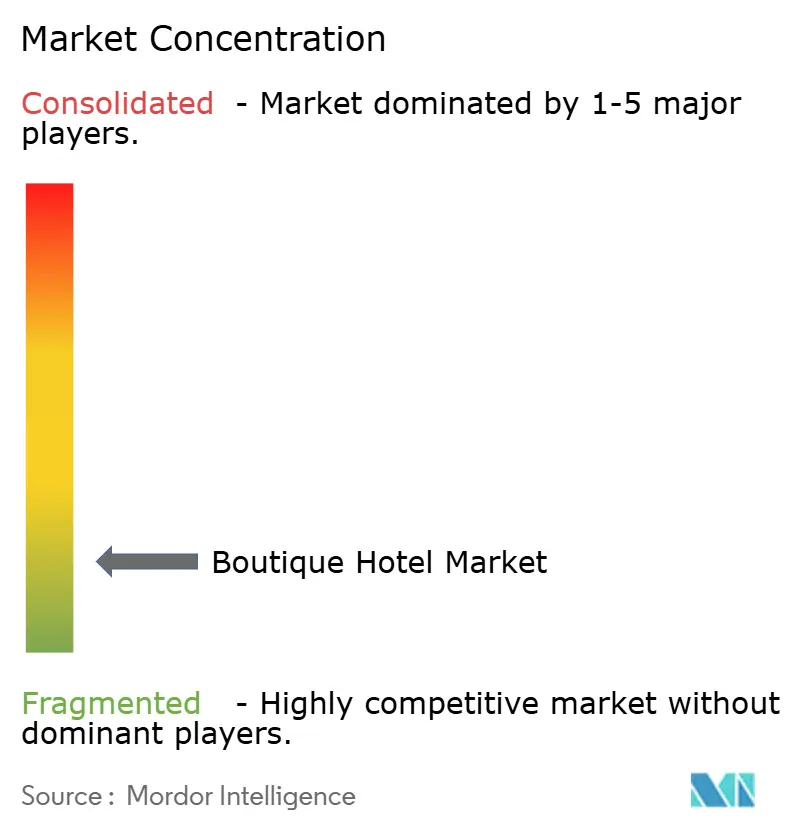
The global boutique hotel market has a concentration score of 2 and remains highly fragmented. Independent properties, regional boutique collections, small luxury groups, and chain-affiliated soft brands use varied operating models. Marriott International, Accor, Hilton Worldwide Holdings, Hyatt Hotels Corporation, and InterContinental Hotels Group have expanded their lifestyle portfolios; however, local identity remains a key factor in guest choice.
An independent hotel's position depends on more than brand scale. Design, service, location, and guest relationships must provide a clear reason to stay. Since 2024, acquisitions by major hotel groups, including Hyatt, IHG, and Marriott, have expanded their presence in the lifestyle hospitality segment. These strategic moves strengthen brand reach, distribution, and loyalty integration, creating competitive advantages over independent operators.
Technology and operational discipline are increasingly important competitive factors. Smaller properties can use digital booking, rate management, and guest communication tools to improve commercial execution while retaining their identity. Opportunities exist in secondary and tertiary cities across Asia-Pacific and the Middle East, where domestic affluence is growing and experiential accommodation supply is limited. Independent operators can compete by combining local storytelling, reliable service, and direct digital relationships. Adaptive reuse can support development when operators manage funding, approvals, conservation standards, and operating requirements.
Boutique Hotel Industry Leaders
-
Marriott International, Inc.
-
Accor
-
Hilton Worldwide Holdings Inc.
-
Hyatt Hotels Corporation
-
InterContinental Hotels Group PLC
- *Disclaimer: Major Players sorted in no particular order
Boutique Hotel Market Companies Covered in this Report
- Marriott International, Inc.
- Accor
- Hilton Worldwide Holdings Inc.
- Hyatt Hotels Corporation
- InterContinental Hotels Group PLC
- Rosewood Hotel Group
- Four Seasons Hotels and Resorts
- Jumeirah Group
- Mandarin Oriental Hotel Group
- Minor Hotels
- Kerzner International
- Ace Hotel Group
- Graduate Hotels
- Firmdale Hotels
- Lore Group
- Soho House & Co. Inc.
- Ovolo Group
- Proper Hospitality
- Aman Group
- The Doyle Collection
Recent Industry Developments in Boutique Hotel Market
- June 2026: IHG’s Ruby Hotels brand announced its second United States hotel signing in New York City, following Chicago. Both properties are expected to open in 2027, expanding Ruby’s United States urban lifestyle footprint.
- October 2025: IHG Hotels & Resorts added nine voco hotels (five signings and four openings) across France, Italy, Portugal, Spain, and Turkey, adding over 1,000 keys and supporting lifestyle-segment growth in Southern Europe.
- July 2025: Marriott International completed its USD 355 million acquisition of citizenM, adding 37 hotels and 8,789 rooms in over 20 cities. The acquisition strengthens Marriott’s select-service lifestyle portfolio and may intensify competition for independent boutique operators.
- April 2025: Accor entered exclusive negotiations to acquire 17 hotel management agreements across the Americas from Royal Holiday Group for USD 79 million, including six all-inclusive Mexican resorts. Three resorts are planned for reflagging as Rixos Hotels after renovations.
Global Boutique Hotel Market Report Scope
The Global Boutique Hotel Market report examines design-led, independently operated, and branded boutique hotels across major hospitality markets worldwide. The market is segmented by boutique hotel type (Urban, Resort, Historic and Heritage, Lifestyle and Design, and Others), service type (Luxury, Upper-Upscale, Midscale, and Economy/Budget), booking channel, tourist type, and geography. The study analyzes key drivers, including demand for authentic travel experiences, lifestyle and soft-brand hotel expansion, digital bookings, rising travel spending, adaptive reuse of heritage properties, and revenue diversification through food, beverage, and wellness services. Restraints include high operating and renovation costs, OTA commissions, limited operating scale, and brand dilution. The report evaluates hotel supply and room inventory, occupancy rates, average daily rates, consumer preferences, the regulatory landscape, technological outlook, and competitive intensity using Porter’s Five Forces framework. It provides market size and growth forecasts, competitive landscape analysis, market concentration, strategic moves, market share analysis, and profiles of leading hotel operators. The study also assesses opportunities in heritage-property conversions and technology-enabled, community-centered boutique hotels. The report offers market size and forecasts for the Global Boutique Hotel Market in value (USD) across all the above segments.
Segmentation Overview
Key Questions Answered in the Report
What is driving growth in the Global Boutique Hotel Market?
Demand for unique, experience-driven travel, direct digital relationships, and lifestyle hotel expansion are supporting growth.
What is the forecast growth rate for boutique hotels?
The Global Boutique Hotel Market is forecast to grow at a 7.05% CAGR from 2027 to 2032.
Which boutique hotel format holds the largest revenue share?
Urban Boutique Hotels lead by type with 42.31% of revenue in 2026.
Which booking channel is most important for boutique hotels?
Direct Booking leads with 38.64% of revenue in 2026, while online travel agencies support new guest discovery.
Why are boutique hotel operators under cost pressure?
Labor, insurance, renovation, and online travel agency commissions can reduce margins, especially for independent properties.
Which region is growing fastest in the Global Boutique Hotel Market?
Asia-Pacific is forecast to grow at the fastest rate, at an 8.97% CAGR from 2027 to 2032.