
Germany Wire and Cable Market Size and Share
Market Overview
| Study Period | 2020 - 2031 |
|---|---|
| Forecast Data Period | 2026 - 2031 |
| Base Year Market Size (2025) | USD 7.08 Billion |
| Market Size (2026) | USD 7.42 Billion |
| Market Size (2031) | USD 9.52 Billion |
| Growth Rate (2026 - 2031) | 5.11 % |
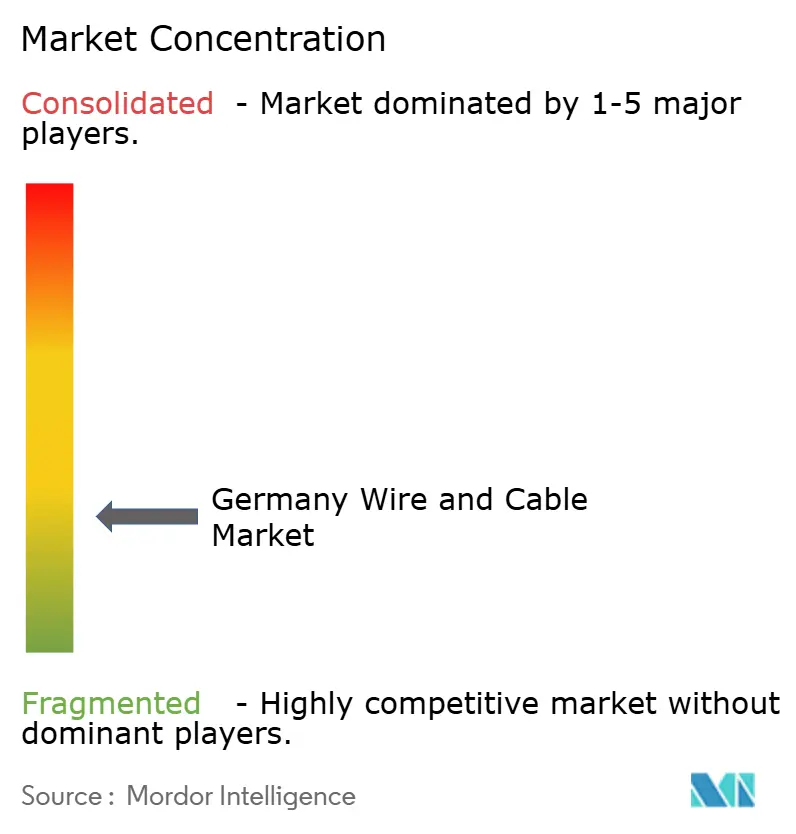
| Market Concentration | Low |
Major Players *Disclaimer: Major Players sorted in no particular order Image © Mordor Intelligence. Reuse requires attribution under CC BY 4.0. | |
Germany Wire and Cable Market Analysis by Mordor Intelligence
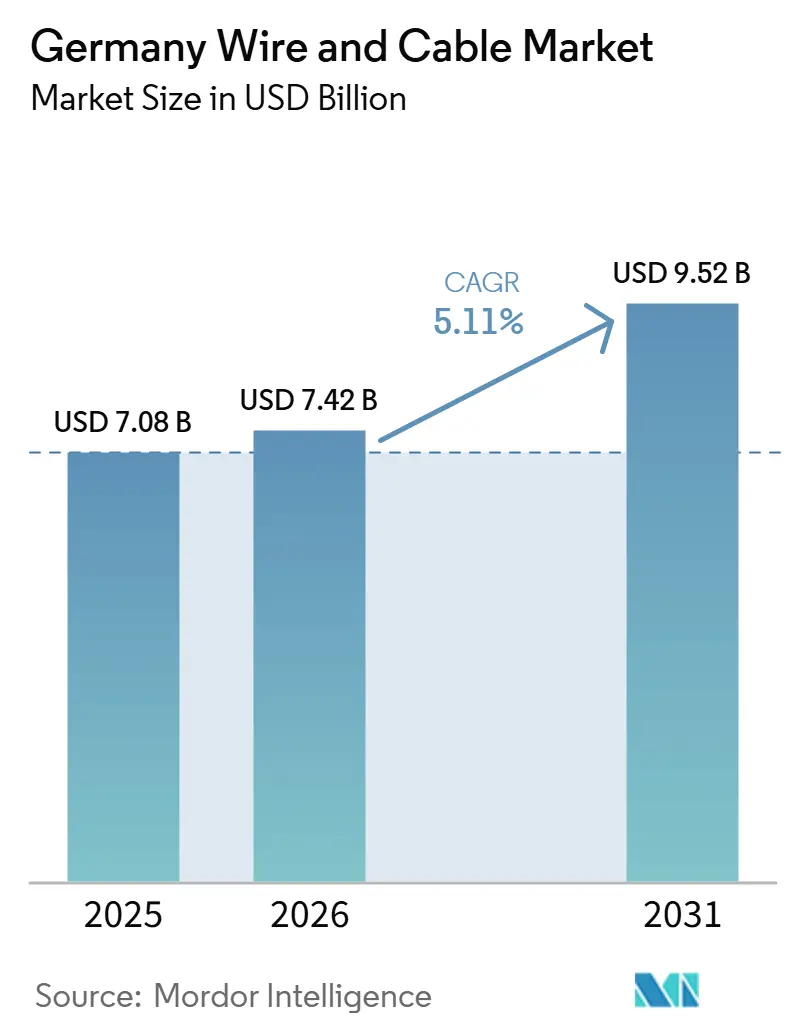
The Germany Wire and Cable Market size is projected to be USD 7.08 billion in 2025, USD 7.42 billion in 2026, and reach USD 9.52 billion by 2031, growing at a CAGR of 5.11% from 2026 to 2031. Grid renewal, offshore wind connections, factory automation, fiber deployment, and charging infrastructure are supporting demand across several cable applications. The largest projects require suppliers to reserve production capacity well before installation begins, which favors companies with qualified high-voltage manufacturing lines. Underground transmission links are increasing cable content, although they also raise project cost and scheduling requirements. Weak residential construction continues to limit some building-wire demand, while data centers and public grid projects provide offsetting demand. The German wire and cable market, therefore, combines a broad installed-base replacement cycle with large energy and digital infrastructure programs.
Key Report Takeaways
- By voltage, low-voltage below 1 kV cable accounted for 49.68% of revenue share in the Germany wire and cable market in 2025, while extra- and high-voltage above 35 kV cable is projected to expand at a 6.48% CAGR through 2031.
- By cable type, power cable accounted for 59.84% of revenue share in the Germany wire and cable market in 2025, while fiber-optic cable is expected to grow at a 5.89% CAGR through 2031.
- By conductor material, copper conductor cable held 63.47% of revenue share in the Germany wire and cable market in 2025, while optical glass/polymer fiber conductors are projected to grow at a 5.92% CAGR through 2031.
- By installation, underground cable accounted for 52.73% of revenue share in the Germany wire and cable market in 2025, while submarine cable is expected to expand at a 6.71% CAGR through 2031.
- By end-user vertical, construction accounted for 27.86% of revenue share in the Germany wire and cable market in 2025, while power infrastructure is projected to grow at a 6.35% CAGR through 2031.
- By insulation, insulated cable accounted for 91.78% of revenue share in the Germany wire and cable market in 2025 and is projected to grow at a 5.18% CAGR through 2031.
Note: Market size and forecast figures in this report are generated using Mordor Intelligence’s proprietary estimation framework, updated with the latest available data and insights as of January 2026.
Germany Wire and Cable Market Trends and Insights
Drivers Impact Analysis*
| Driver | (~) % Impact on CAGR Forecast | Geographic Relevance | Impact Timeline |
|---|---|---|---|
| Renewable-Power Grid Expansion | +2.2% | National, with priority in Northern Germany, North Sea, and Baltic Sea coastal zones | Long term (≥ 4 years) |
| Industrial Automation and Industry 4.0 Investment | +1.1% | National, concentrated in Bavaria, Baden-Württemberg, and North Rhine-Westphalia manufacturing corridors | Medium term (2-4 years) |
| Fiber-Optic and Data-Center Infrastructure Expansion | +0.9% | National, with early gains in Frankfurt-Rhine-Main, Berlin, and Munich metro areas | Medium term (2-4 years) |
| Electric-Vehicle and Charging-Infrastructure Electrification | +0.7% | National, with priority along Autobahn Rhine-Alpine and North Sea-Baltic freight corridors | Short term (≤ 2 years) |
| High-Voltage Cable Demand From North-South Transmission Corridors | +0.5% | Northern Germany to Bavaria and Baden-Württemberg, including the Schleswig-Holstein to Bergrheinfeld axis | Long term (≥ 4 years) |
| Cable-Theft Prevention and Smart Cable Monitoring Adoption | +0.2% | National, with spillover to EV charging corridors and distribution networks | Short term (≤ 2 years) |
| Source: Mordor Intelligence | |||
Renewable-Power Grid Expansion Reshapes Cable Demand At Scale
Germany’s target is 30 GW of installed offshore wind capacity by 2030 and 50 GW by 2035, supporting demand for high-voltage and extra-high-voltage systems. The Offshore Network Development Plan 2025 set out connection requirements for offshore areas through 2034.[1]Bundesamt für Seeschifffahrt und Hydrographie, “Offshore Grid Development Plan,” Bundesamt für Seeschifffahrt und Hydrographie, bsh.de The Bundesnetzagentur approved the final section of the 543 km SuedOstLink at 525 kV and 2 GW in July 2025. BDEW and ZVEI said more than 500,000 km of power cables will be needed by 2045 to replace aging assets and connect renewable generation, heat pumps, and charging infrastructure. This volume encourages long-term supply arrangements, because transmission projects require qualified production capacity years before cable installation. The Germany wire and cable market is consequently exposed to a durable grid-led procurement cycle rather than a short construction cycle.
Industrial Automation and Industry 4.0 Investment Supports Specialty Cable Demand
Industrial automation continues to support demand for flexible, oil-resistant, and electromagnetically shielded cables in German factories. Factory upgrades require dependable signal, control, and power connections for machinery, robotics, and production equipment. This work supports both replacement demand and new installations, as moving cable systems require periodic renewal. Single-pair Ethernet and power-over-data cable designs can increase the value of cable content in individual machines, even when installed lengths are shorter. The Germany wire and cable market also benefits when manufacturers adopt cable specifications that meet higher reliability and motion requirements. These needs are most visible in manufacturing corridors in Bavaria, Baden-Württemberg, and North Rhine-Westphalia.
Fiber-Optic and Data-Center Infrastructure Expansion Creates a Parallel Demand Cycle
The VDE published Guideline 0800-730 in August 2025 and updated it in February 2026, setting material requirements for fiber networks within buildings.[2]Verband der Elektrotechnik Elektronik Informationstechnik, “New VDE Guideline Makes Fiber Optic Expansion in Buildings Cheaper, Faster, and Easier,” VDE, vde.com Germany’s colocation data-center capacity is forecast to reach 3.3 GW by the end of 2029. Outdoor fiber deployment and in-building activation each require cable and connection work. The combination supports demand across access networks, backhaul, and data-center interconnects. This demand stream provides the Germany wire and cable market with exposure to digital infrastructure alongside the energy transition. Fiber deployment also requires civil works, passive network components, and installation capacity, which can influence the timing of local cable orders.
Electric-Vehicle and Charging-Infrastructure Electrification Increases Cable Requirements
Germany’s Masterplan Charging Infrastructure 2030 included 41 measures to support 1 million publicly accessible charging points.[3]Federal Ministry for Digital and Transport, “Germany Presents the Masterplan Charging Infrastructure 2030,” European Alternative Fuels Observatory, alternative-fuels-observatory.ec.europa.eu The plan included EUR 1 billion (USD 1.13 billion) in federal funding for charging at heavy commercial vehicle depots through 2029. High-power charging sites require vehicle connection cables, medium-voltage grid connections, and, in some cases, battery-storage cables. Freight corridors such as Rhine-Alpine and North Sea-Baltic therefore need more complex cable systems than standard alternating-current charging sites. This need supports the demand for low-voltage, medium-voltage, and monitoring cables at the same location. The Germany wire and cable market gains from this layered infrastructure requirement as charging networks expand.
Restraints Impact Analysis*
| Restraint | (~) % Impact on CAGR Forecast | Geographic Relevance | Impact Timeline |
|---|---|---|---|
| Copper and Aluminum Price Volatility | -1.8% | Global, with acute exposure in Germany’s export-oriented cable manufacturing base | Short term (≤ 2 years) |
| High Installation Costs for Underground and Submarine Cables | -1.0% | National, concentrated along SuedLink, SuedOstLink, and offshore wind corridors | Long term (≥ 4 years) |
| Skilled-Labor Shortages and Approval Delays | -0.7% | National, with acute impact in fiber trench laying and medium-voltage cable jointing in rural states | Medium term (2-4 years) |
| Cybersecurity and Physical-Security Requirements for Connected Cable Systems | -0.3% | National, with priority in EV charging corridors and smart-grid monitoring networks | Short term (≤ 2 years) |
| Source: Mordor Intelligence | |||
Copper and Aluminum Price Volatility Pressures Margins Across the Value Chain
Copper reached an intraday high of USD 14,527.50 per tonne on the London Metal Exchange on January 29, 2026. The copper-to-aluminum price ratio reached 4.3 in January 2026, above the 3.5-4.0 range cited for increased material substitution. This situation can increase aluminum use in main feeders and transmission applications where project specifications permit it. Fixed-price engineering, procurement, and construction contracts leave suppliers exposed when metal prices change between bid submission and delivery. Formula pricing tied to commodity benchmarks can reduce this risk, though it requires the project owners' acceptance. The Germany wire and cable market remains sensitive to suppliers’ ability to hedge material purchases and recover costs through contracts.
High Installation Costs For Underground and Submarine Cables Strain Project Economics
The BBPlG requires underground routing for new high-voltage transmission corridors in most terrain categories, which supports cable demand but raises construction requirements. SuedLink is a 700 km, 525 kV, 4 GW underground link targeted for commissioning in 2028. Offshore projects also depend on specialist vessels, qualified jointing teams, and carefully managed installation schedules. These requirements can delay work when equipment and skilled labor are unavailable. The cost burden is greatest where dense settlement, sensitive environments, or marine conditions complicate route construction. The Germany wire and cable market, therefore, faces a project-delivery constraint even as demand for cable systems remains firm.
*Our forecasts treat driver/restraint impacts as directional, not additive. The impact forecasts reflect baseline growth, mix effects, and variable interactions.
Segment Analysis
By Voltage: Grid Electrification Propels Extra- And High-Voltage Growth
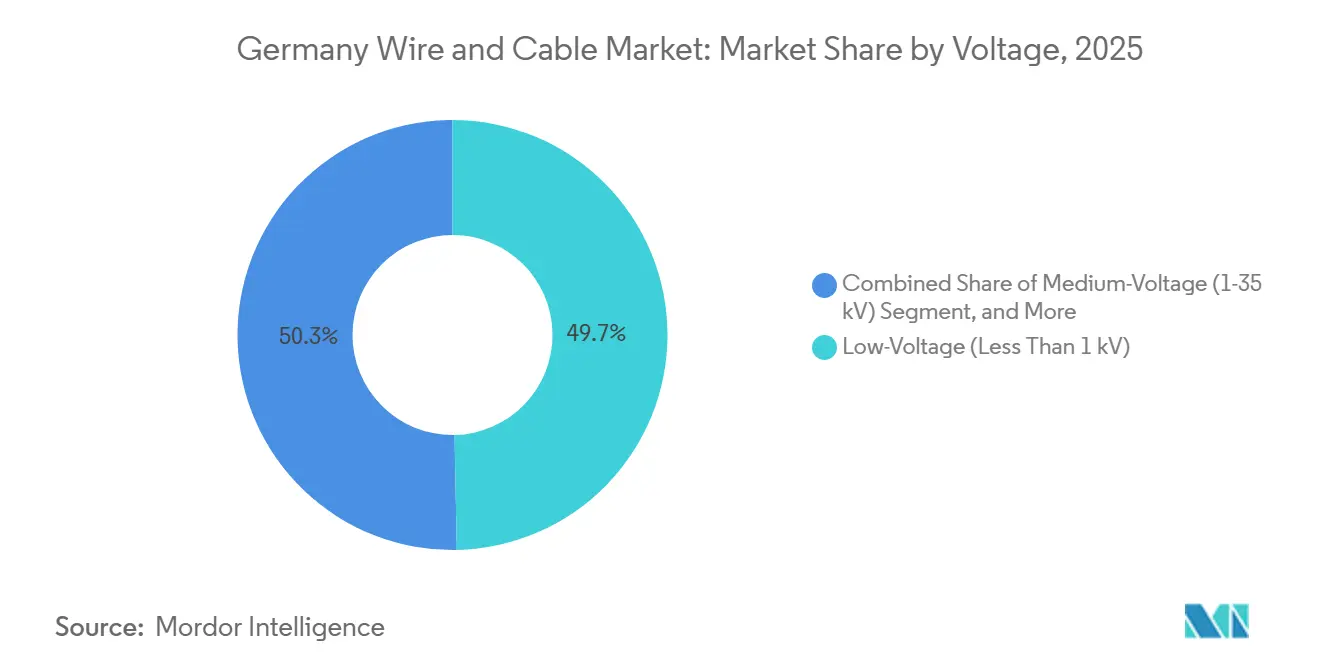
Low-voltage cable accounted for 49.68% of the German wire and cable market share in 2025. It is used in building wiring, charging circuits, industrial machinery, and last-mile distribution connections, creating a broad replacement base. New residential construction remained weak, with the ifo Business Climate Index for residential construction at -20.6 points in December 2025. This reduced some building-wire orders during the period. Industrial retrofits and charging installation programs provided demand in other low-voltage uses.
Medium-voltage cable supports distribution-grid reinforcement, renewable collector networks, industrial substation connections, and the replacement of aging overhead assets with underground systems. This work supports recurring demand across urban, rural, and industrial locations. Extra- and high-voltage cable is projected to record a 6.48% CAGR through 2031. SuedLink, SuedOstLink, A-Nord, Ultranet, and Korridor B require large volumes of land cable. Technical testing and utility qualification requirements limit the field of suppliers able to serve these projects.



By Cable Type: Power Cables Anchor Demand, Fiber-Optic Cable Leads Growth
Power cable accounted for 59.84% of the Germany wire and cable market in 2025. It transmits renewable electricity from generation sites and distributes power through industrial and urban networks using copper and aluminum systems. Signal and control cable supports automation equipment and process-industry instrumentation. Coaxial and data cables continue to play a role in broadcast systems and existing infrastructure. These applications keep the power cable at the center of the Germany wire and cable market.
Fiber-optic cable is expected to expand at a 5.89% CAGR through 2031. The category benefits from fiber-to-the-home deployment, 5G backhaul requirements, and data-center interconnection, while the VDE’s updated guideline supports in-building connections. Data-center campuses require dense fiber routing that can accommodate later network upgrades. Fiber demand also includes access connections, backbone links, and connections inside commercial properties. This broad role makes fiber cable an important growth area, while power cable retains the largest share.
By Conductor Material: Copper Leads, Optical Glass and Polymer Grow Fastest
Copper-conductor cable accounted for 63.47% of the Germany wire and cable market share in 2025. Its position rests on electrical conductivity, reliable jointing, installer familiarity, and use across power, signaling, and data applications. Aluminum is gaining use in medium-voltage distribution and high-voltage land-cable applications. The January 2026 copper-to-aluminum price ratio of 4.3 provided an economic rationale for evaluating substitution where specifications allow it. System design, connector practices, weight requirements, and project specifications still determine final material choice.
Optical glass and polymer fiber conductors are projected to grow at a 5.92% CAGR through 2031. They are used in fiber-to-the-home networks, data centers, industrial sensor networks, and vehicle networks, where resistance to electromagnetic interference can be useful. Polymer optical fiber is particularly relevant when flexibility, weight, or electrical isolation matters. Structured-cabling and fiber-installation standards help planners select compatible systems. These requirements extend the role of optical conductors across the Germany wire and cable market.
By Installation: Underground Cable Dominates, Submarine Cable Grows Fastest
Underground cable accounted for 52.73% of the Germany wire and cable market size in 2025. The BBPlG requirement for underground routing reinforces this position across transmission links, distribution upgrades, and connections between generation assets and substations. Distribution operators also use underground cable to replace aging overhead networks and improve service resilience. Overhead installation remains relevant in certain rural distribution networks and on existing routes. Its relative role is expected to decline as underground programs continue.
Submarine cable is projected to expand at a 6.71% CAGR through 2031. Offshore wind connections require submarine export cables, landfall systems, and onward land transmission links, as shown by TenneT’s 2025 commissioning of BorWin5 and DolWin5, which used 230 km and 130 km of HVDC cable, respectively. BorWin6 at 980 MW is targeted for commissioning in 2027. Amprion stated in July 2026 that DolWin4 and BorWin4, totaling 1.8 GW, are expected to connect to the grid in 2028. The category reflects the high engineering and installation demands of offshore grid expansion.
By End-User Vertical: Construction Leads, Power Infrastructure Grows Fastest
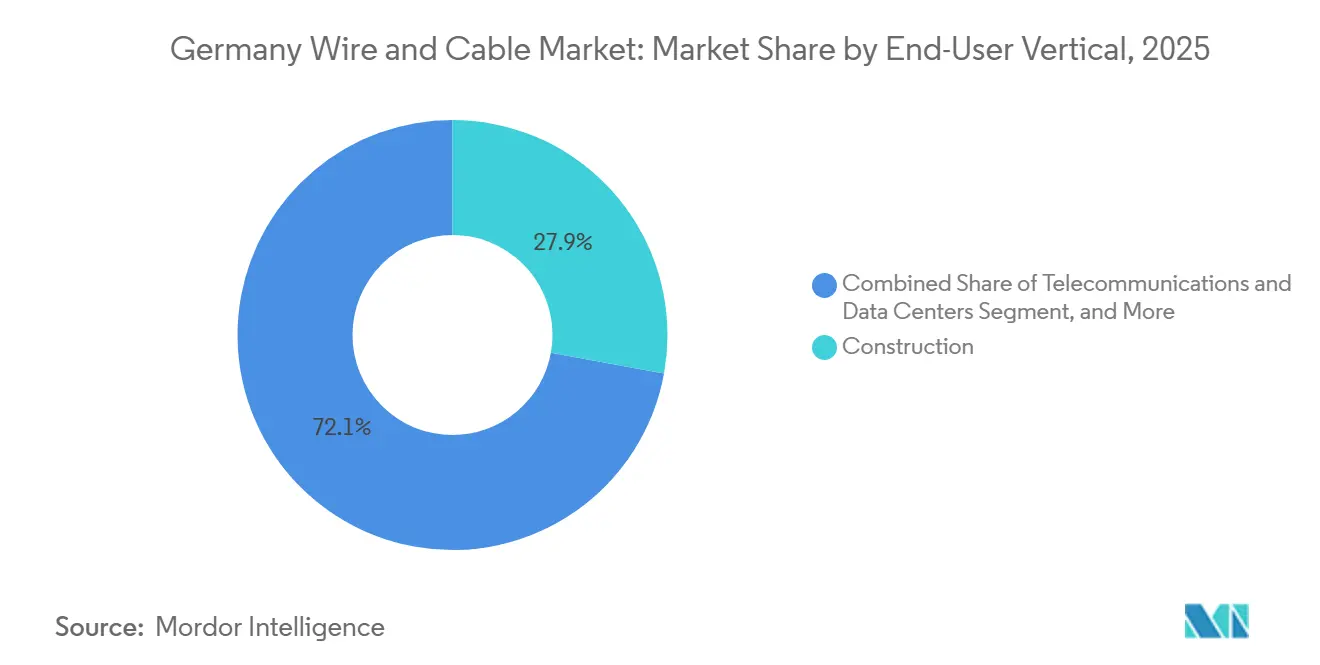
Construction held 27.86% of the Germany wire and cable market share in 2025. The category includes residential and commercial building wiring, fire-alarm cable, structured cabling, and heating, ventilation, and air-conditioning control cable, while 47.7% of firms reported insufficient residential orders in late 2025. This constrained the demand for selected building-cable applications. Commercial facilities, including data centers and logistics buildings, offered more active sources of cable demand. In-building fiber deployment also supports the construction segment.
Power infrastructure is projected to grow at a 6.35% CAGR through 2031. Utilities and renewable projects require high-voltage direct current, high-voltage alternating current, and medium-voltage systems, while telecommunications and data centers add demand as fiber and server capacity expand. Oil, gas, petrochemicals, and industrial manufacturing require armored instrumentation and fire-resistant, continuous-flex cable. Automotive and mobility applications increasingly require wiring systems for higher-voltage architectures. The Germany wire and cable market draws on several end-user demand streams, though public grid investment is projected to provide the strongest growth.
By Insulation: Insulated Cable Is Driven By XLPE and HFFR Adoption
Insulated cable accounted for 91.78% of the Germany wire and cable market size in 2025. It is also projected to grow at a 5.18% CAGR through 2031, while bare conductor is used mainly in overhead ground wires and selected earthing applications. Underground construction reduces the relative role of many bare-conductor uses. Cross-linked polyethylene (XLPE) is gaining use in medium- and high-voltage applications. Halogen-free flame-retardant compounds (HFFR) are increasingly used in low-voltage public buildings and data centers.
Construction Products Regulation fire classifications influence building insulation choices, with public buildings and tunnels requiring ratings such as B2ca or Cca under local implementation rules. This shifts demand from standard polyvinyl chloride systems toward higher-specification compounds. The shift can increase cable value per meter when the installed volume is stable. Suppliers must meet material, testing, and documentation requirements before supplying regulated projects. Compliance requirements support continued product upgrading in the Germany wire and cable industry.
Geography Analysis
Northern Germany is expected to remain a highly intensive cable-pull area during 2026-2031, as it hosts offshore grid landfalls and high-voltage direct-current converter stations. Schleswig-Holstein, Lower Saxony, and Hamburg connect offshore generation with transmission routes to southern demand centers. SuedLink begins at Brunsbüttel and Wilster, while BorWin5 connects at Garrel/Ost, and DolWin4 and BorWin4 cables run inland to Lingen. Korridor B is being built between Heide/West and Polsum, and between Wilhelmshaven and Hamm, using 525 kV high-voltage direct current underground links with a capacity of 4 GW. These overlapping projects require coordinated manufacturing, civil works, jointing, and grid connection activities.
Bavaria and Baden-Württemberg receive power from northern wind corridors and are major centers of industrial electricity use. SuedLink will connect to Großgartach, Leingarten, and Bergrheinfeld, while SuedOstLink will connect to the Isar substation near Landshut. Automotive, chemical, and semiconductor manufacturing support demand for medium-voltage supply cable and specialty control cable in the Munich, Regensburg, and Nuremberg corridors. NKT signed framework agreements with EnBW in July 2025 for the supply of low- and medium-voltage cables across southern Germany, with 3-year commitments and a 2-year extension option. The first SuedOstLink connection is expected in 2027 and can support further reinforcement of distribution in Bavaria and nearby states.
North Rhine-Westphalia has strong industrial cable demand across the Rhine-Ruhr chemical cluster, automotive supply chains, and the Düsseldorf-Cologne data center corridor. Berlin and eastern Germany require upgrades within the 50Hertz transmission area. 50Hertz submitted a NABEG application for TraveBilleLink in June 2025, a 525 kV and 4 GW high-voltage direct-current land link that will carry North Sea wind power south. Brandenburg, Saxony-Anhalt, and Saxony also need medium-voltage collector cable for solar and onshore wind projects.
Competitive Landscape
The Germany wire and cable market is concentrated in high-voltage and extra-high-voltage projects, where a limited number of manufacturers can supply certified 525 kV XLPE high-voltage direct-current systems at scale. Low-voltage building cable and industrial specialty products are more fragmented. Prysmian secured contracts valued at more than EUR 1.8 billion (USD 2.03 billion) for SuedLink, SuedOstLink, and A-Nord. It also secured a EUR 1.1 billion (USD 1.24 billion) award from 50Hertz for the NOR-11-1 submarine and DC31 underground projects. Long-term framework agreements reserve manufacturing slots before construction begins.
This arrangement raises the entry barrier for suppliers without qualified plants and established project records. NKT reported EUR 2,722 million (USD 3.08 billion) in 2025 revenue and record EBITDA of EUR 390 million (USD 441 million). Germany was NKT’s largest individual market for European grid projects. In February 2026, NKT entered a long-term partnership with Mainova for 110 kV high-voltage alternating-current onshore power cables through 2033, produced at NKT’s Cologne facility. In July 2026, NKT delivered a reusable 400 kV temporary cable system for Amprion’s grid-upgrade work.
Mid-market suppliers compete through application engineering, product breadth, and delivery reliability in industrial flex, robotic, and continuous-motion cable. Smart cable monitoring can add fault detection, tamper alerts, and condition-monitoring interfaces for charging corridors and smart grids. Germany’s charging plan assigned the Interior Ministry work on an anti-cable-theft initiative and an assessment of smart monitoring solutions. Digital installation verification and data-enabled cable assemblies can differentiate suppliers in premium industrial projects. The market therefore has high barriers at the transmission-project tier and active competition across standard and specialized cable categories.
Germany Wire and Cable Industry Leaders
Prysmian S.p.A.
Nexans S.A.
NKT A/S
LEONI AG
LAPP GmbH
- *Disclaimer: Major Players sorted in no particular order

Recent Industry Developments
- July 2026: NKT delivered a world-first reusable 400 kV HVAC temporary cable solution for German TSO Amprion during transmission grid upgrade works, marking the first application of an extra-high-voltage reusable cable in live grid operations and establishing a scalable framework for subsequent German TSOs. The development reduced material waste and outage windows, thereby directly improving the economics of Germany’s multi-year grid reinforcement program.
- May 2026: Amprion awarded Sumitomo Electric Industries, Ltd. a billion-euro contract for the DC35 direct-current project, with cables to be manufactured in Germany by Sumitomo subsidiary Südkabel. The award brought Amprion’s total contracts with the Sumitomo group to over EUR 3 billion (USD 3.39 billion) across 3 major Energiewende corridor projects.
- February 2026: NKT entered an exclusive long-term partnership with Frankfurt DSO Mainova for the continuous supply of 110 kV HVAC onshore power cables through 2033, manufactured at NKT’s high-voltage factory in Cologne, ensuring planned grid-upgrade capacity for Germany’s primary financial center.


Germany Wire and Cable Market Report Scope
The Germany wire and cable market revenue is generated through the sale of low-, medium-, and high-voltage wires and cables, including power, fiber-optic, signal and control, and coaxial/data cables with copper, aluminum, or optical glass/polymer conductors, along with associated value-added products and installation-specific solutions for overhead, underground, and submarine network deployments.
The Germany wire and cable market report is segmented by voltage (extra- and high-voltage (greater than 35 kV), medium-voltage (1-35 kV), and low-voltage (less than 1 kV)), cable type (power cable, fiber-optic cable, signal and control cable, and coaxial and data cable), conductor (copper, aluminum, and optical glass/polymer), installation (overhead, underground, and submarine), end-user vertical (construction (residential and commercial), power infrastructure (utilities and renewables), telecommunications and data centers, oil and gas and petrochemicals, automotive and mobility, and industrial manufacturing), and insulation (insulated and non-insulated). The market forecasts are provided in terms of value (USD).
| Extra- and High-Voltage (Greater Than 35 kV) |
| Medium-Voltage (1-35 kV) |
| Low-Voltage (Less Than 1 kV) |
| Power Cable |
| Fiber-Optic Cable |
| Signal and Control Cable |
| Coaxial and Data Cable |
| Copper |
| Aluminum |
| Optical Glass/Polymer |
| Overhead |
| Underground |
| Submarine |
| Construction | Residential |
| Commercial | |
| Power Infrastructure (Utilities and Renewables) | |
| Telecommunications and Data Centers | |
| Oil and Gas and Petrochemicals | |
| Automotive and Mobility | |
| Industrial Manufacturing |
| Insulated |
| Non-Insulated |
| By Voltage | Extra- and High-Voltage (Greater Than 35 kV) | |
| Medium-Voltage (1-35 kV) | ||
| Low-Voltage (Less Than 1 kV) | ||
| By Cable Type | Power Cable | |
| Fiber-Optic Cable | ||
| Signal and Control Cable | ||
| Coaxial and Data Cable | ||
| By Conductor Material | Copper | |
| Aluminum | ||
| Optical Glass/Polymer | ||
| By Installation | Overhead | |
| Underground | ||
| Submarine | ||
| By End-User Vertical | Construction | Residential |
| Commercial | ||
| Power Infrastructure (Utilities and Renewables) | ||
| Telecommunications and Data Centers | ||
| Oil and Gas and Petrochemicals | ||
| Automotive and Mobility | ||
| Industrial Manufacturing | ||
| By Insulation | Insulated | |
| Non-Insulated | ||


Key Questions Answered in the Report
What is the size of the Germany wire and cable market?
The Germany wire and cable market was valued at USD 7.08 billion in 2025, is projected at USD 7.42 billion in 2026, and is forecast to reach USD 9.52 billion by 2031.
What is driving wire and cable demand in Germany?
Grid expansion, offshore wind connections, fiber deployment, factory automation, and charging infrastructure are the main demand factors.
Which cable type has the largest share in Germany?
Power cable held 59.84% of the 2025 total, reflecting its central role in transmission and distribution networks.
Which installation method is growing fastest?
Submarine cable is projected to grow at a 6.71% CAGR through 2031, supported by offshore wind grid connections.
Why is extra- and high-voltage cable expanding quickly?
The category is projected to expand at a 6.48% CAGR through 2031 because large HVDC corridors require qualified underground cable systems.
What constrains cable-project delivery in Germany?
Metal-price volatility, high underground and submarine installation costs, skilled-labor shortages, approval requirements, and security needs can constrain project delivery.
Page last updated on:





