
Germany Soil Monitoring Market Size and Share
Market Overview
| Study Period | 2021 - 2031 |
|---|---|
| Forecast Data Period | 2026 - 2031 |
| Base Year Market Size (2025) | USD 50.30 Million |
| Market Size (2026) | USD 56.5 Million |
| Market Size (2031) | USD 101.40 Million |
| Growth Rate (2026 - 2031) | 12.41 % |
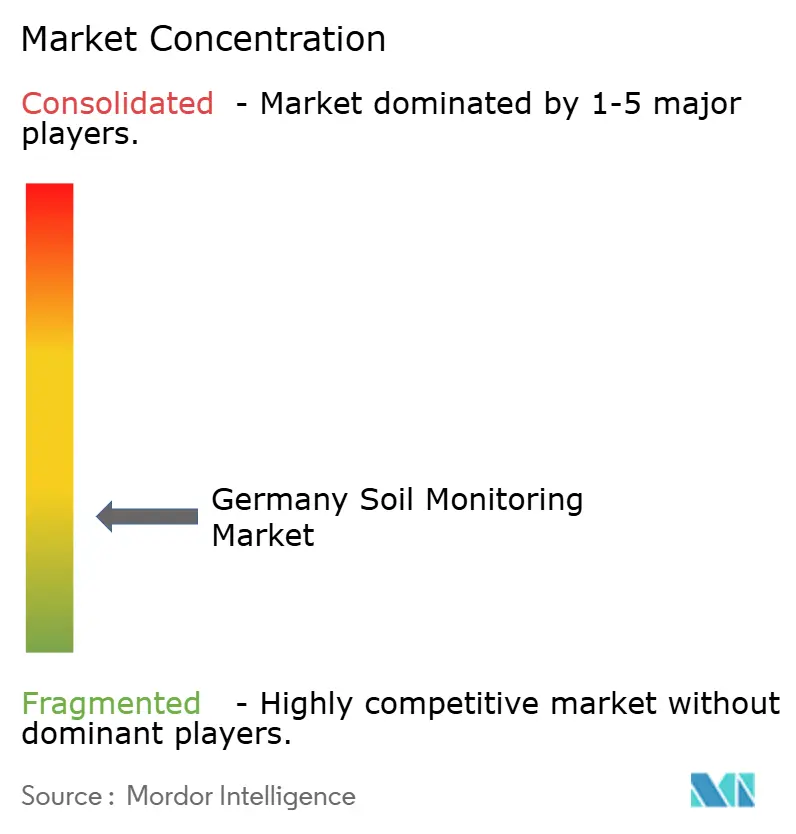
| Market Concentration | Low |
Major Players *Disclaimer: Major Players sorted in no particular order Image © Mordor Intelligence. Reuse requires attribution under CC BY 4.0. | |
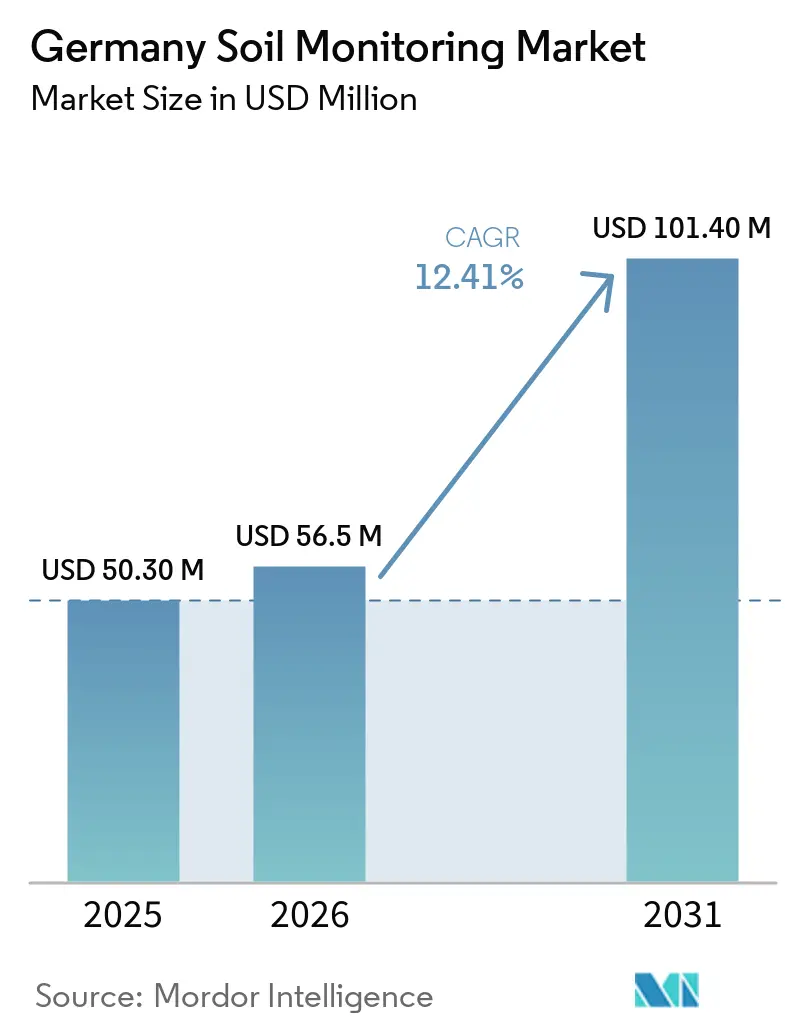
Germany Soil Monitoring Market Analysis by Mordor Intelligence
The Germany soil monitoring market was valued at USD 50.30 million in 2025 and is estimated to grow from USD 56.50 million in 2026 to USD 101.40 million by 2031, registering a CAGR of 12.41% during the forecast period (2026-2031). The European Union (EU) Soil Monitoring Law, set to come into force on December 16, 2025, will require Member States to establish soil monitoring and assessment systems and transpose the law by December 16, 2028. According to Germany Trade and Invest data, Germany recorded more than EUR 73 billion (USD 78.8 billion) in agricultural production value in 2024, with 16.6 million hectares of land used for agriculture[1]. This agricultural base makes soil monitoring relevant for input management, water planning, and compliance documentation across farms with varying soil types, crop systems, and levels of digital equipment adoption. Public monitoring networks, digital farming adoption, and demand for connected data systems that support practical decision-making and formal recordkeeping also shape the market. Political opposition to the European Union law at the Council level may affect the pace and consistency of implementation in Germany, even as operators prepare for new reporting obligations and seek systems that can adapt to detailed national regulations.
Key Report Takeaways
- By component, hardware was the largest segment and held 55.0% of the Germany soil monitoring market share in 2026, while software is the fastest-growing segment and is forecast to expand at a 15.0% CAGR between 2026 and 2031.
- By product type, in-situ sensors were the largest segment, and held 48.0% share in 2025, while remote-sensing platforms are the fastest-growing segment and are forecast to expand at a 16.4% CAGR between 2026 and 2031.
- By connectivity technology, wireless was the largest segment, and accounted for 58.0% of the Germany soil monitoring market size in 2025, and is also the fastest-growing segment, forecast to expand at a 15.6% CAGR between 2026 and 2031.
- By application, open field was the largest segment, and accounted for 61.0% share in 2025, while protected cultivation is the fastest-growing segment and is forecast to expand at a 14.9% CAGR between 2026 and 2031.
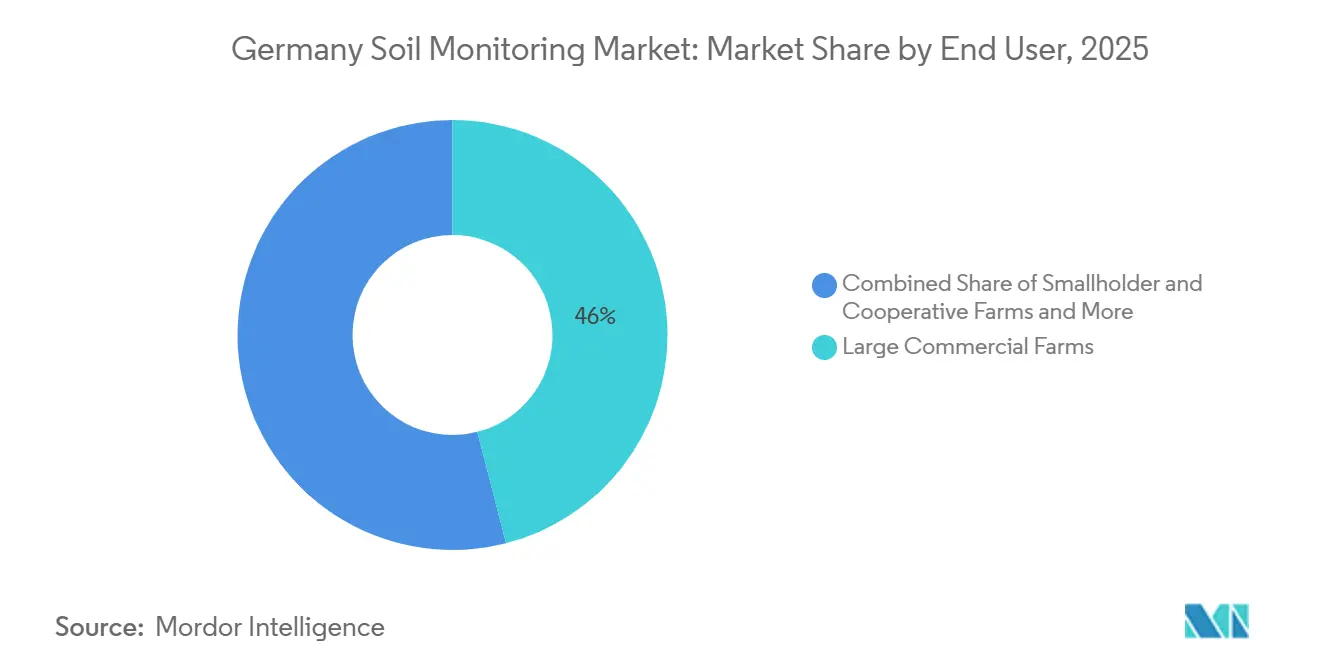
- By end user, large commercial farms were the largest segment and held 46.0% revenue in 2025, while government and nongovernmental organizations (NGOs) are the fastest-growing segment and are forecast to expand at a 13.8% CAGR between 2026 and 2031.
Note: Market size and forecast figures in this report are generated using Mordor Intelligence’s proprietary estimation framework, updated with the latest available data and insights as of January 2026.
Market Trends and Insights
Drivers Impact Analysis of Germany Soil Monitoring Market*
| Driver | (~) % Impact on CAGR Forecast | Geographic Relevance | Impact Timeline |
|---|---|---|---|
| European Union Soil Monitoring Law Implementation | +3.2% | Germany with a European Union-level mandate | Short term (≤ 2 years) |
| Precision Irrigation Adoption in Commercial Farming | +2.4% | National, with concentration in Bavaria, Brandenburg, and Lower Saxony | Medium term (2-4 years) |
| Soil Data Demand for Nutrient and Water Compliance | +2.0% | National | Short term (≤ 2 years) |
| Integration with Digital Farm Management Platforms | +1.6% | National | Medium term (2-4 years) |
| Expansion of Climate-Risk Soil Observation Networks | +1.4% | National, with state-funded programs across all 16 federal states | Long term (≥ 4 years) |
| Research and Public Soil Intelligence Infrastructure | +1.0% | National, with research hubs in Braunschweig, Potsdam, and Munich | Long term (≥ 4 years) |
| Source: Mordor Intelligence | |||
European Union Soil Monitoring Law Implementation
The European Union’s Soil Monitoring and Resilience Directive entered into force in December 2025, establishing the first European Union (EU)-wide framework for monitoring and assessing soil health across physical, chemical, and biological parameters. The Directive establishes common soil-health descriptors and monitoring requirements, with Member States, including Germany, required to transpose its provisions into national law by December 2028. The market can benefit as public agencies and operators procure flexible systems that support comparable field data. According to the Thünen Institute of Climate-Smart Agriculture, Germany has resampled 1,356 Agricultural Soil Inventory sites across eight federal states by October 2025[2]. Existing networks need greater consistency across soil districts under the European Union framework. Germany was the only member state to vote against the law in the Council. This position may create uncertainty around reporting thresholds and technical requirements during the early implementation period. It may also encourage buyers to select multi-parameter equipment that they can adapt as national rules take shape and reporting processes become clearer across different federal states.
Precision Irrigation Adoption in Commercial Farming
Soil moisture and water-potential data support irrigation decisions on commercial farms. A 2024-2025 Federal Ministry of Agriculture, Food and Regional Identity (BMLEH) study, published in Germany Trade and Invest, found that 85.5% of German farmers used digital technologies. This installed digital base reduces the practical barriers to adopting connected soil sensors. As a result, the market can leverage existing farm software and machinery connections. Continuous measurements can replace periodic checks when farm teams need faster water-related decisions. The European Union Water Framework Directive links water management with nitrate protection requirements, while the European Union Farm to Fork strategy supports more efficient fertilizer use. A demonstration on a 1,100-hectare farm in Saxony, Germany, showcased the integration of Yara International ASA’s Atfarm crop-nutrition software with Deere & Company’s John Deere Operations Center, enabling field-specific variable-rate nitrogen application plans based on crop-growth data and supporting more precise fertilizer use. Soil data can integrate irrigation, nutrient planning, and sustainability reporting into a single farm workflow. This capability makes monitoring relevant beyond water savings and links purchase decisions to nutrient planning, documentation, and field-management execution.
Soil Data Demand for Nutrient and Water Compliance
Germany's Fertilizer Ordinance and Federal Water Act set requirements based on measured soil conditions. Nitrogen application limits, manure-spreading periods, and groundwater protection distances require reliable farm records, creating recurring demand for measured data rather than modeled data alone. The nation supports operators that require auditable documentation, while suppliers that link field readings with report generation can address a practical compliance need. By November 2025, the HumusKlimaNetz project had analyzed more than 10,000 soil samples from over 1,000 fields across Germany, establishing baseline data on soil carbon, nitrogen, pH, texture, and bulk density. The measurements support the evaluation of humus-building practices and farm-level greenhouse gas balances, strengthening demand for reliable soil carbon monitoring and verification. This broader reporting role is shifting soil monitoring from an optional precision tool to a regular management input, strengthening the role of software and service providers alongside equipment suppliers.
Integration With Digital Farm Management Platforms
Soil readings provide greater value when farmers can incorporate them into existing decision-support systems and farm-management workflows. Digital platforms increasingly connect field-level data with operational planning, enabling farmers to translate monitoring results into irrigation scheduling, nutrient management, and field operations. CropX Technologies introduced its Apex multi-depth sensor in April 2026, expanding soil-profile monitoring capabilities within its digital agronomy platform. Integration with farm-management software and compatible machinery systems can help translate sensor measurements into actionable recommendations and operational tasks. These integrations broaden sales opportunities for sensor manufacturers and data-service providers while making interoperability, data compatibility, and ease of implementation important factors in vendor selection, particularly among farms that already use multiple digital management systems.
Restraints Impact Analysis of Germany Soil Monitoring Market*
| Restraint | (~) % Impact on CAGR Forecast | Geographic Relevance | Impact Timeline |
|---|---|---|---|
| High Upfront Cost for Sensor Networks | -2.2% | National, most acute for farms under 50 hectares | Short term (≤ 2 years) |
| Fragmented Farm-Level Connectivity and Service Coverage | -1.5% | Rural eastern Germany and lower-density agricultural zones | Medium term (2-4 years) |
| Soil-Specific Calibration and Interoperability Complexity | -1.4% | National | Long term (≥ 4 years) |
| Unclear Return on Investment for Low-Value Crops | -1.0% | National, concentrated in cereal and rapeseed farming regions | Medium term (2-4 years) |
| Source: Mordor Intelligence | |||
High Upfront Cost for Sensor Networks
Sensor networks require device purchases, installation labor, calibration, connectivity equipment, and software subscriptions. These combined costs can be difficult for smaller farms to fund. According to a European Commission article, the SOILMONITOR project indicated a unit price below EUR 500 (USD 545) under project conditions[3]. A 100-hectare farm may need 3 to 8 units per field, and the resulting cost can become a five-figure investment before data services are included. Large commercial farms have more scope to spread these costs across larger operations, whereas smallholder and cooperative farms often have tighter monitoring budgets. Suppliers are offering shared infrastructure, sensor-as-a-service plans, and tiered product lines to reduce the initial payment burden. Cost remains a restraint for the Germany soil monitoring market in the near term.
Fragmented Farm-Level Connectivity and Service Coverage
Uneven connectivity and limited technical support in rural areas can constrain the deployment of real-time soil monitoring systems across Germany. These systems rely on low-power wide-area network (LPWAN) technologies, cellular networks, or satellite connections to transmit field data, but network availability and service coverage can vary across agricultural regions. Although Long Range Wide Area Network (LoRaWAN) can provide long-range communication under suitable conditions, effective coverage depends on factors such as terrain, gateway placement, and network infrastructure. Farms with widely dispersed fields may also face additional costs when installing gateways, maintaining connectivity, and integrating sensor data into existing farm-management systems. Consequently, limited connectivity, installation requirements, and interoperability challenges may increase deployment costs, particularly for farms in underserved areas. Addressing these barriers may require investment in rural network infrastructure and accessible technical support, slowing the wider adoption of soil monitoring solutions in the Germany soil monitoring market.
*Our forecasts treat driver/restraint impacts as directional, not additive. The impact forecasts reflect baseline growth, mix effects, and variable interactions.
Germany Soil Monitoring Market Segment Analysis
By Component:
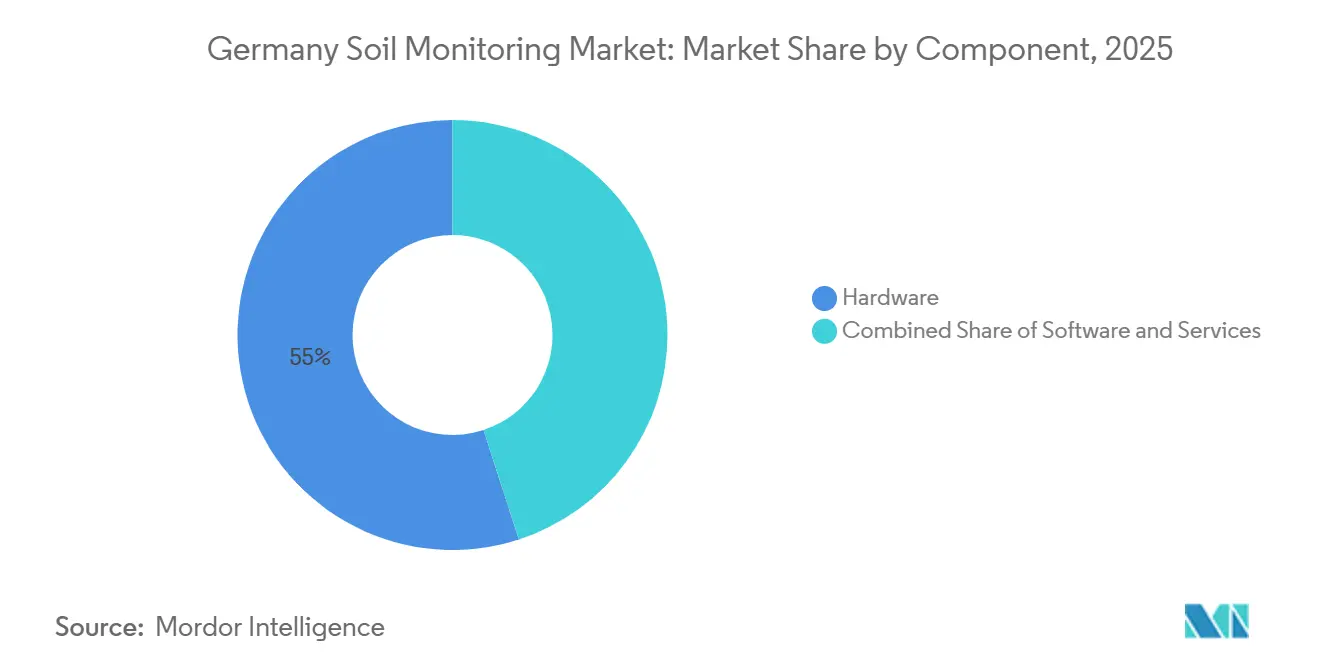
Hardware Anchors the Market, Software Commands GrowthHardware held 55.0% of the Germany soil monitoring market share in 2025. Physical sensors, data loggers, and connectivity modules form the initial investment base. Soil moisture probes, time domain reflectometry (TDR) sensors, and multi-parameter stations represent the major sources of equipment demand. Large farms and government programs require this field infrastructure before analytics can scale. As monitoring networks expand, hardware suppliers also benefit from ongoing installation and replacement demand driven by sensor degradation, site expansion, and technology upgrades.
The software segment is forecast to expand at a 15.0% CAGR between 2026 and 2031. Software supports analysis, alerts, carbon accounting, and reporting dashboards after equipment is installed. As regulatory requirements around soil health and carbon reporting grow, demand for software tools that can process and present field data is expected to increase. Platforms that aggregate data from multiple sensor types and translate raw readings into actionable farm management insights are becoming more relevant as monitoring networks scale. Services cover installation, calibration, field support, and managed data delivery for farm teams that lack specialist capability. This service need can persist beyond the initial sensor purchase, particularly where continuous monitoring and periodic recalibration are required to maintain data accuracy. As farm operations increasingly rely on third-party providers to manage sensor infrastructure, recurring service contracts are becoming a more common component of overall solution delivery.

By Product Type:
Remote-Sensing Platforms Accelerate as In-Situ Sensors DominateIn-situ sensors held 48.0% of the Germany soil monitoring market size in 2025. They provide continuous measurements at root-zone depths, supporting irrigation scheduling and compliance work where aerial data cannot deliver the same field-level depth profile. These sensors are particularly valued for their ability to capture real-time soil conditions, enabling farmers and researchers to make timely decisions based on accurate, localized data. IMKO Mikromodultechnik, part of the Endress+Hauser Group, supplies TDR-based soil moisture systems to German commercial and research users. Portable probes and test kits remain relevant for crop planning, sampling campaigns, and agronomy visits, offering flexibility for users who require periodic rather than continuous monitoring.
Remote-sensing platforms are forecast to expand at a CAGR of 16.4% between 2026 and 2031. These platforms use satellite imagery and multispectral data to assess soil properties over large areas, supporting regional-scale monitoring and agricultural planning. In 2025, AMAZONEN-WERKE H. Dreyer SE & Co. KG presented SoilDetect among its innovations at AGRITECHNICA 2025. Developed under the Soil4Climate joint project in collaboration with Field-Expert GmbH, exatrek GmbH, Osnabrück University of Applied Sciences, and the Julius Kühn Institute (JKI), the system combines geo-electric soil conductivity measurements collected during tillage with machinery sensor data, satellite imagery, and soil assessment data to generate high-resolution, site-specific soil maps using AI. SoilDetect also received the DLG Agrifuture Concept Winner Award in 2025. By integrating field-level measurements with satellite-derived information, the system demonstrates how complementary sensing technologies can improve soil mapping and support precision agriculture through more targeted fertilization and site-specific cultivation.
By Connectivity Technology:
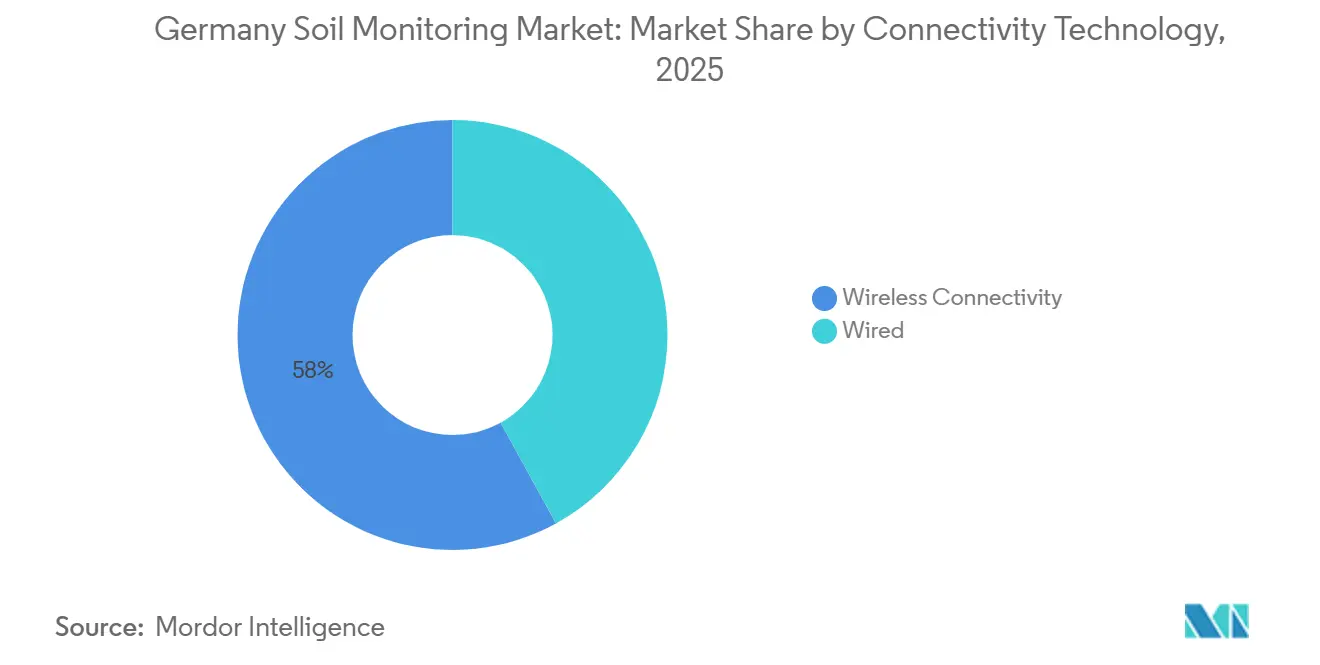
Wireless Leads in Both Share and Growth RateWireless connectivity held 58.0% of the Germany soil monitoring market in 2025. It was the largest connectivity category and is forecast to grow at a 15.6% CAGR between 2026 and 2031. The segment benefits from the need to connect sensors across large agricultural fields without installing cables. Wireless systems also support continuous data collection for irrigation, nutrient management, and soil-health reporting. The European Union soil monitoring law further supports demand for connected monitoring systems, as it requires comparable soil data across monitoring locations.
Wired connectivity remains relevant for permanent research facilities, lysimeter systems, and long-term monitoring stations where power and cable infrastructure are already in place. Universities and public monitoring programs may continue to use wired or hybrid systems where stable measurements are the primary requirement. Commercial farms, however, are more likely to adopt wireless systems, as these can be deployed across larger and more dispersed fields. Declining low-power wide-area network (LPWAN) module costs are also reducing the cost advantage that wired installations previously held, making wireless connectivity central to the expansion of the Germany soil monitoring market.
By Application:
Open Field Leads While Protected Cultivation Captures Specialist DemandOpen field held 61.0% of the 2025 revenue in the German soil monitoring market. According to data from Germany Trade and Invest, Germany's 16.6 million hectares of arable and grassland provide a substantial addressable area for soil monitoring and precision agriculture technologies. Nutrient management, irrigation scheduling, and soil carbon tracking are the core open-field applications. Forestry also generates specialized demand under peatland and forest monitoring programs, extending monitoring requirements beyond seasonal cropping decisions.
Protected cultivation is forecast to expand at a 14.9% CAGR between 2026 and 2031. Greenhouse operators require dense root-zone measurements for fertigation, energy planning, and yield management. Tomatoes, cucumbers, herbs, and seed crops generate higher revenue per hectare than cereals. The SOILMONITOR project, during 2022-2025 in Kiel, Germany, identified high-value vegetables and seed cultivation as its first commercial use cases. These economics support closer monitoring in controlled growing conditions, where dense sensor placement allows operators to respond to root-zone changes within shorter production cycles.
By End User:
Large Farms Command Share as Public Sector AcceleratesLarge commercial farms accounted for 46.0% of the Germany soil monitoring market value in 2025. Their scale allows sensor network costs to be distributed across more hectares. Agricultural cooperatives in Brandenburg, Saxony, and Mecklenburg-Vorpommern are well-suited users of systems that connect field data with variable-rate machinery. The BMLEH allocated EUR 50 million (USD 54 million) to digital experimental fields that support data-driven farming. These field settings help validate systems before wider farm adoption.
The government and NGOs segment is forecast to expand at a 13.8% CAGR between 2026 and 2031. Public demand is driven by European Union legislation, federal inventories, and climate-risk observation networks. The National Monitoring Centre for Soil Biodiversity (NMZB) adds demand for biodiversity-related data collection. Research institutes and universities also fund calibration and methods work. Vendors with compliant data-export formats and calibration support are well positioned for these buyers. Public procurement can also generate longer-term requirements for maintenance and data management.
Geography Analysis
Lower Saxony, Schleswig-Holstein, and Mecklenburg-Vorpommern have large arable operations and high mechanization levels, supporting demand for hardware-intensive sensor networks. These northern states are characterized by large farm sizes and a strong orientation toward precision agriculture, making them key markets for automated soil monitoring systems. Brandenburg serves as a research center for soil monitoring, including neutron sensing and field sensor applications, with ongoing programs that contribute to the development and validation of monitoring technologies. Bavaria supports protected cultivation and forestry applications due to its specialty crops and forest areas, with demand driven by the need for detailed soil health data across diverse land use types.
Saxony, Saxony-Anhalt, and Thuringia combine large consolidated farms with significant nutrient compliance requirements, though some rural areas in these states face connectivity limitations that may affect the deployment of networked monitoring systems. Farm consolidation in these states has increased the scale of individual operations, raising the importance of efficient, data-driven soil management. The European Union Common Agricultural Policy (CAP) 2023-2027 eco-schemes support precision input management and related documentation, providing a regulatory incentive for farmers to adopt soil monitoring technologies. Existing monitoring infrastructure may direct near-term public procurement toward states such as Bavaria and North Rhine-Westphalia. Across these regions, the combination of regulatory requirements, farm consolidation trends, and infrastructure investment is shaping a diverse demand base for soil monitoring technologies.
The geographic scope of soil monitoring extends to urban and peri-urban soils, brownfield programs, and energy infrastructure sites, all of which fall within the scope of the European Union Soil Monitoring Law. METER Group has documented work on thermal conductivity for German underground power transmission cable projects. New underground transmission lines will create soil assessment requirements for utilities and engineering contractors, extending demand beyond conventional agricultural supply chains. Northern states with large-scale arable farming are driving adoption of automated, networked sensor systems, while southern and eastern states present opportunities tied to specialty agriculture, research programs, and compliance-driven monitoring. Non-agricultural applications, particularly those linked to energy infrastructure and urban land management, represent a growing area of demand that is increasingly recognized within the broader regulatory framework governing soil health in Germany.
Competitive Landscape
The Germany soil monitoring market was fragmented in 2025, with the top five companies METER Group, Inc., Campbell Scientific, Inc., CropX Technologies, Inc., Pessl Instruments GmbH, and IMKO Mikromodultechnik GmbH holding a smaller combined market share. This fragmentation reflects the absence of a dominant vendor capable of addressing the full range of end-user requirements. Buyers in this market include agricultural research institutes, precision farming operators, environmental monitoring agencies, and infrastructure assessment firms, each with distinct technical and operational needs. This reflects the varied requirements of research installations, wireless farm networks, and remote-sensing services. Competition is based on measurement capability, calibration, integration, and service coverage. Vendors that offer broader portfolios or stronger regional support tend to retain customers across multiple application segments.
METER Group, Inc. competes in the market through its Munich office, German-language support, and measurement portfolio. Its local presence supports direct engagement with research institutions and agricultural organizations across Germany. Campbell Scientific, Inc. maintains a position in the market through its data logging systems and sensor compatibility, which are widely used in long-term environmental monitoring projects. CropX Technologies combines sensors, weather stations, and digital agronomy recommendations in a subscription model. The company participated in DLG Feldtage 2026 in Bernburg as part of its German commercial activity. In April 2026, CropX Technologies released Apex, which features multi-depth sensing and integration with its digital platform. These developments indicate that platform capabilities are becoming a component of equipment competition, with vendors increasingly differentiating through software and data services rather than hardware specifications alone.
IMKO Mikromodultechnik GmbH, SENTEK PTY. LTD, and Delta-T Devices compete on measurement precision, calibration depth, and compliance suitability. In July 2026, Pessl Instruments announced a partnership with 1NCE to standardize connectivity for METOS operations across 80 countries. Seqana GmbH and Stenon GmbH represent a software and data-led approach that is less dependent on hardware sales. In July 2026, Stenon GmbH raised EUR 18 million ( USD 20.2 million) to develop its real-time soil data operations. Urban soil and infrastructure assessment remain open areas where purpose-built product offerings are limited.
Germany Soil Monitoring Industry Leaders
-
METER Group, Inc.
-
Campbell Scientific, Inc. (Campbell Group, Inc.)
-
CropX Technologies, Inc.
-
Pessl Instruments GmbH
-
IMKO Mikromodultechnik GmbH (Endress+Hauser Group)
- *Disclaimer: Major Players sorted in no particular order
Germany Soil Monitoring Market Companies Covered in this Report
- IMKO Mikromodultechnik GmbH (Endress+Hauser Group)
- Umwelt-Geräte-Technik GmbH
- Deere and Company
- Yara International ASA
- METER Group, Inc.
- Campbell Scientific, Inc. (Campbell Group, Inc.)
- Pessl Instruments GmbH
- Royal Eijkelkamp B.V.
- CropX Technologies, Inc.
- PTx Trimble LLC (AGCO Corporation)
- Topcon Positioning Systems, Inc. (Topcon Corporation)
- SENTEK PTY. LTD
- AMAZONEN-WERKE H. Dreyer GmbH & Co. KG
- Soil Scout Oy (Husqvarna Group)
- Onset Computer Corporation (LI-COR, Inc.)
Recent Industry Developments in Germany Soil Monitoring Market
- July 2026: Potsdam-based Stenon GmbH raised EUR 18 million (USD 20.2 million) in Series B financing led by Pymwymic and DeepTech and Climate Fonds (DTCF), with participation from Atlantic, Oyster Bay, Founders Fund, and TIME Ventures. The funding will accelerate commercial operations and advance FarmLab toward a machine-integrated real-time nutrient intelligence system, with a new platform to be unveiled later in 2026. FarmLab has demonstrated 20-40% nitrogen fertilizer savings in customer deployments.
- December 2025: The European Union soil monitoring law entered into force on December 16, 2025, establishing the first European Union-wide legal framework for soil health monitoring and assessment. Member States, including Germany, have until December 16, 2028, to transpose the law into national law. The first Member State reports to the European Commission are due by December 2031.
- November 2025: Pessl Instruments GmbH unveiled METOS 5, the latest generation of its precision agriculture weather station line, at Agritechnica 2025. METOS 5 is designed for long service life, straightforward field installation, and backward compatibility with existing METOS infrastructure, reinforcing the company's installed-base strategy in Germany.
- November 2025: Germany commissioned its first nationwide peatland soil monitoring network, comprising 155 measurement stations across open land and forests, developed by Thünen Institut research units on behalf of the BMLEH. The network establishes a baseline for Germany's greenhouse gas (GHG) reporting under LULUCF and creates an ongoing instrument procurement and data-management requirement.
Germany Soil Monitoring Market Report Scope
The Soil Monitoring Market refers to the segment of the market that focuses on the use of technology to monitor soil conditions, which is crucial for agriculture and environmental management. It encompasses various components and is driven by the need for real-time data on soil parameters such as moisture, temperature, and nutrient content.
The Germany Soil Monitoring Market Report is Segmented by Component (Hardware, Software and Services), by Product Type (In-Situ Sensors, Remote-Sensing Platforms and Portable Probes and Test Kits), by Connectivity Technology (Wired and Wireless), by Application (Open Field, Protected Cultivation and Forestry), and by End-User (Large Commercial Farms, Smallholder and Cooperative Farms Research Institutes and Universities and Government and NGOs). The Market Forecasts are Provided in Terms of Value (USD).
Segmentation Overview
| Hardware |
| Software |
| Services |
| In-Situ Sensors |
| Remote-Sensing Platforms |
| Portable Probes and Test Kits |
| Wired |
| Wireless (LPWAN, Cellular, Satellite) |
| Open Field |
| Protected Cultivation |
| Forestry |
| Large Commercial Farms |
| Smallholder and Cooperative Farms |
| Research Institutes and Universities |
| Government and NGOs |
| By Component | Hardware |
| Software | |
| Services | |
| By Product Type | In-Situ Sensors |
| Remote-Sensing Platforms | |
| Portable Probes and Test Kits | |
| By Connectivity Technology | Wired |
| Wireless (LPWAN, Cellular, Satellite) | |
| By Application | Open Field |
| Protected Cultivation | |
| Forestry | |
| By End User | Large Commercial Farms |
| Smallholder and Cooperative Farms | |
| Research Institutes and Universities | |
| Government and NGOs |
Key Questions Answered in the Report
What is the Germany Soil Monitoring Market size?
The Germany soil monitoring market size is USD 56.50 million in 2026 and is forecasted to reach USD 101.40 million by 2031, growing at a 12.41% CAGR between 2026 and 2031.
Which component leads Germany soil monitoring demand?
Hardware led with 55.0% of 2026 value because sensors, data loggers, and connectivity equipment are needed before software services can scale.
Why do large commercial farms lead adoption?
Larger operations can distribute equipment and installation costs across more hectares and connect field readings with variable-rate machinery.
What limits deployment on lower-value crops?
Cereal and rapeseed farms have lower value per hectare, which makes the payback from continuous sensing less compelling.