
Germany OTT Market Size and Share
Market Overview
| Study Period | 2020 - 2031 |
|---|---|
| Forecast Data Period | 2026 - 2031 |
| Base Year Market Size (2025) | USD 32.89 Billion |
| Market Size (2026) | USD 36.27 Billion |
| Market Size (2031) | USD 55.12 Billion |
| Growth Rate (2026 - 2031) | 8.73 % |
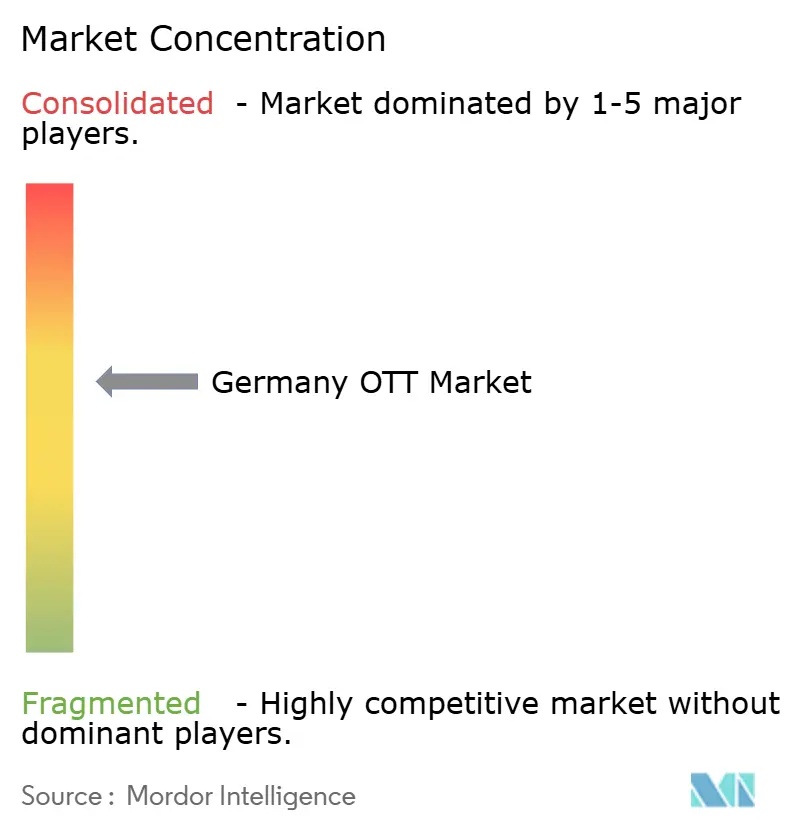
| Market Concentration | Medium |
Major Players *Disclaimer: Major Players sorted in no particular order Image © Mordor Intelligence. Reuse requires attribution under CC BY 4.0. | |
Germany OTT Market Analysis by Mordor Intelligence
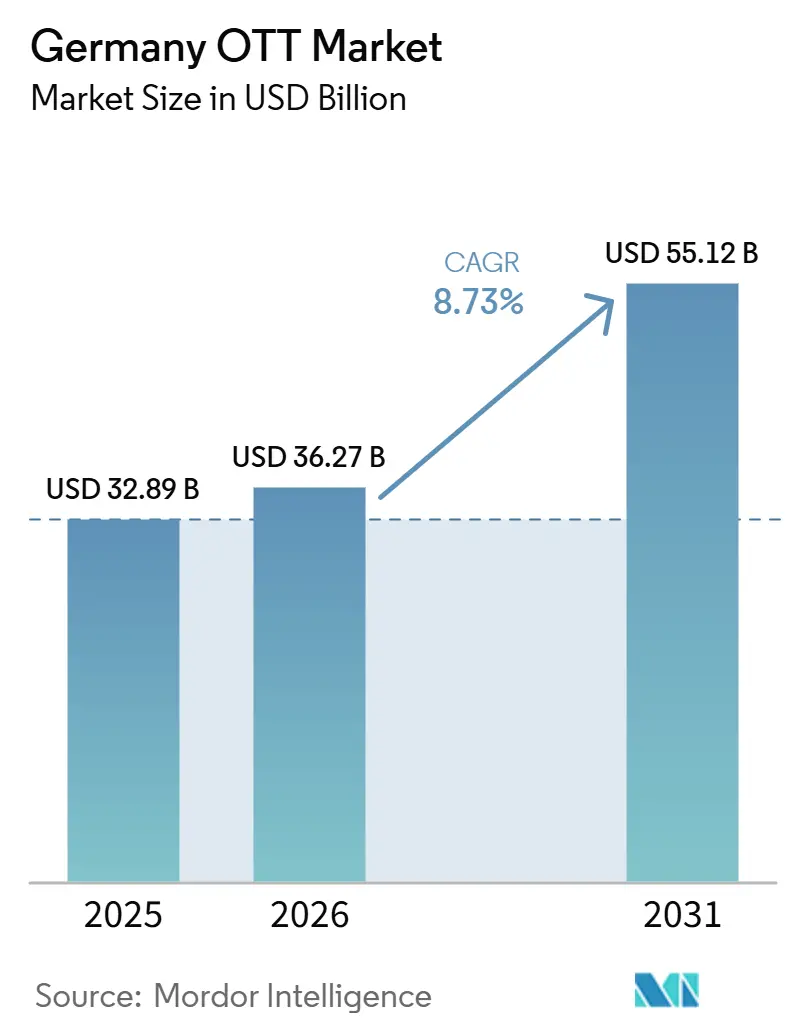
The Germany OTT market size is projected to expand from USD 32.89 billion in 2025 and USD 36.27 billion in 2026 to USD 55.12 billion by 2031, registering a CAGR of 8.73% between 2026 to 2031. Germany combines high household purchasing power with a well-established public broadcasting system, which has supported the use of multiple paid streaming services and created audience expectations for a broad choice of quality programming. Internet-based television reception has become a more important route to viewers after the end of the Nebenkostenprivileg, which required many renters to choose a television service directly rather than receiving cable through building charges. Platforms are responding with lower-priced advertising tiers, local programming, sports rights, and distribution partnerships that make services easier to find and pay for. Content obligations and rules governing smart TV interfaces raise the importance of local investment, access to prominent placement, and reliable relationships with telecommunications and device partners. These factors support continued expansion in the Germany OTT market, although household budgets, recurring subscription choices, and high content costs may limit gains for smaller services.
Key Report Takeaways
- By revenue model, SVOD held 55.83% of the Germany OTT market size in 2025, while hybrid subscription and advertising services are projected to grow at a 9.21% CAGR through 2031.
- By device type, smart TVs held 51.11% of the Germany OTT market share in 2025 and are projected to expand at a 9.51% CAGR through 2031.
- By content genre, TV shows and episodic content held 46.32% of the Germany OTT market size in 2025, while documentaries are projected to grow at a 9.48% CAGR through 2031
Note: Market size and forecast figures in this report are generated using Mordor Intelligence’s proprietary estimation framework, updated with the latest available data and insights as of January 2026.
Germany OTT Market Trends and Insights
Drivers Impact Analysis*
| Driver | (~) % Impact on CAGR Forecast | Geographic Relevance | Impact Timeline |
|---|---|---|---|
| Rising Smart TV and Connected Device Penetration | +2.1% | Germany-wide, concentrated in urban and suburban areas | Short term (≤ 2 years) |
| Faster Shift From Linear TV to On-Demand Viewing | +1.8% | Germany-wide, with accelerated uptake after the Nebenkostenprivileg abolition | Short term (≤ 2 years) |
| Expansion of Local German Originals and Sports Rights | +1.4% | Germany-wide, with a DACH regional spillover effect | Medium term (2-4 years) |
| Bundling With Telecom and Pay-TV Ecosystems | +1.1% | Germany-wide, strongest among Deutsche Telekom and Vodafone subscribers | Short term (≤ 2 years) |
| Ad-Supported Monetization Improving Price Accessibility | +0.9% | Germany-wide, with relevance for price-sensitive younger consumers | Medium term (2-4 years) |
| AI-Assisted Personalization and Content Discovery | +0.6% | Global platforms operating in Germany, with greater benefits for the largest players | Long term (≥ 4 years) |
| Source: Mordor Intelligence | |||
Rising Smart TV and Connected Device Penetration
Smart TV adoption has reduced a major access barrier for the Germany OTT market because viewers can access streaming services directly through the television screen that remains central to household entertainment. AGF found that a substantial majority of German TV households had an internet-connected television in its latest study, which shows that connected viewing has moved beyond a specialist use case. Direct internet connections accounted for most of these households, while streaming sticks or boxes represented an additional share, giving services multiple routes into the living room. ProSiebenSat.1 reported that most television sets were internet-capable, and a large majority of those sets were connected, leaving a limited hardware barrier for video services. The company also found that many television sets in surveyed homes were relatively new, so current interfaces and application stores are widely available. This installed base makes streaming apps and television operating systems central to content discovery, which increases the value of good search, clear app placement, and a dependable user experience.[1]AGF Videoforschung, “AGF Platform Study 2025 II,” AGF, agf.de
Faster Shift From Linear TV to On-Demand Viewing
The shift from scheduled television to on-demand viewing is expanding the addressable audience for the Germany OTT market and is changing how consumers choose television reception.Zattoo reported that a majority of households received television content over the internet in the latest reported period, compared with a lower share in the previous period, showing a substantial increase over a short period. Its research also showed that a notable share of households used OTT streaming services as their primary reception method, rather than treating streaming as an additional service. The share of non-streaming households that considered traditional television sufficient declined from the previous period, reducing a longstanding barrier to adoption. The end of the Nebenkostenprivileg in 2024 made television reception an active choice for many renters, including households that had previously accepted cable as part of housing costs. AGF found that 15.9% of affected households moved to another reception method, creating an opening for internet-based services that can explain their offer clearly and ease the transition.[2]Zattoo AG, “TV Streaming Report 2026 Germany,” Zattoo, zattoo.com
Expansion of Local German Originals and Sports Rights
Local programming and sports rights remain important tools for retaining subscribers in the Germany OTT market because they give viewers a reason to maintain a service after they have watched a global catalog. DAZN secured the Saturday Konferenz and all Sunday Bundesliga matches from the 2025/26 through 2028/29 seasons, ensuring a recurring schedule of live events that can support regular use. Its coverage increased from 106 to 240 matches per season, which made the service more relevant to viewers who follow domestic football throughout the season. Netflix confirmed 17 German-language productions for 2026, including new series, returning titles, and the documentary Schumacher '94, showing continued investment in local programming. German and European content requirements increase the value of relationships with local producers, performers, and rights holders, even as platforms also need international franchises. The resulting demand benefits studios that can supply German-language programming while raising content commitments and planning requirements for international platforms.[3]Netflix, “What Next Germany 2026,” Netflix, netflix.com
Bundling With Telecom and Pay-TV Ecosystems
Telecom and pay-TV bundles give the Germany OTT market an alternative to direct monthly subscription decisions, which can be useful when households are managing several entertainment bills. Deutsche Telekom sells MagentaTV packages that combine RTL+ Premium, Netflix, Disney+, and Apple TV+ under 24-month contracts, bringing several services together in a familiar customer relationship. These packages use an existing billing relationship to simplify sign-up, provide a single point of service, and reduce the need for customers to compare each platform separately. RTL Group reported that RTL+ paying subscribers increased year over year in the first quarter, while streaming and content contributed to organic revenue growth. Bundling can reduce customer acquisition costs for platforms because telecommunications providers already have an established base and recognized channels for promotion. It may also make cancellation less immediate for households, although the value of the included services must remain clear for the contract to support long-term viewing.
Restraints Impact Analysis*
| Restraint | (~) % Impact on CAGR Forecast | Geographic Relevance | Impact Timeline |
|---|---|---|---|
| Subscription Fatigue and Rising Churn Risk | -1.3% | Germany-wide, with the highest churn among consumers aged 18-34 | Medium term (2-4 years) |
| Premium Content Rights Inflation | -1.0% | Germany-wide, directly affecting platform margins and content investment returns | Long term (≥ 4 years) |
| Fragmented Viewing Across Multiple Platforms | -0.7% | Germany-wide, amplified by the growth of standalone streaming apps | Medium term (2-4 years) |
| Ad Load Sensitivity in Free and Hybrid Tiers | -0.4% | Germany-wide, particularly among privacy-conscious consumers | Short term (≤ 2 years) |
| Source: Mordor Intelligence | |||
Subscription Fatigue and Rising Churn Risk
Subscription fatigue has become a material constraint in the Germany OTT market because households can now compare multiple paid services, free services, and bundled offers at the same time. Zattoo found that German consumers continued to cancel streaming subscriptions because of cost, with cancellations increasing compared with the previous period. Households can switch among services when a title or sports season ends, rather than adding every new platform to an already crowded monthly budget. This behavior makes exclusive programs, clear value propositions, and timely release schedules more important for retention than a large library alone. It also places more attention on lower-priced and advertising-supported plans, especially when consumers want to reduce spending without leaving streaming altogether. Services that depend on occasional viewing may face higher churn among younger households that treat subscriptions as temporary choices linked to particular programs.
Premium Content Rights Inflation
The cost of premium rights can limit margins even when revenue in the Germany OTT market grows, because programming investment must be recovered over a consumer base that can easily change services. DAZN's expanded Bundesliga package covers 240 matches each season from 2025/26 through 2028/29, giving it valuable live programming but also creating a significant ongoing commitment. Rights holders can use demand for sport and well-known franchises to seek higher payments for content with reliable viewing appeal. Platforms must recover these costs from subscribers, advertising, distribution partners, or a combination of those sources without making their offers less competitive on price. Local production commitments also make content spending a more durable element of operating costs, particularly where viewers expect German-language programming. Large international services can spread programming investment over broader subscriber bases, while smaller services have less flexibility when a few rights packages take up a large share of their content budget.[4]Die Medienanstalten, “Interstate Media Treaty,” Die Medienanstalten, die-medienanstalten.de
*Our forecasts treat driver/restraint impacts as directional, not additive. The impact forecasts reflect baseline growth, mix effects, and variable interactions.
Segment Analysis
By Revenue Model: Hybrid Tiers Reshape The SVOD-Dominant Landscape
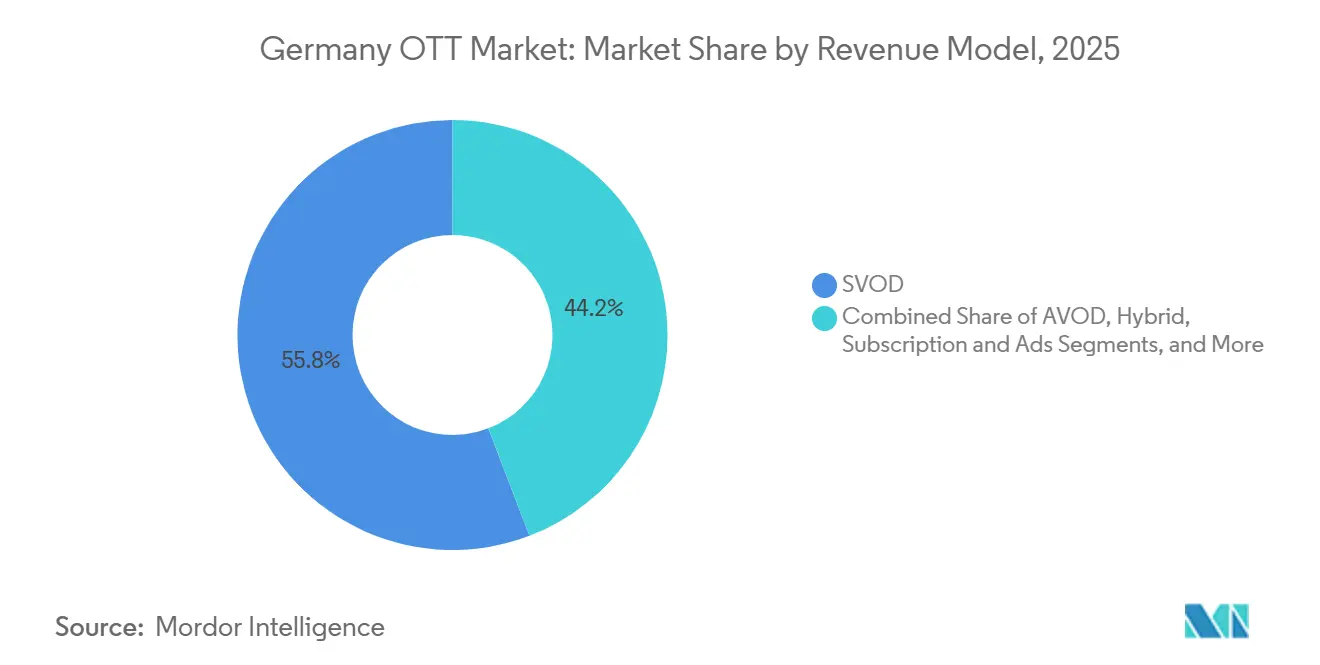
SVOD accounted for 55.83% of revenue in 2025, making it the largest revenue model. The category remains important because many households prefer uninterrupted access to broad libraries, established franchises, and original programming. Netflix and Amazon Prime Video each held 24% of the supplied SVOD comparison in the second quarter of 2026, which shows the strength of the largest subscription services. Hybrid subscription and advertising services are projected to grow at a 9.21% CAGR through 2031. This direction reflects consumer interest in lower entry prices, while platforms seek advertising revenue that can complement monthly fees.
Advertising-supported video provides a route for viewers who do not want another full-price monthly plan, including households that may otherwise rotate among paid services or use only free video. Joyn reported 36% growth in AVoD revenue in 2025, which indicates that free, advertising-funded viewing has commercial relevance for local operators and can broaden the audience available to advertisers. RTL+ and HBO Max introduced a combined advertising-supported package at EUR 9.99 per month, or USD 10.89, for the first 6 months, illustrating how a partnership can use price to encourage trial. TVOD retains a role where theatrical release windows provide access before titles become widely available in subscription libraries, and Prime Video's pay-2 agreement with LEONINE Studios shows why windowing still matters to film distribution. The model mix gives providers a way to address different household budgets, while the quality and quantity of advertising will influence whether viewers consider lower prices a fair exchange.



By Device Type: Smart TVs Anchor The German OTT Experience
Smart TVs held 51.11% of the Germany OTT market size by device type in 2025. They are also projected to grow at a 9.51% CAGR through 2031, making this device both the largest and the fastest-growing category. AGF reported that 75.6% of German TV households used video-on-demand platforms in autumn 2025, excluding YouTube and social media. Zattoo found that 67% of households used smart TVs for television streaming in 2026. Large screens support shared household viewing, premium video formats, and the more deliberate viewing sessions that are often associated with television content.
The screen shown when a household turns on a television has become a meaningful point of competition between platforms and device makers. AGF found that 30.3% of respondents saw a platform interface rather than live programming at start-up, placing application discovery before channel selection for a notable group of viewers. Shortcut buttons, default recommendations, and application placement can influence which service viewers open first, particularly where households subscribe to several platforms. Smartphones and tablets remain useful for commuters and younger viewers, while laptops and desktops retain a role in background and work-adjacent viewing. Streaming sticks and boxes remain useful because 15.2% of connected TV households used them to bring internet access to older televisions, allowing services to reach homes that have not replaced every screen.
By Content Genre: Episodic Content Leads, Documentaries Accelerate
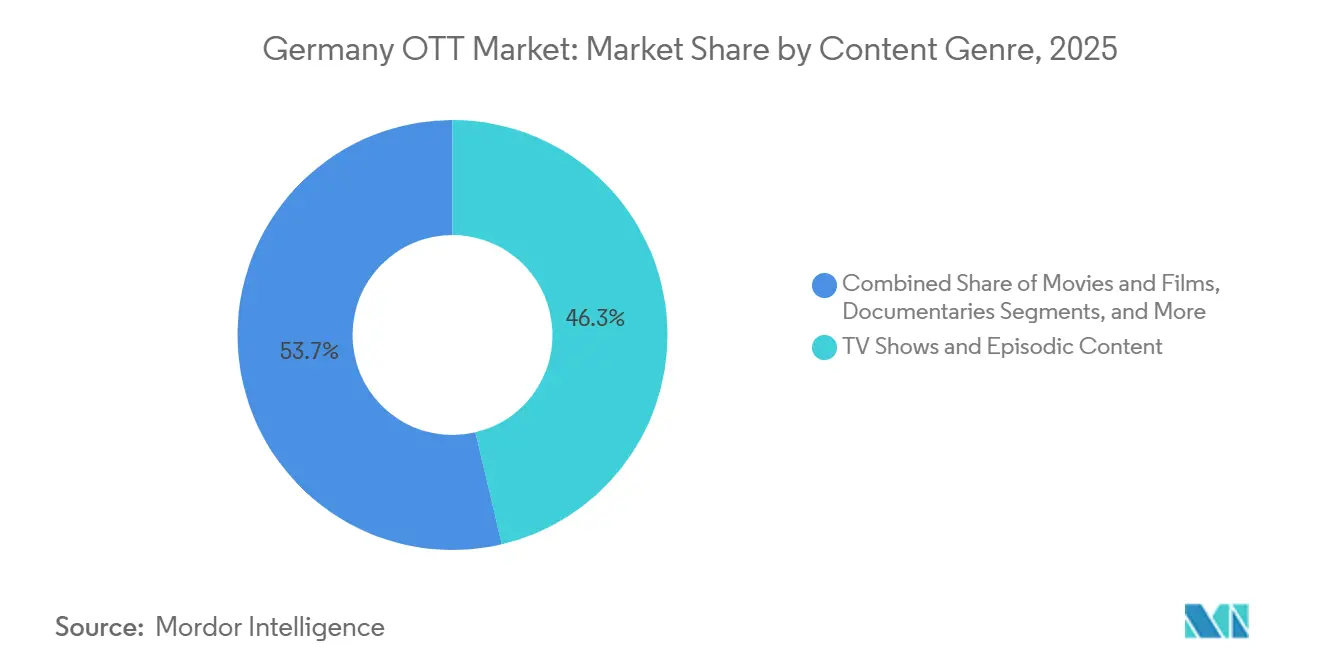
TV shows and episodic content accounted for 46.32% by content genre in 2025. Serialized formats encourage recurring viewing, create reasons to return after each episode, and can support retention over several weeks, especially when a service releases episodes on a predictable schedule. German audiences also have a long relationship with public-service drama and documentary programming, which creates high expectations for local relevance and familiar cultural references. International services, therefore, use German-language series to complement global titles and meet the preferences of local viewers. Netflix confirmed Die Kaiserin, Achtsam Modern, and Kacken an der Havel as part of its 2026 German slate, reinforcing the role of local-language scripted programming in platform planning.
Documentaries are projected to be the fastest-growing content genre, with a 9.48% CAGR through 2031. The category can reach viewers seeking factual storytelling alongside scripted entertainment, sports, and films, and it can provide a different reason to open a service when major series are between seasons. Netflix included Schumacher '94 in its announced German production slate for 2026, with Corinna Schumacher participating as a primary source. Movies and films continue to support rentals, purchases, and later subscription viewing through established release windows, which enables the same title to contribute at different points in its availability cycle. The mix of episodic programming, documentaries, and films lets platforms address different viewing occasions without relying on a single content type or a single release pattern.
Geography Analysis
The Germany OTT market is a single-country market, but differences in connectivity influence viewing quality and device use across its 16 federal states. Berlin, Munich, Hamburg, Frankfurt, and Cologne have stronger fiber and 5G availability than many rural areas. These networks support 4K video, several simultaneous household streams, and a more reliable experience for premium services. In parts of Mecklenburg-Vorpommern, Saxony-Anhalt, and Brandenburg, lower average download speeds can make high-definition streaming less consistent. Rural households may rely more heavily on mobile connections and lower-bitrate video, which does not prevent streaming but can affect the value of premium plans.
The end of the Nebenkostenprivileg in 2024 had particular relevance in large rental markets with substantial cable penetration. The change required households that had received cable television through building charges to make a separate reception decision. AGF reported that 74.4% of affected households had signed new cable contracts by autumn 2025, while 15.9% adopted another reception method. Dense multi-dwelling markets in Berlin, Hamburg, and the Rhine-Ruhr area contained many households making this choice at the same time. Platforms that offered clear installation, familiar content, and suitable prices were better placed to convert this regulatory change into sustained household use.
Germany also operates as part of a wider German-speaking commercial area, which affects rights, distribution, and programming decisions. HBO Max launched across Germany, Austria, Switzerland, Luxembourg, and Liechtenstein in January 2026 through arrangements with RTL+, Prime Video Channels, waipu.tv, and later Sky Deutschland. DAZN's Bundesliga package also covers Germany, Austria, and Switzerland through 2029. The Interstate Media Treaty sets requirements for platform conduct, non-discrimination, and the discoverability of public-service content on user interfaces.
Competitive Landscape
The Germany OTT market has a semi-consolidated platform structure that includes global leaders and several focused local or specialist services. Netflix and Amazon Prime Video are expected to hold leading positions in the SVOD market in the second quarter of 2026, while Disney+ is also expected to maintain a significant share and HBO Max a smaller share. Together, Netflix and Amazon Prime Video are projected to account for a substantial portion of the SVOD market. Beyond these services, competition includes DAZN in sports, RTL+ in local programming, MagentaTV and Sky Deutschland in aggregation, MUBI in arthouse content, and the digital services of ARD and ZDF. This mix gives viewers multiple options to access entertainment, sports, and public-service programming, while ensuring that no single proposition addresses every preference.
Exclusive rights and distribution windows remain a common competitive tool in Germany. Warner Bros. Discovery and LEONINE Studios signed a multi-year agreement in December 2025 that gave HBO Max exclusive SVOD pay-1 premiere rights to LEONINE titles from January 1, 2026. Prime Video signed a separate multi-year agreement for exclusive pay-2 rights to LEONINE theatrical releases in Germany and Austria. The arrangements show that different platforms can hold rights to the same studio slate at distinct points in its release cycle. This structure limits the chance that 1 service can assemble every major film title, while keeping licensing relationships central to content planning.
RTL+ completed its migration to the Bedrock technology platform in April 2026 and reported 7.3 million paying subscribers with 188 million viewing hours in the first quarter. The migration supports RTL Group's stated aim of reaching streaming profitability in 2026. Samsung TV Plus and Rakuten TV use free advertising-supported channels to reach consumers without requiring a separate paid subscription. Smart TV interface rules and local content requirements can favor well-funded services that can meet compliance and programming costs.
Germany OTT Industry Leaders
Amazon.com, Inc.
Netflix, Inc.
The Walt Disney Company
Paramount, a Skydance Corporation
Alphabet Inc.
- *Disclaimer: Major Players sorted in no particular order

Recent Industry Developments
- June 2026: RTL+ reported its strongest first half in company history, with VOD usage reaching 356.32 million hours from January through June 2026, a 6.5% year-over-year increase. Average cumulative total streaming net reach climbed to 10.69 million users, up 4.8%, maintaining RTL+'s position as the number-2 streaming platform in Germany behind Amazon among viewers aged 14 to 49.
- March 2026: RTL+ completed the full migration of its streaming platform to the Bedrock technology infrastructure, finalized in April 2026, replacing its legacy in-house system. The transition was expected to generate long-term cost savings and support RTL Group's 2026 streaming profitability target.
- March 2026: Amazon Prime Video and LEONINE Studios signed a comprehensive multi-year licensing agreement giving Prime Video exclusive SVOD rights in the pay-2 window for all LEONINE theatrical releases in Germany and Austria from January 1, 2026, alongside non-exclusive SVOD rights to a broad selection of LEONINE's catalog library.
- March 2026: Sky Deutschland integrated HBO Max as a directly accessible app within its Sky Stream and Sky Q ecosystem in Germany and Austria, alongside Netflix, Amazon Prime Video, Disney+, RTL+, and Joyn.


Germany OTT Market Report Scope
The Germany OTT market refers to the revenue and ecosystem generated by internet-delivered video services subscription, ad-supported, transactional, and hybrid within Germany. It includes OTT video platforms, TV and movie streaming apps, and connected‑TV services that deliver content over broadband rather than traditional broadcast or cable.
The Germany OTT Market Report is Segmented by Revenue Model (SVOD, AVOD, TVOD, and Hybrid, Subscription and Ads), Device Types (Smartphones and Tablets, Smart TVs, and More), Content Genre (Movies and Films, TV Shows and Episodic Content, and Documentaries). The Market Forecasts are Provided in Terms of Value (USD).
| SVOD |
| AVOD |
| TVOD |
| Hybrid, Subscription and Ads |
| Smartphones and Tablets |
| Smart TVs |
| Laptops and Desktops |
| Other Device Types |
| Movies and Films |
| TV Shows and Episodic Content |
| Documentaries |
| Other Content Genres |
| By Revenue Model | SVOD |
| AVOD | |
| TVOD | |
| Hybrid, Subscription and Ads | |
| By Device Type | Smartphones and Tablets |
| Smart TVs | |
| Laptops and Desktops | |
| Other Device Types | |
| By Content Genre | Movies and Films |
| TV Shows and Episodic Content | |
| Documentaries | |
| Other Content Genres |


Key Questions Answered in the Report
What is the size of the Germany OTT sector?
The Germany OTT market was valued at USD 32.89 billion in 2025, stands at USD 36.27 billion in 2026, and is projected to reach USD 55.12 billion by 2031. This forecast represents a CAGR of 8.73% during 2026-2031 and reflects continued movement toward internet-based television reception across households.
What is driving OTT adoption in Germany?
Smart TV adoption, a shift from linear television, local content, sports rights, and telecom bundles are supporting streaming use. The end of bundled cable charges has also prompted more households to choose their reception service directly, making installation, price, and service choice more important in consumer decisions. High connected-TV availability also lets viewers access applications directly on the main household screen, instead of depending on separate set-top boxes or scheduled channel lineups.
Which revenue model leads in Germany?
SVOD held 55.83% of revenue in 2025, while hybrid subscription and advertising services are projected to grow at a 9.21% CAGR through 2031. Hybrid offers can appeal to consumers looking for lower subscription costs while allowing platforms to add advertising revenue and support wider access.
Which device is most important for streaming in Germany?
Smart TVs held 51.11% by device type in 2025 and are projected to grow at a 9.51% CAGR through 2031. They are important because connected television screens are central to shared household viewing, service discovery, and access to premium video formats. Their home-screen interfaces can also influence which streaming application viewers choose first.
Which content genre is growing fastest?
Documentaries are projected to grow at a 9.48% CAGR through 2031, while TV shows and episodic content held 46.32% by content genre in 2025. Documentaries offer platforms a factual complement to recurring scripted series and film libraries, including locally relevant factual programs that can attract viewers with distinct interests.
Who are the leading streaming platforms in Germany?
Netflix and Amazon Prime Video each held 24% of the supplied SVOD comparison in the second quarter of 2026, followed by Disney+ at 18%. Other relevant services include RTL+, DAZN, MagentaTV, Sky Deutschland, and the digital services of ARD and ZDF, which address distinct viewer preferences and viewing occasions across subscription, sports, aggregation, and public-service programming within the competitive national video ecosystem today.
Page last updated on:


 Your data is secure and never sold or shared.


