
Geotextile Tubes Market Size and Share
Market Overview
| Study Period | 2021 - 2031 |
|---|---|
| Market Size (2026) | USD 1.04 Billion |
| Market Size (2031) | USD 1.61 Billion |
| Growth Rate (2026 - 2031) | 9.15 % |
| Fastest Growing Market | Asia-Pacific |
| Largest Market | Asia-Pacific |
| Market Concentration | Medium |
Major Players *Disclaimer: Major Players sorted in no particular order Image © Mordor Intelligence. Reuse requires attribution under CC BY 4.0. | |
Geotextile Tubes Market Analysis by Mordor Intelligence
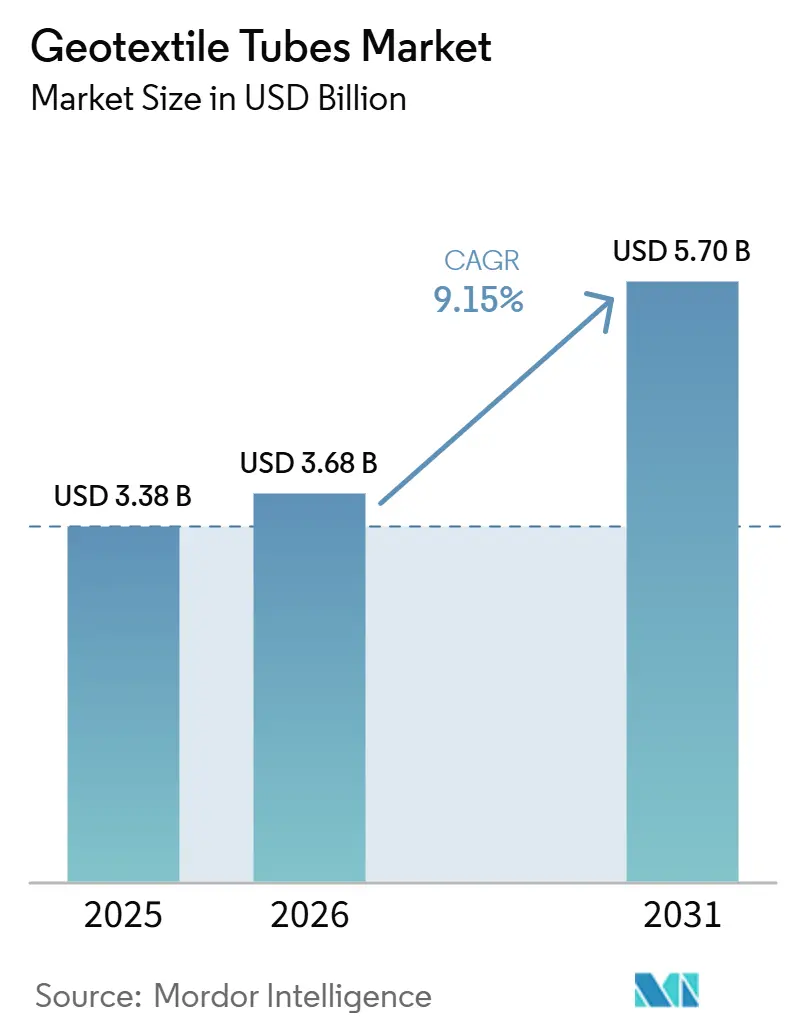
The Geotextile Tubes Market size is expected to grow from USD 0.95 billion in 2025 to USD 1.04 billion in 2026 and is forecast to reach USD 1.61 billion by 2031 at 9.15% CAGR over 2026-2031. The geotextile tubes market is supported by rising coastal exposure, wastewater and sludge management needs, and port and land reclamation projects. Global mean sea level rose 5.9 mm in 2024, compared with an average annual increase of 3.4 mm from 1993 to 2024, which is increasing the need for coastal protection works. Hydraulically filled tube systems use local sand or dredged material, which can reduce quarrying and transport requirements for coastal projects. Suppliers are responding by combining tube materials with scour protection, anchoring, and filtration components. The geotextile tubes market also has an opening in mining, where permanent tailings containment is creating demand for higher-pressure tubes with stricter effluent requirements.
Key Report Takeaways
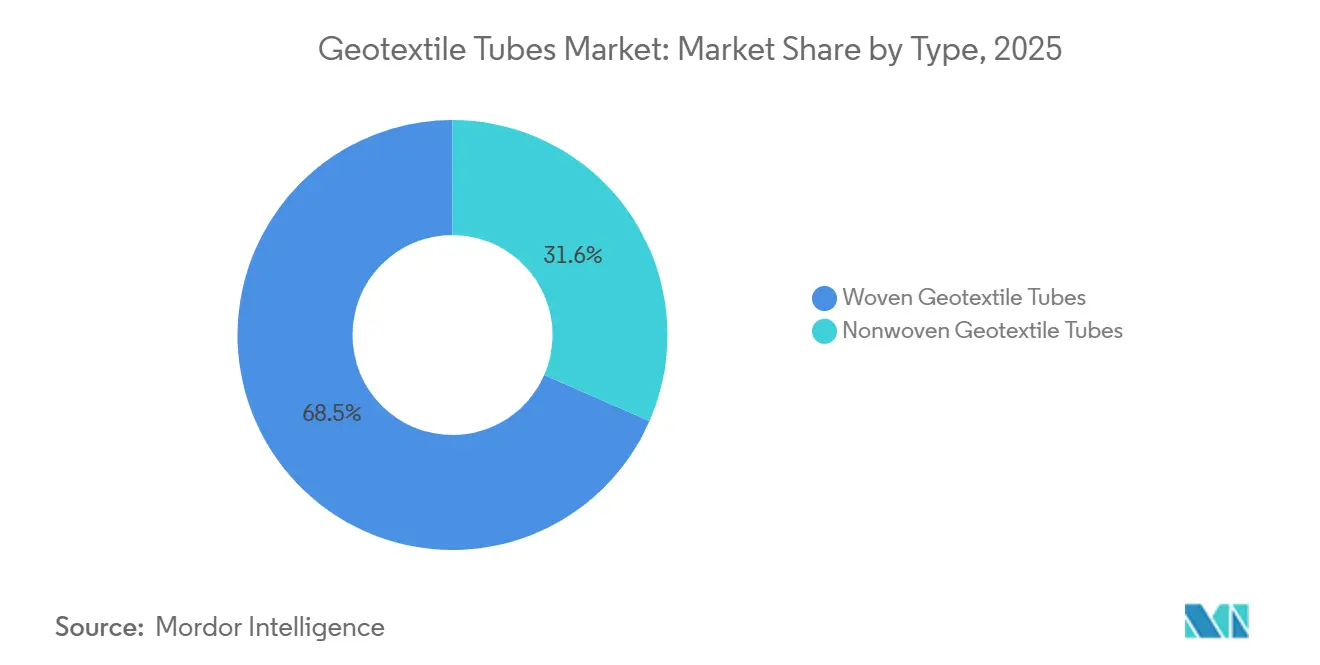
- By type, woven geotextile tubes held 68.45% of the geotextile tubes market in 2025 and are forecast to grow at a 10.61% CAGR through 2031.
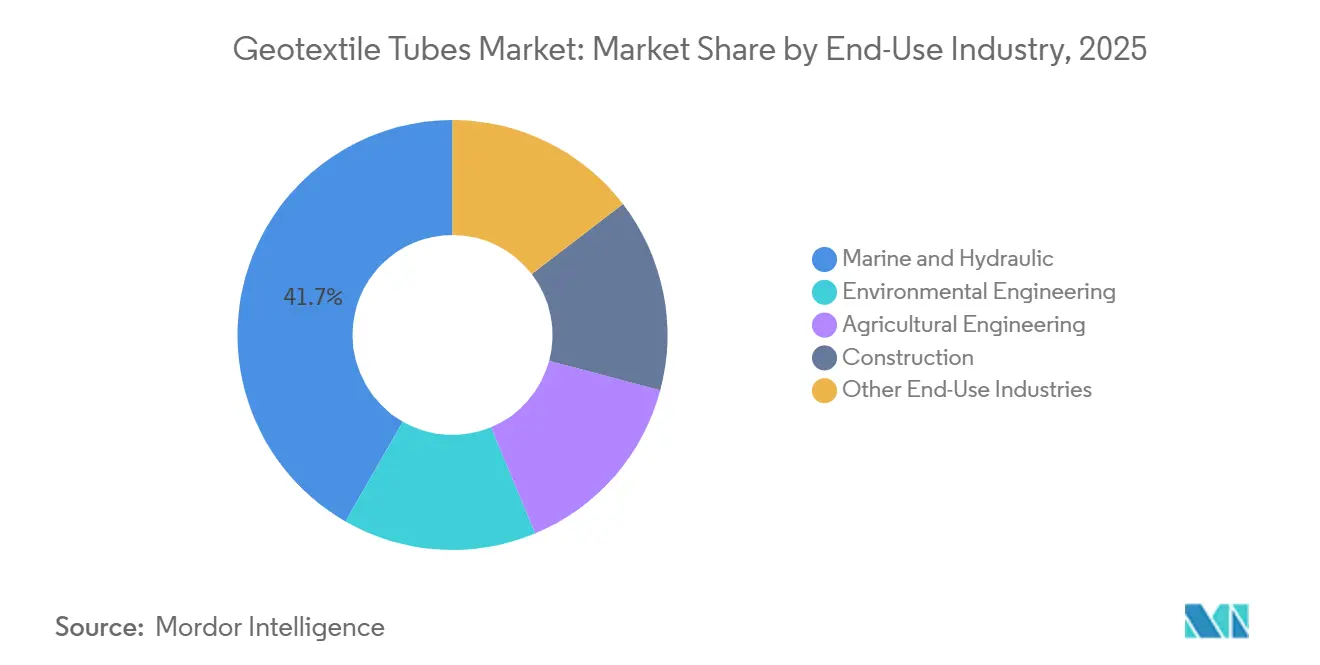
- By end-use industry, marine and hydraulic held 41.71% of the geotextile tubes market in 2025 and is forecast to grow at a 9.89% CAGR through 2031.
- By geography, Asia-Pacific held 38.63% of the geotextile tubes market in 2025 and is forecast to grow at a 10.15% CAGR through 2031.
Note: Market size and forecast figures in this report are generated using Mordor Intelligence’s proprietary estimation framework, updated with the latest available data and insights as of January 2026.
Market Trends and Insights
Drivers Impact Analysis of Geotextile Tubes Market*
| Driver | (~) % Impact on CAGR Forecast | Geographic Relevance | Impact Timeline |
|---|---|---|---|
| Coastal Erosion, Storm Surge, and Sea-Level-Rise Protection | +2.5% | Global; most acute in APAC coastlines and Gulf of Mexico/Atlantic US | Short term (≤ 2 years) |
| Expansion of Wastewater and Sludge-Dewatering Infrastructure | +2.0% | APAC core, spill-over to Sub-Saharan Africa and South America | Medium term (2-4 years) |
| Infrastructure Investment in Ports, Roads, Bridges, and Land Reclamation | +1.8% | APAC core with growing pull from MEA and South America | Medium term (2-4 years) |
| Contaminated Sediment and Mining-Waste Containment Requirements | +1.2% | North America, APAC mining belts (Australia, Indonesia, Peru) | Medium term (2-4 years) |
| Polymer-Dosing and High-Capacity Tube Design Improvements | +0.8% | Global | Short to Medium term (≤ 3 years) |
| Circular Reuse of Dewatered Sediment and Bio-Based Textile Development | +0.5% | Europe and APAC (Southeast Asia) | Long term (≥ 4 years) |
| Source: Mordor Intelligence | |||
Coastal Erosion, Storm Surge, and Sea-Level-Rise Protection
Sea-level rise is increasingly triggering near-term coastal infrastructure procurement in the geotextile tubes market. The World Climate Research Programme reported a 5.9 mm global sea-level increase in 2024, while the annual rate was 4.7 mm from 2014 to 2023. The Intergovernmental Panel on Climate Change (IPCC) reported that 13.6% to 15.2% of global sandy beaches could face severe erosion by 2050, with the range increasing to 35.7% to 49.5% by 2100 under high-emissions pathways[1]Intergovernmental Panel on Climate Change, “Sea Level Rise and Implications for Low-Lying Islands, Coasts and Communities,” IPCC Special Report on the Ocean and Cryosphere in a Changing Climate, ipcc.ch. The same assessment stated that 20 cm to 40 cm of sea-level rise can turn a 1-in-100-year coastal flood into an annual event at many low-lying locations. These conditions can shorten the practical construction period for fixed coastal defenses. Geotextile tubes can be filled on site without the quarrying and transport process required for rock-based structures, which supports their use in tropical and monsoonal coastal settings.
Expansion of Wastewater and Sludge-Dewatering Infrastructure
Municipal wastewater capacity additions are strengthening demand for passive sludge dewatering in the geotextile tubes market. These systems retain polymer-conditioned sludge while water drains through the textile, avoiding the energy use and maintenance needs of centrifuges and belt presses. International Geosynthetics Society conference material reported an 8.5-times reduction in sludge volume after dewatering in geotextile tubes. This reduction can lower transport and disposal costs for municipal operators with constrained land and budgets. New treatment plants that specify tube systems at the outset can create repeated fill-and-drain demand rather than a single coastal construction purchase. Research also supports the role of polymer selection and dosing in improving consolidation, which broadens the range of sludges that passive textile systems can process.
Infrastructure Investment in Ports, Roads, Bridges, and Land Reclamation
Government infrastructure programs continue to support demand in the geotextile tubes market for geotextile tubes in dikes, cofferdams, and land reclamation. The United Kingdom recorded GBP 28.9 billion (approximately USD 38.54 billion) in general government infrastructure investment during 2024, up 2.2% from the prior year. Public investment supports maintenance and upgrades in mature coastal markets where new greenfield construction is less common. Solmax used GEOTUBE Marine units at Malaysia’s Seri Tanjung Pinang Phase 2B project to form a perimeter dike around reclaimed land and limit sediment plumes. Land reclamation needs continuous dike construction over several years, creating more predictable procurement than isolated emergency works. The geotextile tubes market remains exposed to infrastructure cycles in a limited number of Asian countries, which makes end-use diversification important for suppliers.
Polymer-Dosing and High-Capacity Tube Design Improvements
Polymer-dosing improvements are reducing the processing cost of dewatering within the geotextile tubes market. Adaptive dosing methods can align polymer use with slurry viscosity and solids content, reducing unnecessary chemical consumption during repeated filling cycles. These methods are relevant for fine mining tailings and contaminated dredge spoil that previously required mechanical dewatering. HUESKER introduced SoilTain HDW in April 2026 with a doubled filter opening width and fill cycles up to 50% longer than standard SoilTain DW configurations. Higher processing capacity can reduce the containment area needed for a project. Wider use of high-capacity formats also increases the importance of tensile and seam performance testing under ISO 10319 and ISO 10321. These changes allow textile containment to compete in applications that once favored mechanical presses.
Restraints Impact Analysis of Geotextile Tubes Market*
| Restraint | (~) % Impact on CAGR Forecast | Geographic Relevance | Impact Timeline |
|---|---|---|---|
| Polypropylene and Polyester Feedstock Price Volatility | -1.5% | Global; most acute in North America and Europe | Short to Medium term (≤ 3 years) |
| Product Accreditation, Design Liability, and Quality-Control Requirements | -0.8% | North America, EU; growing in APAC (India, Australia) | Medium term (2-4 years) |
| Site-Specific Filtrate, Polymer, and Residual-Solids Compliance Risk | -0.7% | North America and EU (EPA, REACH framework) | Medium term (2-4 years) |
| UV, Abrasion, and Microplastic-Release Risk in Long-Life Installations | -0.5% | Global | Long term (≥ 4 years) |
| Source: Mordor Intelligence | |||
Polypropylene and Polyester Feedstock Price Volatility
Polypropylene and polyester price changes remain a direct cost risk for the geotextile tubes market. Upstream propylene supply disruptions in 2026 tightened petrochemical feedstock availability and increased pressure on polypropylene pricing. Geotextile tubes market suppliers often sell through competitive government tenders and may have limited ability to pass higher material costs to buyers. Energy cost inflation can add further pressure during polymer extrusion and fabrication. Higher material prices can encourage larger-diameter tube designs that use less polymer per cubic meter of treated material. Producers with integrated polymer supply or long-term sourcing contracts can retain a landed-cost advantage over independent manufacturers. This gap may support consolidation among standard-grade suppliers.
Product Accreditation, Design Liability, and Quality-Control Requirements
Certification obligations can extend project approval periods and increase documentation costs in the geotextile tubes market. India’s Quality Control Order requires BIS certification under IS 17880:2022 for geotextile products sold in the country, with the order taking effect in April 2025. In the European Union, CE marking under Regulation (EU) 305/2011 and conformity with EN 13249 and related standards are necessary for many public works projects[2]European Parliament and Council, “Regulation (EU) No 305/2011,” EUR-Lex, eur-lex.europa.eu. These requirements increase factory production control and design verification needs. Certified geotextile tubes market suppliers can achieve stronger positions in regulated procurement because buyers have lower compliance risk. Smaller suppliers may remain focused on less-regulated and lower-value applications. The resulting split between specification-grade and non-certified products can restrict entry into applications with the highest oversight.
*Our forecasts treat driver/restraint impacts as directional, not additive. The impact forecasts reflect baseline growth, mix effects, and variable interactions.
Geotextile Tubes Market Segment Analysis
By Type:
Woven Geotextile Tubes Lead Structural and Dewatering ApplicationsWoven geotextile tubes held 68.45% of the geotextile tubes market share in 2025 and are projected to grow at a 10.61% CAGR through 2031. Their tensile strength supports high fill pressures, large circumferences, and long service life in coastal and industrial installations. A 2024 engineering publication reported woven geotextile tensile strengths of 36 kN/m to 201 kN/m, compared with values near 50 kN/m for nonwoven material in the cited comparison. This strength profile supports their use in dredged-material containment and exposed coastal works. The New Jersey Department of Transportation used Solmax GEOTUBE GT500 woven containers to contain and dewater more than 110,000 cubic yards of dredged material during channel restoration. The project also met New Jersey water-quality discharge requirements. India’s certification framework further favors established suppliers that can demonstrate product quality and documented performance. Woven construction gives project engineers a material option for applications where seam integrity and sustained loading are central design concerns. It also allows suppliers to position performance documentation as part of their technical offer. The resulting preference is strongest in regulated coastal, dredging, and containment projects.
Nonwoven tubes serve projects where permeability and drainage are more important than the highest tensile strength. Water treatment sludge, small lake remediation projects, and temporary containment works are common uses. A 2026 study examined biobased polymer application and high-efficiency pipe-flow mixing for lake-sediment dewatering in nonwoven tube configurations. The approach is relevant for fine-grained and high-organic sediments. HUESKER has also expanded its natural-fiber and high-capacity fabric offering, reflecting interest in material selection and processing performance. The category is moving toward a clearer division. Woven tubes remain suited to large structural applications, while nonwoven tubes are extending their role through filtration and sustainability-oriented development. Their drainage properties can be useful where project conditions favor rapid filtrate release. Material selection, therefore, depends on the solids profile, required retention, and expected service conditions. This specialization reduces direct substitution between the two tube types.


By End-Use Industry:
Marine and Hydraulic Remain the Main Demand BaseThe marine and hydraulic industry accounted for 41.71% of the geotextile tubes market size in 2025 and is forecast to expand at a 9.89% CAGR through 2031. Coastal erosion control, port construction, offshore breakwaters, and near-shore sediment management support this position. Hydraulically filled systems can conform to soft seabeds and dissipate wave energy without the logistical requirements of rigid structures. The Asian Development Bank signed a USD 42 million loan agreement with India in 2025 for coastal protection in Maharashtra. The program covers offshore reef structures, beach nourishment, and shoreline management supported by remote sensing and climate-risk forecasting. Such financing supports a multi-cycle public procurement base for marine applications. This makes coastal resilience spending a central source of demand for the geotextile tubes market. Ports and reclamation projects also require sediment control during construction. A tube system can serve both structural containment and environmental management needs at the same location. That dual role supports its use in complex marine work packages.
Environmental engineering is gaining relevance through contaminated-sediment remediation, mine-tailings containment, and industrial waste isolation. PPX Mining completed a geotube testing program at its Callanquitas Mine in Peru during June 2025 with Universidad Nacional de Ingeniería. The selected woven fabric achieved dewatering efficiency above 70%, effluent sediment below 50 mg/L, and low residual moisture in retained solids. Construction, agricultural engineering, wastewater treatment, aquaculture, and pulp and paper sludge management represent the remaining applications. Agricultural drainage and flood-control applications support demand for geotextile tubes in Southeast Asia and South America. Wastewater systems offer a different purchasing pattern because tubes can be filled and drained multiple times. The 8.5-times volume reduction reported by the International Geosynthetics Society can reinforce the operational value of these replacement and service-based purchases. These uses help reduce reliance on the timing of major marine projects. They also give manufacturers a route to recurring demand through operating facilities. The breadth of end-use industries supports a wider customer base for the geotextile tubes industry.

Geography Analysis
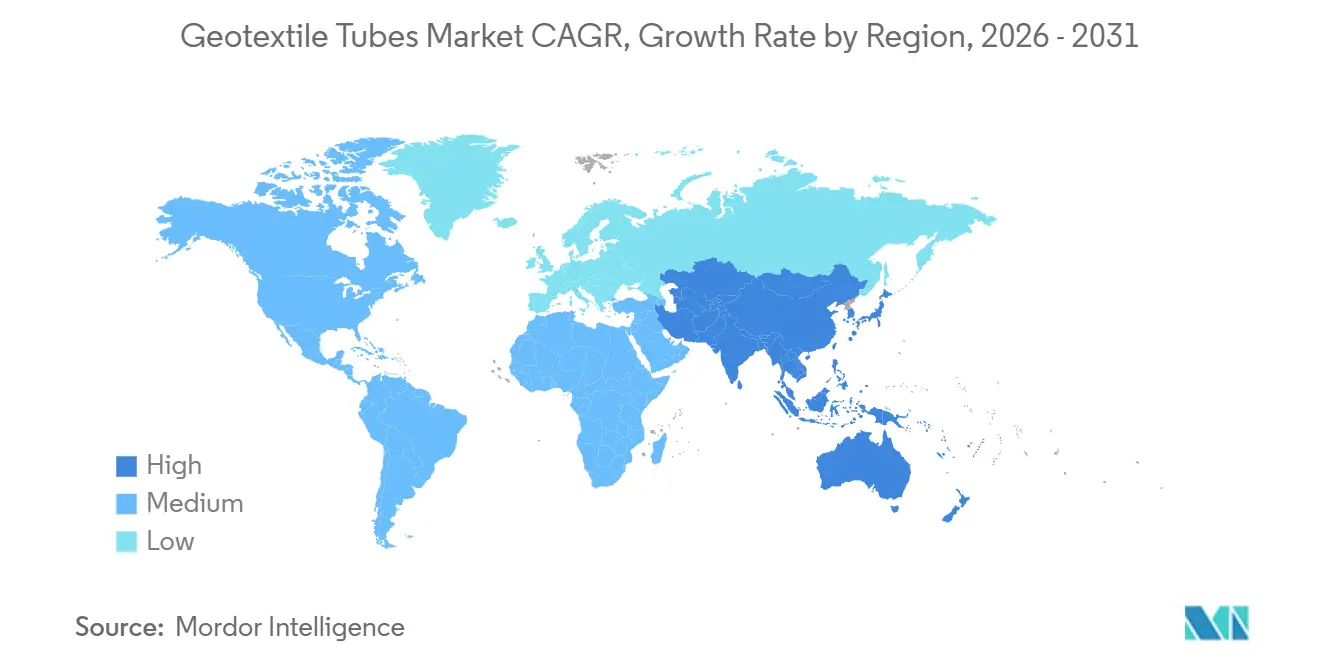
APAC Geotextile Tubes Market
Asia-Pacific held 38.63% of the geotextile tubes market share in 2025 and is forecast to grow at a 10.15% CAGR through 2031. The region combines low-elevation coastal exposure, active land reclamation, and public geosynthetics programs. The Asian Development Bank’s USD 42 million Maharashtra loan shows the role of multilateral financing in coastal resilience. In Malaysia, GEOTUBE Marine units formed a perimeter dike at Seri Tanjung Pinang Phase 2B and limited sediment plumes. A 2025 EuroGeo8 study found retained tensile strength of 18% to 80% in 6-year-old Singapore marine samples, depending on UV exposure direction.
North America and Europe Geotextile Tubes Market
Demand in North America and Europe is supported by infrastructure renewal, environmental remediation, and regulated sludge management. The United Kingdom recorded GBP 28.9 billion (approximately USD 38.54 billion) in general government infrastructure investment in 2024. United States harbor maintenance creates recurring dewatering demand for dredged sediment. European CE marking, EN 13249, and Construction Products Regulation obligations increase the value of manufacturing control and design documentation.
South America and MEA Geotextile Tubes Market
South America, and the Middle-East and Africa are markets with distinctive demand drivers. Brazil’s contaminated-sediment experience following mining incidents is transferring to coastal and port applications. Saudi Arabia’s Vision 2030 coastal projects and South African mining needs support for offshore protection and tailings containment. Their growth depends on financing, engineering capability, and wider familiarity with geotextile tube design.

Competitive Landscape
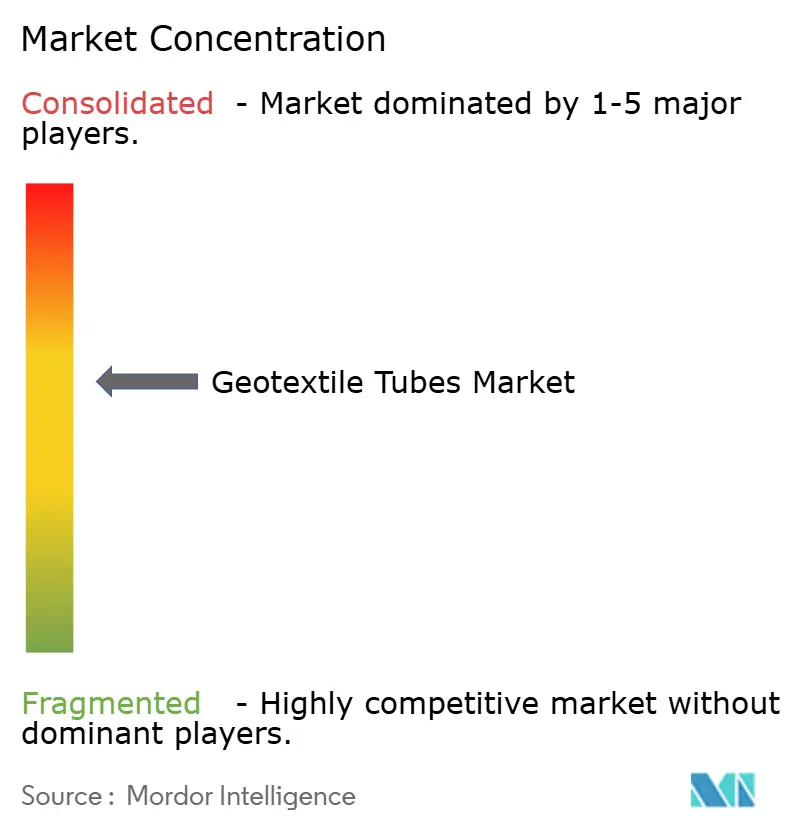
The geotextile tubes market is moderately concentrated, with the top five players including Solmax, HUESKER International, Officine Maccaferri Spa, Geofabrics Australasia Pty Ltd., and TECHFABINDIA. HUESKER International, Naue GmbH & Co. KG, Officine Maccaferri Spa, and Solmax serve coastal protection, dredged-material management, and land reclamation. HUESKER promoted SoilTain Tubes in March 2026 as an integrated system with a scour protection mat, anchor tubes, and UV- and abrasion-resistant fabric. Solmax demonstrated a similar system role in Malaysia, where GEOTUBE Marine provided containment and sediment-plume control in one reclamation project. These approaches make engineering support and application performance important competitive factors.
Asia-Pacific geotextile tubes market suppliers compete in standard civil infrastructure and agricultural work, where cost and delivery proximity influence awards. TECHFABINDIA and FlexiTuff Ventures International supply India’s domestic market with woven tube products. Ace Geosynthetics, Geofabrics Australasia, and Global Synthetics provide products suited to regional soil and marine conditions. India’s IS 17880:2022 requirement favors suppliers that can meet documented quality conditions. Local fabrication, shorter transport routes, and contractor relationships support regional producers in less complex applications.
Mining tailings containment is a developing field for the geotextile tubes market, where few suppliers hold entrenched positions. PPX Mining’s Peru testing program showed that woven tube systems can meet results relevant to permanent tailings management. Higher fill pressure and effluent-quality requirements create room for product differentiation. The competitive picture remains based on engineering capability, compliance documentation, local supply, and fabrics tailored to project conditions.
Geotextile Tubes Industry Leaders
Solmax
HUESKER International
Officine Maccaferri Spa
Geofabrics Australasia Pty Ltd.
TECHFABINDIA
- *Disclaimer: Major Players sorted in no particular order
Geotextile Tubes Market Companies Covered in this Report
- Ace Geosynthetics
- FlexiTuff Ventures International Ltd
- Flint Technical Geosolutions (FTG).
- Geofabrics Australasia Pty Ltd.
- HUESKER International
- Naue GmbH & Co. KG
- Officine Maccaferri Spa
- Solmax
- TECHFABINDIA
- Thrace Group

Recent Industry Developments in Geotextile Tubes Market
- June 2025: PPX Mining Corp. completed a geotextile tube testing program for tailings containment at its Callanquitas Mine in Peru, in collaboration with Universidad Nacional de Ingeniería (UNI). The results validated geotubes as a structurally and environmentally lower-risk alternative to conventional tailings dams.
- February 2025: In India, Kerala State Coastal Area Development Corporation completed the first phase of an offshore geotube breakwater project at Poonthura. The project demonstrates the adoption of sand-filled geotextile tubes for coastal protection, indicating the solution costs approximately one-tenth as much as conventional rock seawalls.


Global Geotextile Tubes Market Report Scope
Geotextile tubes are large, permeable fabric containers manufactured from high-strength geotextiles and filled with dredged material, sand, sludge, or other sediments for dewatering, containment, erosion control, and shoreline protection. They provide a cost-effective and environmentally efficient solution for hydraulic engineering, coastal protection, waste management, and infrastructure development projects.
The Geotextile Tubes Market is segmented by type, end-use industry, and geography. By type, the market is segmented into woven geotextile tubes and nonwoven geotextile tubes. By end-use industry, the market is segmented into marine and hydraulic, environmental engineering, agricultural engineering, construction, and other end-use industries (including wastewater treatment, mining and mineral processing, pulp and paper mills, and aquaculture). The report also covers the market size and forecasts for geotextile tubes in 16 countries across major regions. For each segment, the market sizing and forecasts have been done on the basis of value (USD).
| Woven Geotextile Tubes |
| Nonwoven Geotextile Tubes |
| Marine and Hydraulic |
| Environmental Engineering |
| Agricultural Engineering |
| Construction |
| Other End-Use Industries (including Wastewater Treatment, Mining and Mineral Processing, Pulp and Paper Mills, and Aquaculture) |
| Asia-Pacific | China |
| India | |
| Japan | |
| South Korea | |
| ASEAN Countries | |
| Rest of Asia-Pacific | |
| North America | United States |
| Canada | |
| Mexico | |
| Europe | Germany |
| United Kingdom | |
| France | |
| Italy | |
| NORDIC Countries | |
| Russia | |
| Rest of Europe | |
| South America | Brazil |
| Argentina | |
| Rest of South America | |
| Middle-East and Africa | Saudi Arabia |
| South Africa | |
| Rest of Middle-East and Africa |
| By Type | Woven Geotextile Tubes | |
| Nonwoven Geotextile Tubes | ||
| By End-Use Industry | Marine and Hydraulic | |
| Environmental Engineering | ||
| Agricultural Engineering | ||
| Construction | ||
| Other End-Use Industries (including Wastewater Treatment, Mining and Mineral Processing, Pulp and Paper Mills, and Aquaculture) | ||
| By Geography | Asia-Pacific | China |
| India | ||
| Japan | ||
| South Korea | ||
| ASEAN Countries | ||
| Rest of Asia-Pacific | ||
| North America | United States | |
| Canada | ||
| Mexico | ||
| Europe | Germany | |
| United Kingdom | ||
| France | ||
| Italy | ||
| NORDIC Countries | ||
| Russia | ||
| Rest of Europe | ||
| South America | Brazil | |
| Argentina | ||
| Rest of South America | ||
| Middle-East and Africa | Saudi Arabia | |
| South Africa | ||
| Rest of Middle-East and Africa | ||


Key Questions Answered in the Report
What is the size of the geotextile tubes market?
The Geotextile Tubes Market size is expected to grow from USD 0.95 billion in 2025 to USD 1.04 billion in 2026 and is forecast to reach USD 1.61 billion by 2031 at 9.15% CAGR over 2026-2031.
Which type leads demand for geotextile tubes?
Woven geotextile tubes led with a 68.45% share in 2025 and are forecast to expand at a 10.61% CAGR through 2031.
Which end-use industry has the largest demand base?
Marine and hydraulic held a 41.71% share in 2025 and are forecast to grow at a 9.89% CAGR through 2031. They cover erosion control, ports, breakwaters, and sediment management.
Which region leads demand for geotextile tubes?
Asia-Pacific held a 38.63% share in 2025 and is forecast to grow at a 10.15% CAGR through 2031. Reclamation and coastal resilience programs support the regional outlook.
Page last updated on:


 Your data is secure and never sold or shared.


