
Geotextile Bags and Containers Market Size and Share
Market Overview
| Study Period | 2021 - 2031 |
|---|---|
| Market Size (2026) | USD 1.20 Billion |
| Market Size (2031) | USD 1.76 Billion |
| Growth Rate (2026 - 2031) | 7.94 % |
| Fastest Growing Market | Asia-Pacific |
| Largest Market | Asia-Pacific |
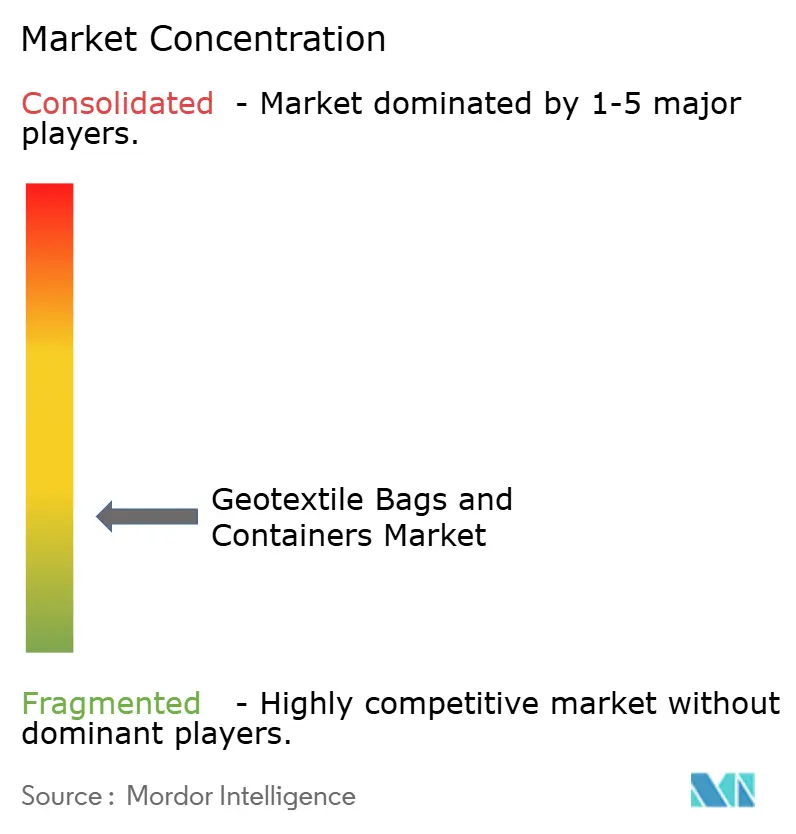
| Market Concentration | Low |
Major Players *Disclaimer: Major Players sorted in no particular order Image © Mordor Intelligence. Reuse requires attribution under CC BY 4.0. | |
Geotextile Bags and Containers Market Analysis by Mordor Intelligence
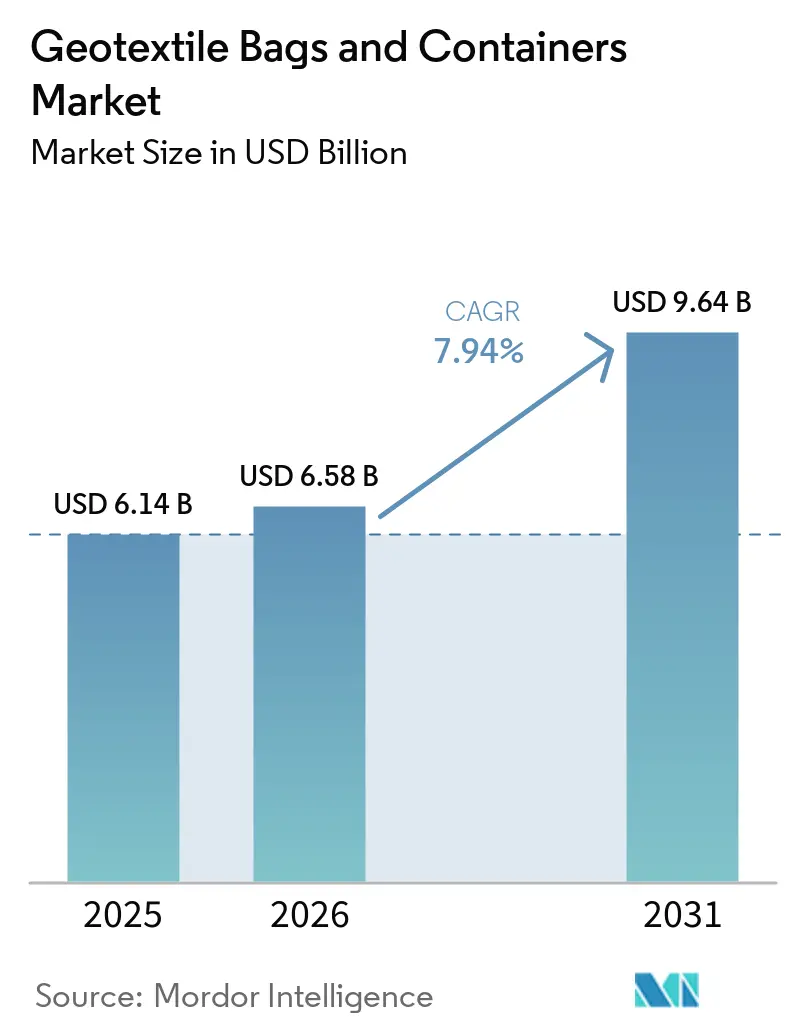
The Geotextile Bags And Containers Market size is projected to be USD 1.12 billion in 2025, USD 1.20 billion in 2026, and reach USD 1.76 billion by 2031, at a CAGR of 7.94% from 2026 to 2031. The geotextile bags and containers market is supported by coastal infrastructure programs, port dredging, and municipal wastewater upgrades. Public agencies are shifting from emergency repairs toward long-term hydraulic protection systems, which broadens the role of these products in procurement plans. The use of locally available sand, silt, and sludge reduces reliance on quarried stone and lowers transport requirements at project sites. This advantage is most relevant where erosion control, dredging, and flood protection are funded as public works. Competitive conditions remain mixed, as engineering-grade suppliers serve specification-led projects while regional converters compete on cost for standard products.
Key Report Takeaways
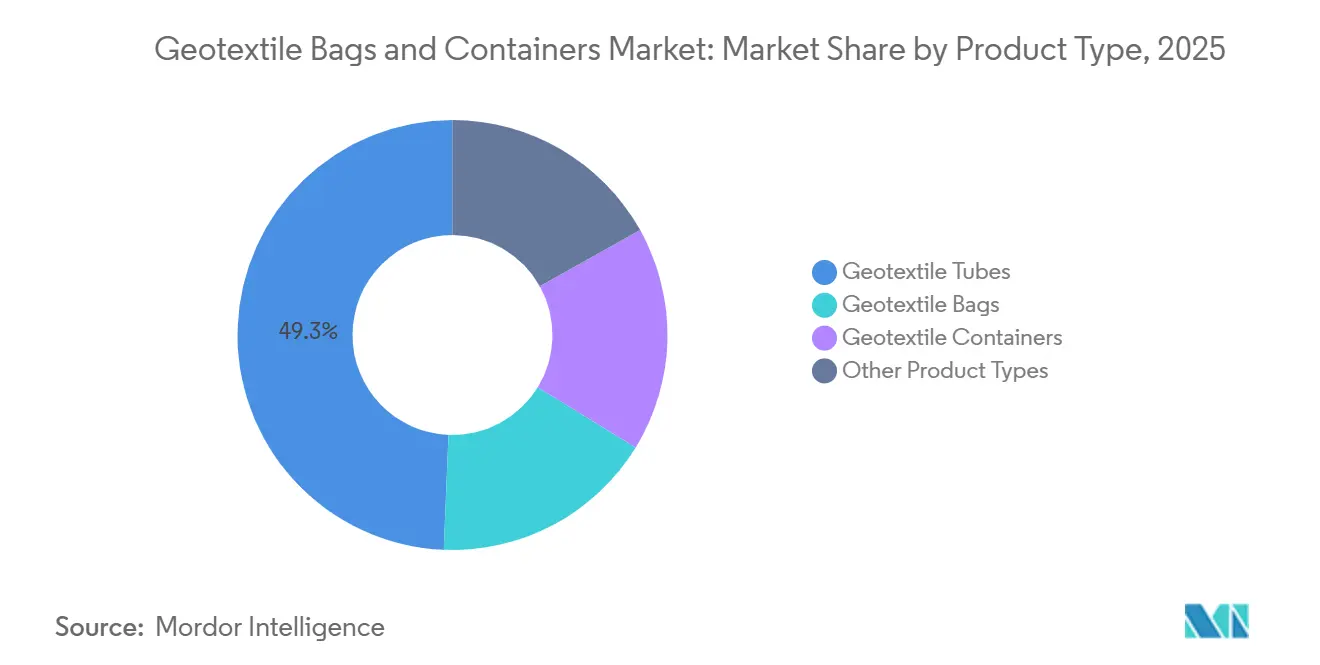
- By product type, geotextile tubes held 49.34% of the Geotextile bags and containers market share in 2025 and are forecast to grow at a 9.15% CAGR through 2031.
- By material, polypropylene held 52.83% of segment revenue in 2025, while polyester is forecast to grow at an 8.57% CAGR through 2031.
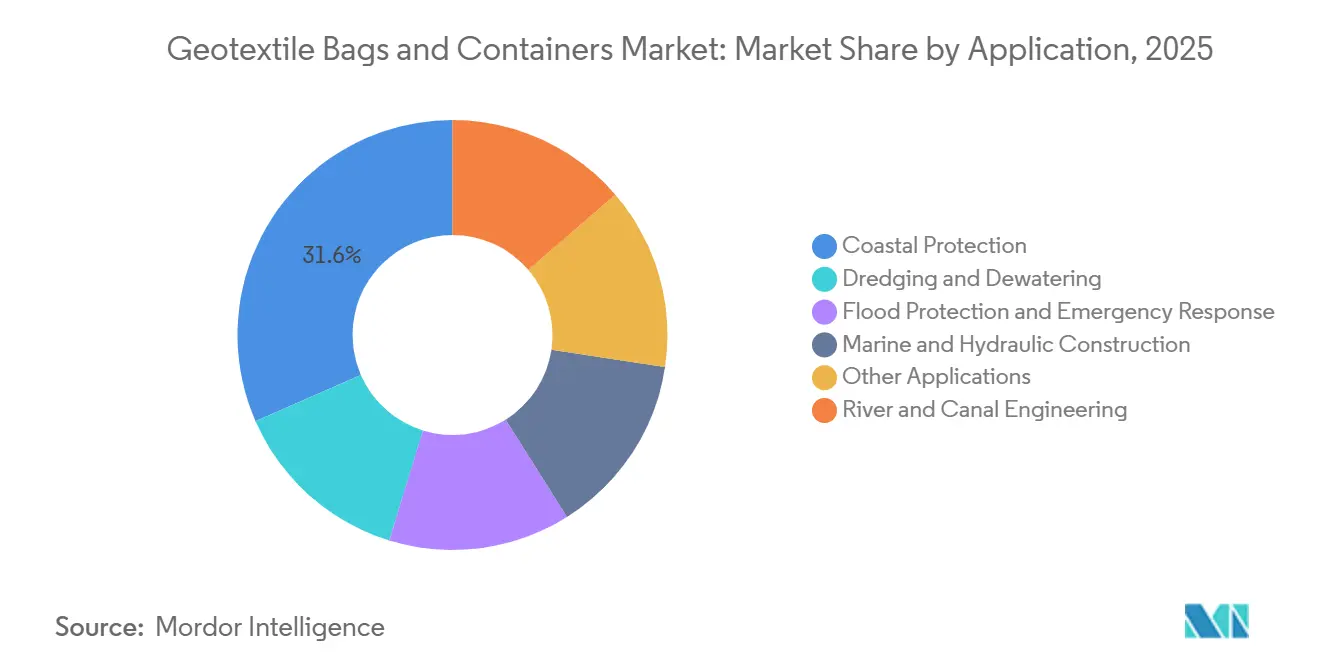
- By application, coastal protection accounted for 31.56% of the Geotextile bags and containers market size in 2025, while flood protection and emergency response are projected to expand at a 9.12% CAGR through 2031.
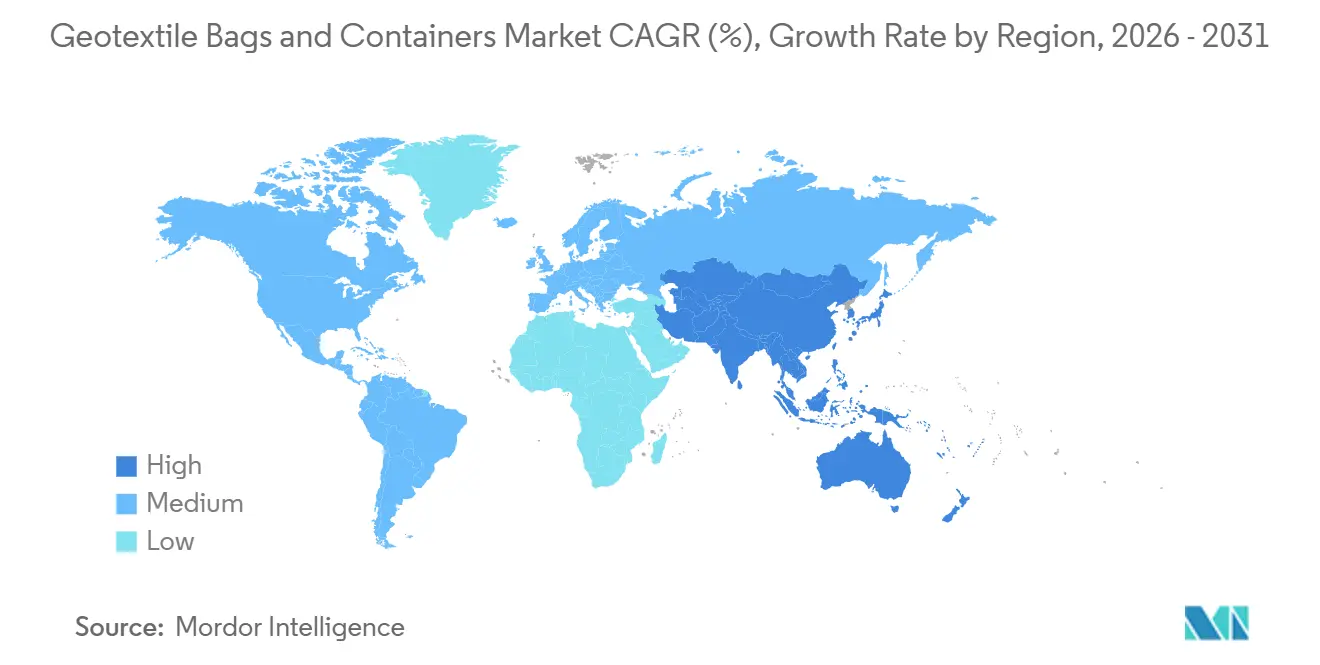
- By geography, Asia-Pacific held 36.10% of revenue in 2025 and is forecast to grow at an 8.73% CAGR through 2031.
Note: Market size and forecast figures in this report are generated using Mordor Intelligence’s proprietary estimation framework, updated with the latest available data and insights as of January 2026.
Market Trends and Insights
Drivers Impact Analysis of Geotextile Bags and Containers Market*
| Drivers | (~) % Impact on CAGR Forecast | Geographic Relevance | Impact Timeline |
|---|---|---|---|
| Climate-Resilient Coastal and Flood Protection Investment | +2.1% | Global, with highest intensity in APAC and Sub-Saharan Africa | Medium term (2–4 years) |
| Expansion of Dredging and Sludge Dewatering Infrastructure | +1.7% | APAC core, spill-over to MEA and North America | Medium term (2-4 years) |
| Government Regulation for Sediment and Wastewater Management | +1.1% | North America, EU, China, India | Short term (≤ 2 years) |
| Local-Fill Construction and Lower Logistics Requirements | +0.7% | Emerging markets in South Asia, Southeast Asia, West Africa | Long term (≥ 4 years) |
| Reusable and Bio-Based Geotextile Solutions for Nature-Based Defense | +0.5% | EU, Japan, Australia | Long term (≥ 4 years) |
| Source: Mordor Intelligence | |||
Climate-Resilient Coastal and Flood Protection Investment
Coastal and flood protection spending is a central source of demand for the geotextile bags and containers market. In March 2026, the World Bank approved the USD 240 million West Africa Coastal Areas Management Program (WACA+) for Benin and Mauritania, which includes shoreline stabilization, sand containers, and dune-belt reinforcement. This funding links climate-resilience commitments to the procurement of containment and shoreline protection systems. World Bank financing for Karnataka and Tamil Nadu also supports shoreline management programs in India[1]World Bank, “India Coastal Protection Program, Karnataka and Tamil Nadu IBRD Loans,” World Bank, documents1.worldbank.org. Such programs create longer procurement cycles that favor suppliers capable of providing engineered systems and technical support. The geotextile bags and containers market benefits when public authorities convert coastal risk assessments into funded construction plans.
Expansion of Dredging and Sludge Dewatering Infrastructure
Port expansion and waterway maintenance provide a steady project base for the geotextile bags and containers market. Geotextile containment systems separate sediment and water during dredging, making them relevant to both marine construction and wastewater handling. Solmax reported that its GEOTUBE system was used in the Marmara Sea restoration project, which involved nearly 3,500 units and 5 million m² of mixed-contaminant dredged sludge. The International Geosynthetics Society documented the use of GEOTUBE dewatering containers in the New Jersey Department of Transportation's Wildwood channel restoration, which received a 2025 award for technology and innovation. These examples indicate that dewatering specifications are being applied in public projects as well as environmental restoration work, broadening the geotextile bags and containers market beyond conventional shoreline applications.
Government Regulation for Sediment and Wastewater Management
Regulations governing sediment handling and coastal modification can increase demand for containment systems in the geotextile bags and containers market. The EU Nature Restoration Regulation entered into force in 2024 and requires member states to prepare National Restoration Plans. The European Commission's work on climate resilience also incorporates sea-level rise into coastal management planning. These requirements support projects that combine engineered shoreline protection with restoration measures. In Europe, geotextile sand containers can be used within dune and dike systems where site conditions call for hybrid coastal protection. Regulatory requirements can also make documented product performance and installation guidance more important during tender review.
Local-Fill Construction and Lower Logistics Requirements
Geotextile bags and containers can be filled with locally dredged sand, silt, or stabilized soil, which is a practical advantage for the geotextile bags and containers market. This approach reduces the need to transport quarried rock to remote shorelines and riverbanks. The value of local fill is greatest in locations where hard armor materials are scarce, costly, or difficult to move during emergency work. It also supports faster deployment for embankment repairs and flood barriers where fill material is already available near the site. The design still requires suitable material properties, hydraulic planning, and installation control. As local fabricators develop production capacity, this advantage supports lower-cost public procurement in South Asia, Southeast Asia, and West Africa.
Restraints Impact Analysis of Geotextile Bags and Containers Market*
| Restraints | (~) % Impact on CAGR Forecast | Geographic Relevance | Impact Timeline |
|---|---|---|---|
| Synthetic Polymer Price Volatility | -1.0% | Global, with the highest sensitivity in Asia-Pacific and North America | Short term (≤ 2 years) |
| Project-Specific Design, Installation, and Permitting Complexity | -0.6% | Emerging markets, Sub-Saharan Africa, South Asia, Southeast Asia | Medium term (2-4 years) |
| Limited Contractor Familiarity with Performance-Based Specifications | -0.4% | Sub-Saharan Africa, South Asia, South America | Long term (≥ 4 years) |
| Source: Mordor Intelligence | |||
Synthetic Polymer Price Volatility
Polypropylene and polyester products in the geotextile bags and containers market remain exposed to oil-linked feedstock price movements. The U.S. Energy Information Administration reported that oil price volatility remained elevated due to geopolitical developments and supply management decisions. Changes in polymer prices can affect fixed-price bids for multi-year public projects. Manufacturers with limited hedging capacity may find it difficult to protect margins when raw materials account for a large share of product cost. Price uncertainty can also delay the adoption of bio-based materials when petroleum-based inputs become less expensive. This challenge also affects regional converters that compete primarily on price in standard product categories.
Project-Specific Design, Installation, and Permitting Complexity
Geotextile bags and containers require hydraulic and geotechnical designs suited to local wave conditions, fill pressure, soil capacity, and tidal range. This requirement can slow growth in the geotextile bags and containers market where engineering capacity or regulatory familiarity is limited. A 2025 New South Wales planning document required a dedicated removal plan for a 40-meter geobag coastal protection extension, including removal within 5 years. Environmental reviews, permits, and customized specifications can extend project lead times. Suppliers that combine products with permitting guidance and design support can reduce some of this burden. Limited familiarity with performance-based specifications remains a longer-term constraint in Sub-Saharan Africa, South Asia, and South America.
*Our forecasts treat driver/restraint impacts as directional, not additive. The impact forecasts reflect baseline growth, mix effects, and variable interactions.
Geotextile Bags and Containers Market Segment Analysis
By Product Type:
Tubes Support Coastal and Dewatering ApplicationsGeotextile tubes accounted for 49.34% of the segment's revenue share in 2025 and are forecast to expand at a 9.15% CAGR through 2031. Their continuous-fill geometry enables the formation of large containment berms using hydraulically placed dredged slurry, making them suitable for long coastal revetments where locally sourced fill is available. Solmax used GEOTUBE units in the Marmara Sea restoration project to dewater and contain mixed-contaminant sludge, illustrating the product's use in technically demanding environmental work. The geotextile bags and containers market also uses tubes in coastal protection, channel restoration, and industrial dewatering.
Geotextile bags hold the next position because crews can place and stack individual units with limited equipment during smaller coastal repairs and emergency work. Containers serve larger hydraulic projects, including port expansion and scour protection, where crane or marine placement is practical. Other custom-formed structures are used where irregular coastal geometries require a different layout. Tubes also have an application in mine tailings dewatering, where retaining fine solids and recovering filtrate can be valuable. ZebraTube offers a composite-lined product designed for ultrafine dewatering without the addition of flocculant. NAUE provides design support for geotextile sand containers, helping engineers select dimensions for site-specific applications. These design tools can reduce over-engineering and support the use of engineered systems in the geotextile bags and containers market.



By Material:
Polypropylene Leads While Polyester Serves Demanding SpecificationsPolypropylene accounted for 52.83% of the segment's revenue share in 2025, driven by its widespread use in standard-grade coastal protection, river engineering, and emergency response applications. Its cost position has made it a common material for large government tenders in South Asia, Southeast Asia, and Sub-Saharan Africa. Polypropylene is suited to applications where chemical inertness is a primary requirement and tensile demands are less stringent. Polyester is forecast to grow at an 8.57% CAGR through 2031, the fastest rate among material types, reflecting demand for lower creep and sustained tensile strength in applications exposed to long-term hydraulic loading. As a result, the geotextile bags and containers market is expected to continue using polypropylene for standard projects, while polyester gains importance in performance-sensitive applications.
Polyethylene has a more selective role in projects that require resistance to industrial effluents, such as mine tailings dewatering and contaminated sediment management. Polyamide and hybrid formulations remain smaller categories but can serve specialty industrial uses. Fraunhofer IAP's GREEN project, published in July 2026, is developing recycled materials for nonwovens, fibers, and membranes used in geotextiles. Recycled-content products are still at a development stage as processing quality and cost remain important considerations. Circular procurement requirements can create demand for products with documented recycled content in Europe, Australia, and North America. Suppliers that establish certified supply chains may be better positioned to meet these requirements in the geotextile bags and containers market.
By Application:
Coastal Protection Leads by Share, While Flood Response Records Faster GrowthCoastal protection accounted for 31.56% of the geotextile bags and containers market in 2025, making it the largest application. It is used across coastlines that require erosion control, shoreline stabilization, and long-duration public works. Large coastal programs can give manufacturers clearer production and supply planning because project pipelines often span several years. River and canal engineering is also significant, with inland waterways requiring erosion control and bank stabilization. Dredging and dewatering maintain demand through port expansion and sediment management. Jan De Nul completed a beach widening project in Itapoá, Brazil, between October 2025 and January 2026, placing 4 million cubic meters of sand.
Flood protection and emergency response are forecast to grow at a 9.12% CAGR through 2031, the fastest application growth rate in the geotextile bags and containers market. Public authorities are increasingly integrating geo-bag barriers into ongoing flood-risk programs rather than relying solely on post-disaster stock. This shift makes demand less dependent on individual emergency events and more linked to recurring public procurement. The need for rapid deployment favors suppliers that maintain approved product ranges and dependable logistics. Marine and hydraulic construction also uses containment systems in seawall reinforcement and offshore breakwater foundations. Application demand is consequently spread across shoreline work, waterways, dredging, flood control, and major hydraulic infrastructure.
Geography Analysis
APAC Geotextile Bags and Containers Market
Asia-Pacific accounted for 36.10% of revenue in 2025 and is projected to grow at an 8.73% CAGR through 2031, making it the largest and fastest-growing region in the geotextile bags and containers market. China's coastal and waterway programs support demand for erosion control and shoreline systems. India's road, coastal, and flood-control requirements create demand across multiple public infrastructure applications. The World Bank's financing for shoreline management in Karnataka and Tamil Nadu supports a longer pipeline for coastal protection work. Bangladesh also has a recurring demand for embankment protection in soft-soil delta areas.
North America Geotextile Bags and Containers Market
North America is the second-largest regional market. Coastal barriers, channel dredging, and levee reinforcement drive demand for separators, containment bags, and tube systems. Manufacturers are responding by investing in local production. Officine Maccaferri inaugurated a North American manufacturing facility in Fort Lawn, South Carolina, in June 2026, producing woven and nonwoven geotextiles, drainage geocomposites, and geogrids. Canada and Mexico contribute through port maintenance and river flood-control projects, supporting demand across coastal and inland applications.
EMEA and South America Geotextile Bags and Containers Market
Europe is shaped by restoration and climate-resilience policy, while South America has a growing base in Brazil's dredge-and-fill coastal projects. The EU Nature Restoration Regulation requires National Restoration Plans that support coastal measures addressing ecosystem restoration and sea-level risks[2]European Union, “Regulation (EU) 2024/1991 on Nature Restoration,” EUR-Lex, eur-lex.europa.eu. The DuneFront project is testing dune-dike hybrid nature-based solutions at 12 vulnerable European coastal sites. The Middle-East and Africa offer longer-term potential through port, shoreline, and flood infrastructure development. The West Africa Coastal Areas Management Program (WACA+) represents a near-term example of funding for coastal resilience in West Africa. Regional demand varies, but the geotextile bags and containers market benefits where public programs combine coastal protection with dredging and flood management.

Competitive Landscape
The geotextile bags and containers market is fragmented. Solmax, HUESKER, Naue, and Officine Maccaferri compete in performance-specified engineering projects, while regional manufacturers in India, South Africa, and Southeast Asia compete more actively in standard products where price is a key decision factor. This structure puts pressure on margins in standard-grade products while preserving specialized positions for engineered systems.
Solmax has integrated TenCate Geosynthetics and Propex into its portfolio and is developing a European center near Les Mureaux, scheduled to begin operations by the end of 2026. This investment expands its capacity to serve a broad range of geosynthetic applications. HUESKER acquired Italian drainage specialist Sineco International in April 2025, adding thermoplastic monofilament 3D-structure technology to its product offering. The company also expanded its Dülmen production facility to meet demand for specialty products. Naue expanded its GreenLine range to 5 product groups by 2025, including bio-based and renewable-material formats for sand containers and coastal protection. These developments indicate that suppliers have invested in capacity, drainage technology, and lower-impact materials. ZebraTube focuses on ultrafine dewatering, an application in which its composite-lined product is designed to retain fine tailings without the use of flocculants. Such product specialization supports defensible positions in the geotextile bags and containers market.
Local suppliers retain an advantage where domestic tender knowledge and supply-chain access matter more than product differentiation. Kaytech Engineered Fabrics and TECHFABINDIA are examples of companies positioned near public procurement activity in South Africa and India, respectively. Digital design support and monitoring tools are becoming an additional means of differentiation, as they can shorten specification cycles and support customer retention. The geotextile bags and containers market also presents opportunities in recycled-content products, flood barrier kits, and difficult dewatering applications. Competition is therefore split between global firms with engineering capabilities and local manufacturers with cost and tender advantages.
Geotextile Bags and Containers Industry Leaders
Solmax
HUESKER International
Naue GmbH & Co. KG
Officine Maccaferri Spa
Tensar International Corporation
- *Disclaimer: Major Players sorted in no particular order
Geotextile Bags and Containers Market Companies Covered in this Report
- ACE Geosynthetics
- FlexiTuff Ventures International Limited
- Geofabrics Australasia Pty Ltd
- Global Synthetics Pty Ltd
- HUESKER International
- Kaytech Engineered Fabrics
- Naue GmbH & Co. KG
- Officine Maccaferri Spa
- SKAPS Industries
- Solmax
- TECHFABINDIA
- Tensar International Corporation
- Thrace Group
- Titan Environmental
- ZebraTube

Recent Industry Developments in Geotextile Bags and Containers Market
- July 2026: Fraunhofer IAP published the GREEN project, targeting the development of sustainable geotextiles from recycled polymers for nonwovens, fibers, and membranes with industrial-grade processability. The project seeks collaboration with geotextile manufacturers for pilot projects and technology transfer.
- June 2026: Officine Maccaferri inaugurated a new North American production facility at Fort Lawn, South Carolina. The facility, one of the largest within the Group's global operations, integrates domestic manufacturing of woven and nonwoven geotextiles, drainage geocomposites, and geogrids for the North American infrastructure market.


Global Geotextile Bags and Containers Market Report Scope
Permeable synthetic fabric systems are used for erosion control, coastal protection, dewatering, and gardening. Primary product types include geotextile sand containers, large geotubes, and horticultural grow bags.
The geotextile bags and containers market is segmented by product type, material, application, and geography. By product type, the market is segmented into geotextile bags, geotextile containers, geotextile tubes, and other product types. By material, the market is segmented into polypropylene, polyester, polyethylene, and other materials. By application, the market is segmented into coastal protection, river and canal engineering, dredging and dewatering, flood protection and emergency response, marine and hydraulic construction, and other applications. The report also covers market size and forecasts for geotextile bags and containers across 16 countries in major regions. The market sizes and forecasts are provided in terms of value (USD).
| Geotextile Bags |
| Geotextile Containers |
| Geotextile Tubes |
| Other Product Types |
| Polypropylene |
| Polyester |
| Polyethylene |
| Other Materials |
| Coastal Protection |
| River and Canal Engineering |
| Dredging and Dewatering |
| Flood Protection and Emergency Response |
| Marine and Hydraulic Construction |
| Other Applications |
| Asia-Pacific | China |
| India | |
| Japan | |
| South Korea | |
| ASEAN Countries | |
| Rest of Asia-Pacific | |
| North America | United States |
| Canada | |
| Mexico | |
| Europe | Germany |
| United Kingdom | |
| France | |
| Italy | |
| NORDIC Countries | |
| Russia | |
| Rest of Europe | |
| South America | Brazil |
| Argentina | |
| Rest of South America | |
| Middle-East and Africa | Saudi Arabia |
| South Africa | |
| Rest of Middle-East and Africa |
| By Product Type | Geotextile Bags | |
| Geotextile Containers | ||
| Geotextile Tubes | ||
| Other Product Types | ||
| By Material | Polypropylene | |
| Polyester | ||
| Polyethylene | ||
| Other Materials | ||
| By Application | Coastal Protection | |
| River and Canal Engineering | ||
| Dredging and Dewatering | ||
| Flood Protection and Emergency Response | ||
| Marine and Hydraulic Construction | ||
| Other Applications | ||
| By Geography | Asia-Pacific | China |
| India | ||
| Japan | ||
| South Korea | ||
| ASEAN Countries | ||
| Rest of Asia-Pacific | ||
| North America | United States | |
| Canada | ||
| Mexico | ||
| Europe | Germany | |
| United Kingdom | ||
| France | ||
| Italy | ||
| NORDIC Countries | ||
| Russia | ||
| Rest of Europe | ||
| South America | Brazil | |
| Argentina | ||
| Rest of South America | ||
| Middle-East and Africa | Saudi Arabia | |
| South Africa | ||
| Rest of Middle-East and Africa | ||


Key Questions Answered in the Report
What is current market size of Geotextile Bags and Containers Market?
The Geotextile Bags And Containers Market size is projected to be USD 1.12 billion in 2025, USD 1.20 billion in 2026, and reach USD 1.76 billion by 2031, at a CAGR of 7.94% from 2026 to 2031.
Which product type has the strongest growth outlook?
Geotextile tubes are expected to grow at a 9.15% CAGR through 2031. They held a 49.34% revenue share in 2025 and are used for coastal containment and dewatering work.
Why are geotextile tubes used in coastal projects?
They can be filled with locally dredged material to form containment berms. This can reduce dependence on imported rock and support coastal stabilization, sediment handling, and dewatering.
Which material leads demand?
Polypropylene led with 52.83% share in 2025 because it is used in standard coastal, river, and emergency applications. Polyester is expected to expand at an 8.57% CAGR through 2031.
Page last updated on:


 Your data is secure and never sold or shared.


