
Geocomposites Market Size and Share
Market Overview
| Study Period | 2021 - 2031 |
|---|---|
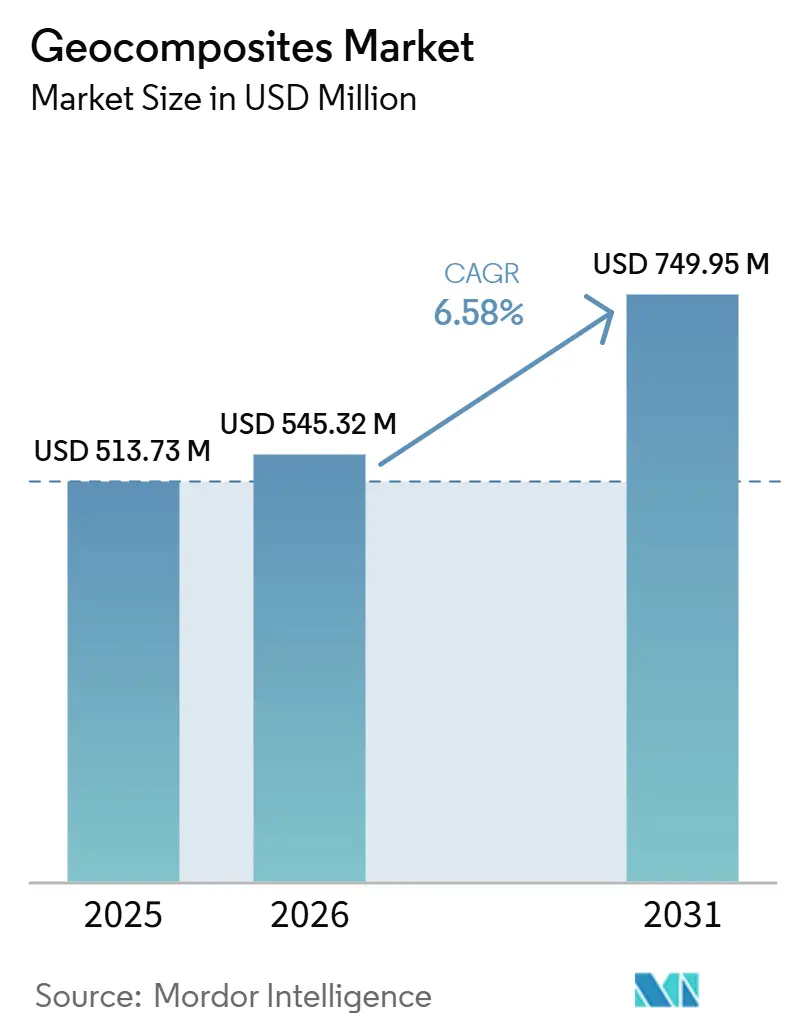
| Market Size (2026) | USD 545.32 Million |
| Market Size (2031) | USD 749.95 Million |
| Growth Rate (2026 - 2031) | 6.58 % |
| Fastest Growing Market | Asia-Pacific |
| Largest Market | Asia-Pacific |
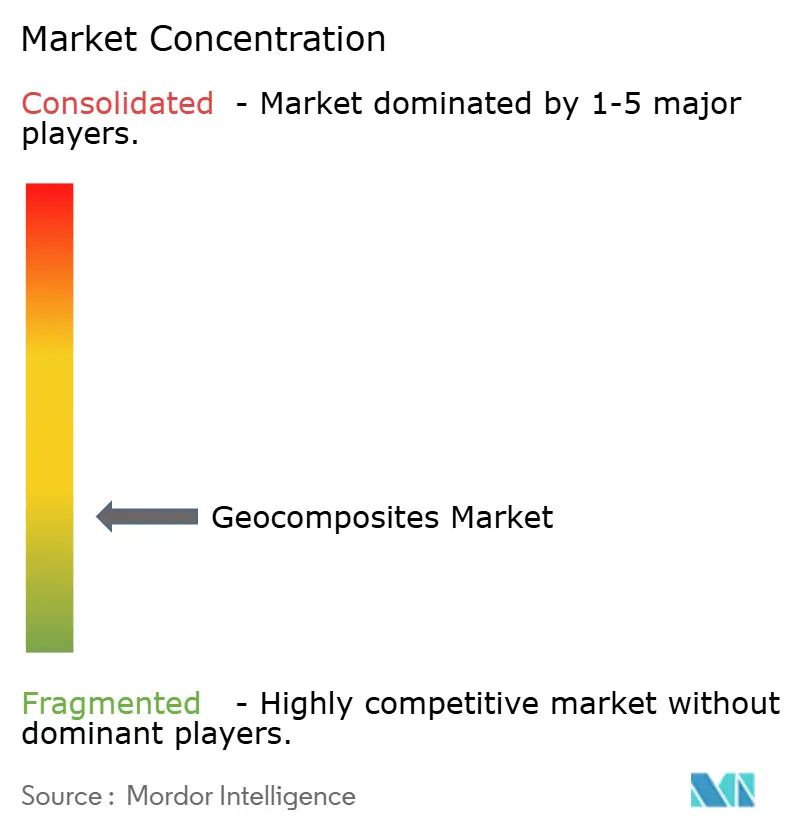
| Market Concentration | Low |
Major Players *Disclaimer: Major Players sorted in no particular order Image © Mordor Intelligence. Reuse requires attribution under CC BY 4.0. | |
Geocomposites Market Analysis by Mordor Intelligence
The Geocomposites Market was valued at USD 513.73 million in 2025 and is estimated to grow from USD 545.32 million in 2026 to reach USD 749.95 million by 2031, at a CAGR of 6.58% during the forecast period (2026–2031). The geocomposites market is benefiting from infrastructure programs that specify drainage, separation, reinforcement, and containment materials in road and rail projects. Environmental requirements are also making engineered containment systems a necessary part of landfill, wastewater, and mining projects rather than an optional design choice. Integrated products can reduce the material layers and quality-control steps required on-site, which supports their use in complex projects. Producers with polymer conversion capacity, engineering support, and verified documentation have an advantage when buyers require consistent performance and compliance records. Price movements in polymer feedstocks, fragmented testing systems, and growing environmental scrutiny remain important constraints on the geocomposites market.
Key Report Takeaways
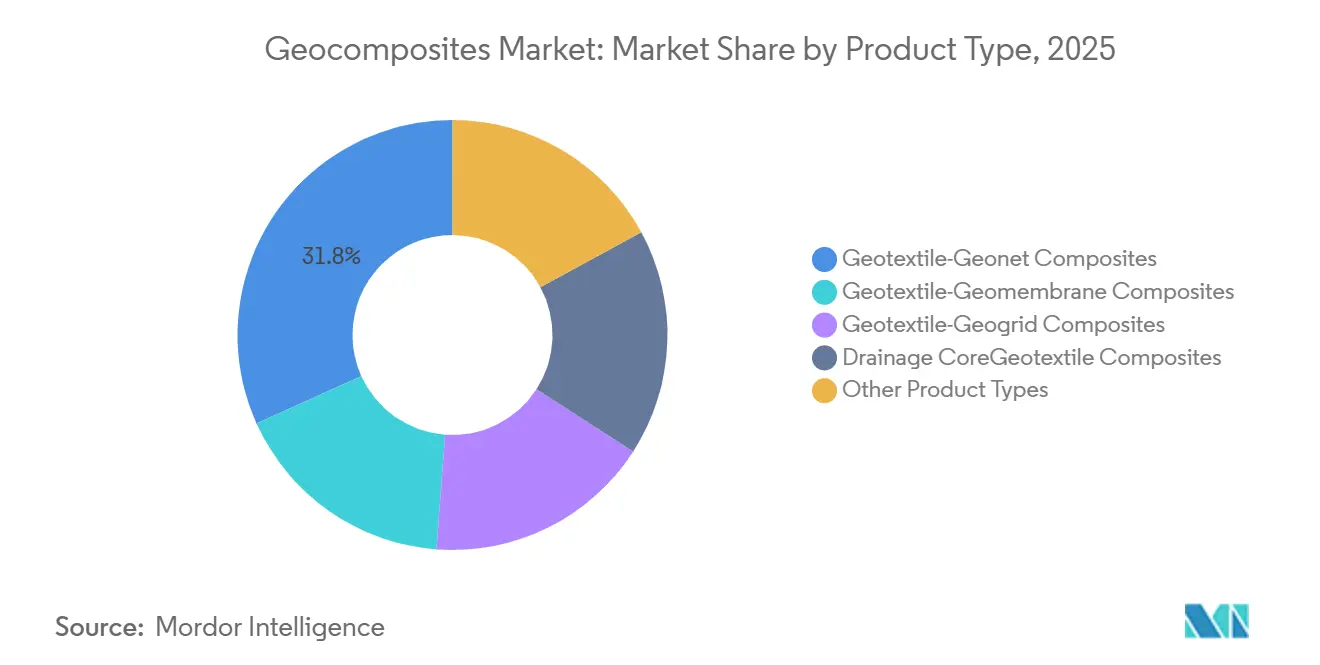
- By product type, geotextile-geonet composites held 31.75% of the geocomposites market share in 2025, while geotextile-geomembrane composites are projected to expand at a 7.43% CAGR through 2031.
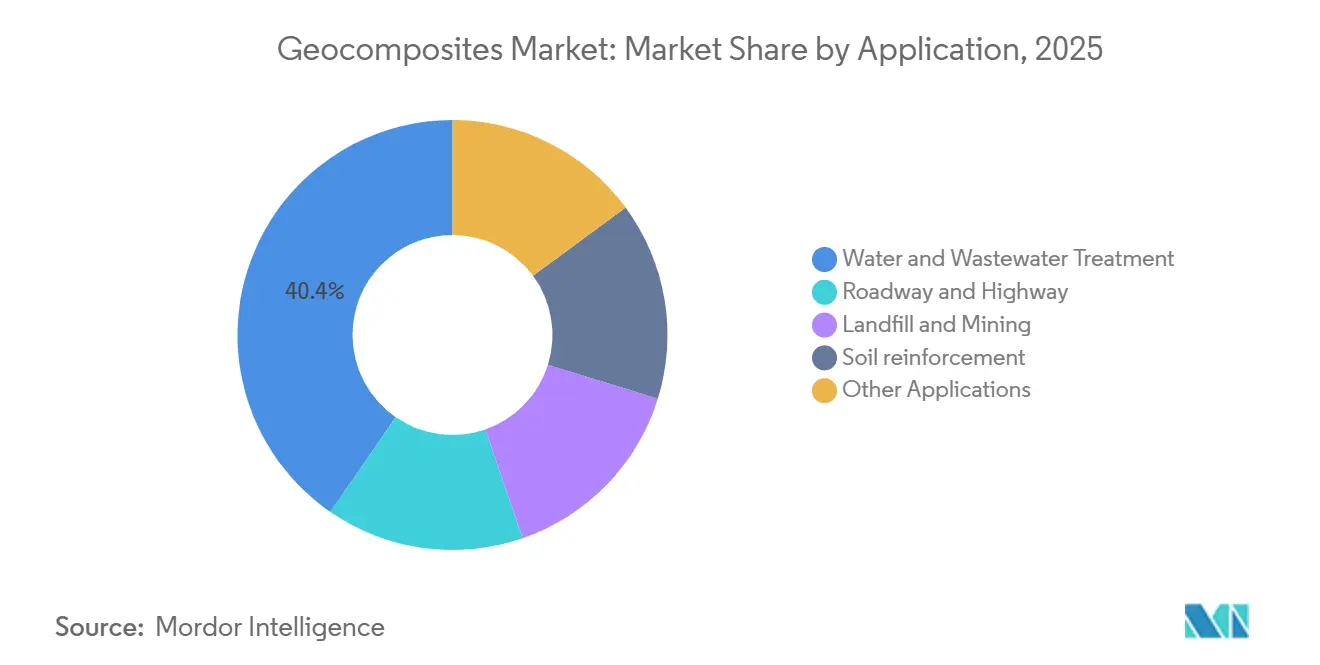
- By application, roadway and highway accounted for 40.38% of the geocomposites market share in 2025, while water and wastewater treatment is projected to grow at a 7.81% CAGR through 2031.
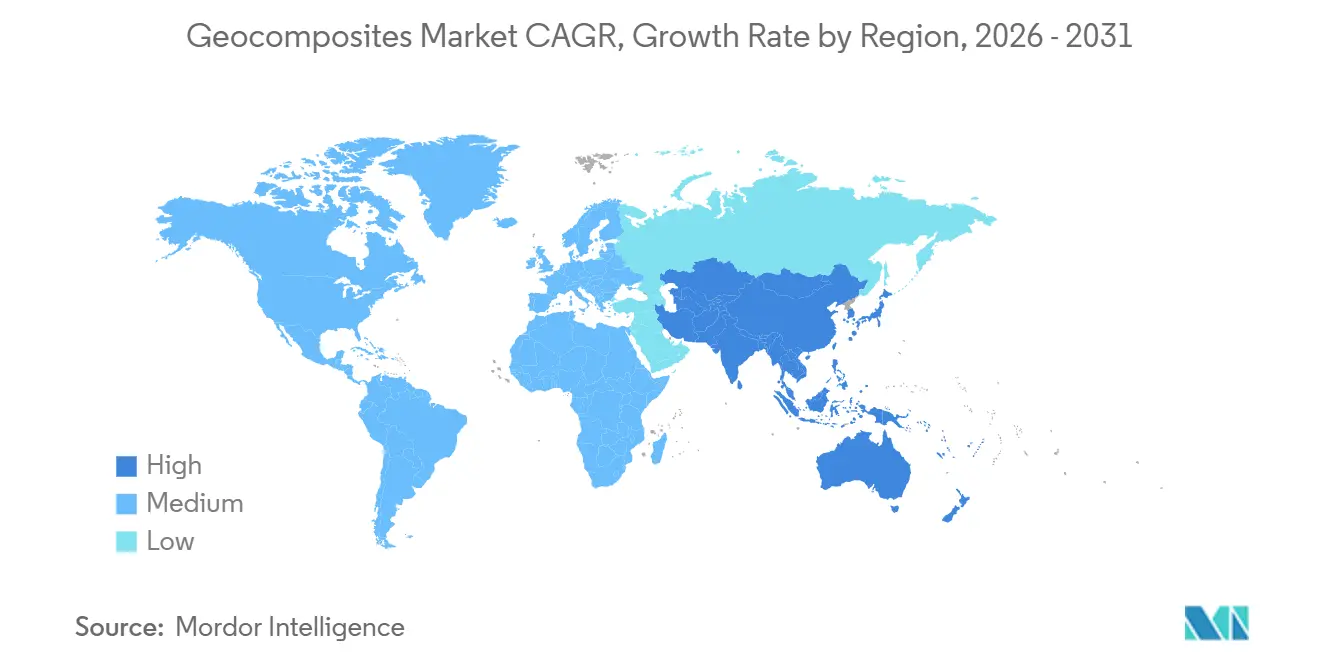
- By geography, Asia-Pacific accounted for 41.03% of the geocomposites market share in 2025 and is forecast to expand at a 7.77% CAGR through 2031.
Note: Market size and forecast figures in this report are generated using Mordor Intelligence’s proprietary estimation framework, updated with the latest available data and insights as of January 2026.
Market Trends and Insights
Drivers Impact Analysis of Geocomposites Market*
| Driver | (~) % Impact on CAGR Forecast | Geographic Relevance | Impact Timeline |
|---|---|---|---|
| Infrastructure Modernization and Road-Railway Investment | +1.5% | Global; primary concentration in APAC and Middle-East | Short term (≤ 2 years) |
| Mandatory Wastewater, Landfill, and Containment Infrastructure | +1.2% | North America, EU, and expanding APAC mandate landscape | Medium term (2–4 years) |
| Mining Tailings, Heap-Leach, and Slope-Stabilization Demand | +0.7% | South America, Australia, and APAC mining corridors | Medium term (2–4 years) |
| Lifecycle-Cost Advantage Versus Conventional Drainage and Fill Systems | +0.6% | Global; most decisive in logistics-intensive APAC and MEA markets | Long term (≥ 4 years) |
| Embedded Monitoring and Smart Geocomposite Adoption | +0.4% | North America, EU, Japan, and South Korea | Long term (≥ 4 years) |
| Recycled and Bio-Based Geocomposite Specifications | +0.3% | EU, Australia, and East Asia (China dual-carbon corridor) | Medium term (2–4 years) |
| Source: Mordor Intelligence | |||
Infrastructure Modernization and Road-Railway Investment
Road and rail programs are creating predictable, high-volume procurement for the geocomposites market because drainage, filtration, separation, and reinforcement layers are increasingly included in project design standards. India’s road authorities and the Japan International Cooperation Agency issued guidance that requires agencies to evaluate geosynthetic integration for slope protection and embankment works during detailed project preparation, making material evaluation part of the formal project process. Bharatmala Pariyojana, which targets the development of more than 26,000 km of national highways, provides a multiyear demand base for geotextile-geonet and geotextile-geogrid composites across many individual packages rather than a single project cycle. China’s expressway and high-speed rail expansion similarly supports recurring demand, especially where revisions to national material specifications increase the need for documented performance. Rehabilitation is also important because aging roads on weak subgrades often need higher-specification overlays than new construction, raising product value in technically maturing markets.
Mandatory Wastewater, Landfill, and Containment Infrastructure
Environmental compliance is making containment infrastructure a core source of demand in the geocomposites market because owners must meet defined liner, drainage, and monitoring requirements. U.S. rules for municipal solid-waste facilities require composite liner systems, while hazardous-waste rules require double-composite liners and leak-detection systems in defined facilities[1]U.S. Environmental Protection Agency, “Solid Waste Disposal Facility Criteria,” eCFR, ecfr.gov. These requirements make demand less dependent on short-term construction activity because landfill upgrades, wastewater lagoon replacement, and remediation programs follow compliance schedules. Manufacturers that align certifications with applicable environmental rules can participate more easily in procurement where technical documentation is a precondition for supply and where material failure creates lasting liability.
Mining Tailings, Heap-Leach, and Slope-Stabilization Demand
Mining projects require drainage and containment materials that can operate under high compressive loads, acidic chemistry, and extended service periods without compromising liner performance. Multilinear drainage geocomposites with tubular cores have maintained transmissivity under compressive stress of up to 2.4 MPa and stable flow during 90-day testing at pH 1.4. These conditions explain why tailings storage facilities and heap-leach pads favor specification-grade products that maintain flow capacity under loads that can challenge planar alternatives. The International Council on Mining and Metals’ tailings standard is encouraging operators to improve tailings-management practices and strengthen the technical basis for storage-facility decisions[2]International Council on Mining and Metals, “Global Industry Standard on Tailings Management,” International Council on Mining and Metals, icmm.com. Failure liability and long environmental exposure encourage buyers to prioritize certified systems, concentrating value with suppliers that can provide technical design assistance, test evidence, and reliable construction-quality documentation.
Lifecycle-Cost Advantage Versus Conventional Drainage and Fill Systems
The economic case for drainage composites increasingly includes transport, installation, replacement, and environmental effects rather than material purchase price alone. A 2025 conference paper from Afitex-Texel reported cradle-to-site emissions of 2.0-3.5 kg CO2e per m² for drainage geocomposites, compared with 7.2 kg CO2e per m² for a gravel-and-geotextile separator system. The same work showed that lower transported weight and less aggregate handling are material parts of the comparison, particularly where quarry material must travel long distances to the project site. This advantage is relevant where aggregate is scarce, expensive to move, or subject to supply restrictions, including logistics-intensive infrastructure programs in the Asia-Pacific and the Middle-East. It can make the geocomposites market more resilient to short-term pricing changes because total installed cost, construction speed, and long-term maintenance remain important to infrastructure owners.
Restraints Impact Analysis of Geocomposites Market*
| Restraint | (~) % Impact on CAGR Forecast | Geographic Relevance | Impact Timeline |
|---|---|---|---|
| Synthetic Polymer and Resin Price Volatility | -0.7% | Global; most acute for non-integrated producers in APAC and MEA | Short term (≤ 2 years) |
| Fragmented Standards, Testing, and Contractor Qualification | -0.5% | Cross-regional; most disruptive in APAC, MEA, and South America | Medium term (2–4 years) |
| Microplastic, End-of-Life, and Long-Term Liability Scrutiny | -0.4% | EU and North America, with regulatory spillover to APAC | Long term (≥ 4 years) |
| Installation Skill Gaps and Design-Responsibility Risk | -0.3% | Emerging markets; particularly India and Sub-Saharan Africa | Medium term (2–4 years) |
| Source: Mordor Intelligence | |||
Synthetic Polymer and Resin Price Volatility
Polypropylene, polyester, and polyethylene feedstock movements create immediate margin pressure across the geocomposites market because polymer cost is embedded in almost every product configuration. Polypropylene prices rose during mid-2025 and later stabilized, while polyethylene followed a similar pattern, leading some suppliers to raise prices or add polymer-index escalation clauses to bids. Producers with captive polymer extrusion capacity can retain more control over material availability, conversion cost, and pricing during feedstock increases. Non-integrated fabricators must either absorb margin compression, seek contract revisions, or risk losing work when bid prices are adjusted. This difference supports further vertical integration among established producers and raises the entry barrier in premium product categories that need consistent resin quality and assured supply.
Fragmented Standards, Testing, and Contractor Qualification
Different test methods and qualification rules increase cost and delay market entry for suppliers serving multiple countries, even where products are designed for similar end uses. ASTM D7273 provides acceptance-testing guidance for geonets and geonet drainage geocomposites, while ISO work addresses the strength of internal structural junctions in geocomposites. National pathways can still require separate product evidence that is not interchangeable across borders, extending the approval process for manufacturers and contractors. India’s Quality Control Orders for geotextiles increased the emphasis on documented conformity in infrastructure supply chains. Limited formal training also shifts design responsibility back to manufacturers through restrictive specifications and contractual conditions, leaving owners in markets with limited installer depth dependent on a smaller qualified supplier group.
*Our forecasts treat driver/restraint impacts as directional, not additive. The impact forecasts reflect baseline growth, mix effects, and variable interactions.
Geocomposites Market Segment Analysis
By Product Type:
Geotextile-Geomembrane Composites Gain Ground in ContainmentGeotextile-geonet composites led with 31.75% of the geocomposites market size in 2025 because they support landfill leachate collection, subsurface road drainage, and foundation-wall drainage. Their biplanar and triplanar HDPE geonet cores provide flow channels at lower material weight than conventional aggregate systems, while commodity-grade civil-drainage versions face price pressure where products are easily substituted and offshore fabrication capacity is available. Geotextile-geomembrane composites are forecast to grow at a 7.43% CAGR from 2026 to 2031. They combine an impermeable barrier with a protective textile layer in wastewater lagoons, reservoir lining, and mining tailings works, reducing installation steps and simplifying construction quality assurance. This design is especially relevant where containment performance, leakage control, and reliable documentation are central to project approval.
Geotextile-geogrid composites support road subgrades, embankments, and retaining structures, so their demand follows road and rail investment in the Asia-Pacific. They combine separation, filtration, stabilization, and reinforcement functions in one installed layer, while drainage core-geotextile composites serve buildings, green roofs, and sports-facility sub-bases that require low profiles and compression resistance. Geomembrane-geonet and geomembrane-geogrid composites support cap-cover systems and process-pond liners, where technical requirements limit substitution. China released a national standard for bamboo-woven geogrids in 2026, an early step for bio-material development in related reinforcement applications, though near-term revenue remains limited until performance equivalence is established.



By Application:
Roadway and Highway Anchors Market RevenueRoadway and highway retained 40.38% of the geocomposites market size in 2025, making it the largest application segment. National highway programs in Asia-Pacific and the Middle-East use geotextile-geonet and geotextile-geogrid composites for pavement drainage, subgrade separation, and reinforcement. Afitex-Texel reported that these systems can reduce aggregate needs by 20-40% compared with conventional unbound base designs. Single-roll combinations can reduce bill-of-quantity items, simplify installation, and reduce construction quality-assurance requirements. Tunnels, building foundations, agriculture, landscaping, and coastal works broaden application demand beyond road construction.
Water and wastewater treatment is forecast to expand at a 7.81% CAGR through 2031, the highest rate among applications. Urbanization, aging water systems, and stricter effluent requirements support demand for containment and protection in wastewater lagoons, leachate ponds, and stormwater impoundments. The New Delhi Municipal Council advanced urban rainwater harvesting in December 2024 through 139 modular pits that used geotextile fabric liners. Landfill and mining applications also use drainage composites to replace aggregate layers in heap-leach pads, while repeated use of validated designs can shorten future design cycles and strengthen supplier relationships with specifiers.
Geography Analysis
APAC Geocomposites Market
Asia-Pacific held 41.03% of the geocomposites market size in 2025 and is projected to record the fastest regional CAGR of 7.77% through 2031. China’s expressway and high-speed rail construction supports high-volume procurement, while India’s 2024 Quality Control Orders increased the focus on certified products in infrastructure tenders. Japan, South Korea, and ASEAN countries add demand through containment, coastal protection, and wastewater investment. Vietnam, Indonesia, and the Philippines contribute through wastewater treatment programs. Geofabrics Australasia produces continuous-filament polyethylene terephthalate (PET) geotextile geocomposites from recycled PET feedstock, supporting sustainability requirements in regional procurement.
North America and Europe Geocomposites Market
North America and Europe rely more on replacement cycles, technical upgrades, and containment remediation than on new-build volumes. U.S. Subtitle D rules require composite liners for new municipal solid-waste landfills and lateral expansions. European landfill requirements, climate-adaptation work, and environmental-product documentation affect which suppliers qualify for public projects. Procurement agencies increasingly favor verified lifecycle data, which can narrow the qualified supplier pool.
MEA and South America Geocomposites Market
South America is supported by tailings-storage upgrades and mining development in the Andes corridor. The Middle-East and Africa are supported by water-security infrastructure, reservoir lining, pipelines, mining, and corridor-road projects. Saudi Arabia is a leading regional buyer under water-security investment programs. Naue GmbH & Co. KG formed a distribution partnership with TeMa South Africa in June 2025 for South Africa and project-related opportunities across Sub-Saharan Africa. South Africa’s mining base and road investments in East and West Africa provide an initial base for containment, separation, and drainage demand.

Competitive Landscape
The geocomposites market is highly fragmented, with the top five players including Solmax, Officine Maccaferri Spa, HUESKER International, Naue GmbH & Co. KG, and Thrace Group. Their positions are supported by polymer-to-composite integration, engineering design tools, and construction quality-assurance documentation that matter in applications with strict performance and compliance requirements. Solmax began constructing an eight-hectare European geosynthetics center in Les Mureaux, France, in May 2026. The facility combines manufacturing, laboratory, and commercial functions and is expected to begin operations by the end of 2026. This investment reinforces the scale advantage of integrated suppliers over regional fabricators without comparable production and testing resources.
HUESKER expanded its Dülmen, Germany, production footprint from 7,500 m² to 12,500 m² through a new production hall. It also acquired Sineco International in April 2025, adding thermoplastic monofilament drainage technology that can produce three-dimensional drainage structures with void indices of up to 99%. Research on fiber-optic Bragg-grating embedded geogrids has demonstrated strain sensing with accuracy above 93%, creating a potential future use in rail and highway embankment monitoring. Smart monitoring and recycled-content specifications offer differentiation where suppliers can demonstrate verified performance.
Across the geocomposites market, backward integration into materials and forward integration into engineering services are becoming more important. Product qualification under North American, Indian, and Chinese requirements can determine access to public infrastructure tenders. Agru’s Drain Liner family combines drainage structures within the geomembrane, reducing installed material layers for landfill-closure projects. The competitive structure remains moderately consolidated because leading firms have clear technical advantages, while regional suppliers continue to serve localized and less demanding work.
Geocomposites Industry Leaders
Solmax
Officine Maccaferri Spa
HUESKER International
Naue GmbH & Co. KG
Thrace Group
- *Disclaimer: Major Players sorted in no particular order
Geocomposites Market Companies Covered in this Report
- ABG Limited
- agru Kunststofftechnik GmbH
- CETCO
- CLIMAX SYNTHETICS PVT. LTD.
- Freudenberg Performance Materials
- Geofabrics Australasia Pty Ltd
- GEOfabrics Ltd
- HUESKER International
- Leggett & Platt, Incorporated
- Naue GmbH & Co. KG
- Officine Maccaferri Spa
- SKAPS Industries
- Solmax
- Strata Geosystems
- TENAX SPA
- Tensar, A Division of CMC
- Terram Geosynthetics Pvt. Ltd.
- Thrace Group

Recent Industry Developments in Geocomposites Market
- June 2026: Geoquest signed an agreement to acquire Grupo TDM's geosynthetics division, expanding its manufacturing presence in Latin America. The acquisition, which included a broad geosynthetics portfolio comprising geocomposite products, strengthened Geoquest's regional manufacturing and distribution capabilities.
- May 2026: Solmax began construction of its European geosynthetics manufacturing facility in Les Mureaux, France, consolidating European nonwoven geotextile operations into a 8-hectare location with integrated manufacturing, laboratory, and commercial functions. The facility represented Solmax's most significant European production investment and reinforced its position in the geocomposites market.


Global Geocomposites Market Report Scope
Geocomposites are engineered geosynthetic materials formed by combining two or more geosynthetic products, such as geotextiles, geonets, geomembranes, or geogrids, to deliver multiple functions within a single system. They are widely used for drainage, filtration, separation, reinforcement, protection, and containment in civil engineering, transportation, environmental, and water management projects.
The Geocomposites Market is segmented by product type, application, and geography. By product type, the market is segmented into geotextile-geonet composites, geotextile-geomembrane composites, geotextile-geogrid composites, drainage core-geotextile composites, and other product types (including geomembrane-geonet composites and geomembrane-geogrid composites). By application, the market is segmented into water and wastewater treatment, roadway and highway, landfill and mining, soil reinforcement, and other applications (including tunnels, building foundations, and agriculture and landscaping). The report also covers the market size and forecasts for geocomposites in 17 countries across major regions. For each segment, the market sizing and forecasts have been done on the basis of value (USD).
| Geotextile-Geonet Composites |
| Geotextile-Geomembrane Composites |
| Geotextile-Geogrid Composites |
| Drainage CoreGeotextile Composites |
| Other Product Types (Geomembrane-Geonet Composites, and Geomembrane-Geogrid Composites) |
| Water and Wastewater Treatment |
| Roadway and Highway |
| Landfill and Mining |
| Soil reinforcement |
| Other Applications (Tunnels, Building Foundations, and Agriculture and Landscaping) |
| Asia-Pacific | China |
| India | |
| Japan | |
| South Korea | |
| ASEAN Countries | |
| Rest of Asia-Pacific | |
| North America | United States |
| Canada | |
| Mexico | |
| Europe | Germany |
| United Kingdom | |
| France | |
| Italy | |
| Spain | |
| NORDIC Countries | |
| Russia | |
| Rest of Europe | |
| South America | Brazil |
| Argentina | |
| Rest of South America | |
| Middle-East and Africa | Saudi Arabia |
| South Africa | |
| Rest of Middle-East and Africa |
| By Product Type | Geotextile-Geonet Composites | |
| Geotextile-Geomembrane Composites | ||
| Geotextile-Geogrid Composites | ||
| Drainage CoreGeotextile Composites | ||
| Other Product Types (Geomembrane-Geonet Composites, and Geomembrane-Geogrid Composites) | ||
| By Application | Water and Wastewater Treatment | |
| Roadway and Highway | ||
| Landfill and Mining | ||
| Soil reinforcement | ||
| Other Applications (Tunnels, Building Foundations, and Agriculture and Landscaping) | ||
| By Geography | Asia-Pacific | China |
| India | ||
| Japan | ||
| South Korea | ||
| ASEAN Countries | ||
| Rest of Asia-Pacific | ||
| North America | United States | |
| Canada | ||
| Mexico | ||
| Europe | Germany | |
| United Kingdom | ||
| France | ||
| Italy | ||
| Spain | ||
| NORDIC Countries | ||
| Russia | ||
| Rest of Europe | ||
| South America | Brazil | |
| Argentina | ||
| Rest of South America | ||
| Middle-East and Africa | Saudi Arabia | |
| South Africa | ||
| Rest of Middle-East and Africa | ||


Key Questions Answered in the Report
What is the size of the geocomposites market?
The geocomposites market stands at USD 545.32 million in 2026 and is forecast to reach USD 749.95 million by 2031.
Which geocomposite product type is expected to grow the fastest through 2031?
The geotextile-geomembrane composites are forecast to grow at a 7.43% CAGR through 2031, supported by regulated containment applications.
Which application is expected to grow the fastest through 2031?
Water and wastewater treatment is projected to record a 7.81% CAGR through 2031, supported by urban water systems and compliance-led projects.
Which region leads geocomposite demand?
Asia-Pacific held 41.03% of global demand in 2025 and is forecast to grow at a 7.77% CAGR through 2031.
Page last updated on:





