
Geosynthetic Drainage Products Market Size and Share
Market Overview
| Study Period | 2021 - 2031 |
|---|---|
| Market Size (2026) | USD 3.17 Billion |
| Market Size (2031) | USD 4.71 Billion |
| Growth Rate (2026 - 2031) | 8.23 % |
| Fastest Growing Market | Asia-Pacific |
| Largest Market | Asia-Pacific |
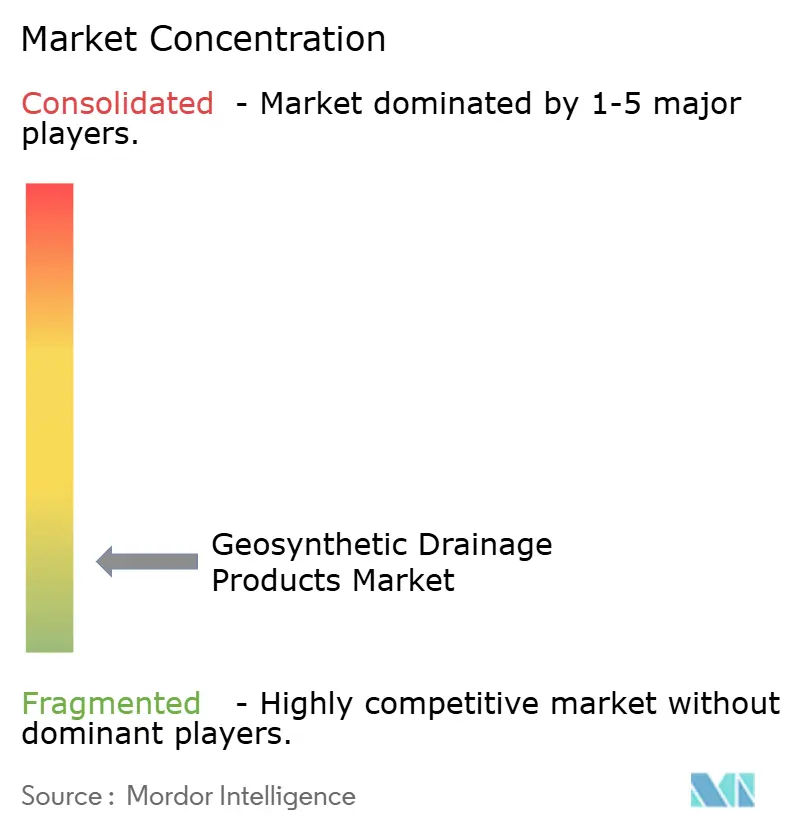
| Market Concentration | Low |
Major Players *Disclaimer: Major Players sorted in no particular order Image © Mordor Intelligence. Reuse requires attribution under CC BY 4.0. | |
Geosynthetic Drainage Products Market Analysis by Mordor Intelligence
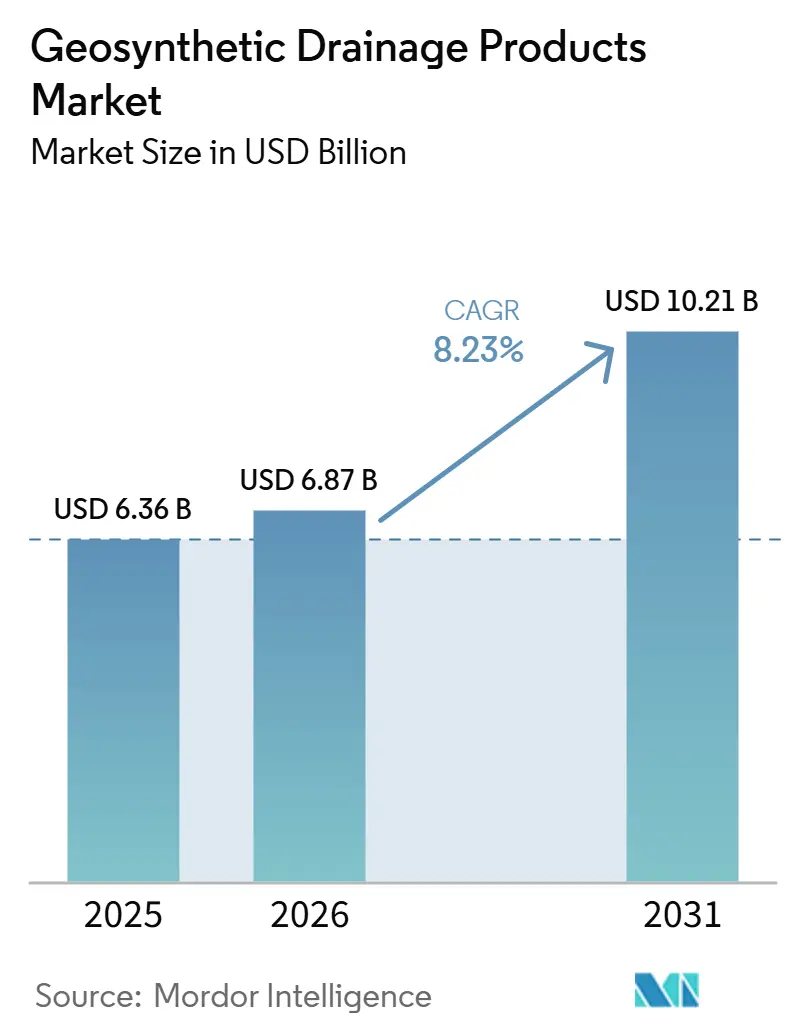
The Geosynthetic Drainage Products Market size is expected to increase from USD 2.93 billion in 2025 to USD 3.17 billion in 2026 and reach USD 4.71 billion by 2031, at a CAGR of 8.23% over 2026-2031. Government programs for transport, water, and urban infrastructure are supporting steady demand for drainage systems that protect roads, embankments, and built assets. Environmental regulations for landfill leachate, mine tailings, and wastewater containment are increasing the use of certified geocomposites. Product selection is shifting from granular drainage layers to thinner systems with controlled hydraulic performance and lower installation volumes. This shift supports suppliers that provide application engineering, test data, and local manufacturing support across major project regions, particularly when contractors must demonstrate drainage performance before material approval for roads, containment works, water facilities, and complex urban construction.
Key Report Takeaways
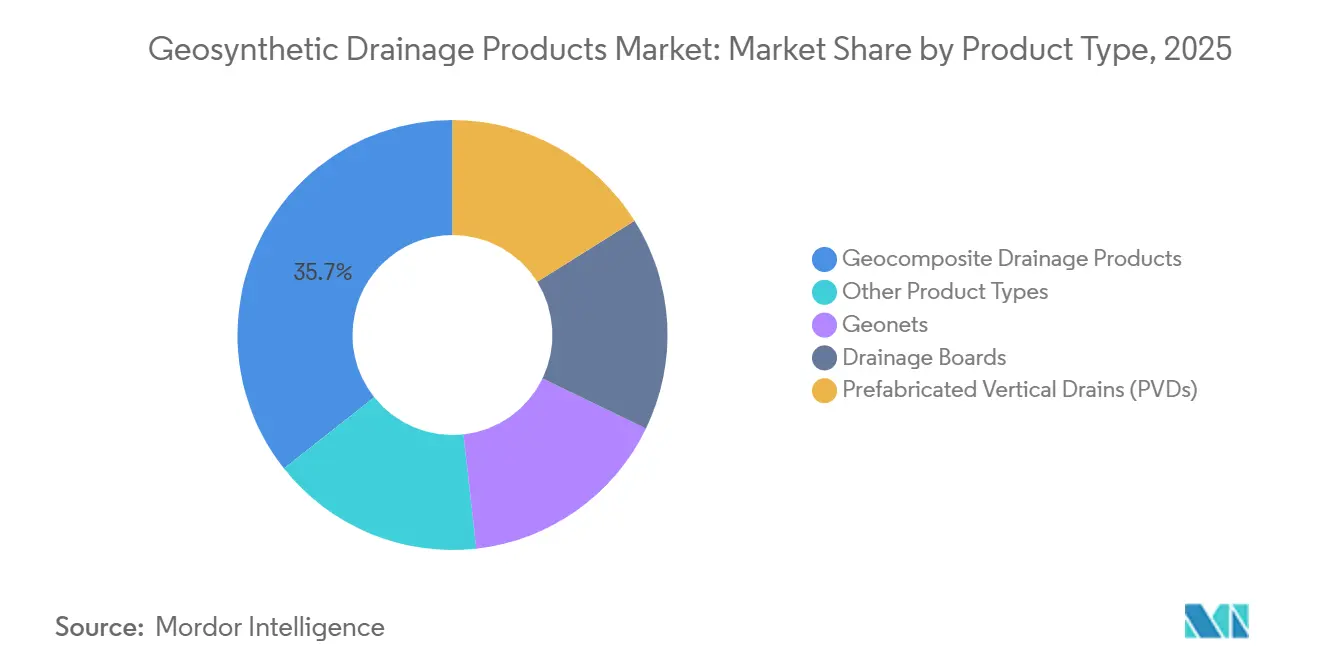
- By product type, geocomposite drainage products held 35.67% of the geosynthetic drainage products market share in 2025, while prefabricated vertical drains are forecast to grow at an 8.63% CAGR through 2031.
- By material, polypropylene held 48.23% of the geosynthetic drainage products market share in 2025 and is forecast to grow at an 8.95% CAGR through 2031.
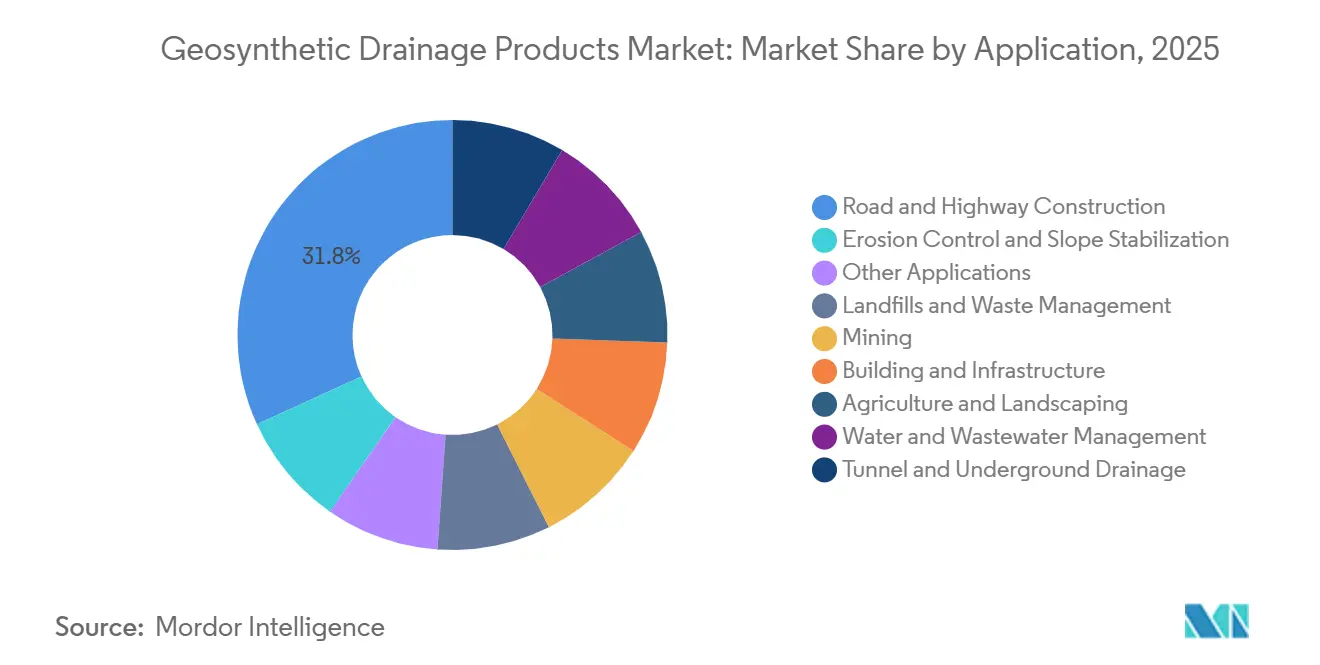
- By application, road and highway construction held 31.82% of the geosynthetic drainage products market share in 2025, while water and wastewater management is forecast to grow at a 9.14% CAGR through 2031.
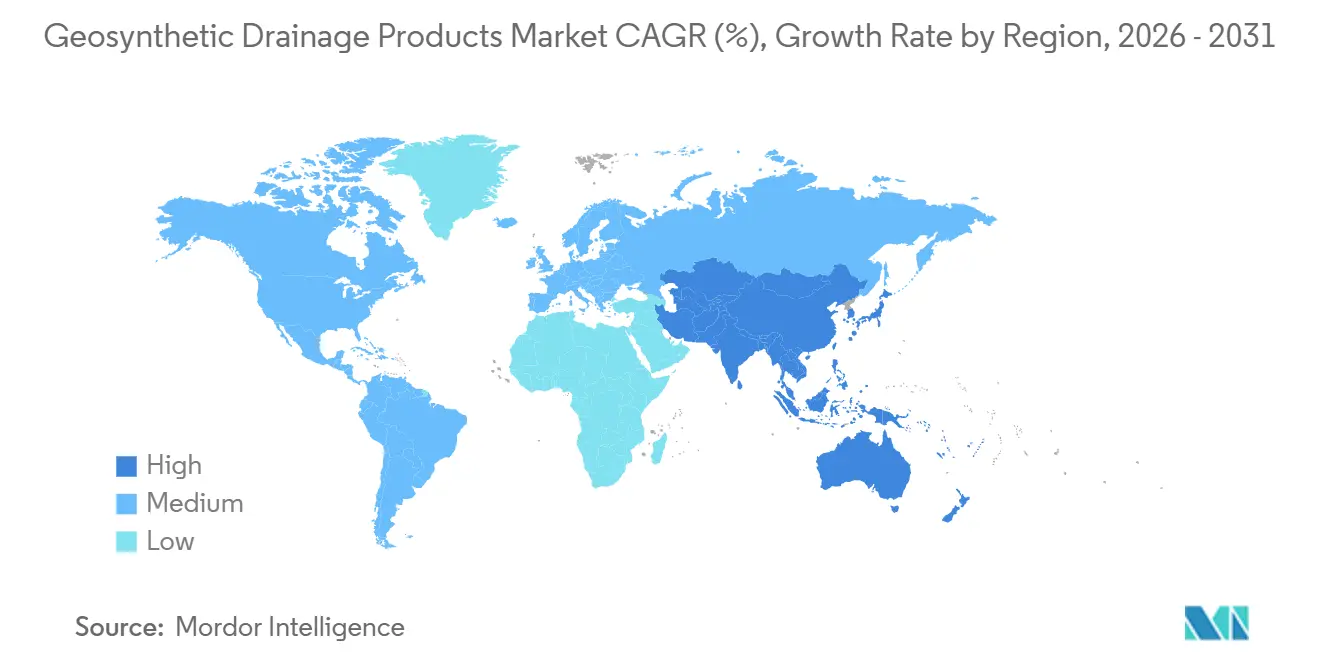
- By geography, Asia-Pacific held 41.23% revenue share in 2025, and is forecast to grow at a CAGR of 9.03% through 2031.
Note: Market size and forecast figures in this report are generated using Mordor Intelligence’s proprietary estimation framework, updated with the latest available data and insights as of January 2026.
Market Trends and Insights
Drivers Impact Analysis of Geosynthetic Drainage Products Market*
| Drivers | (~) % Impact on CAGR Forecast | Geographic Relevance | Impact Timeline |
|---|---|---|---|
| Infrastructure-Led Construction Investment | +3.2% | Global; concentrated in APAC, North America, and the Middle-East | Short term (≤ 2 years) |
| Mandatory Landfill and Wastewater Containment | +1.8% | Global; regulatory intensity is highest in North America and the EU | Medium term (2-4 years) |
| Tailings and Heap-Leach Mining Expansion | +0.8% | APAC, South America (Chile, Peru), MEA (South Africa) | Medium term (2-4 years) |
| Climate-Resilient Stormwater and Erosion Control | +0.9% | Global; greatest urgency in APAC and coastal North America | Medium term (2-4 years) |
| Digital Soil-Consolidation and Internet of Things (IoT) Drain Monitoring | +0.6% | APAC core; early adoption in Western Europe | Long term (≥ 4 years) |
| Thin High-Flow Composite Substitution for Aggregate Drains | +0.7% | Global; cost pressure strongest in Europe and North America | Medium term (2-4 years) |
| Source: Mordor Intelligence | |||
Infrastructure-Led Construction Investment
Government infrastructure spending provides a steady source of project demand for the geosynthetic drainage products market. The U.S. Bipartisan Infrastructure Law allocated USD 350 billion to highway programs through September 2026, supporting drainage specifications for road sub-bases and bridge approaches. State transportation agencies use geocomposite layers to manage freeze-thaw cycles and hydrostatic pressure, which can reduce pavement life. China’s 15th Five-Year Plan supports transportation networks and water management systems, creating a multiyear procurement base for drainage materials. India’s rural road and highway corridor programs also use Prefabricated Vertical Drains (PVDs) and drainage boards in soft-ground improvement work. Specifications embedded in long-running public programs can sustain demand beyond the original funding announcement, giving certified suppliers visibility across the geosynthetic drainage products market and limiting disruption from individual project delays, tender changes, or local variations in construction sequencing.
Mandatory Landfill and Wastewater Containment
Rules for landfill leachate collection and municipal wastewater containment support demand for certified drainage geocomposites. U.S. landfill regulations require new municipal solid-waste units to use drainage layers that meet hydraulic-conductivity requirements, which geocomposite systems can achieve at a lower installed thickness than gravel. Existing single-liner landfill cells in emerging markets may require upgrades to double-liner configurations as national environmental rules become stricter. These upgrades require drainage layers between liner systems and can expand the addressable market for geosynthetic drainage products. Wastewater treatment expansion under Saudi Arabia’s Vision 2030 also supports containment-focused drainage demand. Compliance-driven applications offer more predictable purchasing conditions than discretionary construction activity, as landfill, wastewater, and containment operators must meet performance requirements even when broader building activity slows or project priorities change.
Tailings and Heap-Leach Mining Expansion
Mining projects require drainage products that maintain flow under high loads and aggressive chemical conditions, supporting demand in the geosynthetic drainage products market. In heap-leach facilities, drainage layers below ore stacks can experience loads exceeding 350 kPa, making retained transmissivity a critical operating requirement. Triplanar structures can retain flow more effectively than biplanar products under compression, supporting demand for higher-specification designs in deep-heap applications. Research also identifies drainage-layer design as an important factor in geomembrane leak performance in tailings storage facilities. Reviews of heap-leach and tailings facilities are increasing expectations for drainage verification in Chile, Peru, and Canada. This trend supports geosynthetic drainage products market participants with documented transmissivity data and established technical certifications, as project owners can compare drainage performance under load rather than rely only on unit price or nominal product thickness.
Climate-Resilient Stormwater and Erosion Control
Climate adaptation programs are expanding the use of geosynthetic drainage systems in slopes, riverbanks, and flood-resilience infrastructure. The American Society of Civil Engineers (ASCE) reported that geocell and geotextile systems can support reliable access roads in severe terrain, a capability relevant to hurricane-response corridors[1]American Society of Civil Engineers, “Building Climate-Resilient Infrastructure Using Geosynthetics,” Civil Engineering Source, asce.org.. ISO/TR 18228-8:2026 provides design guidance for geosynthetics used in surface erosion control on slopes and riverbanks. A scientific review found that a coupled thermo-hydro-mechanical assessment is necessary to evaluate drainage performance during extreme weather. Higher design requirements support suppliers that can demonstrate performance under multiple site conditions. Municipal stormwater projects in Asian cities are creating a broader urban retrofit opportunity for the geosynthetic drainage products market, especially where space constraints limit the use of wide stone channels and asset owners need systems that can be installed around existing utilities.
Restraints Impact Analysis of Geosynthetic Drainage Products Market*
| Restraints | (~) % Impact on CAGR Forecast | Geographic Relevance | Impact Timeline |
|---|---|---|---|
| Volatile Polypropylene and Resin Pricing | -1.4% | Global; monomer supply risk concentrated in Middle-East dependent regions | Short term (≤ 2 years) |
| Cross-Regional Standards and Installation Expertise Gaps | -0.8% | Middle-East and Africa (MEA), South America, parts of Southeast Asia; spillover to Eastern Europe | Medium term (2-4 years) |
| Microplastic and End-of-Life Compliance Risk | -0.5% | EU and Northwestern Europe; emerging in North America and East Asia | Long term (≥ 4 years) |
| Long-Term Transmissivity and Clogging Verification Risk | -0.4% | Global; most acute in markets with limited third-party testing infrastructure | Medium term (2-4 years) |
| Source: Mordor Intelligence | |||
Volatile Polypropylene and Resin Pricing
Across the geosynthetic drainage products market, polypropylene represents a significant share of raw material costs in geocomposite manufacturing, making resin pricing a key commercial risk. North American spot polypropylene prices increased during the first half of 2026 amid disruptions to Middle Eastern propylene supply chains. European contract prices also rose before a correction began in June 2026. Suppliers operating under 12- to 18-month fixed-price public contracts may face margin pressure if resin costs rise during active delivery periods. Multi-year resin agreements and vertically integrated extrusion capacity can reduce this exposure. Smaller converters in the geosynthetic drainage products market have less capacity to absorb price fluctuations or fund certification and product development, which can widen the gap between low-cost local suppliers and suppliers qualified for technically demanding public projects.
Microplastic and End-of-Life Compliance Risk
European regulations are creating a long-term compliance challenge for polymer-based drainage products. Commission Regulation (EU) 2023/2055 established disclosure and user-instruction requirements for products containing synthetic polymer microparticles[2]European Union, “Commission Regulation (EU) 2023/2055,” Official Journal of the European Union, eur-lex.europa.eu.. Comité Européen de Normalization Technical Committee (CEN/TC) 189 is developing methods to assess the potential release of microplastics from geosynthetic installations. A 2025 case study found that properly installed geosynthetics under design loads do not represent a significant current source of microplastics. However, future abrasion-resistance or mass-loss requirements could make lower-specification products less suitable for environmentally sensitive projects. Suppliers developing recyclable, bio-based, or biodegradable components may be better positioned as procurement criteria evolve in the geosynthetic drainage products market, particularly when buyers request clearer end-of-life information alongside conventional hydraulic and mechanical performance documentation.
*Our forecasts treat driver/restraint impacts as directional, not additive. The impact forecasts reflect baseline growth, mix effects, and variable interactions.
Geosynthetic Drainage Products Market Segment Analysis
By Product Type:
Geocomposites Hold the Largest Position While Prefabricated Vertical Drains (PVDs) Benefit from Soft-GroundworkGeocomposites accounted for 35.67% of the geosynthetic drainage products market share in 2025, supported by their use in road sub-bases, landfill basal drainage, retaining-wall back drains, and green-roof drainage systems. They replace conventional granular layers when designers require controlled flow, reduced material movement, and simpler installation logistics on constrained sites. Supplied technical evidence places geocomposite hydraulic transmissivity at 10⁻³ to 10⁻⁴ m²/s under American Society for Testing and Materials (ASTM) D4716 testing. GeoFrontiers 2025 research also indicated that equivalency-based substitution can reduce quarrying, transport volumes, and construction time. Geonets remain used in landfill leachate collection because their continuous planar flow paths limit hydraulic head under containment covers. Drainage boards, prefabricated cores, tube drains, and capillary-break geocomposites serve basement walls, podium decks, tunnel walls, and specialized construction and agricultural applications where integrated filters can reduce on-site work.
Prefabricated vertical drains are forecast to expand at a CAGR of 8.63% through 2031, making them the fastest-growing product type in the geosynthetic drainage products market. High-speed rail, airport, port, and coastal reclamation projects are increasing the need for soft-ground consolidation across Asia-Pacific before developers place major structures and pavements. A study of the Lamongan North Ring Road project found that PVD spacing of 1.5 to 2.0 meters improved consolidation speed compared with natural drainage, an approach applicable across similar soft-clay transport corridors. PVDs reduce settlement uncertainty and support more predictable construction schedules before structural work begins. Research published in 2025 showed that conductive polymer networks can be integrated with geosynthetics to monitor soil deformation, potentially shifting PVDs from passive drainage components to monitored infrastructure systems.



By Material:
Polypropylene Leads While Feedstock Exposure Encourages Material DiversificationPolypropylene held 48.23% of the geosynthetic drainage products market share in 2025 and is forecast to grow at a CAGR of 8.95% through 2031. Manufacturers widely use it in road geocomposites, landfill drainage layers, and PVD filters because it supports high-volume needle-punch and extrusion methods and offers a competitive cost position. Its chemical resistance in acidic and alkaline leachate environments, along with UV-stabilized grades for exposed work, supports its use in municipal, industrial, and transport applications. Its position across geotextiles, geocomposites, and drainage products also exposes manufacturers to regional disruptions in propylene supply. As a result, producers are assessing polyethylene and polyester alternatives for niche applications where they can maintain drainage performance while diversifying feedstock sources.
Polyethylene, mainly HDPE, remains relevant in landfill systems that require high chemical resistance and low creep under sustained loading. Specifiers often use it with HDPE geomembranes as part of an integrated containment system. Polyester is used in mining drainage applications, especially on heap-leach pads exposed to ultraviolet radiation and long-term compression. PVC continues to serve preformed channels and connector applications in Southern Europe and Latin America, where contractor familiarity supports its specification alongside polyethylene and polypropylene alternatives. Other materials include bio-based and recycled-content products, and Naue’s March 2026 Secutex Green indicated that biodegradable geotextiles can serve temporary filtration and separation applications. European circularity requirements may broaden material choices over time, although conventional polymers remain central to long-life drainage applications.
By Application:
Road Construction Leads While Water and Wastewater Management Grows FasterRoad and highway construction accounted for 31.82% of the geosynthetic drainage products market share in 2025, supporting broad demand across national road programs in South and Southeast Asia, the Gulf Cooperation Council, and parts of Sub-Saharan Africa. Drainage layers beneath road sub-bases limit hydrostatic pressure in granular fill and reduce the risk of pumping failures, helping extend pavement life where road rehabilitation is costly. Landfills and waste management form the next major application group because base and cap containment systems require drainage layers. Mining applications include heap-leach pads, tailings-storage drainage, and process-chemical containment, with users increasingly adopting high-transmissivity products tested against recognized standards. The geosynthetic drainage products industry serves this range through standard systems for conventional work and advanced designs for high-load or chemical-exposure conditions.
Water and wastewater management is expected to record a CAGR of 9.14% through 2031, the fastest application growth rate in the geosynthetic drainage products market. Municipal investment in the Middle-East, India, and Southeast Asia supports lined channels and subsurface networks that limit infiltration and improve the operating life of water assets. Building and infrastructure work is also increasing demand for high-flow drainage below podium decks and within dense urban redevelopment, where ABG Geosynthetics’ Roofdrain 60 replaces deeper stone layers and reduces structural dead load. Tunnel and underground drainage applications require systems that maintain transmissivity under sustained groundwater pressure, with supplied evidence citing conditions of 150 to 350 kPa in certain applications. Erosion control and slope stabilization are gaining ground in coastal and urban climate-adaptation programs, supported by ISO/TR 18228-8:2026 design guidance.
Geography Analysis
APAC Geosynthetic Drainage Products Market
Asia-Pacific accounted for 41.23% of the geosynthetic drainage products market share in 2025 and is forecast to grow at a CAGR of 9.03% through 2031. China’s JTG/T 3332-2026 standard, which took effect on July 1, 2026, updates geosynthetic specifications for new national highway projects and raises the baseline performance requirements for drainage materials. India supports the demand for Prefabricated Vertical Drains (PVDs) through rural road connectivity initiatives, Smart Cities projects, and soil improvement works in flood-prone metro corridors. Vietnam, Indonesia, and the Philippines are expanding soft-ground transport networks, where PVDs serve as a primary engineering tool. South Korea’s redevelopment pipeline supports the use of thin drainage geocomposites in basement and podium construction, while Japan’s aging infrastructure and seismic-resilience programs require systems that can maintain hydraulic performance during ground deformation. Maccaferri announced its Khandale, India, facility in July 2026 as the Group’s second-largest global site, reflecting the region’s role in the geosynthetic drainage products market.
North America and Europe Geosynthetic Drainage Products Market
North American demand is supported by Infrastructure Investment and Jobs Act (IIJA)-funded transportation programs and EPA requirements for landfill leachate management and stormwater runoff. After federal funds are authorized, state agencies can procure specified drainage systems across multiyear project schedules, as major highway projects can take three to five years to complete. Maccaferri opened its Fort Lawn, South Carolina facility in June 2026 to combine local production with engineering support near key US project clusters. Europe is supported by rail-corridor rehabilitation, climate-resilient coastal and riverside works, and infrastructure programs funded through EU mechanisms. The DACH region and Benelux form a high-specification demand core, as their installer networks and national approvals favor suppliers that provide documented performance and conformity records.
South America and MEA Geosynthetic Drainage Products Market
South America has a road-drainage opportunity through Brazil’s private road concession pipeline, while Chile and Peru are reviewing tailings standards that could upgrade drainage layers at heap-leach and mining facilities. Argentina has significant potential for road rehabilitation, although infrastructure constraints and currency risk limit near-term purchasing power. The Middle-East and Africa remain divided between Gulf Cooperation Council markets, where Saudi water-infrastructure expansion supports high-specification containment projects, and Sub-Saharan Africa, where investment in training and distribution is needed before volumes increase. Fibertex Nonwovens’ 2025 collaboration with Terrain Plant Ltd illustrates this skills-transfer model for East African distribution.

Competitive Landscape
The geosynthetic drainage products market is fragmented, with Solmax, Officine Maccaferri, HUESKER, NAUE, and ABG competing through certifications, application engineering, and manufacturing proximity to major projects. Regional converters in India, Southeast Asia, and Eastern Europe compete mainly on price in applications where technical standards are less prescriptive. HUESKER acquired Sineco International in April 2025, adding thermoplastic monofilament technology for three-dimensional drainage structures with void indices of up to 99%. This acquisition added a higher-specification product tier that conventional geonet extrusion cannot readily replicate. Compliance with ISO 9862, ASTM D4716, and European technical requirements limits smaller suppliers’ access to government work.
Solmax began construction of its European manufacturing center in Les Mureaux in May 2026, where it is consolidating nonwoven production and integrating manufacturing, laboratory, and commercial teams on an 8-hectare site. The investment increases production scale and supports a faster response to European project specifications. Thrace Group has patented a geosynthetic reactive clay composite, extending product differentiation beyond conventional extrusion geometry. Sensor-integrated drainage monitoring is moving from research into early commercial pilots, and a 2026 study validated smart geosynthetic monitoring in urban landfill conditions. These systems may provide continuous performance verification without requiring separate instruments, supporting technical suppliers in the geosynthetic drainage products market.
Biodegradable and bio-based temporary drainage products are gaining attention in Northern Europe and Japan as environmental procurement criteria become more detailed. Naue’s product launch and June 2026 MyHIJAU certification in Malaysia provide early examples of this direction. Multilinear drainage geocomposites for deep heap-leach operations remain a specialized area with limited certified supply, even as mining operators face greater pressure to document long-term drainage performance. Regional suppliers are gaining mid-tier business through lower prices and local access, but resin-cost exposure and limited certification restrict their ability to enter higher-specification segments.
Geosynthetic Drainage Products Industry Leaders
Solmax
Naue GmbH & Co. KG
Officine Maccaferri Spa
Contech Engineered Solutions LLC
Thrace Group
- *Disclaimer: Major Players sorted in no particular order
Geosynthetic Drainage Products Market Companies Covered in this Report
- ABG Limited
- AGRU America Inc.
- American Wick Drain
- Cofra B.V.
- Contech Engineered Solutions LLC
- Fibertex Nonwovens A/S
- GEOfabrics Ltd
- HUESKER International
- Naue GmbH & Co. KG
- Officine Maccaferri Spa
- SKAPS Industries
- Solmax
- TECHFABINDIA
- Tenax Corporation
- Thrace Group

Recent Industry Developments in Geosynthetic Drainage Products Market
- July 2026: Officine Maccaferri announced plans to establish a new manufacturing facility in Khandale, India, which is expected to become the Group’s second-largest facility globally, covering approximately 400,000 square feet. The plant will expand the company’s capabilities across geosynthetics, double-twist, and rockfall protection solutions.
- May 2026: Solmax began construction of its European geosynthetics manufacturing center in Les Mureaux, near Paris. The facility will consolidate the company’s European nonwoven geotextile operations into a single center that integrates manufacturing, laboratory, and commercial functions. Scheduled for commissioning by the end of 2026, the center will support Solmax’s geosynthetic applications across major infrastructure and agriculture.


Global Geosynthetic Drainage Products Market Report Scope
Geosynthetic drainage products are synthetic, polymer-based materials used in construction to collect, filter, and direct water away from soil and structures. These products include geonets, geocomposites, and geotextiles.
The geosynthetic drainage products market is segmented by product type, material, application, and geography. By product type, the market is segmented into geocomposite drainage products, geonets, drainage boards, prefabricated vertical drains (PVDS), and other product types. By material, the market is segmented into polypropylene, polyethylene, polyester, polyvinyl chloride (PVC), and other materials. By application, the market is segmented into road and highway construction, landfills and waste management, mining, building and infrastructure, agriculture and landscaping, water and wastewater management, tunnel and underground drainage, erosion control and slope stabilization, and other applications. The report also covers market size and forecasts for geosynthetic drainage products across 16 countries in major regions. The market sizes and forecasts are provided in terms of value (USD).
| Geocomposite Drainage Products |
| Geonets |
| Drainage Boards |
| Prefabricated Vertical Drains (PVDs) |
| Other Product Types |
| Polypropylene |
| Polyethylene |
| Polyester |
| Polyvinyl Chloride (PVC) |
| Other Materials |
| Road and Highway Construction |
| Landfills and Waste Management |
| Mining |
| Building and Infrastructure |
| Agriculture and Landscaping |
| Water and Wastewater Management |
| Tunnel and Underground Drainage |
| Erosion Control and Slope Stabilization |
| Other Applications |
| Asia-Pacific | China |
| India | |
| Japan | |
| South Korea | |
| ASEAN Countries | |
| Rest of Asia-Pacific | |
| North America | United States |
| Canada | |
| Mexico | |
| Europe | Germany |
| United Kingdom | |
| France | |
| Italy | |
| NORDIC Countries | |
| Russia | |
| Rest of Europe | |
| South America | Brazil |
| Argentina | |
| Rest of South America | |
| Middle-East and Africa | Saudi Arabia |
| South Africa | |
| Rest of Middle-East and Africa |
| By Product Type | Geocomposite Drainage Products | |
| Geonets | ||
| Drainage Boards | ||
| Prefabricated Vertical Drains (PVDs) | ||
| Other Product Types | ||
| By Material | Polypropylene | |
| Polyethylene | ||
| Polyester | ||
| Polyvinyl Chloride (PVC) | ||
| Other Materials | ||
| By Application | Road and Highway Construction | |
| Landfills and Waste Management | ||
| Mining | ||
| Building and Infrastructure | ||
| Agriculture and Landscaping | ||
| Water and Wastewater Management | ||
| Tunnel and Underground Drainage | ||
| Erosion Control and Slope Stabilization | ||
| Other Applications | ||
| By Geography | Asia-Pacific | China |
| India | ||
| Japan | ||
| South Korea | ||
| ASEAN Countries | ||
| Rest of Asia-Pacific | ||
| North America | United States | |
| Canada | ||
| Mexico | ||
| Europe | Germany | |
| United Kingdom | ||
| France | ||
| Italy | ||
| NORDIC Countries | ||
| Russia | ||
| Rest of Europe | ||
| South America | Brazil | |
| Argentina | ||
| Rest of South America | ||
| Middle-East and Africa | Saudi Arabia | |
| South Africa | ||
| Rest of Middle-East and Africa | ||


Key Questions Answered in the Report
What is current market size of Geosynthetic Drainage Products Market?
The Geosynthetic Drainage Products Market size is expected to increase from USD 2.93 billion in 2025 to USD 3.17 billion in 2026 and reach USD 4.71 billion by 2031, at a CAGR of 8.23% over 2026-2031.
Which product type is growing fastest?
Prefabricated vertical drains are forecast to grow at an 8.63% CAGR through 2031, supported by soft-ground consolidation work in transport and reclamation projects.
Which material leads to demand for drainage geosynthetics?
Polypropylene held 48.23% share in 2025 and is forecast to grow at an 8.95% CAGR through 2031.
What application has the strongest expected growth?
Water and wastewater management is forecast to grow at a 9.14% CAGR through 2031 as municipalities invest in drainage and containment infrastructure.
Page last updated on:


 Your data is secure and never sold or shared.


