
Prefabricated Vertical Drains Market Size and Share
Market Overview
| Study Period | 2021 - 2031 |
|---|---|
| Market Size (2026) | USD 510.19 Million |
| Market Size (2031) | USD 744.10 Million |
| Growth Rate (2026 - 2031) | 7.84 % |
| Fastest Growing Market | Asia-Pacific |
| Largest Market | Asia-Pacific |
| Market Concentration | Medium |
Major Players *Disclaimer: Major Players sorted in no particular order Image © Mordor Intelligence. Reuse requires attribution under CC BY 4.0. | |
Prefabricated Vertical Drains Market Analysis by Mordor Intelligence
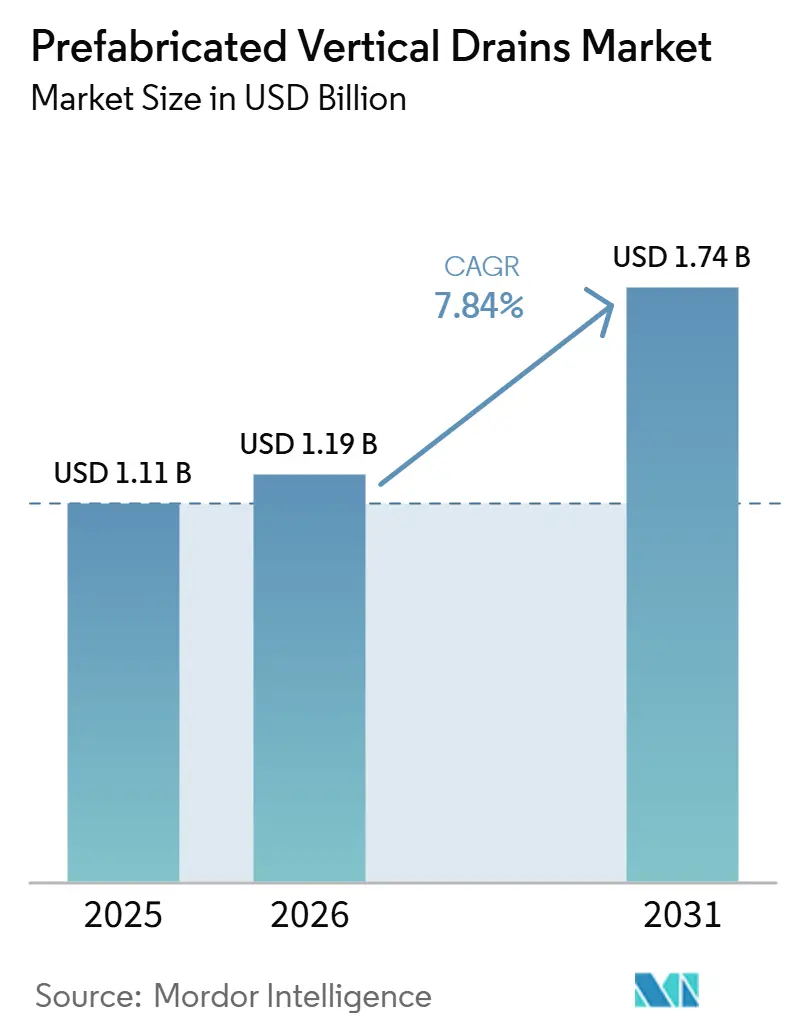
The Prefabricated Vertical Drains Market size is projected to be USD 476.81 million in 2025, USD 510.19 million in 2026, and reach USD 744.10 million by 2031, at a CAGR of 7.84% from 2026 to 2031. The prefabricated vertical drains market supports construction on soft, compressible, reclaimed, and coastal soils by reducing pore-water drainage and consolidation time. This function supports airport, port, rail, highway, and coastal projects, where settlement control influences construction schedules and long-term asset performance. Large public infrastructure programs create steady demand, as treatment specifications are often set early in the design process and become difficult to modify after approval. Suppliers are introducing drains with biodegradable materials and monitoring features, while polypropylene products remain relevant across applications. However, the prefabricated vertical drains market faces pressure from polypropylene price volatility and inconsistent standards for newer materials, which can slow adoption among design engineers.
Key Report Takeaways
- By type, wick drains held 52.67% of the share of the prefabricated vertical drains market in 2025 and are forecast to grow at an 8.34% CAGR through 2031.
- By application, infrastructure accounted for 42.43% of the share of the prefabricated vertical drains market in 2025 and is projected to expand at an 8.57% CAGR through 2031.
- By installation method, static installation held 58.12% of the share of the prefabricated vertical drains market in 2025, while dynamic installation is projected to grow at an 8.12% CAGR through 2031.
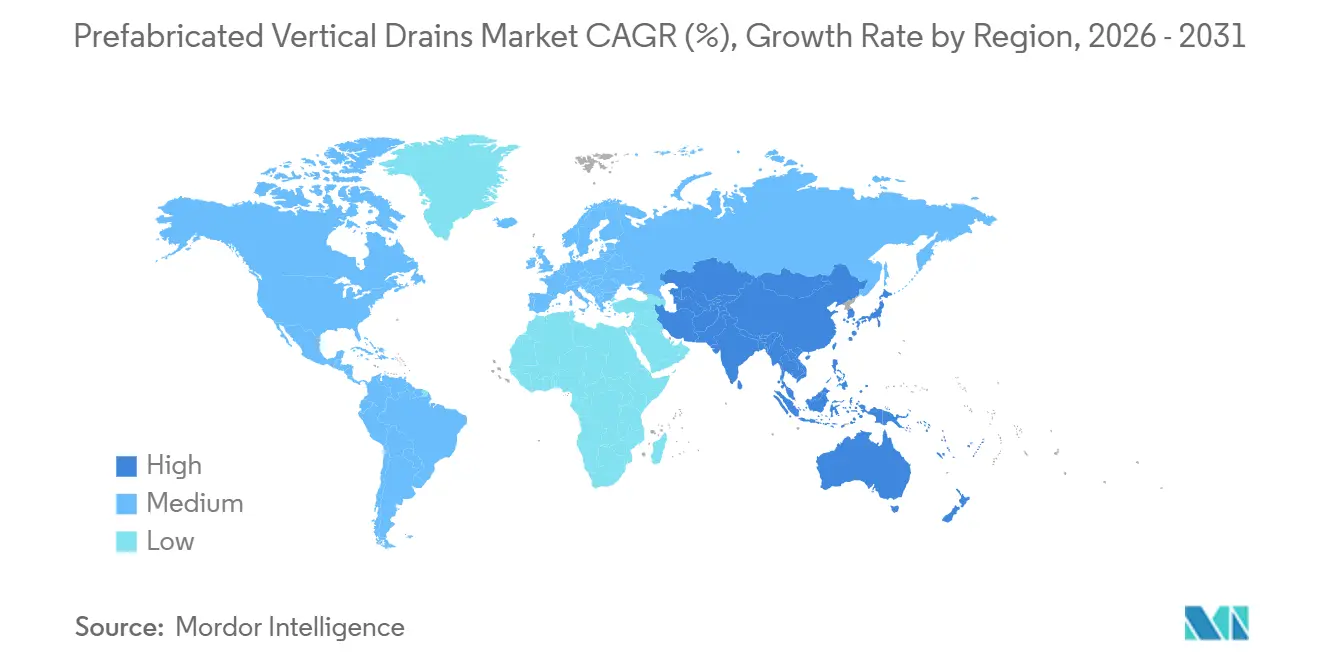
- By geography, Asia-Pacific held 41.39% revenue share in 2025, and is forecast to grow at a CAGR of 8.96% through 2031.
Note: Market size and forecast figures in this report are generated using Mordor Intelligence’s proprietary estimation framework, updated with the latest available data and insights as of January 2026.
Market Trends and Insights
Drivers Impact Analysis of Prefabricated Vertical Drains Market*
| Drivers | (~) % Impact on CAGR Forecast | Geographic Relevance | Impact Timeline |
|---|---|---|---|
| Infrastructure and Land-Reclamation Buildout on Soft Soils | +2.1% | APAC is dominant, spillover to MEA and South America | Long term (≥ 4 years) |
| Urban Expansion into Compressible and Reclaimed Land | +1.5% | APAC core (China, India, ASEAN), with secondary demand in MEA and Europe | Medium term (2-4 years) |
| Faster Consolidation and Reduced Foundation Schedules | +1.0% | Global, with the strongest pull in APAC and North America, infrastructure | Medium term (2-4 years) |
| Climate-Resilient Embankment and Coastal Protection Investment | +0.8% | APAC, Europe, MEA, South America coastal zones | Long term (≥ 4 years) |
| Digital Soil-Consolidation Design and Monitoring | +0.5% | North America, Europe, Japan, South Korea; maturing uptake in APAC | Short term (≤ 2 years) |
| Low-Carbon and Biobased Vertical-Drain Materials | +0.4% | Europe, Southeast Asia pilot markets; expanding globally | Medium term (2-4 years) |
| Source: Mordor Intelligence | |||
Infrastructure and Land-Reclamation Buildout on Soft Soils
Sovereign infrastructure programs in soft-soil regions remain a key driver of demand for the prefabricated vertical drains market. Reclaimed land formed from hydraulically placed dredged material often requires denser treatment than natural soft clay, as the slurry must stabilize before heavy equipment can access the site. Menard Asia installed prefabricated vertical drains (PVDs) to an average depth of 30 m across a 29,000 m² water-production site in Phnom Penh. Keller installed 82,500 km of wick drains at East Port Said, demonstrating the scale achievable within a single contract. Vietnam’s Phu Quoc International Airport expansion includes a 3,300-meter runway over coastal soft fill and involves a total investment of VND 22,000 billion (USD 0.83 billion). India’s Odisha coastal port expansion also used vacuum-PVD ground improvement to treat marine clay.
Urban Expansion into Compressible and Reclaimed Land
Coastal urban growth continues to push construction into tidal flats, former marshland, and reclaimed areas containing deep marine clay. Jakarta, Mumbai, Ho Chi Minh City, and Dhaka represent locations where marine clay extends 20 to 60 meters below grade. Under these conditions, conventional preloading alone can require 15 to 20 years to achieve full consolidation. Urban reclamation sites can require more complex work due to limited access, seismic conditions, and layered slurry profiles, which necessitate staged vacuum systems and closer engineering control within the prefabricated vertical drains market. Menard Asia used a combined controlled modulus column and PVD methods at the VVIP Airport in Nusantara to stabilize coastal clays in East Kalimantan. Further infrastructure work under the Nusantara master plan could sustain procurement as development progresses through the late 2020s.
Faster Consolidation, Climate Resilience, and Digital Monitoring
Wick drains shorten the radial drainage path and can reduce primary consolidation to 3 to 6 months when used with surcharge or vacuum preloading. This time saving reduces holding costs for large infrastructure and real estate projects and supports drain adoption when material prices rise. A study of Bangkok Suvarnabhumi Airport found that double-cycle vacuum-PVD treatment improved undrained shear strength and reduced void ratios during a second treatment cycle. Research on soft soil treated with PVDs and vacuum-surcharge preloading found that optimized triangular spacing can achieve 90% consolidation in as little as 2 months. Coastal protection programs create related demand because embankments, flood defenses, and seawalls often require foundation treatment on saturated soils. The World Bank has committed USD 212.64 million to the Karnataka and Tamil Nadu coastal resilience program for FY2026 to FY2031[1].
Low-Carbon and Biobased Vertical-Drain Materials
Biobased drain materials address procurement interest in reducing the environmental impact of ground-improvement work. Poly-lactic acid-core products can deliver discharge capacities of up to 220 mL/s under 120 kPa, compared with 75 mL/s for conventional PVDs. This reported performance range indicates that sustainability goals do not always require lower drainage performance. DAEHAN i.m.’s Bio Verti-Drain received Korea’s Ministry of Environment Eco-Label and TÜV OK compost INDUSTRIAL certification. COFRA’s BioDrain contains 80% biobased material and holds TÜV Austria OK biobased 4-star certification. The prefabricated vertical drains market may gain from these products where clients use environmental certification in technical procurement requirements and compare lifecycle credentials with conventional materials.
Restraints Impact Analysis of Prefabricated Vertical Drains Market*
| Restraints | (~) % Impact on CAGR Forecast | Geographic Relevance | Impact Timeline |
|---|---|---|---|
| Petrochemical Feedstock Price Volatility | -1.0% | Global, most acute in Northwest Europe (naphtha-cracking dependent) | Short term (≤ 2 years) |
| Long Consolidation Period and Dependence on Surcharge or Vacuum Loading | -0.8% | Global, most severe in dense urban and high-water-table environments | Long term (≥ 4 years) |
| Installation Damage, Clogging, and Inconsistent Field Quality | -0.6% | APAC and emerging markets, where specialist oversight is limited | Medium term (2-4 years) |
| Limited Standardization and Specialist Contractor Capacity | -0.5% | MEA, South America, parts of Eastern Europe | Long term (≥ 4 years) |
| Source: Mordor Intelligence | |||
Petrochemical Feedstock Price Volatility
Polypropylene remains the core material for conventional wick drains, so its price tracks crude oil and propylene cycles. Price movements can affect manufacturer margins and complicate bid pricing for long-duration public infrastructure contracts. The impact varies by region because producers in Northwest Europe rely more on naphtha-based steam cracking, while parts of Southeast Asia use more diversified feedstock routes. Contractors and manufacturers cannot fully hedge commodity risks across every multi-year project. Manufacturers are exploring biobased polylactic acid (PLA) and polybutylene succinate (PBS) materials to reduce dependence on conventional resin inputs. Conventional wick drains remain exposed to resin price movements, despite their use in cost-focused infrastructure procurement.
Long Consolidation Period, Field Quality, and Specialist Capacity Constraints
Prefabricated vertical drain (PVD) performance depends on maintaining surcharge embankments or vacuum pressure for several months until the project reaches the target consolidation level. This requirement can extend project schedules and create challenges in dense urban areas or locations with high groundwater levels. Research in Korea found that higher organic content in dredged fill can delay consolidation and increase the importance of drain spacing and smear-zone effects[2]. Heavy surcharge loading can also create slope-stability concerns in seismically active coastal areas, requiring staged loading and extended monitoring. Vacuum consolidation can reduce lateral loading, but it requires specialist equipment, reliable membranes, and experienced supervision in the prefabricated vertical drains market. Installation damage, clogging, and limited contractor capacity can affect project outcomes in areas with limited technical oversight.
*Our forecasts treat driver/restraint impacts as directional, not additive. The impact forecasts reflect baseline growth, mix effects, and variable interactions.
Prefabricated Vertical Drains Market Segment Analysis
By Type:
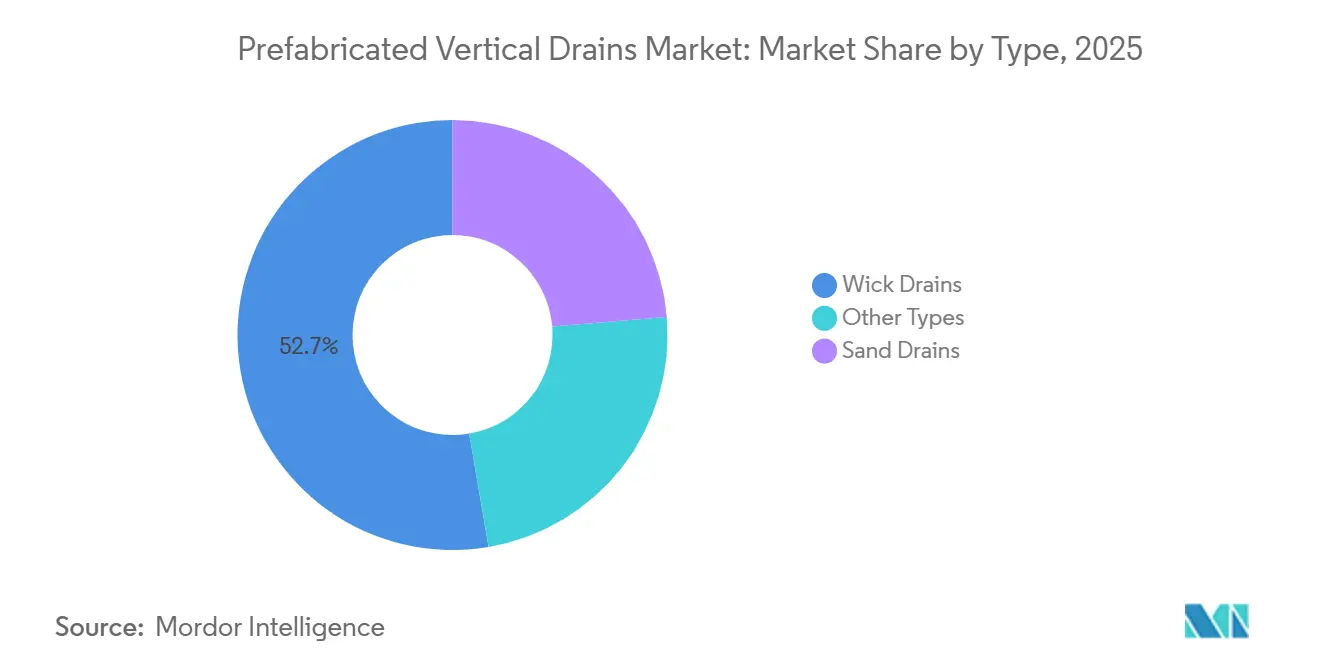
Wick Drains Maintain Leadership Through Broad Performance CapabilitiesWick drains held 52.67% of the prefabricated vertical drains market share in 2025, and the segment is forecast to grow at a CAGR of 8.34% through 2031. This position reflects the practical range of thermoplastic cores and nonwoven geotextile filter sleeves available to contractors. Contractors can select corrugated and fishbone-channel profiles to suit different soil conditions and discharge requirements. Wick drains can be installed beyond 50 meters and used with pre-drilling when harder intermediate soil layers are present. These features support their use in ports, coastal reclamation projects, and long infrastructure alignments. Simpler logistics compared to sand drains on remote coastal sites also support the prefabricated vertical drains market size for wick drains.
Sand drains remain useful for shallow bulk treatment in locations with available natural sand and lower material transport costs. They can offer a cost advantage where imported prefabricated products create longer lead times. However, their use becomes less favorable when project teams require consistent material quality and smaller mandrel diameters. Sand drains also require local supply, handling, and quality control for filling material. Biodegradable wick drains represent the highest-growth sub-category within the type segment. COFRA has deployed BioDrain on Dutch dike reinforcement projects and Green PVD, made from jute and coconut fibers, on Southeast Asian infrastructure sites. These examples show how environmental specifications can influence product selection without changing the core drainage purpose.

By Application:
Infrastructure Remains the Central Demand BaseInfrastructure accounted for 42.43% of the prefabricated vertical drains market share in 2025 and is projected to grow at a CAGR of 8.57% through 2031. Airports, seaports, highway embankments, and rail beds require tight control of differential settlement after project handover. PVD treatment helps project teams meet these requirements within practical construction schedules. A study of a railway embankment on 11-meter-deep soft silty clay found that PVDs combined with high-strength geogrid reduced consolidation time from 189,306 days to 300 days. This reduction supports the product’s use in schedule-sensitive transport construction and strengthens the prefabricated vertical drains market's role in large public works. Infrastructure, therefore, accounted for the largest share of the prefabricated vertical drains market among the stated application groups.
Commercial buildings form a secondary application area as development moves onto compressible fluvial clay and former marshland. Developers use ground improvement to prepare urban-fringe sites before foundation work begins. Residential construction is also expanding in low-lying coastal cities where urban density is increasing. Vietnam’s Mekong Delta cities and Indonesia’s northern Java coast are examples of locations facing this pressure. Local road and utility projects can create additional demand when new urban districts require access across soft alluvial basins. Application demand remains linked to the need to control settlement rather than to a single building category. This gives the prefabricated vertical drains market a role across public infrastructure and private-site development, including sites where project teams must address settlement risk before construction.
By Installation Method:
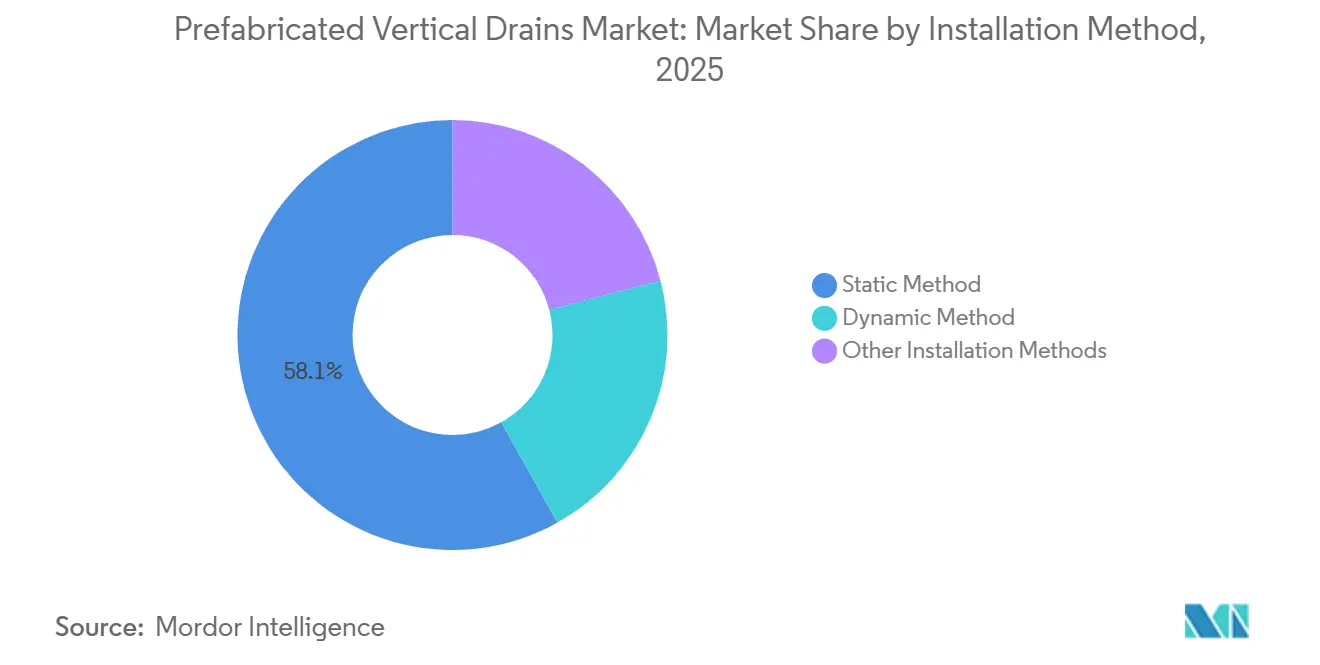
Static Installation Holds the Larger Base, While Dynamic Methods Address Difficult GroundStatic installation accounted for 58.12% of the prefabricated vertical drains market share in 2025. Contractors widely use this method because it produces less vibration near adjacent structures and works with standard hydraulic rigs. Project teams often specify static mandrel-push installation for highway embankments, levees, and runway aprons. These projects require consistent productivity across long, continuous alignments. The method also helps contractors manage cost per shift when access and ground conditions are predictable. Its established operating model maintains a large installed base across major geotechnical contractors.
Dynamic installation is projected to expand at a CAGR of 8.12% through 2031 as more projects encounter stiff intermediate layers. Vibratory hammers and impact-driven mandrels can reach design depth where static penetration is difficult. However, the method places greater mechanical stress on the drain core and filter sleeve during installation. A 2025 Lamongan North Ring Road analysis showed that restricted overhead clearance required redesigned anchor plates and modified installation sequences to protect drain integrity at a depth of 18 meters. These site conditions increase the need for engineering supervision alongside the drain supply. ISO 10318 geosynthetics testing standards provide a reference framework for filter-sleeve testing and tender documentation.
Geography Analysis
APAC Prefabricated Vertical Drains Market
Asia-Pacific accounted for 41.39% of the prefabricated vertical drains market share in 2025 and is forecast to grow at a CAGR of 8.96% through 2031. The region has coastal alluvium, large urban development programs, and established wick-drain contractors. India’s Odisha port work and the World Bank’s coastal resilience program in Karnataka and Tamil Nadu indicate demand across port and shoreline infrastructure. Japan uses the PVD method for road and rail embankments on soft ground. Its observational construction practices use settlement plates and piezometers, which may require repeated specialist supervision. Several ASEAN markets are adopting similar approaches as their contractor ecosystems mature.
North America and Europe Prefabricated Vertical Drains Market
North America and Europe are the second- and third-largest demand areas, although their project profiles differ. In North America, coastal flood-risk infrastructure and industrial-site soil improvement drive demand. The St. Tammany Parish coastal storm-risk management project in Louisiana was authorized at USD 5.9 billion under the Water Resources Development Act of 2024 and received initial federal funding in FY2026. The project includes 15 miles of earthen levees, with compressible alluvial soils that may require PVD pretreatment in some areas. Keller reported that its North America division grew faster than the broader US construction market in 2025, while ground improvement accounted for 31% of group revenue. Europe has higher unit specifications and demand for products supported by environmental declarations or lifecycle credentials.
EMEA and South America Prefabricated Vertical Drains Market
Naue’s Secudrain WAS 7 received renewed Deutsche Bahn product qualification in January 2026 under DBS 918 039, with validity through January 2029. This qualification indicates how railway requirements can support higher-specification products over lower-cost alternatives. South America, the Middle-East, and Africa remain smaller demand areas, but coastal ports and waterway projects create soft-soil treatment needs. Brazil’s port modernization and Argentina’s Paraná waterway work involve delta or coastal soil conditions that may require drainage treatment. The World Bank’s WACA+ Phase 1 program supports coastal works in Benin and Mauritania, including IDA financing of USD 128.1 million for those components. Boskalis can supply equipment and materials to coastal programs through its COFRA/CeTeau PVD business.
Competitive Landscape
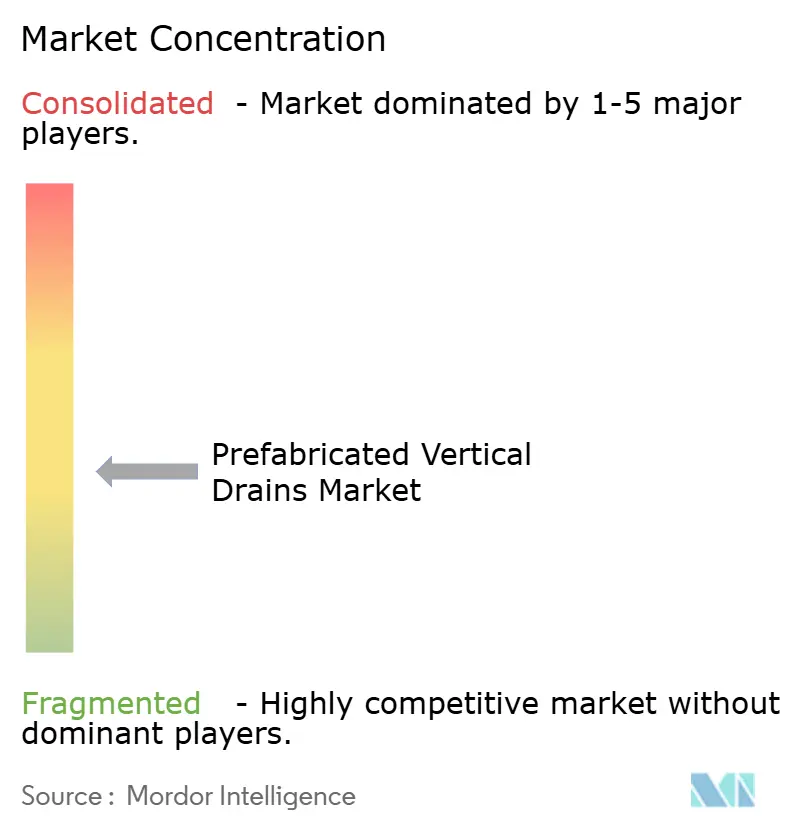
The prefabricated vertical drains market is moderately fragmented. Keller Group and Menard Group account for high installation volumes through global rig fleets and contracts across several markets. ACE Geosynthetics, TechFab India, American Wick Drain, and COFRA/CeTeau serve distinct geographic and technical niches. No single material manufacturer reportedly holds more than a mid-teen share of global PVD production, which keeps procurement options available for many project owners. Contracting has higher entry barriers, as large projects require deep-penetration rigs, monitoring systems, and rapid equipment mobilization. Material manufacturing has lower entry barriers, although product qualification and installation reliability remain important.
Keller reported that ground improvement accounted for 31% of its revenue in 2025. Solmax’s 2021 acquisition of TenCate Geosynthetics created a larger geosynthetics platform and expanded its filter-fabric supply capabilities. In May 2026, Solmax began construction of an 8-hectare geosynthetics manufacturing center in Les Mureaux, scheduled to start operations by the end of 2026. The project will consolidate nonwoven geotextile production from Linz and Bezons into one site. DAEHAN i.m.’s Bio Verti-Drain provides one example of a certified biodegradable product. COFRA’s BioDrain and Green PVD indicate another strategic focus on biobased drain materials.
Companies are also seeking value beyond the physical drain product. ACE Geosynthetics has developed sensor-enabled PVDs with integrated strain sensors for 15% of its product line. These drains can provide consolidation data that would otherwise require external settlement plates and piezometers. Digital-twin approaches for consolidation management were presented at the 21st International Conference on Soil Mechanics and Geotechnical Engineering in Vienna in 2026. Biodegradable products still face price pressure, as their premium typically ranges from 20% to 40% above conventional PVDs. Compliance with ISO 14040/44 lifecycle assessment principles and EN 13432 compostability standards is becoming more relevant in Northern European procurement.
Prefabricated Vertical Drains Industry Leaders
-
TenCate Geosynthetics
-
CeTeau B.V.
-
Boskalis
-
Menard Group
-
Keller Group plc
- *Disclaimer: Major Players sorted in no particular order
Prefabricated Vertical Drains Market Companies Covered in this Report
- ABG Limited
- ACE Geosynthetics
- American Wick Drain
- Asahi Kasei Advance Corporation
- CeTeau B.V.
- Boskalis
- Geofabrics Australasia Pty Ltd
- KAYTECH
- Keller Group plc
- Menard Group
- Naue GmbH & Co. KG
- Officine Maccaferri Spa
- TECHFABINDIA
- TenCate Geosynthetics
Recent Industry Developments in Prefabricated Vertical Drains Market
- May 2026: Solmax began construction of its European geosynthetics manufacturing center in Les Mureaux, France. The 8-hectare facility will consolidate nonwoven geotextile production from Linz and Bezons into one modernized plant, with operations scheduled to begin by the end of 2026. The expansion will increase Solmax's capacity to supply filter fabrics used in wick-drain manufacturing for European infrastructure projects.
- January 2026: Naue GmbH & Co. KG received Deutsche Bahn's renewed Herstellerprodukt-Qualifizierung (HPQ) certification for Secudrain WAS 7, qualifying the alkali-resistant drainage composite for use within the DB rail network until January 2029 under DBS 918 039. The renewal outlines the compliance requirements governing the procurement of drainage products for European high-speed and intercity rail infrastructure.
Global Prefabricated Vertical Drains Market Report Scope
Prefabricated vertical drains are geocomposite strips consisting of a plastic core wrapped in filter fabric. Contractors install them in soft, wet ground to support water discharge and improve soil stability before constructing roads or structures.
The prefabricated vertical drains market is segmented by type, application, installation method, and geography. By type, the market is segmented into sand drains, wick drains, and other types. By application, the market is segmented into infrastructure, commercial buildings, residential buildings, and other applications. By installation method, the market is segmented into static method, dynamic method, and other installation methods. The report also covers market size and forecasts for prefabricated vertical drains across 16 countries in major regions. The market sizes and forecasts are provided in terms of value (USD).
Segmentation Overview
| Sand Drains |
| Wick Drains |
| Other Types |
| Infrastructure |
| Commercial Buildings |
| Residential Buildings |
| Other Applications |
| Static Method |
| Dynamic Method |
| Other Installation Methods |
| Asia-Pacific | China |
| India | |
| Japan | |
| South Korea | |
| ASEAN Countries | |
| Rest of Asia-Pacific | |
| North America | United States |
| Canada | |
| Mexico | |
| Europe | Germany |
| United Kingdom | |
| France | |
| Italy | |
| NORDIC Countries | |
| Rest of Europe | |
| South America | Brazil |
| Argentina | |
| Rest of South America | |
| Middle-East and Africa | Saudi Arabia |
| South Africa | |
| Rest of Middle-East and Africa |
| By Type | Sand Drains | |
| Wick Drains | ||
| Other Types | ||
| By Application | Infrastructure | |
| Commercial Buildings | ||
| Residential Buildings | ||
| Other Applications | ||
| By Installation Method | Static Method | |
| Dynamic Method | ||
| Other Installation Methods | ||
| By Geography | Asia-Pacific | China |
| India | ||
| Japan | ||
| South Korea | ||
| ASEAN Countries | ||
| Rest of Asia-Pacific | ||
| North America | United States | |
| Canada | ||
| Mexico | ||
| Europe | Germany | |
| United Kingdom | ||
| France | ||
| Italy | ||
| NORDIC Countries | ||
| Rest of Europe | ||
| South America | Brazil | |
| Argentina | ||
| Rest of South America | ||
| Middle-East and Africa | Saudi Arabia | |
| South Africa | ||
| Rest of Middle-East and Africa | ||
Key Questions Answered in the Report
What is current market size of Prefabricated Vertical Drains Market?
The Prefabricated Vertical Drains Market size is projected to be USD 476.81 million in 2025, USD 510.19 million in 2026, and reach USD 744.10 million by 2031, growing at a CAGR of 7.84% from 2026 to 2031.
Which drain type leads demand?
Wick drains led with a 52.67% share in 2025 and are projected to grow at an 8.34% CAGR through 2031.
Which application has the strongest growth outlook?
Infrastructure is the largest application, with a 42.43% share in 2025, and is forecast to grow at an 8.57% CAGR through 2031.
Why are biodegradable wick drains gaining attention?
Certified biobased products can meet environmental procurement requirements while offering reported drainage performance suitable for soft-ground treatment. In the prefabricated vertical drains market, they may appeal where buyers assess lifecycle credentials alongside installation performance.