
Generator Packaging and Enclosures Market Size and Share
Market Overview
| Study Period | 2022 - 2032 |
|---|---|
| Market Size (2027) | USD 2.98 Billion |
| Market Size (2032) | USD 4.42 Billion |
| Growth Rate (2027 - 2032) | 8.22 % |
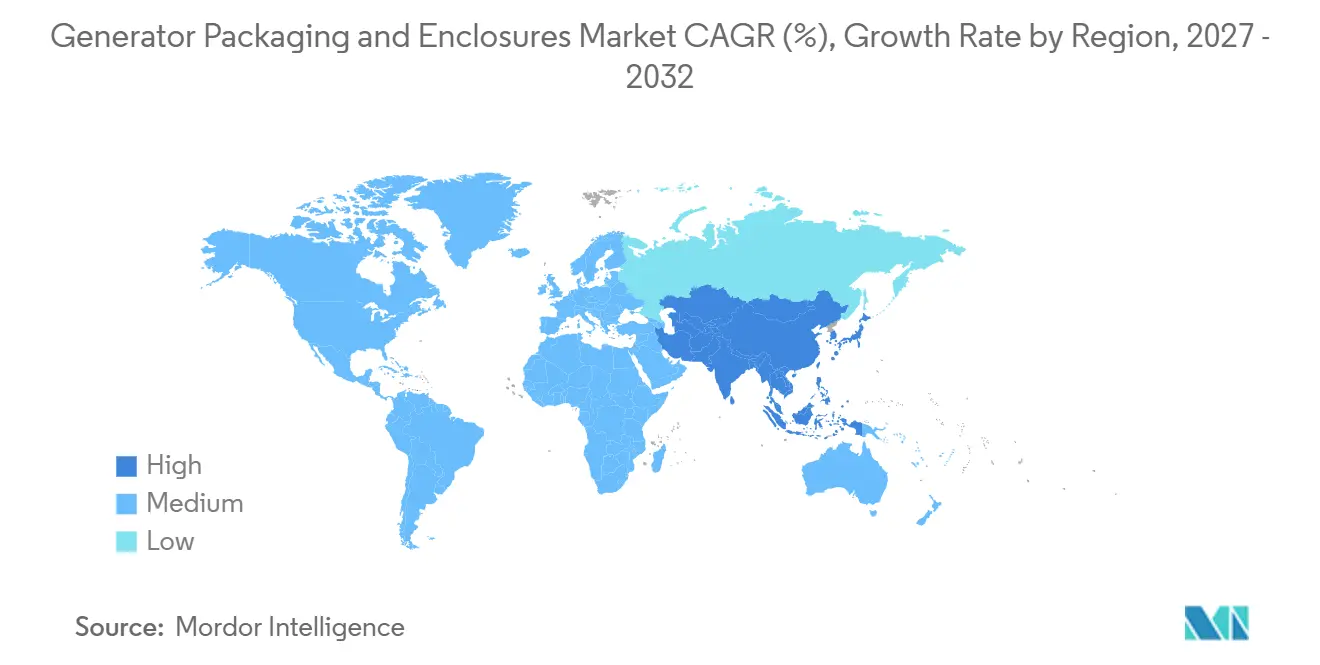
| Fastest Growing Market | Asia-Pacific |
| Largest Market | Asia-Pacific |
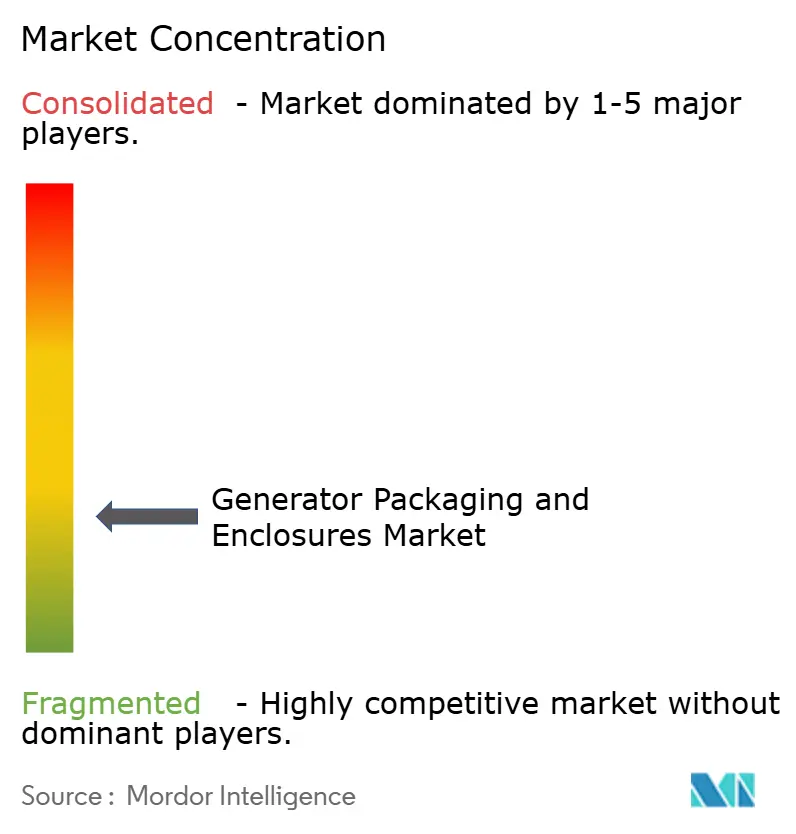
| Market Concentration | Low |
Major Players *Disclaimer: Major Players sorted in no particular order Image © Mordor Intelligence. Reuse requires attribution under CC BY 4.0. | |
Generator Packaging and Enclosures Market Analysis by Mordor Intelligence
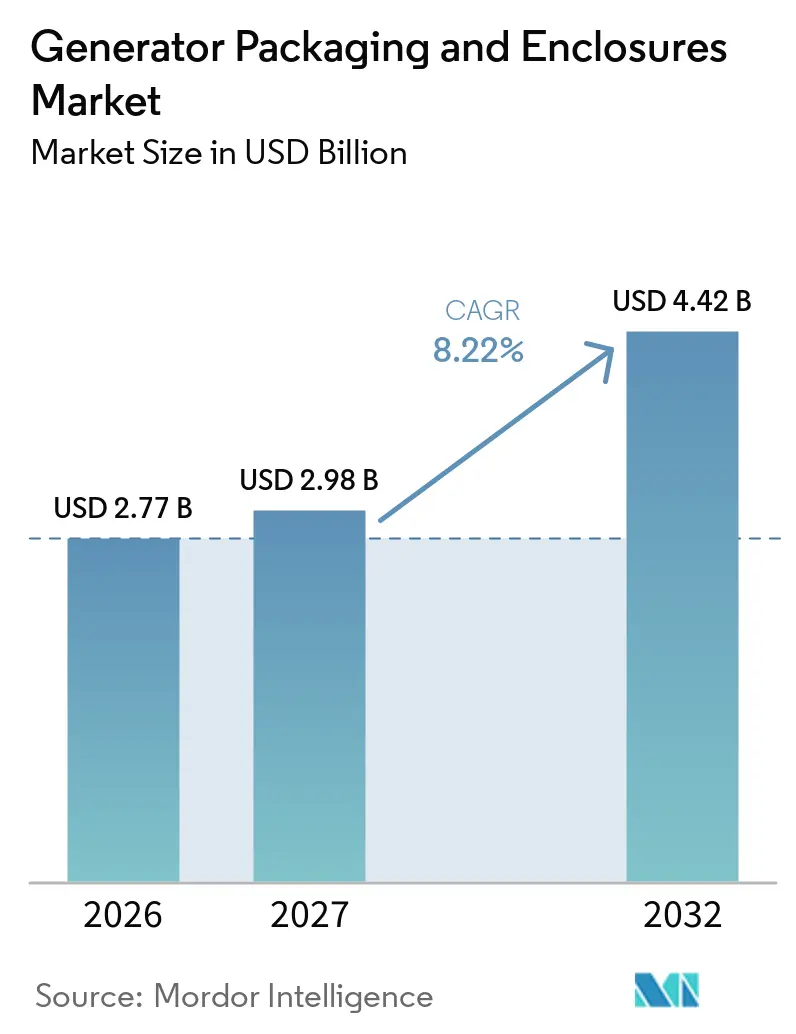
The Generator Packaging And Enclosures Market size is expected to increase from USD 2.77 billion in 2026 to USD 2.98 billion in 2027 and reach USD 4.42 billion by 2032, growing at a CAGR of 8.22% over 2027-2032. Growth is tied to data center construction, grid reliability needs, and rules that require lower noise and stronger environmental performance. Buyers increasingly specify thermal control, acoustic performance, weather protection, and remote monitoring as part of a complete power package. This changes enclosure procurement from a basic equipment purchase into a part of critical power planning. Large generator manufacturers are responding with containerized and certified product platforms, while specialist fabricators compete through customization and local approval experience. Material cost pressure and location-specific permitting will continue to shape project timing and supplier selection in the Generator packaging and enclosures market.
Key Report Takeaways
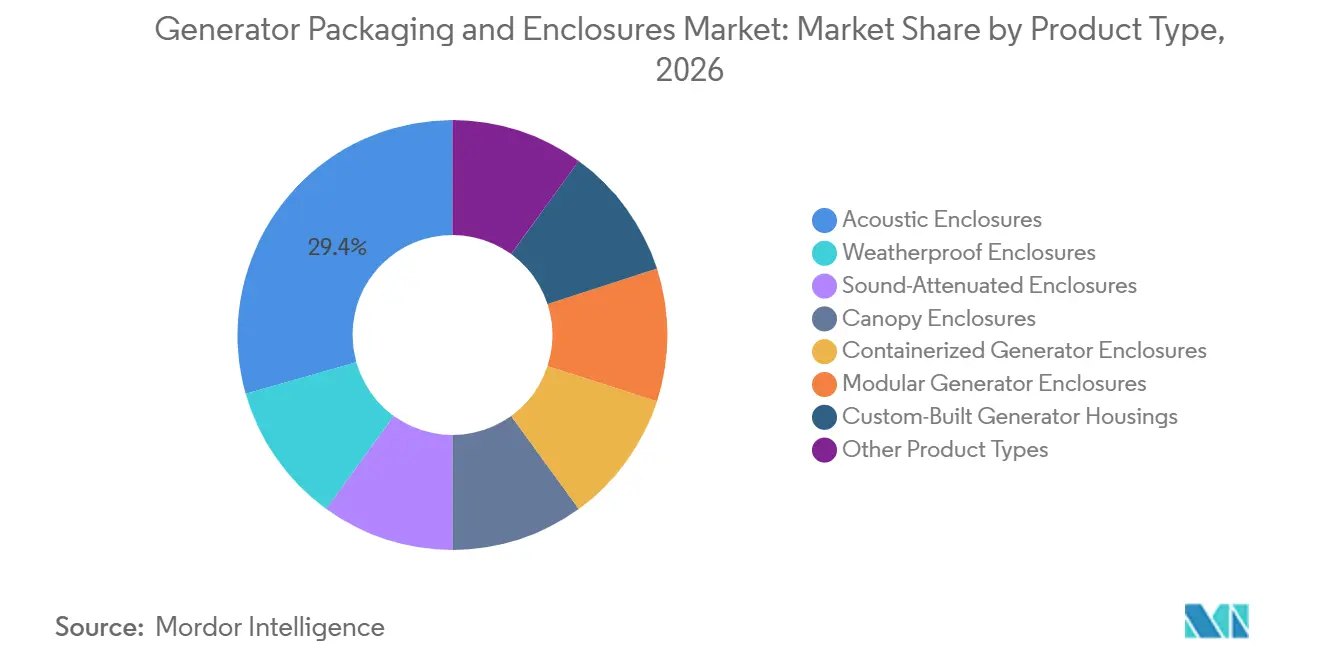
- By product type, acoustic enclosures held 29.4% of the Generator packaging and enclosures market share in 2026, while containerized generator enclosures are projected to grow at an 8.7% CAGR through 2032.
- By material, metallic materials held 84.5% of the Generator packaging and enclosures market share in 2026, while non-metallic materials are projected to grow at an 8.9% CAGR through 2032.
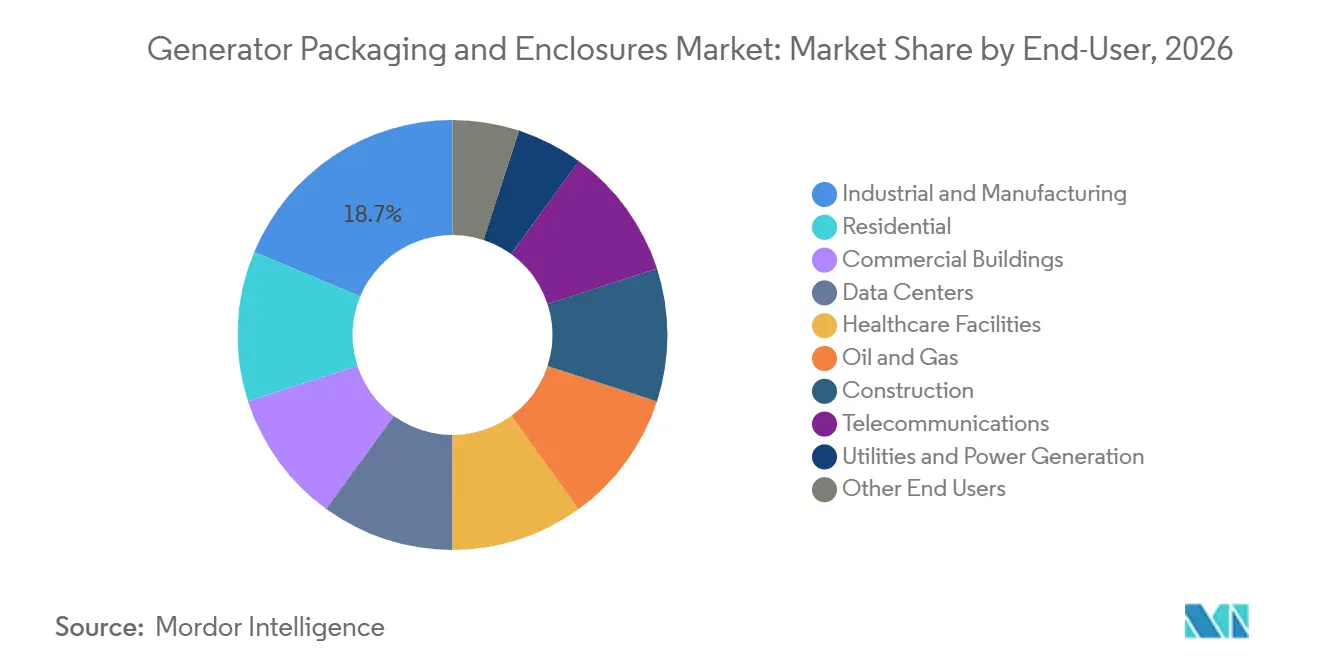
- By end-user, industrial and manufacturing held 18.7% revenue share in 2026, while data centers are projected to grow at a 13.1% CAGR through 2032.
- By geography, Asia-Pacific held 41.3% revenue share in 2026 and is projected to grow at a 9.1% CAGR through 2032.
Note: Market numbers in this report are based on Mordor Intelligence's proprietary estimation framework, which combines nine months of actuals with Q4 projections for base year 2026.
Market Trends and Insights
Drivers Impact Analysis of Generator Packaging and Enclosures Market*
| Driver | (~) % Impact on CAGR Forecast | Geographic Relevance | Impact Timeline |
|---|---|---|---|
| Data Center and Mission-Critical Power Expansion | +2.1% | Global, concentrated in North America, Asia-Pacific, China, India, and Singapore | Short term (≤ 2 years) |
| Grid Reliability Gaps and Severe-Weather Resilience | +1.4% | Asia-Pacific, North America, Middle East and Africa, and South America | Medium term (2-4 years) |
| Urban Noise and Environmental Compliance Requirements | +1.1% | Global, with strong regulatory relevance in Europe, India, and Asia-Pacific cities | Medium term (2-4 years) |
| Modular Containerization for Faster Multi-Megawatt Deployment | +1.3% | Global, with early gains in North America, Europe, and Asia-Pacific | Short term (≤ 2 years) |
| Remote Monitoring and Predictive Maintenance Integration | +0.9% | Global, with faster adoption in North America and Europe | Medium term (2-4 years) |
| Hybrid Power Systems and Battery-Integrated Enclosure Demand | +0.8% | Global, including construction, events, and remote sites | Long term (≥ 4 years) |
| Source: Mordor Intelligence | |||
Data Center and Mission-Critical Power Expansion
The Generator packaging and enclosures market is benefiting as large data center operators use generators for more than occasional standby duty. Some operators use prime power to manage long utility connection queues. This operating model raises the need for continuous thermal dissipation, acoustic control, weather protection, and remote management. Large sites can require many generator units, which creates demand for repeated enclosure packages rather than a single custom installation. India is expected to increase data center capacity from 1.5 GW to 8-10 GW by 2030, and backup power needs track information technology load growth. This demand pattern gives the Generator packaging and enclosures market a larger role in new campus design.
Grid Reliability Gaps and Severe-Weather Resilience
The Generator packaging and enclosures market also benefits from aging transmission assets and weather events that interrupt power supply. Enclosures protect generator sets in both standby and prime-power settings where exposure to rain, wind, dust, and debris can affect operating reliability. Procurement standards in hurricane-prone locations place particular weight on structural strength and weather resistance. Florida requirements for generator enclosures include demanding wind, rain intrusion, and debris conditions, which raises the design benchmark for exposed installations. Grid gaps in developing Asia-Pacific markets and the Middle East support demand across telecommunications, construction, commercial facilities, and industrial sites. This supports a recurring base of orders for the Generator packaging and enclosures market even when discretionary industrial investment slows.
Urban Noise and Environmental Compliance Requirements
The Generator packaging and enclosures market is shaped by rules that turn sound control into a compliance requirement. India’s Central Pollution Control Board sets a maximum sound pressure level of 75 dB(A) at 1 meter from the enclosure surface for generator sets up to 1,000 kVA. These limits support the use of acoustic enclosure systems near residential, commercial, and healthcare settings. European requirements also refer to noise standards for generator sets and rotating electrical equipment. Suppliers must balance noise reduction with airflow, service access, and heat removal. These requirements make compliant designs more important in the Generator packaging and enclosures market as development becomes denser.
Modular Containerization for Faster Multi-Megawatt Deployment
The Generator packaging and enclosures market is seeing faster uptake of containerized products for large data center projects. Standard 40-ft ISO container formats reduce the amount of site civil work and support intermodal transport. They can shorten installation and commissioning schedules when compared with site-built solutions. Cummins introduced its Centum Force containerized generator series in May 2025 with stackable 40-ft ISO units rated from 2,000 kVA to 2,750 kVA. The company stated that the design can provide up to 34% space utilization savings and ex-factory lead times of 16-20 weeks.[1] Mitsubishi Heavy Industries Engine System Asia launched a 2,500 kVA containerized solution in October 2025 that is designed for rapid deployment in Asia-Pacific data center applications.[2]
Restraints Impact Analysis of Generator Packaging and Enclosures Market*
| Restraint | (~) % Impact on CAGR Forecast | Geographic Relevance | Impact Timeline |
|---|---|---|---|
| Steel and Aluminum Cost Volatility | -1.2% | Global, with elevated exposure in North America and Europe | Short term (≤ 2 years) |
| Site-Specific Certification and Permitting Complexity | -0.8% | Global, with high relevance in North America, Europe, and Southeast Asia | Medium term (2-4 years) |
| Acoustic and Thermal Trade-Offs in High-Attenuation Designs | -0.5% | Global, particularly in dense urban deployments | Long term (≥ 4 years) |
| High Customization and Engineering Intensity | -0.6% | Global, with increased relevance in Middle East and Africa and South America | Medium term (2-4 years) |
| Source: Mordor Intelligence | |||
Steel and Aluminum Cost Volatility
The Generator packaging and enclosures market faces material cost pressure because steel and aluminum are core inputs for metallic panels and structural parts. The Associated General Contractors of America reported that aluminum mill shape prices rose 30.5% from December 2024 to December 2025. Steel mill product prices increased 17% during the same period.[3] In September 2026, aluminum mill shape prices were 25.2% higher year over year, and steel mill product prices were 27.6% higher.[4] Producers working under fixed-price contracts may have limited ability to pass those increases to customers. The resulting margin pressure can limit capacity expansion and complicate pricing in the Generator packaging and enclosures market.
Site-Specific Certification and Permitting Complexity
The Generator packaging and enclosures market is constrained by approvals that differ across regions and project locations. Large containerized installations may need structural wind-load certification, acoustic sign-off, environmental approval, and verification against data center standards. A design accepted in 1 jurisdiction may still need additional validation in another. The combined approval process can add 3-6 months to deployment schedules for multi-megawatt projects. These delays reduce the speed advantage that supports containerized systems. Established equipment manufacturers can benefit because their packaged offerings are already designed around multiple certification requirements.
*Our forecasts treat driver/restraint impacts as directional, not additive. The impact forecasts reflect baseline growth, mix effects, and variable interactions.
Generator Packaging and Enclosures Market Segment Analysis
By Product Type:
Acoustic Enclosures Lead While Containerized Formats ExpandAcoustic enclosures held 29.4% of revenue in 2026. Their position reflects the need to manage both generator noise and outdoor exposure at urban industrial, commercial, and institutional sites. Hospitals, office buildings, and utility installations need designs that meet local sound requirements without sacrificing equipment protection. India’s noise requirements for sets up to 1,000 kVA reinforce a compliance base for this product type. Weatherproof, sound-attenuated, and canopy products serve different performance requirements, price points, and maintenance preferences across construction and oil and gas applications.
Containerized generator enclosures are projected to expand at an 8.7% CAGR through 2032, making them the fastest-growing product category. The Generator packaging and enclosures market size for this format is supported by standard shipping dimensions that limit custom site engineering. ISO-compatible units can be transported through established freight networks and placed more quickly at the project site. Their application is strongest where data centers need multiple generators within a defined footprint. Modular enclosures and custom-built housings serve larger industrial campuses and specialized facilities with nonstandard technical requirements. These higher-specification products can command premium pricing when power, access, and environmental conditions cannot be addressed by a standard package.

By Material:
Metallic Materials Remain Dominant While Alternatives Gain InterestMetallic materials held 84.5% of revenue in 2026. Steel remains widely used because it provides proven load-bearing performance and fits established fabrication processes. Aluminum is valued for its corrosion resistance, especially at coastal and tropical sites. Rimco introduced a generator line with full aluminum enclosures in Puerto Rico and the Caribbean in February 2026. The company identified corrosion resistance in high-humidity coastal locations as the main reason for the design. These characteristics keep metallic designs central to projects that require familiar structural specifications and broad service support.
Non-metallic materials are projected to grow at an 8.9% CAGR through 2032. Higher aluminum costs narrow the ownership-cost difference between composite panels and conventional sheet metal in some applications. Polycarbonate materials developed for outdoor electrical equipment can combine lower weight with electromagnetic interference shielding and IP66 protection. Research published in 2025 found that carbon-glass fiber hybrid composites improved flexural load capacity by 26.5%-34.4% when compared with glass-fiber-only panels. Wider use in large generator systems remains limited by the lack of standardized structural specifications for non-metallic generator enclosure panels.
By End-User:
Industrial and Manufacturing Holds the Largest Position While Data Centers Grow FastestIndustrial and manufacturing held 18.7% of revenue in 2026. Continuous-process sectors such as petrochemicals, automotive production, and food processing need reliable backup power because outages can create substantial production losses. Enclosures for these sites emphasize weather protection, maintenance access, and resistance to dust, vapors, and vibration. Commercial buildings, oil and gas sites, utilities, and power generation facilities also provide steady demand. Their purchasing decisions are often tied to equipment protection and compliance rather than short-term expansion. This broad use base gives the Generator enclosures industry recurring demand across several end-user settings.
Data centers are forecast to grow at a 13.1% CAGR through 2032. Large generator ratings require purpose-built thermal and acoustic packaging, which raises enclosure value relative to small commercial standby units. Data center clients also place high importance on deployment schedules, redundancy, and certification. The result favors scalable containerized products and pre-engineered system designs. Healthcare facilities and telecommunications applications hold intermediate positions because uptime requirements remain strict. Telecommunications retains a clear need for backup power as network densification extends equipment into locations where local noise limits affect product selection.
Geography Analysis
Asia-Pacific held 41.3% of revenue in 2026 and is projected to expand at a 9.1% CAGR through 2032. This makes Asia-Pacific the largest regional position in the Generator packaging and enclosures market size and the fastest-growing region over the forecast period. India’s planned expansion in data center capacity supports demand for large generator packages and related enclosure systems. China also remains an important production base for diesel generator sets and related packaged equipment. Thailand, Malaysia, Vietnam, and Indonesia add demand from telecom, construction, and commercial installations. Grid-extension costs in rural and semi-urban areas continue to support generator use in these markets.
North America is the second-largest regional market in the Generator packaging and enclosures market. Demand reflects hyperscale investment, aging grid infrastructure, and state-level sound and emissions requirements. Data center projects favor systems that are engineered for high capacity, rapid installation, and reliable operation. Severe-weather exposure also raises the importance of structural and weatherproof construction. Europe advances at a more measured pace, supported by noise compliance requirements and demand for certified backup power. Cummins states that it has deployed more than 3.5 GW of standby power across more than 1,400 generator sets in European data centers over the past decade.
South America, the Middle East, and Africa represent smaller revenue pools but remain important to the Generator packaging and enclosures market. Brazil supports demand through industrial and commercial applications. Ecuador’s 2024-2025 electricity crisis highlighted how power disruption can increase attention to generator noise and enclosure requirements. Saudi Arabia and the United Arab Emirates provide data center-led demand in the Middle East. Egypt and South Africa add demand from industrial and telecommunications customers. These markets can favor suppliers that combine flexible product design with local approvals and service capabilities.
Competitive Landscape
The Generator packaging and enclosures market is fragmented. Caterpillar, Cummins, Generac, Rehlko, and Mitsubishi Heavy Industries package enclosure solutions with generator platforms. This approach allows them to align enclosure design with engine performance, controls, and product certification. Specialist firms such as Enercon Engineering, Freeman Enclosure Systems, and AVL Manufacturing compete through customized fabrication, faster response, and regional approval knowledge. Original equipment manufacturers are moving toward modular platforms that can be certified and supplied across multiple jurisdictions. Specialist suppliers are increasing their focus on data center-specific offerings where requirements are more demanding.
Cummins illustrates the product-platform approach through its Centum Force range. The stackable container configuration is designed for high-density installations and has ratings up to 2,750 kVA. Mitsubishi Heavy Industries Engine System Asia has also introduced the MGS2500R, a 2,500 kVA product housed in a 40-ft High Cube Container for Tier III and Tier IV data center requirements. Rimco’s February 2026 aluminum enclosure launch shows a different strategy that addresses corrosion exposure in Puerto Rico and Caribbean locations. These moves show that design choices are increasingly linked to site density, compliance needs, and operating conditions.
Hybrid packaged systems provide another area of activity in the Generator packaging and enclosures market. Atlas Copco offers modular hybrid generators that combine a diesel generator with battery energy storage in a unified product package. This type of system is relevant for construction, events, and remote applications that need lower fuel use alongside familiar generator support. Containerized designs also create value where transport, installation speed, and site footprint are decisive. Composite enclosure suppliers have an opening if they can meet acoustic and structural requirements at a cost that supports adoption. Competition will therefore depend on product integration, local compliance capability, materials expertise, and delivery speed.
Generator Packaging and Enclosures Industry Leaders
-
Caterpillar Inc.
-
Cummins Inc.
-
Generac Power Systems, Inc.
-
Kohler Co.
-
Atlas Copco AB
- *Disclaimer: Major Players sorted in no particular order
Generator Packaging and Enclosures Market Companies Covered in this Report
- ADE Power Ltd.
- AKSA Power Generation
- Atlas Copco AB
- Caterpillar Inc.
- Cummins Inc.
- Enercon Engineering, Inc.
- Falcon Structures
- FG Wilson (Engineering) Ltd.
- Freeman Enclosure Systems LLC
- Generac Power Systems, Inc.
- Global Power Components
- HIMOINSA, S.L.
- JCB Power Products
- Kirloskar Oil Engines Limited
- Kohler Co.
- Mitsubishi Heavy Industries, Ltd.
- Pramac S.p.A.
- Rolls-Royce plc
- Teksan Jeneratör Elektrik Sanayi ve Ticaret A.Ş.
- Yanmar Holdings Co., Ltd.
Recent Industry Developments in Generator Packaging and Enclosures Market
- February 2026: Rimco, Caterpillar's exclusive distributor for Puerto Rico and the Caribbean, launched a generator line with fully aluminum enclosures, replacing galvanized construction. The design addresses coastal corrosion challenges specific to humid, high-salinity environments and carries a 158-gallon diesel tank for extended runtime.
- October 2025: Mitsubishi Heavy Industries Engine System Asia launched the MGS2500R Containerized Solution at Data Centre World Asia 2025 in Singapore. Housed in a 40-ft High Cube Container, the 2,500 kVA unit is compliant with Tier III and Tier IV data center requirements and is engineered for rapid deployment and site relocation across APAC's 50 Hz markets. The launch signals MHI-ESA's intent to compete directly with Cummins and Caterpillar in packaged data-center power.
- June 2025: Cummins launched the S17, a 17-liter engine platform generator set delivering up to 1 MW from a compact footprint, assembled at its Fridley, Minnesota facility. Designed for urban environments where space is constrained, the S17 supports HVO fuel flexibility and carries a three-year base warranty, targeting healthcare, water treatment, and commercial property segments.
- May 2025: Cummins introduced the Centum Force containerized generator series for European markets, offering models from 2,000 kVA to 2,750 kVA in stackable 40-ft ISO containers. The first commercial sale was 24 units to UK modular data center provider Durata, backed by a three-year service plan. The product directly addresses customer concerns about deployment time, enclosure footprint, and transport cost.
Global Generator Packaging and Enclosures Market Report Scope
The Global Generator Packaging and Enclosures Market refers to the market for protective housings and enclosure systems designed to accommodate and safeguard generators from environmental exposure, physical damage, and operational noise. These enclosures include acoustic, weatherproof, canopy, containerized, modular, and custom-built designs manufactured using metallic and non-metallic materials. They support noise reduction, weather protection, ventilation, thermal management, and operational safety across residential, commercial, industrial, and infrastructure applications.
The global generator packaging and enclosures market is segmented by product type, material, end-user, and geography. By product type, the market is segmented into acoustic enclosures, weatherproof enclosures, sound-attenuated enclosures, canopy enclosures, containerized generator enclosures, modular generator enclosures, custom-built generator housings, and other product types. By material, the market is segmented into metallic materials and non-metallic materials. By end-user, the market is segmented into residential, commercial buildings, industrial and manufacturing, data centers, healthcare facilities, oil and gas, construction, telecommunications, utilities and power generation, and other end users. The report also covers the market size and forecasts for the global generator packaging and enclosures market across 26 countries in key regions. For each segment, the market sizing and forecasts are provided on the basis of value (USD).
Segmentation Overview
| Acoustic Enclosures |
| Weatherproof Enclosures |
| Sound-Attenuated Enclosures |
| Canopy Enclosures |
| Containerized Generator Enclosures |
| Modular Generator Enclosures |
| Custom-Built Generator Housings |
| Other Product Types |
| Metallic Materials |
| Non-Metallic Materials |
| Residential |
| Commercial Buildings |
| Industrial and Manufacturing |
| Data Centers |
| Healthcare Facilities |
| Oil and Gas |
| Construction |
| Telecommunications |
| Utilities and Power Generation |
| Other End Users |
| North America | United States |
| Canada | |
| Mexico | |
| Europe | Germany |
| France | |
| Italy | |
| Spain | |
| United Kingdom | |
| Poland | |
| Russia | |
| Rest of Europe | |
| Asia-Pacific | China |
| India | |
| Japan | |
| South Korea | |
| Australia | |
| Indonesia | |
| Vietnam | |
| Thailand | |
| Rest of Asia-Pacific | |
| South America | Brazil |
| Argentina | |
| Chile | |
| Rest of South America | |
| Middle East and Africa | Saudi Arabia |
| United Arab Emirates | |
| Egypt | |
| South Africa | |
| Morocco | |
| Rest of Middle East and Africa |
| By Product Type | Acoustic Enclosures | |
| Weatherproof Enclosures | ||
| Sound-Attenuated Enclosures | ||
| Canopy Enclosures | ||
| Containerized Generator Enclosures | ||
| Modular Generator Enclosures | ||
| Custom-Built Generator Housings | ||
| Other Product Types | ||
| By Material | Metallic Materials | |
| Non-Metallic Materials | ||
| By End-User | Residential | |
| Commercial Buildings | ||
| Industrial and Manufacturing | ||
| Data Centers | ||
| Healthcare Facilities | ||
| Oil and Gas | ||
| Construction | ||
| Telecommunications | ||
| Utilities and Power Generation | ||
| Other End Users | ||
| By Geography | North America | United States |
| Canada | ||
| Mexico | ||
| Europe | Germany | |
| France | ||
| Italy | ||
| Spain | ||
| United Kingdom | ||
| Poland | ||
| Russia | ||
| Rest of Europe | ||
| Asia-Pacific | China | |
| India | ||
| Japan | ||
| South Korea | ||
| Australia | ||
| Indonesia | ||
| Vietnam | ||
| Thailand | ||
| Rest of Asia-Pacific | ||
| South America | Brazil | |
| Argentina | ||
| Chile | ||
| Rest of South America | ||
| Middle East and Africa | Saudi Arabia | |
| United Arab Emirates | ||
| Egypt | ||
| South Africa | ||
| Morocco | ||
| Rest of Middle East and Africa | ||
Key Questions Answered in the Report
What is the projected size of generator enclosures in 2032?
The Generator packaging and enclosures market is forecast to reach USD 4.42 billion by 2032, expanding at an 8.22% CAGR from 2027. Data center construction, grid reliability needs, and compliance requirements support this outlook.
Which product category is expanding fastest?
Containerized generator enclosures are projected to grow at an 8.7% CAGR through 2032. Standardized ISO formats can reduce site work, support transport, and shorten installation schedules for larger projects.
Why are acoustic enclosures widely used?
Acoustic enclosures held 29.4% revenue share in 2026 because they address noise control and equipment protection at commercial and urban sites. They are especially relevant where hospitals, offices, and utilities must meet sound requirements.
Which end-user has the highest forecast growth?
Data centers are projected to grow at a 13.1% CAGR through 2032. Their high-capacity generator requirements increase the need for thermal management, acoustic performance, redundancy, and rapid installation.
Which region leads global demand?
Asia-Pacific held 41.3% revenue share in 2026 and is forecast to expand at a 9.1% CAGR through 2032. Data center development, generator production, and grid infrastructure gaps support regional demand.
What is the principal cost challenge for suppliers?
Steel and aluminum cost volatility can compress margins for suppliers that use metallic panels and work under fixed-price contracts. Higher input costs can also affect pricing, lead times, and capacity decisions.