
Gel Warmers Market Size and Share
Market Overview
| Study Period | 2020 - 2031 |
|---|---|
| Market Size (2026) | USD 125.66 Million |
| Market Size (2031) | USD 161.91 Million |
| Growth Rate (2026 - 2031) | 5.20 % |
| Fastest Growing Market | Asia-Pacific |
| Largest Market | North America |
| Market Concentration | Medium |
Major Players *Disclaimer: Major Players sorted in no particular order Image © Mordor Intelligence. Reuse requires attribution under CC BY 4.0. | |
Gel Warmers Market Analysis by Mordor Intelligence
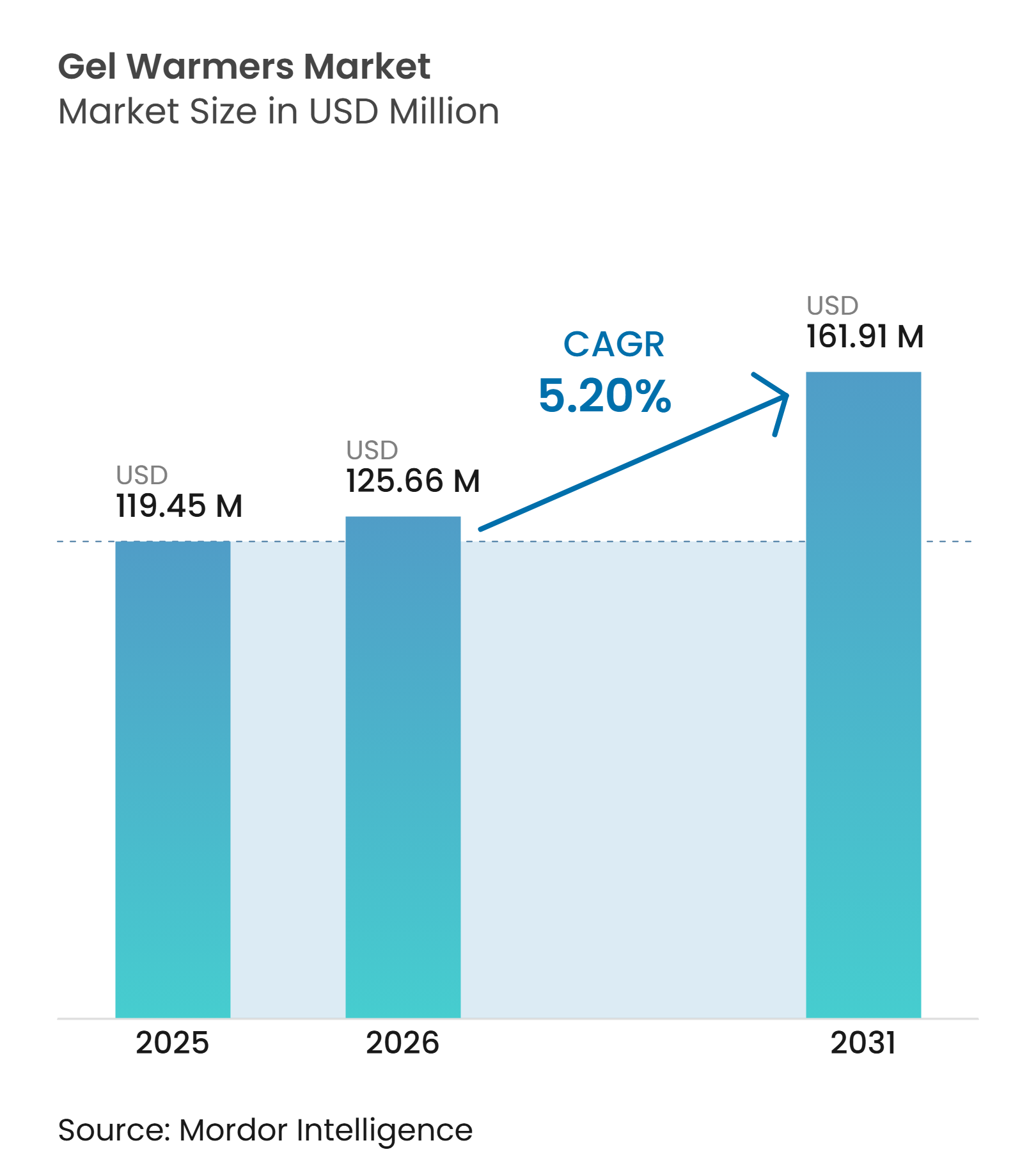
The Gel Warmers Market size was valued at USD 119.45 million in 2025 and is estimated to grow from USD 125.66 million in 2026 to reach USD 161.91 million by 2031, at a CAGR of 5.20% during the forecast period (2026-2031).
The broader adoption of diagnostic ultrasound and the increasing focus on patient comfort drive growth in the gel warmers market. Point-of-care ultrasound is expanding into ambulatory and outpatient settings, increasing demand for practical warming equipment. High-throughput imaging facilities are adopting standardized gel-packet procedures, supporting recurring procurement and requirements for storage, availability, and temperature verification. Suppliers are enhancing product offerings through temperature control, energy-efficient designs, compliance documentation, and bundled distribution, although lower-cost private-label products continue to pressure the entry-level single-bottle category.
Key Report Takeaways
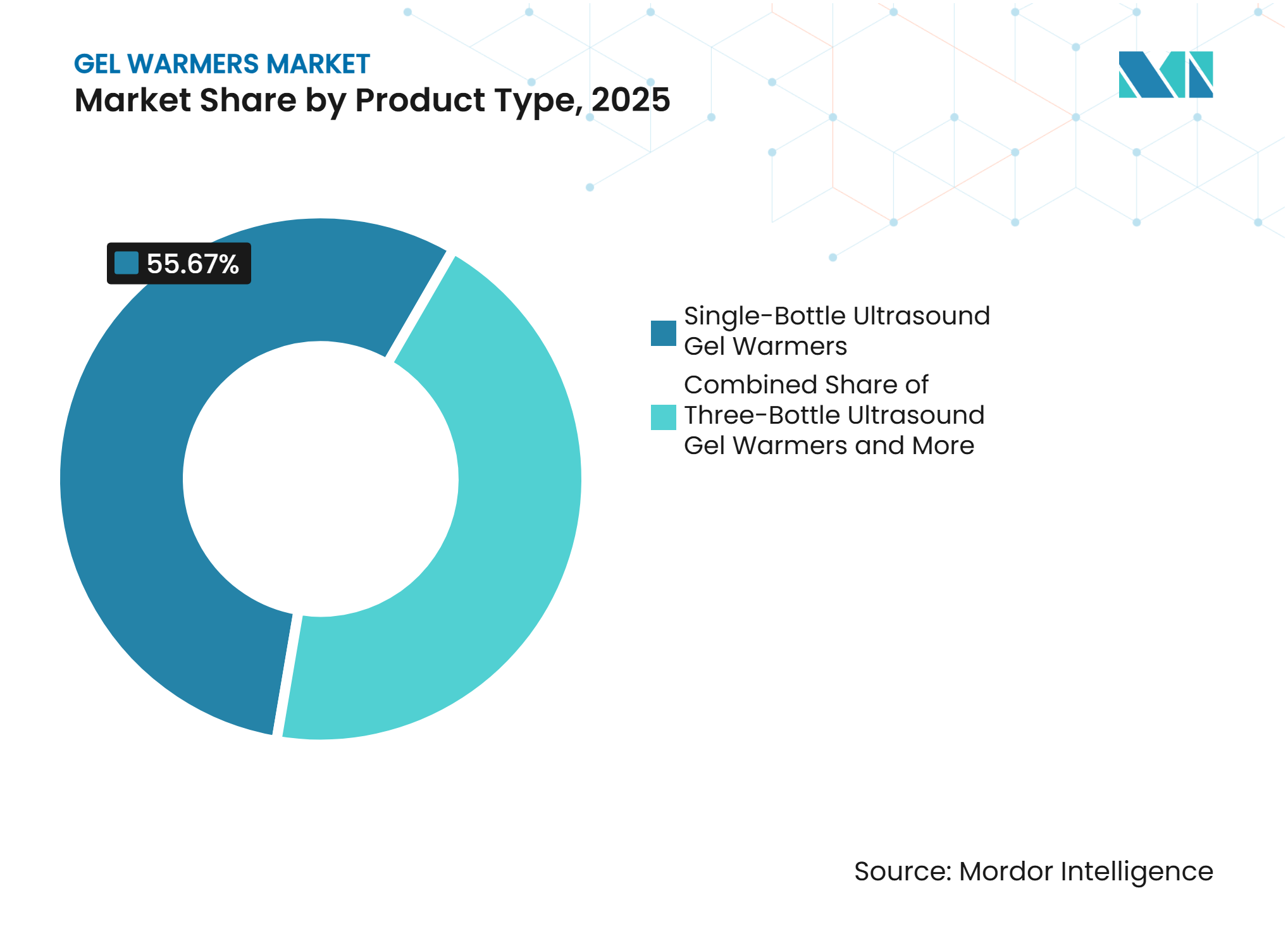
- By product type, single-bottle ultrasound gel warmers held 55.67% of the gel warmers market share in 2025 and are projected to grow at a CAGR of 6.20% through 2031.
- By mode of operation, automatic units held 55.45% revenue share in 2025, while manual units are projected to record the highest CAGR of 5.46% through 2031.
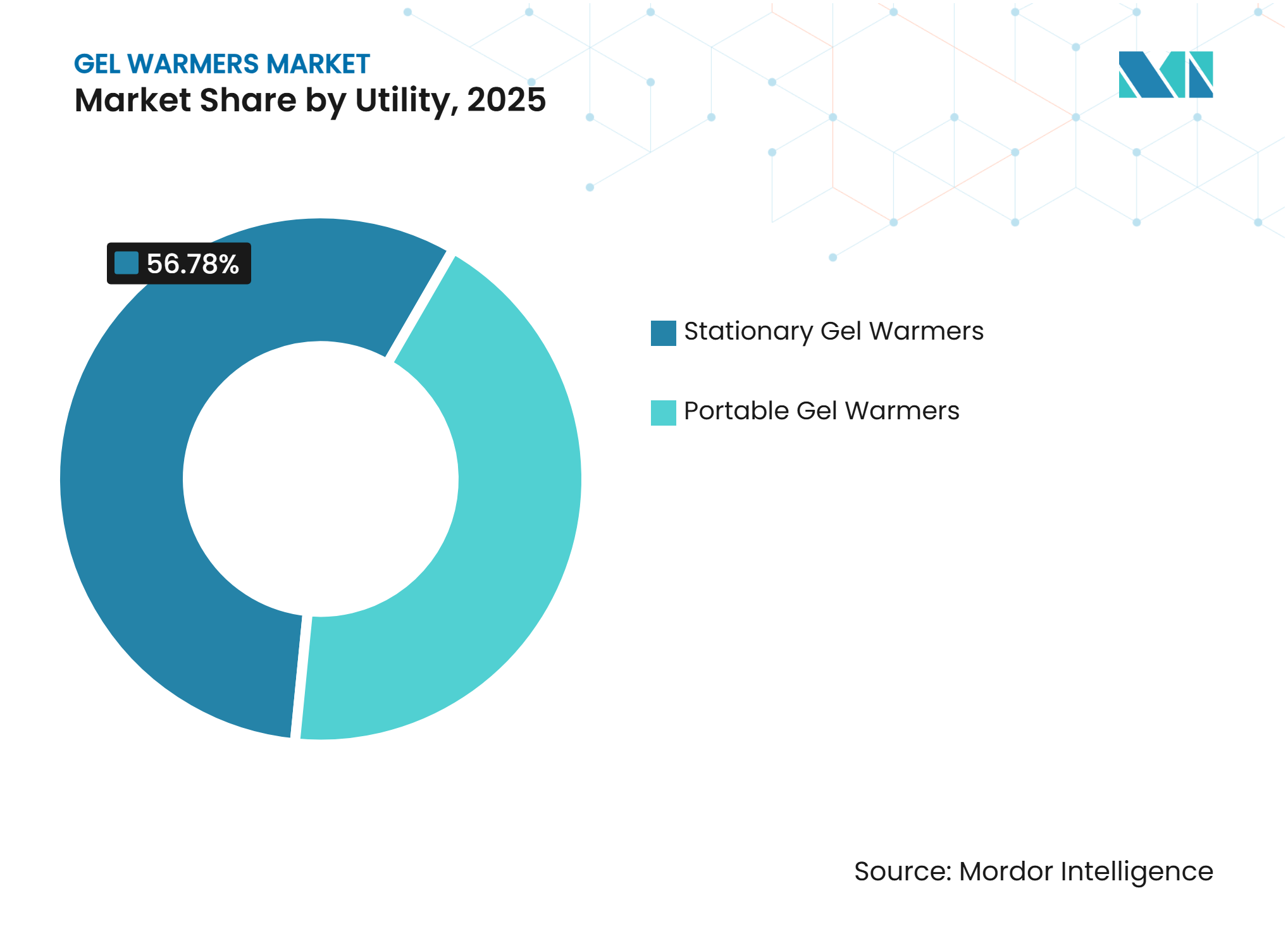
- By utility, stationary units accounted for 56.78% revenue share in 2025, while portable units are projected to grow at a CAGR of 6.67% through 2031.
- By application, hospitals held 48.76% revenue share in 2025, while diagnostic laboratories are expected to grow at a CAGR of 5.77% through 2031.
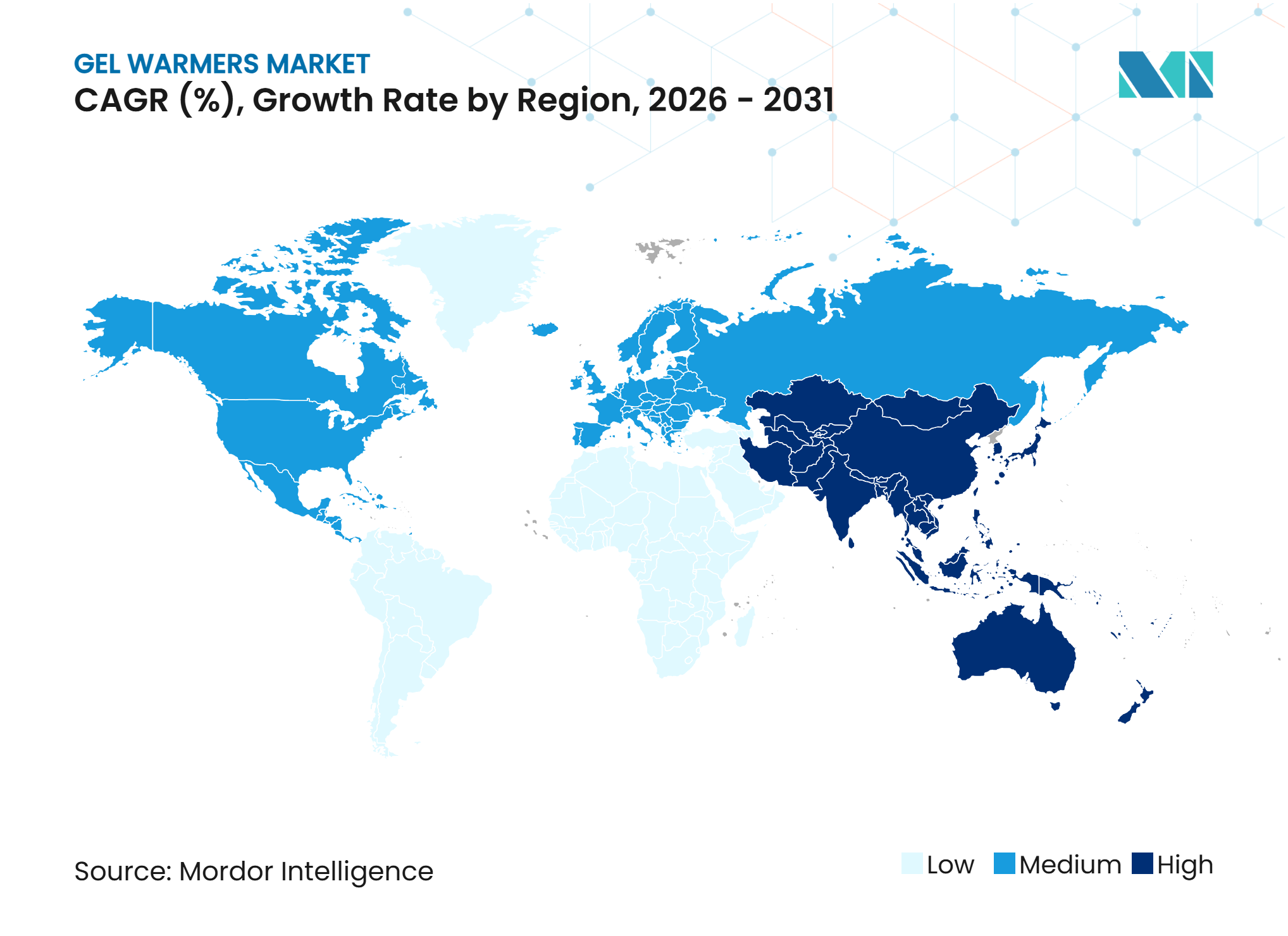
- By geography, North America held 41.23% revenue share in 2025, while Asia-Pacific is projected to grow at a CAGR of 5.98% through 2031.
Note: Market size and forecast figures in this report are generated using Mordor Intelligence’s proprietary estimation framework, updated with the latest available data and insights as of January 2026.
Market Trends and Insights
Drivers Impact Analysis of Gel Warmers Market*
| Driver | (~) % Impact on CAGR Forecast | Geographic Relevance | Impact Timeline |
|---|---|---|---|
| Growth in ultrasound-based diagnostics | +1.8% | Global | Long term (≥ 4 years) |
| Healthcare infrastructure expansion | +1.5% | APAC core, spillover to MEA and South America | Medium term (2-4 years) |
| Increasing focus on patient comfort | +0.8% | Global | Short term (≤ 2 years) |
| Energy-efficient and temperature-controlled designs | +0.7% | North America and Europe | Long term (≥ 4 years) |
| Standardized gel-packet workflows in high-throughput imaging | +0.6% | North America and Europe | Medium term (2-4 years) |
| Procurement resilience in underserved diagnostic markets | +0.5% | MEA, South America, and the Rest of APAC | Long term (≥ 4 years) |
| Source: Mordor Intelligence | |||
Growth In Ultrasound-Based Diagnostics
The growing use of diagnostic ultrasound across obstetrics, cardiology, musculoskeletal imaging, and emergency medicine supported demand for gel warmers. Regular ultrasound procedures generated recurring demand for warmed gel. The World Health Organization included ultrasound in its Essential Diagnostics List for primary health care settings, supporting broader ultrasound adoption across primary care and ambulatory facilities.[1] These settings favored portable and battery-operated gel warmers for use across multiple examination rooms and changing patient volumes.
Healthcare Infrastructure Expansion
New diagnostic facilities in developing health systems created demand beyond replacement purchases in North America and Europe. Fujifilm Nura planned to establish 100 screening centers globally by 2030, including 30 centers in India. These facilities introduced imaging equipment to locations with limited formal gel-warming procedures, creating demand for accessories during equipment procurement. Cost-sensitive facilities often selected compact automatic single-bottle products, while hospital modernization initiatives in India expanded the customer base for diagnostic accessories.
Increasing Focus On Patient Comfort
Patient comfort gained importance in ultrasound workflows, particularly for prenatal and pediatric examinations. Warm gel improved the examination experience and supported consistent acoustic coupling, positioning gel warmers as a clinical workflow requirement rather than a patient-preference feature. Parker Laboratories issued updated Instructions for Use for its single-bottle and multi-bottle Thermasonic gel warmers in its 2026 catalog. Automatic units with microprocessor controls also helped maintain stable operating temperatures during high-volume clinical schedules.
Energy-Efficient And Temperature-Controlled Designs
Manufacturers designed gel warmers with lower-power controls and more precise temperature management to align with hospitals’ focus on energy efficiency, safety, and equipment reliability. Newer products provided more accurate temperature control than older resistive heating designs. The FDA recognized IEC 60601-2-35 Edition 2.1 for medical heating equipment, increasing the value of products designed for thermal safety and temperature uniformity. Remote monitoring features also helped staff identify temperature deviations and reduce manual oversight across multiple examination rooms.
Restraints Impact Analysis of Gel Warmers Market*
| Restraint | (~) % Impact on CAGR Forecast | Geographic Relevance | Impact Timeline |
|---|---|---|---|
| Medical-safety and electrical-compliance requirements | -0.5% | North America and Europe | Medium term (2-4 years) |
| Product commoditization and price-based competition | -0.4% | Global | Short term (≤ 2 years) |
| Calibration drift and limited after-sales service capacity | -0.3% | MEA, South America, and the Rest of APAC | Long term (≥ 4 years) |
| Low standalone budget visibility in diagnostic procurement | -0.3% | Global | Medium term (2-4 years) |
| Source: Mordor Intelligence | |||
Medical-Safety And Electrical-Compliance Requirements
Medical heating devices face stringent safety and electrical compliance requirements. The FDA will accept declarations of conformity to IEC 60601-2-35 Edition 2 until July 2, 2028. After this date, the FDA will accept only Edition 2.1 declarations under the stated transition. Updated certification can require changes to product documentation, temperature testing, and durability records. These requirements may strengthen suppliers with established compliance programs, documentation processes, and product-testing capabilities in the gel warmers market.
Product Commoditization And Price-Based Competition
Price competition is strongest in the single-bottle stationery category, which held a 55.67% share in 2025. Manufacturers in China supply cost-focused heating platforms to private-label distributors, increasing pressure on established brands. Buyers compare energy use, service arrangements, replacement parts, and purchase prices. Portable and Bluetooth-enabled products retain stronger pricing support through differentiated features. Suppliers are adopting antimicrobial surfaces, connectivity, and infection-control functions to reduce direct price competition in the gel warmers market.
*Our forecasts treat driver/restraint impacts as directional, not additive. The impact forecasts reflect baseline growth, mix effects, and variable interactions.
Gel Warmers Market Segment Analysis
By Product Type:
Single-Bottle Format Anchors Volume And Preserves GrowthSingle-bottle units held 55.67% of the gel warmers market share in 2025 and are forecast to grow at a CAGR of 6.20% through 2031. Their compact footprint and lower acquisition cost support adoption across private practices, clinics, and smaller imaging centers requiring room-level installations. Hospitals also use these units to maintain dedicated gel supplies and standardized workflows across examination rooms. Segment growth reflects replacement demand in mature markets and first-time installations in developing health systems.
Three-bottle warmers remain relevant for large ultrasound departments and imaging centers with multiple active bays that require uninterrupted gel availability. The other category includes 20-gram packet warmers and units designed for single-use gel packets in interventional and sterile procedures. These formats address distinct clinical requirements, with bottle-based equipment supporting routine scanning and packet-based products meeting infection-control needs.



By Mode Of Operation:
Automatic Dominance Meets Manual Resurgence In POCUS SettingsAutomatic units accounted for 55.45% of revenue in 2025. Demand is driven by hands-free temperature maintenance in hospital departments and imaging centers with high patient volumes. Microprocessor-controlled products maintain selected operating temperatures consistently, reducing the need for repeated staff checks. Automatic models also support wireless temperature monitoring and routine equipment oversight.
Manual units are forecast to grow at a CAGR of 5.46% through 2031. They are suited to point-of-care ultrasound applications in emergency medicine, field hospitals, mobile screening teams, and community clinics. Their limited electronic components make them practical where calibration, repair, and maintenance support are limited. Automatic products lead high-throughput settings, while manual units address demand for durability and operational simplicity.
By Utility:
Stationary Base Remains Dominant But Portable Gel Warmers Lead Forecast GrowthStationary equipment held a 56.78% revenue share in 2025. Hospitals and larger imaging centers use wall-mounted and countertop units to provide continuous warming with limited user intervention. These configurations suit examination rooms with stable patient volumes and established power access. Parker Laboratories offers Thermasonic gel warmers in 120V and 230V CE configurations with UL and CSA listings.
Portable warmers are forecast to grow at a CAGR of 6.67% through 2031. They support point-of-care ultrasound, bedside imaging, emergency medicine, anesthesiology, and mobile diagnostic services. Rechargeable designs enable gel warming without reliance on wall outlets. In April 2025, VCOMIN introduced a portable gel-warming pouch for mobile and ambulance applications with a two-hour warm-gel hold time.

By Application:
Hospitals Lead Revenue, Diagnostic Laboratories Gain MomentumHospitals held 48.76% of application revenue in 2025. Their supplier relationships, group purchasing memberships, and capital equipment budgets position them as the largest purchasing channel. Procurement teams also prioritize infection-control procedures, favoring closed and temperature-verified systems where documented processes are required. Medline reported FY2025 net sales of USD 28.4 billion and customer signings that included the U.S. Department of Veterans Affairs and major faith-based integrated delivery networks.
Diagnostic laboratories are forecast to grow at a CAGR of 5.77% through 2031, supported by the expansion of independent laboratory chains and diagnostic franchises in Asia-Pacific. Standardized ultrasound-guided sample collection creates repeatable equipment requirements within laboratory workflows. Academic institutions prioritize durability and training suitability, while imaging centers favor high-capacity units. Clinics and private practices commonly select entry-level automatic single-bottle equipment because of its affordability and simplicity.
Geography Analysis
North America held 41.23% of revenue in 2025, supported by established group purchasing structures, high outpatient imaging capacity, and stringent device compliance requirements. Parker Laboratories received a national group purchasing agreement from Premier, Inc., effective June 1, 2026. The agreement covers Thermasonic gel warmers and other ultrasound-related products, supporting access through broader clinical purchasing arrangements. The United States remains the largest contributor, driven by hospital demand and a substantial outpatient imaging base.
Canada contributes demand through compliance practices that often align with the United States. Mexico adds volume in a cost-sensitive environment, where mid-range equipment competes with premium products. Europe is the second-largest regional contributor, with Germany, the United Kingdom, and France supporting demand for CE-certified automatic warmers. EU MDR 2017/745 documentation requirements increase the importance of product records, instructions for use, and post-market support. Germany and France use three-bottle stationary products in larger ultrasound suites, while the United Kingdom favors portable single-bottle products in decentralized imaging settings.
Asia-Pacific is the fastest-growing region, with a CAGR of 5.98% through 2031. China combines a large supply base with increasing demand from modernizing urban hospitals, while India supports new installations through expanding diagnostic networks and hospital modernization programs. Fujifilm Nura is planning 30 AI-enabled diagnostic centers in India by 2030. Japan, South Korea, and Australia contribute replacement demand from established imaging networks. Brazil and Argentina remain the larger South American country markets, while Ghana's planned diagnostic center investment indicates potential demand in Africa.
Competitive Landscape
Market Concentration
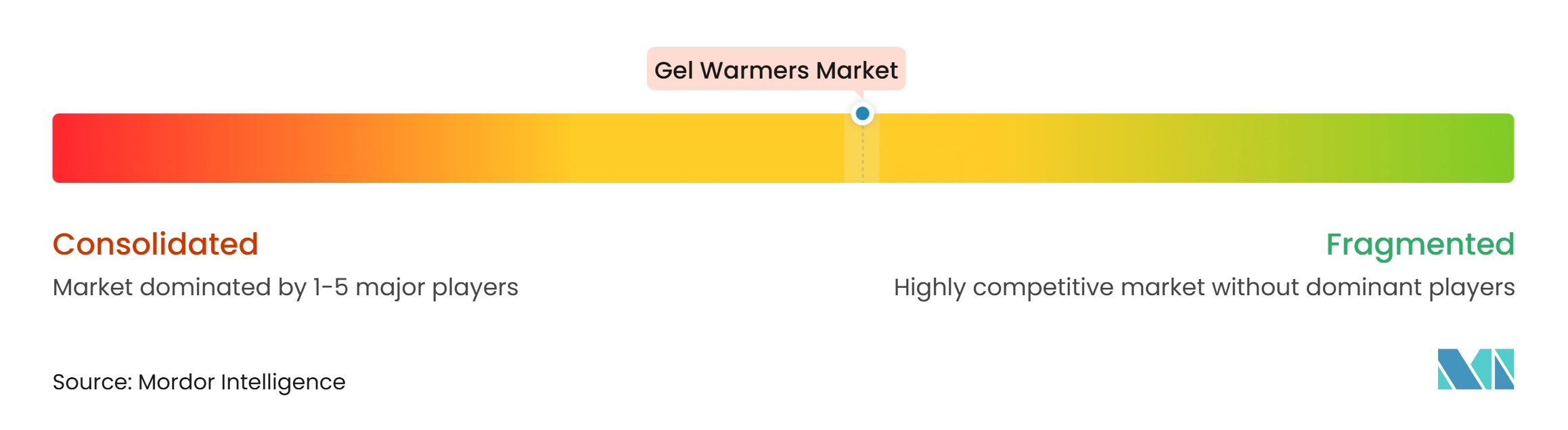
The gel warmers market is moderately fragmented. Parker Laboratories, CIVCO Medical Instruments, Medline Industries, Softgel International, Imotek, and Cadmet compete through product coverage, compliance support, and distribution reach. Parker Laboratories maintains a strong position in North America through its Thermasonic range, regulatory certifications, and ultrasound consumables portfolio. The company received a Premier national group purchasing agreement effective June 1, 2026, covering Thermasonic gel warmers and Aquasonic 100 Ultrasound Transmission Gel. This arrangement expands its access to hospital and health system purchasing networks.
CIVCO distributes Thermasonic warmers through its ultrasound accessory portfolio, expanding product access beyond direct sales channels. Competition is strongest in the single-bottle stationary segment, where lower-cost private-label products pressure established suppliers. Products offering portability, remote monitoring, or specialized temperature controls face less direct price competition. Suppliers in these segments compete on reliability, documentation, and service support rather than unit cost alone. VCOMIN launched a Wireless Bluetooth Monitoring Gel Warmer in August 2025, enabling healthcare staff to monitor and adjust temperature settings through a mobile application.
Medline completed its initial public offering in FY2025 and reported net sales of USD 28.4 billion. The company expanded its U.S. distribution center network through robotic automation, added capacity at its Mexico kitting facility, and deployed Mpower, an AI-enabled supply chain control tower developed with Microsoft. These initiatives strengthen medical supply distribution infrastructure and support gel warmer availability. Multifunctional devices combining warming and infection-control functions remain a potential product development area. The market remains moderately fragmented, as available information identifies several suppliers but does not specify their combined market share.
Gel Warmers Industry Leaders
-
Parker Laboratories, Inc.
-
CIVCO Medical Instruments Co., Inc.
-
AliMed, LLC
-
Medline Industries, LP
-
Imotek
- *Disclaimer: Major Players sorted in no particular order
Gel Warmers Market Companies Covered in this Report
- AliMed, LLC
- Beurer
- Breg
- Cadmet, Inc.
- Caldera International, Inc.
- Cardinal Health
- CIVCO Medical Instruments Co., Inc.
- Core Products International, Inc.
- Enovis Corporation
- Ideal Products
- Imotek
- Medline Industries
- Mueller Sports Medicine, Inc.
- Next Medical Products
- Nortech Laboratories, Inc.
- Parker Laboratories, Inc.
- Performance Health Holdings Corp.
- Polar Products, Inc.
- Rapid Aid Corporation
- Softgel International
- VERMED
Recent Industry Developments in Gel Warmers Market
- June 2026: Parker Laboratories secured a national group purchasing agreement with Premier, Inc., expanding access to its U.S. hospital and health system network for gel warmers, ultrasound gel, disinfectant foam, and barrier dressings.
- April 2026: Bard Access Systems received U.S. Patent 12,605,476 for a UV-enabled ultrasound gel treatment station designed to maintain clinical gel temperatures while sterilizing bottles and reducing infection-control risks.
- August 2025: VCOMIN launched a Bluetooth-enabled gel warmer that allowed health care professionals to monitor and adjust temperatures through a mobile application, with heating to 35°C–40°C within three minutes.
Global Gel Warmers Market Report Scope
As per the scope of the report, a gel warmer is an electronic device designed to heat bottles or packets of medical and cosmetic gels, most commonly ultrasound gel, massage lotions, or physio oils, to body temperature for patient comfort.
The gel warmers market is segmented by product type, mode of operation, utility, application, and geography. By product type, the market includes single-bottle ultrasound gel warmers, three-bottle ultrasound gel warmers, and others. By mode of operation, the market is segmented into automatic and manual gel warmers. By utility, the market is categorized into stationary gel warmers and portable gel warmers. By application, the market is segmented into hospitals, academic institutions, diagnostic laboratories, clinics and private practices, imaging centers, and ambulatory and outpatient facilities. By geography, the market is analyzed across North America, Europe, Asia-Pacific, the Middle East and Africa, and South America. The report also covers estimated market sizes and trends for 17 countries across major regions globally. The report provides market sizes and forecasts in terms of value (USD) for the above segments.
Segmentation Overview
| Single-Bottle Ultrasound Gel Warmers |
| Three-Bottle Ultrasound Gel Warmers |
| Others |
| Automatic |
| Manual |
| Stationary Gel Warmers |
| Portable Gel Warmers |
| Hospitals |
| Academic Institutions |
| Diagnostic Laboratories |
| Clinics and Private Practices |
| Imaging Centers |
| Ambulatory and Outpatient Facilities |
| North America | United States |
| Canada | |
| Mexico | |
| Europe | Germany |
| United Kingdom | |
| France | |
| Italy | |
| Spain | |
| Rest of Europe | |
| Asia-Pacific | China |
| India | |
| Japan | |
| Australia | |
| South Korea | |
| Rest of Asia-Pacific | |
| Middle East and Africa | GCC |
| South Africa | |
| Rest of Middle East and Africa | |
| South America | Brazil |
| Argentina | |
| Rest of South America |
| By Product Type | Single-Bottle Ultrasound Gel Warmers | |
| Three-Bottle Ultrasound Gel Warmers | ||
| Others | ||
| By Mode of Operation | Automatic | |
| Manual | ||
| By Utility | Stationary Gel Warmers | |
| Portable Gel Warmers | ||
| By Application | Hospitals | |
| Academic Institutions | ||
| Diagnostic Laboratories | ||
| Clinics and Private Practices | ||
| Imaging Centers | ||
| Ambulatory and Outpatient Facilities | ||
| By Geography | North America | United States |
| Canada | ||
| Mexico | ||
| Europe | Germany | |
| United Kingdom | ||
| France | ||
| Italy | ||
| Spain | ||
| Rest of Europe | ||
| Asia-Pacific | China | |
| India | ||
| Japan | ||
| Australia | ||
| South Korea | ||
| Rest of Asia-Pacific | ||
| Middle East and Africa | GCC | |
| South Africa | ||
| Rest of Middle East and Africa | ||
| South America | Brazil | |
| Argentina | ||
| Rest of South America | ||
Key Questions Answered in the Report
What is driving demand for gel warmers?
Diagnostic ultrasound expansion, point-of-care imaging, and patient-comfort practices support demand for warming equipment. The gel warmers market also benefits when facilities standardize preparation procedures and purchase related equipment through more regular clinical supply arrangements.
How large is the gel warmers market in 2026?
The gel warmers market was valued at USD 125.66 million in 2026 and is forecast to reach USD 161.91 million by 2031. The forecast reflects a CAGR of 5.20% from 2026 to 2031, based on the supplied research data.
Which gel warmer product type leads sales?
Single-bottle units led with 55.67% share in 2025 and are projected to grow at a CAGR of 6.20% through 2031. Their size, cost, and suitability for room-level use support their continued relevance across the gel warmers market.
Why are portable gel warmers gaining adoption?
Portable products support bedside imaging, emergency medicine, mobile diagnostic work, and point-of-care ultrasound workflows. They allow staff to carry warmed gel across clinical settings without relying on a fixed workstation or a dedicated examination room. This flexibility is useful when patient care moves between emergency rooms, inpatient beds, mobile services, and outpatient locations during the same working day.
Which end user accounts for the largest demand?
Hospitals held 48.76% of application revenue in 2025 because they are large-volume buyers with established procurement systems. Their requirements for consistent workflows, patient comfort, and controlled equipment use support routine demand for gel warming products.
Which region is growing fastest for gel warmers?
Asia-Pacific is projected to grow at a CAGR of 5.98% through 2031, supported by diagnostic-center expansion and health infrastructure investment. China, India, Japan, South Korea, and Australia each contribute through different demand and procurement patterns.