
GCC Hazelnut Market Size and Share
GCC Hazelnut Market Analysis by Mordor Intelligence
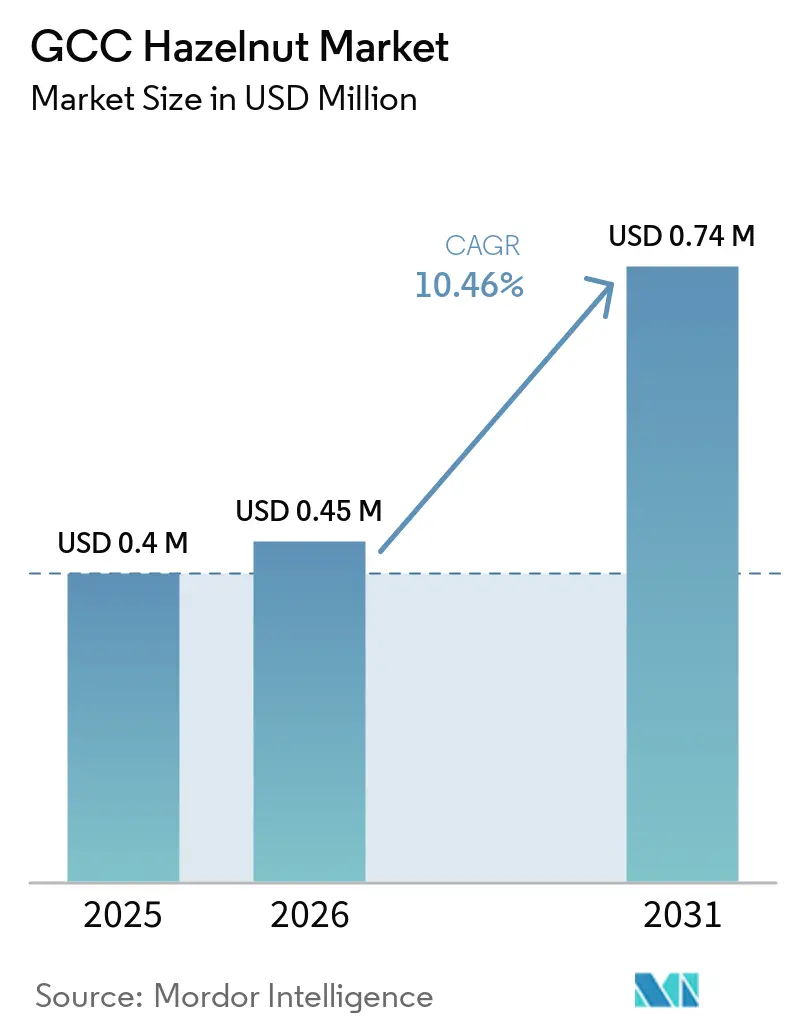
The GCC hazelnut market size was valued at USD 0.40 million in 2025 and is forecast to increase from USD 0.45 million in 2026 to USD 0.74 million by 2031. The market is forecast to grow at a CAGR of 10.46% from 2026 to 2031. Demand from the confectionery, bakery, premium hospitality, and specialty retail segments shapes the market. Supply conditions in Türkiye remain significant, as crop performance affects ingredient availability, quality, and import costs in the Gulf Cooperation Council (GCC). The United Arab Emirates (UAE) serves as the primary import and redistribution hub, giving the GCC hazelnut market a logistics-driven structure rather than a purely domestic consumption profile. Buyers operate across two distinct channels: bulk ingredients for food manufacturing and higher-grade formats for hotels, restaurants, cafés, and artisanal producers. This structure favors distributors that can offer documented traceability, temperature-controlled handling, and differentiated products for both industrial and premium customers.
Key Report Takeaways
- By geography, the United Arab Emirates was the largest market, accounting for 55.0% of the GCC hazelnut market share in 2025, while Oman is forecast to be the fastest-growing market, with a CAGR of 9.1% from 2026 to 2031.
Note: Market size and forecast figures in this report are generated using Mordor Intelligence’s proprietary estimation framework, updated with the latest available data and insights as of January 2026.
Market Trends and Insights
Drivers Impact Analysis of GCC Hazelnut Market*
| Driver | (~) % Impact on CAGR Forecast | Geographic Relevance | Impact Timeline | ||
|---|---|---|---|---|---|
| GCC Re-Export and Re-Distribution Hub Expansion | +1.2% | United Arab Emirates primarily, with effects across Oman, Saudi Arabia, and the wider GCC | Medium term (2-4 years) | ||
| Premium Hospitality and Patisserie Demand | +1% | United Arab Emirates and Saudi Arabia, with contributions from Qatar and Bahrain | Medium term (2-4 years) | ||
| Health-Oriented Snacking and Portion-Pack Growth | +0.8% | GCC-wide, strongest in Saudi Arabia and the United Arab Emirates | Short term (≤ 2 years) | ||
| Industrial Hazelnut Paste Adoption by Local Food Manufacturers | +0.7% | United Arab Emirates and Saudi Arabia as manufacturing hubs | Long term (≥ 4 years) | ||
| Cross-Border E-Commerce Expanding Specialty-Nut Access | +0.6% | GCC-wide, with greatest demand in the United Arab Emirates, Saudi Arabia, and Kuwait | Medium term (2-4 years) | ||
| GCC Foodservice Menu Localization Using Hazelnut Ingredients | +0.5% | United Arab Emirates, Saudi Arabia, and Qatar | Short term (≤ 2 years) | ||
| Source: Mordor Intelligence | |||||
GCC Re-Export and Re-Distribution Hub Expansion
The expansion of GCC food-trade and logistics infrastructure is strengthening the region's role as an import, re-export, and redistribution hub for hazelnuts. Dubai handles 75% of the UAE's food and beverage imports, supported by Jebel Ali Port and integrated logistics infrastructure connecting international suppliers with regional markets[1]. The development of dedicated agro-commodity facilities is further expanding storage, processing, packaging, and distribution capabilities. For example, Spring Valley announced an AED 184 million (USD 50 million) investment in a Jebel Ali agro-commodity hub in February 2025, with the facility designed to process and store commodities including nuts[2]. These capabilities can facilitate the import, storage, processing, and redistribution of hazelnuts to Saudi Arabia, Kuwait, Qatar, Oman, and Bahrain, supporting the growth of the GCC hazelnut market.
Premium Hospitality and Patisserie Demand
Premium hospitality supports demand for high-quality, unprocessed hazelnuts in the GCC hazelnut market. Hotels, luxury restaurants, patisseries, specialty cafés, and premium bakeries procure whole hazelnuts and raw kernels for direct use in desserts, confectionery, bakery products, and food presentations. These buyers prioritize kernel size, freshness, appearance, flavor, and consistent quality to meet premium menu standards. As hospitality and tourism infrastructure expands in Saudi Arabia and the United Arab Emirates, demand for premium-grade hazelnuts is supported by the growing presence of upscale dining establishments and specialty dessert outlets. This creates opportunities for importers and distributors to supply whole hazelnuts and raw kernels in different grades and calibers, alongside standard commodity-grade shipments.
Health-Oriented Snacking and Portion-Pack Growth
Health-oriented retail formats are expanding the use of roasted, portion-packed, branded, and private-label hazelnut products across the GCC hazelnut market. This trend is supported by consumer interest in protein-rich and lower-sugar snack options, particularly among younger urban consumers. Portion packaging allows suppliers to serve convenience retail, online grocery, travel retail, and workplace consumption channels without depending solely on large bakery or confectionery buyers. Branded and private-label packs can also generate higher unit value than unprocessed bulk ingredients, given the added costs of packaging, product presentation, and retail distribution. This shift is particularly relevant for Saudi Arabia and the UAE, where modern retail networks and digital shopping channels are more developed than in several smaller GCC states. It can help sustain trade value when buyers adjust pack sizes or retail formats in response to higher raw-material costs.
Industrial Hazelnut Paste Adoption by Local Food Manufacturers
Food processors and manufacturers across the GCC support demand for hazelnuts as raw materials for bakery products, confectionery, chocolates, desserts, and other food applications. According to the United States Department of Agriculture Foreign Agricultural Service (USDA FAS), more than 570 food and beverage processors operate in the UAE, producing approximately 5.96 million metric tons of food and beverage products annually[3]. This established food-processing base provides potential demand channels for imported whole hazelnuts and raw kernels, which manufacturers can process according to their product requirements. The use of hazelnuts in premium chocolates, baked goods, confectionery, and specialty desserts further supports procurement by industrial buyers. As manufacturers expand their product portfolios, reliable access to imported hazelnuts with consistent quality and specifications becomes important for production planning. This creates opportunities for hazelnut importers and distributors to supply food manufacturers across the GCC through regular procurement arrangements and long-term supply relationships.
Restraints Impact Analysis of GCC Hazelnut Market*
| Restraint | (~) % Impact on CAGR Forecast | Geographic Relevance | Impact Timeline |
|---|---|---|---|
| Imported-Origin Price and Supply Volatility | -1.5% | GCC-wide, most acute in Saudi Arabia and the United Arab Emirates | Short term (≤ 2 years) |
| Aflatoxin, Residue, and Clearance Risk | -0.8% | GCC-wide, with compliance checks at Saudi and United Arab Emirates entry points | Medium term (2-4 years) |
| Limited GCC Cold-Chain and Ingredient-Processing Depth | -0.7% | All GCC states, particularly smaller and inland markets | Long term (≥ 4 years) |
| Re-Export Data Opacity and Multi-Tier Margin Leakage | -0.4% | United Arab Emirates re-export corridor and recipient GCC markets | Medium term (2-4 years) |
| Source: Mordor Intelligence | |||
Imported-Origin Price and Supply Volatility
The GCC hazelnut market remains exposed to limited diversification of global supply. According to the International Nut and Dried Fruit Council, Türkiye's crop was affected by severe frost and drought in 2025, while the Turkish Grain Board released 20,000 metric tons in early 2025. This intervention provided temporary supply support, but its discretionary timing limits the certainty available to importers planning shipments. When Turkish supply is constrained, GCC buyers can consider Chilean and Georgian suppliers, although switching origins may require additional quality checks and supplier qualification. Sustained price increases can also influence procurement decisions among downstream users. For instance, hazelnut paste manufacturers may substitute hazelnuts with more competitively priced nuts, such as almonds or peanuts, depending on the required flavor profile, product specifications, and cost targets. Such substitution can reduce demand for hazelnuts and delay volume recovery even after supply conditions improve.
Aflatoxin, Residue, and Clearance Risk
Food safety requirements create a significant compliance burden for hazelnut imports into the GCC. The GCC Standardization Organization (GSO) sets maximum aflatoxin limits of 10 parts per billion for ready-to-eat hazelnuts and 15 parts per billion for hazelnuts intended for further processing. Consignments require supporting laboratory documentation, and non-compliance can result in rejection, destruction, or re-export at the importer's expense. The Saudi Food and Drug Authority (SFDA) published updated food contaminant requirements in September 2024 under GSO 05 FDS 193:2024. Delays, retesting, storage, and rebooking can increase the cost of shipments that have already reached a GCC port. Larger distributors with established testing and documentation systems are better positioned to manage these obligations than smaller importers.
*Our forecasts treat driver/restraint impacts as directional, not additive. The impact forecasts reflect baseline growth, mix effects, and variable interactions.
Geography Analysis
United Arab Emirates
The UAE accounted for 55.0% of the GCC hazelnut market share in 2025, making it the region’s largest import destination and redistribution hub. This position reflects the concentration of import operations, free-zone logistics, specialty retail, foodservice activity, and distribution links to other GCC states. UAE ports and trading entities receive multi-origin shipments, maintain the required documentation, and supply processors, retailers, and hospitality customers in various formats. This operational depth explains why demand recorded in the UAE does not always represent final consumption within the country. Tree-nut imports into the UAE reached USD 1.08 billion in 2024, underscoring the country's broader importance in specialty-nut trade.
Oman, Saudi Arabia, Qatar, Kuwait, and Bahrain
The Oman hazelnut market is forecast to grow at a CAGR of 9.1% from 2026 to 2031. This growth reflects a smaller starting base, rising specialty-food imports, an expanding foodservice network, and investments in logistics infrastructure connecting ports to inland areas. Saudi Arabia also presents a large addressable base, driven by its growing hospitality, retail, and food-manufacturing sectors. Manufacturers in the Kingdom use paste and praline formats in local confectionery and bakery production. Qatar and Kuwait sustain demand through premium retail and foodservice channels, though their supply relies heavily on established regional distribution routes. Bahrain's smaller consumer base and competitive import conditions limit its relative pace of expansion.
Re-export flows affect how GCC hazelnut market data is recorded. Goods entering the UAE are often redistributed to Oman, Kuwait, Qatar, Bahrain, and Saudi Arabia without appearing as direct imports from the country of origin in every national dataset. This can understate final consumption in markets served primarily by UAE-based distributors. Agriculture and Agri-Food Canada identified Saudi Arabia and the UAE as key drivers of specialty-food import value in the GCC in its 2024 trade analysis. Improved cold storage capacity and more transparent re-export records would support more efficient planning across the regional supply network.
Competitive Landscape
The GCC hazelnut market operates across origin production and primary processing, import and distribution, and downstream food manufacturing and foodservice. Turkish suppliers remain central to regional supply, while Chile and Georgia provide alternative origins for buyers seeking supply diversification. UAE-based importers play an important role in procurement, food-safety documentation, storage, repackaging, and onward distribution, as GCC buyers prioritize consistent product quality, traceability, and reliable delivery.
Competition also varies across the value chain. Ferrero is a vertically integrated participant in the hazelnut industry, with processing and sourcing operations across multiple countries. Its activities include hazelnut processing through Oltan, its subsidiary in Türkiye, while AgriChile, Grupo Hijuelas, and Nefuen are associated with Chilean hazelnut production and supply, offering GCC buyers alternatives to Turkish-origin supply. Ferrero’s Hazelnut Charter and Action Plan 2024–2026 emphasize traceability, responsible sourcing, and agricultural practices. The company also maintains commercial operations in the GCC. These participants compete at different stages of the supply chain rather than solely within a single local distribution channel.
Competition is primarily based on procurement reliability, product quality, food-safety compliance, traceability, storage conditions, documentation, and delivery capabilities, particularly for industrial and premium buyers. Much of the higher-value processing, including roasting, paste production, and retail-ready packaging, is conducted before products reach GCC markets. However, the expansion of UAE-based processing and agro-commodity infrastructure could increase local value addition if processors can achieve the required scale, food-safety standards, and consistent quality.
Recent Industry Developments in GCC Hazelnut Market
- January 2026: DP World announced a 29 million sq. ft. integrated food-trade hub expanding the Al Aweer Central Fruit and Vegetable Market. The facility will combine food trading, cold storage, processing, and distribution and connect suppliers with more than 20 global markets, strengthening Dubai's role as a regional gateway for imported specialty foods, including nuts.
- September 2025: Americold opened its first operational Middle East facility in partnership with DP World at Jebel Ali Free Zone, providing 40,000 pallet positions, multi-temperature storage, and bonded and non-bonded facilities. The hub is designed to connect global food producers with GCC markets and improve regional food-flow and storage capabilities.
- February 2025: Spring Valley announced an AED 184 million (USD 50 million) agro-commodity hub at Jafza. The facility will provide processing, storage, consumer packaging, roasting, and grinding capabilities for more than 65,000 metric tons of commodities, including nuts, strengthening Dubai's capacity for regional food distribution and value-added processing.
GCC Hazelnut Market Report Scope
Hazelnuts are the edible nuts of deciduous trees and shrubs belonging to the genus Corylus, primarily Corylus avellana. They are enclosed in a hard shell and contain a nutrient-rich kernel used in confectionery, bakery products, chocolates, spreads, and other food applications.
The GCC hazelnut market report is segmented by geography (United Arab Emirates, Bahrain, Kuwait, Oman, and more). The report includes production analysis (volume), consumption analysis (value and volume), import analysis (value and volume), export analysis (value and volume), wholesale price trend analysis and forecast, a list of key players, and more. The market forecasts are provided in terms of value (USD) and volume (metric tons).
Segmentation Overview
| Saudi Arabia | Production Analysis (Area Harvested, Yield, and Production Volume) |
| Consumption Analysis (Consumption Value and Volume) | |
| Import Market Analysis (Import Value, Volume, and Key Supplying Markets) | |
| Export Market Analysis (Export Value, Volume, and Key Destination Markets) | |
| Wholesale Price Trend Analysis and Forecast | |
| Regulatory Framework | |
| List of Key Players | |
| Logistics and Infrastructure | |
| Seasonality Analysis | |
| United Arab Emirates | Production Analysis (Area Harvested, Yield, and Production Volume) |
| Consumption Analysis (Consumption Value and Volume) | |
| Import Market Analysis (Import Value, Volume, and Key Supplying Markets) | |
| Export Market Analysis (Export Value, Volume, and Key Destination Markets) | |
| Wholesale Price Trend Analysis and Forecast | |
| Regulatory Framework | |
| List of Key Players | |
| Logistics and Infrastructure | |
| Seasonality Analysis | |
| Kuwait | Production Analysis (Area Harvested, Yield, and Production Volume) |
| Consumption Analysis (Consumption Value and Volume) | |
| Import Market Analysis (Import Value, Volume, and Key Supplying Markets) | |
| Export Market Analysis (Export Value, Volume, and Key Destination Markets) | |
| Wholesale Price Trend Analysis and Forecast | |
| Regulatory Framework | |
| List of Key Players | |
| Logistics and Infrastructure | |
| Seasonality Analysis | |
| Qatar | Production Analysis (Area Harvested, Yield, and Production Volume) |
| Consumption Analysis (Consumption Value and Volume) | |
| Import Market Analysis (Import Value, Volume, and Key Supplying Markets) | |
| Export Market Analysis (Export Value, Volume, and Key Destination Markets) | |
| Wholesale Price Trend Analysis and Forecast | |
| Regulatory Framework | |
| List of Key Players | |
| Logistics and Infrastructure | |
| Seasonality Analysis | |
| Bahrain | Production Analysis (Area Harvested, Yield, and Production Volume) |
| Consumption Analysis (Consumption Value and Volume) | |
| Import Market Analysis (Import Value, Volume, and Key Supplying Markets) | |
| Export Market Analysis (Export Value, Volume, and Key Destination Markets) | |
| Wholesale Price Trend Analysis and Forecast | |
| Regulatory Framework | |
| List of Key Players | |
| Logistics and Infrastructure | |
| Seasonality Analysis | |
| Oman | Production Analysis (Area Harvested, Yield, and Production Volume) |
| Consumption Analysis (Consumption Value and Volume) | |
| Import Market Analysis (Import Value, Volume, and Key Supplying Markets) | |
| Export Market Analysis (Export Value, Volume, and Key Destination Markets) | |
| Wholesale Price Trend Analysis and Forecast | |
| Regulatory Framework | |
| List of Key Players | |
| Logistics and Infrastructure | |
| Seasonality Analysis | |
| Rest of GCC Countries | Production Analysis (Area Harvested, Yield, and Production Volume) |
| Consumption Analysis (Consumption Value and Volume) | |
| Import Market Analysis (Import Value, Volume, and Key Supplying Markets) | |
| Export Market Analysis (Export Value, Volume, and Key Destination Markets) | |
| Wholesale Price Trend Analysis and Forecast | |
| Regulatory Framework | |
| List of Key Players | |
| Logistics and Infrastructure | |
| Seasonality Analysis |
| By Geography | Saudi Arabia | Production Analysis (Area Harvested, Yield, and Production Volume) |
| Consumption Analysis (Consumption Value and Volume) | ||
| Import Market Analysis (Import Value, Volume, and Key Supplying Markets) | ||
| Export Market Analysis (Export Value, Volume, and Key Destination Markets) | ||
| Wholesale Price Trend Analysis and Forecast | ||
| Regulatory Framework | ||
| List of Key Players | ||
| Logistics and Infrastructure | ||
| Seasonality Analysis | ||
| United Arab Emirates | Production Analysis (Area Harvested, Yield, and Production Volume) | |
| Consumption Analysis (Consumption Value and Volume) | ||
| Import Market Analysis (Import Value, Volume, and Key Supplying Markets) | ||
| Export Market Analysis (Export Value, Volume, and Key Destination Markets) | ||
| Wholesale Price Trend Analysis and Forecast | ||
| Regulatory Framework | ||
| List of Key Players | ||
| Logistics and Infrastructure | ||
| Seasonality Analysis | ||
| Kuwait | Production Analysis (Area Harvested, Yield, and Production Volume) | |
| Consumption Analysis (Consumption Value and Volume) | ||
| Import Market Analysis (Import Value, Volume, and Key Supplying Markets) | ||
| Export Market Analysis (Export Value, Volume, and Key Destination Markets) | ||
| Wholesale Price Trend Analysis and Forecast | ||
| Regulatory Framework | ||
| List of Key Players | ||
| Logistics and Infrastructure | ||
| Seasonality Analysis | ||
| Qatar | Production Analysis (Area Harvested, Yield, and Production Volume) | |
| Consumption Analysis (Consumption Value and Volume) | ||
| Import Market Analysis (Import Value, Volume, and Key Supplying Markets) | ||
| Export Market Analysis (Export Value, Volume, and Key Destination Markets) | ||
| Wholesale Price Trend Analysis and Forecast | ||
| Regulatory Framework | ||
| List of Key Players | ||
| Logistics and Infrastructure | ||
| Seasonality Analysis | ||
| Bahrain | Production Analysis (Area Harvested, Yield, and Production Volume) | |
| Consumption Analysis (Consumption Value and Volume) | ||
| Import Market Analysis (Import Value, Volume, and Key Supplying Markets) | ||
| Export Market Analysis (Export Value, Volume, and Key Destination Markets) | ||
| Wholesale Price Trend Analysis and Forecast | ||
| Regulatory Framework | ||
| List of Key Players | ||
| Logistics and Infrastructure | ||
| Seasonality Analysis | ||
| Oman | Production Analysis (Area Harvested, Yield, and Production Volume) | |
| Consumption Analysis (Consumption Value and Volume) | ||
| Import Market Analysis (Import Value, Volume, and Key Supplying Markets) | ||
| Export Market Analysis (Export Value, Volume, and Key Destination Markets) | ||
| Wholesale Price Trend Analysis and Forecast | ||
| Regulatory Framework | ||
| List of Key Players | ||
| Logistics and Infrastructure | ||
| Seasonality Analysis | ||
| Rest of GCC Countries | Production Analysis (Area Harvested, Yield, and Production Volume) | |
| Consumption Analysis (Consumption Value and Volume) | ||
| Import Market Analysis (Import Value, Volume, and Key Supplying Markets) | ||
| Export Market Analysis (Export Value, Volume, and Key Destination Markets) | ||
| Wholesale Price Trend Analysis and Forecast | ||
| Regulatory Framework | ||
| List of Key Players | ||
| Logistics and Infrastructure | ||
| Seasonality Analysis | ||
Key Questions Answered in the Report
What is the forecasted size of the GCC hazelnut market?
The GCC hazelnut market size was valued at USD 0.40 million in 2025 and is forecast to increase from USD 0.45 million in 2026 to USD 0.74 million by 2031. The market is forecast to grow at a CAGR of 10.46% from 2026 to 2031.
Which country leads GCC hazelnut consumption?
The UAE accounted for 55.0% of the GCC hazelnut market share in 2025, supported by its import, storage, and re-export network.
What is driving demand for hazelnut ingredients in the GCC?
Food manufacturing, premium hospitality, specialty retail, portion-packed snacks, and the UAE’s redistribution role are key sources of demand.
What are the main risks for GCC hazelnut importers?
Key risks include crop-related supply and price volatility in major producing countries, aflatoxin compliance requirements, and potential customs clearance or shipment delays.