
GCC Countries Destination Wedding Market Size and Share
Market Overview
| Study Period | 2021 - 2031 |
|---|---|
| Forecast Data Period | 2026 - 2031 |
| Base Year Market Size (2025) | USD 1.68 Billion |
| Market Size (2026) | USD 1.97 Billion |
| Market Size (2031) | USD 2.76 Billion |
| Growth Rate (2026 - 2031) | 6.98 % |
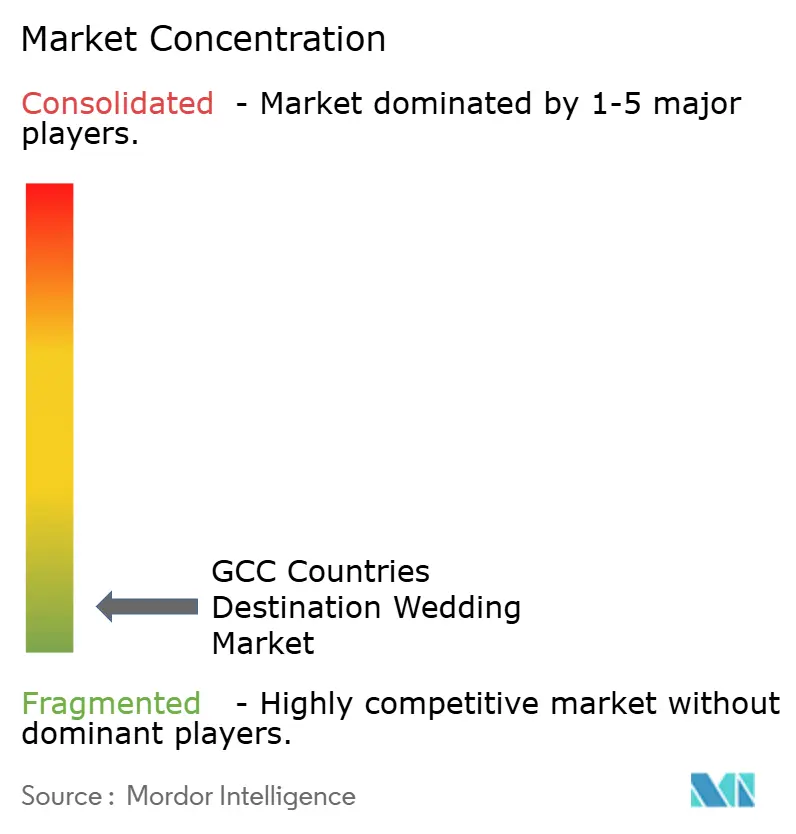
| Market Concentration | Low |
Major Players *Disclaimer: Major Players sorted in no particular order Image © Mordor Intelligence. Reuse requires attribution under CC BY 4.0. | |
GCC Countries Destination Wedding Market Analysis by Mordor Intelligence
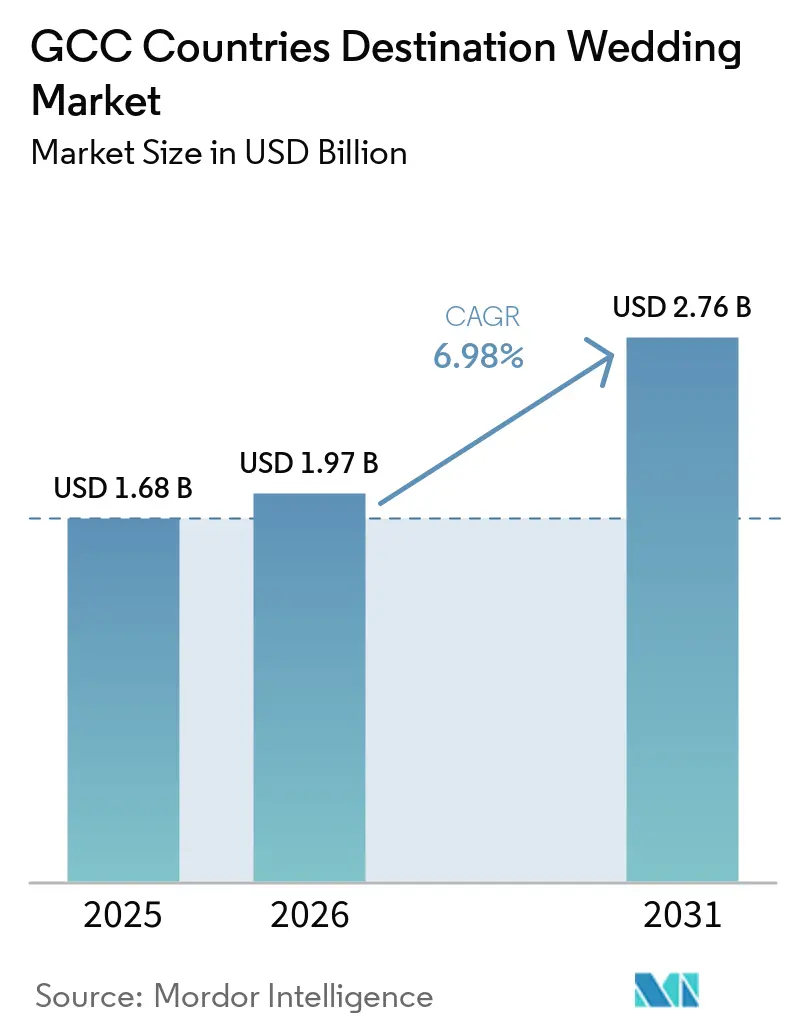
The GCC destination wedding market is expected to grow from USD 1.68 billion in 2025 to USD 1.97 billion in 2026 and is forecast to reach USD 2.76 billion by 2031 at a CAGR of 6.98% over 2026–2031. Growth is driven by investments in luxury tourism, a significant expatriate population with spending power, and improved travel access for couples, guests, and vendors. The UAE, particularly Dubai, accounted for strong demand in 2025, with 19.59 million overnight visitors and an average daily hotel rate of AED 579 (USD 157.62), an 8% rise from 2024[1]. Saudi Arabia is expected to see the fastest growth as resort-led destinations expand venue options beyond the UAE, attracting high-value ceremonies. The market remains fragmented, with integrated hotel-led operators benefiting from bundling venue access, event permitting, accommodation, and planning services. Growth faces challenges such as limited outdoor booking seasons due to extreme summer heat, event restrictions on alcohol in some markets, and vendor margin pressures caused by rising procurement costs outpacing client pricing.
Key Report Takeaways
- By type, domestic destination weddings held 55.92% share of the GCC Countries Destination Wedding Market in 2025, while international destination weddings are forecast to record the fastest CAGR of 8.92% through 2031.
- By wedding size, the medium segment accounted for 46.71% share of the GCC Countries Destination Wedding Market in 2025, while the intimate or micro segment is projected to grow at the fastest CAGR of 8.75% through 2031.
- By expenditure or budget, mid-range weddings held 41.84% share of the GCC Countries Destination Wedding Market in 2025, while luxury weddings are forecast to register the fastest CAGR of 9.12% through 2031.
- By service type, venue and accommodation held 30.12% share of the GCC Countries Destination Wedding Market in 2025, while decor and theming is forecast to record the fastest CAGR of 9.84% through 2031.
- By geography, the UAE accounted for 35.97% share of the GCC Countries Destination Wedding Market in 2025, while Saudi Arabia is projected to witness the fastest CAGR of 9.54% through 2031.
Note: Market size and forecast figures in this report are generated using Mordor Intelligence’s proprietary estimation framework, updated with the latest available data and insights as of January 2026.
GCC Countries Destination Wedding Market Trends and Insights
Drivers Impact Analysis*
| Drivers | (~) % Impact on CAGR Forecast | Geographic Relevance | Impact Timeline |
|---|---|---|---|
| Escalating Disposable Income And Lavish Wedding Culture | +1.8% | Concentrated in United Arab Emirates and Saudi Arabia | Short term (≤ 2 years) |
| Visa-On-Arrival Expansion And Regional Connectivity | +1.0% | United Arab Emirates core, spill-over to Qatar and Oman | Short term (≤ 2 years) |
| Government Push For Luxury Tourism And MICE | +1.3% | Saudi Arabia, United Arab Emirates, Qatar | Medium term (2-4 years) |
| Rise Of Intimate Weddings Among Resident Expatriates | +0.7% | United Arab Emirates and Qatar | Short term (≤ 2 years) |
| Immersive Hybrid Ceremonies For Diaspora Families | +0.5% | United Arab Emirates, spill-over to Oman and Bahrain | Medium term (2-4 years) |
| Expansion Of Mega-Project Venues | +0.8% | Saudi Arabia | Long term (≥ 4 years) |
| Source: Mordor Intelligence | |||
Escalating disposable income & lavish wedding culture
Spending patterns in the GCC highlight the importance of high-value weddings, which emphasize family status, hospitality, and guest experience. Budgets remain steady despite shifts between domestic and international bookings. In the destination wedding market, revenue growth relies on increasing event numbers and enhancing ticket sizes through multi-day events, entertainment, and tailored production. Domestic weddings have historically dominated revenue, driven by demand from affluent nationals and long-term residents, even before accounting for international contributions. This trend explains why venue operators and luxury properties actively pursue wedding businesses, as higher spending per event supports profitability and enables bundled services like planning, catering, décor, and accommodation.
Visa-on-arrival expansion & regional connectivity
Travel policy changes in the UAE have simplified planning for couples, guests, entertainers, photographers, and event specialists. The introduction of new visit visa categories in 2025, covering entertainment, events, maritime tourism, and AI specialists, has increased flexibility for destination celebrations. Dubai’s connectivity, with direct access to numerous cities, strengthens its position in the GCC destination wedding market. Visitor intensity significantly boosted overnight arrivals that year, supporting ceremonies reliant on timely guest arrivals from India, Europe, and Asia. This connectivity enhances venue selection and ancillary spending, as shorter coordination cycles help convert intent into confirmed bookings for hotels, transport, dining, and celebration-related leisure activities.
Government push for luxury tourism & MICE
Government-backed initiatives are expanding the GCC's destination wedding market by increasing the physical supply base. In the UAE, strong tourism performance supports room additions and higher pricing. Saudi Arabia is creating new destination clusters aligned with Vision 2030. Jumeirah's Mission 2030 plan, including portfolio growth in Dubai and the upcoming Jumeirah The Red Sea, highlights how regional operators are leveraging these opportunities. Many new properties are dual-purpose, accommodating leisure travelers, corporate events, and weddings within the same infrastructure. This approach improves operational efficiency and diversifies venue options, ranging from intimate villas to large beachfronts and ballrooms[2].
Rise of intimate weddings among resident expatriates
Resident expatriates are influencing wedding demand differently from traditional large family events, particularly in urban centers such as Dubai, Abu Dhabi, and Doha. These couples prefer smaller guest lists, greater design control, and legally straightforward ceremonies, avoiding the complexities of cross-border family movements. This aligns with the GCC destination wedding market, which caters to residents seeking local luxury settings. Abu Dhabi’s civil marriage reforms have expanded options for cross-nationality couples, while Dubai offers diverse venues, including beaches, deserts, and heritage sites, due to its extensive hotel infrastructure. Intimate, resident-led weddings are not replacing larger events but are contributing to a steady flow of shorter-lead, design-focused bookings, reducing reliance on peak-season mega celebrations.
Restraints Impact Analysis*
| Restraints | (~) % Impact on CAGR Forecast | Geographic Relevance | Impact Timeline |
|---|---|---|---|
| Extreme summer heat limiting outdoor venues | -0.3% | All GCC countries, most severe in Kuwait, Qatar, United Arab Emirates | Short term (≤ 2 years) |
| Event & alcohol regulations in select GCC states | -0.3% | Saudi Arabia primarily, partial restrictions in Kuwait | Medium term (2-4 years) |
| Currency-peg exposure vs imported inflation | -0.2% | All GCC countries | Medium term (2-4 years) |
| Shortage of specialized multicultural wedding planners | -0.2% | United Arab Emirates and Qatar, highest multinational wedding density | Short term (≤ 2 years) |
| Source: Mordor Intelligence | |||
Extreme Summer Heat Limiting Outdoor Venues
The GCC destination wedding market faces challenges due to climate, as the region's popular venues are often outdoor, waterfront, desert, or garden-based. High summer temperatures limit the season for outdoor ceremonies to the October to April period. This restriction increases venue demand, raises prices during peak months, and extends booking lead times for properties with beachfront or open-air appeal. Hotels address this issue by offering indoor ballrooms and climate-controlled spaces. For instance, Atlantis The Palm promotes large-capacity venues to accommodate significant guest numbers. However, heat remains a concern, as clients often prioritize weather suitability over service quality, décor, or hospitality standards when comparing the GCC with island or Mediterranean destinations.
Event & Alcohol Regulations in Select GCC States
Regulatory differences across the GCC create uneven conditions in the destination wedding market. In Saudi Arabia, the alcohol-free environment impacts beverage offerings and influences how planners design hospitality packages, particularly for international couples accustomed to diverse food and beverage options. Operators are adapting to these conditions. For example, the Four Seasons Resort and Residences Red Sea focuses its wedding offerings on the destination experience rather than alcohol-centered celebrations. Regulations do not eliminate demand but reshape client preferences, event designs, and revenue distribution among vendors. Properties and planners that integrate local compliance into their service offerings are likely to achieve better outcomes than those treating regulations as obstacles addressed late in the planning process[3].
*Our forecasts treat driver/restraint impacts as directional, not additive. The impact forecasts reflect baseline growth, mix effects, and variable interactions.
Segment Analysis
By Type of Destination Wedding: Domestic Bookings Underpin Revenue While International Accelerates
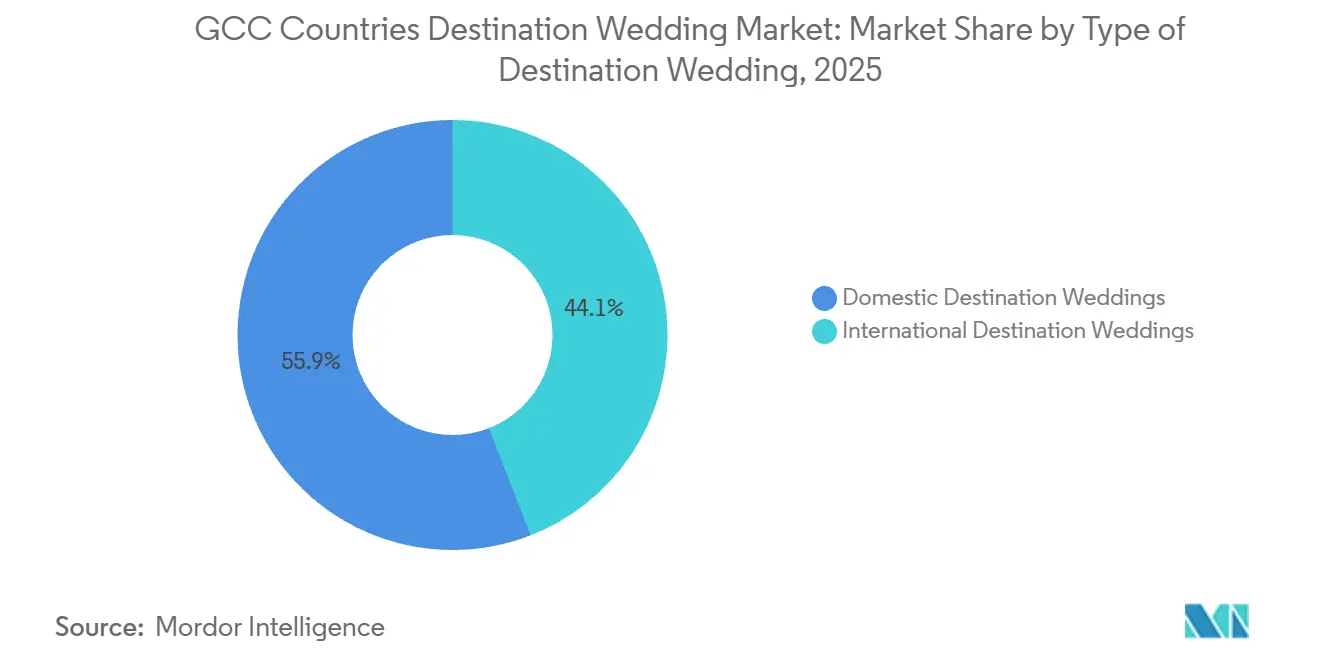
Domestic destination weddings accounted for 55.92% of the GCC destination wedding market share in 2025, highlighting the importance of resident-led celebrations. This segment benefits from affluent GCC nationals, long-term expatriates, and families who prefer hosting events locally. Key advantages include venue familiarity, smoother guest logistics, and better control over vendor quality. These factors drive spending on entertainment, accommodation, and multi-day event designs, even with smaller guest lists. Domestic weddings form the revenue base for hotels, planners, decorators, and catering partners year-round.
International destination weddings are projected to grow at a CAGR of 8.92% through 2031, making them the faster-growing segment. Growth is driven by couples from South Asia, Europe, and East Asia who increasingly view GCC venues as luxury alternatives to traditional destinations. Vivaah Weddings exemplifies this trend, having executed a three-day celebration across multiple venues, including Hilton Al Habtoor City, Delano Dubai, Four Seasons Jumeirah Beach, and Atlantis The Royal. This demonstrates how multi-venue events and extended guest itineraries boost revenue. The GCC destination wedding market operates on two fronts: domestic bookings provide stability and scale, while international bookings drive growth and visibility. This dual demand necessitates segmented positioning strategies, as service requirements, sales cycles, and venue priorities differ between local and international clients[4].
By Wedding Size: Medium Scale Commands the Market as Micro Formats Gain Strategic Relevance
The Medium (50–200 guests) segment accounted for 46.71% of the GCC destination wedding market size in 2025, making it a key focus for operators in the region. This format aligns with the social norms of GCC families and diaspora, offering meaningful guest participation without the complexities of large-scale events. Hotels benefit from medium weddings as they allow efficient management of banquet inventories, room blocks, and transport planning compared to larger events. This combination of cultural relevance, logistical practicality, and spending capacity makes the medium category attractive to both established venues and newer entrants in the GCC destination wedding market.
The Intimate or Micro category is projected to grow at an 8.75% CAGR through 2031, reflecting evolving buyer preferences. Younger resident couples and cross-nationality pairs are reducing guest counts while increasing spending on personalization, food quality, decor, and curated experiences. This format also benefits from weekday pricing strategies and legal reforms in the UAE that simplify smaller civil or mixed-culture celebrations. Although smaller than medium weddings, micro weddings are significant for the GCC destination wedding market. They effectively utilize villa, terrace, garden, and boutique venue inventory, diversifying demand beyond traditional large family receptions.
By Expenditure/Budget: Mid-Range Holds Structural Weight as Luxury Delivers Superior Returns
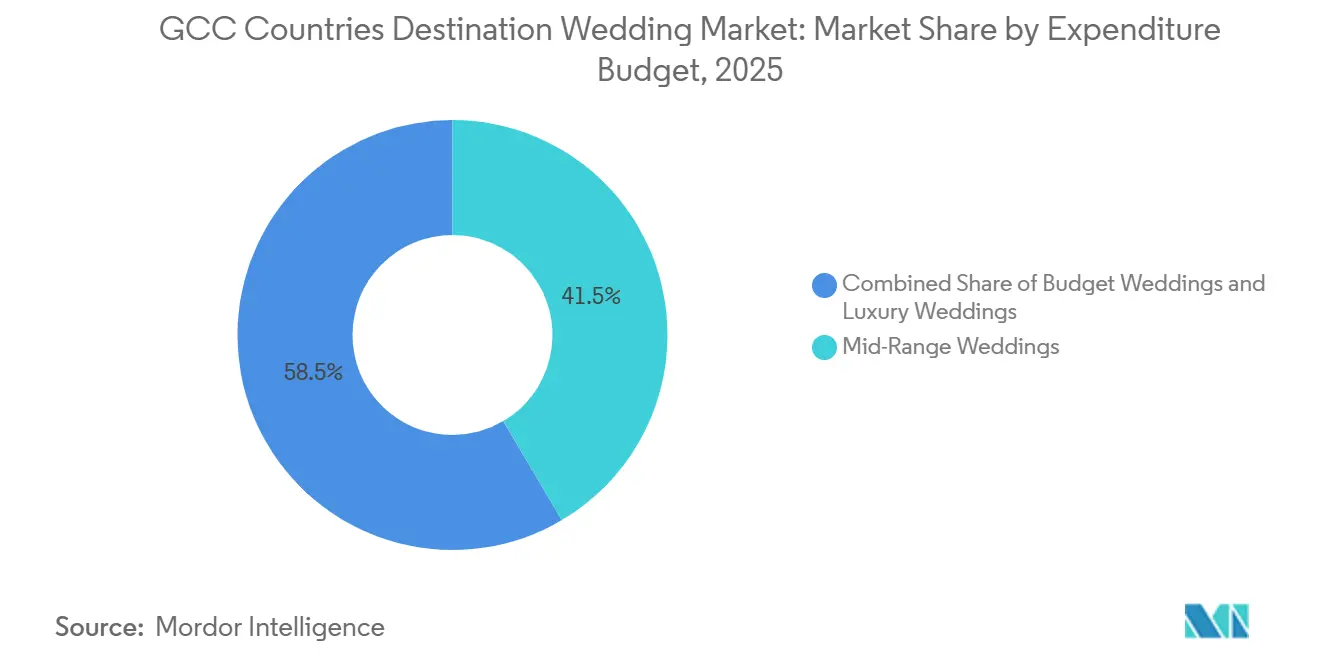
Mid-Range Weddings accounted for 41.84% of revenue in 2025, making them a key segment in the GCC destination wedding market. This category is driven by resident expatriates and upper-middle-income households who carefully allocate budgets across venues, photography, guest hospitality, and décor. The UAE, Qatar, and Bahrain, with their significant expatriate populations, sustain steady demand for this segment. Mid-range clients prioritize reliable venues and guest comfort over exclusivity, keeping hotels with strong event infrastructure competitive. Despite the attention ultra-luxury weddings receive, mid-range weddings hold structural importance in the market.
Luxury Weddings are projected to grow at a 9.12% CAGR through 2031, the fastest within this segmentation. Growth is supported by an increasing supply of high-end venues, such as those in the Red Sea and AlUla, which accommodate higher event budgets. Kempinski’s weddings and honeymoons program, introduced in September 2025, illustrates how hospitality brands are focusing on celebration-led travel rather than general event sales. The GCC destination wedding market for luxury formats is expanding due to the development of purpose-built or repositioned venues catering to affluent clients. Budget weddings remain present but face growth limitations due to high base costs driven by licensed venues and imported event components.

By Service Type/Vendor: Venue Spend Dominates While Decor Gains Pace
Venues and accommodations represented 30.12% of the GCC destination wedding market size in 2025, highlighting the central role of venue selection in budget planning. A venue often includes guest rooms, permits, event spaces, food services, bridal preparation areas, and planning support. Hotel-affiliated operators maintain an advantage over independent planners, particularly for large or multi-day events. Once couples choose a property, related purchases frequently follow within the same operator network, reinforcing the venue-led nature of the market.
Decor and Theming is projected to grow at a 9.84% CAGR through 2031, making it the fastest-growing service segment. Couples increasingly prefer immersive venue transformations over standard floral and lighting setups. This trend shifts spending toward creative direction, custom fabrication, advanced lighting, and experience design, driving supplier specialization. Décor is evolving from a supporting role to a key identity element in the GCC destination wedding market. In cities such as Dubai and Riyadh, visual differentiation has become significant. For vendors, opportunities exist, but managing margins requires disciplined sourcing due to reliance on imported supply chains for many décor components.
Geography Analysis
The UAE held 35.97% of the GCC destination wedding market share in 2025, maintaining its leading position. This was due to global air connectivity, a high density of luxury hotels, flexible ceremony formats, and international recognition. Dubai recorded 19.59 million international overnight visitors in 2025, with 154,264 hotel rooms across 827 establishments, offering unmatched venue and accommodation options. Dubai's hotel RevPAR reached AED 467 (USD 127) in 2025, reinforcing the UAE's central role in the GCC destination wedding market by providing diverse options with logistical convenience.
Saudi Arabia is projected to grow at a 9.54% CAGR through 2031, making it the fastest-growing geography in the GCC destination wedding market. Growth is driven by new tourism districts, luxury coastal projects, and heritage venues. Developments like NEOM’s Sindalah and Red Sea projects introduce new destination categories, while Banyan Tree AlUla adds a desert and heritage setting. Jumeirah’s upcoming Red Sea property highlights sustained demand for wedding venues in Saudi Arabia.
Qatar, Oman, Kuwait, and Bahrain contribute smaller revenue shares but offer distinct niches. Qatar benefits from integrated resorts and appeals to South Asian and GCC diaspora celebrations. Oman is known for grand resort weddings with large ballrooms and beachfront venues like Al Bustan Palace. Bahrain focuses on intimate luxury and waterfront venues, supported by projects like Kempinski Harbour Heights. Regional trade integration remains significant, with the Gulf Bride Show 2026 in Abu Dhabi fostering cross-border vendor collaboration and service delivery.
Competitive Landscape
The GCC destination wedding market is fragmented, with the top players collectively holding a small share of the total revenue. Vivaah Weddings, Atlantis The Palm, Jumeirah Group, Four Seasons Hotels and Resorts, and QnA International are among the key contributors. This distribution highlights the lack of a dominant player, with the market shared among global luxury hotels, regional hospitality groups, specialized planners, and independent vendors. The structure reflects the demand for customization, cultural alignment, and venue style alongside brand recognition.
Venue-linked operators hold a competitive edge over independent planners, particularly in larger formats. Atlantis The Palm offers multiple event venues and significant guest capacity, making it challenging for external planners without hotel partnerships. Jumeirah is expanding its wedding-related offerings through new developments in Dubai and its upcoming Red Sea property, catering to diverse demands. Kempinski has introduced a dedicated wedding and honeymoons segment across its properties, focusing on integrated event solutions that combine venue, accommodation, and experience design.
Independent and specialized planners remain relevant due to their ability to provide creative direction, multicultural coordination, and flexibility in using multiple venues. Vivaah Celebrations’ participation in EWPC 2025 RAK 2.0 demonstrates efforts to build vendor networks and cross-border relevance. Arabia Weddings’ role in the Dubai stop of WIM Tour 2026 highlights the growing activity in professional ecosystems for planning, sourcing, and partnerships. However, the market lacks a Saudi-based planning brand with regional cultural expertise and scale. This gap presents opportunities for locally anchored operators to leverage technology, multilingual services, and venue partnerships to address the fragmented landscape effectively.
GCC Countries Destination Wedding Industry Leaders
-
Vivaah Weddings
-
Atlantis The Palm (Kerzner)
-
Jumeirah Group
-
Four Seasons Hotels & Resorts
-
QnA International
- *Disclaimer: Major Players sorted in no particular order
Recent Industry Developments
- September 2025: The UAE's Federal Authority for Identity, Citizenship, Customs and Port Security (ICP) introduced four visit visa categories for AI Specialists, Entertainment, Events, and Cruise Ship & Leisure Boat Tourism. Each category requires a UAE-based sponsor or host entity licensed in the relevant sector.
- September 2025: Kempinski Hotels introduced its global wedding and honeymoon collection, offering curated romantic packages at historic and luxury destinations. The program includes on-site planning support for personalized events and features a portfolio of alpine retreats and tropical resorts tailored for couples.
- April 2025: Dubai Holding and Jumeirah Group announced three luxury projects, including the Jumeirah Asora Bay resort on La Mer South, opening in 2029. Part of the "Mission 2030" strategy to double Jumeirah's portfolio, the expansion was revealed at Arabian Travel Market (ATM 2025) to strengthen Dubai's luxury hospitality sector.
- February 2025: Vivaah Celebrations participated in the 14th Exotic Wedding Planning Conference (EWPC 2025 RAK 2.0) from February 26 to 28, 2025, in Ras Al Khaimah to establish international collaborations, expand its GCC vendor network, and enhance luxury destination wedding standards.
GCC Countries Destination Wedding Market Report Scope
| Domestic Destination Weddings |
| International Destination Weddings |
| Intimate / Micro (Less than 50 guests) |
| Medium (50 - 200 guests) |
| Large/Grand (More than 200 guests) |
| Budget Weddings |
| Mid-Range Weddings |
| Luxury Weddings |
| Venue & Accommodation |
| Travel & Transport |
| Event Planning & Coordination |
| Catering & Beverages |
| Entertainment & Photography |
| Decor & Theming |
| Saudi Arabia |
| United Arab Emirates |
| Qatar |
| Kuwait |
| Oman |
| Bahrain |
| By Type of Destination Wedding | Domestic Destination Weddings |
| International Destination Weddings | |
| By Wedding Size | Intimate / Micro (Less than 50 guests) |
| Medium (50 - 200 guests) | |
| Large/Grand (More than 200 guests) | |
| By Expenditure/Budget | Budget Weddings |
| Mid-Range Weddings | |
| Luxury Weddings | |
| By Service Type/Vendor | Venue & Accommodation |
| Travel & Transport | |
| Event Planning & Coordination | |
| Catering & Beverages | |
| Entertainment & Photography | |
| Decor & Theming | |
| By Geography | Saudi Arabia |
| United Arab Emirates | |
| Qatar | |
| Kuwait | |
| Oman | |
| Bahrain |
Key Questions Answered in the Report
What is the size of the GCC destination wedding sector in 2026?
The GCC destination wedding market size is estimated at USD 1.97 billion in 2026 and is projected to reach USD 2.76 billion by 2031 at a 6.98% CAGR.
Which country leads wedding demand across the GCC?
The UAE led the region in 2025 with a 35.97% revenue share, supported by strong international air links, deep hotel inventory, and flexible ceremony formats.
Which destination is growing the fastest through 2031?
Saudi Arabia is expected to expand the fastest, with a forecast CAGR of 9.54%, driven by new luxury resorts, Red Sea development, and broader tourism infrastructure creation.
Are domestic or international ceremonies larger in revenue today?
Domestic Destination Weddings led with 55.92% of revenue in 2025, although International Destination Weddings are projected to grow faster at an 8.92% CAGR through 2031.
Which service category captures the biggest share of spending?
Venue and Accommodation held 30.12% of spending in 2025, reflecting the importance of bundled hotel, event space, and guest stay packages in the region.
What are the main risks affecting growth across GCC wedding destinations?
The main constraints are extreme summer heat, uneven event and alcohol regulations across markets, imported cost inflation, and a shortage of planners with strong multicultural execution capability.