
GCC Aesthetic Wellness Market Size and Share
Market Overview
| Study Period | 2022 - 2032 |
|---|---|
| Forecast Data Period | 2027 - 2032 |
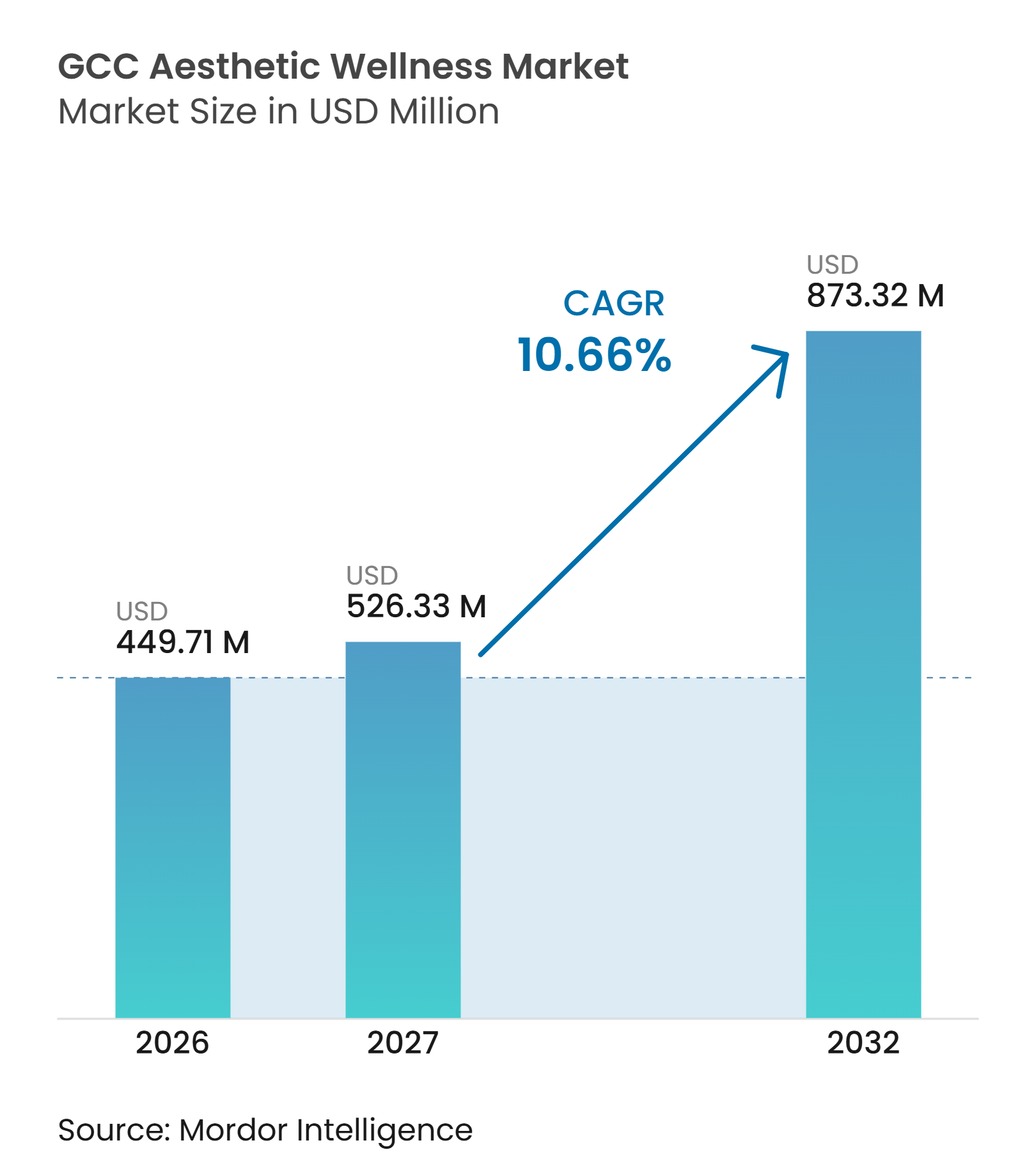
| Base Year Market Size (2026) | USD 449.71 Million |
| Market Size (2027) | USD 526.33 Million |
| Market Size (2032) | USD 873.32 Million |
| Growth Rate (2027 - 2032) | 10.66 % |
| Market Concentration | Low |
Major Players *Disclaimer: Major Players sorted in no particular order Image © Mordor Intelligence. Reuse requires attribution under CC BY 4.0. | |
GCC Aesthetic Wellness Market Analysis by Mordor Intelligence
The GCC aesthetic wellness market size was valued at USD 449.71 million in 2026 and is estimated to grow from USD 526.33 million in 2027 to reach USD 873.32 million by 2032, at a CAGR of 10.66% during the forecast period (2027-2032). The GCC aesthetic wellness market is supported by a large young consumer base, national wellness initiatives, and investments in clinical and destination wellness facilities. Saudi Arabia’s Ministry of Health includes wellness and longevity in the Kingdom’s health agenda, while projects are adding facilities that combine spa, diagnostic, and clinical services. The market also benefits from the growing adoption of low-downtime treatments in physician-supervised settings. Regulatory standards are becoming more detailed, particularly in Saudi Arabia and the UAE, increasing the need for licensed practitioners, documented clinical protocols, and compliant product supply chains. Competition includes standalone clinics, hospital departments, medical spas, and destination resorts. Staffing, product registration, technology support, and local compliance requirements increasingly influence treatment delivery. These factors favor networks that standardize clinical practices across locations while adapting to country-specific regulations. The market benefits operators that combine clinical credibility with accessible customer experience.
Key Report Takeaways
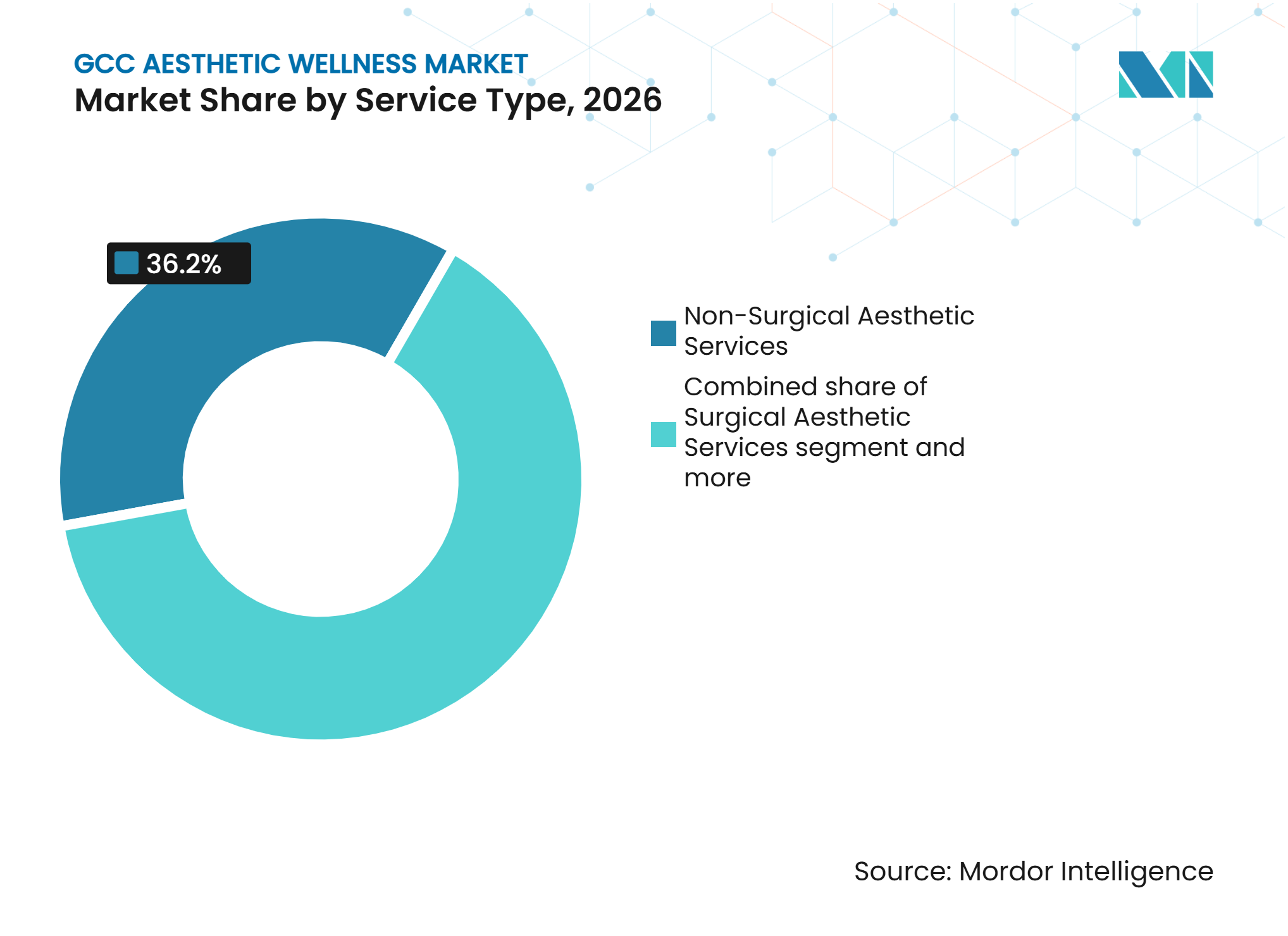
- By service type, Non-Surgical Aesthetic Services accounted for 36.20% of the GCC aesthetic wellness market share in 2026, while Minimally Invasive Services are projected to grow at an 11.71% CAGR through 2032.
- By treatment category, Facial Aesthetics and Skin Rejuvenation accounted for 31.40% of the GCC aesthetic wellness market share in 2026, while Injectables and Biostimulatory Treatments are projected to grow at an 11.60% CAGR through 2032.
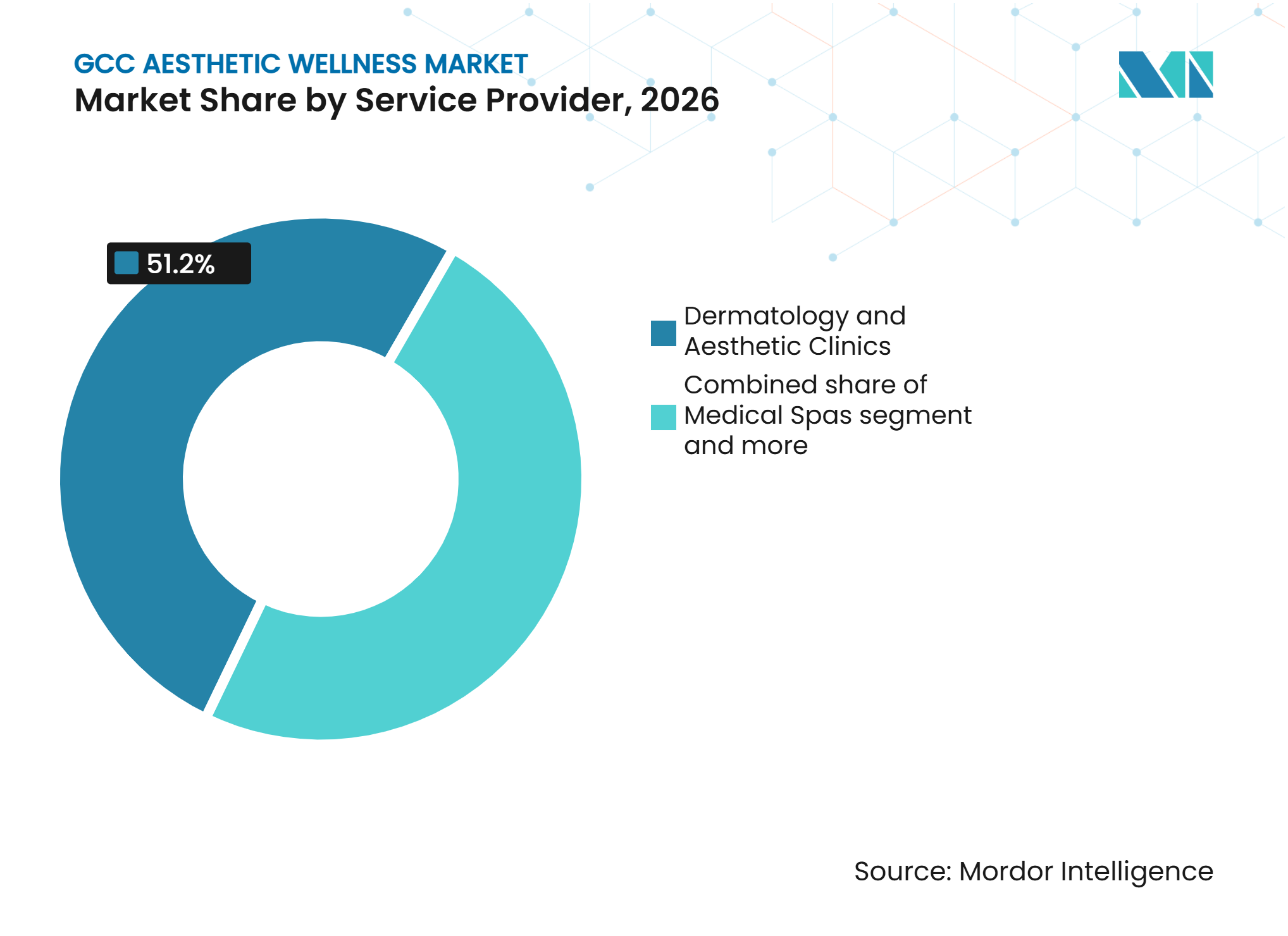
- By service provider, Dermatology and Aesthetic Clinics accounted for 51.20% of the GCC aesthetic wellness market share in 2026, while Medical Spas are projected to grow at an 11.20% CAGR through 2032.
- By end user, Female consumers accounted for 72.70% of the GCC aesthetic wellness market revenue in 2026, while the male consumer segment is projected to grow at a 10.80% CAGR through 2032.
- By geography, Saudi Arabia accounted for 45.40% of the GCC aesthetic wellness market revenue in 2026, while the United Arab Emirates is projected to grow at an 11.45% CAGR through 2032.
Note: Market numbers in this report are based on Mordor Intelligence's proprietary estimation framework, which combines nine months of actuals with Q4 projections for base year 2026.
Market Trends and Insights
Drivers Impact Analysis of GCC Aesthetic Wellness Market*
| Driver | (~) % Impact on CAGR Forecast | Geographic Relevance | Impact Timeline |
|---|---|---|---|
| Vision 2030 and National Wellness Investment | +2.5% | Saudi Arabia primarily, with spillover to the UAE, Qatar, and Oman | Long term (≥ 4 years) |
| Wellness Tourism and Medical Tourism Corridor Expansion | +1.8% | UAE and Saudi Arabia, with growth in Qatar and Bahrain | Medium term (2-4 years) |
| Rising Demand for Minimally Invasive Treatments | +2.2% | Gulf Cooperation Council (GCC)-wide, strongest in UAE and Saudi Arabian urban corridors | Short term (≤ 2 years) |
| Social Media and Preventive Aesthetic Adoption | +1.6% | GCC-wide, particularly UAE, Saudi Arabia, and Kuwait youth cohorts | Short term (≤ 2 years) |
| Premium Hospitality and Destination Wellness Development | +0.8% | Saudi Arabia and UAE | Long term (≥ 4 years) |
| Male Grooming and Gender-Specific Wellness Programs | +0.7% | UAE and Saudi Arabia, with growth in Qatar and Oman | Medium term (2-4 years) |
| Source: Mordor Intelligence | |||
Vision 2030 and National Wellness-Economy Investment
Saudi Arabia’s Vision 2030 supports investment in preventive healthcare, leisure, and wellness infrastructure. In October 2025, Saudi Arabia’s Ministry of Health reported that the Kingdom’s holistic health economy exceeded SAR 74 billion (USD 19.72 billion) and highlighted wellness, preventive health, and longevity through the VIBE initiative, aligned with Vision 2030[1]. This policy direction supports the GCC aesthetic wellness market by enabling clinics to integrate services within broader wellness and healthcare settings. Saudi destination developments are also expanding the range of facilities that can provide aesthetic and wellness services. Red Sea Global’s AMAALA development includes resort brands with spa, longevity, and wellness facilities, supporting integrated service delivery. The impact is strongest in Saudi Arabia, while similar national wellness initiatives in neighboring GCC countries may support regional demand over time.
Rising Demand for Minimally Invasive, Low-Downtime Treatments
Demand for minimally invasive care drives growth in the GCC aesthetic wellness market. The study details are accurate: a 2025 Frontiers in Public Health study surveyed 744 Kuwait University undergraduate students, of whom 20.6% (153 students) reported having undergone minimally invasive facial cosmetic procedures, including Botox, fillers, and permanent makeup[2]. In Dubai, Dubai Health Authority (DHA)'s Version 2.1 standards restrict specified invasive skin-opening procedures to licensed plastic surgeons and establish clear limits for other providers. These requirements direct patients to regulated clinics for procedures requiring medical oversight. Device-based services, including Radio Frequency (RF) microneedling and body contouring, can expand the addressable consumer base while increasing the importance of provider credentials. These trends create opportunities for qualified clinic operators across the region.
Social Media, Influencer Culture, and Preventive Aesthetic Adoption
Digital channels are reshaping how prospective patients discover aesthetic services and evaluate providers. A 2025 Kuwait study of 730 participants found electronic word-of-mouth strongly influenced attitudes toward cosmetic facial procedures. This finding highlights the importance of peer validation and visible treatment outcomes, as patients often seek reassurance before scheduling a procedure. Preventive care aligns with this behavior because it involves recurring visits for skin, hair, and appearance management rather than a single major intervention. Clinics that provide accurate clinical information and authentic treatment outcomes can build patient trust more effectively than those relying on unverified promotional claims.
Wellness Tourism and Medical-Tourism Corridor Expansion
Wellness tourism increases visitor demand and raises service expectations among local patients. Beautyworld Middle East 2025 attracted 85,297 visitors from 178 countries, highlighting Dubai’s role as a regional hub for beauty, wellness, and related service suppliers[3]. The event provides clinics, medical spas, and distributors access to international product launches and professional networks. Dubai’s medical tourism infrastructure and Saudi Arabia’s destination development projects create different pathways toward increased demand for regulated treatment experiences. This trend benefits providers that integrate clinical services with hospitality, scheduling, and multilingual patient support. It also increases competitive pressure on standalone clinics to demonstrate treatment quality and provide a reliable patient journey.
Restraints Impact Analysis of GCC Aesthetic Wellness Market*
| Restraint | (~) % Impact on CAGR Forecast | Geographic Relevance | Impact Timeline |
|---|---|---|---|
| Shortage of Licensed Practitioners and Specialist Therapists | -1.2% | Gulf Cooperation Council (GCC)-wide, particularly Oman, Bahrain, Kuwait, and developing Saudi training centers | Short term (≤ 2 years) and medium term (2-4 years) |
| Fragmented Product, Facility, and Practitioner Regulation | -0.9% | GCC-wide, especially for multi-country operators and device importers | Medium term (2-4 years) |
| High Capital, Import, Maintenance, and Consumables Costs | -1.1% | GCC-wide, with heavier pressure in Oman and Bahrain | Medium term (2-4 years) |
| Safety, Reputation, and Consumer Trust Risk | -0.8% | GCC-wide, particularly UAE and Saudi Arabia | Short term (≤ 2 years) |
| Source: Mordor Intelligence | |||
Shortage of Licensed Practitioners and Specialist Therapists
Specialist availability is a material operational constraint in the GCC aesthetic wellness market. Dubai Health Authority (DHA) requirements mandate that qualifying facilities maintain appropriate licensed specialist oversight and define clinical responsibilities for non-surgical cosmetic care. Saudi Arabia also enforces separate professional registration requirements through the Saudi Commission for Health Specialties. Although these requirements protect patient safety, they can delay new clinic openings when qualified professionals are scarce. The constraint is more pronounced in smaller markets and secondary cities, where patient volumes may not support large specialist teams. It can also lead to uneven service quality if operators seek to meet demand without sufficient clinical capacity.
Fragmented Product, Facility, and Practitioner Regulation Across GCC Countries
Regulatory fragmentation increases the cost and time required to scale across GCC markets. In Saudi Arabia, the Saudi Food and Drug Authority (SFDA) sets product and cosmetic requirements, while separate healthcare authorities oversee professional and facility approvals. The SFDA adopted updated technical regulations in 2025 covering cosmetic safety requirements and product claims, requiring companies to verify compliance with the revised rules. In the UAE, Dubai, Abu Dhabi, and federal authorities each play a role in healthcare regulation. Differences in product registration, facility approvals, provider scope, and marketing rules complicate a unified regional launch process. Established distributors and clinic groups may manage these requirements more effectively than new entrants because they have local compliance capabilities.
*Our forecasts treat driver/restraint impacts as directional, not additive. The impact forecasts reflect baseline growth, mix effects, and variable interactions.
Consumer Preferences & Spending Patterns
Wellness travelers show a strong willingness to spend beyond conventional sightseeing. The Global Wellness Institute’s 2025 report estimated 1.239 billion wellness trips worldwide in 2024, with average spending of USD 721 per trip, compared with USD 340 across all tourism trips. In the Middle East and North Africa, average wellness-trip spending reached USD 1,257, approximately 74% above the global wellness tourism average. This spending pattern creates opportunities for GCC destinations to combine beauty services, wellness consultations, luxury shopping, and hospitality. However, wellness tourism spending includes activities beyond aesthetic treatments.
Saudi Arabia recorded 29.3 million inbound tourists in 2025, generating SAR 176.6 billion (USD 47.06 billion) in spending, compared with SAR 168.5 billion (USD 44.90 billion) in 2024. These figures indicate substantial visitor expenditure but do not isolate spending on beauty or wellness. Providers can capture this demand through multilingual booking, transparent treatment pricing, flexible appointments, and packages coordinated with retail and accommodation. Providers must distinguish medical procedures from non-medical wellness experiences when designing these offers.
Service Market Performance Intelligence
Dubai welcomed 691,478 medical tourists in 2023, generating more than AED 1.034 billion (USD 0.28 billion) in direct healthcare spending, compared with 674,000 visitors and AED 992 million (USD 270.05 million) in 2022. This represented a 2.6% increase in arrivals and a 4.2% increase in spending. This expenditure created opportunities for treatment packages combining consultations, procedures, accommodation, and luxury retail, although total medical-tourism spending cannot be attributed solely to aesthetic services. Providers can compete with value rather than discounts by offering transparent pricing, clear follow-up costs, and treatment-specific packages. A 2025 Kuwait study of 730 participants found that electronic word-of-mouth had a stronger association with cosmetic-surgery attitudes than influencer marketing. Its model explained 47.3% of the variation in procedural intention. Dubai generated AED 2.305 billion (USD 0.63 billion) in indirect medical-tourism revenue in 2023, demonstrating the economic value of healthcare visitors. Providers should prioritize verified reviews, qualified clinician profiles, realistic results, and multilingual digital information while tracking cost per inquiry, booking conversion, and international patient acquisition costs.
GCC Aesthetic Wellness Market Segment Analysis
By Service Type:
Non-Surgical Services Lead While Minimally Invasive Care ExpandsNon-surgical aesthetic services accounted for 36.20% of revenue in 2026. The segment includes treatments delivered without surgery or extended recovery periods. It serves as an entry point for consumers seeking facial care, light-based treatments, chemical peels, and body-care services. The GCC aesthetic wellness market size for this segment benefits from availability in clinical and upscale spa settings. Accessibility supports first-time patient adoption and recurring treatment demand. Medical supervision remains important when treatments extend beyond routine wellness services.
Minimally invasive services are forecast to grow at a CAGR of 11.71% from 2027 to 2032. RF microneedling, injectable biostimulators, and energy-based body-contouring treatments are narrowing the gap with non-surgical services. DHA standards establish requirements for invasive, skin-opening procedures and provider eligibility, supporting a regulated pathway for this category. Surgical services remain relevant for higher-acuity procedures but require longer recovery periods and more stringent facilities. Complementary wellness, hybrid longevity, and hair-care services are expanding the treatment mix and enabling clinics to diversify revenue beyond injectable and laser procedures.



By Treatment Category:
Facial Care Anchors Demand While Injectables and Biostimulators GrowFacial aesthetics and skin rejuvenation accounted for 31.40% of the GCC aesthetic wellness market in 2026. Recurring demand for pigmentation correction, skin brightening, and collagen-stimulating treatments supports the segment. High ultraviolet exposure makes skin management an important part of routine aesthetic care across the region. Maintenance also supports repeat appointments throughout the year. Consumer preference for visible yet natural-looking results strengthens demand for physician-led skincare and energy-based facial procedures.
Injectables and biostimulatory treatments are forecast to grow at a CAGR of 11.60% through 2032. Suppliers and clinics are developing protocols for longer-lasting neurotoxins, fillers, and collagen-stimulating modalities. Saudi Arabia’s technical requirements for cosmetic products and claims make compliance documentation important for product selection and provider communication. Body contouring is gaining traction as consumers seek non-surgical body-enhancement options. Hair removal and restoration remain high-volume categories across many clinics. Regenerative and longevity-focused offerings represent a smaller but emerging add-on category for specialist providers.
By Service Provider:
Clinics Maintain Leadership While Medical Spas Gain GroundDermatology and aesthetic clinics accounted for 51.20% of revenue in 2026, equivalent to USD 230.25 million. Their position reflects their role as credentialed providers of injectables, laser procedures, and advanced skincare services. The GCC aesthetic wellness industry relies on clinical supervision for treatment categories with the highest regulatory requirements. Dubai Health Authority (DHA) provides a compliance framework for non-surgical cosmetic services in Dubai. Hospitals and surgical centers handle more complex procedures and benefit from institutional trust. Clinic networks can strengthen their position through specialist recruitment, standardized treatment pathways, and reliable product sourcing.
Medical spas are projected to grow at a CAGR of 11.2% during 2027–2032. They provide a less formal setting for consumers seeking wellness and aesthetic services in one visit. Hospitality-linked wellness facilities can enhance aesthetic services through privacy, spa amenities, and coordinated scheduling. Beautyworld Middle East 2025 attracted visitors from 178 countries, highlighting the region’s expanding beauty and wellness ecosystem[4]. Hybrid models must comply with applicable provider-scope and facility regulations. Salon-integrated and other informal models face increased pressure as enforcement of practitioner-scope requirements strengthens.

By End User:
Female Consumers Form the Core Base While Male Demand AcceleratesFemale consumers accounted for 72.70% of revenue in 2026, equivalent to USD 326.94 million. This segment uses facial rejuvenation, hair removal, body contouring, and injectable services. Recurring appointments and familiarity with professional aesthetic care support consistent revenue in the GCC aesthetic wellness market. Social proof and reliable information influence provider and procedure selection. A 2025 Kuwait study highlighted the role of electronic word-of-mouth in cosmetic procedure intentions.
The male end-user segment accounted for 27.30% of revenue in 2026 and is projected to grow at a 10.80% CAGR through 2032. Demand includes precision laser services, clinical facials, body contouring, subtle anti-aging treatments, and hair restoration. Low-downtime procedures suit preferences for discretion and minimal disruption to work and social activities. Tailored consultations and service menus can address male patient needs while maintaining clinical care standards. The segment expands the patient base for dermatology clinics, medical spas, and device-led service providers and supports repeat demand for hair, skin, and appearance-management treatments.
Geography Analysis
Saudi Arabia accounted for 45.40% of GCC revenue in 2026, equivalent to USD 204.17 million. Domestic demand and Vision 2030 investments in health, lifestyle, and tourism support growth. The Ministry of Health reported that the Kingdom’s holistic health economy exceeded SAR 74 billion (USD 19.72 billion) and identified wellness and longevity as strategic areas. AMAALA’s first phase adds resort wellness facilities, including spa and longevity services. Saudi Food and Drug Authority (SFDA) cosmetic safety and claims regulations promote compliance and consumer protection.
The UAE is forecast to grow at a CAGR of 11.45% from 2027 to 2032. Dubai’s medical tourism, hospitality, and trade events support its role as a service and distribution hub. DHA Version 2.1 standards define eligibility and scope requirements for non-surgical cosmetic procedures. These smaller markets have distinct demand profiles and regulations. Qatar supports longevity and wellness demand, while Oman expands capacity under Health Vision 2050. Bahrain’s National Health Regulatory Authority (NHRA) and Kuwait’s Ministry of Health govern licensing and compliance. DNA Health & Wellness announced expansion plans into Oman and Bahrain in 2025. Smaller patient pools and specialist availability require deliberate operating models.
Service Provider Network & Expansion Intelligence
The GCC aesthetic treatment network includes hospital plastic surgery departments, dermatology clinics, aesthetic clinics, medical spas, and luxury wellness resorts. Dermatology and aesthetic clinics accounted for a reported 51.2% of regional revenue in 2026, reflecting their role in physician-led injectables, laser treatments, and advanced skincare; however, this estimate requires independent verification. Dubai’s DHA regulatory circular emphasizes clinical compliance. In Saudi Arabia, the AMAALA destination spans 4,200 km² and includes nine planned hotels with approximately 1,600 keys, combining luxury accommodation and wellness experiences. These developments support the integration of retail, beauty treatments, and resort stays into higher-value tourism itineraries.
Provider expansion and equipment distribution are increasing regional service capacity. DNA Health & Wellness opened an 11,000 sq. ft. clinic in Abu Dhabi in 2025, incorporating advanced imaging, blood testing, and artificial intelligence (AI)-based reporting. In February 2025, Cynosure Lutronic and Amico Group announced a distribution agreement covering 10 Middle Eastern markets, supported by more than 250 specialists and plans for clinical training and customer support. Broader access to aesthetic technologies and wellness services can support multi-stop luxury tourism itineraries; however, consistent licensing, practitioner training, and treatment quality remain essential.
Competitive Landscape
Market Concentration
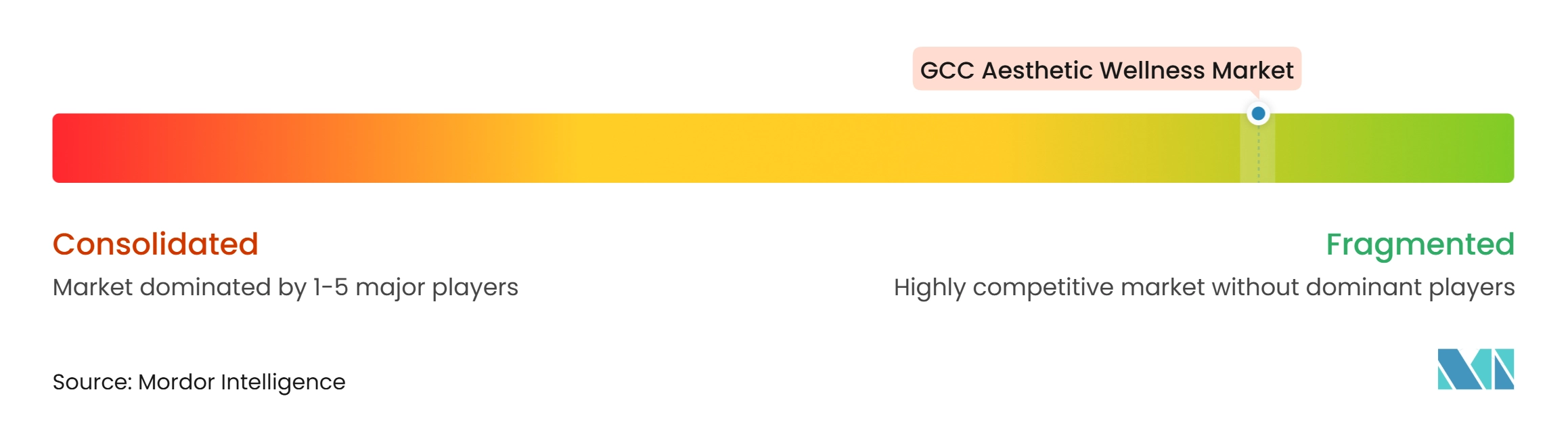
The GCC aesthetic wellness market is highly fragmented. Independent dermatology clinics, medical spas, hospital departments, hospitality providers, and international brands compete across the region. Service quality, pricing, and consumer experience vary, while practitioner reputation, outcomes, and trust remain key success factors. Operators can expand through standardized protocols, specialist recruitment, and multi-city networks. Technology suppliers influence service portfolios through devices, injectables, training, and maintenance support. Sisram Medical reported USD 16.8 million in Middle East and Africa revenue in the first half of 2026, up 20.9% year over year, indicating continued adoption of medical aesthetics and injectables. Galderma reported first-half 2025 sales of USD 2.448 billion, with 12.2% constant-currency growth. Cynosure Lutronic's Middle East alliance with AMICO supports device availability, local service, and provider education. Product registration, training, maintenance capabilities, and compliance requirements in Saudi Arabia and the UAE favor established local operators. DNA Health & Wellness opened a facility in Abu Dhabi and announced GCC expansion plans in 2025. Effect Doctors London opened a second Riyadh clinic and announced entries into Jeddah and Dammam. AMAALA introduced destination-based wellness facilities. Competition is shifting toward networks, destination models, and supplier-supported ecosystems.
GCC Aesthetic Wellness Industry Leaders
-
Imdad
-
AK International LLC
-
DUBIMED
-
Medway LLC
-
BASMed Health Sciences FZC
- *Disclaimer: Major Players sorted in no particular order
GCC Aesthetic Wellness Market Companies Covered in this Report
- Imdad
- AK International LLC
- DUBIMED
- Medway LLC
- BASMed Health Sciences FZC
- Arabian Medical Enterprises LLC
- AME Company
- Zahrawi Group
- Gulf Drug LLC
- Gulf Medical Company
- Al Faisaliah Medical Systems
- Al Jeel Medical and Trading Company
- Tamer Group
- Modern Pharmaceutical Company
- Merz Pharma GmbH & Co. KGaA
- Galderma Group AG
- Sisram Medical Ltd.
- Candela Corporation
- BTL Industries
- InMode Ltd.
Recent Industry Developments in GCC Aesthetic Wellness Market
- April 2026: Burjeel Holdings opened its flagship Tajmeel Clinic in Dubai’s Jumeirah, offering over 30 specialized procedures across aesthetics, dentistry, and surgical care.
- November 2025: Red Sea Global announced AMAALA’s opening, Phase One received SAR 51.04 billion (USD 13.60 billion) in investment and includes nine planned resorts. Equinox features hyperbaric chambers and personalized IV therapies.
- June 2025: Dubai Health Authority issued circular CIR-2025-00000107 reinforcing Version 2.1 of its Non-Surgical Cosmetic Procedures Standards, clarifying restrictions on invasive skin-opening procedures, platelet-rich plasma (PRP) injections, and beauty-therapist activities.
- March 2025: NIAN Ventures opened Effect Doctors London’s second Riyadh clinic, adding advanced dermatology to its intravenous (IV) vitamin therapy services. The company also announced plans to expand into Jeddah and Dammam within two months.
GCC Aesthetic Wellness Market Report Scope
The GCC aesthetic wellness market report examines demand for aesthetic treatments and wellness-oriented appearance enhancement services across the Gulf Cooperation Council (GCC) region. The market is segmented by service type (Non-Surgical Aesthetic Services, Minimally Invasive Aesthetic Services, Surgical Aesthetic Services, and Others); treatment category (Facial Aesthetics and Skin Rejuvenation, Injectables and Biostimulatory Treatments, Body Contouring and Shaping, Hair Removal and Hair Restoration, and Other Aesthetic Treatments); service provider (Dermatology and Aesthetic Clinics, Medical Spas, Hospitals and Surgical Centers, and Others); end user (Male and Female); and geography (Saudi Arabia, United Arab Emirates, Qatar, Oman, and Bahrain and Kuwait). The study analyzes market drivers, including Vision 2030 and national wellness-economy investment, medical and wellness tourism, demand for minimally invasive and low-downtime procedures, social media and influencer-driven adoption, premium hospitality and destination wellness development, and male grooming programs. It also assesses restraints such as shortages of licensed practitioners, fragmented regulations across GCC countries, high capital and equipment costs, and patient-safety and consumer-trust risks associated with unlicensed or inconsistent providers. The report evaluates the regulatory landscape, technological outlook, Porter’s Five Forces, service-provider networks, new launches, geographic expansion, service pricing, customer acquisition trends, consumer preferences, spending patterns, competitive landscape, market concentration, strategic developments, market shares, and company profiles. It further identifies white-space opportunities, unmet needs, cross-border aesthetic wellness packages, medical-tourism bundles, and physician-supervised, data-driven longevity and regenerative wellness centers. The report provides market size and growth forecasts in USD value for 2022–2032 across the GCC region and its covered country markets.
Segmentation Overview
Key Questions Answered in the Report
What is the forecast growth rate for GCC aesthetic wellness services?
The GCC aesthetic wellness market is projected to grow at 10.66% CAGR from 2027 to 2032, reaching USD 873.32 million by 2032.
Which service type currently generates the largest share of revenue?
Non-surgical aesthetic services lead with 36.20% of revenue in 2026, supported by demand for treatments with limited recovery time.
Which GCC country has the largest aesthetic wellness opportunity?
Saudi Arabia accounted for 45.40% of regional revenue in 2026, supported by domestic demand and Vision 2030-linked health and wellness investment.
What is driving demand for minimally invasive procedures in the GCC?
Consumers favor visible results with less downtime, while regulatory standards direct higher-risk procedures toward licensed clinical settings.
Why are dermatology and aesthetic clinics the leading provider type?
These clinics accounted for 51.20% of revenue in 2026 because they provide physician-supervised injectables, laser procedures, and advanced skincare.
How is the male consumer segment changing in GCC aesthetics?
The male segment is forecast to grow at 10.80% CAGR through 2032, with demand for hair restoration, skin treatments, body contouring, and discreet low-downtime care.