
Size and Share of Gaseous Fuels Market For Internal Combustion (IC) Engines
Market Overview
| Study Period | 2021 - 2031 |
|---|---|
| Market Volume (2026) | 138.64 Million tons |
| Market Volume (2031) | 254.11 Million tons |
| Growth Rate (2026 - 2031) | 12.88 % |
| Fastest Growing Market | Asia-Pacific |
| Largest Market | Asia-Pacific |
| Market Concentration | Low |
Major Players *Disclaimer: Major Players sorted in no particular order Image © Mordor Intelligence. Reuse requires attribution under CC BY 4.0. | |
Analysis of Gaseous Fuels Market For Internal Combustion (IC) Engines by Mordor Intelligence
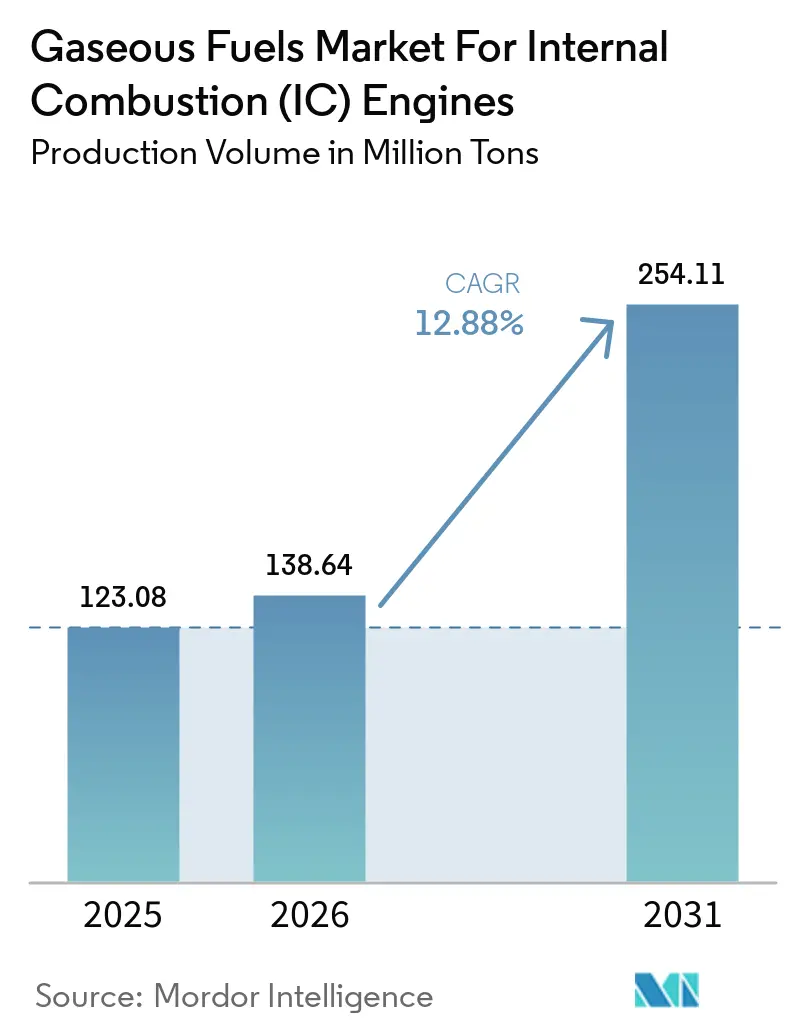
The Gaseous Fuels Market for Internal Combustion Engines Industry size in terms of production volume is expected to grow from 123.08 million tons in 2025 to 138.64 million tons in 2026 and is forecast to reach 254.11 million tons by 2031 at 12.88% CAGR over 2026-2031. Fleet operators are using gaseous fuels to meet emissions requirements while maintaining practical range and refueling times in demanding commercial applications. CNG remains central to established urban fleets, while LNG, biomethane, and hydrogen create opportunities in long-haul, marine, and off-road uses. Fuel supply, refueling access, and vehicle maintenance are increasingly being contracted together, which makes the Gaseous Fuels Market for IC Engines market more dependent on long-term operating relationships. Gas price volatility remains a material concern, particularly for import-dependent regions, and supports interest in renewable gas contracts with more predictable terms. Competitive success in the Gaseous Fuels Market for IC Engines market therefore, depends on reliable stations, fuel availability, and fleet support rather than fuel supply alone.
Key Report Takeaways
- By fuel type, CNG held 51.3% volume share in 2025, while hydrogen is expected to grow at a CAGR of 17.1% through 2031.
- By application, light-duty vehicles accounted for 62.1% volume share in 2025, while marine and waterborne transport is forecast to expand at a 15.1% CAGR through 2031.
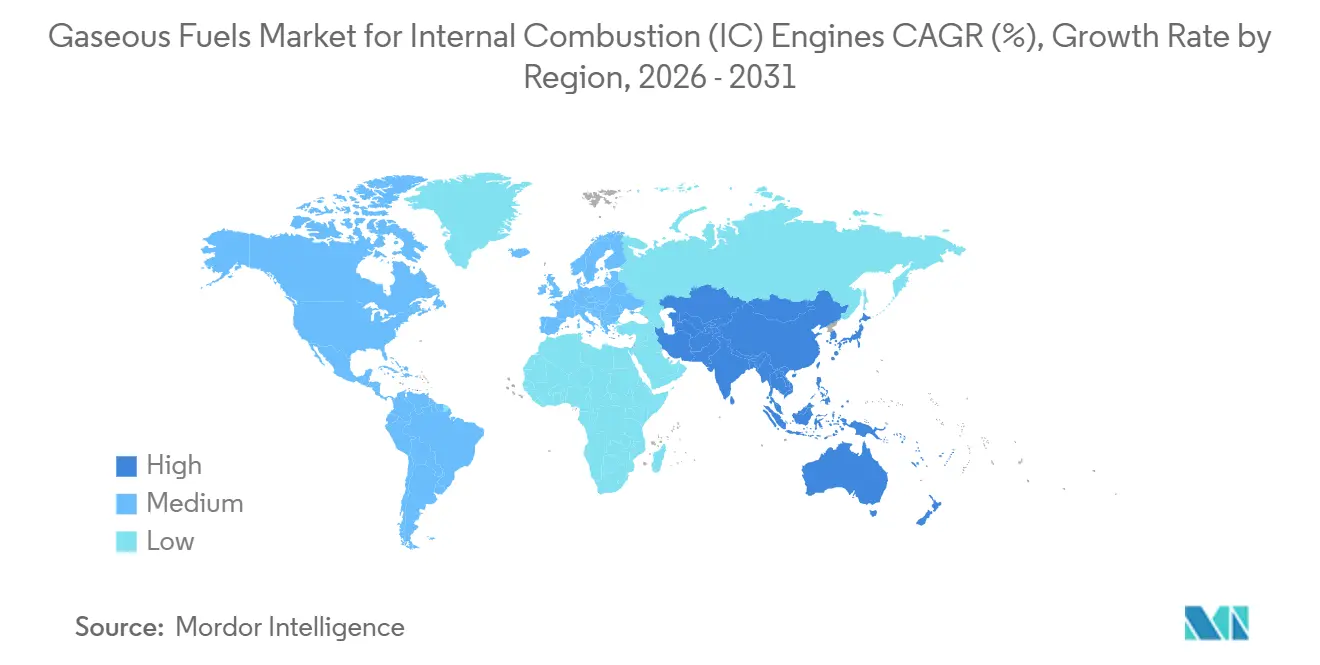
- By geography, Asia-Pacific held 53.3% volume share in 2025 and is forecast to grow at a 14.8% CAGR through 2031.
Note: Market size and forecast figures in this report are generated using Mordor Intelligence’s proprietary estimation framework, updated with the latest available data and insights as of January 2026.
Market Trends and Insights
Drivers Impact Analysis of Gaseous Fuels Market For Internal Combustion (IC) Engines*
| Driver | (~) % Impact on CAGR Forecast | Geographic Relevance | Impact Timeline |
|---|---|---|---|
| Lower Total Cost of Ownership Versus Diesel | +2.80% | Global; highest in North America, South Asia, and South America where gas-diesel price spreads are widest | Short term (≤ 2 years) |
| Stricter Emission Standards for Heavy-Duty and Urban Fleets | +2.50% | North America and EU core; spill-over to APAC and MEA via OEM platform decisions | Medium term (2–4 years) |
| Expansion of CNG, LNG and Renewable Gas Refueling Infrastructure | +2.20% | Global; concentrated in EU freight corridors, US drayage hubs, and Indian city gas districts | Medium term (2–4 years) |
| Factory-Fitted Gaseous-Fuel Powertrain Adoption | +1.00% | Global OEM platforms; strongest demand pull in China, EU, and India | Medium term (2–4 years) |
| Biomethane Compatibility With Existing Gas Engines and Infrastructure | +1.30% | EU, UK, and Latin America core; early activity in ASEAN and MEA | Long term (≥ 4 years) |
| Hydrogen-Ready Engine Platforms for Hard-to-Electrify Applications | +1.80% | EU (Germany, Netherlands, Belgium), Japan, South Korea; emerging in India and Australia | Long term (≥ 4 years) |
| Source: Mordor Intelligence | |||
Lower Total Cost of Ownership Versus Diesel Drives Fleet Conversion Decisions
The operating cost advantage of CNG is an immediate reason for fleet conversion in the Gaseous Fuels Market for IC Engines. Cummins stated in May 2026 that CNG averaged USD 2.99 per diesel gallon equivalent, compared with USD 4.25 for diesel, which produced USD 12,600 in annual fuel savings for 10,000 gallons consumed. The comparison matters most for vehicles with predictable daily routes and high annual mileage, which are also the operating patterns that support the Gaseous Fuels Market for IC Engines. CNG engines also avoid diesel exhaust fluid systems and diesel particulate filters, which reduces exposure to some diesel aftertreatment maintenance needs [1]. A lower and more transparent operating cost can make fuel, maintenance, and station agreements easier for fleet managers to justify. This advantage is strongest when fleets have enough utilization to support dedicated refueling assets or dependable public stations.
Stricter Emission Standards for Heavy-Duty and Urban Fleets Create Compliance-Driven Demand
Emission requirements are raising the value of engine options that can meet fleet operating needs with lower system complexity. The International Maritime Organization approved the IMO Net-Zero Framework in April 2025, establishing measures under MARPOL Annex VI that address greenhouse gas performance in shipping. Similar regulatory direction in road transport supports demand for fuel and engine combinations that can be deployed on fixed urban and freight routes. Compliance requirements are especially relevant for buses, refuse trucks, and distribution vehicles that operate where air-quality rules are closely monitored. Gaseous engines can offer a practical response when operators need to renew fleets but cannot accept battery range, payload, or charging constraints. These requirements create a steadier procurement base for the Gaseous Fuels Market for IC Engines market, even when fuel price differences change.
Expansion of Refueling Infrastructure Unlocks Fleet Conversion in Constrained Markets
Refueling access determines whether a gaseous-fuel vehicle can be used beyond a limited route network. The European Investment Bank approved a loan of up to EUR 264 million in July 2025 for Snam to connect biomethane production plants to Italy’s transmission network [2]. This type of network investment improves the availability of renewable gas for transport and supports stations serving commercial fleets. Clean Energy Fuels opened 6 renewable natural gas stations on major United States freight corridors in May 2026 [3]. More consistent coverage reduces route planning risk and can improve the expected resale value of gaseous-fuel vehicles in the Gaseous Fuels Market for IC Engines market. It also helps providers offer fleet customers a combined fuel and service arrangement rather than a single fuel purchase.
Factory-Fitted Gaseous-Fuel and Hydrogen-Ready Platforms Broaden Practical Applications
Factory-fitted gaseous-fuel engines and hydrogen-ready platforms can reduce the technical and warranty concerns associated with aftermarket conversion. JCB placed its hydrogen combustion backhoe loader into full production in May 2025 after receiving European Union type approval for non-road mobile machinery [4]. A scientific assessment published in 2025 reported that hydrogen internal combustion engines can tolerate hydrogen purity levels that are less demanding than those required by fuel-cell systems. This makes hydrogen combustion relevant where fuel quality, high utilization, and operational continuity are important. Construction, agriculture, marine activity, and other off-road operations can benefit where battery charging access is limited. The Gaseous Fuels Market for IC Engines industry is therefore supported by both established gas engines and newer hydrogen-capable platforms.
Restraints Impact Analysis of Gaseous Fuels Market For Internal Combustion (IC) Engines*
| Restraint | (~) % Impact on CAGR Forecast | Geographic Relevance | Impact Timeline |
|---|---|---|---|
| Uneven Refueling Coverage and High Station Capital Costs | -1.80% | Highest friction in South and Southeast Asia, Sub-Saharan Africa, and secondary US/EU corridors outside established freight lanes | Short term (≤ 2 years) |
| Natural Gas Price Volatility and Import Exposure | -1.40% | EU (LNG import-dependent), APAC (spot LNG buyers), South Asia; lower impact in North America and domestic-supply markets | Short term (≤ 2 years) |
| Methane Slip and Lifecycle-Emission Accounting Risk | -0.80% | Global; most acute in markets where well-to-wake GHG accounting is mandatory (EU FuelEU Maritime, US RFS) | Medium term (2–4 years) |
| Residual Value Discount for Gaseous-Fuel Vehicles in Electrifying Markets | -0.60% | California, EU member states with aggressive ZEV mandates, South Korea | Long term (≥ 4 years) |
| Source: Mordor Intelligence | |||
Uneven Refueling Coverage and High Station Capital Costs Limit Broader Adoption
Station investment remains difficult for smaller operators with irregular routes or low vehicle volumes. A new network must provide enough coverage for fleet confidence, but providers often need proven vehicle demand before committing capital. This circular problem is more acute for LNG because storage and handling requirements are more demanding than for CNG. Infrastructure gaps can also limit the Gaseous Fuels Market for IC Engines in regions with gas resources but limited transport fuel networks. Larger fleets have an advantage because they can justify private stations and spread operating costs across more vehicles. Public corridor expansion and agreements with logistics operators are therefore important for extending adoption beyond early fleet users.
Natural Gas Price Volatility and Lifecycle Emissions Risk Reduce Fleet Certainty
Natural gas price changes can weaken the fuel cost certainty that supports a conversion decision. ACER identified price volatility as an issue for Europe’s LNG supply conditions in its 2026 LNG monitoring report. Import-dependent buyers face greater exposure when global supply disruptions affect wholesale gas prices. Long-term renewable natural gas contracts can reduce this uncertainty, although they may be harder for smaller fleets to obtain. Lifecycle emissions rules also place more importance on methane control, fuel certification, and verified feedstock pathways. These factors may favor providers that can document renewable content and manage emissions performance across the Gaseous Fuels Market for IC Engines market supply chain.
*Our forecasts treat driver/restraint impacts as directional, not additive. The impact forecasts reflect baseline growth, mix effects, and variable interactions.
Gaseous Fuels Market For Internal Combustion (IC) Engines Segment Analysis
By Fuel Type:
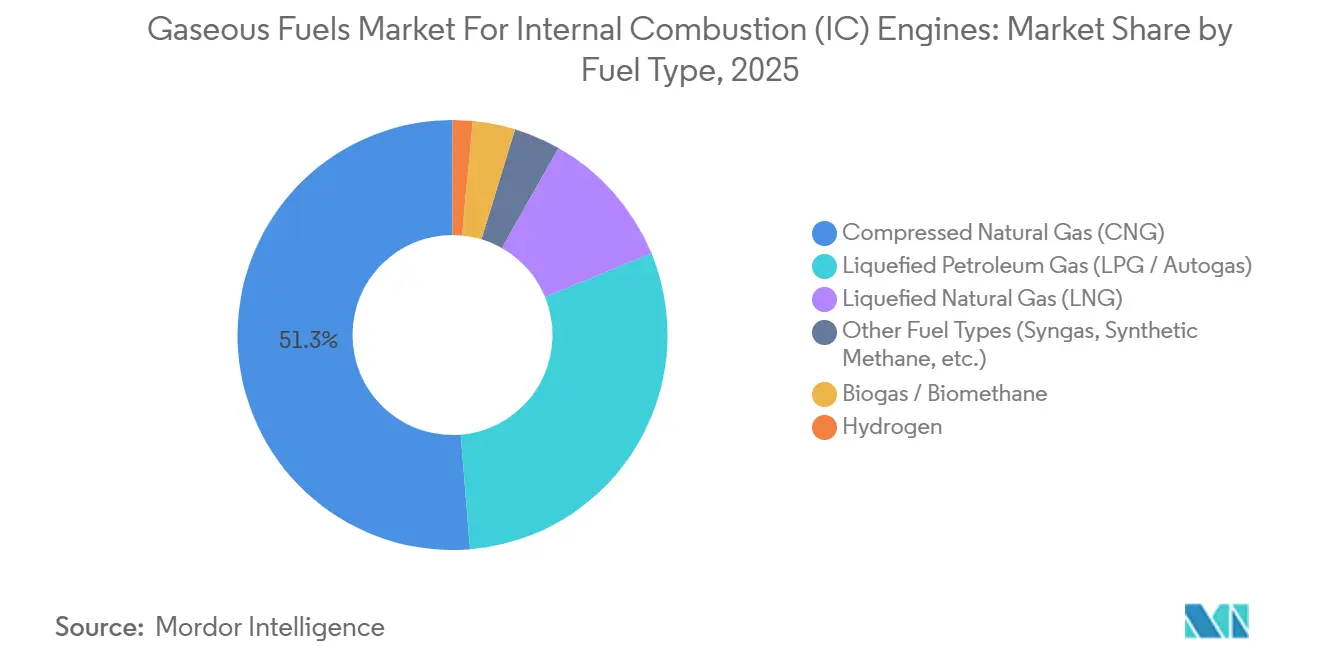
CNG Retains Scale While Hydrogen Expands in Specialized UsesCNG held 51.3% of the Gaseous Fuels Market for IC Engines market share in 2025, supported by long-standing use in urban buses, municipal refuse fleets, and local logistics operations. Its installed vehicle base and mature refueling model give operators a clear starting point for fuel and maintenance planning. CNG is particularly suitable where vehicles return to a depot and use fixed daily routes. LNG serves a different operating need because it can support long-distance trucking and marine activity where compressed gas storage may limit range. LPG or autogas continues to serve passenger cars and light commercial vehicles where conversion capability, taxation, and retail access are established. Dacia expanded its LPG and gasoline bi-fuel lineup in 2026, which shows that OEMs continue to support this fuel option in relevant European vehicle categories.
Hydrogen is projected to grow at a 17.1% CAGR through 2031, the fastest rate among fuel types in the Gaseous Fuels Market for IC Engines market size. The 2025 technical assessment found that hydrogen internal combustion systems can cost less than comparable fuel-cell systems while using familiar engine manufacturing approaches. This supports deployment in operations where utilization, range, and rapid refueling matter more than broad passenger vehicle use. Biomethane offers a separate path because it can use much of the existing gas engine and distribution system. The European Parliament described transport provisions in the Renewable Energy Directive framework as a meaningful policy basis for biomethane deployment. Syngas and synthetic methane remain less developed and have limited commercial use during the forecast period.

By Application:
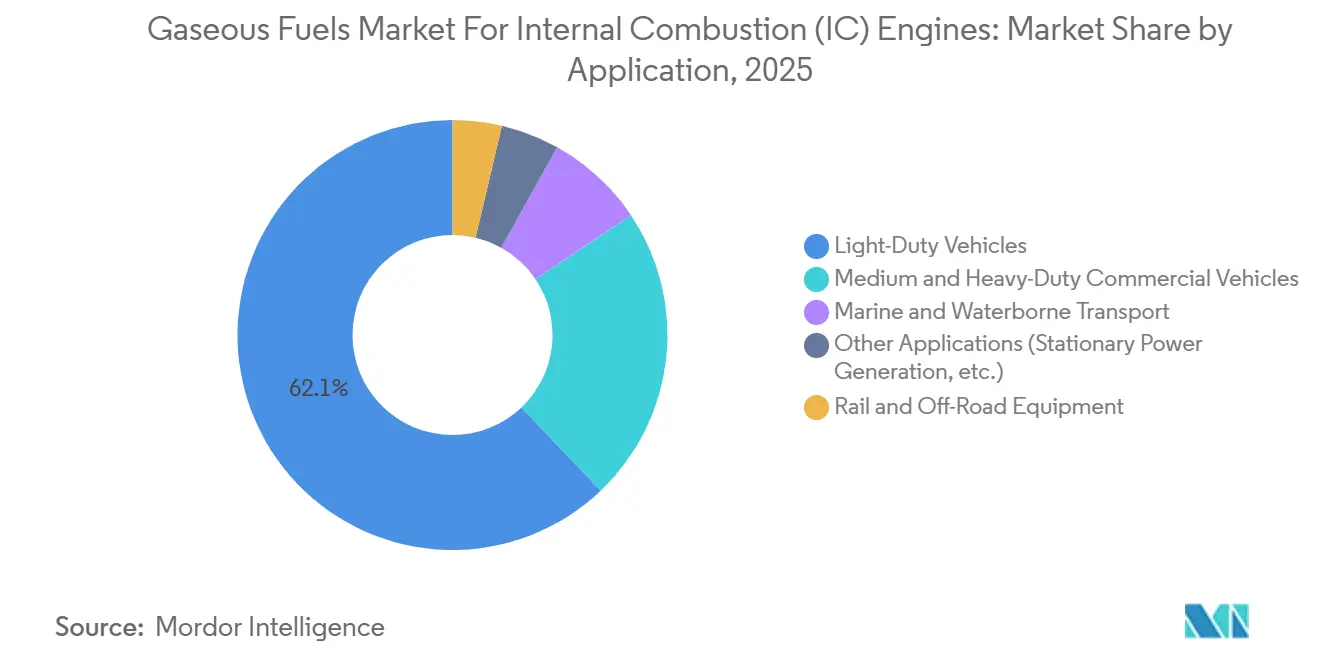
Light-Duty Vehicles Lead Volumes While Marine Activity Gains MomentumLight-duty vehicles accounted for 62.1% of the Gaseous Fuels Market for IC Engines market share in 2025, reflecting established CNG and LPG vehicle populations in several large vehicle markets. These fleets are supported by routine urban driving patterns and retail or depot refueling access. Passenger and light commercial vehicles can benefit where local gas prices and conversion systems make gaseous fuels economical. Their large installed base also supports maintenance networks and familiarity with gaseous-fuel systems. Medium- and heavy-duty vehicles have a lower unit share but remain essential to station economics because they consume more fuel and operate on repeat corridors. They are especially important for creating reliable demand for CNG, LNG, and renewable gas stations.
Marine and waterborne transport is forecast to grow at a 15.1% CAGR through 2031, making it the fastest-growing application in the Gaseous Fuels Market for IC Engines market size. The IMO’s framework creates stronger demand for fuels and engine systems that can help ships improve greenhouse gas performance. LNG dual-fuel vessels also face growing attention to engine certification and methane management. Rail and off-road equipment remain smaller applications, but hydrogen combustion developments have increased their relevance. JCB’s approved hydrogen backhoe loader provides evidence that certified production equipment is now possible in this area. Stationary power generation provides additional demand in gas-rich locations and can strengthen local infrastructure economics.
Geography Analysis
APAC Gaseous Fuels Market for Internal Combustion (IC) Engines
Asia-Pacific held 53.3% regional revenue share in 2025 and is forecast to grow at a 14.8% CAGR through 2031. The region combines large vehicle fleets, established CNG activity, city gas development, and increasing LNG demand for long-haul transport. China remains an important source of commercial vehicle volume, while India is expanding from urban CNG use toward LNG logistics infrastructure. Indraprastha Gas Limited opened the National Capital Region’s first LNG station in Dadri in 2026, extending the region’s options for long-distance truck operations. Southeast Asia offers additional potential where urban air-quality goals, gas availability, and new CNG programs can converge. Development will still depend on whether station coverage reaches the level needed by fleet operators.
North America and Europe Gaseous Fuels Market for Internal Combustion (IC) Engines
North America and Europe are important technology and regulatory centers for the Gaseous Fuels Market for IC Engines market. In the United States, Clean Energy Fuels is expanding renewable natural gas capacity and stations along freight corridors. Europe has a stronger policy focus on biomethane integration and lifecycle emissions performance. The European Investment Bank’s financing for Snam supports new links between biomethane plants and Italy’s gas network. This investment can improve access to renewable gas supply for transport users across the Gaseous Fuels Market for IC Engines market. These regions also provide a testing ground for hydrogen combustion equipment, certified marine systems, and fleet service models.
MEA and South America Gaseous Fuels Market for Internal Combustion (IC) Engines
South America, the Middle East and Africa provide positive growth opportunities but have more uneven infrastructure conditions. Gas availability, local fuel price relationships, and public investment can support adoption in selected locations. Argentina is relevant for vehicle conversion activity, while local production of natural gas engines can strengthen regional supply capability. FPT Industrial began producing natural gas engines in Argentina in August 2025 for commercial, agricultural, and urban transport applications. Nigeria’s planned CNG network and Saudi gas-to-mobility efforts indicate interest in broader regional deployment in the Gaseous Fuels Market for IC Engines market. Execution will depend on station financing, reliable fuel distribution, and fleet operators that can anchor initial demand.
Competitive Landscape
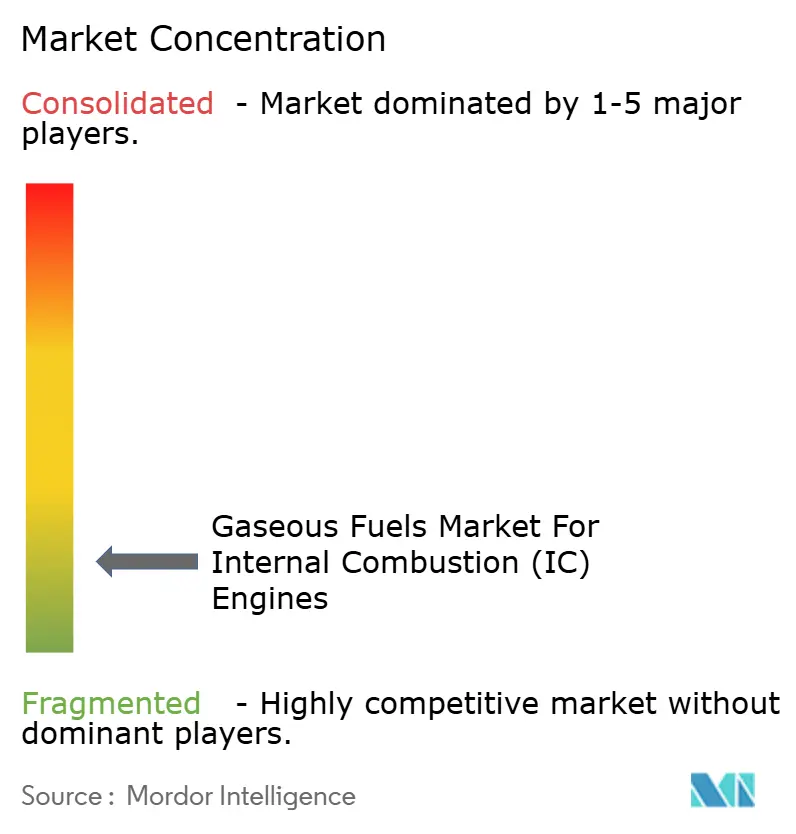
The Gaseous Fuels Market for IC Engines is fragmented. Integrated energy companies have an advantage in gas supply, distribution assets, and regional relationships. Specialists compete by offering station density, renewable fuel content, operations support, and long-term customer agreements. These customer relationships are important because fleet operators need dependable fuel, maintenance, and route coverage at the same time. Clean Energy Fuels reported continued demand across transit buses, refuse trucks, and heavy-duty trucks in its 2025 results. This model shows how service and renewable fuel supply can create customer retention beyond a basic fuel sale in the Gaseous Fuels Market for IC Engines.
Snam is reshaping the renewable gas supply setting through its 2026 to 2030 strategic plan. The company plans EUR 14 billion in investment and intends to divest its Bioenerys biomethane production assets by 2027 to meet European Union unbundling requirements. This move may create more independently operating biomethane producers that compete for grid access and transport contracts. Clean Energy Fuels also announced a March 2026 joint venture with TotalEnergies to develop 10 large-scale renewable natural gas projects. These actions show that the Gaseous Fuels Market for IC Engines industry is moving toward integrated renewable fuel and infrastructure offerings. Companies that can secure feedstock, certify renewable content, and operate stations can hold a practical advantage.
Hydrogen engine platforms and marine certification add further competitive differences in the Gaseous Fuels Market for IC Engines market. JCB’s production hydrogen backhoe loader shows that industrial equipment companies can participate through certified engine products rather than fuel supply alone. LNG and dual-fuel vessel suppliers also need to meet the evolving requirements that apply to marine greenhouse gas performance. The strongest opportunities remain in emerging CNG corridors, biomethane supply and certification, and equipment for applications where electrification is harder to use. These areas require capital, technical capability, and local fleet relationships. No combined market share for the top companies was provided, so a numerical market concentration score cannot be assigned without creating unsupported data.
Leaders of Gaseous Fuels Market For Internal Combustion (IC) Engines
-
Shell plc
-
TotalEnergies SE
-
bp p.l.c.
-
China National Petroleum Corporation
-
Exxon Mobil Corporation
- *Disclaimer: Major Players sorted in no particular order
Gaseous Fuels Market For Internal Combustion (IC) Engines Companies Covered in this Report
- Adani Total Gas Limited
- bp p.l.c.
- Chevron Corporation
- China National Petroleum Corporation
- Clean Energy Fuels Corp.
- ENGIE SA
- Eni S.p.A.
- Equinor ASA
- Exxon Mobil Corporation
- FortisBC Energy Inc.
- Gasum Oy
- Indian Oil Corporation Limited
- L'Air Liquide S.A.
- Linde plc
- Repsol, S.A.
- Shell plc
- Snam S.p.A.
- TotalEnergies SE
Recent Industry Developments in Gaseous Fuels Market For Internal Combustion (IC) Engines
- May 2026: Clean Energy Fuels Corp. opened six new RNG stations on major US freight corridors at ACT Expo. The announcement followed a March 2026 JV with TotalEnergies to develop ten large-scale RNG projects with 0.8 TWh annual projected capacity from agricultural waste.
- May 2026: GreenLine Mobility Solutions, an Essar venture, announced an INR 1,500 crore investment plan to expand its LNG truck fleet to 10,000 vehicles and grow to 50 refueling stations in India within three years, projecting annual fuel-import savings of USD 5–6 billion if 10% of India's diesel trucking fleet converts.
- March 2026: Snam launched its 2026–2030 Strategic Plan, committing EUR 14 billion total investment, with EUR 140 million dedicated to biomethane capacity expansion to 70 MW by 2027. The plan envisages full divestment of Bioenerys by 2027 in compliance with EU unbundling regulation, creating an independent Italian biomethane supply market.
- December 2025: Linde LienHwa launched two hydrogen refueling stations in Taiwan with CPC Corporation. The Nanzih station serves up to 7 hydrogen buses per day at 700 bar.
Scope of Report on Gaseous Fuels Market For Internal Combustion (IC) Engines
The Global Gaseous Fuels Market for Internal Combustion (IC) Engines comprises the volume of gaseous fuels consumed in internal combustion engine applications across transportation, off-road equipment, marine, rail, and stationary power generation sectors. The market includes both conventional gaseous fuels and low-carbon/carbon-neutral gaseous fuels used as primary or dual-fuel energy sources in spark-ignition and compression-ignition engine platforms.
The Gaseous Fuels Market for Internal Combustion (IC) Engines is segmented by fuel type, application, and geography. By fuel type, the market is segmented into compressed natural gas (CNG), liquefied natural gas (LNG), liquefied petroleum gas (LPG/Autogas), biogas/biomethane, hydrogen, and other fuel types. By application, the market is segmented into light-duty vehicles, medium- and heavy-duty vehicles, marine and waterborne transport, rail and off-road equipment, and others. The report also covers the market size and forecasts for the global gaseous fuels market for IC engines across 17 countries in key regions. For each segment, the market sizing and forecasts have been provided on the basis of volume (Million Tons).
Segmentation Overview
| Compressed Natural Gas (CNG) |
| Liquefied Natural Gas (LNG) |
| Liquefied Petroleum Gas (LPG / Autogas) |
| Biogas / Biomethane |
| Hydrogen |
| Other Fuel Types (Syngas, Synthetic Methane, etc.) |
| Light-Duty Vehicles (Passenger Cars and Light Commercial Vehicles) |
| Medium- and Heavy-Duty Commercial Vehicles (Trucks and Buses) |
| Marine and Waterborne Transport |
| Rail and Off-Road Equipment |
| Other Applications (Stationary Power Generation, etc.) |
| North America | United States |
| Canada | |
| Mexico | |
| Europe | Germany |
| United Kingdom | |
| France | |
| Russia | |
| Spain | |
| Rest of Europe | |
| Asia-Pacific | China |
| India | |
| Japan | |
| South Korea | |
| ASEAN | |
| Rest of Asia-Pacific | |
| South America | Brazil |
| Argentina | |
| Rest of South America | |
| Middle East and Africa | Saudi Arabia |
| United Arab Emirates | |
| South Africa | |
| Rest of Middle East and Africa |
| By Fuel Type | Compressed Natural Gas (CNG) | |
| Liquefied Natural Gas (LNG) | ||
| Liquefied Petroleum Gas (LPG / Autogas) | ||
| Biogas / Biomethane | ||
| Hydrogen | ||
| Other Fuel Types (Syngas, Synthetic Methane, etc.) | ||
| By Application | Light-Duty Vehicles (Passenger Cars and Light Commercial Vehicles) | |
| Medium- and Heavy-Duty Commercial Vehicles (Trucks and Buses) | ||
| Marine and Waterborne Transport | ||
| Rail and Off-Road Equipment | ||
| Other Applications (Stationary Power Generation, etc.) | ||
| By Geography | North America | United States |
| Canada | ||
| Mexico | ||
| Europe | Germany | |
| United Kingdom | ||
| France | ||
| Russia | ||
| Spain | ||
| Rest of Europe | ||
| Asia-Pacific | China | |
| India | ||
| Japan | ||
| South Korea | ||
| ASEAN | ||
| Rest of Asia-Pacific | ||
| South America | Brazil | |
| Argentina | ||
| Rest of South America | ||
| Middle East and Africa | Saudi Arabia | |
| United Arab Emirates | ||
| South Africa | ||
| Rest of Middle East and Africa | ||
Key Questions Answered in the Report
What is the projected size of the Gaseous Fuels Market for IC Engines by 2031?
The Gaseous Fuels Market for IC Engines market is forecast to reach 254.11 million tons by 2031. It rises from 138.64 million tons in 2026 at a 12.88% CAGR, with commercial transport, marine uses, and broader renewable gas access supporting demand where fleet operations require practical range and rapid refueling. This outlook reflects the Gaseous Fuels Market for IC Engines need for fuel availability alongside dependable vehicle support.
Which fuel type leads gaseous-fuel use in IC engines?
CNG led with 51.3% share in 2025 because it is established in urban buses, refuse fleets, and local logistics. Its role in the Gaseous Fuels Market for IC Engines market is reinforced where predictable depot routes allow operators to combine fuel supply, refueling, maintenance arrangements, and steady asset utilization.
Which fuel type is expected to grow fastest through 2031?
Hydrogen is forecast to grow at a 17.1% CAGR through 2031. Its role is concentrated in equipment and transport uses where range, high utilization, and rapid refueling are more important than widespread passenger vehicle deployment, particularly for hard-to-electrify operations.
Which application is growing fastest for gaseous fuels in IC engines?
Marine and waterborne transport is forecast to expand at a 15.1% CAGR through 2031. In the Gaseous Fuels Market for IC Engines market, shipping regulation is increasing attention to greenhouse gas performance, dual-fuel engine systems, certification, methane management, and verified fuel pathways.
Which region has the largest demand for gaseous fuels in IC engines?
Asia-Pacific held 53.3% share in 2025 and is forecast to grow at a 14.8% CAGR through 2031. The region combines large commercial fleets, established CNG use, city gas development, increasing interest in LNG logistics, and demand for dependable station coverage.
What limits adoption of gaseous fuels in commercial fleets?
Uneven station coverage, high infrastructure costs, gas price volatility, and lifecycle emissions requirements can delay conversion decisions. These constraints in the Gaseous Fuels Market for IC Engines market are more difficult for small fleets that cannot support private stations, commit enough volume, or negotiate long-term renewable gas contracts, which can leave viable vehicle choices without an operating fuel network.