
France Wire and Cable Market Size and Share
Market Overview
| Study Period | 2020 - 2031 |
|---|---|
| Forecast Data Period | 2026 - 2031 |
| Base Year Market Size (2025) | USD 5.76 Billion |
| Market Size (2026) | USD 6.05 Billion |
| Market Size (2031) | USD 7.71 Billion |
| Growth Rate (2026 - 2031) | 4.97 % |
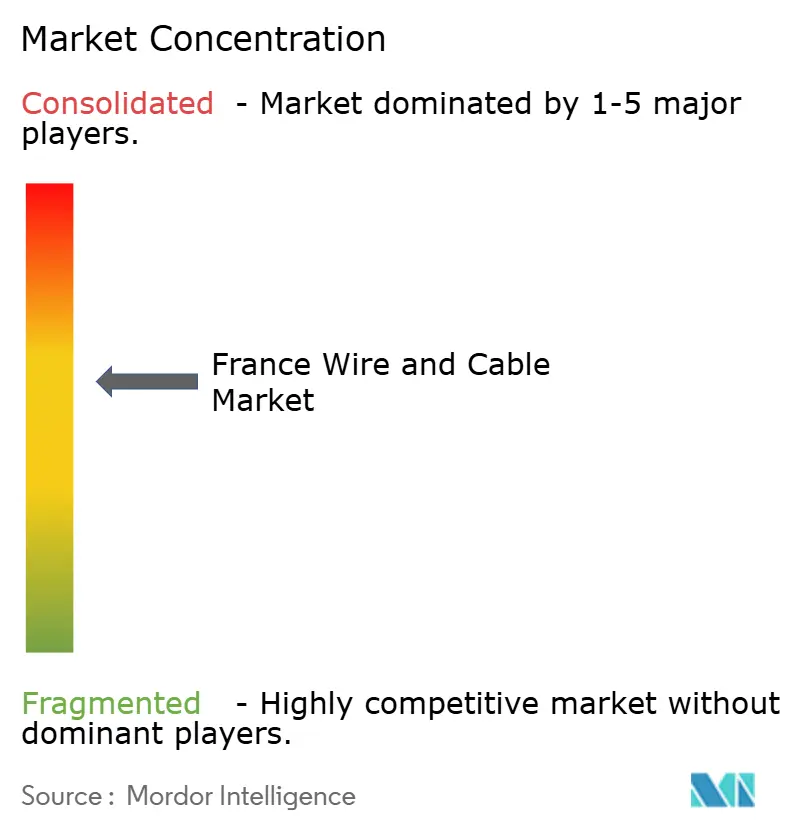
| Market Concentration | Medium |
Major Players *Disclaimer: Major Players sorted in no particular order Image © Mordor Intelligence. Reuse requires attribution under CC BY 4.0. | |
France Wire and Cable Market Analysis by Mordor Intelligence
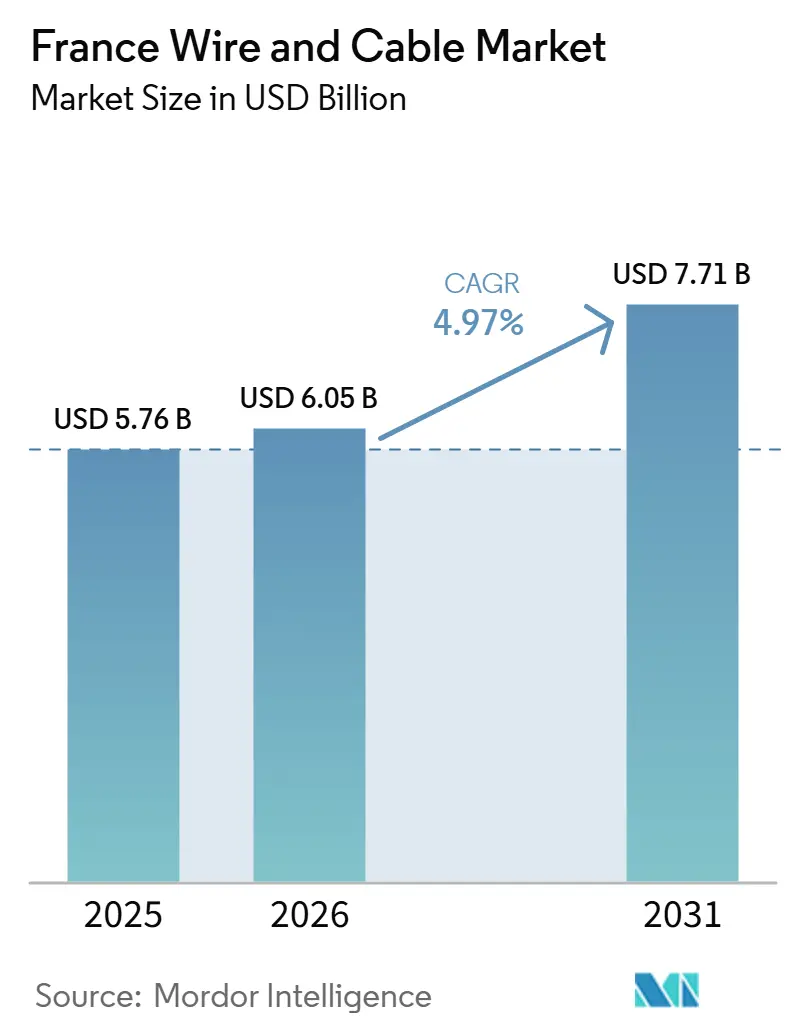
The France wire and cable market size is expected to increase from USD 5.76 billion in 2025 to USD 6.05 billion in 2026 and reach USD 7.71 billion by 2031, growing at a CAGR of 4.97% over 2026-2031. Investment in transmission and distribution renewal is creating sustained demand across the France wire and cable market. Renewable-energy connections and offshore wind projects are increasing the requirements for high-voltage and submarine systems. The remaining fiber rollout and denser 5G networks are shifting demand toward more complex installations. Compliance rules are raising the use of certified low-smoke, zero-halogen cables in regulated buildings. Suppliers with utility qualifications, reliable material sourcing, and certified products are better positioned to serve the France wire and cable market.
Key Report Takeaways
- By voltage, low-voltage cables below 1 kV accounted for 51.62% of revenue share in the France wire and cable market in 2025, while extra- and high-voltage cables are projected to expand at a 6.32% CAGR through 2031.
- By cable type, power cables accounted for 62.08% of revenue share in the France wire and cable market in 2025, while fiber-optic cables are projected to grow at a 5.37% CAGR through 2031.
- By conductor material, copper held 64.18% of revenue share in the France wire and cable market in 2025, while aluminum conductors are expected to expand at a 5.52% CAGR through 2031.
- By installation, underground cables held 55.14% of revenue share in the France wire and cable market in 2025, while submarine cables are projected to grow at a 6.68% CAGR through 2031.
- By end-user vertical, construction held 29.36% of revenue share in the France wire and cable market in 2025, while power infrastructure is expected to expand at a 6.21% CAGR through 2031.
- By insulation, insulated cables held 92.14% of revenue share in the France wire and cable market in 2025 and are projected to expand at a 5.02% CAGR through 2031.
Note: Market size and forecast figures in this report are generated using Mordor Intelligence’s proprietary estimation framework, updated with the latest available data and insights as of January 2026.
France Wire and Cable Market Trends and Insights
Drivers Impact Analysis*
| Driver | (~) % Impact on CAGR Forecast | Geographic Relevance | Impact Timeline |
|---|---|---|---|
| Grid Modernization and Electrification of End Uses | +1.7% | National, with concentrated investment in Île-de-France, Dunkerque, Le Havre, and Fos-sur-Mer | Short term (≤ 2 years) |
| Renewable Energy and Offshore Wind Interconnection Build-Out | +1.3% | Normandy, Brittany, Mediterranean coast, Bay of Biscay | Medium term (2-4 years) |
| Fiber-to-the-Premises and 5G Network Expansion | +0.7% | National, with priority in rural white zones and dense urban deployments | Short term (≤ 2 years) |
| Electric Vehicle Charging Infrastructure Deployment | +0.5% | National, accelerated in motorway corridors, urban parking, and logistics hubs | Medium term (2-4 years) |
| Industrial Reindustrialization and Nuclear Fleet Modernization | +0.4% | Penly, Gravelines, Bugey, and the Dunkerque industrial zone | Long term (≥ 4 years) |
| Long-Term Procurement Visibility From Transmission-System Contracts | +0.2% | National, with clustered benefits near cable manufacturing regions | Short term (≤ 2 years) |
| Source: Mordor Intelligence | |||
Grid Modernization and Electrification of End Uses
France entered a capital-intensive period of grid investment, supporting demand in the France wire and cable market. RTE recorded EUR 3.346 billion (USD 3.61 billion) in total investment expenditure in 2025, 29% higher than the prior year, while grid-renewal spending reached EUR 1.3 billion (USD 1.4 billion).[1]RTE, “Annual Results 2025: Increased Activity to Modernise the Grid and Strengthen Energy Sovereignty in France,” RTE, assets.rte-france.com Its SDDR 2025 set out a EUR 100 billion (USD 112 billion) investment path over 15 years, rising from EUR 3 billion (USD 3.24 billion) in 2025 to EUR 8 billion (USD 8.64 billion) annually by 2040.[2]RTE, “Strategic Development Plan for the French Transmission Grid (SDDR 2025): Executive Summary,” RTE, assets.rte-france.com CRE approved RTE’s 2026 program, including EUR 1.5 billion (USD 1.68 billion) in annual renewal spending and EUR 64.1 million (USD 71.8 million), EUR 67.4 million (USD 75.5 million), and EUR 37.3 million (USD 41.8 million) for Dunkerque, Fos-sur-Mer, and Le Havre, respectively. More than half of RTE connection investments in 2025 served industrial projects in port areas, while more than 200 industrial and data center projects secured access, totaling 33 GW. Enedis also received a EUR 1 billion (USD 1.08 billion) European Investment Bank loan, including a EUR 500 million (USD 540 million) tranche signed in July 2025, to support 7 GW of renewable connections and 2,500 km of buried lines.[3]European Investment Bank, “EDF and the EIB Announce the Signature of EUR 500 Million Financing Contract to Support the Modernisation and Resilience of Enedis-Managed Public Electricity Grid,” European Investment Bank, eib.org
Renewable Energy and Offshore Wind Interconnection Build-Out
Offshore wind projects are increasing demand for submarine and extra-high-voltage cables in the France wire and cable market. Nexans secured an RTE framework agreement in March 2025 worth more than EUR 1 billion (USD 1.08 billion) for 450 km of HVDC subsea cable and 280 km of onshore cable for Centre Manche 1, Centre Manche 2, and Oléron. Prysmian’s RTE framework agreement for Fos and Narbonnaise included 2 EPCI contracts estimated at EUR 700 million (USD 756 million), with call-offs expected during 2026-2027. Hellenic Cables and Asso.subsea received an RTE contract for 32 km of 225 kV submarine cable and 38 km of underground cable for the 500-600 MW Dunkerque project. In May 2026, Nexans, RTE, SuperGrid Institute, and other partners launched the EUR 16 million (USD 17.9 million) RHODÉ project to develop floating HVDC systems for deep-water Atlantic wind farms. RTE also identified a French submarine cable plant as a strategic feasibility priority, reflecting concern about capacity concentrated in a limited number of European facilities.
Fiber-to-the-Premises and 5G Network Expansion
Fiber and mobile investment continue to support specialized cable requirements. France had 27.1 million FttH subscriptions at the end of 2025, equal to 82% of internet subscriptions, and 42.4 million premises passed, or 94.3% national coverage. FttH subscriptions reached 27.7 million by the end of the first quarter of 2026, even as the number of newly passed premises fell to 1.8 million in 2025 from 2.6 million in 2024. The 2.6 million remaining premises require longer, more complex cable routes than those in many earlier urban installations. France also had 32.9 million active 5G SIM cards in the fourth quarter of 2025, accounting for 39% of the 84.9 million mobile cards in service. Operators invested EUR 10.3 billion (USD 11.1 billion) in infrastructure in 2025, with 50% directed to ultrafast fixed and wireless local-loop networks. Binding AMEL commitments to local authorities also provides clearer deployment schedules for suppliers serving the France wire and cable market.
Electric Vehicle Charging Infrastructure Deployment
Charging expansion is adding demand for medium-voltage, grounding, and signaling cables. France had 197,663 public charging points open at the end of June 2026, a 21% year-on-year increase. The April 2026 national electrification plan targeted 30,000 fast-charging points on motorways and major roads by 2035, including 22,000 passenger-vehicle points rated at least 150 kW and 8,000 truck points. These targets require 2.8 GW of grid power at motorway sites for light vehicles and 1.6 GW for trucks. A 150 kW DC charger requires dedicated medium-voltage feeds, larger conductor cross-sections, often 240 mm² or more for main runs, and separate grounding and signaling connections. Enedis estimated that 1.6 million private home charging points had been installed by the end of 2025. ADVENIR increased the maximum subsidy for shared-building projects from EUR 8,000 (USD 8,640) to EUR 12,500 (USD 13,500) in 2026, supporting upgrades to panels and cable runs in apartment buildings.
Restraints Impact Analysis*
| Restraint | (~) % Impact on CAGR Forecast | Geographic Relevance | Impact Timeline |
|---|---|---|---|
| Copper and Aluminum Price Volatility | -0.5% | Global, with direct cost impact on French cable manufacturers and EPC contractors | Short term (≤ 2 years) |
| Stringent Fire, Environmental, and Product-Compliance Requirements | -0.3% | National, concentrated in public buildings, high-rise buildings, and ERP installations | Medium term (2-4 years) |
| Skilled Installation and Qualification Bottlenecks | -0.2% | National, concentrated in grid installation, underground cabling, and nuclear-grade work | Medium term (2-4 years) |
| Grid-Connection Queue and Permitting Friction for Large Loads | -0.2% | National, with acute pressure in Île-de-France, industrial-port zones, and renewable-rich regions | Long term (≥ 4 years) |
| Source: Mordor Intelligence | |||
Copper and Aluminum Price Volatility
Material pricing remains a material risk for cable manufacturers and contractors. Copper reached an intraday high of USD 14,527.50 per tonne on January 29, 2026, and traded at USD 13,544 per tonne in May 2026. The copper-to-aluminum price ratio reached 4.3 in January 2026 and remained near 4.2 at the end of June, above the 3.5-4.0 range that commonly prompts material substitution. This can reduce margins where manufacturers hold copper-priced inventory against fixed-price contracts. Prysmian used 40% aluminum by weight and 60% copper, an increase of 3 percentage points over 5 years. Fixed-price tenders over 12-month periods are becoming less attractive, prompting a shift toward LME-linked or COMEX-indexed prices with quarterly adjustment clauses. The resulting contract negotiations can take longer and complicate multi-year public procurements.
Stringent Fire, Environmental, and Product-Compliance Requirements
The fire-performance rules have increased certification and documentation requirements in the France wire and cable market. A Ministry of Interior decree of May 17, 2024, which took effect on May 23, 2025, required a minimum Cca-s2,d2,a2 CPR classification for power cables in ERP and IGH buildings. New permits submitted after that date must identify compliant cables and provide a visible Declaration of Performance, while underground metro cables must meet the B2ca-s1a,d1,a1 class. Established suppliers with certified product ranges and notified-body relationships can compete for work that smaller suppliers may be unable to serve. Nexans launched its NF-USE-certified Protect FRN1 X6G3 range in October 2025, reporting a fire-spread reduction of 5 to 10 times and a 3-times improvement in evacuation performance compared with a conventional U1000 R2V cable. Suppliers serving both French and non-CPR markets may need to maintain separate certification paths. Traceability obligations for chemical content and components are also increasing administrative work over the forecast period.
*Our forecasts treat driver/restraint impacts as directional, not additive. The impact forecasts reflect baseline growth, mix effects, and variable interactions.
Segment Analysis
By Voltage: High-Voltage Projects Support Faster Growth
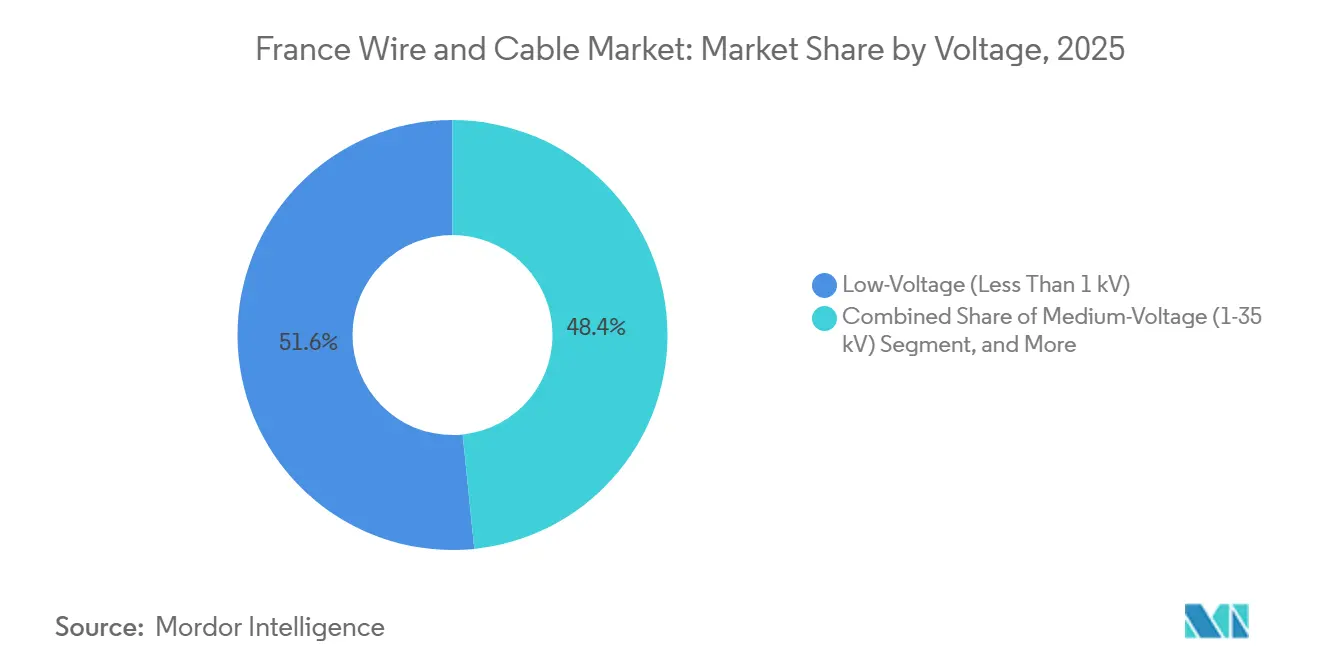
Low-voltage cables held 51.62% of France wire and cable market share in 2025. Their use across buildings, charging infrastructure, and local distribution made them the largest voltage category. Medium-voltage cables remain central to Enedis’s distribution system. Nexans and Prysmian signed 7-year Enedis agreements totaling EUR 600 million (USD 672 million) and EUR 550 million (USD 616 million), respectively, in 2026, including 3 optional years, intended to double average annual deliveries through 2032.
Extra- and high-voltage cables are projected to record the highest growth, at a 6.32% CAGR through 2031. Offshore wind export links and grid reinforcement are the main sources of demand. RTE planned EUR 1.5 billion (USD 1.68 billion) in annual renewal spending for 2026. Projects have supplier qualification lead times of 24-36 months and EPCI structures that secure capacity well before installation. Order-book depth is therefore more relevant than short-term demand measures for qualified producers.



By Cable Type: Power Cables Lead While Fiber-Optic Cables Expand
Power cables accounted for 62.08% of the France wire and cable market size in 2025. Utility investment and industrial demand support this leading position. Signal and control cables support process automation and building management, while coaxial and data cables support broadcasting, CCTV, and legacy telecommunications. Fiber-optic cable is projected to grow at a 5.37% CAGR through 2031. Its growth is supported by 2.6 million premises that still require FttH connections at the end of 2025.
France had 27.7 million active FttH subscriptions at the end of the first quarter of 2026, equal to 84% of fixed internet subscriptions. Remaining connections generally require longer and more difficult routes. Fifth-generation densification and in-building antenna systems add feeder and backhaul demand. Data center campuses are also increasing the need for fiber interconnections. Dense wavelength-division multiplexing increases fiber count per cable and broadens demand beyond last-mile rollout.
By Conductor Material: Aluminum Gains Ground Alongside Copper
Copper held 64.18% of the France wire and cable market share by conductor material in 2025. Its electrical performance remains important for high-voltage systems, nuclear instrumentation, and premium data cable. Optical glass and polymer conductors support fiber-optic applications. The 27.7 million active FttH subscriptions recorded in the first quarter of 2026 continue to support fiber-strand demand. Copper remains hard to replace where performance and certification requirements are demanding.
Aluminum conductors are projected to expand at a 5.52% CAGR through 2031. The record 4.3 copper-to-aluminum price ratio in January 2026 increased substitution in distribution and overhead applications. Nexans’s 2026 Enedis agreement included aluminum conductors with 10% recycled content, and its July 2026 Hydro agreement covered 85,000 tonnes of low-carbon aluminum wire rod. Recycled content and carbon-footprint reporting increasingly influence supplier evaluation. Copper will remain necessary where aluminum does not satisfy technical requirements.
By Installation: Underground Cables Lead and Submarine Projects Accelerate
Underground cable held 55.14% of France wire and cable market share by installation mode in 2025. France’s policy of burying distribution networks supports this position. The European Investment Bank co-funded EUR 500 million (USD 540 million) for 2,500 km of buried distribution lines in 2025. Overhead cable remains relevant in lower-density regions. RTE identified overhead reinforcement as a cost-effective option for long-distance backbone investment in central and eastern France.
Submarine cable is projected to be the fastest-growing installation category, at a 6.68% CAGR through 2031. Centre Manche, Oléron, Dunkerque, Fos, and Narbonnaise create a substantial project pipeline. The Bay of Biscay France-Spain interconnector had a total project value of EUR 3.1 billion (USD 3.35 billion) and is expected to enter service in 2028. Nexans, Prysmian, NKT, and Hellenic Cables hold the qualifications and assets needed for this work. Specialized vessels and lengthy qualification processes make this category more concentrated than mainstream cable categories.
By End-User Vertical: Power Infrastructure Outgrows Construction
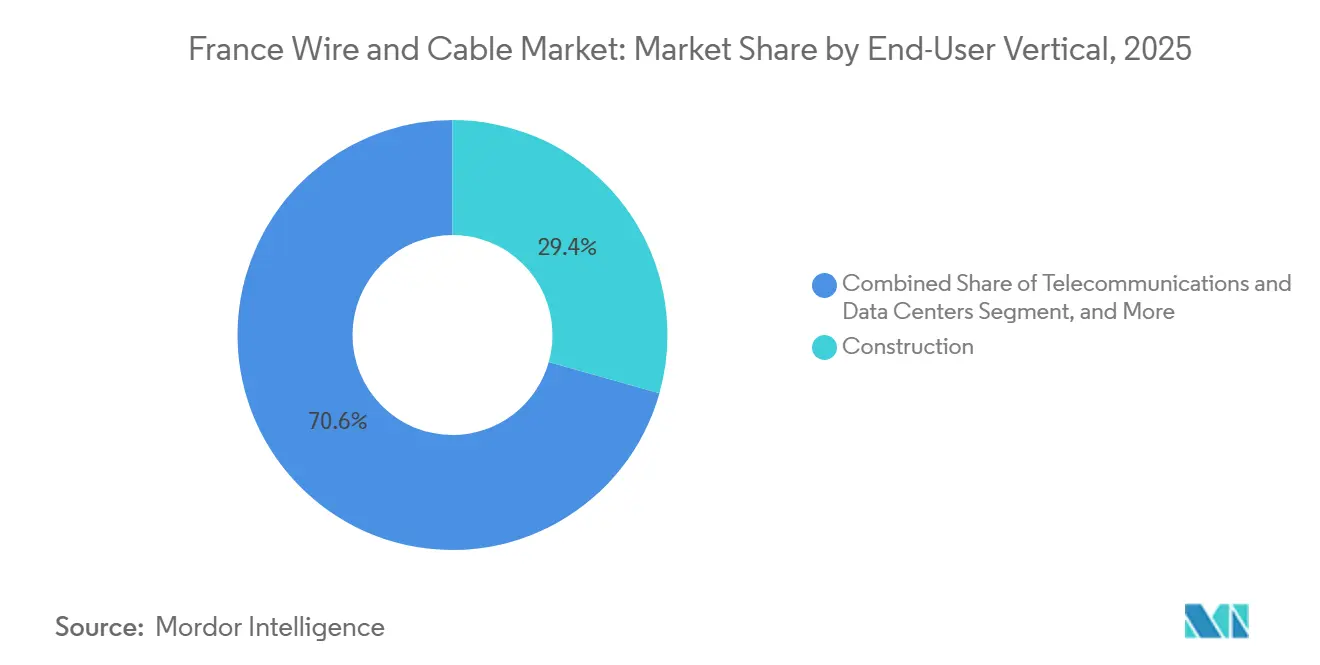
Construction held 29.36% of the France wire and cable market share in 2025. It remained the largest end-user category across residential and commercial activity. French construction investment declined 4% by volume in 2025, while residential and commercial building activity fell 4.7%, and public works declined 0.4%. A 2.7% recovery in building construction was expected in 2026. This provides some support for low-voltage cable demand.
Power infrastructure and renewables are projected to grow at a 6.21% CAGR through 2031. RTE and Enedis investment programs, offshore wind links, and nuclear modernization support this outlook. Telecommunications and data centers, oil and gas and petrochemicals, automotive and mobility, and industrial manufacturing require different cable specifications. Lynxeo’s 12-year EDF agreement covered 15,000 km of ENERGEN K1 and K2 halogen-free, LSZH cable for 6 EPR2 reactors and the existing fleet. Nuclear qualification requirements limit eligible suppliers and extend revenue visibility.
By Insulation: Certified Insulated Cables Remain Predominant
Insulated cables accounted for 92.14% of the France wire and cable market by insulation type in 2025. Building, grid, and industrial safety rules support this dominant position. Non-insulated products are mainly bare aluminum or copper conductors used in overhead transmission and rural distribution. RTE’s overhead strategy supports their continuing use in selected locations. Safety-code coverage limits the addressable use of non-insulated products.
Insulated cable is also projected to grow at a 5.02% CAGR through 2031. The May 2025 CPR requirement is replacing legacy PVC cable with Cca and B2ca low-smoke, zero-halogen products. XLPE is gaining use in medium- and high-voltage systems because it can enable greater current capacity without a larger conductor. SYCABEL issued 2026 guidance on the parallel NF C 32-070 and CPR Euroclass systems. The dual framework favors suppliers with established testing and certification capabilities.
Geography Analysis
Île-de-France is a major center for high-density electrification and data-center activity. RTE identified the 400 kV and 225 kV grid backbone around Paris as requiring renewal and capacity reinforcement, with commissioning around 2035 if major digital and industrial projects proceed. The network was largely built in the 1960s and 1970s, while Paris-Nord II creates demand for redundant medium-voltage and high-density fiber links. ERP buildings, commercial towers, and high-rise housing also increase CPR retrofit activity.
Northern France, covering Hauts-de-France and Normandy, is a cable-intensive industrial corridor. CRE allocated EUR 64.1 million (USD 71.8 million) to Dunkerque and EUR 37.3 million (USD 41.8 million) to Le Havre in RTE’s 2026 investment program for industrial-port electrification. Centre Manche 2 had a planned capacity of 1.5 GW and a total investment of EUR 4.5 billion (USD 5.1 billion), while Centre Manche 1 was within Nexans’s HVDC framework agreement. Penly and Gravelines are 2 of the 3 EPR2 locations, within a EUR 72.8 billion (USD 81.5 billion) program that included EUR 2.7 billion (USD 3.02 billion) for 2026. NKT completed 2 of 3 French landfalls for the Bay of Biscay interconnector by 2026, which is expected to raise France-Spain exchange capacity from 2,800 MW to 5,000 MW in 2028.
Southern and eastern France have different demand patterns within the France wire and cable market. CRE allocated EUR 67.4 million (USD 75.5 million) to Fos-sur-Mer in 2026 for petrochemical electrification, hydrogen loads, and wider grid needs. The Fos offshore project, Bugey, and cross-border links with Germany, Switzerland, and Italy support longer-term transmission and nuclear-grade cable demand. The remaining fiber connections are concentrated in the Massif Central, western Pyrenees, and Alpine foothills. Metropolitan France had 94.9% fiber coverage by the first quarter of 2026, but these locations require longer routes and rugged outdoor cable.
Competitive Landscape
The France wire and cable market is moderately consolidated in premium infrastructure supply and more fragmented in specialist and mid-market categories. Nexans and Prysmian secured EUR 1.15 billion (USD 1.29 billion) in new Enedis medium-voltage agreements in 2026, covering the largest domestic procurement stream through 2032. NKT has built credentials through the Bay of Biscay HVDC installation. Lynxeo’s EDF agreement shows the value of its certified ENERGEN platform and K1 and K2 nuclear qualifications.
Compliance and circular sourcing are increasingly important competitive criteria. Prysmian’s Enedis agreement included more than 12% recycled aluminum and more than 30% recycled copper, while Nexans’s agreement included 10% recycled aluminum. These terms, along with the CPR upgrade cycle, favor firms with certified low-smoke, zero-halogen products. Suppliers without certified products or circular-material sourcing may face greater difficulty in regulated procurements. Combining LSZH certification and lower-carbon conductors may improve access to sustainability-led tenders.
Nexans completed the Autoelectric sale and, in July 2026, signed a lower-carbon aluminum supply agreement with Hydro. Prysmian continued to support domestic supply through its Gron and Montereau-Fault-Yonne facilities. OMERIN, CEV, and Favier Group serve specialized industrial and infrastructure applications. Engineering support, customization, and compliance credentials can matter more than price in these niches. Reported agreements establish leading positions but do not provide a combined market-share figure for the top suppliers.
France Wire and Cable Industry Leaders
Nexans S.A.
Prysmian S.p.A.
NKT A/S
Hellenic Cables S.A.
SILEC Cable SAS
- *Disclaimer: Major Players sorted in no particular order

Recent Industry Developments
- July 2026: Nexans and Hydro signed a 5-year supply agreement for 85,000 tonnes of low-carbon aluminum wire rod produced in Norway using 100% renewable energy, securing a decarbonized raw-material supply chain aligned with evolving EU sustainable procurement and carbon-footprint disclosure requirements for grid cable.
- June 2026: LEONI Cable Solutions broke ground on a new production facility in the Kenitra Free Trade Zone in Morocco, with a total investment of EUR 60 million (USD 67.2 million) and production scheduled to begin in mid-2027, extending manufacturing capacity for automotive and industrial cable markets serving European end-customers.
- May 2026: Nexans, RTE, SuperGrid Institute, Chantiers de l’Atlantique, France Energies Marines, GE Vernova, and Fondation OPEN-C launched the RHODÉ project, a EUR 16 million (USD 17.9 million) France 2030-funded R&D initiative to develop floating HVDC cable systems for large-scale deep-water offshore wind farms in the Atlantic, addressing a cable technology gap that no current commercial product fully covers.


France Wire and Cable Market Report Scope
The France wire and cable market revenue is generated through the sale of low-, medium-, and high-voltage wires and cables, including power, fiber-optic, signal and control, and coaxial/data cables with copper, aluminum, or optical glass/polymer conductors, along with associated value-added products and installation-specific solutions for overhead, underground, and submarine network deployments.
The France wire and cable market report is segmented by voltage (extra- and high-voltage (greater than 35 kV), medium-voltage (1-35 kV), and low-voltage (less than 1 kV)), cable type (power cable, fiber-optic cable, signal and control cable, and coaxial and data cable), conductor (copper, aluminum, and optical glass/polymer), installation (overhead, underground, and submarine), end-user vertical (construction (residential and commercial), power infrastructure (utilities and renewables), telecommunications and data centers, oil and gas and petrochemicals, automotive and mobility, and industrial manufacturing), and insulation (insulated and non-insulated). The market forecasts are provided in terms of value (USD).
| Extra- and High-Voltage (Greater Than 35 kV) |
| Medium-Voltage (1-35 kV) |
| Low-Voltage (Less Than 1 kV) |
| Power Cable |
| Fiber-Optic Cable |
| Signal and Control Cable |
| Coaxial and Data Cable |
| Copper |
| Aluminum |
| Optical Glass/Polymer |
| Overhead |
| Underground |
| Submarine |
| Construction | Residential |
| Commercial | |
| Power Infrastructure (Utilities and Renewables) | |
| Telecommunications and Data Centers | |
| Oil and Gas and Petrochemicals | |
| Automotive and Mobility | |
| Industrial Manufacturing |
| Insulated |
| Non-Insulated |
| By Voltage | Extra- and High-Voltage (Greater Than 35 kV) | |
| Medium-Voltage (1-35 kV) | ||
| Low-Voltage (Less Than 1 kV) | ||
| By Cable Type | Power Cable | |
| Fiber-Optic Cable | ||
| Signal and Control Cable | ||
| Coaxial and Data Cable | ||
| By Conductor Material | Copper | |
| Aluminum | ||
| Optical Glass/Polymer | ||
| By Installation | Overhead | |
| Underground | ||
| Submarine | ||
| By End-User Vertical | Construction | Residential |
| Commercial | ||
| Power Infrastructure (Utilities and Renewables) | ||
| Telecommunications and Data Centers | ||
| Oil and Gas and Petrochemicals | ||
| Automotive and Mobility | ||
| Industrial Manufacturing | ||
| By Insulation | Insulated | |
| Non-Insulated | ||


Key Questions Answered in the Report
What is the France wire and cable market size?
The France wire and cable market size is expected to increase from USD 5.76 billion in 2025 to USD 6.05 billion in 2026 and reach USD 7.71 billion by 2031, at a 4.97% CAGR.
What is driving demand for wire and cable in France?
Grid modernization, renewable connections, offshore wind, fiber deployment, 5G densification, and EV charging are supporting demand.
Which cable category is expected to grow fastest in France?
Submarine cables are projected to grow at a 6.68% CAGR through 2031, supported by offshore wind and interconnector projects.
Which end-user category is expanding fastest?
Power infrastructure and renewables are expected to expand at a 6.21% CAGR through 2031, supported by transmission, distribution, and generation investment.
How are French fire-safety rules affecting cable purchasing?
The CPR requirement in ERP and IGH buildings is increasing demand for certified Cca and B2ca low-smoke, zero-halogen cable products.
Why is aluminum gaining use in French cable systems?
Aluminum conductors are projected to grow at a 5.52% CAGR through 2031 as high copper prices and recycled-content requirements support substitution in suitable applications.
Page last updated on:





