
France Pet Treats Market Size and Share
Market Overview
| Study Period | 2021 - 2031 |
|---|---|
| Forecast Data Period | 2026 - 2031 |
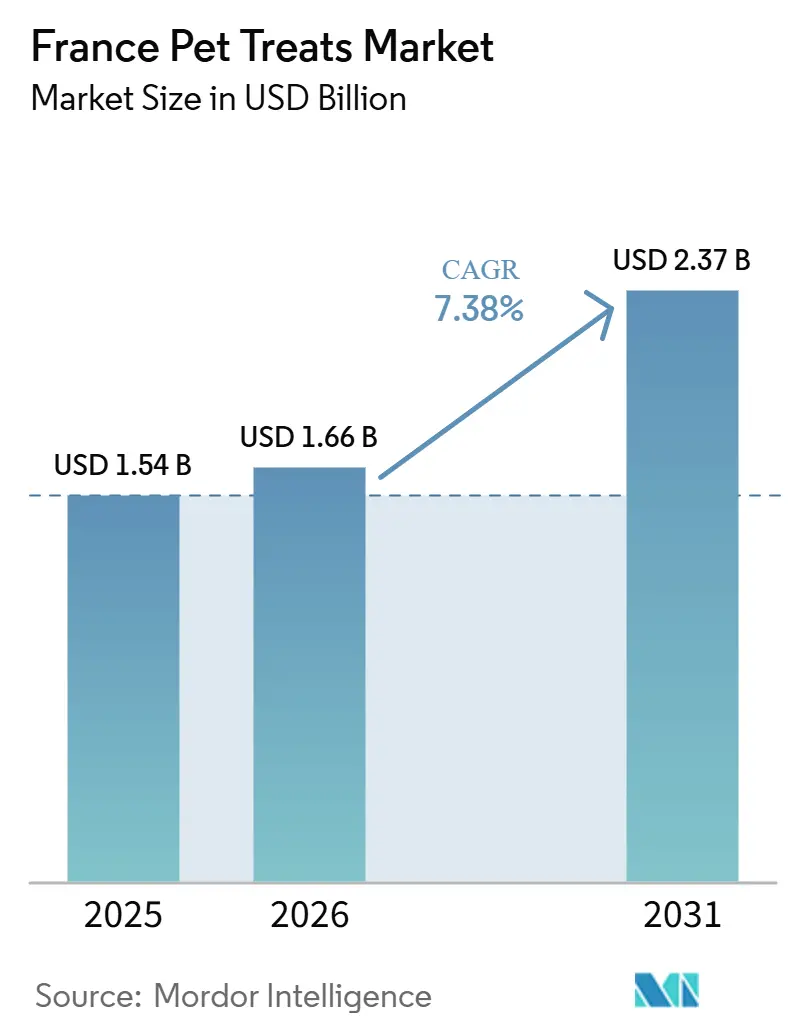
| Base Year Market Size (2025) | USD 1.54 Billion |
| Market Size (2026) | USD 1.66 Billion |
| Market Size (2031) | USD 2.37 Billion |
| Growth Rate (2026 - 2031) | 7.38 % |
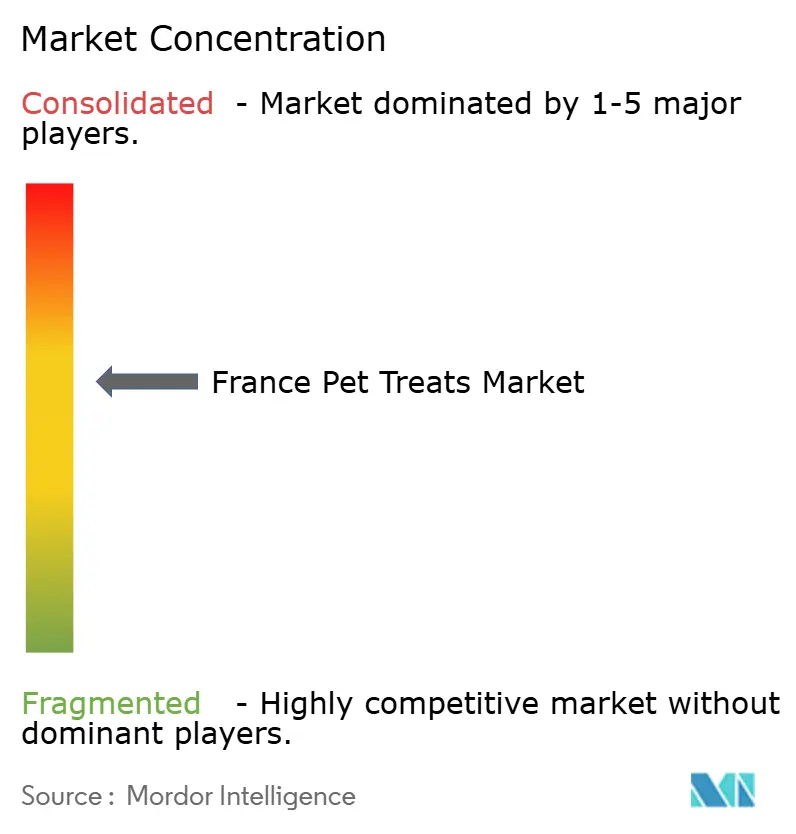
| Market Concentration | Medium |
Major Players
*Disclaimer: Major Players sorted in no particular order Image © Mordor Intelligence. Reuse requires attribution under CC BY 4.0. |
|
France Pet Treats Market Analysis by Mordor Intelligence
The France Pet Treats Market size was valued at USD 1.54 billion in 2025 and is estimated to grow from USD 1.66 billion in 2026 to reach USD 2.37 billion by 2031, at a CAGR of 7.38% during the forecast period 2026 to 2031. Demand in the France pet treats market is shifting from occasional reward purchases toward products used more regularly for dental care, digestive support, behavioral calm, hydration, and mobility support. This transition reflects a broader change in how French pet owners perceive treats, increasingly viewing them as functional supplements rather than simple indulgences. Veterinary recommendations are reinforcing this shift and helping suppliers maintain pricing, as owners are less likely to switch away from daily-use functional products. Manufacturers are responding by reformulating existing product lines and introducing new formats, such as soft chews and dental sticks, that align with specific health outcomes. Online ordering and subscription purchases are also changing repeat-buying patterns, as consumers find it easier to maintain consistent purchasing of functional treats through digital channels. At the same time, private-label competition remains strongest in mass retail, where price-sensitive shoppers are more likely to trade down, putting pressure on branded players to differentiate through health claims, ingredient transparency, and veterinary endorsements.
Key Report Takeaways
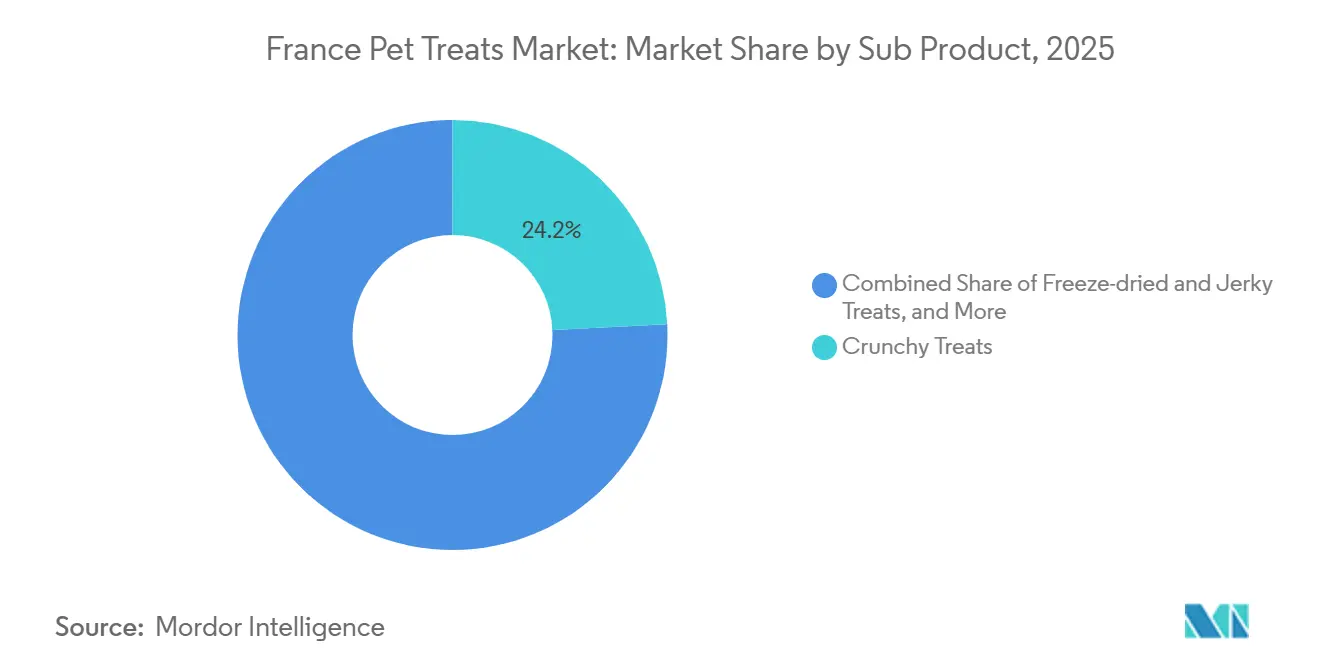
- By sub-product, crunchy treats accounted for 24.2% of the France pet treats market size in 2025, while freeze-dried and jerky treats are the fastest-growing, projected to grow at 8.3% through 2031.
- By pet type, cats were the largest, with 40.1% of the France pet treats market share in 2025, and also the fastest-growing, at 8.6% through 2031.
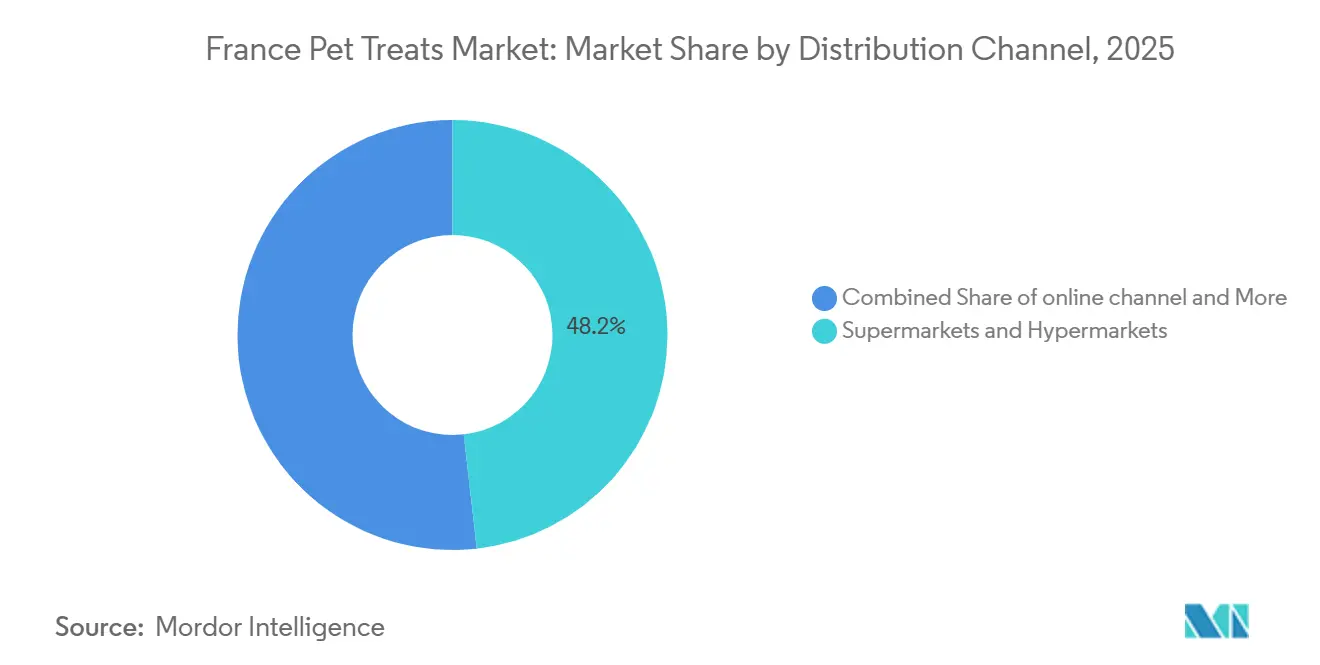
- By distribution channel, supermarkets and hypermarkets were the largest at 48.2% in 2025, while the online channel is the fastest at 8.7% through 2031.
Note: Market size and forecast figures in this report are generated using Mordor Intelligence’s proprietary estimation framework, updated with the latest available data and insights as of January 2026.
France Pet Treats Market Trends and Insights
Drivers Impact Analysis*
| Driver | (~) % Impact on CAGR Forecast | Geographic Relevance | Impact Timeline |
|---|---|---|---|
| Premiumization and humanization of pet care | 2.10% | National, with highest density in Île-de-France, Lyon, and Bordeaux urban centers | Long term (≥ 4 years) |
| Treats used for training, bonding, and rewarding behavior | 1.30% | National, with above-average uptake among households with younger owners | Medium term (2-4 years) |
| Demand for functional benefits in dental, digestive, calm, and mobility support | 1.50% | National, with stronger concentration in specialty and veterinary channels in major cities | Long term (≥ 4 years) |
| Growth of natural, freeze-dried, and high-protein formulations | 1.20% | National, with cross-border sourcing from Belgium and the Netherlands for specialty ingredients | Medium term (2-4 years) |
| Expansion of e-commerce and subscription purchases | 0.90% | National, with stronger concentration in metropolitan and suburban areas with high digital adoption | Short term (≤ 2 years) |
| Veterinary endorsement for health-oriented treats | 0.70% | National, with early adoption in veterinary-dense areas including Paris, Marseille, and Toulouse | Long term (≥ 4 years) |
| Source: Mordor Intelligence | |||
Premiumization and Humanization of Pet Care
Humanization has become a clear spending pattern across the France pet treats market rather than a passing idea. The French Federation of Manufacturers of Food for Dogs, Cats, Birds, and Other Companion Animals (FACCO) reported that 61% of French households owned at least 1 pet in 2024, providing premium treat suppliers with a very broad consumer base[1]Source: FACCO (French Federation of Manufacturers of Food for Dogs, Cats, Birds, and Other Companion Animals), "FACCO–Odoxa Barometer 2024–2025 – Figures 1/5," FACCO, facco.fr.. Owners are treating many purchases as part of everyday pet care, not just as occasional rewards. That change supports higher demand for products with clearer ingredient lists, more specialized nutrition positioning, and stronger quality cues. It also helps the France pet treats market better absorb pressure on household budgets than more standard snack categories, because buyers often place these products in routine care spending. Brands that link premium recipes with practical benefits and clear sourcing are more likely to retain repeat buyers over time.
Treats Used for Training, Bonding, and Rewarding Behavior
Training and bonding treats are gaining a firmer role in the France pet treats market as pet owners use treats more intentionally in daily interactions. The French Federation of Manufacturers of Food for Dogs, Cats, Birds, and Other Companion Animals (FACCO) showed that 33% of cat owners and 47% of dog owners in France regularly bought treats, and reward use remains one of the main reasons behind those purchases in 2024. This matters because treats bought for behavior and bonding tend to be more brand-led than impulse-led. Owners usually stay with products that their pets accept well, which gives established brands a steadier base. Nestlé Purina Petcare (Nestlé S.A.) reflected this pattern in 2026 with launches such as Fido Festi' Nuggets and Fido Happy Strips, both aimed at bonding and reward occasions. As a result, training and reward occasions help increase purchase frequency while also creating space for more premium claims.
Demand for Functional Benefits, Dental, Digestive, Calm, and Mobility Support
Functional products are moving closer to the center of the France pet treats market as owners spend more on preventive care. A 2025 review published in Frontiers in Animal Science highlighted the growing use of functional ingredients in pet snacks, including probiotics and prebiotics for digestive health, glucosamine and omega-3 fatty acids for joint support, and vitamins, minerals, and antioxidants for immune health. That shift matters because owners are willing to pay more for treats that do more than just provide simple indulgence. Products that enter the home through veterinary recommendation also tend to face less switching during promotions because owners treat them as part of a routine. The European Food Safety Authority (EFSA) continues to review and renew authorizations for key feed additives used in pet nutrition, giving companies with stronger regulatory capabilities a practical timing advantage. This makes functionality one of the more durable value drivers in the France pet treats market.
Growth of Natural, Freeze-Dried, and High-Protein Formulations
Natural, freeze-dried, and high-protein formats are expanding in the France pet treats market because human food preferences are spilling into pet care choices. Research published in Animals in 2025 highlighted growing consumer preference for pet food products that provide benefits beyond essential nutrition. This trend is particularly evident in Western Europe, where premiumization and pet humanization continue to drive demand for functional pet food and treats. In France, this supports a stronger interest in minimal processing, ingredient transparency, and protein-rich recipes. These products also come with a more demanding supply model because freeze-drying is energy-intensive and many specialty inputs are sourced from outside France. Cross-border sourcing from Belgium and the Netherlands has therefore become part of the operating model for several premium lines. Suppliers with broader protein sourcing and steadier manufacturing partnerships are better positioned to maintain stable pricing when input costs rise.
Restraints Impact Analysis*
| Restraint | (~) % Impact on CAGR Forecast | Geographic Relevance | Impact Timeline |
|---|---|---|---|
| Private label price pressure in mass-market channels | -1.20% | National, with strongest pressure in Brittany, Occitanie, and peri-urban areas with higher price sensitivity | Short term (≤ 2 years) |
| Regulatory burden on functional and health claims | -0.80% | European Union wide EFSA framework, nationally administered by DGAL | Long term (≥ 4 years) |
| Raw material and packaging cost volatility | -0.90% | National, with upstream exposure in marine proteins, imported specialty ingredients, and packaging films | Medium term (2-4 years) |
| Supply dependence on imported specialty inputs | -0.50% | National, with highest exposure in freeze-dried and high-protein formats | Medium term (2-4 years) |
| Source: Mordor Intelligence | |||
Private Label Price Pressure in Mass-Market Channels
Private label treats continue to gain ground in supermarkets and hypermarkets, which creates a direct pricing challenge in the France pet treats market. The pressure is strongest where shopping remains highly price-led, and retailer brands receive prominent shelf placement. Better recipe quality and clearer packaging have narrowed the gap between retailer labels and branded products in entry and middle price tiers. That limits branded suppliers' ability to rely solely on promotions in mass retail. The pressure is lower online and in specialty stores, where curation, education, and subscription programs matter more than shelf price alone. Manufacturers that move volume toward those channels can better protect margins, but the shift requires stronger digital execution and more credible premium positioning.
Regulatory Burden on Functional and Health Claims
Regulation remains a meaningful restraint for the France pet treats market, especially in products built around functional claims. France applies national oversight through the Directorate General for Food (Direction Générale de l'Alimentation) within the wider European Union framework for feed additives and labeling. In 2025, the European Food Safety Authority reviewed additive renewals, including taurine and L-cysteine hydrochloride monohydrate for cats and dogs, demonstrating the ongoing activity of the evidence cycle for ingredient approval and renewal[2]Source: S. Vuthisopon et al., “Advances in Functional Pet Food Research: Health-Driven Ingredients, Nutritional Targets and Evidence-Based Claims,” Animals, doi.org. Novel inputs such as insect-derived proteins and fermentation-based bioactives can face approval timelines of 18 to 36 months, which slows innovation for smaller suppliers. This burden is heavier when companies also face raw material swings and dependence on imported specialty inputs. Larger companies with established regulatory teams, therefore, hold a real advantage when launching new functional concepts.
*Our forecasts treat driver/restraint impacts as directional, not additive. The impact forecasts reflect baseline growth, mix effects, and variable interactions.
Segment Analysis
By Sub Product: Freeze-Dried Momentum Reshaping France's Treat Mix
Crunchy Treats accounted for 24.2% of the France pet treats market size in 2025, which made them the largest sub product group by value. Their position stems from wide availability across supermarkets, hypermarkets, and convenience stores, along with familiar textures that suit pets of many ages and sizes. Soft and chewy formats, in particular, appeal to younger pets and senior animals with sensitive teeth, while harder biscuit-style treats remain popular for adult dogs. This scale also gives established brands strong visibility on retail shelves, making it easier for pet owners to identify and repurchase trusted products. Dental treats remain important in the premium tier as veterinarians increasingly incorporate oral care into daily routines rather than treating it as an occasional procedure. This shift has encouraged manufacturers to develop treats that address specific oral health concerns, such as tartar buildup, gum health, and breath freshness, driving consistent demand for products that combine palatability with functional benefits.
Freeze-dried and Jerky Treats are the fastest-growing sub-product group in the France pet treats market and are projected to grow at 8.3% through 2031. French buyers often connect low processing intensity with better nutrient retention and cleaner labels, which helps the segment hold premium pricing. This creates a different demand pattern from the crunchy segment because product choice is more ingredient-led and less promotion-led. Nestlé Purina Petcare (Nestlé S.A.) expanded its Extras portfolio in France in January 2026, noting that the segment was valued at EUR 354 million (USD 386 million) in the large-format retail channel. The France pet treats industry still depends on careful sourcing and processing discipline in this category, so cost control matters alongside brand strength.



By Pets: Cats Lead Volume as Segment Accelerates
Cats were the largest pet segment with a 40.1% share in 2025 and are also the fastest-growing segment, with an 8.6% CAGR through 2031. The French Federation of Manufacturers of Food for Dogs, Cats, Birds, and Other Companion Animals (FACCO) reported that 16.7 million cats lived in France in 2024, and that 39% of households owned at least 1 cat, providing suppliers with a large and active demand base. Cat owners already buy treats at a high rate, but usage is still not fully habitual across the entire base. That leaves room for suppliers to increase buying frequency through dental, urinary, and calm-support products that fit routine care. Veterinary guidance matters strongly here because many cat-related treat occasions sit close to longer-term care needs rather than simple reward use.
Dogs treat demand is spreading from training rewards into dental, mobility, and digestive support use cases. Other pets, including rabbits, guinea pigs, and small rodents, remain niche in volume terms but continue to attract specialty suppliers offering more natural formulations. These animals have distinct dietary needs, which has encouraged suppliers to develop targeted treat formats with limited ingredient lists and higher fiber content. While the segment does not match the scale of dog or cat treats, it represents a consistent area of growth as more households adopt smaller companion animals. This distribution across cats, dogs, and smaller companion animals keeps the France pet treats market open to both mainstream products and focused premium lines, supporting a broad range of product strategies across price points and formulation types.
By Distribution Channel: Supermarkets Dominate While Online Disrupts Category Economics
Supermarkets and Hypermarkets held the largest 48.2% share in 2025, which made them the biggest route to volume in the France pet treats market. Their strength comes from heavy foot traffic, a broad assortment across price points, and the convenience of buying treats during normal grocery trips. The French Federation of Manufacturers of Food for Dogs, Cats, Birds, and Other Companion Animals (FACCO) in 2024 reported that 69% of cat owners and 50% of dog owners in France bought pet products in supermarkets and grocery stores, confirming the channel's wide reach. The same reach also makes it the main battlefield for branded lines and retailer private labels. For suppliers, that means the largest channel is not always the most attractive from a margin perspective.
The Online Channel is the fastest route in the France pet treats market and is projected to grow at 8.7% through 2031. Its importance goes beyond sales volume because subscription purchasing can convert irregular buying into scheduled replenishment. Specialty Stores hold a smaller overall share, but they carry a larger portion of premium and veterinary-backed products because a deeper assortment and staff guidance matter more in those outlets. Convenience Stores remain tied to impulse purchases and small pack sizes, while veterinary clinics and garden centers are more relevant for functional and therapeutic formats. The split between mass retail, digital, specialty, and professional outlets means channel strategy is now one of the clearest points of competitive difference in the France pet treats market.
Geography Analysis
The France pet treats market stands at a scale that reflects one of the largest companion animal bases in Europe. The largest premium spending pool is concentrated in Île-de-France, where higher disposable income, heavier veterinary use, and stronger digital shopping habits support premium and functional products. Lyon and Bordeaux show similar urban patterns, especially in premium and subscription-based buying. In Brittany and Occitanie, price sensitivity is stronger, and hypermarkets remain more influential than specialty outlets or online channels.
The largest value pools still sit in dense metropolitan areas, but the fastest expansion in the France pet treats market is not limited to Paris. Marseille and Toulouse show early adoption of veterinary-backed health-oriented treats, while Nantes, Rennes, and Strasbourg offer room for subscription-led growth where specialty penetration is still lower. This matters because suppliers do not need one national channel plan to compete effectively. Companies that match product mix, pricing, and education efforts to local shopping habits can improve both sell-through and repeat purchase rates.
Cross-border sourcing also shapes the France pet treats market because freeze-dried and specialty ingredients often move in from Belgium and the Netherlands. France benefits from tariff-free movement inside the European Union, but smaller importers still face tighter traceability and labeling pressure than established manufacturers with audited supply chains. The Directorate General for Food (Direction Générale de l'Alimentation) applies national controls inside the broader European Union framework, while the European Food Safety Authority continues to review additives and functional ingredients that matter for premium treat development. Clearer rules for functional claims would lower uncertainty for compliant suppliers and support wider rollout of advanced treat formats across the country.
Competitive Landscape
Market concentration is moderate, with the top five players, including Mars, Incorporated, Affinity Petcare, S.A. (Agrolimen, S.A.), Nestlé Purina Petcare (Nestlé S.A.), Hill's Pet Nutrition, Inc. (Colgate-Palmolive Company), and VAFO Group a.s., together accounting for a smaller market share in 2025. The France pet treats market has a mixed structure, with 2 large multinational groups leading mass retail volume, while several specialist companies compete for premium, functional, and veterinary-led demand. Mars, Incorporated and Nestlé Purina Petcare (Nestlé S.A.) remain the most visible names on mainstream shelves, giving them strong consumer reach and brand familiarity. Virbac S.A., Farmina Pet Foods Holding B.V., and Wellness Pet Company, Inc. strengthen competition in premium and health-oriented niches. This means rivalry in the France pet treats market is less about first-mover advantage and more about moving shoppers from standard treats to higher-value products. Private-label lines keep pressure high in the entry and middle price tiers, so branded suppliers need clear reasons for consumers to pay more.
Nestlé Purina Petcare (Nestlé S.A.) signaled its 2026 strategy with 8 launches in France's Extras segment, spanning hydration-led liquid treats, low-fat strips, and cat products built around complementary usage occasions[3]Source: Nestlé S.A. (Purina), "Purina Brings New Momentum to the Pet Food Market and Enters the Extras Segment with Eight Dedicated Innovations," Purina France, purina.fr.. That move shows how large suppliers are widening their portfolios to capture more daily-use moments rather than relying on seasonal or purely impulse demand. Virbac S.A. has taken a different route by building on veterinary credibility, and its 2025 launch of Vikaly in Europe showed how closely health nutrition and treat-adjacent care formats are starting to overlap. Together, those moves show that product development in the France pet treats market now depends on both consumer appeal and clinical credibility.
The clearest open spaces remain cat-specific functional products, subscription-native propositions for secondary cities, and recipes built around natural or alternative proteins that fit evolving authorization pathways. Companies that invest in substantiated functional claims, professional endorsement, and recurring purchase models are building stronger defenses against simple price competition. Firms without those supports are more exposed to retailer labels, input cost swings, and slower innovation cycles. As a result, the France pet treats market is likely to stay competitive, but the strongest positions will belong to suppliers that can connect formulation, trust, and channel execution more effectively than rivals.
France Pet Treats Industry Leaders
-
Mars, Incorporated
-
VAFO Group a.s.
-
Affinity Petcare, S.A. (Agrolimen, S.A.)
-
Hill's Pet Nutrition, Inc. (Colgate-Palmolive Company)
-
Nestlé Purina Petcare (Nestlé S.A.)
- *Disclaimer: Major Players sorted in no particular order

Recent Industry Developments
- April 2026: Nestlé Purina Petcare (Nestlé S.A.) launched 8 products exclusively in France's Extras segment, a EUR 354 million (USD 386 million) category within large-format retail. The launches include Fido Festi' Nuggets and Fido Happy Strips for dogs, and FELIX Sauce Time and Gourmet Soup' Royale for cats. The products became available in major French supermarkets from April 2026, with all dog treat formats offered in fully recyclable packaging. The launches target bonding, reward, and functional hydration treat occasions.
- December 2024: Mars, Incorporated launched two new production lines at its Saint-Denis-de-l'Hôtel facility in the Loiret region of France, following a EUR 120 million (USD 130.8 million) investment over three years. The expansion increases France's domestic manufacturing capacity for premium pet nutrition products and strengthens the country's position as a major European production and supply base for the pet food industry, supporting growth in the France pet treats market.
- July 2024: ADM introduced seven turnkey pet wellness product concepts for the European market, including France, available as soft chews and supplement powder sachets. The formulations target digestive health, joint mobility, calm behavior, and skin and coat support, incorporating functional ingredients such as clinically studied microbiome solutions where applicable. The launch expands ADM's portfolio of ready-to-market pet wellness solutions, designed to help European pet brands accelerate product development while complying with European regulatory requirements.


France Pet Treats Market Report Scope
Pet treats are commercial food products formulated specifically for pets. They are not designed to provide complete and balanced nutrition but are intended for occasional feeding as rewards, during training, or for enjoyment. The France Pet Treats Market Report is Segmented by Sub Product (Crunchy Treats, Dental Treats, Freeze-Dried and Jerky Treats, Soft and Chewy Treats, and Other Treats), by Pets (Cats, Dogs, and Other Pets), and by Distribution Channel (Convenience Stores, Online Channel, Specialty Stores, Supermarkets/Hypermarkets, and Other Channels). The Market Forecasts are Provided in Terms of Value (USD) and Volume (Metric Tons).
| Dental Treats |
| Crunchy Treats |
| Soft & Chewy Treats |
| Freeze-dried and Jerky Treats |
| Other Treats |
| Cats |
| Dogs |
| Other Pets |
| Convenience Stores |
| Online Channel |
| Specialty Stores |
| Supermarkets/Hypermarkets |
| Other Channels |
| Sub Product | Dental Treats |
| Crunchy Treats | |
| Soft & Chewy Treats | |
| Freeze-dried and Jerky Treats | |
| Other Treats | |
| Pets | Cats |
| Dogs | |
| Other Pets | |
| Distribution Channel | Convenience Stores |
| Online Channel | |
| Specialty Stores | |
| Supermarkets/Hypermarkets | |
| Other Channels |


Key Questions Answered in the Report
What is the projected value of France pet treats by 2031?
France pet treats are projected to reach USD 2.37 billion by 2031, rising from USD 1.66 billion in 2026 at a 7.38% CAGR.
Which pet category leads demand in France?
Cats lead demand with a 40.1% share in 2025, and they are also the fastest-growing pet segment with an 8.6% CAGR through 2031.
Which sub product is growing the fastest in France?
Freeze-dried and jerky treats are the fastest-growing sub product group, with projected growth of 8.3% through 2031.
Why are functional products gaining ground in pet treats in France?
Owners are increasingly buying treats for dental care, digestion, calm behavior, hydration, and mobility support, and veterinary recommendation is reinforcing this shift.
Which sales channel matters most for suppliers in France?
Supermarkets and hypermarkets remain the largest channel with a 48.2% share in 2025, but the online channel is growing the fastest at 8.7% through 2031.
What are the main competitive priorities for brands selling pet treats in France?
The main priorities are premium product development, stronger functional claims, veterinary credibility, and channel strategies that support repeat buying through specialty and online formats.
Page last updated on:





