
France Microgreens Market Size and Share
Market Overview
| Study Period | 2021 - 2031 |
|---|---|
| Forecast Data Period | 2026 - 2031 |
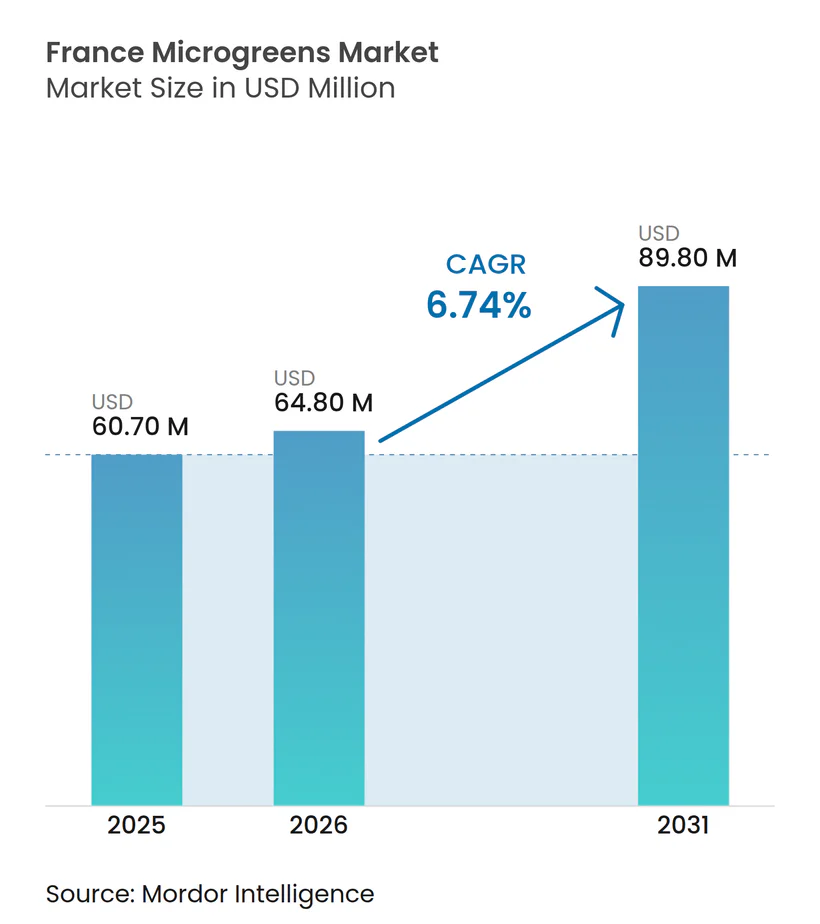
| Base Year Market Size (2025) | USD 60.70 Million |
| Market Size (2026) | USD 64.80 Million |
| Market Size (2031) | USD 89.80 Million |
| Growth Rate (2026 - 2031) | 6.74 % |
| Market Concentration | Low |
Major Players *Disclaimer: Major Players sorted in no particular order Image © Mordor Intelligence. Reuse requires attribution under CC BY 4.0. | |
France Microgreens Market Analysis by Mordor Intelligence
The France Microgreens Market size is projected to be USD 60.70 million in 2025, USD 64.80 million in 2026, and reach USD 89.80 million by 2031, growing at a CAGR of 6.74% from 2026 to 2031. Demand is supported by consumers who are choosing fresh, nutrient-dense foods over processed health products. Broccoli, radish, red cabbage, amaranth, and pea shoots align with interest in immunity, energy, and metabolic health. France’s restaurant culture gives producers a route to introduce varieties through professional kitchens before retail listings. Local sourcing and reliable year-round supply are becoming more important to retailers and foodservice buyers. The France microgreens market also faces pressure from electricity costs, consumer awareness gaps, and restrictions on organic labeling for soilless production.
Key Report Takeaways
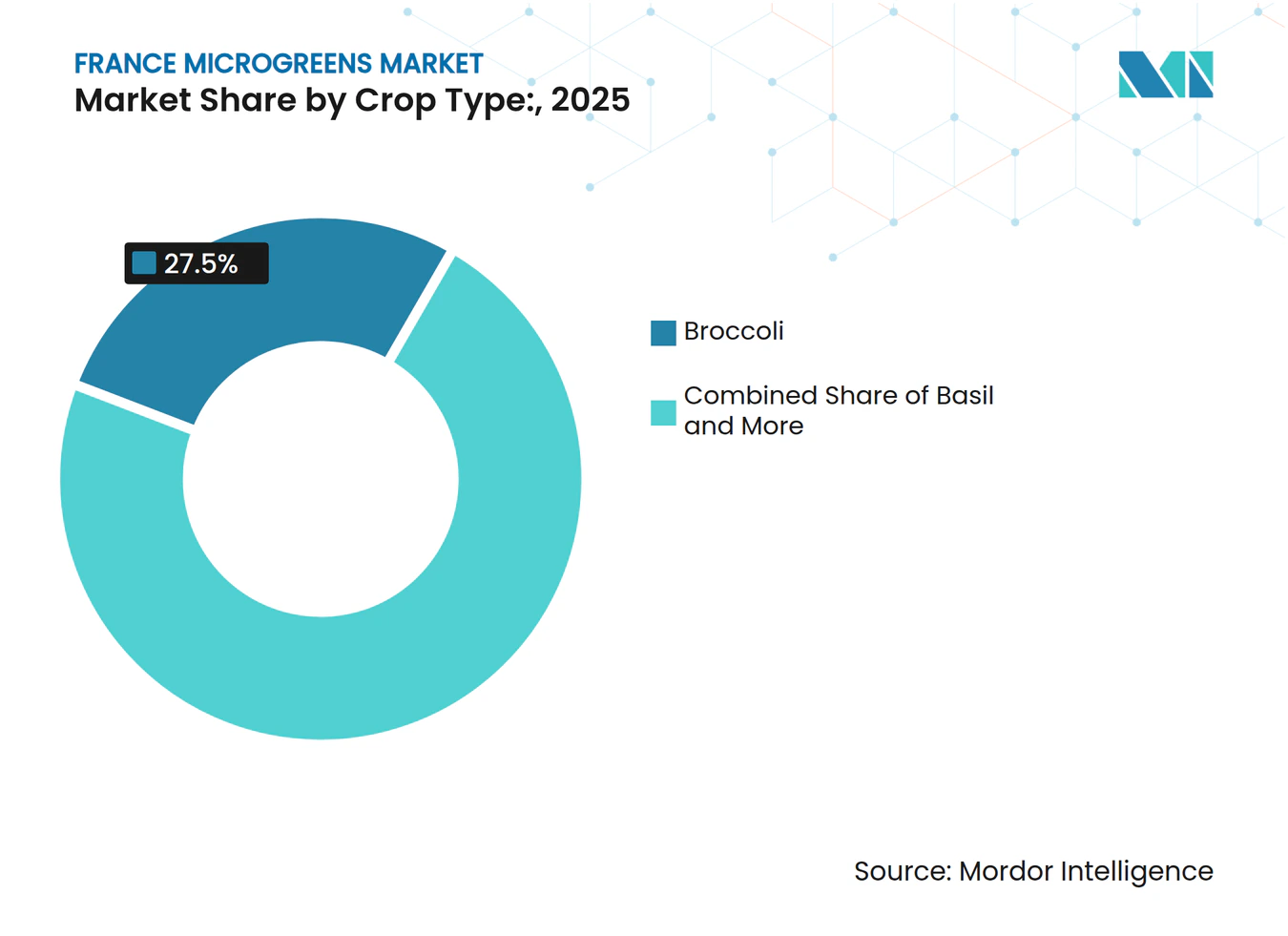
- By crop type, broccoli was the largest segment with 27.5% of the France microgreens market share in 2025, supported by broad use in restaurant dishes and health-oriented retail products, while basil is the fastest-growing segment with a projected 9.5% CAGR from 2026 to 2031.
- By farming method, indoor farming was the largest segment, with a 34.3% of the France microgreens market size in 2025, because it supports planned year-round harvests, while vertical farming is the fastest-growing segment, with a projected 7.4% CAGR from 2026 to 2031.
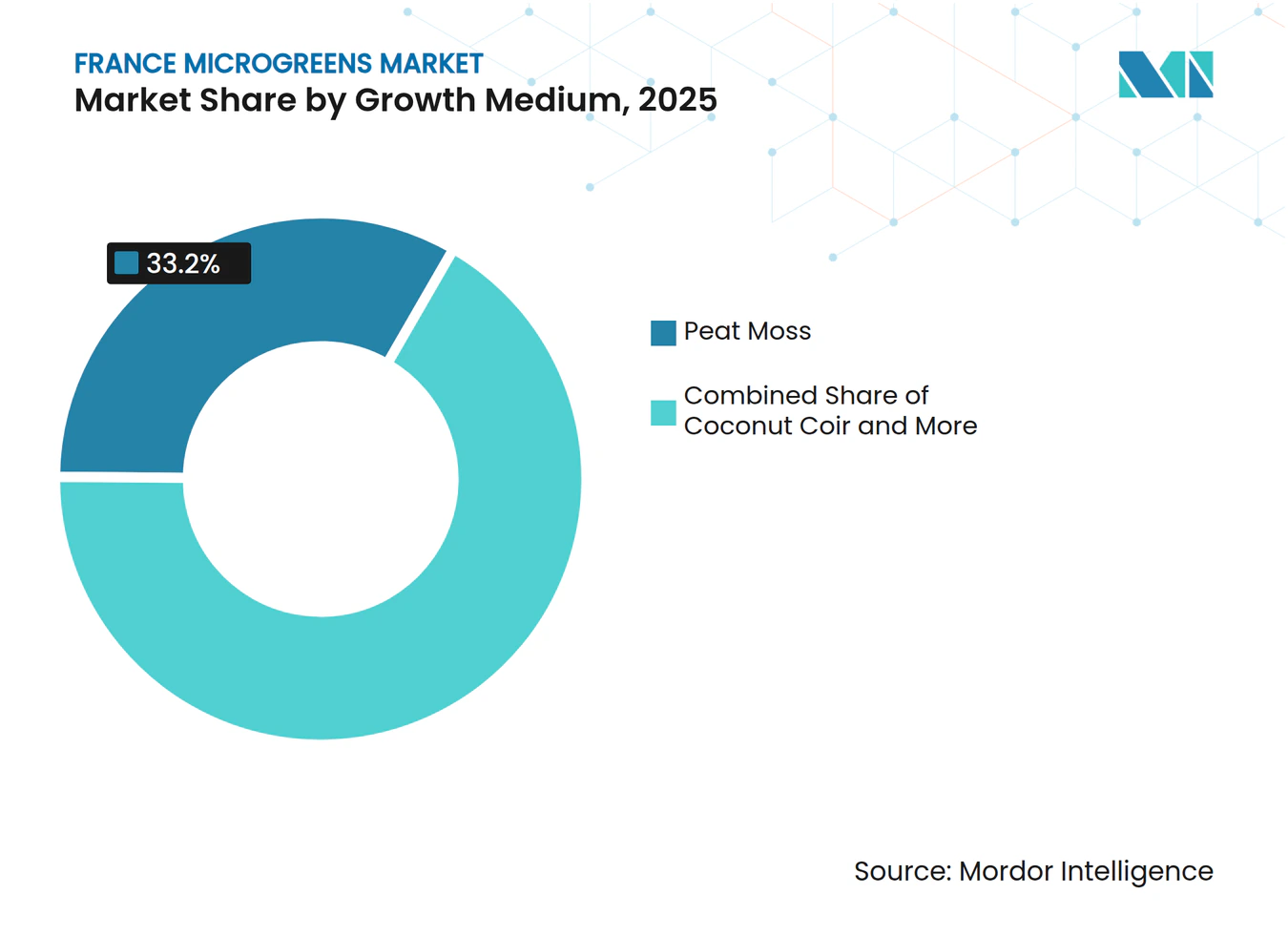
- By growth medium, peat moss was the largest segment with a 33.2% share in 2025 because growers value its familiar handling properties, while coconut coir is the fastest-growing segment, with a projected 8.2% CAGR from 2026 to 2031.
- By distribution channel, supermarkets and hypermarkets were the largest segment, with a 37.8% share in 2025, as they offer a broad consumer reach, while online channels are the fastest-growing segment, with a projected 9.5% CAGR from 2026 to 2031.
Note: Market size and forecast figures in this report are generated using Mordor Intelligence’s proprietary estimation framework, updated with the latest available data and insights as of January 2026.
Market Trends and Insights
Drivers Impact Analysis of France Microgreens Market*
| Driver | (~) % Impact on CAGR Forecast | Geographic Relevance | Impact Timeline |
|---|---|---|---|
| Rising demand for nutrient-dense and functional foods | +1.5% | National, with early gains in Paris, Lyon, and Marseille | Short term (≤ 2 years) |
| Expansion of chef-led and premium foodservice applications | +1.2% | National, concentrated in Paris, the Côte d’Azur, and Lyon | Medium term (2-4 years) |
| Growth of indoor vertical farming and year-round production | +1.3% | National, with early gains in Île-de-France, Provence-Alpes-Côte d’Azur, and Auvergne-Rhône-Alpes | Medium term (2-4 years) |
| Supermarket introduction of ready-to-pick microgreens | +0.9% | National, with early gains in Brittany and Pays de la Loire | Short term (≤ 2 years) |
| Substitution of imported microgreens through local sourcing | +0.8% | National | Medium term (2-4 years) |
| Ultra-fresh delivery models enabled by short harvest cycles | +0.7% | National | Short term (≤ 2 years) |
| Source: Mordor Intelligence | |||
Rising Demand for Nutrient-Dense and Functional Foods
French consumers are placing greater value on foods that fit daily health and wellness routines. Microgreens provide glucosinolates in broccoli and radish varieties, anthocyanins in red cabbage and amaranth, and lutein in pea shoots. These characteristics support interest in foods associated with immunity, metabolic health, and energy. Subscription delivery services and living tray formats indicate that purchases are becoming part of regular household routines. Younger urban households are also more familiar with restaurant-style presentation and fresh garnishes. This combination supports demand across both health-focused and culinary uses in the France microgreens market.
Expansion of Chef-Led and Premium Foodservice Applications
Fine dining restaurants give microgreen producers a credible route to build demand before pursuing wider retail distribution. Professional kitchens use varieties such as basil, tagete, and shiso because they add distinct flavor and visual detail to plated dishes. Once chefs regularly use a variety, retailers can see clearer evidence of consumer familiarity. VIF Systems, supported by Limagrain, has positioned catering establishments as an important outlet for its micro-pod harvests through the Cafés, Hôtels, Restaurants channel. This channel helps producers establish recurring demand before incurring the costs of broad retail listings. France’s concentration of premium restaurants, therefore, remains an important route to market for specialist growers.
Growth of Indoor Vertical Farming and Year-Round Production
Indoor production helps address seasonal supply gaps that had encouraged purchases of imported microgreens during winter. Growers can schedule harvests year-round and provide customers with a predictable supply. VIF Systems has developed container-based units for Limagrain cooperative member farms in Auvergne, creating an additional source of income without the need to build a dedicated facility. Vertical farm operators can improve their cost position by managing their electricity use more actively. Research published in 2026 found that participation in day-ahead energy markets could reduce vertical-farm lighting costs by 15% to 32%[1]. This makes energy management a practical part of production planning rather than a back-office consideration.
Supermarket Introduction of Ready-to-Pick Microgreens
Living trays in supermarket aisles extend microgreens distribution beyond specialty stores and restaurant buyers. This format allows shoppers to harvest greens at home rather than purchase pre-cut products, which can extend usable shelf life and differentiate microgreens from packaged salad products. Because the greens continue growing until cut, households can consume them over several days, reducing waste compared to pre-packaged alternatives. Positioning living trays alongside fresh herbs and household plants may lower the barrier for first-time buyers, as the purchase decision feels familiar rather than unfamiliar. This approach broadens the retail audience for microgreens in France and gives retailers a clearer rationale for stocking microgreens in stores where customers seek fresh and premium produce. For retailers, the format also offers a visible and distinctive product that can draw attention within the fresh produce section.
Restraints Impact Analysis of France Microgreens Market*
| Restraint | (~) % Impact on CAGR Forecast | Geographic Relevance | Impact Timeline |
|---|---|---|---|
| High energy and capital requirements for controlled-environment production | -1.2% | National | Long term (≥ 4 years) |
| Limited consumer awareness and premium retail pricing | -0.9% | National, more pronounced in rural areas and smaller urban centers | Short term (≤ 2 years) |
| Organic-label restrictions for soilless microgreen production | -0.5% | National | Long term (≥ 4 years) |
| Food-safety, traceability and skilled-labor compliance burden | -0.5% | National | Medium term (2-4 years) |
| Source: Mordor Intelligence | |||
High Energy and Capital Requirements for Controlled-Environment Production
Electricity is a major cost consideration for controlled-environment microgreen production in France. A 2024 life-cycle assessment of a Paris-area aeroponic indoor farm found that on-farm electricity could account for up to 60% of its carbon footprint[2]. Bioplants France SAS invested EUR 8.7 million (USD 9.4 million) in its 14,500-square-meter greenhouse complex in Anjou in 2021. This scale of investment helps explain why many operators remain artisan producers rather than large industrial farms. Research published in 2026 noted that the energy burden limits vertical farming’s commercial role to higher-value crops, including microgreens, herbs, and leafy greens. Producers without favorable electricity arrangements or renewable energy options face tighter margins as competition grows.
Limited Consumer Awareness and Premium Retail Pricing
Microgreens remain unfamiliar to many mainstream French shoppers, especially outside major urban areas. Producers must explain how to use the product and why it differs from standard salad leaves or herbs. High indoor production costs place microgreens in a premium retail price range. This can make purchases more sensitive to household budget pressure. The difference between strong restaurant demand and limited retail basket penetration suggests that consumer education will take time. Retailers may also delay prime shelf placement when trial rates do not provide enough evidence of repeat demand.
*Our forecasts treat driver/restraint impacts as directional, not additive. The impact forecasts reflect baseline growth, mix effects, and variable interactions.
France Microgreens Market Segment Analysis
By Crop Type:
Broccoli Holds the Largest Share While Basil Is the Fastest-Growing TypeBroccoli was the largest crop type, accounting for 27.5% of the France microgreens market size in 2025. Its mild profile makes it suitable for a variety of restaurant dishes and health-focused retail products. Broccoli also benefits from its established consumer recognition among Brassica vegetables. Scientific literature has documented higher concentrations of glucosinolates and sulforaphane precursors in Brassica microgreens than in mature vegetables. Cabbage, cauliflower, and radish serve more specific flavor and presentation needs. Radish offers peppery intensity, while cauliflower supports milder salad blends. Arugula and peas are particularly relevant for restaurant menus, where flavor, texture, and short growing cycles matter. The France microgreens industry can use this mix of familiar and distinctive varieties to serve both retail and foodservice demand.
Basil is the fastest crop type, with a projected 9.5% CAGR from 2026 to 2031. Herb-focused cooking and plant-based meals support demand for basil microgreens. Its rapid cycle and favorable light-use profile also make it attractive for indoor growers seeking higher output from limited space. This combination links consumer demand with a production profile suited to controlled environments. Lettuce and chicory mixes fit ready-to-eat salad formats in supermarkets and specialty stores. These types can support higher-volume purchases at more accessible price points. Sunflower shoots, beet, shiso, toona, and specialty herbs give chefs choices for seasonal menus. Their use reflects continued culinary experimentation in the France microgreens market. Producers can therefore diversify without moving away from the premium qualities that define the category. This wider crop portfolio helps growers balance familiar varieties with specialized restaurant demand. It also gives retailers more options when building a trial assortment.



By Farming Method:
Indoor Farming Is the Largest Method While Vertical Farming Is the Fastest-Growing MethodIndoor farming was the largest farming method, with 34.3% of the segment in 2025. It allows growers to limit weather-related yield fluctuations and schedule harvests year-round. This consistency is valuable for retail chains and foodservice buyers who need a dependable supply. Indoor systems also use a limited land footprint, which supports production near large demand centers. Commercial greenhouse farming and other methods remain relevant for growers with rural land and lower investment capacity. However, dependence on natural light can create seasonal limitations. Those limitations can be difficult for buyers who require year-round supply contracts. The France microgreens sector is therefore giving greater attention to methods that improve supply continuity.
Vertical farming is the fastest farming method, with a projected 7.4% CAGR from 2026 to 2031. Distributed container formats can lower the barrier to entry compared with conventional commercial greenhouses. VIF Systems developed a model that places production containers at Limagrain cooperative farms in Auvergne. The systems create an option for smaller landholders to add controlled-environment production. They also enable the introduction of production capacity across existing agricultural locations. Cost competitiveness still depends on producing more biomass from each unit of light. A 2026 study linked cost-competitive vertical farming to effective daily light levels and efficient conversion of light into biomass. This places energy-efficient lighting protocols at the center of operator decisions. The France microgreens market will favor vertical operators that can maintain crop quality while controlling energy use. This requirement makes operational capability as important as the physical growing system.
By Growth Medium:
Peat Moss Is the Largest Medium While Coconut Coir Is the Fastest-Growing MediumPeat moss was the largest growth medium, representing 33.2% share in 2025. Its water retention, pH buffering, and weed-free composition make it a familiar choice for growers. These features give producers a predictable starting point for small and commercial-scale production. Soil remains important for growers seeking certified organic positioning. European Union organic production rules require plants to be grown in living soil, which limits organic labeling for hydroponic and other soilless crops. Tissue paper has a smaller role in home growing, education, and minimal-waste formats. Rockwool and perlite blends remain relevant for systems that prioritize pH control. The France microgreens market size for soil-based production remains linked to demand for organically certified products.
Coconut coir was the fastest growth medium, with a projected 8.2% CAGR from 2026 to 2031. European horticulture is moving toward lower-peat and peat-free substrates as environmental commitments strengthen. The PEATLESS project began in May 2025 with 12 partners from 4 countries to develop low-peat and peat-free formulations for commercial horticulture. This work signals a longer-term change in sourcing decisions for French growers. Coconut fiber mats also support aquaponic and other soilless systems. They can help producers move away from peat without changing the core purpose of their growing operation. A 2026 scientific study cautioned that constraints in global coir supply could affect availability as horticultural demand expands. Producers that shift toward coir will need to manage both sustainability goals and supply reliability. This balance will shape medium selection across the France microgreens market. It may also encourage growers to retain more than 1 substrate option.

By Distribution Channel:
Supermarkets and Hypermarkets Are the Largest Channel While Online Channels Are the Fastest-Growing ChannelSupermarkets and hypermarkets were the largest distribution channel, with 37.8% share in 2025. They are the main link between growers and mass-market consumers. Their reach makes them important for moving microgreens beyond specialist outlets. Specialty retail stores continue to serve consumers seeking health-focused and premium products. These buyers may be more willing to pay per-tray prices that are difficult to maintain in mainstream supermarket formats. Foodservice distributors provide volume to restaurants and catering accounts. This volume can support cash flow and production capacity planning. The France microgreens market relies on these channels for both broad access and a dependable professional customer base.
Online channels are the fastest distribution pathway, with a projected 9.5% CAGR from 2026 to 2031. Subscription farm boxes and direct-to-consumer delivery services can build recurring relationships without relying entirely on retail listings. This model is suited to urban professionals who value regular deliveries of fresh products. It also gives producers direct contact with customers and their preferences. Direct-to-consumer sales and farmers' markets can give growers stronger margins and immediate feedback on varieties. That feedback may help producers adjust crop mixes more quickly. Meal kit and catering partnerships offer an additional outlet for ready-to-eat services. Living trays can be useful in these channels because they remain usable longer than cut greens. These models give the France microgreens sector several ways to reach consumers beyond conventional stores. They also reduce dependence on a single retailer or foodservice account.
Geography Analysis
Western France, particularly Maine-et-Loire in Pays de la Loire, remains a major production hub for the France microgreens market. The region benefits from established agricultural infrastructure and a strong base of horticultural expertise that supports year-round greenhouse production. Bioplant Frans SAS operates a 14,500-square-meter greenhouse complex in Anjou, which reported EUR 3.8 million (USD 4.1 million) in revenue in 2024. Brittany and Pays de la Loire were among the first regions to introduce ready-to-pick trays in mainstream supermarkets, giving the area an early advantage in consumer familiarity. This head start has helped local producers build stable retail relationships and maintain consistent shelf presence across major distribution networks.
Île-de-France and major cities such as Lyon, Bordeaux, and Marseille account for significant demand from restaurants, food halls, and specialty retailers. Buyers in these areas favor producers that can deliver within the same day, making proximity to urban centers a key operational consideration. Paris remains particularly important due to its concentration of gastronomy professionals and strong demand for premium foodservice, with chefs and specialty buyers consistently seeking high-quality, fresh microgreens. Lyon is emerging as a secondary production and demand center, supported by growing foodservice capacity and an expanding base of independent restaurants. Urban production sites help reduce delivery distances and support product freshness, making them increasingly attractive to producers targeting city-based buyers.
Provence-Alpes-Côte d'Azur and Occitanie show close alignment between production and premium local demand. The Côte d'Azur has a high concentration of restaurants that value fresh, locally sourced specialty produce, creating consistent demand for microgreens supplied by nearby growers. Occitanie is developing a network of small urban and underground production facilities focused on local restaurant sales, with producers in cities such as Toulouse and Montpellier expanding their capacity to meet growing interest from the foodservice segment. These regional patterns allow the France microgreens market to pursue national distribution while maintaining shorter local supply chains, supporting both product quality and regional producer viability.
Competitive Landscape
Market Concentration
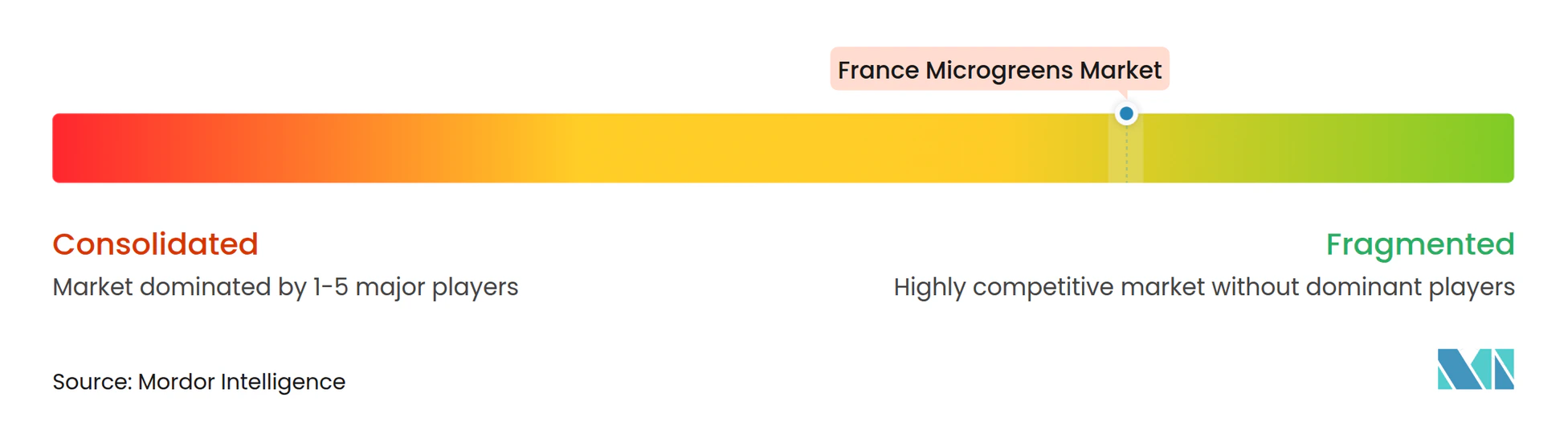
The France microgreens market is fragmented in 2025, with several hundred small and mid-sized producers alongside a limited number of brands with regional or national distribution. Most artisan operators serve local restaurants, farmers' markets, or specialty stores. This structure keeps buyer leverage high and restricts pricing power for smaller growers. Bioplant Frans SAS has a commercially advanced position through supermarket distribution and a large greenhouse complex dedicated to microgreen production. VIF Systems uses a technology-led distributed production model through its relationship with Limagrain cooperative farms.
A clear opening remains for an operator capable of providing a reliable national supply while building a recognized consumer brand. Major retailers can require volumes that individual artisan producers may struggle to provide consistently. This creates room for cooperative aggregation or growers with larger controlled-environment capacity. Limagrain acquired a 25% stake in VIF Systems after an earlier seed financing round, showing interest in scalable production technology[3]. The France microgreens market can therefore attract investment when a production model offers repeatable deployment rather than only local sales.
Energy efficiency is becoming a meaningful competitive factor for indoor growers. Operators that manage lighting demand and electricity procurement can protect margins more effectively. As energy costs represent a significant portion of operating expenses, investments in efficient lighting systems can yield measurable returns over time. Growing medium choices may also become a point of differentiation as peat reduction gains attention. Regulatory pressure and sustainability expectations are pushing growers to evaluate alternative substrates such as coco coir and wood fiber. The France microgreens market is likely to reward businesses that combine consistent quality with effective cost control.
France Microgreens Industry Leaders
-
NEOpouss
-
La Pousseraie
-
Les Pousses Vertes
-
Cycloponics
-
Ma Micropousse Culinaire
- *Disclaimer: Major Players sorted in no particular order
France Microgreens Market Companies Covered in this Report
- Bioplant Frans SAS (Max Schwarz AG)
- NEOpouss
- La Pousseraie
- Les Pousses Vertes
- A vos pousses
- Hydropousse
- VIF Systems (Limagrain)
- Futura Gaïa
- Champerché
- Cycloponics
- Ma Micropousse Culinaire
- Chef’s Farm (Growy)
- METRO France (METRO AG)
- Auchan Retail France SAS (ELO Group)
- Carrefour SA
Recent Industry Developments in France Microgreens Market
- March 2026: QSF – Quête de Saveurs & Fraîcheur launched a vertical urban microgreen farm in Draguignan, Var, producing varieties including broccoli, pea, sunflower, radish, beet, mustard, and coriander in a controlled environment. The farm supplies restaurants, caterers, and AMAPs across the Dracénie area, adding local controlled-environment microgreen production to the still-emerging market in the Var and Côte d’Azur.
- March 2026: Midiflore Group, a Var-based producer of edible flowers and aromatic herbs, integrated Éric Roy’s premium mini-vegetable business, Jardin des Roys, in Saint-Genouph near Tours in 2026, establishing a second production site outside its Mediterranean base. The combination expands Midiflore’s product portfolio and creates complementary production capabilities across the Var and Loire Valley, supporting its supply of premium French produce to the gastronomy market.
- January 2026: Futura Gaïa developed its first industrial-scale controlled-environment production facility at Plan d’Orgon, Bouches-du-Rhône, with a planned footprint of 4,700 m² and an estimated investment of USD 13.8–14.9 million. The project followed the validation of the company’s 1,800 m² pilot facility in Tarascon, which had been operational since 2021, supporting Futura Gaïa’s transition from pilot-scale production toward commercial-scale vertical farming.
France Microgreens Market Report Scope
Microgreens are young, edible plants harvested shortly after germination, typically at the cotyledon or early true-leaf stage. They are valued for their concentrated flavors, nutrients, colors, and use as fresh ingredients in salads, garnishes, and prepared foods.
The France Microgreens Market Report segments the industry by Crop Type (Broccoli, Cabbage, Cauliflower, Arugula, Peas, Basil, Radish, Lettuce and Chicory, and Others), Farming Method (Indoor Farming, Vertical Farming, Commercial Greenhouse Farming, and Others), Growth Medium (Peat Moss, Soil, Coconut Coir, Tissue Paper, and Others), and Distribution Channel (Supermarkets and Hypermarkets, Specialty Retail Stores, Online Channels, Foodservice Distributors, Direct-to-Consumer and Farmers Markets, and Others). The Market Forecasts are Provided in Terms of Value (USD).
Segmentation Overview
| Broccoli |
| Cabbage |
| Cauliflower |
| Arugula |
| Peas |
| Basil |
| Radish |
| Lettuce and Chicory |
| Other Types |
| Indoor Farming |
| Vertical Farming |
| Commercial Greenhouse Farming |
| Other Farming Methods |
| Peat Moss |
| Soil |
| Coconut Coir |
| Tissue Paper |
| Other Growth Media |
| Supermarkets and Hypermarkets |
| Specialty Retail Stores |
| Online Channels |
| Foodservice Distributors |
| Direct-to-Consumer and Farmers Markets |
| Other Distribution Channels |
| By Crop Type | Broccoli |
| Cabbage | |
| Cauliflower | |
| Arugula | |
| Peas | |
| Basil | |
| Radish | |
| Lettuce and Chicory | |
| Other Types | |
| By Farming Method | Indoor Farming |
| Vertical Farming | |
| Commercial Greenhouse Farming | |
| Other Farming Methods | |
| By Growth Medium | Peat Moss |
| Soil | |
| Coconut Coir | |
| Tissue Paper | |
| Other Growth Media | |
| By Distribution Channel | Supermarkets and Hypermarkets |
| Specialty Retail Stores | |
| Online Channels | |
| Foodservice Distributors | |
| Direct-to-Consumer and Farmers Markets | |
| Other Distribution Channels |
Key Questions Answered in the Report
What is the projected value of the France microgreens market by 2031?
The France microgreens market is forecast to reach USD 89.80 million by 2031, growing at a 6.74% CAGR from 2026. This reflects continued demand for fresh, nutrient-dense products and reliable year-round supply.
Which crop type leads microgreen sales in France?
Broccoli was the largest crop type with 27.5% share in 2025, supported by its familiar flavor profile and health positioning. It serves both restaurant applications and health-focused retail use.
Which microgreen crop type is projected to grow fastest in France?
Basil is projected to be the fastest crop type, with a 9.5% CAGR from 2026 to 2031. Its herb profile and rapid indoor production cycle support this position.
Why is indoor farming important for French microgreen producers?
Indoor farming was the largest production method with 34.3% share in 2025 because it supports year-round harvests and dependable supply. It also helps reduce weather-related production changes.
What is the fastest-growing sales channel for microgreens in France?
Online channels are projected to grow at a 9.5% CAGR through 2031, supported by subscriptions and direct-to-consumer delivery. These models can create repeat purchases and direct customer feedback.
What limits wider adoption of microgreens in France?
High electricity costs, premium prices, limited consumer awareness, and organic-label restrictions for soilless systems remain important constraints. These factors can restrict margins and slow wider retail adoption.