
Forged Alloy Aluminum Wheel Market Size and Share
Market Overview
| Study Period | 2021 - 2031 |
|---|---|
| Market Size (2026) | USD 5.67 Billion |
| Market Size (2031) | USD 7.81 Billion |
| Growth Rate (2026 - 2031) | 6.62 % |
| Fastest Growing Market | Asia-Pacific |
| Largest Market | Asia-Pacific |
| Market Concentration | Medium |
Major Players *Disclaimer: Major Players sorted in no particular order Image © Mordor Intelligence. Reuse requires attribution under CC BY 4.0. | |
Forged Alloy Aluminum Wheel Market Analysis by Mordor Intelligence
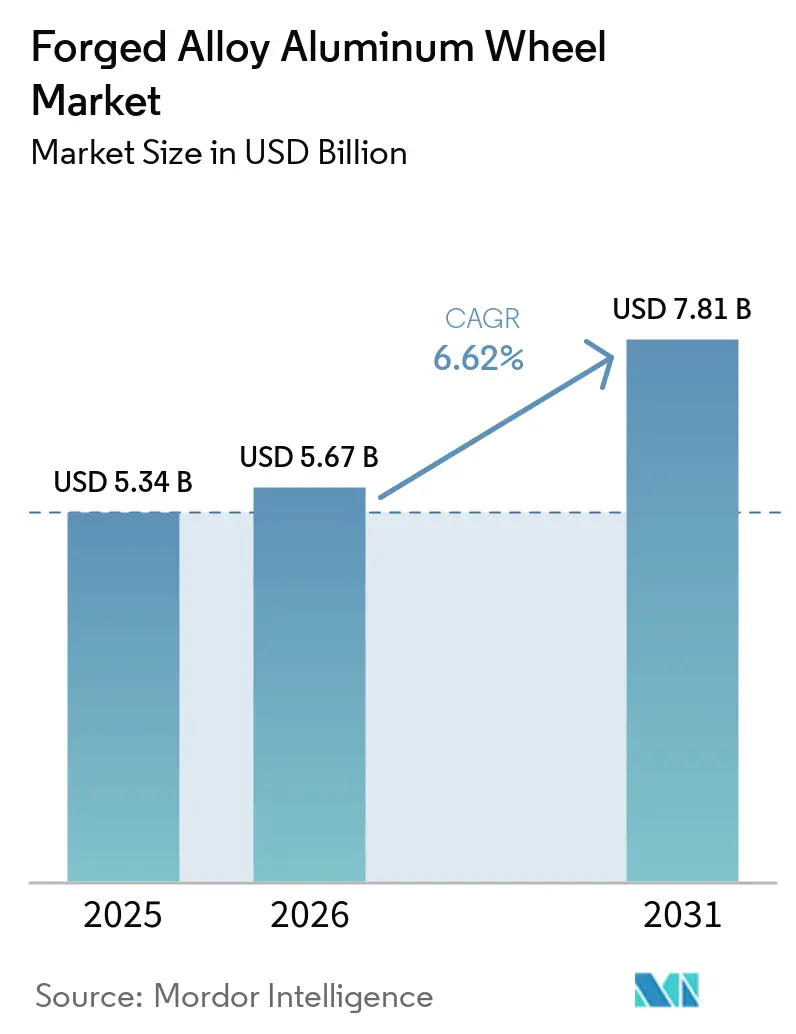
The Forged Alloy Aluminum Wheel market size was estimated at USD 5.34 billion in 2025 and is estimated to grow from USD 5.67 billion in 2026 to USD 7.81 billion by 2031, at a CAGR of 6.62% during the forecast period (2026-2031). The forged alloy aluminum wheel market is supported by vehicle programs that prioritize lower wheel weight, particularly on electric-vehicle platforms. Forging aligns the aluminum grain structure and gives wheel designers more flexibility in managing spoke thickness and load paths. Research on lightweight wheel design reported that a 10% reduction in new energy vehicle weight reduces electricity consumption by 6.3% and increases driving range by 5-6%. The market also benefits from premium vehicle fitments and commercial fleets seeking higher payload efficiency. Capacity additions by established suppliers indicate that commercial vehicle applications are becoming a greater focus of competition.
Key Report Takeaways
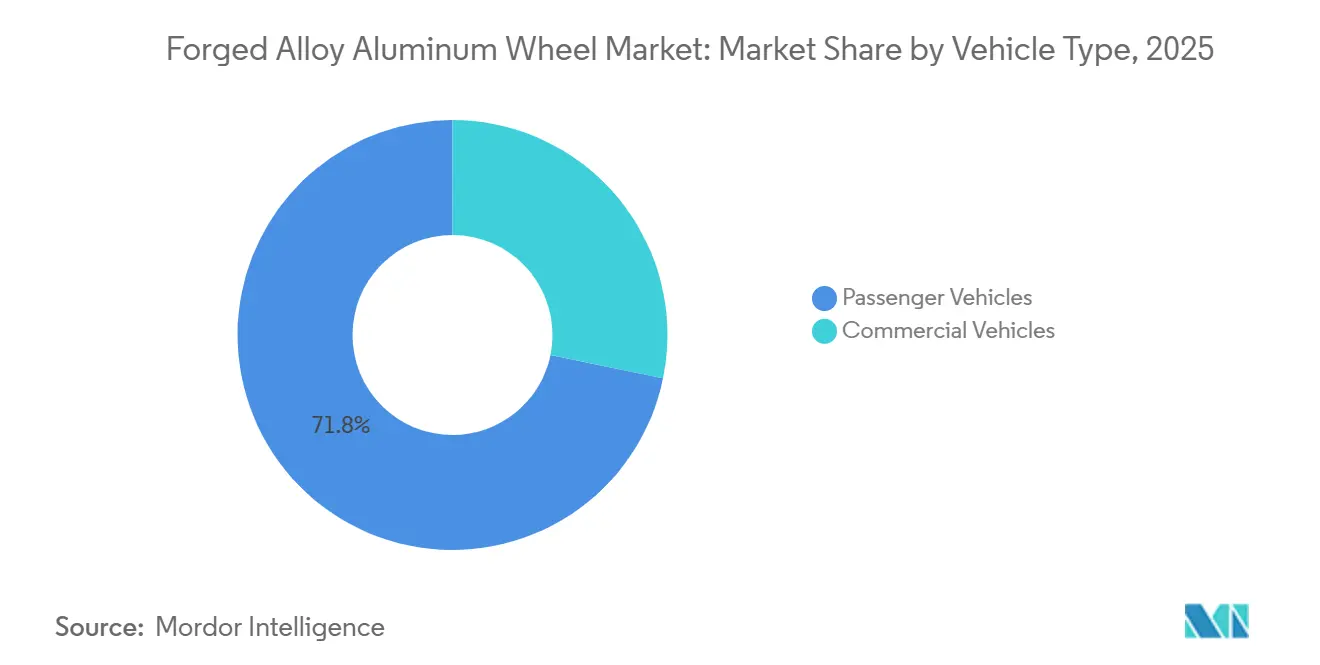
- By vehicle type, passenger vehicles held 71.78% of the forged alloy aluminum wheel market share in 2025, while commercial vehicles are forecast to grow at a CAGR of 7.52% through 2031.
- By product configuration, one-piece wheels accounted for 62.69% of the forged alloy aluminum wheel market share in 2025, while multi-piece wheels are forecast to grow at a CAGR of 7.17% through 2031.
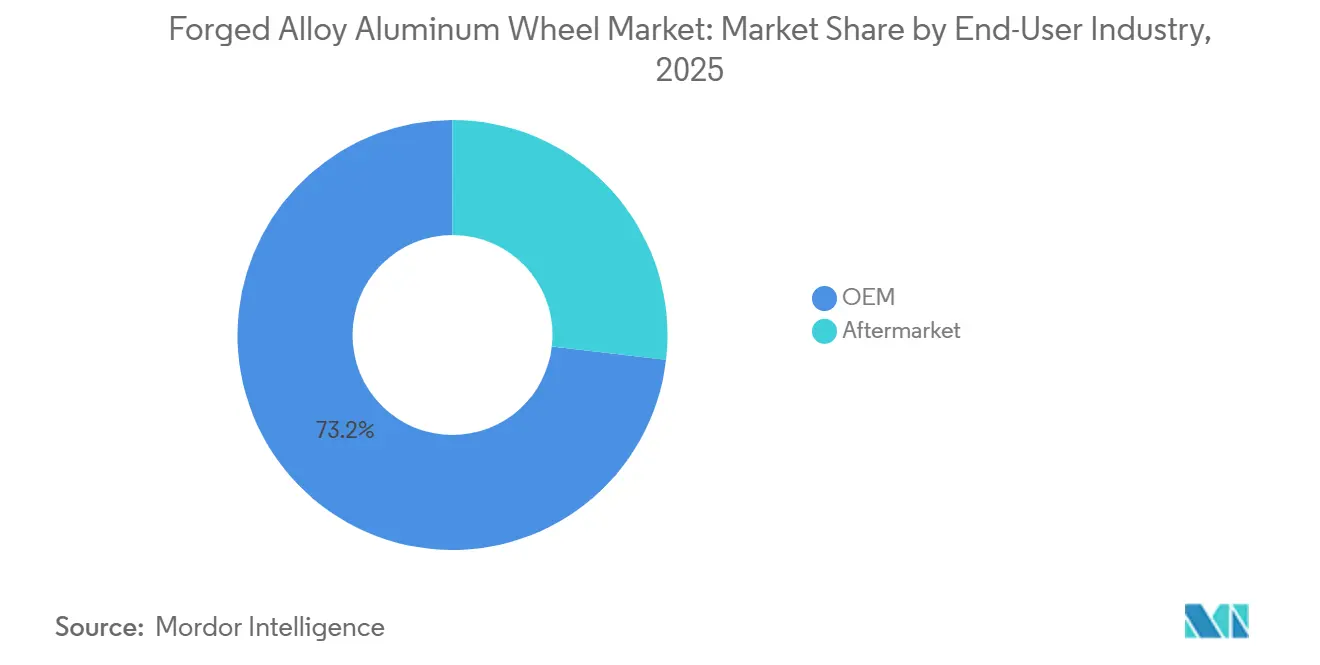
- By end-user industry, Original Equipment Manufacturers (OEMs) represented 73.17% of demand in 2025, while the aftermarket is forecast to expand at a CAGR of 7.21% through 2031.
- By geography, Asia-Pacific held 49.05% of the forged alloy aluminum wheel market share in 2025 and is forecast to advance at a CAGR of 7.35% through 2031.
Note: Market size and forecast figures in this report are generated using Mordor Intelligence’s proprietary estimation framework, updated with the latest available data and insights as of January 2026.
Global Forged Alloy Aluminum Wheel Market Trends and Insights
Drivers Impact Analysis*
| Drivers | (~) % Impact on CAGR Forecast | Geographic Relevance | Impact Timeline |
|---|---|---|---|
| EV Lightweighting and Unsprung-Mass Optimization | +2.1% | Global, with the highest intensity in China, South Korea, and Germany | Medium term (2-4 years) |
| Fleet Efficiency and Emissions Compliance | +1.5% | North America & EU; spillover to APAC | Medium term (2-4 years) |
| Premium Vehicle and High-Performance Production | +1.2% | Europe & North America | Medium term (2-4 years) |
| Original Equipment Manufacturer (OEM) Forged-Wheel Adoption for Large-Diameter and High-Load Platforms | +1.0% | Global; concentrated in North America & APAC | Long term (≥ 4 years) |
| Forged-Wheel E-Commerce and Customization-Led Aftermarket Expansion | +0.8% | North America, Europe, APAC core | Short term (≤ 2 years) |
| Source: Mordor Intelligence | |||
EV Lightweighting and Unsprung-Mass Optimization
Electric vehicle platforms have changed how vehicle manufacturers assess wheel mass. Battery packs add substantial vehicle weight, making rotating mass a key factor in energy consumption during acceleration, braking, and directional changes. Forged-wheel construction supports thinner sections and optimized load paths while retaining rated load capacity. The forged alloy aluminum wheel market benefits when engineers treat unsprung mass as part of suspension and brake-system design rather than as a separate purchasing specification. This approach moves wheel selection earlier into the vehicle development process and strengthens the role of approved suppliers. Lightweight wheel research also links vehicle mass reduction with lower electricity consumption and improved driving range.
Premium Vehicle and High-Performance Production
Premium vehicles use forged wheels to support handling, design, and brand positioning. Ferrari delivered 13,640 vehicles in 2025, with output held flat during its model changeover[1]Ferrari N.V., “Strong Performance in 2025 Sets the Foundation for Continued Growth in 2026,” Ferrari, ferrari.com. This segment of the forged aluminum alloy wheel market exhibits a different demand pattern from that of fleet and mainstream electric vehicle applications. Wheel fitment on high-performance vehicles can also support demand for replacement and customization over the vehicle life cycle. The relationship between original equipment fitment and aftermarket demand makes supplier partnerships valuable beyond the initial production program. This channel relies on product engineering and established brand recognition rather than high production output alone.
OEM Adoption for Large-Diameter and High-Load Platforms
OEMs are extending forged-wheel specifications to large-diameter, high-load vehicle architectures, including larger electric vehicle platforms, sport-utility vehicles, and commercial vehicles. Forged blanks give engineers greater flexibility to accommodate large brake assemblies while meeting durability requirements. Cast alternatives can meet the same requirements by adding material, which increases wheel mass. CITIC Dicastal and SAIC-GM-Wuling signed a cooperation agreement in March 2025 to build an intelligent aluminum parts manufacturing system in Guangxi. The forged alloy aluminum wheel market, therefore, presents opportunities where vehicle designers require both load capacity and reduced weight.
Aftermarket Customization and Digital Distribution
The aftermarket provides buyers with greater choice over wheel diameter, offset, finish, and lip depth. Multi-piece wheel construction supports this demand, as the center, inner barrel, and outer lip can be selected separately. Digital configuration tools can match a buyer's vehicle requirements to a compatible wheel specification, enabling a closer fit between the selected wheel and the vehicle than a standard-fitment catalog allows. The forged alloy aluminum wheel market benefits when brands sustain demand beyond any single original equipment program. RAYS introduced its VOLK RACING TE37 30th Anniversary series in January 2026, and the product continues to serve the replacement and customization channel.
Restraints Impact Analysis*
| Restraints | (~) % Impact on CAGR Forecast | Geographic Relevance | Impact Timeline |
|---|---|---|---|
| High Forging, Machining, and Tooling Cost | -1.3% | Global | Long term (≥ 4 years) |
| Aluminum, Energy, and Alloy-Input Price Volatility | -1.0% | Global, concentrated in China and North America | Short term (≤ 2 years) |
| Forged-Wheel Fitment, Load-Rating, and Counterfeit-Compliance Risk | -0.5% | APAC (Japan, South Korea), MEA | Medium term (2-4 years) |
| Source: Mordor Intelligence | |||
High Forging, Machining, and Tooling Cost
Forging requires dedicated press capacity, wheel-specific tooling, and machining operations, which create a cost premium over lower-cost cast-wheel alternatives. This cost structure can limit adoption on price-sensitive vehicle platforms. Suppliers must also secure sufficient output to recoup tooling costs over the duration of a production program, making frequent changes in wheel diameter, bolt pattern, and regional variants harder to support. The forged alloy aluminum wheel market remains most suitable for applications where performance, load capacity, or vehicle positioning justifies the higher manufacturing cost.
Aluminum, Energy, and Alloy-Input Price Volatility
Aluminum is a major variable cost in forged-wheel production, and changes in raw material prices affect supplier planning and contract economics. Energy costs and alloy inputs can further increase manufacturing costs. Sourcing position is especially important when original equipment supply agreements run for multiple years. Suppliers may respond by diversifying sourcing, tightening purchasing controls, and improving working capital management. While these measures can protect delivery schedules, they can also increase operating complexity. The forged alloy aluminum wheel market is more resilient when suppliers maintain certified production capacity across more than one region.
*Our forecasts treat driver/restraint impacts as directional, not additive. The impact forecasts reflect baseline growth, mix effects, and variable interactions.
Segment Analysis
By Vehicle Type: Commercial Vehicles Gain Traction Through Weight and Payload Economics
Passenger vehicles held 71.78% of the forged alloy aluminum wheel market share in 2025. Their position reflects the large global production base for passenger cars and the established use of forged wheels on premium and electric vehicle models. Original equipment specification cycles lock in wheel choices well before a vehicle enters production, supporting passenger-vehicle demand even when commercial-vehicle orders fluctuate. Passenger vehicle applications also emphasize styling, ride quality, brake clearance, and energy-efficiency requirements that favor forged construction when manufacturers seek to reduce wheel mass without compromising structural performance. The passenger vehicle category remains central to the forged alloy aluminum wheel market, with higher production volumes, ongoing electrification trends, and a large installed base driving demand for replacement wheels.
Commercial vehicles are forecast to grow at a CAGR of 7.52% through 2031. The forged alloy aluminum wheel market for commercial vehicles is expanding as fleet operators weigh wheel weight against payload capacity and operating efficiency. Truck and bus buyers have a direct incentive to evaluate lower wheel weight where axle limits affect usable payload. MAXION Wheels began serial production of forged aluminum truck wheels in January 2026 at its Manisa, Türkiye facility, and introduced its forged aluminum truck wheel portfolio in South America at Lat. Bus 2026. These developments indicate that established suppliers view commercial vehicles as an area warranting investment in capacity. Segment growth depends on fleet replacement cycles, customer economics, and the availability of qualified products for demanding operating conditions.



By Product Configuration: Multi-Piece Wheels Build on Customization Demand
One-piece wheels accounted for 62.69% of the forged aluminum wheel market share in 2025. Their position reflects simpler construction and lower assembly variability. A single-piece blank is easier to qualify for high-volume original equipment programs and reduces the number of components that must be assembled and managed in the field. These characteristics support warranty control and make one-piece designs suitable for standardized vehicle production. The one-piece segment, therefore, remains important for original equipment customers who value repeatability and scale, forming the established product base of the forged alloy aluminum wheel market.
Multi-piece wheels are projected to grow at a CAGR of 7.17% through 2031. Two-piece and three-piece designs allow separate selection of the center, inner barrel, and outer lip, giving aftermarket buyers more choice in fitment and finish. Suppliers can also use shared centerpiece inventory across multiple vehicle applications, supporting customization without requiring a completely separate wheel design for each vehicle. Digital sales channels make this flexibility more accessible to buyers who need specific dimensions and finishes. BORBET's SUPA-Wheel research partnership, which began in May 2025 with Fraunhofer IGCV, Trimet Aluminum, and Fachhochschule Dortmund, indicates that production methods and material characteristics in the aluminum alloy wheel market, combining higher production volumes with ongoing electrification trends and a large installed base, are driving replacement-wheel credentials to remain relevant across both product configurations.
By End-User Industry: OEM Demand Leads While the Aftermarket Outpaces It
OEMs accounted for 73.17% of the forged alloy aluminum wheel market share in 2025. Their position stems from multiyear vehicle platform awards and the early integration of wheel requirements into vehicle development programs. Original equipment customers typically require validated products, consistent production quality, and reliable delivery, which favors suppliers with established engineering resources and manufacturing capacity. The OEM channel is also shaped by a smaller number of larger supply agreements. CITIC Dicastal and SAIC-GM-Wuling's 2025 cooperation agreement linked aluminum parts manufacturing capabilities with vehicle assembly programs. The forged alloy aluminum wheel market remains closely tied to OEM production schedules and platform decisions, creating stability while also placing significant importance on securing program awards early.
The aftermarket is forecast to grow at a CAGR of 7.21% through 2031. Buyers in this channel seek replacement wheels, performance upgrades, and vehicle-specific designs. The aftermarket is less dependent on the timing of new vehicle launches and can therefore serve demand throughout the life of an existing vehicle population. Brand history and product fitment information are particularly important in this channel. RAYS launched the VOLK RACING TE37 30th Anniversary series in January 2026. The forged aluminum alloy wheel market benefits when recognized brands leverage original vehicle fitment and motorsport associations to sustain ongoing replacement demand. Certification requirements can also influence which wheel brands premium distributors choose to carry.
Geography Analysis
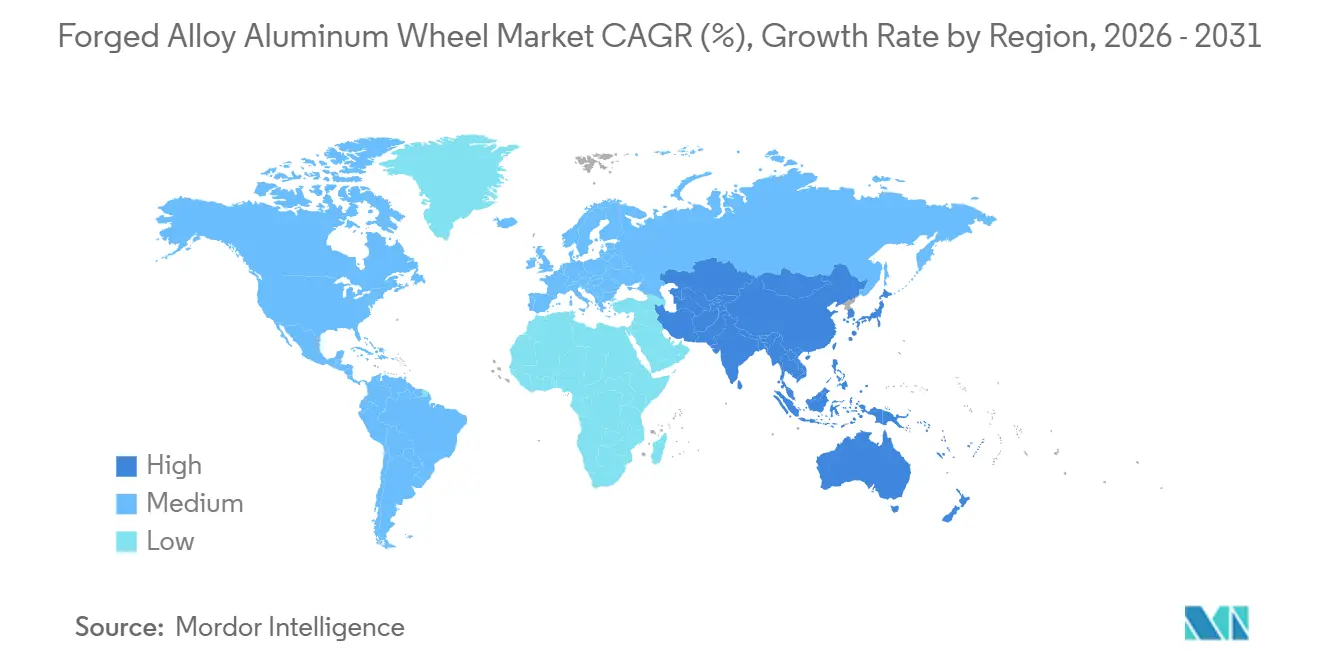
Asia-Pacific held 49.05% of the forged alloy aluminum wheel market share in 2025 and is forecast to grow at a CAGR of 7.35% through 2031. China supports the regional position through its electric-vehicle supply chains and aluminum-component manufacturing. In March 2025, CITIC Dicastal and SAIC-GM-Wuling agreed to build an intelligent aluminum parts manufacturing system in Guangxi, connecting wheel and aluminum-component capabilities to a major vehicle manufacturing base. India also offers a growing production environment for alloy wheels. In February 2026, Steel Strips Wheels signed a USD 19 million agreement to build a new alloy-wheel facility in Bhuj, Gujarat, with an initial capacity of 1.2 million wheels per year[2]Steel Strips Wheels Limited, “Steel Strips Wheels Limited Enters USD 19 Million Tripartite Agreement for Alloy Wheel Facility in Gujarat,” Machinist, machinist.in. Local certification and fuel-efficiency requirements raise the entry threshold for suppliers serving the Indian vehicle market.
Europe and North America form the second major demand cluster for the forged alloy aluminum wheel market. Premium vehicle production supports demand for performance-oriented fitments in Europe, while fleet efficiency requirements drive interest in lower-weight truck and bus wheels across both regions. In April 2026, Howmet Aerospace expanded wheel production capacity at its Howmet-Köfém facility in Székesfehérvár, Hungary, adding European capacity for Dura-Bright wheels used on heavy-duty trucks and buses. BORBET also emphasizes production flexibility and green aluminum credentials in the European wheel market. In North America, suppliers remain attentive to vehicle program sourcing decisions and fleet operating conditions.
South America is gaining relevance in the forged alloy aluminum wheel market through commercial fleet applications. MAXION Wheels introduced forged aluminum truck wheels for the region at Lat.Bus 2026 in São Paulo, Brazil, with Brazil and Argentina identified as the initial target markets for commercial vehicles. The Middle East and Africa represent a smaller but growing base, where premium vehicle imports support aftermarket demand in select countries. Saudi Arabia and South Africa are the primary markets in the region. Certification requirements are emerging as a filter for wheel imports as regulators and customs authorities increase product oversight.

Competitive Landscape
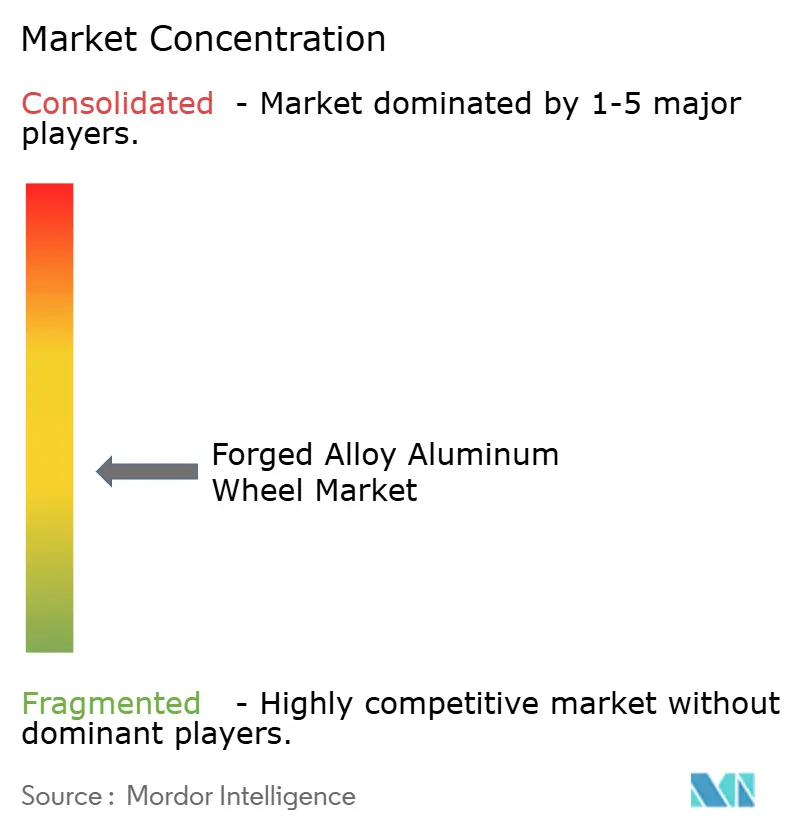
The forged alloy aluminum wheel market is moderately fragmented among large original equipment and commercial vehicle suppliers. MAXION Wheels, CITIC Dicastal, and Howmet Aerospace operate across high-volume applications and benefit from broad manufacturing footprints. Their scale and multiyear platform awards make supplier changes more difficult for vehicle manufacturers. The competitive focus in 2025 and 2026 has centered on new commercial-vehicle capacity rather than on broad consolidation. MAXION Wheels prepared its Manisa facility to produce forged aluminum truck wheels through a joint venture with Inci Holding. Howmet expanded its Hungarian facility to produce European heavy-duty truck and bus wheels in April 2026. These investments target fleets evaluating steel-wheel alternatives. The leading suppliers compete through engineering capability, regional production, and established customer programs.
High-performance suppliers, including HRE Wheels, RAYS, and O.Z. S.p.A. and Enkei International compete through product design and recognized performance credentials. Their approach differs from the output-led model of global Tier-1 suppliers. These companies serve buyers who value fitment, finish, driving performance, and brand association. RAYS' January 2026 VOLK Racing TE37 30th Anniversary series illustrates a product move aimed at this channel. Motorsport and premium-vehicle associations can extend brand recognition to purchases of replacements and customizations. These specialists can protect margins where product engineering and fitment knowledge matter more than scale. The forged alloy aluminum wheel market, therefore, includes both large supply programs and smaller performance-led businesses, each addressing different customer requirements.
Sustainability credentials are becoming part of supplier differentiation, particularly in Europe. BORBET was recertified against the Aluminum Stewardship Initiative Performance Standard V3 in 2024. The company's SUPA-Wheel research partnership also addresses lower-carbon methods for producing aluminum wheels. These actions are relevant where OEMs require traceable material practices alongside wheel performance. Competition remains fragmented in high-performance aftermarket niches, where individual brands hold specialized positions. Large OEM programs present higher entry barriers, as qualification, capacity, and supply reliability are critical factors. Smaller aftermarket brands can still compete where design range and vehicle-specific fitment are valued.
Forged Alloy Aluminum Wheel Industry Leaders
Howmet Aerospace
MAXION Wheels
CITIC Dicastal Co., Ltd.
Superior Industries International, Inc.
RONAL GROUP
- *Disclaimer: Major Players sorted in no particular order

Recent Industry Developments
- August 2026: Maxion Wheels debuted its forged aluminum truck wheel portfolio in South America at Lat.Bus 2026 in São Paulo, Brazil. The launch introduced sizes 22.5x8.25, 22.5x9.00, and 22.5x11.75, featuring Maxion C-GUARD ceramic surface treatment. This marked the brand's first regional commercial launch of forged aluminum commercial vehicle (CV) wheels manufactured at the Manisa, Türkiye joint-venture facility.
- March 2025: CITIC Dicastal and SAIC-GM-Wuling (SGMW) signed a strategic cooperation agreement and held a technology event to jointly develop an aluminum parts intelligent manufacturing system at a pan-aluminum advanced manufacturing site in Guangxi, targeting aluminum wheel supply for SGMW's EV-platform assembly programs.


Global Forged Alloy Aluminum Wheel Market Report Scope
Forged alloy aluminum wheels are premium vehicle rims formed under high hydraulic pressure from solid metal billets, offering greater strength and lower weight than standard cast wheels.
The forged alloy aluminum wheel market is segmented by vehicle type, product configuration, end-user industry, and geography. By vehicle type, the market is segmented into passenger vehicles and commercial vehicles. By product configuration, the market is segmented into one-piece wheels and multi-piece wheels. By end-user industry, the market is segmented into OEM and aftermarket. The report also covers market size and forecasts for forged alloy aluminum wheels across 16 countries in major regions. The market sizes and forecasts are provided in terms of value (USD).
| Passenger Vehicles |
| Commercial Vehicles |
| One-Piece Wheels |
| Multi-Piece Wheels |
| OEM |
| Aftermarket |
| Asia-Pacific | China |
| India | |
| Japan | |
| South Korea | |
| ASEAN Countries | |
| Rest of Asia-Pacific | |
| North America | United States |
| Canada | |
| Mexico | |
| Europe | Germany |
| United Kingdom | |
| France | |
| Italy | |
| NORDIC Countries | |
| Rest of Europe | |
| South America | Brazil |
| Argentina | |
| Rest of South America | |
| Middle East and Africa | Saudi Arabia |
| South Africa | |
| Rest of Middle East and Africa |
| By Vehicle Type | Passenger Vehicles | |
| Commercial Vehicles | ||
| By Product Configuration | One-Piece Wheels | |
| Multi-Piece Wheels | ||
| By End-User Industry | OEM | |
| Aftermarket | ||
| By Geography | Asia-Pacific | China |
| India | ||
| Japan | ||
| South Korea | ||
| ASEAN Countries | ||
| Rest of Asia-Pacific | ||
| North America | United States | |
| Canada | ||
| Mexico | ||
| Europe | Germany | |
| United Kingdom | ||
| France | ||
| Italy | ||
| NORDIC Countries | ||
| Rest of Europe | ||
| South America | Brazil | |
| Argentina | ||
| Rest of South America | ||
| Middle East and Africa | Saudi Arabia | |
| South Africa | ||
| Rest of Middle East and Africa | ||


Key Questions Answered in the Report
What is current market size of Forged Alloy Aluminum Wheel Market?
The Forged Alloy Aluminum Wheel market size was estimated at USD 5.34 billion in 2025 and is estimated to grow from USD 5.67 billion in 2026 to USD 7.81 billion by 2031, at a CAGR of 6.62% during the forecast period (2026-2031).
Which vehicle category has the fastest growth?
Commercial vehicles are forecast to grow at a CAGR of 7.52% through 2031, supported by weight and payload considerations.
Which wheel configuration is growing fastest?
Multi-piece wheels are forecast to expand at a CAGR of 7.17% through 2031, supported by customization and fitment flexibility.
Which region drives demand for forged alloy aluminum wheels?
Asia-Pacific held a 49.05% share in 2025 and is projected to grow at a CAGR of 7.35% through 2031.
Page last updated on:





