
Food and Beverage Date-Code Inspection Systems Market Size and Share
Market Overview
| Study Period | 2020 - 2031 |
|---|---|
| Market Size (2026) | USD 135.64 Million |
| Market Size (2031) | USD 267.65 Million |
| Growth Rate (2026 - 2031) | 14.56 % |
| Fastest Growing Market | Asia-Pacific |
| Largest Market | Asia-Pacific |
| Market Concentration | Low |
Major Players *Disclaimer: Major Players sorted in no particular order Image © Mordor Intelligence. Reuse requires attribution under CC BY 4.0. | |
Food and Beverage Date-Code Inspection Systems Market Analysis by Mordor Intelligence
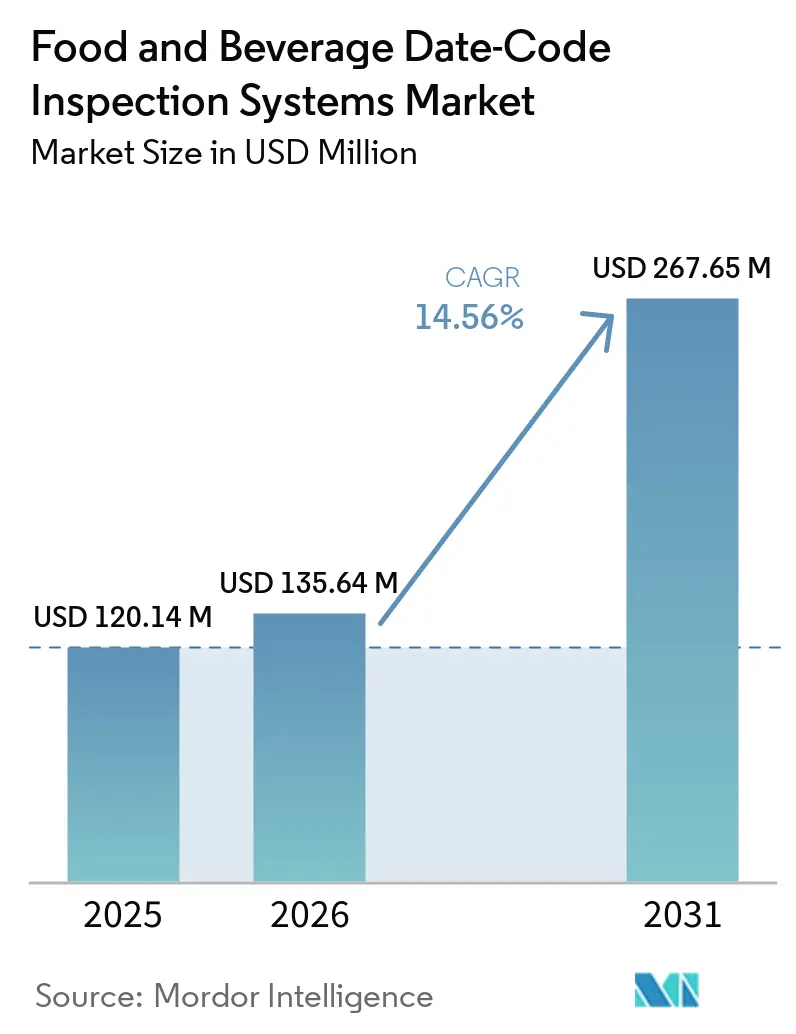
The Food and Beverage Date-Code Inspection Systems Market size was expected to increase from USD 120.14 million in 2025 to USD 135.64 million in 2026 and reach USD 267.65 million by 2031, expanding at a CAGR of 14.56% over 2026-2031. Food safety rules, date-label requirements, and the retail shift toward GS1-compliant 2D codes are increasing the need for inspection systems across packaged food production. These requirements place greater emphasis on accurate date, lot, and batch information at the point of production. The Food and Beverage Date-Code Inspection Systems Market is also moving toward connected equipment that records inspection results within plant data systems. Manufacturers are increasingly treating inspection equipment as part of a wider packaging-line investment rather than as a separate quality-control purchase. This supports replacement demand in beverage, dairy, bakery, and packaged food facilities, while older lines face higher integration costs and greater operational disruption during upgrades.
Key Report Takeaways
- By system type, integrated print-and-inspect systems held 31.83% of the Food and Beverage Date-Code Inspection Systems Market share in 2025, while software-only date-code verification is projected to expand at a CAGR of 16.87% through 2031.
- By packaging format, bottles and cans accounted for 27.64% of the Food and Beverage Date-Code Inspection Systems Market share in 2025, while bags and pouches are projected to expand at a CAGR of 16.68% through 2031.
- By application, expiry-date and best-before verification held 28.47% of the Food and Beverage Date-Code Inspection Systems Market share in 2025, while barcode and DataMatrix traceability is projected to expand at a CAGR of 16.29% through 2031.
- By end-user industry, beverage processing held 25.73% of the Food and Beverage Date-Code Inspection Systems Market share in 2025, while contract packers and co-manufacturers are projected to expand at a CAGR of 16.84% through 2031.
- By geography, Asia-Pacific held 35.96% of the Food and Beverage Date-Code Inspection Systems Market share in 2025 and is projected to expand at a CAGR of 16.47% through 2031.
Note: Market size and forecast figures in this report are generated using Mordor Intelligence’s proprietary estimation framework, updated with the latest available data and insights as of January 2026.
Global Food and Beverage Date-Code Inspection Systems Market Trends and Insights
Drivers Impact Analysis*
| Driver | (~) % Impact on CAGR Forecast | Geographic Relevance | Impact Timeline |
|---|---|---|---|
| Stricter Food-Safety and Date-Label Compliance | +5.5% | Global, with early concentration in Asia-Pacific and North America | Short term (≤ 2 years) |
| Expansion of Inline Vision Inspection on High-Speed Lines | +4.8% | Global, with core gains in North America, Europe, and Asia-Pacific | Short term (≤ 2 years) |
| Retailer and E-Commerce Traceability Requirements | +4.2% | North America and Europe, with spillover to Asia-Pacific and Middle East and Africa | Medium term (2-4 years) |
| Integration of Code Verification With MES, ERP, and SCADA | +3.5% | North America and Europe, with emerging adoption in core Asia-Pacific markets | Medium term (2-4 years) |
| AI-Based Recognition of Low-Contrast and Variable-Surface Codes | +2.8% | Global, with the strongest gains in Europe and Asia-Pacific | Medium term (2-4 years) |
| Returnable-Glass Bottle Geometry and Moisture Tolerance Requirements | +1.5% | Europe and core Asia-Pacific markets | Long term (≥ 4 years) |
| Source: Mordor Intelligence | |||
Stricter Food-Safety and Date-Label Compliance
China’s GB 7718-2025 standard was published in March 2025 and takes effect on March 16, 2027. It requires prepackaged food to show production and best-before dates in a standardized year, month, and day format. The requirement increases the number of data fields that packaging lines must print and verify on each pack. The Food and Beverage Date-Code Inspection Systems Market, therefore, benefits when manufacturers replace single-field equipment with systems that can inspect multiple fields in a single line pass.[1] The FDA Food Traceability Rule under FSMA Section 204 requires electronic traceability records that include key data elements, lot codes, and dates, with records available within 24 hours upon agency request. European food information rules also require best-before or use-by dates for most packaged foods, although format requirements vary with product shelf life and national enforcement practices.[2]
Expansion of Inline Vision Inspection on High-Speed Lines
High-speed beverage and dairy lines render manual checks inadequate, as sampling cannot provide full pack coverage. This keeps 100% inline inspection central to the Food and Beverage Date-Code Inspection Systems Market for large production sites. Earlier AI-enabled equipment often posed a cost barrier for processors needing line-speed verification. Cognex introduced the In-Sight 3900 in May 2026 with up to 25 MP resolution, embedded processing, and claimed processing performance 4 times faster than the previous generation. Fortress Technology presented the Raptor Tritek at Interpack 2026 as an integrated metal-detection, checkweighing, and vision frame with embedded OCR for real-time inspection at 150 packs per minute. These offerings place code verification within the production line itself and make recall avoidance, throughput, and compliance part of the same investment decision.
Retailer and E-Commerce Traceability Requirements
GS1 Sunrise 2027 requires retail point-of-sale systems to scan and accept 2D barcodes by December 31, 2027. A GS1 Digital Link code can combine a GTIN, lot number, and best-before date into a single symbol, supporting stock rotation, targeted recalls, and management of products approaching expiry.[3] This transition requires more than ordinary character recognition because systems must decode the symbol and validate the embedded data structure. The Food and Beverage Date-Code Inspection Systems Market gains where manufacturers update both printing and verification equipment for each migrated SKU. Domino introduced the Gx-Series PRO Printhead in April 2026 for high-contrast GS1 2D coding and integration with its R-Series smart vision system. Nestlé and Procter & Gamble have supported the GS1 global statement on 2D adoption, creating additional pressure on suppliers to retain retail shelf placement.
Integration of Code Verification With MES, ERP, and SCADA
Connected inspection sends verification results to manufacturing execution, enterprise resource planning, and supervisory-control systems. This helps manufacturers link each inspected pack with its lot, production date, and production shift. The FDA’s electronic record requirement makes automated capture at the point of inspection increasingly important for traceability. Systems using OPC UA and MQTT can timestamp inspection events and add them to batch genealogy records without manual entry. Antares Vision Group demonstrated the DIAMIND platform at Interpack 2026 and CFIA 2026 as a system that links inline inspection, track-and-trace, and enterprise data through a single layer. The Food and Beverage Date-Code Inspection Systems Market increasingly favors suppliers whose equipment integrates with existing plant software, as integrated data flows can make replacement more difficult after a system is installed.
Restraints Impact Analysis*
| Restraint | (~) % Impact on CAGR Forecast | Geographic Relevance | Impact Timeline |
|---|---|---|---|
| High Integration and Changeover Costs for Existing Lines | -1.8% | Global, most acute in South America, Middle East and Africa, and fragmented European markets | Short term (≤ 2 years) |
| Fragmented Date-Format and Labeling Practices Across Markets | -1.2% | Global | Medium term (2-4 years) |
| False Rejects From Condensation, Glare, and Curved Substrates | -0.8% | Global, with core impact in dairy, beverage, and glass-jar segments | Short term (≤ 2 years) |
| Cybersecurity and Data-Integrity Exposure in Connected Inspection Systems | -0.6% | North America, Europe, and core Asia-Pacific markets | Long term (≥ 4 years) |
| Source: Mordor Intelligence | |||
High Integration and Changeover Costs for Existing Lines
Retrofitting legacy filling and packaging lines requires more than purchasing a camera or vision controller. The work can include integration engineering, PLC programming, reject-mechanism installation, and operational qualification for GFSI or BRCGS audits. Deployment feedback in the PMMI 2025 Food Safety and Sanitation report indicated that these requirements can add 30% to 60% to the base equipment cost. Multi-SKU facilities also incur downtime while systems are commissioned and recipes are configured. Contract packers that run 60 to 100 SKUs each week must maintain frequent adjustments, operator training, and recipe libraries throughout the equipment life cycle. These constraints limit the adoption of integrated equipment in South America, the Middle East, and Africa, where investment cycles are longer and local commissioning support is less available.
Fragmented Date-Format and Labeling Practices Across Markets
Food packaging must meet differing rules on date wording, position, language, character size, and order across many jurisdictions. The United States uses "Best if Used By" wording, while the European Union requires "best-before" and "use-by" descriptions. Japan applies year, month, and day formats with defined character-size rules, while China requires a dual-date display by March 2027. A multinational producer must therefore configure country-specific templates, date logic, character tolerances, and expected field counts. The Food and Beverage Date-Code Inspection Systems Market faces added complexity when a code passes optical inspection but does not meet the destination country's format requirements. This diversity raises recipe-management demands and limits the scale efficiencies available to global food manufacturers.
*Our forecasts treat driver/restraint impacts as directional, not additive. The impact forecasts reflect baseline growth, mix effects, and variable interactions.
Segment Analysis
By System Type: Software Platforms Extend Verification Beyond Large Production Lines
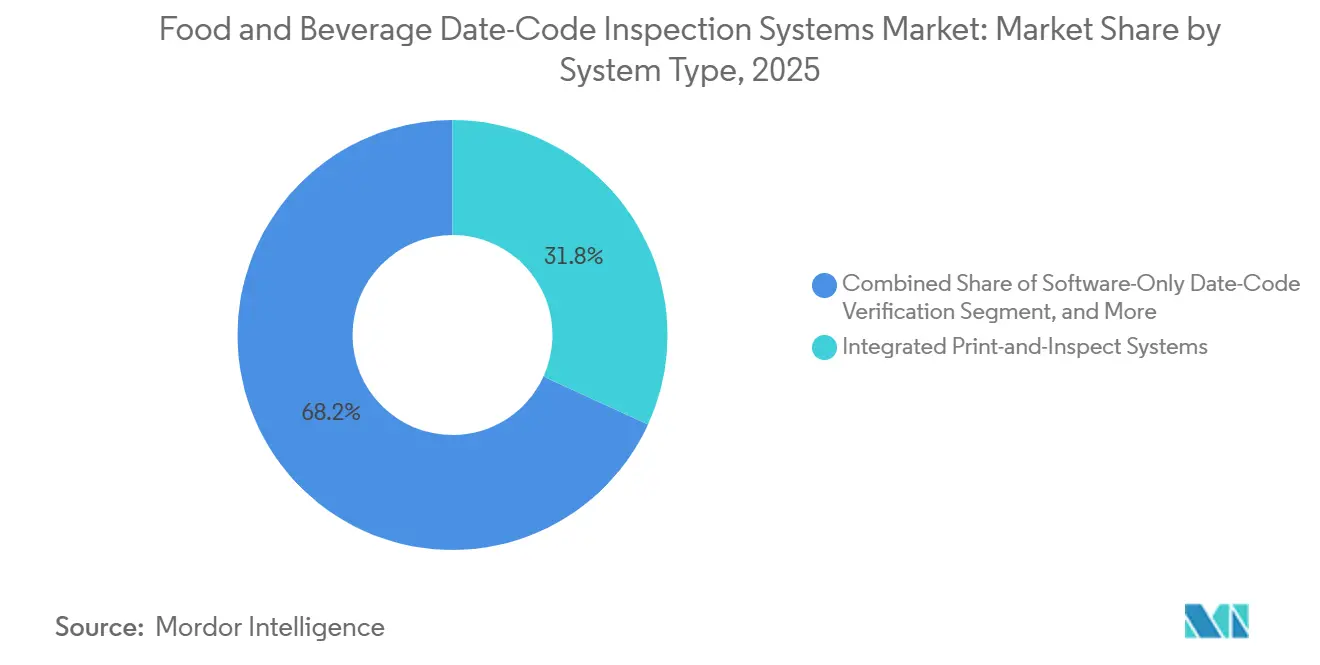
Integrated print-and-inspect systems held 31.83% of the Food and Beverage Date-Code Inspection Systems Market share in 2025. These systems combine a continuous inkjet, thermal inkjet, or laser coder with an inline camera and verification controller. Their design supports high-speed dairy, beverage, and packaged-food lines that require coordinated printing and verification. Videojet, Domino, and Markem-Imaje built a large installed base in major food plants over the prior decade. Standalone vision systems, code readers, and smart cameras remain relevant where an existing printer needs an added verification layer. This approach is common when facilities are upgrading for BRCGS or GFSI audit requirements. Domino’s Gx-Series PRO Printhead was introduced in April 2026 with R-Series smart vision integration for code management and inline verification. The release shows that the boundary between printing and inspection is narrowing within the Food and Beverage Date-Code Inspection Systems Market.[4]
Software-only date-code verification is projected to expand at a CAGR of 16.87% through 2031. Edge-AI software can operate on industrial PCs or embedded modules without requiring a complete replacement of cameras and controllers. This enables processors to change verification logic while retaining some established line hardware. FutureStandard deployed a generative-AI data-code inspection solution at a Japanese food manufacturer in 2025. The installation replaced one dedicated line operator used for continuous date and lot verification. Contract packers can use these platforms to maintain flexible inspection models for different customer code formats. The Food and Beverage Date-Code Inspection Systems Market thus has an entry route for smaller manufacturers that cannot dedicate capital to a proprietary integrated platform. Other system types include hybrid configurations and portable code readers used for first-article checks in low-throughput specialty facilities.

By Packaging Format: Flexible Pouches Receive Greater Inspection Attention
Bottles and cans held 27.64% of the Food and Beverage Date-Code Inspection Systems Market share in 2025. Beverage and dairy production volumes supported this position across rigid packaging lines. These containers have defined inspection geometry, which assists camera positioning and code-location control. Returnable glass creates added difficulty because surface wear, pasteurization moisture, and code adhesion vary on reused bottles. These conditions can increase OCR errors and support the use of NIR imaging and moisture-tolerant illumination. Cartons and paperboard packs also represent an important installed base in dairy beverage and UHT products. China’s dual-date rule increases the need to capture two date fields on these packages without slowing the line. Cups, trays, tubs, jars, and other rigid containers require inspection systems that can access lids and similarly constrained print locations.
Bags and pouches are projected to expand at a CAGR of 16.68% through 2031. Snacks, pet food, frozen meals, and premium protein products use flexible packaging because it is lightweight and widely used in direct-to-consumer distribution. Metalized films and multilayer pouches are more difficult to inspect than rigid containers. Wrinkles, changes in film tension, and reflective surfaces can degrade the performance of rule-based OCR tools. AI-based vision systems are designed to handle variations that traditional models struggle with. Cognex stated that its In-Sight 3900 Edge AI tools address difficult-to-read codes at full packaging-line speeds. The Food and Beverage Date-Code Inspection Systems Market, therefore, has a stronger opportunity in flexible substrates where code quality varies between runs. Packaging format increasingly shapes equipment selection because it influences lighting, camera placement, and the level of image-processing capability needed.
By Application: Barcode Traceability Expands as Packaging Becomes Digital
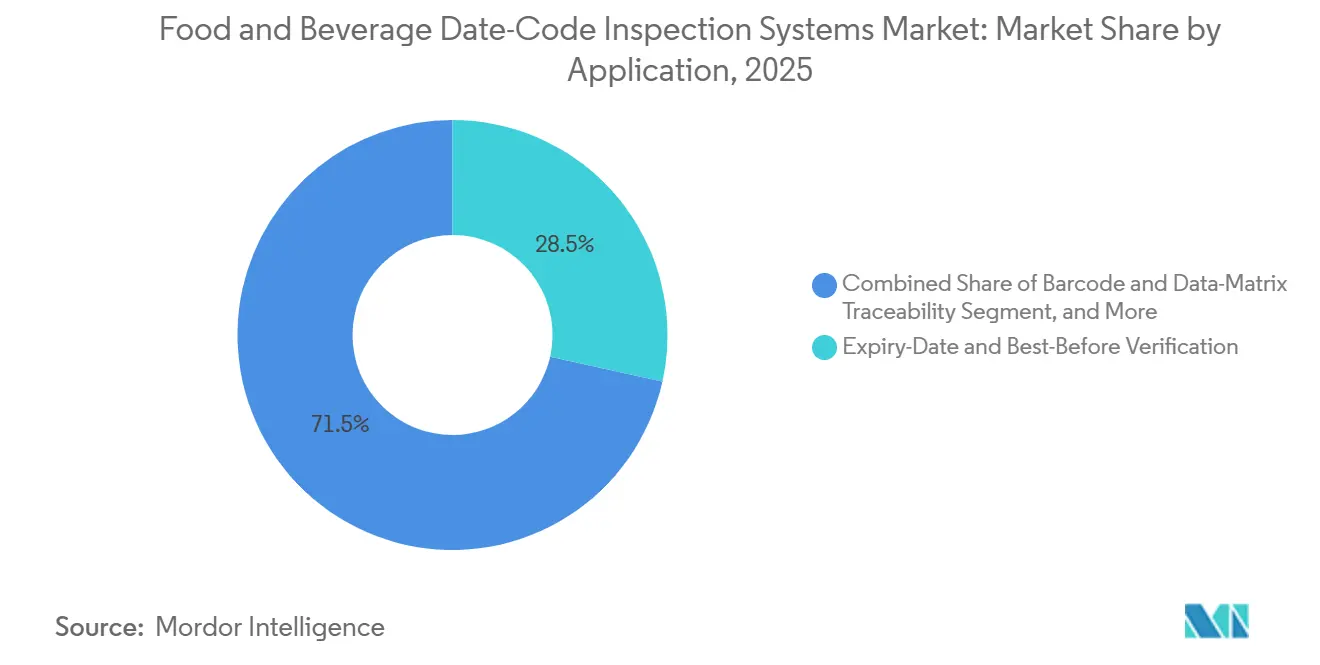
Expiry-date and best-before verification held 28.47% of the Food and Beverage Date-Code Inspection Systems Market share in 2025. Date marking is required across major food jurisdictions and occurs more frequently than most other variable-data checks. The application serves large dairy and beverage plants as well as bakery and confectionery producers. Its regulatory foundation includes FDA 21 CFR Part 101, European Regulation 1169/2011, and comparable national requirements. Batch and lot-code verification follow closely because processors must link production events to traceability records. FSMA Section 204 formalized this need through key data elements and critical tracking events. Print presence, position, and legibility inspection also remains essential because nozzle blockage, ribbon errors, and laser-focus drift can leave many units without a compliant code. The Food and Beverage Date-Code Inspection Systems Market continues to rely on these applications as the base layer of packaging compliance.
Barcode and DataMatrix traceability is projected to expand at a CAGR of 16.29% through 2031. GS1 Sunrise 2027 is driving the move from basic character reading toward symbol decoding and structured data validation. Digital Link codes can encode a GTIN, lot, and expiry date in a single symbol, extending the inspection task beyond conventional OCR. Antares Vision presented the IE6000 Label Inspection system at Interpack 2026 for AI-based validation of labels and codes on different container types. Label and artwork compliance remains relevant where packaging information must align with approved product files. Reject management and audit-record generation are also increasingly important because complete records influence BRCGS and GFSI certification outcomes. The Food and Beverage Date-Code Inspection Systems Market is shifting toward systems that validate both visible print and the information carried within each code. This places more value on software capability, data storage, and integration with plant records.
By End-User Industry: Contract Packers Change the Pattern of Equipment Demand
Beverage processing held 25.73% of the Food and Beverage Date-Code Inspection Systems Market share in 2025. High line speeds and high inspection volumes supported its leading position. Bottling and canning operations also have an established base of Videojet and Domino coding systems. Dairy processing holds the second-largest position because temperature-sensitive products require accurate date coding under HACCP and BRCGS controls. Japanese food manufacturers are automating manual inspection activities as labor shortages persist. Bakery, confectionery, and packaged food facilities represent the broadest installed base by site count, although their line speeds are often lower. Meat, poultry, and seafood operations require more capable equipment because steam, moisture, and dark packaging surfaces make codes harder to inspect. These operating conditions sustain demand for NIR-enhanced and AI-based systems across the Food and Beverage Date-Code Inspection Systems Market.
Contract packers and co-manufacturers are projected to expand at a CAGR of 16.84% through 2031. Consumer packaged goods companies outsource production to retain capital flexibility and include code-compliance requirements in manufacturing contracts. Inspection becomes a commercial requirement for the co-manufacturer rather than merely an internal quality decision. Kaminashi launched an AI label-inspection feature in June 2025 for food contract manufacturers. The company stated that label misprinting or incorrect date codes were involved in nearly half of Japanese food recalls, including facilities operated by Ito Ham Yonekyu Plant. AutoCoding Systems also held an April 2025 training session with Marks and Spencer’s Food Technical team, illustrating retailer influence on inspection practices at contract packing sites. The Food and Beverage Date-Code Inspection Systems Market expands beyond brand-owned facilities when these requirements flow through outsourced production networks. This demand pattern favors systems that can handle frequent changes in customers, SKUs, and packaging.
Geography Analysis
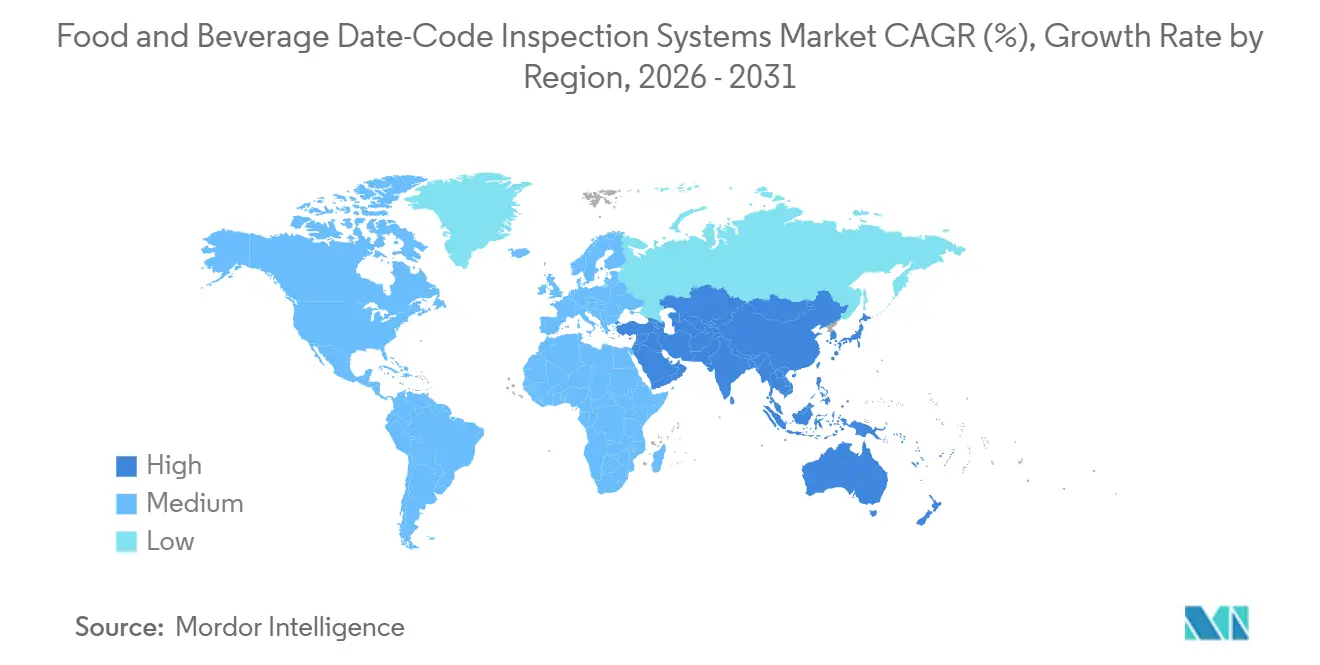
Asia-Pacific held 35.96% of the Food and Beverage Date-Code Inspection Systems Market share in 2025 and is projected to expand at a CAGR of 16.47% through 2031. China is the primary regional driver, as GB 7718-2025 requires dual-date labeling for prepackaged food as of March 2027. The rule establishes a replacement cycle for systems that inspect only a single date field. Japan also has a labor-driven need for automation, as demonstrated by FutureStandard’s 2025 food-plant deployment. India’s packaging-rule modernization is creating early demand for packaged food and dairy, although its installed base remains below that of China, Japan, and South Korea. Thailand and Vietnam are aligning export packaging with European and U.S. retailer requirements for 2D-code readiness.
North America and Europe formed the second-largest revenue pool in the Food and Beverage Date-Code Inspection Systems Market. In the United States, the FSMA Section 204 enforcement date is July 2028, encouraging voluntary investment before the compliance deadlines. Walmart and Target have set supplier timelines for 2D-code compliance ahead of GS1 Sunrise 2027, bringing equipment purchases forward. Canada and Mexico follow U.S. supply-chain requirements. Europe applies Regulation 1169/2011 across 27 member states, while the United Kingdom retains comparable rules. Germany leads regional demand due to its dense food and beverage processing base and strict labeling enforcement, while France, Italy, and Spain remain active markets for integrated inspection platforms.
South America, the Middle East, and Africa show a different pattern in the Food and Beverage Date-Code Inspection Systems Market. Brazil leads South American adoption as agribusiness exporters align with retailer-led 2D-code requirements. Argentina and other South American markets have slower equipment cycles because of currency volatility and limited local engineering support. Saudi Arabia’s Vision 2030 food-manufacturing program and the UAE food-product registration requirements are raising inspection standards and supporting greenfield installations. South Africa leads adoption in Africa due to its export-oriented food manufacturing base and labeling standards. Nigeria remains at an earlier stage of industrial inspection penetration. Software-only verification may be more suitable across the Middle East and Africa because lower hardware requirements and remote updates reduce reliance on scarce certified machine-vision engineers.
Competitive Landscape
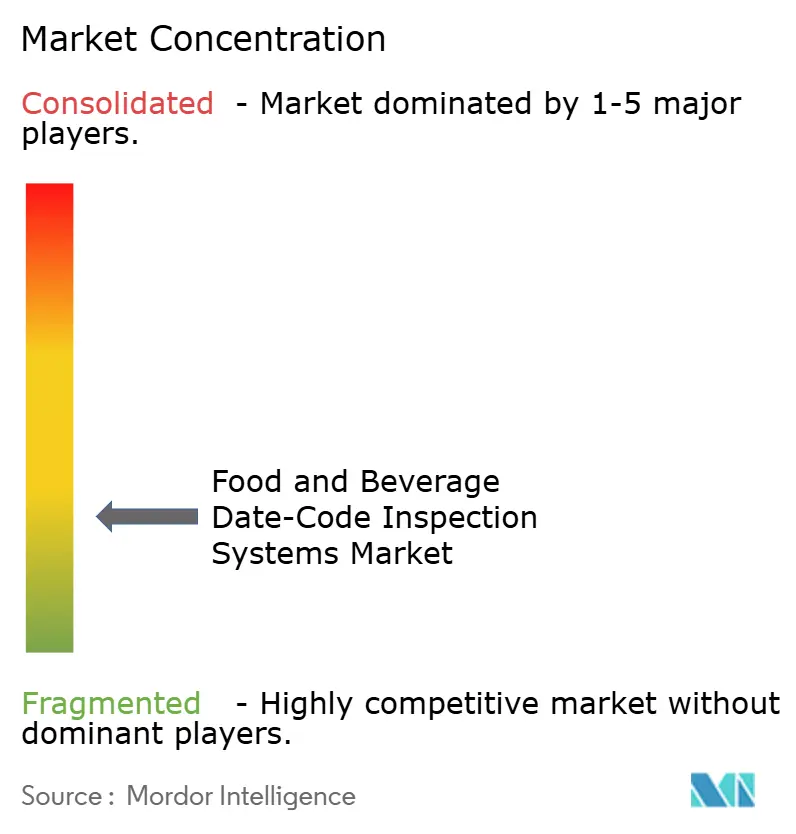
The Food and Beverage Date-Code Inspection Systems Market is fragmented at the technology level. Videojet Technologies, Domino Printing Sciences, Cognex Corporation, Keyence Corporation, and Antares Vision Group form the leading group of suppliers for high-throughput beverage and dairy projects. These suppliers compete by integrating coding equipment, vision systems, and data-management software. Domino introduced the Gx-Series PRO in April 2026 with integration to R-Series smart vision and Domino Automation for full code management. Cognex introduced the In-Sight 3900 in May 2026 with embedded AI processing and no external PC requirement. SICK and Omron operate in industrial sensor integration, while Mettler-Toledo uses CI-Vision to offer combined code-verification and checkweighing systems. Mettler-Toledo showed its CV Combination system at Interpack 2026 as part of this combination-inspection approach.
Software-only verification, integrated 2D-code inspection, and lower-cost AI systems for smaller processors are the main open areas in the Food and Beverage Date-Code Inspection Systems Market. PEKAT VISION, GlobalVision, and Bytronic Automation focus on AI-based models that adapt to new pack formats without having to rebuild the entire recipe library. This addresses changeover costs at facilities with many SKUs. AutoCoding Systems, part of JBT Marel, combines centralized code-management software, Proseal tray sealers, and vision inspection in validated food-safety configurations. Its work with Marks and Spencer’s technical team illustrates how retailer standards affect supplier selection at contract facilities. Antares Vision’s DIAMIND Connect platform also combines traceability, customer engagement, and supply-chain digitalization for food and beverage brand owners. These strategies position software integration as a material part of competitive differentiation.
Hardware-focused suppliers face longer-term pressure from AI software providers that reduce the need for product-specific OCR template configuration. Open data formats could reduce the integration advantages held by established equipment ecosystems. At the same time, connected systems can create new data-integrity and cybersecurity requirements for food manufacturers. Suppliers that offer secure links between inspection, manufacturing execution, and enterprise records can strengthen their position on complex projects. The Food and Beverage Date-Code Inspection Systems Market also rewards systems that handle condensation, glare, curved surfaces, and variable packaging without excessive false rejects. Fortress Technology’s Raptor Tritek combined metal detection, checkweighing, and vision inspection in a single 2.5-meter frame, with OCR for labels and date codes, at 150 packs per minute. This reflects the shift toward equipment that meets multiple line-quality requirements in a single installation.
Food and Beverage Date-Code Inspection Systems Industry Leaders
-
Videojet Technologies Inc.
-
Domino Printing Sciences plc
-
Cognex Corporation
-
Keyence Corporation
-
Antares Vision S.p.A.
- *Disclaimer: Major Players sorted in no particular order
Recent Industry Developments
- September 2026: KPM Analytics introduced the SiftAI FM HD platform with significantly improved AI detection models, an IP69K Extreme Hygiene enclosure, and expanded support for low-density foreign-material detection in food processing, extending AI inspection capabilities for combined quality-control platforms used alongside date-code verification.
- August 2026: Mettler-Toledo launched the X56 DXD+, a dual-energy photon-counting X-ray inspection system with AI capabilities, expanding the X6 Series for packaged food applications including pet food and snacks, demonstrating the company’s push to embed AI across its food safety inspection portfolio.
- June 2026: Zebra Technologies unveiled the CV70 CXP machine vision camera at Automate 2026 in Chicago, featuring a high-performance CoaXPress interface designed for high-speed, high-resolution inspection applications, including AI-based OCR for product identification and label validation in manufacturing workflows.
- May 2026: Cognex Corporation launched the In-Sight 3900 Vision System on May 5, powered by Qualcomm Dragonwing platforms, delivering up to 25 MP resolution and processing up to 4 times faster than prior-generation embedded systems, enabling real-time inspection at full production line speeds without an external PC.
Global Food and Beverage Date-Code Inspection Systems Market Report Scope
Food and Beverage Date-Code Inspection Systems are automated vision solutions designed to verify the presence, accuracy, legibility, and compliance of expiry dates, batch codes, and lot numbers on packaging, ensuring regulatory adherence, traceability, and consumer safety across high-speed production lines.
The Food and Beverage Date-Code Inspection Systems Market Report is Segmented by System Type (Integrated Print-and-Inspect Systems, Standalone Vision Inspection Systems, Code Readers and Smart Cameras, Software-Only Date-Code Verification, and Other System Types), Packaging Format (Bottles and Cans, Cartons and Paperboard Packs, Cups, Trays, and Tubs, Bags and Pouches, Jars and Rigid Containers, and Other Packaging Formats), Application (Expiry-Date and Best-Before Verification, Batch and Lot-Code Verification, Print Presence, Position, and Legibility Inspection, Barcode and Data-Matrix Traceability, Label and Artwork Compliance, Reject Management and Audit-Record Generation, and Other Applications), End-User Industry (Beverage Processing, Dairy Processing, Bakery and Confectionery Processing, Meat, Poultry, and Seafood Processing, Packaged Food Processing, Contract Packers and Co-Manufacturers, and Other End-User Industries), and Geography (North America, South America, Europe, Asia-Pacific, Middle East and Africa). The Market Forecasts are Provided in Terms of Value (USD).
| Integrated Print-and-Inspect Systems |
| Standalone Vision Inspection Systems |
| Code Readers and Smart Cameras |
| Software-Only Date-Code Verification |
| Other System Types |
| Bottles and Cans |
| Cartons and Paperboard Packs |
| Cups, Trays, and Tubs |
| Bags and Pouches |
| Jars and Rigid Containers |
| Other Packaging Formats |
| Expiry-Date and Best-Before Verification |
| Batch and Lot-Code Verification |
| Print Presence, Position, and Legibility Inspection |
| Barcode and Data-Matrix Traceability |
| Label and Artwork Compliance |
| Reject Management and Audit-Record Generation |
| Other Applications |
| Beverage Processing |
| Dairy Processing |
| Bakery and Confectionery Processing |
| Meat, Poultry, and Seafood Processing |
| Packaged Food Processing |
| Contract Packers and Co-Manufacturers |
| Other End-User Industries |
| North America | United States | |
| Canada | ||
| Mexico | ||
| South America | Brazil | |
| Argentina | ||
| Rest of South America | ||
| Europe | Germany | |
| United Kingdom | ||
| France | ||
| Italy | ||
| Spain | ||
| Rest of Europe | ||
| Asia-Pacific | China | |
| Japan | ||
| India | ||
| South Korea | ||
| Rest of Asia-Pacific | ||
| Middle East and Africa | Middle East | Saudi Arabia |
| United Arab Emirates | ||
| Turkey | ||
| Rest of the Middle East | ||
| Africa | South Africa | |
| Nigeria | ||
| Rest of Africa | ||
| By System Type | Integrated Print-and-Inspect Systems | ||
| Standalone Vision Inspection Systems | |||
| Code Readers and Smart Cameras | |||
| Software-Only Date-Code Verification | |||
| Other System Types | |||
| By Packaging Format | Bottles and Cans | ||
| Cartons and Paperboard Packs | |||
| Cups, Trays, and Tubs | |||
| Bags and Pouches | |||
| Jars and Rigid Containers | |||
| Other Packaging Formats | |||
| By Application | Expiry-Date and Best-Before Verification | ||
| Batch and Lot-Code Verification | |||
| Print Presence, Position, and Legibility Inspection | |||
| Barcode and Data-Matrix Traceability | |||
| Label and Artwork Compliance | |||
| Reject Management and Audit-Record Generation | |||
| Other Applications | |||
| By End-User Industry | Beverage Processing | ||
| Dairy Processing | |||
| Bakery and Confectionery Processing | |||
| Meat, Poultry, and Seafood Processing | |||
| Packaged Food Processing | |||
| Contract Packers and Co-Manufacturers | |||
| Other End-User Industries | |||
| By Geography | North America | United States | |
| Canada | |||
| Mexico | |||
| South America | Brazil | ||
| Argentina | |||
| Rest of South America | |||
| Europe | Germany | ||
| United Kingdom | |||
| France | |||
| Italy | |||
| Spain | |||
| Rest of Europe | |||
| Asia-Pacific | China | ||
| Japan | |||
| India | |||
| South Korea | |||
| Rest of Asia-Pacific | |||
| Middle East and Africa | Middle East | Saudi Arabia | |
| United Arab Emirates | |||
| Turkey | |||
| Rest of the Middle East | |||
| Africa | South Africa | ||
| Nigeria | |||
| Rest of Africa | |||
Key Questions Answered in the Report
What is the Food and Beverage Date-Code Inspection Systems Market size?
The Food and Beverage Date-Code Inspection Systems Market was expected to increase from USD 120.14 million in 2025 to USD 135.64 million in 2026 and reach USD 267.65 million by 2031.
What is driving demand for date-code inspection equipment?
Food safety rules, electronic traceability requirements, and the adoption of GS1 2D codes are driving demand for automated verification.
Which system type leads food and beverage code verification?
Integrated print-and-inspect systems led with 31.83% share in 2025, while software-only verification is projected to record the fastest CAGR of 16.87%.
Why are 2D barcodes important for food packaging lines?
They can carry GTIN, lot, and expiry information in one symbol, requiring systems that can validate both the code and its data structure.
Which packaging format is projected to expand fastest?
Bags and pouches are projected to expand at a CAGR of 16.68% through 2031 because flexible surfaces create more demanding inspection conditions.
Which region leads demand for these systems?
Asia-Pacific led with 35.96% share in 2025 and is projected to expand at a CAGR of 16.47% through 2031.