
Image-Based Industrial Code Reader Market Size and Share
Market Overview
| Study Period | 2020 - 2031 |
|---|---|
| Market Size (2026) | USD 1.56 Billion |
| Market Size (2031) | USD 2.41 Billion |
| Growth Rate (2026 - 2031) | 9.09 % |
| Fastest Growing Market | Asia-Pacific |
| Largest Market | Asia-Pacific |
| Market Concentration | Medium |
Major Players *Disclaimer: Major Players sorted in no particular order Image © Mordor Intelligence. Reuse requires attribution under CC BY 4.0. | |
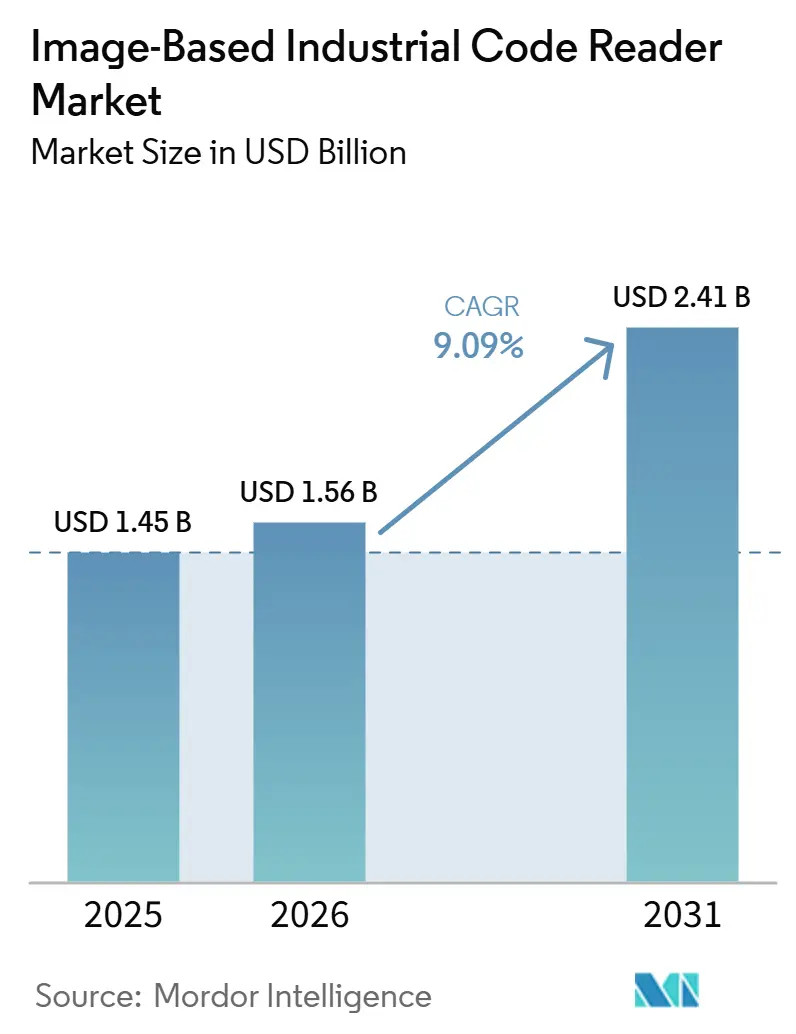
Image-Based Industrial Code Reader Market Analysis by Mordor Intelligence
The Image-Based Industrial Code Reader Market size was valued at USD 1.45 billion in 2025 and estimated to expand from USD 1.56 billion in 2026 to reach USD 2.41 billion by 2031, at a CAGR of 9.09% during the forecast period (2026-2031). Serialization rules and broader traceability requirements are raising demand for calibrated 2D code verification across pharmaceutical and medical-device operations. The transition to GS1 Digital Link codes also extends replacement demand into retail, logistics, and consumer-packaged goods. Manufacturers are placing verification closer to printing and marking steps, which supports investment in inline systems and related software. Competition is increasingly shaped by optical performance, standards expertise, and the ability to connect verification data with plant systems. Integration, validation, and calibration requirements remain material barriers for smaller facilities and sites with older equipment.
Key Report Takeaways
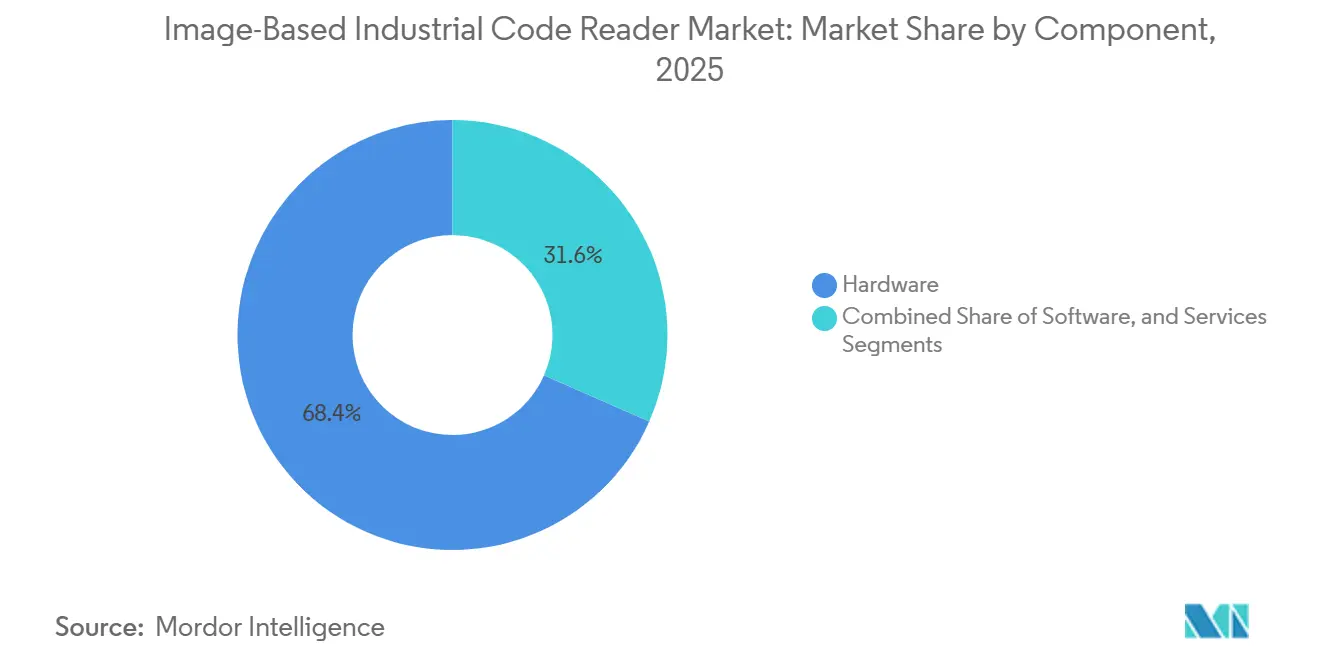
- By component, hardware held 68.41% Image-Based Industrial Code Reader Market revenue share in 2025, while software is projected to expand at a 10.24% CAGR through 2031.
- By verification mode, in-line verification held 57.61% revenue share in 2025, while portable verification is projected to expand at a 10.76% CAGR through 2031.
- By code symbology, Data Matrix and GS1 DataMatrix accounted for 43.71% of the Image-Based Industrial Code Reader Market revenue in 2025, while QR Code and GS1 QR Code are projected to expand at a 10.18% CAGR through 2031.
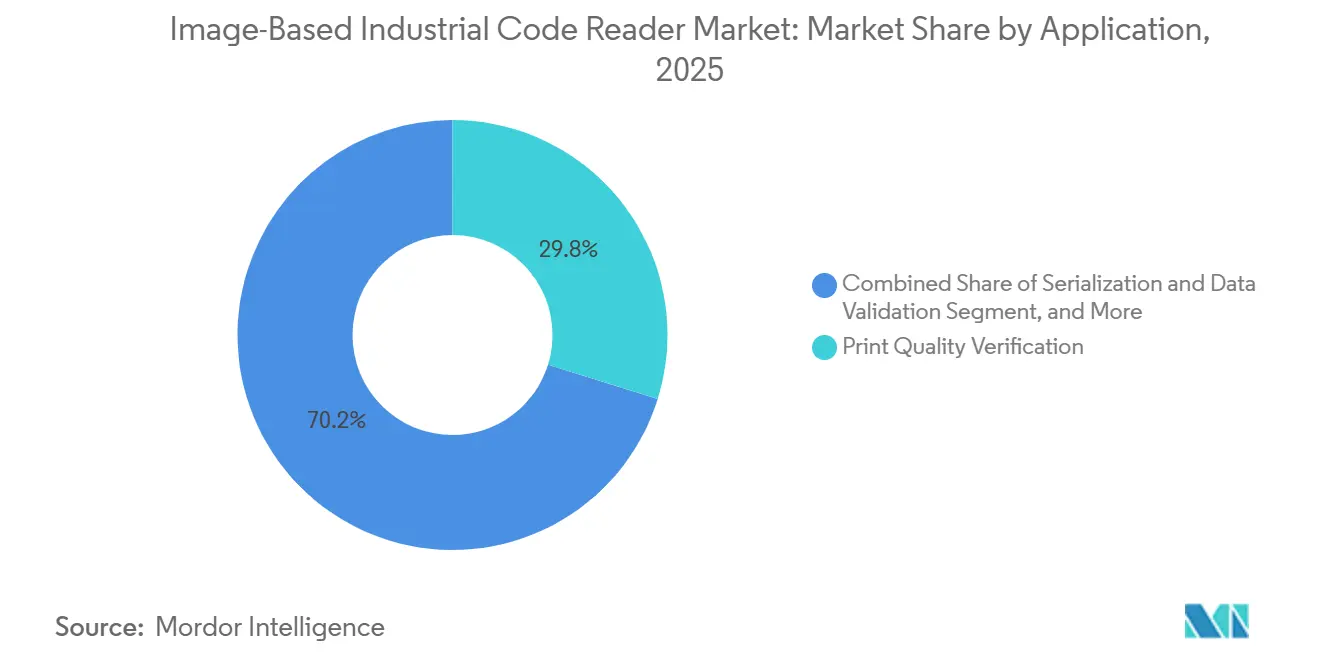
- By application, print quality verification accounted for 29.81% of revenue in 2025, while serialization and data validation are projected to expand at an 11.42% CAGR through 2031.
- By end-user industry, pharmaceuticals accounted for 24.61% of the Image-Based Industrial Code Reader Market revenue in 2025, while electronics and semiconductors are projected to expand at a 10.63% CAGR through 2031.
- By geography, Asia-Pacific accounted for 35.21% of revenue in 2025 and is projected to expand at an 11.21% CAGR through 2031.
Note: Market size and forecast figures in this report are generated using Mordor Intelligence’s proprietary estimation framework, updated with the latest available data and insights as of January 2026.
Global Image-Based Industrial Code Reader Market Trends and Insights
Drivers Impact Analysis*
| Driver | (~) % Impact on CAGR Forecast | Geographic Relevance | Impact Timeline |
|---|---|---|---|
| Serialization and Traceability Mandates | +2.8% | Global pharmaceutical and medical-device supply chains in North America, Europe, and Asia-Pacific | Short term (≤ 2 years) |
| Manufacturing Automation and Industry 4.0 | +2.2% | Asia-Pacific, with spillover to North America and Europe | Medium term (2-4 years) |
| Supply Chain Digitalization and E-Commerce | +1.5% | Global, especially North America, China, and Europe | Medium term (2-4 years) |
| Quality Assurance and First-Pass Yield | +1.1% | Global, led by electronics clusters in Asia-Pacific | Medium term (2-4 years) |
| ISO/IEC 15415:2024 Decimal Grading Upgrade | +0.9% | Global, with early adoption in North America and Europe | Short term (≤ 2 years) |
| Closed-Loop Verification Data Control | +0.5% | Primarily North America and Europe | Long term (≥ 4 years) |
| Source: Mordor Intelligence | |||
Regulatory Serialization and Traceability Mandates
Serialization mandates are the strongest driver of demand for the Image-Based Industrial Code Reader Market because enforcement now requires package-level verification. The U.S. Drug Supply Chain Security Act required trading partners to meet enhanced drug distribution security requirements as of November 27, 2024.[1]U.S. Food and Drug Administration, “Drug Supply Chain Security Act,” U.S. Food and Drug Administration European rules require manufacturers to verify barcode readability and data accuracy before releasing medicinal products for sale or distribution. These requirements favor calibrated inline verification systems that can document results at production speed. Similar traceability obligations are extending into adjacent product categories, including electronics, textiles, and EV batteries. Verifier conformance requirements also favor suppliers that can provide calibrated grading and auditable records.
Manufacturing Automation and Industry 4.0 Implementation
Automation is moving code verification from offline sampling toward continuous checks in the Image-Based Industrial Code Reader Market. Omron introduced the VHV5-SRV Barcode Verification System in June 2026, with a rating of up to 1,200 parts per minute.[2]Omron Automation, “OMRON Introduces VHV5-SRV Barcode Verification System for 100% Inline Inspection,” Omron Automation The system supports real-time grading in accordance with ISO/IEC 15415, ISO/IEC 15416, and ISO/IEC TR 29158. Inline inspection combines verification with production activity and can reduce rework and audit effort. Plants with connected manufacturing execution systems can implement these systems more readily than facilities dependent on manual checks. This difference can widen operating gaps in semiconductor packaging and automotive parts marking.
Supply Chain Digitalization and E-Commerce Expansion
The GS1 Sunrise 2027 initiative is creating an upgrade cycle for code-printing and verification equipment in the Image-Based Industrial Code Reader Market. GS1 supports the use of QR codes with GS1 Digital Link at retail point of sale as the transition advances.[3]GS1, “GS1 Digital Link,” GS1 Dual-coded packaging raises the consequence of a print defect because the same package must work in retail and supply-chain settings. Tesco moved an entire product range to GS1-enabled QR codes in 2026. GS1 reported that the transition affects more than 25,000 member companies and 6 billion barcode scans each day. Expanding e-commerce sorting networks also increase use of automated identification systems in logistics hubs.
Quality Assurance and First-Pass Yield Improvement
Inline verification gives Image-Based Industrial Code Reader Market manufacturers usable feedback before defective output accumulates. Code-quality data can trigger corrective action at the marking or printing stage, thereby limiting rework, rejected shipments, and recall exposure. Cognex introduced the In-Sight 3900 Vision System in May 2026 for AI-based 2D code reading and inspection on difficult surfaces. ISO/IEC 15415:2024 changed grading to continuous decimal values from 0.0 to 4.0 in 0.1 increments. This added precision helps engineers identify deterioration earlier than a legacy whole-grade result. The financial case is particularly clear where a noncompliant serialization mark can hold a pharmaceutical batch.[4]REA Jet UK, “ISO/IEC 15415 and ISO/IEC 15416 Update of 2024/2025,” REA Jet UK
Restraints Impact Analysis*
| Restraint | (~) % Impact on CAGR Forecast | Geographic Relevance | Impact Timeline |
|---|---|---|---|
| Integration, Calibration, and Validation Costs | -1.8% | Global, with a stronger effect in South America and the Middle East and Africa | Short term (≤ 2 years) |
| Legacy ERP, MES, and Printer Compatibility | -1.3% | North America and Europe, with global spillover | Medium term (2-4 years) |
| Direct Part Mark Substrate Variability | -0.9% | Global, concentrated in Asia-Pacific manufacturing | Medium term (2-4 years) |
| False Rejects During Standards Transition | -0.6% | Global | Short term (≤ 2 years) |
| Source: Mordor Intelligence | |||
High Integration, Calibration, and Validation Costs
Integration and validation costs remain a significant barrier to adoption in the Image-Based Industrial Code Reader Market. ISO-compliant verifiers require calibration cards, controlled lighting, and validation procedures, which add recurring expenses. Engineering time can raise the qualification cost beyond the equipment price. Life-sciences sites must document validation and repeat it after relevant software changes, in accordance with applicable electronic-record and good-manufacturing-practice requirements. Integrating marking, labeling, packaging, and verification equipment may also require custom interfaces across vendor systems. The constraint is most acute in South America, the Middle East, and Africa, where specialized integration support is less available.
Legacy ERP, MES, and Printer Compatibility Gaps
Older enterprise and plant systems can delay the adoption of inline verification in the Image-Based Industrial Code Reader Market. Many installed ERP platforms do not natively receive the real-time grading data produced by newer verifiers. Manufacturers may need custom ERP work, middleware, or an isolated deployment that limits closed-loop control. Older thermal-transfer and inkjet printers can also lack the communication capability for print-quality feedback. NIST published its Supply Chain Traceability Manufacturing Meta-Framework in September 2026 to support interoperable approaches. Greenfield sites can therefore deploy connected verification systems faster than facilities with mixed legacy equipment.
*Our forecasts treat driver/restraint impacts as directional, not additive. The impact forecasts reflect baseline growth, mix effects, and variable interactions.
Segment Analysis
By Component: Hardware Leads Initial Spending While Software Builds Contract Value
Hardware held 68.41% of the Image-Based Industrial Code Reader Market share in 2025. Precision optical assemblies, illumination systems, embedded processors, and calibration tools account for much of the initial equipment cost. Physical hardware remains necessary for ISO-compliant 2D grading at line speed. Services provide calibration, validation support, and maintenance agreements for regulated accounts. This supports demand for Image-Based Industrial Code Reader Market hardware, even as digital capabilities expand.
Software is projected to expand at a 10.24% CAGR through 2031, the highest rate among components. Cloud-connected data platforms, defect classification tools, and reporting modules turn grade results into process information. Cognex made its OneVision platform generally available in 2026 after more than 100 manufacturing customers had used it during beta testing from June 2025. The platform supports AI development and deployment across multiple production sites. The Image-Based Industrial Code Reader industry is placing greater value on connected quality data tools within the Image-Based Industrial Code Reader Market.



By Verification Mode: In-Line Systems Support High-Volume Compliance
In-line verification accounted for 57.61% of revenue in 2025. It suits high-volume plants in the Image-Based Industrial Code Reader Market that must inspect codes throughout production. Pharmaceutical packaging, food labeling, and electronics assembly lines increasingly use this architecture. DSCSA and EU FMD requirements have supported the move away from end-of-batch sampling. Desktop and laboratory systems remain important for controlled print setup and ISO audit work.
Portable verification is projected to expand at a 10.76% CAGR through 2031. These devices support incoming goods checks, distribution center audits, and supplier qualification, where fixed equipment is not practical. They can move between facilities without a permanent installation. This flexibility is relevant to fast-changing logistics networks in the Asia-Pacific region. The Image-Based Industrial Code Reader Market benefits where users need standardized checks across varied locations.
By Code Symbology: Data Matrix Remains Established as QR Code Use Expands
Data Matrix and GS1 DataMatrix accounted for 43.71% of revenue in 2025. Traceability rules in pharmaceuticals, medical devices, and aerospace support their Image-Based Industrial Code Reader Market role. The codes fit products and components with limited space for marking. ISO/IEC 15415:2024 applies continuous grading to matrix symbols, including Data Matrix. Other code types continue to serve narrower uses in transport, identity, and pharmaceutical marking.
QR Code and GS1 QR Code are projected to expand at a 10.18% CAGR through 2031. Sunrise 2027 is pushing retailers and suppliers toward 2D codes that can carry web-enabled product information. Tesco’s 2026 rollout showed that this shift has moved into everyday retail use. Suppliers must validate print quality as these symbols enter the Image-Based Industrial Code Reader Market packaging lines. PDF417, MicroPDF417, Aztec Code, and DotCode retain specialized uses in ticketing, identity, transit, and pharmaceutical packaging.
By Application: Print Quality Verification Provides the Base
Print quality verification accounted for 29.81% of revenue in 2025. It is the base inspection function for readable Image-Based Industrial Code Reader Market codes and downstream data integrity. The application identifies low contrast, ink spread, and poor symbol formation. Direct part mark verification requires specialized optics for laser, dot-peen, and electrochemical marks. Label and package verification, authentication, and supplier checks cover additional control points.
Serialization and data validation are projected to expand at an 11.42% CAGR through 2031. This application checks the quality of symbols and the accuracy of encoded information. It is relevant to regulated products that require GS1 syntax and traceability data. Systems combining print grading and data validation can reduce the number of inspection stations. The Image-Based Industrial Code Reader industry is benefiting as requirements extend into electronics, food, beverage, and consumer goods.
By End-User Industry: Pharmaceuticals Set Requirements While Electronics Accelerate
Pharmaceuticals held 24.61% revenue share in 2025. The Image-Based Industrial Code Reader Market sector combines serialization requirements, medical-device marking needs, and good-manufacturing-practice expectations for readable codes. These controls make verification part of product release. Medical devices, automotive and tires, food and beverage, logistics and transportation, and packaging have different demand conditions. Pharmaceutical manufacturing provides a stable base for system suppliers.
Electronics and semiconductors are projected to expand at a 10.63% CAGR through 2031. Direct part marks on chip trays, wafer boxes, printed circuit boards, and modules require reliable reading at very small sizes. High-throughput fabrication requires systems that handle changing geometry and mark conditions. Keyence states that its VS Series uses optical zoom across 19 lenses for varied imaging requirements. These requirements broaden the Image-Based Industrial Code Reader Market beyond traditional serialization applications.
Geography Analysis
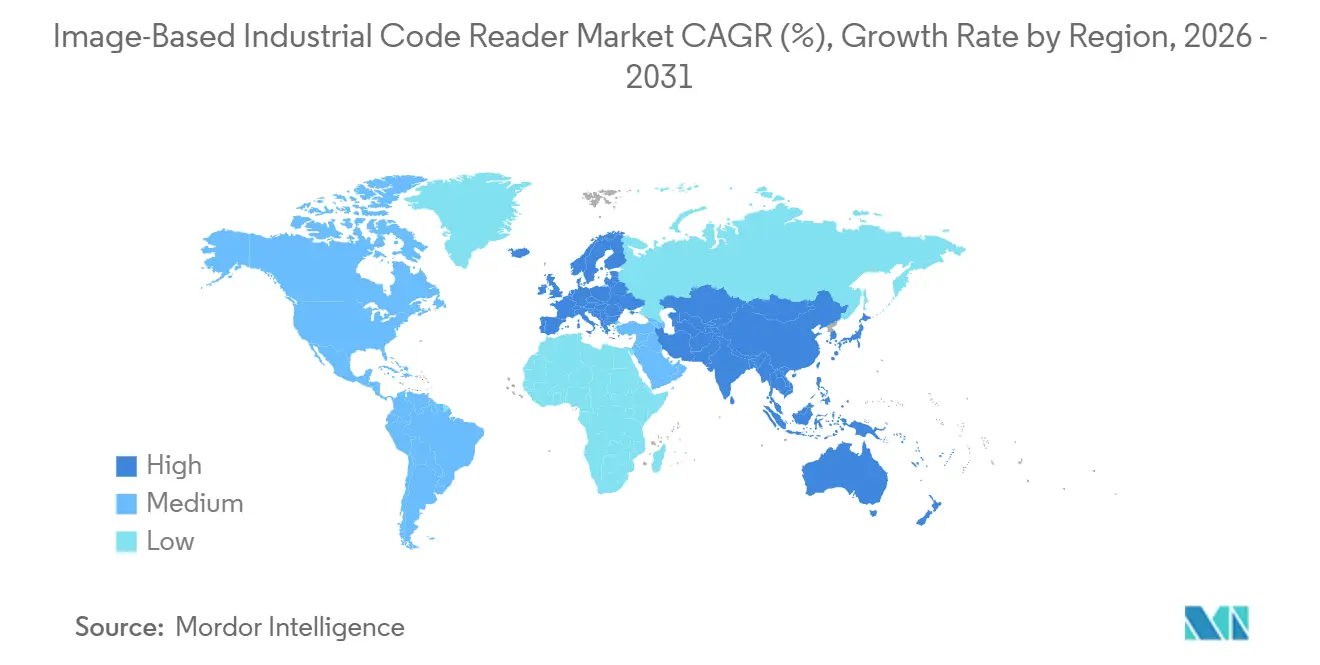
Asia-Pacific held 35.21% of the Image-Based Industrial Code Reader Market share in 2025 and is projected to expand at an 11.21% CAGR through 2031. Taiwan, South Korea, and Japan support demand through semiconductor fabrication and advanced electronics production. India adds demand from pharmaceutical export supply chains subject to U.S. and European compliance requirements. China’s manufacturing base and the region’s e-commerce sorting infrastructure support wider use of automated code reading and verification. This combination increases the region’s revenue separation from other geographies.
North America maintained a significant position in 2025, supported by U.S. pharmaceutical compliance requirements. The region has established technology suppliers and system integrators for multi-site deployments in the Image-Based Industrial Code Reader Market. Brady completed its acquisition of Honeywell’s Productivity Solutions and Services business for USD 1.4 billion in August 2026. Europe follows, with established demand for automotive, packaging, consumer goods, and pharmaceutical verification. Brady stated that the acquisition expands its addressable market to USD 9 billion.
South America, the Middle East, and Africa remain smaller but developing markets for the Image-Based Industrial Code Reader Market. Brazil supports adoption through medicine-traceability requirements, while Saudi Arabia and the United Arab Emirates are implementing GS1-based serialization. South Africa is an entry point in Africa, and Nigeria has emerging consumer-goods demand. Cost sensitivity and limited technical support can slow deployments, although regional integrators offer modular services.

Competitive Landscape
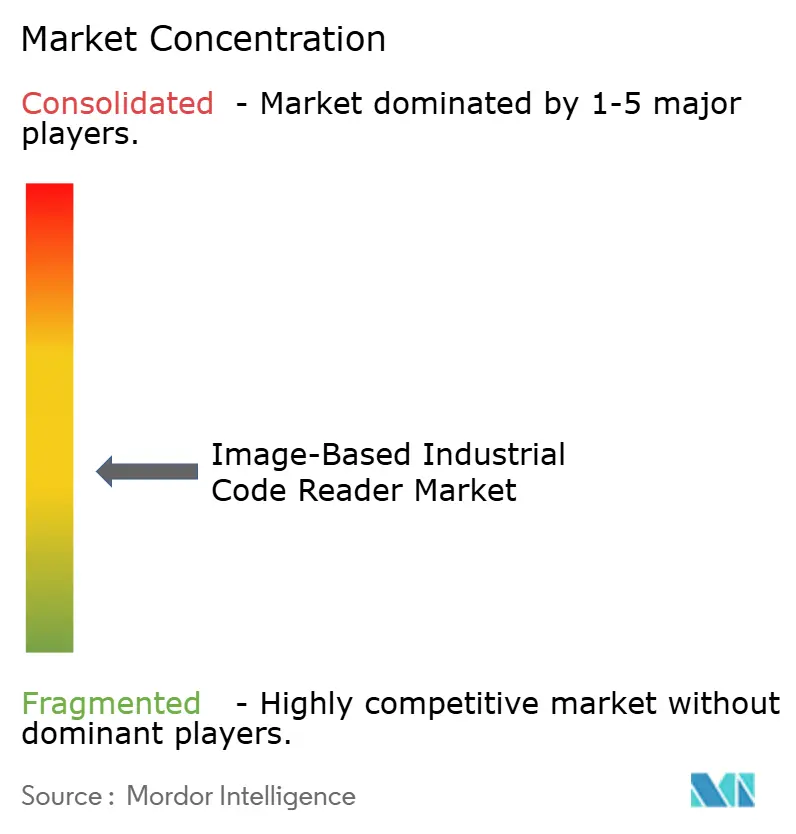
The Image-Based Industrial Code Reader Market has moderate fragmentation in certified inline verification. Cognex and Omron lead this tier through calibrated optics, embedded AI processing, and enterprise software. Axicon Auto ID, REA Elektronik, Webscan, and RJS Technologies serve laboratory, portable, and specialized requirements where standards expertise supports switching costs. Competitive positions depend on performance, calibration confidence, and integration capability.
Cognex made OneVision generally available in 2026 to support collaborative AI development across multi-site production networks. Omron released the VHV5-SRV in June 2026 with surface-correction software for curved and irregular marks. Zebra expanded its portfolio through its 2025 acquisitions of Photoneo and Elo. These moves show a focus on broader inspection platforms rather than standalone readers. Suppliers that link hardware, software, and workflow data can build longer-term customer relationships.
Small and mid-sized manufacturers in the Asia-Pacific region are relevant because many lack resources for complex enterprise deployments. Pre-validated modular systems can address this gap. Curved, reflective, and non-planar direct part marks remain difficult to inspect. AI-assisted grading can combine defect classification with ISO parameter measurement. Cognex positioned its In-Sight 3900 for high-throughput reading on difficult surfaces in 2026.
Image-Based Industrial Code Reader Industry Leaders
Zebra Technologies Corporation
Cognex Corporation
Honeywell International Inc.
Datalogic S.p.A.
Keyence Corporation
- *Disclaimer: Major Players sorted in no particular order

Recent Industry Developments
- September 2026: Zebra Technologies debuted new 3D and AI machine vision solutions at VISION 2026 in Stuttgart, including the CV70 CXP high-performance machine vision camera and enhanced deep-learning classification and segmentation features for the NS42 Smart Vision Sensor. The CV70 CXP is described by the company as the smallest dual-link CXP camera on the market, and the launches extend Zebra's machine vision portfolio into high-speed, high-resolution logistics and manufacturing inspection applications.
- August 2026: Brady Corporation completed its USD 1.4 billion all-cash acquisition of Honeywell's Productivity Solutions and Services business, funded with cash on hand, a senior unsecured credit facility, and private placement debt. The transaction adds approximately USD 1.1 billion in annual PSS revenue and expands Brady's addressable market to the USD 9 billion productivity solutions space, integrating barcode scanning, mobile computing, RFID, and workflow software into Brady's existing identification and printing platform.
- June 2026: Omron Automation released the VHV5-SRV Barcode Verification System, an inline verifier rated at up to 1,200 parts per minute that delivers calibrated 100% barcode quality inspection during production without reducing line speed. The system complies with ISO/IEC 15415, ISO/IEC 15416, and ISO/IEC TR 29158, integrates GS1 syntax validation alongside ISO print grading, and supports DPM verification on curved or irregular surfaces, addressing a long-standing gap in automotive and aerospace marking workflows.
- May 2026: Cognex Corporation launched the In-Sight 3900 Vision System, powered by Qualcomm Dragonwing platforms, delivering edge-level AI inspection for 2D code reading and quality control at 4 times the speed of its predecessor systems without requiring an external PC. The system integrates with Cognex's OneVision cloud-to-edge AI platform and targets high-throughput code reading on curved, reflective, and difficult surfaces across manufacturing applications.


Global Image-Based Industrial Code Reader Market Report Scope
Image-Based Industrial Code Readers are advanced optical scanning systems that use digital cameras and sophisticated image-processing algorithms to decode 1D and 2D barcodes, enabling high-speed, reliable identification and traceability of products and components across diverse industrial manufacturing and logistics environments.
The Image-Based Industrial Code Reader Market Report is Segmented by Component (Hardware, Software, and Services), Verification Mode (In-Line Verification, Portable Verification, and Desktop and Laboratory Verification), Code Symbology (Data Matrix and GS1 DataMatrix, QR Code and GS1 QR Code, PDF417 and MicroPDF417, Aztec Code, DotCode, and Other 2D Code Symbologies), Application (Print Quality Verification, Direct Part Mark Verification, Label and Package Code Verification, Serialization and Data Validation, Product Authentication and Anti-Counterfeiting, Incoming Goods and Supplier Quality Verification, and Other Applications), End-User Industry (Pharmaceuticals, Medical Devices, Automotive and Tires, Electronics and Semiconductors, Food and Beverage, Logistics and Transportation, Printing, Packaging, and Consumer Goods, and Other End-User Industries), and Geography (North America, South America, Europe, Asia-Pacific, Middle East and Africa). The Market Forecasts are Provided in Terms of Value (USD).
| Hardware |
| Software |
| Services |
| In-Line Verification |
| Portable Verification |
| Desktop and Laboratory Verification |
| Data Matrix and GS1 DataMatrix |
| QR Code and GS1 QR Code |
| PDF417 and MicroPDF417 |
| Aztec Code |
| DotCode |
| Other 2D Code Symbologies |
| Print Quality Verification |
| Direct Part Mark Verification |
| Label and Package Code Verification |
| Serialization and Data Validation |
| Product Authentication and Anti-Counterfeiting |
| Incoming Goods and Supplier Quality Verification |
| Other Applications |
| Pharmaceuticals |
| Medical Devices |
| Automotive and Tires |
| Electronics and Semiconductors |
| Food and Beverage |
| Logistics and Transportation |
| Printing, Packaging, and Consumer Goods |
| Other End-User Industries |
| North America | United States | |
| Canada | ||
| Mexico | ||
| South America | Brazil | |
| Argentina | ||
| Rest of South America | ||
| Europe | Germany | |
| United Kingdom | ||
| France | ||
| Italy | ||
| Spain | ||
| Rest of Europe | ||
| Asia-Pacific | China | |
| Japan | ||
| India | ||
| South Korea | ||
| Rest of Asia-Pacific | ||
| Middle East and Africa | Middle East | Saudi Arabia |
| United Arab Emirates | ||
| Turkey | ||
| Rest of the Middle East | ||
| Africa | South Africa | |
| Nigeria | ||
| Rest of Africa | ||
| By Component | Hardware | ||
| Software | |||
| Services | |||
| By Verification Mode | In-Line Verification | ||
| Portable Verification | |||
| Desktop and Laboratory Verification | |||
| By Code Symbology | Data Matrix and GS1 DataMatrix | ||
| QR Code and GS1 QR Code | |||
| PDF417 and MicroPDF417 | |||
| Aztec Code | |||
| DotCode | |||
| Other 2D Code Symbologies | |||
| By Application | Print Quality Verification | ||
| Direct Part Mark Verification | |||
| Label and Package Code Verification | |||
| Serialization and Data Validation | |||
| Product Authentication and Anti-Counterfeiting | |||
| Incoming Goods and Supplier Quality Verification | |||
| Other Applications | |||
| By End-User Industry | Pharmaceuticals | ||
| Medical Devices | |||
| Automotive and Tires | |||
| Electronics and Semiconductors | |||
| Food and Beverage | |||
| Logistics and Transportation | |||
| Printing, Packaging, and Consumer Goods | |||
| Other End-User Industries | |||
| By Geography | North America | United States | |
| Canada | |||
| Mexico | |||
| South America | Brazil | ||
| Argentina | |||
| Rest of South America | |||
| Europe | Germany | ||
| United Kingdom | |||
| France | |||
| Italy | |||
| Spain | |||
| Rest of Europe | |||
| Asia-Pacific | China | ||
| Japan | |||
| India | |||
| South Korea | |||
| Rest of Asia-Pacific | |||
| Middle East and Africa | Middle East | Saudi Arabia | |
| United Arab Emirates | |||
| Turkey | |||
| Rest of the Middle East | |||
| Africa | South Africa | ||
| Nigeria | |||
| Rest of Africa | |||


Key Questions Answered in the Report
What is the size of the Image-Based Industrial Code Reader Market?
The Image-Based Industrial Code Reader Market was valued at USD 1.45 billion in 2025 and is estimated at USD 1.56 billion in 2026. It is forecast to reach USD 2.41 billion by 2031 at a 9.09% CAGR.
What is driving demand for image-based industrial code readers?
Pharmaceutical serialization requirements, GS1 2D code adoption, production automation, and the need for earlier print-quality control are key demand factors.
Which component accounted for the largest share in 2025?
Hardware led with 68.41% revenue share, reflecting the need for optical assemblies, calibrated illumination, and embedded processing equipment.
Which verification mode is expanding fastest through 2031?
Portable verification is projected to expand at a 10.76% CAGR because it supports flexible checks at receiving points, distribution hubs, and supplier sites.
Which region is expected to advance fastest?
Asia-Pacific is projected to expand at an 11.21% CAGR through 2031, supported by electronics, semiconductor, pharmaceutical, and logistics activity.
Why is Data Matrix important for industrial traceability?
Data Matrix and GS1 DataMatrix held 43.71% revenue share in 2025 because they are widely used in regulated pharmaceutical, medical-device, and aerospace traceability applications.
Page last updated on:





