
Food and Beverage Machine Vision Inspection Systems Market Size and Share
Market Overview
| Study Period | 2020 - 2031 |
|---|---|
| Market Size (2026) | USD 1.91 Billion |
| Market Size (2031) | USD 3.85 Billion |
| Growth Rate (2026 - 2031) | 15.05 % |
| Fastest Growing Market | Middle East and Africa |
| Largest Market | Asia-Pacific |
| Market Concentration | Medium |
Major Players *Disclaimer: Major Players sorted in no particular order Image © Mordor Intelligence. Reuse requires attribution under CC BY 4.0. | |
Food and Beverage Machine Vision Inspection Systems Market Analysis by Mordor Intelligence
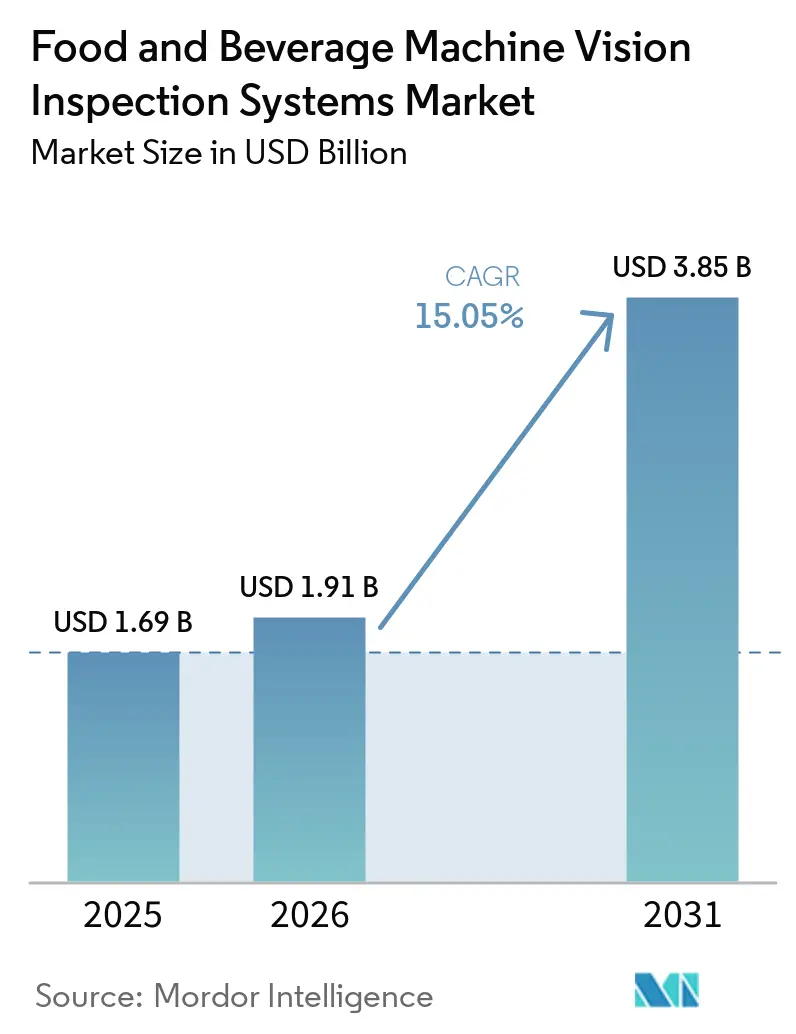
The Food and Beverage Machine Vision Inspection Systems Market size was valued at USD 1.69 billion in 2025 and is estimated to grow from USD 1.91 billion in 2026 to reach USD 3.85 billion by 2031, at a CAGR of 15.05% during the forecast period (2026-2031). Food safety rules and traceability requirements are increasing the need for inspection records that can be retrieved by lot. Faster food and beverage lines also require inspection equipment that can operate without slowing production. Suppliers are responding with systems that combine defect detection, code verification, contamination control, and reporting functions. The Food and Beverage Machine Vision Inspection Systems Market also benefits from processor demand for more consistent checks when trained inspection labor is difficult to retain. Both compliance requirements and practical line-operating requirements consequently shape the Food and Beverage Machine Vision Inspection Systems Market.
Key Report Takeaways
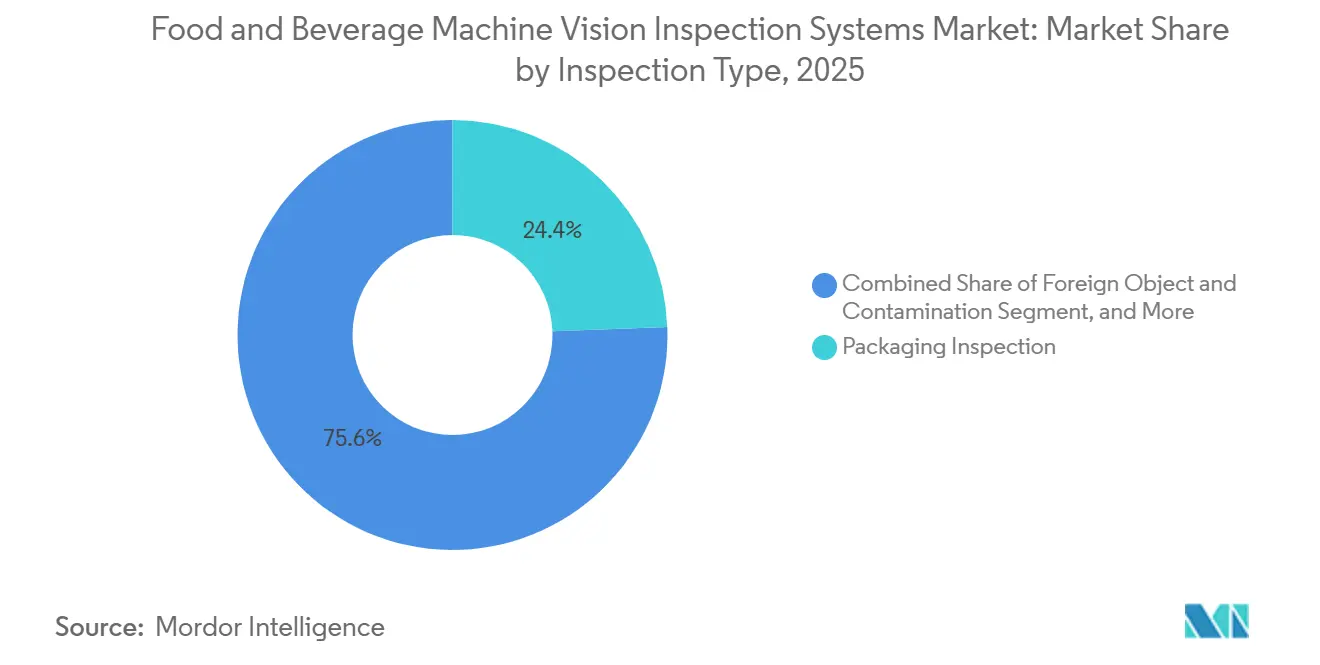
- By inspection type, packaging inspection accounted for 24.41% of the Food and Beverage Machine Vision Inspection Systems Market revenue in 2025, while foreign object and contamination detection is projected to expand at a 16.89% CAGR through 2031.
- By machine vision technology, 2D vision systems held 72.34% revenue share in 2025, while hyperspectral and multispectral vision is expected to expand at an 19.45% CAGR through 2031.
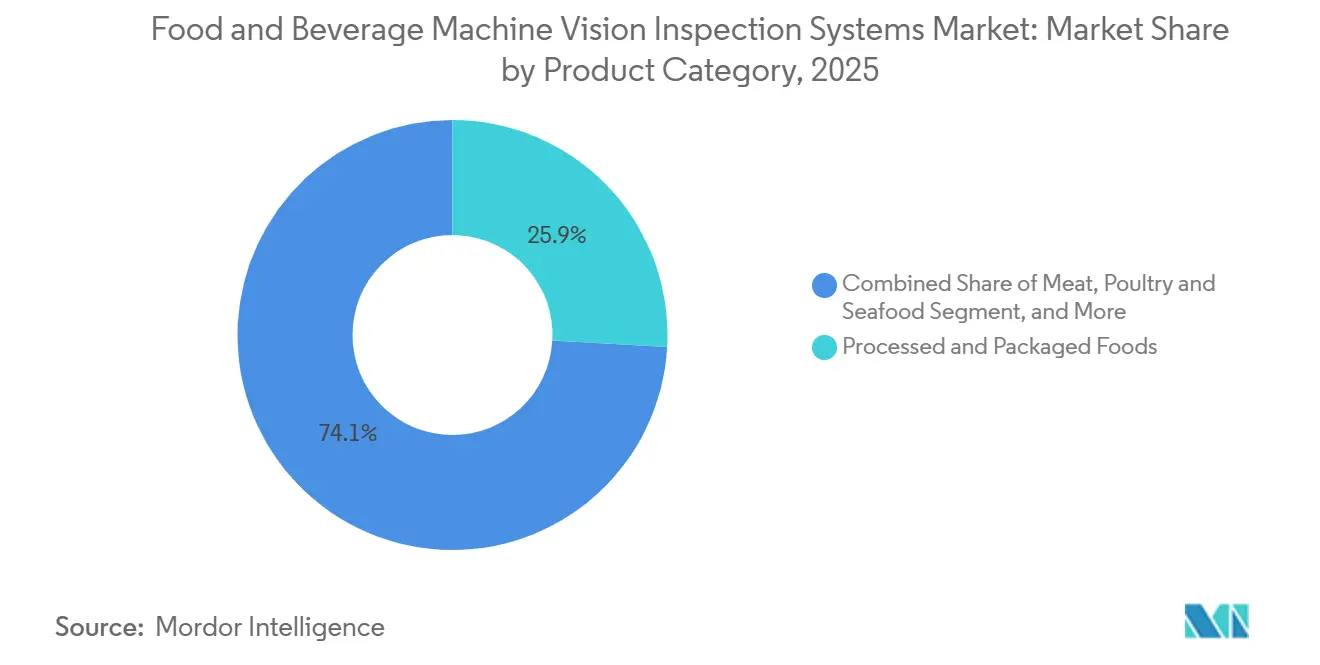
- By product category, processed and packaged foods held 25.89% Food and Beverage Machine Vision Inspection Systems Market revenue share in 2025, while meat, poultry, and seafood are projected to expand at an 16.66% CAGR through 2031.
- By packaging format, PET and HDPE bottles held 22.67% revenue share in 2025, while flexible pouches and bags are projected to expand at an 16.43% CAGR through 2031.
- By geography, Asia-Pacific held 38.78% of the Food and Beverage Machine Vision Inspection Systems Market revenue share in 2025, while the Middle East and Africa are projected to expand at a 16.93% CAGR through 2031.
Note: Market size and forecast figures in this report are generated using Mordor Intelligence’s proprietary estimation framework, updated with the latest available data and insights as of January 2026.
Global Food and Beverage Machine Vision Inspection Systems Market Trends and Insights
Drivers Impact Analysis*
| Driver | (~) % Impact on CAGR Forecast | Geographic Relevance | Impact Timeline |
|---|---|---|---|
| Stricter Food Safety, Traceability, and Recall Prevention Requirements | +2.2% | Global, with early intensity in North America and Europe | Short term (≤ 2 years) |
| High-Speed Multi-SKU Packaging Lines | +1.6% | Global, concentrated in Asia-Pacific and North America | Medium term (2-4 years) |
| AI and Deep-Learning Reduction in False Rejects | +1.5% | Global, with leading deployments in North America and Europe | Short term (≤ 2 years) |
| Labor Shortages and Automated Inline Quality Assurance | +1.3% | North America and Europe primarily, with spillover to Asia-Pacific core markets | Medium term (2-4 years) |
| Federated Defect Libraries Across Distributed Plants | +0.7% | North America and Europe, with early Asia-Pacific adoption | Long term (≥ 4 years) |
| Retrofit Demand From Legacy Packaging Lines | +0.5% | Global, concentrated in South America and Middle East and Africa | Long term (≥ 4 years) |
| Source: Mordor Intelligence | |||
Stricter Food Safety, Traceability, and Recall Prevention Requirements
Lot-level traceability is increasing the demand for inspection systems that record Key Data Elements during production. The FDA’s Food Traceability Rule has a July 2028 compliance date following a 30-month extension.[1] FDA guidance issued in February 2026 called for packing, shipping, receiving, and transformation events to be linked to retrievable lot codes for traceability. The Food and Beverage Machine Vision Inspection Systems Market benefits from investments in connected inspection and traceability, while automated records can reduce manual documentation after a check is completed.
High-Speed Multi-SKU Packaging Lines
High-speed lines with frequent product changes require systems that can inspect a variety of packages without repeated setup. A 2026 study of mixed-SKU bottling found that a hybrid deep-learning and rule-based approach achieved 100% cap-sealing accuracy, compared with 90.9% for a rule-based approach.[2] The study also reported 100% accuracy for color and SKU classification and 97.0% for structural deformation detection. These changeover needs increase the relevance of the Food and Beverage Machine Vision Inspection Systems Market for varied production runs.[3]
AI and Deep-Learning Reduction in False Rejects
False rejects remove good product and can justify the replacement of installed inspection equipment. On a line running at 600 bottles per minute, a 0.5% false-reject rate can incorrectly classify 8,500 good units during a 24-hour shift. Cognex introduced OneVision in beta in June 2025, and the platform had more than 100 customers by mid-2026. For the Food and Beverage Machine Vision Inspection Systems Market, models trained on acceptable variation can reduce dependence on fixed thresholds and support wider rollout across sites.
Labor Shortages and Automated Inline Quality Assurance
Labor constraints are strengthening demand for automated inline quality assurance. PMMI reported in 2025 that consumer packaged goods end users planned to focus automation investment on inspection operations in response to skilled labor gaps. End-of-line labeling and fill-level checks are suited to automation because they are repetitive and require steady visual attention. The Food and Beverage Machine Vision Inspection Systems Market supports consistent checks across shifts without relying on a particular operator.[4]
Restraints Impact Analysis*
| Restraint | (~) % Impact on CAGR Forecast | Geographic Relevance | Impact Timeline |
|---|---|---|---|
| High Total Cost of Ownership for Multi-Camera Systems | -1.5% | Global, most acute in South America and Middle East and Africa | Medium term (2-4 years) |
| Integration Complexity With Legacy PLC, MES, and ERP Assets | -1.0% | Global, concentrated in Europe and North America | Medium term (2-4 years) |
| Defect-Library Scarcity for Novel Foods and Irregular Products | -0.5% | Global | Long term (≥ 4 years) |
| Data-Sovereignty and Cybersecurity Constraints in Cloud Inspection | -0.4% | North America, Europe, and Asia-Pacific core markets | Medium term (2-4 years) |
| Source: Mordor Intelligence | |||
High Total Cost of Ownership for Multi-Camera Systems
Multi-camera installations require high-resolution sensors, embedded computing, lighting, integration software, and maintenance support. They can cost 4-7 times more than a single-camera rule-based installation, and deep-learning models need periodic review against updated defect libraries. This cost profile can slow adoption in the Food and Beverage Machine Vision Inspection Systems Market, particularly where calibration specialists and local service are limited. Modular single-camera platforms lower entry costs but offer less coverage and throughput than full multi-camera systems.
Integration Complexity With Legacy PLC, MES, and ERP Assets
Many food plants use programmable logic controllers and manufacturing execution systems that have operated for 15-25 years and were not designed to exchange structured data with modern AI inspection platforms. A 2025 scientific review identified legacy integration, skills gaps, and data privacy as key barriers to AI adoption in food manufacturing. For the Food and Beverage Machine Vision Inspection Systems Market, connecting inspection data to traceability and inventory records can require custom middleware and partial system changes. Validation can extend a project by 3-12 months and delay equipment deployment.
*Our forecasts treat driver/restraint impacts as directional, not additive. The impact forecasts reflect baseline growth, mix effects, and variable interactions.
Segment Analysis
By Inspection Type: Packaging Verification Leads While Contamination Detection Accelerates
Packaging inspection held 24.41% of the Food and Beverage Machine Vision Inspection Systems Market share in 2025. Camera arrays at bottling, canning, and carton-filling stations provide the final control point before retail distribution. Label, print, fill-level, and closure checks address allergen declarations, codes, opaque packaging, and the growing use of flexible packaging. Multifunction platforms combine these checks at a single station and can reduce the space required by separate devices.
Foreign object and contamination detection is projected to expand at a 16.89% CAGR through 2031. The Food and Beverage Machine Vision Inspection Systems Market size for this application is driven by processor demand to detect contaminants that traditional methods cannot reliably identify. A 2025 review found that hyperspectral models detected glass fragments, dense plastics, and homochromatic foreign material in processed proteins, with calibration accuracy exceeding 96.67%. These contaminants can be difficult for standard X-ray and metal-detection systems when their composition resembles the product. Meat, dairy, and snack producers are evaluating spectral inspection where retailer requirements specify smaller detectable particles. Product appearance checks are also increasingly included in multifunction platforms, changing how suppliers package inspection capability and line reporting.

By Machine Vision Technology: 2D Vision Holds the Base While Hyperspectral Inspection Expands
2D vision systems held 72.34% of revenue in 2025, representing the largest technology position in the Food and Beverage Machine Vision Inspection Systems Market. The installed base supports labeling, presence checks, orientation, and visible package-defect inspection at production speed. Cognex launched the In-Sight 3900 embedded AI vision system in May 2026 with a processing speed 4 times higher and a resolution of up to 25 MP. 3D vision supports dimensional, uneven-tray fill-level, and flexible-package deformation checks, although its higher cost has limited its wider use.
Hyperspectral and multispectral vision is projected to expand at a 19.45% CAGR through 2031. Engilico presented HyperScope at IFFA 2025 to identify organic contaminants in seal zones through opaque or printed films. This technology enables the Food and Beverage Machine Vision Inspection Systems Market to identify material differences that RGB cameras may miss. A 2024 review described reconstruction methods that can derive hyperspectral information from lower-cost RGB inputs. Lower-cost capabilities could extend spectral inspection beyond specialized plants, while thermal and infrared systems support seal integrity and fill-level checks.
By Product Category: Processed Foods Anchor Volume While Meat, Poultry, and Seafood Lead Expansion
Processed and packaged foods accounted for 25.89% of revenue in 2025 and were the largest product category in the Food and Beverage Machine Vision Inspection Systems Market. High volumes and frequent SKU changes support label, print, and contamination inspection, especially where allergen disclosures change. Beverage lines can operate at up to 1,200 units per minute, making reliable fill-level control valuable. Dairy, bakery, confectionery, grains, cereals, and snacks also require inspection that can manage pathogen controls and natural product variation.
Meat, poultry, and seafood are projected to expand at a 16.66% CAGR through 2031. Bone-detection needs, pathogen-reduction verification, and dual-energy x-ray use at speeds up to 90 meters per minute support this demand. These requirements broaden the Food and Beverage Machine Vision Inspection Systems Market in protein processing. Fruits and vegetables are adopting grading systems that combine hyperspectral imaging with structured-light 3D scanning. A 2025 study described a four-dimensional approach that supports grading without destructive sampling. HACCP requirements under national food safety frameworks encourage documented inspection across product categories.
By Packaging Format: Bottles Retain Volume Leadership While Pouches Change Inspection Needs
format. Beverage and water lines use bottle systems to check cap placement, fill level, label position, and code quality. Glass jars require demanding glass-in-glass inspection, while cans, cartons, trays, tubs, and lidded containers increasingly use thermal and hyperspectral seal checks. These applications maintain a broad installed base for the Food and Beverage Machine Vision Inspection Systems Market. HEUFT demonstrated 360-degree filled-jar inspection with its eXaminer II XAC system at Interpack 2026.
Flexible pouches and bags are projected to expand at a 16.43% CAGR through 2031. Lighter and single-serve packaging makes fill-level, seal, and label checks more difficult because pouches deform under line pressure. The Food and Beverage Machine Vision Inspection Systems Market must therefore support different inspection methods from those used for bottles. Visible, infrared, and hyperspectral sensing can be combined to identify cosmetic, structural, and contamination defects. Modular designs are relevant to processors seeking broader coverage without full line replacement.
Geography Analysis
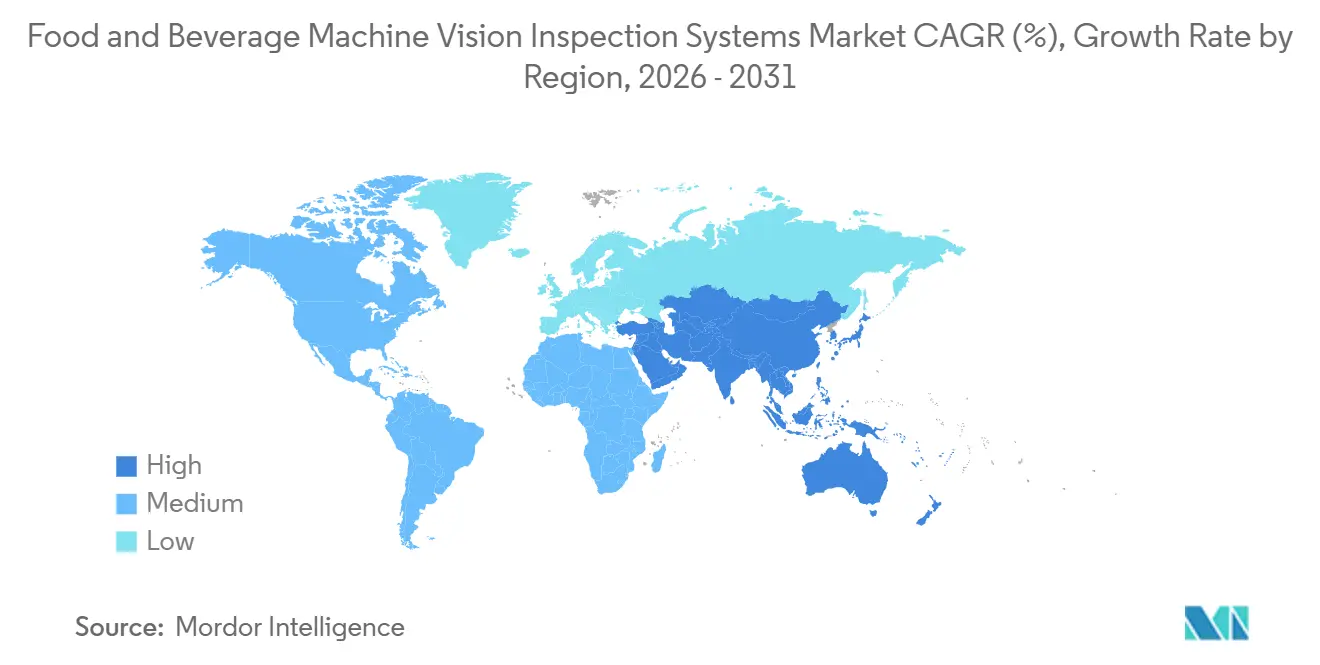
Asia-Pacific held 38.78% of the Food and Beverage Machine Vision Inspection Systems Market share in 2025. China, Japan, India, and South Korea lead regional demand through food safety and documented production-control requirements. China’s export-oriented processors are expanding their HACCP implementation, while India’s dairy cooperatives face FSSAI pathogen-audit requirements for international markets. South Korea and Singapore are emulating Japan’s seafood traceability trials.
Europe and North America have a high concentration of multifunction inspection installations in the Food and Beverage Machine Vision Inspection Systems Market. Germany, the United Kingdom, France, and Italy lead European demand through mature safety and certification requirements. North America is replacing older rule-based systems as early-2010s installations approach the end of their operating life. FDA traceability needs and South American export requirements also support equipment investment.
The Middle East and Africa are projected to expand at a 16.93% CAGR through 2031. Saudi Arabia and the UAE are increasing processing capacity and need equipment for halal-certified exports. This creates a growth opportunity for the Food and Beverage Machine Vision Inspection Systems Market. South Africa anchors the regional installed base, while other markets upgrade export-focused facilities. Entry-level x-ray and metal-detection equipment remains common, creating an opening for modular upgrades with label, code, and contaminant checks. Organized retail expansion and halal certification requirements shape procurement across networks in the Middle East and Southeast Asia.
Competitive Landscape
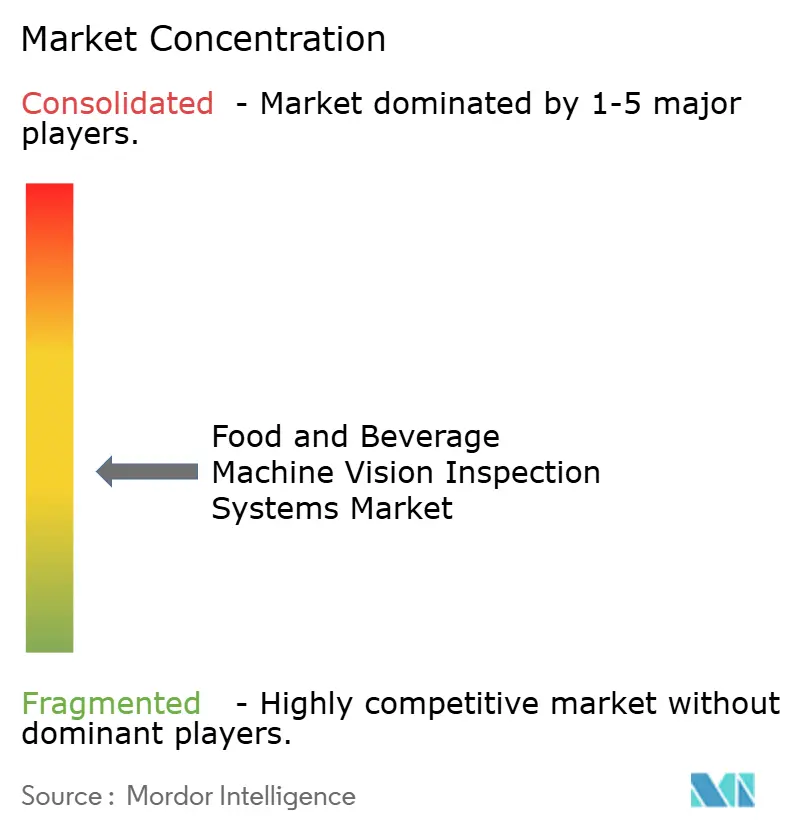
The Food and Beverage Machine Vision Inspection Systems Market is moderately fragmented. Cognex, KEYENCE, Mettler-Toledo, Teledyne, and Antares Vision Group combine broad portfolios with established relationships with original equipment manufacturers. Leading suppliers are moving from standalone devices to connected platforms with contamination detection, weight control, label verification, traceability data, and AI model management. Antares Vision Group presented its ALL-IN-ONE ecosystem at Interpack 2026, combining x-ray inspection, checkweighing, leak detection, and code verification.
Specialists compete in sensing methods and packaging formats, whereas general systems have less depth. Engilico focuses on hyperspectral seal inspection, while Basler supports third-party AI models and SICK develops sensor-fusion systems. Roeslein introduced its retrofit-first R.U.D.I. AI Vision Camera for canmaking lines in 2026. These offerings provide the Food and Beverage Machine Vision Inspection Systems Market with options for mid-market processors that may not adopt a full premium platform.
Cognex expanded its embedded portfolio with the In-Sight 3900 in May 2026. Antares Vision Group’s combined platform reflects the move toward a smaller footprint with broader checking capability. Engilico’s seal-zone application shows how specialists can address defects that conventional RGB systems may miss. Patent activity in AI classification and multispectral sensing is increasing, making algorithms and data management important alongside sensor hardware. The Food and Beverage Machine Vision Inspection Systems Market, therefore, rewards both integrated platforms and focused technology suppliers.
Food and Beverage Machine Vision Inspection Systems Industry Leaders
-
Cognex Corporation
-
Keyence Corporation
-
OMRON Corporation
-
Teledyne Technologies Incorporated
-
Mettler-Toledo International In
- *Disclaimer: Major Players sorted in no particular order
Recent Industry Developments
- May 2026: Cognex Corporation Launches In-Sight 3900 Vision System. Built on Qualcomm Dragonwing platforms, the system delivers 4× faster processing than prior-generation Cognex embedded vision products at resolutions up to 25 MP, supporting edge-AI inspection at full production speed. The launch extends Cognex's OneVision cloud-to-edge ecosystem, which passed 100 active customers worldwide following its June 2025 beta launch, with many users progressing from single-line pilots to multi-site rollouts within days. This supports wider deployment in the Food and Beverage Machine Vision Inspection Systems Market.
- September 2026: Smobler Expands Robin AI to Halal Compliance at LEAP 2026, Riyadh, Saudi Arabia. Singapore-based AI company Smobler announced plans to extend its Robin AI compliance platform to halal inspection workflows across ASEAN and MENA food producers, targeting markets connected by significant food trade and Muslim consumer demand. The move positions AI-driven compliance verification as a growth vector for inspection investment in Middle East and Africa.
- May 2026: Mettler-Toledo International Inc. Unveils AI-Enabled Product Suite at Interpack 2026, Düsseldorf. Key launches included the M50 R-Series AdvancedLine metal detector with enhanced traceability connectivity, the X56 DXD+ dual-energy photon-counting x-ray inspection system for low-density contaminants including rubber and plastic, AI-enabled x-ray capabilities for overlapping and mixed-product applications, and ProdX data management software for centralized traceability and audit readiness. Combination inspection systems integrating checkweighing, metal detection, x-ray, and vision inspection within a single footprint were also demonstrated.
- May 2026: HEUFT SYSTEMTECHNIK GMBH Demonstrates Deep-Learning AI Inspection at Interpack 2026. The HEUFT eXaminer II XAC uses reflexx A.I. deep-learning x-ray image processing to enable reliable glass-in-glass detection in filled food jars, while reducing false rejection of non-critical anomalies. The compact eXaminer II XS platform targets full-container foreign body detection for tins and opaque formats at high throughput.
Global Food and Beverage Machine Vision Inspection Systems Market Report Scope
Food and Beverage Machine Vision Inspection Systems are automated optical solutions designed to ensure product quality, safety, and regulatory compliance by detecting defects, verifying labels and codes, checking fill levels, and identifying foreign contaminants in high-speed production environments.
The Food and Beverage Machine Vision Inspection Systems Market Report is Segmented by System Type (Integrated Print-and-Inspect Systems, Standalone Vision Inspection Systems, Code Readers and Smart Cameras, Software-Only Date-Code Verification, and Other System Types), Packaging Format (Bottles and Cans, Cartons and Paperboard Packs, Cups, Trays, and Tubs, Bags and Pouches, Jars and Rigid Containers, and Other Packaging Formats), Application (Expiry-Date and Best-Before Verification, Batch and Lot-Code Verification, Print Presence, Position, and Legibility Inspection, Barcode and Data-Matrix Traceability, Label and Artwork Compliance, Reject Management and Audit-Record Generation, and Other Applications), End-User Industry (Beverage Processing, Dairy Processing, Bakery and Confectionery Processing, Meat, Poultry, and Seafood Processing, Packaged Food Processing, Contract Packers and Co-Manufacturers, and Other End-User Industries), and Geography (North America, South America, Europe, Asia-Pacific, Middle East and Africa). The Market Forecasts are Provided in Terms of Value (USD).
| Packaging Inspection |
| Label and Print Inspection |
| Fill-Level and Volume Inspection |
| Seal and Closure Inspection |
| Product Appearance and Defect Inspection |
| Foreign Object and Contamination Detection |
| Other Inspection Types |
| 2D Vision Systems |
| 3D Vision Systems |
| Hyperspectral and Multispectral Vision |
| Thermal and Infrared Vision |
| Other Machine Vision Technologies |
| Processed and Packaged Foods |
| Beverages |
| Dairy and Dairy Products |
| Meat, Poultry, and Seafood |
| Bakery and Confectionery |
| Fruits and Vegetables |
| Grains, Cereals, and Snacks |
| Other Product Categories |
| PET and HDPE Bottles |
| Glass Bottles and Jars |
| Aluminum Cans |
| Cartons and Tetra Pak Packages |
| Flexible Pouches and Bags |
| Trays, Tubs, and Lidded Containers |
| Other Packaging Formats |
| North America | United States | |
| Canada | ||
| Mexico | ||
| South America | Brazil | |
| Argentina | ||
| Rest of South America | ||
| Europe | Germany | |
| United Kingdom | ||
| France | ||
| Italy | ||
| Spain | ||
| Rest of Europe | ||
| Asia-Pacific | China | |
| Japan | ||
| India | ||
| South Korea | ||
| Rest of Asia-Pacific | ||
| Middle East and Africa | Middle East | Saudi Arabia |
| United Arab Emirates | ||
| Turkey | ||
| Rest of the Middle East | ||
| Africa | South Africa | |
| Nigeria | ||
| Rest of Africa | ||
| By Inspection Type | Packaging Inspection | ||
| Label and Print Inspection | |||
| Fill-Level and Volume Inspection | |||
| Seal and Closure Inspection | |||
| Product Appearance and Defect Inspection | |||
| Foreign Object and Contamination Detection | |||
| Other Inspection Types | |||
| By Machine Vision Technology | 2D Vision Systems | ||
| 3D Vision Systems | |||
| Hyperspectral and Multispectral Vision | |||
| Thermal and Infrared Vision | |||
| Other Machine Vision Technologies | |||
| By Product Category | Processed and Packaged Foods | ||
| Beverages | |||
| Dairy and Dairy Products | |||
| Meat, Poultry, and Seafood | |||
| Bakery and Confectionery | |||
| Fruits and Vegetables | |||
| Grains, Cereals, and Snacks | |||
| Other Product Categories | |||
| By Packaging Format | PET and HDPE Bottles | ||
| Glass Bottles and Jars | |||
| Aluminum Cans | |||
| Cartons and Tetra Pak Packages | |||
| Flexible Pouches and Bags | |||
| Trays, Tubs, and Lidded Containers | |||
| Other Packaging Formats | |||
| By Geography | North America | United States | |
| Canada | |||
| Mexico | |||
| South America | Brazil | ||
| Argentina | |||
| Rest of South America | |||
| Europe | Germany | ||
| United Kingdom | |||
| France | |||
| Italy | |||
| Spain | |||
| Rest of Europe | |||
| Asia-Pacific | China | ||
| Japan | |||
| India | |||
| South Korea | |||
| Rest of Asia-Pacific | |||
| Middle East and Africa | Middle East | Saudi Arabia | |
| United Arab Emirates | |||
| Turkey | |||
| Rest of the Middle East | |||
| Africa | South Africa | ||
| Nigeria | |||
| Rest of Africa | |||
Key Questions Answered in the Report
What is the size of the Food and Beverage Machine Vision Inspection Systems Market?
The market was valued at USD 1.69 billion in 2025, is estimated at USD 1.91 billion in 2026, and is forecast to reach USD 3.85 billion by 2031 at a CAGR of 15.05%.
Which inspection type leads the Food and Beverage Machine Vision Inspection Systems Market?
Packaging inspection led with a 24.41% revenue share in 2025 because it provides a final quality checkpoint before retail distribution.
Which technology is expanding fastest in food inspection?
Hyperspectral and multispectral vision is projected to expand at a 19.45% CAGR through 2031, supported by its ability to identify contaminants that RGB cameras may miss.
Which food category is expected to expand fastest for inspection systems?
Meat, poultry, and seafood is projected to expand at a 16.66% CAGR through 2031, supported by bone detection and pathogen-reduction verification needs.
Which region leads the Food and Beverage Machine Vision Inspection Systems Market?
Asia-Pacific held the largest regional revenue share at 38.78% in 2025, while Middle East and Africa is projected to expand fastest at a 16.93% CAGR through 2031.
Why are processors adopting AI-enabled inspection systems?
Processors use AI-enabled systems to reduce false rejects, manage frequent SKU changes, document traceability checks, and support inspection work when labor is difficult to secure.